




Abstract
Services currently represent most of the present economic activity. Research methodologies that allow organisations to solve their service operations-related problems while facilitating the design and creation of new artefacts with which to support the complex reality that services represent are required. Action Research (AR) is a methodology that has proved to be effective in organisations by solving real problems. This methodology can be enriched with others that provide practical and usable solutions. This paper presents Design Science Action Research (DSAR), a methodology that combines AR and Design Service Research (DSR) and examines its usefulness for Service (Operation) Management research by supporting the development of new artefacts acting in the real context of organisations. DSAR has been applied in a case study concerning a service company that is addressing the transformation of its service design and delivery processes. We contribute to the literature on AR and DSR with a new methodology resulting from the combination of both approaches that can be used in order to conduct SOM research. We provide step-by-step guidance on its application and discuss the main advantages of using this combination in a real case.
Introduction
Operations Management (OM) is regarded as a problem-solving oriented discipline that focuses on creating new knowledge by interacting with practitioners in the real world (Van Aken et al., 2016). There is, in general, a need for academia to increase the practical relevance of OM research by supporting practitioners in their real problem-solving efforts (Alfaro-Tanco et al., 2021). This need is more pronounced in the case of Service Operations Management (SOM), since the scope of services is always more difficult to analyse owing to their characteristics when compared to those of goods, namely intangibility, heterogeneity, simultaneity and caducity (seminal work of Parasuraman et al., 1985). Academia acknowledges and emphasizes the essential uniqueness of service management (Fitzsimmons & Fitzsimmons, 2008).
The design and delivery of services require ad hoc research methodologies that can address the complex problems identified in the field of service operations. ‘While the new directions on what needs to be done in service research are explained in comprehensive terms, there is little debate on how the knowing–doing gap should be bridged’ (Elg et al., 2020, p. 87).
One of the research methodologies that is clearly oriented towards solving real problems in companies is Action Research (AR) (Coughlan & Coghlan, 2002). AR is a qualitative research methodology. It has great relevance for professionals, can be applied to unstructured topics, and can also contribute to generating theory (Coughlan & Coghlan, 2002; Rapoport, 1970; Westbrook, 1995). The fact that researchers create new knowledge in conjunction with practitioners implies spirals of AR cycles, including planning, action, observing and reflecting (Ballantyne, 2004; Susman & Evered, 1978). These cycles provide a range of challenges for researchers engaged in AR, signifying that AR cases can provide new forms of conceptual understanding by allowing researchers to empirically investigate individual cases, which helps them to attain a profound understanding of the complexity (Wacker, 1998).
Bearing the new transformative reoriented role of service research in mind (Corus & Saatcioglu, 2015), there is a need to move from the guidance provided by the early advocates of AR in service management research (Elg et al., 2020; Gummesson, 2000; Gummesson & Grönroos, 2012) to the specific problems encountered by researchers in current practical AR projects. As Erro-Garcés and Alfaro-Tanco (2020) establish, it is more significant to determine what kind of problems associated with traditional research methods in the field of management might be solved by specifically using a variety of methodologies. The need to enrich AR as methodology research arose after applying AR in order to address the problems of real practitioners and detecting the need to create new artefacts with which to solve these problems. Design Science Research (DSR) is an appropriate means to design these artefacts, and synergies between AR and DSR appear by combining both.
DSR focuses on creating and evaluating artefacts such as processes, methods, systems or technologies with which to improve organisational performance. Its goal is to develop new knowledge and practical solutions. DSR is increasingly used in Engineering and is also applicable to other disciplines (Vaishnavi & Kuechler, 2015). One discipline that is conducive to its application is precisely SOM, since the unit of analysis represented by services facilitates a valid application scenario.
The aim of this paper is to propose a qualitative research methodology based on the combination of AR and DRS. The objective is to show how this methodology, which will from here on be denominated as Design Science Action Research (DSAR), can be useful as a methodological approach in the context of SOM. Addressing such issues in SOM will provide a well-established systematised research methodology that can help researchers better ground their contributions on existing knowledge and more robustly evaluate the suitability of these contributions in order to address service (operations) management challenges.
The proposed methodology was, in fact, developed by following the DSR methodology (Peffers et al., 2007). Starting from the analysis of the real problems posed by research in the context of service organisations and the need to design artefacts, in a cyclical and collaborative manner, that can solve the problems of the service management in organisations and their operations, this paper proposes the DSAR methodology. This is a new methodological approach that combines AR and DSR, that is it defines a research process that integrates elements of AR and DSR (Collatto et al., 2018), which is particularly indicated when the artifact needs to be developed and evaluated in a real environment (Venable, 2006). DSAR is a complete and detailed methodology that has been designed and applied in the framework of a real case. The application of the DSAR research methodology to a real case study (the NEURO case) has led to the creation of a new artefact denominated as ReforceSME, which was defined and validated within the organisation. Researchers and practitioners worked together on the creation, development and validation of each of the techniques, models, procedures and phases (parts of the artefact) that were necessary.
This paper contributes to literature by presenting a new methodological approach. The combination of AR and DSR could lead to a more comprehensive and effective approach with which to solve problems in service organisations. This approach could help organisations to continuously improve their practices and achieve their goals more effectively. The methodology could, by extension, also be applied in other fields not limited to the context of SOM. For example, it could be useful in different environments in which it is generally necessary to combine research clearly oriented towards solving real problems in companies and the need to create new artefacts with which to solve those problems.
This paper is organised as follows: Section 2 provides a description of the background to AR and DSR, while Section 3 justifies the need to combine both methods, considering their application in SOM. The research methodology developed by combining AR and DSR is presented in Section 4, and its application to the case study is described in Section 5. Section 6 presents a discussion, and finally, Section 7 shows some concluding remarks and suggestions for further work.
Background
Action Research in Service (Operations) Management
SOM oversees the design and delivery of services and manages most of an organisation’s resources, significantly impacting on its success (Fitzsimmons & Fitzsimmons, 2008; Johnston et al., 2012).
The nature of services such as simultaneity or heterogeneity has favoured the application of multiple research methodologies in this field. Many service management problems are fuzzy and unstructured, multidimensional and complex and are less conducive to normative analytical modelling (Roth & Menor, 2003). Research methodologies in SOM involve a variety of quantitative and qualitative methods. Quantitative methods are important as regards understanding the complexities of SOM (Domínguez-Machuca et al., 2007), while qualitative research methods, such as interviews and case studies, can be used to gain greater insights into SOM (Bertrand & Fransoo, 2002). However, literature has paid little attention to the analysis of research methods in this area.
Conducting research that is both practice- and theory-relevant is important for the service research community (Gummesson & Grönroos, 2012). AR can be a fruitful approach for service researchers studying the transformative role of service research (Elg et al., 2020). Service Action Research has arisen from the need to solve real and complex problems (owing to the characteristics of services, i.e. their heterogeneous and intangible nature) which, are in turn, increasing considerably because of the growth of services. Publications on AR in service research have increased in recent years, investigating services in various industries (Elg et al., 2020) and covering different topics such as marketing and human resources. However, very few papers focus on service operations research.
AR is a type of qualitative research and can be defined as an emerging research process that is carried out in the spirit of collaboration and co-research (Shani & Coghlan, 2021). AR research methodology has sometimes been questioned owing to its lack of precision and replicability. This could be because when ‘compared with other approaches […] it is an imprecise, uncertain and sometimes unstable activity’ (Coughlan & Coghlan, 2002, p. 238). However, it is increasingly useful in research, as is shown by the increase in the number of papers published in indexed journals that use AR (Erro-Garcés & Alfaro-Tanco, 2020). Moreover, some literature has proposed criteria with which to assess the quality of the research executed using AR (Mediavilla et al., 2020), considering theoretical novelty (Coughlan & Coghlan, 2002; Eden & Huxham, 1996), practical relevance and usefulness (Coughlan & Coghlan, 2002; Reason & Bradbury, 2006), and the applicability of the findings to other situations (Coghlan & Brannic, 2014; Coughlan & Coghlan, 2002). These criteria can serve as a guide when assessing the scope of AR as a research methodology.
According to Elg et al. (2020), the advancement in the creation of knowledge in service research should be based on methodological options whose starting point is the characteristics of services and contact with the customer. This approach favours the use of collaborative research designs such as AR. Theorising becomes experiential in nature and is created in the space between the researcher and the practitioner. AR emerges as a research domain with which to provide responses to the multiple scenarios defined by services in general, and service operations in particular.
Dick et al. (2015) used AR as a meta-methodology— that is, a process that can subsume multiple subprocesses and under which contradicting demands can be satisfied. AR can, therefore, be described as an umbrella process, signifying that it can be used jointly with other methods. Moreover, AR is a collaborative methodology (Cordeiro et al., 2017), which facilitates its use with other quantitative and qualitative methods.
Design Science Research and its Usefulness in Service (Operations) Management
Design methodologies originated in the 1960s (Cross, 2007), when discussions began on whether “design” was a scientific discipline or simply an artistic and craft activity. The challenge of creating systematic methods with which to solve problems and develop design solutions then emerged (Archer, 1965). The foundations for a ‘science of design’ were established in Simon’s (1996) work in ‘The Sciences of the Artificial’.
Design Science (DS) entered the mainstream academic literature on information systems thanks to the seminal paper by Hevner et al. (2004). The DS approach addresses real organisational problems using practical methods that are closer to business practice than purely theoretical ones. This approach led to research focused on designing artefacts in order to solve existing problems (Van Aken, 2004), which required new methods to handle these designs (Marcos, 2005).
DS creates and validates new systems by developing, recombining or modifying products, processes, software or methods in order to improve current situations (Dresch et al., 2019). The core of DSR is “solution technology invention” (Venable, 2006). When using DSR, a rigorous design process—problem identification, solution design, and evaluation—is essential. A strong theoretical foundation on which to guide the design process in addition to evaluating the effectiveness of the solutions is also critical (Ebneyamini, 2022).
Romme (2003) proposed DSR as a principal methodology with which to conceive knowledge and conduct scientific research in organisational studies. However, many DSR studies lack detailed characterisations of the environments and problems being addressed, which has hindered the advancement of knowledge on how to design (Dresch et al., 2019). Most methodological discussion has focused on justifying DS as a valid means of carrying out research (comparing DS to ‘traditional’ research approaches) rather than methodological exploration and elaborating on how and when DS research should be conducted in operations management settings (Öhman, 2019).
DSR has the potential to contribute to the field of service (operations) management. The prescriptive knowledge generated by DSR can complement the body of knowledge produced in SOM, and the development of artefacts can contribute to the expansion of knowledge. Although few studies focus on DSR in operations management (Holmström et al., 2009), it has the potential for better problem-solving and innovation in the context of operations management research (Dresch et al., 2019; Silva & Proença, 2015).
DSR has also proven effective in service research, and has contributed to the development of robust methodologies, methods and techniques that have extended the body of knowledge in this field (Patrício et al., 2018). Service design is a key area in which to boost innovation in services, and a large part of the growth of this discipline has been developed using well-documented and structured research methodologies such as DSR (Salgado et al., 2022; Teixeira et al., 2019). However, as stated by Patrício et al. (2018), design-research methodological approaches in service research are still in their infancy. Further research proving a more in-depth understanding of the different design research approaches and how they can be used to advance service design and innovation is, therefore, required.
DSR is especially suitable for SOM owing to its focus on developing and refining artefacts with which to solve specific problems or opportunities. Its iterative nature fosters continuous improvement in service artefacts and processes (Peffers et al., 2007). Note that we use the concept of “artefact” in a broad sense, aligned with the DSR tradition, in which artefacts are not limited to products such as information systems or software, but can also include processes, frameworks, models or methods/methodologies. In the case of services, new processes, management approaches and service delivery models can be viewed as artefacts, as they are the result of intentional design efforts aimed at addressing specific organisational problems. By using DSR, service organisations can innovate, improve efficiency and enhance customer and employee experiences. DSR and SOM complement each other and work together to create effective service systems and ensure efficient delivery.
On the Need for a Combination of AR and DSR in Service (Operations) Management
The AR and DSR approaches are both used in different fields. While they have some similarities, they have different objectives and focus on different aspects of research. The work of Järvinen (2007) considered the research activities that are typically implemented in these two approaches and concluded that DSR and AR are similar. This author additionally suggested that AR should be conceptually moved from a purely qualitative approach to a more DS-oriented one. DSR can adopt qualitative and/or quantitative approaches depending on the data collection or analysis needs at each stage of the process (Dresch et al., 2015).
The work of Livari and Venable (2009) highlights some of the challenges involved in combining AR with DSR. Even though the two methods are compatible, the conclusion is reached that it may be difficult to combine them in practice for several reasons. Thus, for example, while collaboration between researchers and the customer is essential in AR, DSR assumes neither a specific customer nor collaboration between researchers and the customer when applying it. The objective of DSR is to create innovative artefacts that are often not robust, while AR customers usually prefer a proven and robust technology that does not disrupt their work. This difference in goals may create a conflict of interest in research (Venable, 2006).
DSR is more varied in its paradigmatic assumptions than is AR. According to Dresch et al. (2015), one of the main differences between the two is the epistemological paradigm to which each methodology is subordinated: AR is subordinated to natural and social sciences, while DSR is subordinated to the sciences of the artificial. While AR is used to explore, describe, explain and predict a particular phenomenon, DSR aims to prescribe solutions or design artefacts. It is not necessary to develop (implement) artefacts in order to characterise the research carried out in DSR, but their design is essential to certify that the researcher’s objectives have been achieved. The development of artefacts is, however, neither necessary nor decisive within the AR framework; in fact, this methodology is not intended for this purpose.
Some researchers have looked beyond the differences between the two approaches and have argued the convenience and benefits of a possible integration of AR and DSR. The work of Collatto et al. (2018) further explores the similarities and differences between AR and DSR by studying the suitability of creating a methodology that combines both approaches, either by creating a new combined methodology that integrates elements of AR and DSR (as proposed in this paper) or by using them in a complementary or mixed manner. The authors also conclude that both approaches have significant similarities and that there are complementary and positive synergies in their use.
Combination of AR and DSR in the SOM Context.

Contextualising the Design Problem in the Organisation
The creation of artefacts in SOM must consider the organisational context of the problems being investigated. The idea that the purpose, construction logic and continuous improvement of artefacts depend on the context was recognised by Sein et al. (2011). This characteristic differentiates AR from DSR: AR focuses on understanding organisational reality, while DSR does not consider that this is essential (Livari & Venable, 2009). Problems can be identified by means of qualitative studies or fieldwork, thus inspiring solutions. The construction and application of artefacts in organisations allow design science researchers to better understand the problem and the feasibility of the solution. The seminal work of Nunamaker et al. (1990) already argued that the design and creation of systems (artefacts) in the context of organisations are not only practical activities, but also academic activities that generate knowledge.
These activities of understanding the problems in the context of the organisation and developing artefacts with which to contribute to the solution are considered in DSAR in the environment understanding phase in order to identify problems and motivate solutions, while the design in action phase has been proposed so as to design and evaluate artefacts within the organisational context.
The Action Design Research (ADR) proposed by Sein et al. (2011) focuses on technological artefacts (IT artefacts) and highlights the importance of creating artefacts within the organisational context, in which their value depends on both technical quality and organisational utility, which are especially relevant in services.
Cole et al. (2005) mentions a deficiency in DSR, proposing to add a “reflection” phase to DSR with which to evaluate results and understand how they have contributed to the desired change and why success or failure is observed in organisational contexts. This is a key aspect in SOM, whose objective is to solve problems and discover operational solutions within organisations.
Technical Action Research (TAR) combines AR and DSR in order to validate artefacts designed using DSR (Wieringa & Morali, 2012). It proposes using the artefact in the organisational context for evaluation purposes, which is useful when the artefact does not depend on a problem of a specific organisation but is rather created according to the needs established by a designer (e.g. the design of a new generic medical device). TAR focuses on testing artefacts in specific contexts so as to reduce idealisations. It provides guidelines for the validation of designs in real-world problems but does not focus on the design itself.
Co-Creation of the Solution
AR requires cooperation between researchers and practitioners (Coughlan & Coghlan, 2002). Several authors highlight the importance and suitability of AR for service research (Gummesson et al., 2014). Elg et al. (2020) emphasize the need for more action research and participant observation in service research, arguing that methodological choices should be grounded on the situational and interactive nature of services. Collaborative research designs such as AR, in which theorising becomes experiential through researcher-practitioner exchanges, are promoted.
DSAR considers that the co-creation of solutions in service research involves researchers and practitioners collaborating to design and evaluate artefacts that address organisational problems related to SOM. This collaboration improves satisfaction with the results (Alles et al., 2013; Papas et al., 2012). While DSR does not emphasize this collaboration (Livari & Venable, 2009), the combination of AR and DSR requires it, making both researchers and practitioners co-creators of (and co-responsible for) the solution. Practitioners analyse and describe real problems, contributing to solution design and evaluation, while researchers define the problem class, identify practical relevance, and conceptualise solutions.
Despite not discussing a co-creation of the solution, previous works combining AR and DSR highlight the need for R&P collaboration. Cole et al. (2005) emphasize the cross-fertilisation of AR and DSR without explicitly mentioning R&P collaboration, while Wieringa and Morali (2012) identify both roles in the research process. Their approach focuses on artefact evaluation in specific organisational contexts, potentially involving researchers working collaboratively with practitioners from various organisations (those in which the artefact created needs to be evaluated or tested).
Design of Artefacts in Cycles of Action
AR is a multidisciplinary approach that can be combined with other qualitative and quantitative methodologies or used as a meta-methodology or umbrella process (Cordeiro et al., 2017; Dick et al., 2015; Erro-Garcés & Alfaro-Tanco, 2020). According to Collatto et al. (2018), the design, evaluation and improvement of artefacts are strengthened by using the concept of cyclicality and the collection and analysis of data within organisations, as proposed by AR.
Design is an inherently iterative and incremental activity (Hevner et al., 2004). Combining iterative design within the organisation with data collection, analysis and reflection enhances the chances of a successful solution. Artefacts should be designed and adapted by means of organisational intervention, allowing continuous improvement in each design cycle. Repeated data collection and analysis can be adjusted in order to incorporate new insights throughout the research process. This process of designing while intervening in the organisation using an AR approach is what DSAR calls design in action.
The proposal by Sein et al. (2011) also emphasizes the need for intervention in the organisation so as to reinforce the design of IT artefacts, defining a stage denominated as “Building, Intervention, Evaluation”.
The synthesized process proposed by Cole et al. (2005) defines an “Intervention” stage, similar to the “Build” stage of Design Science Research (DSR), and a combination of the action planning and action taking stages of AR. It suggests that the research process may require both the construction of an artefact and intervention in order to change the organisation.
Finally, the TAR proposal (Wieringa & Morali, 2012) also emphasizes combining artefact design with intervention in the organisation, although with a different objective: that of reducing the idealisations that occur when an artefact is built. It focuses on designing artefacts (via DSR) and evaluating them in an organisational context (using AR), rather than defining an integrated research process.
Research Methodology
It appears to be clear that the definition of a new research methodology that combines AR and DSR would be appropriate and particularly relevant when carrying out research in a real organisational context and when additionally having to create innovative solutions with which to provide responses to organisations’ operational challenges, as is the case of the SOM field. Existing proposals are focused mainly on IT artefacts and are not very specific as regards how the research should be carried out, stressing only macro steps (Collatto et al., 2018).
This work presents a complete and detailed research methodology that appeared as the result of combining the AR and DSR methodologies. The proposed methodology was developed by following the DSR methodology (Peffers et al., 2007). See Figure 1. Starting from the analysis of the needs raised by service (operations) management research discussed in previous section, the DSAR methodology has been designed and applied to a specific real case with the objective of showing its usefulness in the SOM area. The specific steps of the methodology, along with its application in a real case are presented in the following sections. Research methodology (Adapted from Peffers et al., 2007).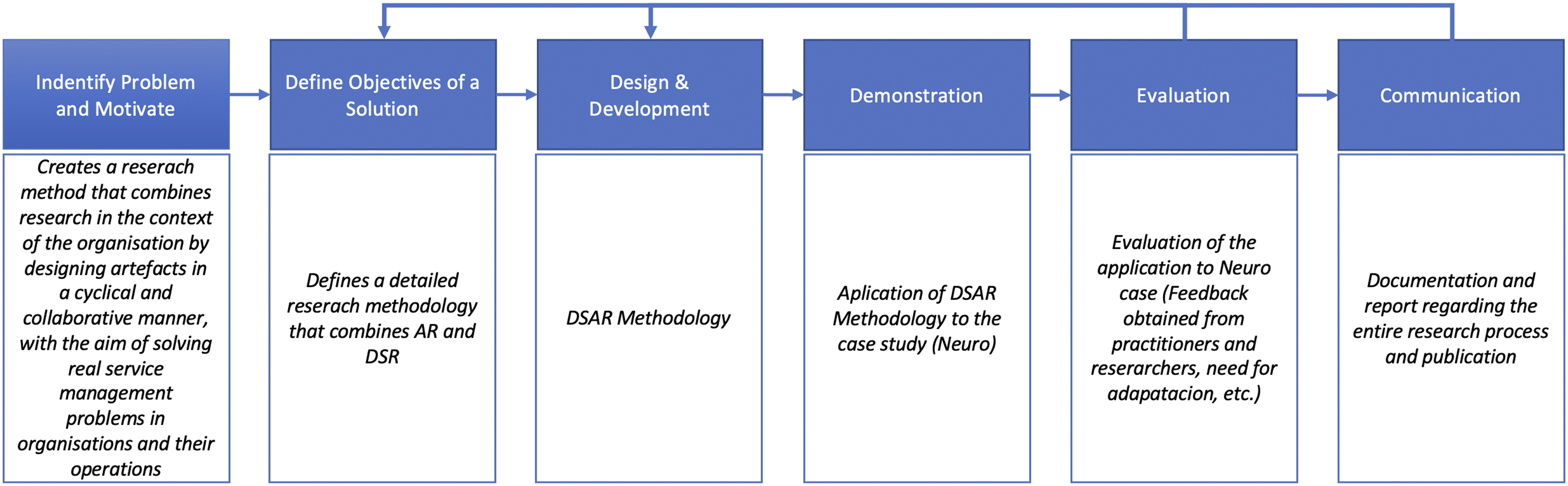
Design Science Action Research Methodology
According to Collatto et al. (2018), there are three possible ways in which AR and DSR can be used in a combined manner: a) using AR under the DSR paradigm, b) using the AR and DSR as mixed methods, which is a sequential use of the AR + DSR methods, and c) combining AR and DSR. The proposal described in this work corresponds with option c). We therefore propose a methodology denominated as Design Science Action Research (DSAR) in which characteristics from the AR and DSR methodologies are combined.
The combination is particularly recommended when the artefact to be developed and evaluated is an instantiation-type artefact or, which is the same, is an artefact that needs to be implemented (developed and evaluated) in the context of a real environment (Venable, 2006). The attainment of a satisfactory artefact therefore depends on the close collaboration and interaction between researchers and practitioners, since both must work together from the conception of the artefact until its validation, iterating in design cycles related to the artefact (or parts of it) that are carried out within the framework of the organisation.
The seminal work on DSR (Hevner et al., 2004) provided a definition of a conceptual framework with which to understand, execute and evaluate information systems research. This work was later extended by defining an approach in three cycles inherent to the research (Hevner, 2007): the Relevance Cycle, which bridges the contextual environment of the research project with the DS activities; the Rigor Cycle, which connects the DS activities with the knowledge base of scientific foundations, experience and expertise that inform the research project, and the central Design Cycle, which iterates between the core activities of building and evaluating the design artefacts and the processes of the research. Furthermore, the work of Peffers et al. (2007) proposes a methodology for use when conducting research into DS that incorporates practices and a specific procedure with which to advance in the research that includes six steps: problem identification and motivation, definition of the objectives for a solution, design and development, demonstration, evaluation, and communication.
The DSAR methodology (see Figure 2) is structured around the conceptual framework and the three cycles of DSR (Hevner, 2007) and integrates the DS research practices and processes defined in Peffers et al. (2007). As a central part of the methodology, we propose a design phase denominated as ‘Design in Action’, which extends and complements the original DS design cycle by integrating the AR cycle into it (Susman & Evered, 1978). This cycle involves researchers and practitioners collaborating on the design, development, use and evaluation of artefacts in order to solve organisational problems. They work together in the relevance cycle of solution, aligning environmental knowledge with design needs, and in the rigor cycle, linking design activities to existing knowledge. A detailed description of the methodology is provided below. Framework of the DSAR methodology.
The first steps of the methodology are framed within the
The next steps in the methodology are the core of the
The
Applying the DSAR Methodology to SOM Research: The Case of NEURO
The DSAR methodology has been applied in the sphere of SOM research to a case study concerning the company NEURO, a small business run by service professionals specialised in treating people with neuropsychological disorders.
The researchers initially encountered NEURO as customers of its services. After using the service for a while, they realised that although the company had an excellent interdisciplinary team (including psychologists, neurologists and speech therapists), it lacked experience in management fields such as operations, human resources, marketing, finances, etc. This meant that the service design and delivery process took place day by day without following a structured development, which was inefficient. A collaboration with NEURO was, therefore, proposed in order to provide a solution and improve the design and delivery of its services.
The process began with an evaluation of NEURO’s customer satisfaction. This led to the discovery that the customers were satisfied with the service received, which was basically for two reasons: the effectiveness of the treatments and the empathy of the personnel. There was, therefore, a paradox between the provision of a service that was well valued by the customers (in the front-office) and the fact that there was much room for improvement as regards the design and delivery processes (in the back-office). The company’s real problem was consequently the lack of alignment between the professional knowledge and that required for the functional operation of the business based on service operations management.
This real-world problem offered an ideal opportunity for research driven by AR principles. The methodology chosen needed to document the research robustly, facilitate interaction among staff, customers, and researchers, involve customers and staff in designing and developing the solution (the artefact), and rigorously evaluate the results. A combination of AR and DSR was consequently deemed the most suitable approach.
AR enables researchers to participate in design activities and service provision, fostering collaboration among customers, researchers, and professionals in order to define, validate, and evaluate the artefact. DSR provides a framework in which to identify the organisational context, define the problem and objectives, design and validate the artefact, and document the research systematically while rigorously evaluating the impact of the artefact.
Figure 3 shows the research process defined by DSAR and applied to the NEURO case, which led to the creation of the artefact denominated as ReforceSME. The step-by-step research process and results obtained in each of the iterations are described in the following points. DSAR methodology applied to the NEURO case.
Understanding the Environment
Once the environment of NEURO had been analysed, the research began by
After carrying out a systematic literature review and analysing service design and process improvement proposals, the
Designing in Action
The
Design in Action. Details of the Iterations Carried out During the Research.

Contributing to the Knowledge Base
Finally, in the
The theoretical foundations of this research comprised a set of techniques, methods and theories from the following areas: Service Design (Junginger & Sangiorgi, 2009), Service Innovation (Gustafsson et al., 2020), Service Operations Management (Roth & Menor, 2003) and Service Quality (Parasuraman et al., 1988). The contributions to the knowledge base that have resulted from this research are both the ReforceSME artefact and the DSAR research methodology presented in this work.
Discussion
The DSAR methodology presented in this work has proved to be a rigorous and methodological approach with which to solve real practitioners’ problems. Its application in the sphere of NEURO has allowed researchers and practitioners to collaborate and co-create innovative solutions to the operational challenges of this service organisation. The main advantages of the DSAR methodology can be summarised as follows: it is the explicit declaration of a process that facilitates the research, development and evaluation of artefacts in the context of the organisation, in such a way that it is possible to solve its real problems. An organisation’s attainment of satisfactory artefact/s, therefore, depends on the close collaboration and interaction between researchers and practitioners, who must work together from the conception of the artefact until its validation by iterating the planning, acting, observing and reflecting cycles that are carried out within the framework of the organisation. New knowledge arises from carrying out the research, which is generated thanks to the implementation of the artefact in a real context. Given that this new knowledge responds to the identification of a problem with a practical relevance, it is possible to generalise it to a certain class of problem, thus allowing the identification and analysis of the practical and theoretical contributions of the artefact.
This collaboration between researchers and practitioners during the application of the methodology to the NEURO case was fundamental as regards attaining a successful result in the project. The researchers acted as guides in the process of searching for a solution, playing the role of researcher and consultant when applying the various techniques and activities defined. In fact, at some stages of the research process, the researchers acted as “coaches” accompanying the practitioners in the identification of differential aspects in the design of the solution that would add value to their real situation. The need for AR cycles in the framework of NEURO was evident from the outset, given that an attempt was being made to solve a real problem in the context of the organisation. The artefact (or parts of it) was designed in an iterative and incremental manner, but with the characteristic that this took place within the context of the company by planning each new aspect of the design, using it in a real context, collecting and analysing data and reflecting on its usefulness.
The case study concerning NEURO also made it possible for the authors to learn about the importance of the company perceiving the results of the research as relevant from the managerial point of view. From the academic point of view, the research process implies activities that are characteristic of the rigorousness and formality of the process, which are not always understood or well received by the company. This is even more important in the case of companies that provide services. As stated by Mejía-Villa and Alfaro-Tanco (2017), one of the main issues as regards diffusion is that academic results are usually obtained in the medium-long term and the practitioners need to see the results in the short-medium term. It is, therefore, crucial for researchers not to lose sight of the real needs affecting the company. Focusing on the search for solutions that are aligned with the approval of all the managers, along with the correct communication of the results and advances made in the process, are fundamental and necessary aspects for the efficient management of the company’s resources (people, processes, technologies, etc.).
One important point that should be discussed is whether the DSAR methodology, although applied in the context of SOM, has the potential to be extended to other fields of study. We consider that DSAR, by combining DSR and AR, has a versatile approach that can be adapted to different disciplines in which collaboration between researchers and practitioners is essential, such as engineering, information systems, healthcare or knowledge management. Its ability to generate contextual solutions to organisational problems could be particularly useful in areas requiring the implementation of emerging technologies or the redesign of complex processes.
Another relevant aspect is the possibility of applying DSAR on a larger scale. For example, would it be feasible to apply this methodology in organisations of different sizes or in multicultural or global contexts? As DSAR promotes the co-creation of knowledge and solutions within an organisational context, it is adaptable to different cultural and organisational environments. However, it is important to acknowledge the challenges that may arise, such as the need for greater coordination and customisation in broader scenarios.
Furthermore, DSAR not only contributes to solving specific problems but also helps to develop new theories and conceptual frameworks. By involving practitioners in the research and design process, the methodology fosters a constant dialogue between practice and theory, which could lead to the identification of phenomena or patterns that had not been previously observed. This allows the creation of new theories that are more relevant and applicable to contemporary organisational contexts.
DSAR could also contribute to methodological advancements in disciplines that use design-based research or participatory research. A new perspective on how to generate more relevant and practical research outcomes is provided, which could influence how research is developed and applied in other areas (such as education, social sciences, etc.).
Conclusions
Despite being a growing research area owing to the significant increase in services, only Roth and Menor (2003) and Domínguez-Machuca et al. (2007) have analysed the state of the SOM situation and have proposed future research agendas. Field et al. (2018) also provide a broad range of ideas with which to spur conceptual and empirical research related to service operations. It is, therefore, vital to have robust research methodologies with which to respond to the many research questions posed.
One methodology that responds to this approach is AR. AR differs from experimental sciences, but is genuinely scientific in that it places emphasis on the careful observation and study of the effects of human behaviour on human systems as they manage change. Human behaviour and human systems are particularly relevant in the service field, and AR is especially suitable for research in this field for this very reason (Elg et al., 2020). However, AR studies in the field of business and management have failed to realise their potential for generating robust actionable knowledge (Shani & Coghlan, 2021). One way in which to overcome this drawback is that of combining AR with other methodologies.
Technological and social changes undoubtedly create the opportunity for AR projects that focus on new thinking about design principles and planned change processes and technology (Repenning et al., 2018). Integrating an AR orientation into the discovery process for the exploration of appropriate designs could serve as the engine for implementation and action. The combination of AR with DSR makes it possible to address many of the research problems that arise in the field of SOM in a holistic manner. This paper presents DSAR, which is a combination of AR and DRS. The practical application of the DSAR methodology led to the creation of ReforceSME, an artefact designed to address specific service (operations) management challenges in organisations. This artefact was developed and validated in a real case study, demonstrating the practical utility of the DSAR methodology.
With regard to the contributions of this work at a theoretical level, this paper makes a methodological contribution that could help to reduce the gap between academic research and what practitioners require in terms of support as regards the problems of SOM. A new research methodology is proposed, whose description and evaluation have been carried out through its application to a real reference case. DSAR is defined as a methodology that combines the DSR approach (DS framework, cycles, practice and process) with the AR proposal, which promotes and enhances the design of artefacts in the context of the organisation (design in action) and is carried out by researchers and practitioners together. This signifies that DSAR makes a dual contribution for both research and practitioners (Alfaro-Tanco et al., 2021). This work also contributes to SOM literature, since the collaboration between practitioners and researchers can help to gain an in-depth understanding of the complexities of service operations and to develop new theories, models and frameworks that will advance the knowledge in this area.
In fact, the combination of DSR and AR contributes to a new means of addressing organisational problems. DSAR provides a new way in which to view the design of artefacts within the organisational context. Unlike methodologies that seek generalised solutions, DSAR focuses on solutions that are tailored to specific contexts, which broadens the discussion on internal versus external validity in theory building in the field of SOM (although the methodology may be applicable to other fields, as mentioned in the Discussion section). All in all, DSAR helps to uncover new theoretical constructs, such as identifying new variables or relationships that had not been previously explored. By involving both researchers and practitioners, this methodology reveals greater complexity in problems and provides a richer foundation on which to theorise about service operations phenomena.
Moreover, the DSAR methodology not only allows the development of artefacts but also promotes a more iterative and collaborative approach, which is a theoretical advancement. In this line, the DSAR methodology fosters a continuous and active interaction between researchers and practitioners, generating theoretical knowledge based on practice. This can be interpreted as a significant innovation in the epistemological approach to SOM (i.e. how knowledge is created and validated), as it not only serves to validate existing theories, but also facilitates the creation of new ones through direct hands-on collaboration with practitioners within the specific context of application. The fact that the development of theoretical constructs is grounded in real-world challenges and iterative problem-solving signifies that DSAR enables a more dynamic and responsive approach to theory-building, one that is profoundly informed by the complexities and nuances of practical service operation environments.
DSAR has theoretical implications for interdisciplinarity in research. On the strength of merging research and practice approaches, it promotes convergence between different fields of study, such as information systems, engineering and management, thus contributing to a more holistic and connected theoretical advancement.
The results of this study have several implications for managers. By facilitating the design and implementation of service operations, DSAR can help organisations to improve the efficiency, quality and effectiveness of their service operations, which can in turn enhance the customer’s experience and provide a competitive advantage in the marketplace. Coupling the AR process with the new emerging design practices provides organisations with collaborative ways in which to study and design an optimal balance between autonomy and oversight (Shani & Coghlan, 2021). Moreover, this study proposes an alternative paradigm of collaborative research between practitioners and scholars within the SOM field with the objective of conducting methodologically rigorous projects that should solve real organisational problems. DSAR can be replicated by practitioners in order to address different challenges in the service sector, making it a versatile tool with which to improve service (operations) management.
Limitations and Future Research
This study has some limitations, which provide opportunities for future research. First, the main purpose of this paper is to propose a research methodology with which to conduct AR in combination with DSR in the context of SOM. The function of the case reported is principally to explain the DSAR methodology. Further empirical studies could apply the DSAR methodology in other fields, thus making it possible to refine the theoretical framework and add ‘actionable results’ to a specific research domain.
Second, and related to the previous point, the proposed methodology has been tested and evaluated in a specific case study, which limits the possibility of making generalisations regarding its validity in other contexts of application. Further research could examine how DSAR can be adapted and scaled in various organisational contexts, including organisation sizes, and multicultural environments. These studies would not only extend the theoretical contributions of DSAR but also help to refine its practical applicability, offering insights into the coordination and customisation required for a broader implementation.
Future studies could also focus on the iterative and collaborative aspects of DSAR, exploring how they contribute to the co-creation of new theoretical constructs in different disciplines. Such work would further solidify the role played by DSAR as regards bridging the gap between academic research and practical needs, fostering interdisciplinary collaboration and innovation.
Footnotes
Declaration of Conflicting Interests
The author(s) declared no potential conflicts of interest with respect to the research, authorship, and/or publication of this article.
Funding
The author(s) disclosed receipt of the following financial support for the research, authorship, and/or publication of this article: This research is funded by the following projects: Grant (SERDigital PID2020-117244RB-I00) funded by MCIN/AEI/ 10.13039/501100011033. Grant (DESAFíO-CM project TEC-2024/COM-235) funded by Community of Madrid.
