




Abstract
Strength-based approaches are regarded as being effective in research with communities but there are minimal examples of application as a research approach, particularly in health, with Indigenous populations, and with youth. Systemic racism manifested through colonization, including in academic institutions, has contributed to historical and ongoing traumas by supporting the overuse of deficit-based approaches with Indigenous populations in many disciplines, including health. We present our creation and application of a strength-based methodological approach to research in health alongside Dene First Nation youth. It was developed on principles consistent with the strength-based paradigms in social work, psychology, and education. We share four main components of strength-based research approach: 1) identifying strengths, 2) prioritizing and creating descriptions of strengths, 3) refining strengths by gathering contextual examples, and 4) depicting strengths to plan future research. Each component included qualitative methods (such as asset-mapping, nominal group technique, storytelling interviews, and participatory 360-degree video) that reflected aspects of strength-based approaches and emphasized active participation, multiple knowledge sources, and empowerment. Utilizing this approach promoted connectivity to the larger environment, inclusivity of multi-knowledge sources, agency and voice, increased empowerment, and practicality in action. We share challenges and lessons learned from exploring a strength-based approach in health research and provide insights for researchers interested in applying a strength-based approach to research, particularly in Indigenous health.
Keywords
Introduction: What is a Strength-Based Approach?
A researcher’s approach greatly influences their chosen methods and if or how their results are translated into action. In recent years, using a strength-based (rather than a deficit-based) approach to determine research methods and knowledge translation and mobilization practices has been increasingly advocated as a more effective way to conduct research with communities (First Nations Information Governance Centre (FNIGC), 2020).
Strength-based approaches have been readily defined and applied in social work, psychology, nursing, business, and education practice (Bibb, 2016; Gottlieb, 2014; Lopez & Louis, 2009; Rapp & Goscha, 2006; Saleebey, 2008), starting with social work in the 1980s; however, strength-based approaches in Indigenous public health in the literature have only been more prominent since the 2010s (Askew et al., 2020). Why? In the Western hemisphere, the health field originally stemmed from a bio-medical model and a pathologizing lens centered on finding a solution for disease. This foundation cultivated a research atmosphere grounded in deficit-based approaches, prioritizing what is ‘wrong’ with an individual or population and finding solutions for those ‘wrongs.’ Such approaches usually result in one-sided solutions that rely on resources outside the community, denying those affected agency over changing their outcomes. Nonetheless, deficit-based approaches tend to be the ‘fallback approach’ for health because practitioners and researchers can efficiently isolate a problem, find solutions relatively quickly, and systematically ‘treat’ those affected by connecting them to outside experts and specialists who ‘know’ those solutions. Within the broader health system, deficit approaches are often perpetually prioritized by privileging the values of decision-makers of resource and funding allocations. Utilizing a strength-based approach must start with individuals re-evaluating their approach to research.
The range of strength-based approaches is vast, and continually changing because of the many ways they can be operationalized (Caiels et al., 2021). In health, they can be employed to focus on recognizing and reinforcing: personal, relational, and communal assets; protective factors; ways of being, thinking, and knowing; and actions that encourage wellness (FNIGC, 2020). Researchers employ a strength-based approach acknowledging that the individual or population they are working with has the knowledge and resources to find solutions (Pulla & Francis, 2015). Strength-based approaches are recognized for their collaborative, multidisciplinary, and holistic characteristics (Baron et al., 2019). Although many fields utilize strength-based models, such as those based on resilience, hope, positive psychology, and community empowerment (Rapp et al., 2005), significant gaps persist in the health literature in conceptualizing a strength-based paradigm as a research approach, which reinforces the need for developing more interdisciplinary health research (Kivits et al., 2019).
The idea of utilizing strength-based approaches in health stems from the medical sociology concept of salutogenesis (first introduced in 1978 by Aaron Antonovsky (1979)), which centers on the factors that promote health and wellness. In his Theory of Salutogenic Model of Health, Antonovsky (1979) explains how salutogenesis, which translates in Latin to the origins of health, differs from pathogenesis, which translates in Latin to the origins of disease or suffering. Under a salutogenic orientation, Antonovsky deviated from a pathogenic paradigm by accepting health as well-being (as opposed to the absence of illness), fitting ‘being healthy’ on a continuum rather than using a sick/healthy dichotomy, and opening definitions of health to include those other than defined by medical experts as the absence of disease (Vinje et al., 2017). “Salutogenesis makes a fundamentally different philosophical assertion about the world than does pathogenesis” (Antonovsky, 1998, p. 5). By pivoting one’s philosophy, Antonovsky postulated that salutogenic approaches have implications for health research, particularly health promotion (Vinje et al., 2017). However, he also recognized that “A salutogenic orientation is not likely to take over. Pathogenesis is too deeply entrenched in our thinking.” (Antonovsky, 1998, p. 6). Furthermore, implementing a strength-based approach means changing “from a pathology-focused paradigm to a possibility-focused paradigm. This shift is more than theoretical; it demands a deep inner transformation” (Pulla & Francis, 2015, p. 138). For example, in mental health social work, utilizing a strength-based approach has proven more challenging than simply switching approaches, partly because practitioners are trained from a pathology-based model where the objective is to seek a diagnosis (Xie, 2013). These pathology-focused actions are commonly engrained in paradigms of what constitutes ‘normal’ health in Western contexts. To understand how these differ, let us unpack what is meant by strength-based.
The attributes of strength-based approaches in a health context are not well-defined. These approaches are often over-simplified to mean positive talk, being kind, or simply listing positive attributes (Rapp et al., 2005), which increases misunderstandings of definitions and applications. Additionally, deficit-based and strength-based can easily be misinterpreted as opposing perspectives, when they are, in fact, not mutually exclusive. Each approach can be employed separately for different benefits or together to find different types of complementary information. For example, a deficit-based paradigm is commonly used in cardiovascular disease prevention when designing messages about the adverse health effects of sedentary lifestyles and physical inactivity and creating minimum activity level recommendations (Warburton & Bredin, 2019). However, Warburton and Bredin (2019) noted that this approach was ineffective in practice and advocated for strength-based approaches to promote lasting changes for patients, communities, and populations. They recommended established practices and tools, like strengths-based case management (a rehabilitation model based on a client’s goals, networks, and skills), and new approaches, such as goal orientation and utilizing resources from one’s environment, that recognize the strength-based aspects identified by Rapp et al. (2005). In this field, utilizing a deficit-based approach isolated the target area as increased physical activity for improving cardiovascular health. However, as Warburton and Bredin (2019) argue, using strength-based approaches may provide real, long-lasting changes in improving physical activity and, thus, cardiovascular health, through patients increasing their determination and empowerment by building on the strengths or activities currently in their life.
Tang et al. (2016) also exemplified this approach by working with community youth to define physical activity beyond standard definitions, such as sports and organized exercise, and recognizing physical activity is inherent in First Nations’ culture and traditional activities. For example, in their research, youth identified through participatory videos that physical activity in their communities includes tanning moose hide, chopping wood, and being out on the land. Tang and colleagues recognize that being physically active is connected to being culturally active, which may have implications for increasing physical activity in current recommendations. This research demonstrates that strength-based approaches can help surface new solutions that promote sustainable and appropriate change.
Why Use a Strength-Based Approach in Indigenous Health Research?
The historic tragedies and continuing neocolonialism of Indigenous Peoples in Canada have further impacted research approaches focusing on ‘fixing’ the wrongs and shortfalls in Indigenous health. Systemic racism manifested through colonization and beliefs of White supremacy to support cultural genocide has contributed to historical and ongoing traumas that continue to support the overuse of deficit-based approaches with Indigenous populations in many disciplines, including Indigenous health. Such an approach “frames and represents Aboriginal identity in a narrative of negativity, deficiency, and disempowerment” (Gorringe, 2015, p. 1), where they need to be “fixed” (Tuck & Yang, 2014). Under the umbrella of colonialism, a manipulative tactic called “cognitive imperialism” was used to discredit Indigenous knowledge and values and promote cultural erosion while simultaneously elevating and sanctioning ‘Western’ knowledge (for instance, in educational curricula) (Battiste, 2000, p. 198). In Canada, a layered history of cognitive imperialism was employed, primarily implemented from 1892 to 1996 in the Indian Residential School systems that were designed to fulfill the Indian Affairs Deputy Superintendent’s goal to “… get rid of the Indian problem … until there is not a single Indian in Canada…” (Aboriginal Healing Foundation (AHF), 2002, p. 3). In the Indian Residential Schools, Indigenous children were not allowed to speak their language or share ways of knowing and were often punished for these actions. Unfortunately, the harmful effects of these tactics are still present today. Western knowledge is still privileged over Indigenous knowledge, which is often discounted, misinterpreted, or overlooked in Canadian society. In Canadian academic training, the singular worldview of Western health concepts, such as the over-emphasis on deficit-based approaches, may inhibit researchers from using more promising, strength-based approaches that may be more effective with specific populations or topics (Lines, 2020). When used appropriately with Indigenous groups, strength-based approaches can offer a perspective shift where Indigenous knowledge, worldviews, and resources are recognized as valuable and imperative for finding appropriate solutions.
A significant challenge in building a strength-based health research approach is adapting or creating innovative methods that support Indigenous strengths in research interventions (Tsey et al., 2007). Researchers must consider an Indigenous population’s cultural and historical context, intergenerational traumas, and resistance strategies (FNIGC, 2020). They must also develop methods that address the specific adversities resisted by Indigenous Peoples at different levels, including individuals, families, communities, and nations (Kirmayer et al., 2009). Our research project, a collaboration between academic researchers and community partners, allowed us an opportunity to explore the utility of different research methods to engage First Nations youth in a strength-based manner. This research was conducted with the Yellowknives Dene First Nation (YKDFN), located near the city of Yellowknife in the Canadian Northwest Territories. The YKDFN consists of two communities, Ndilo and Dettah. We knew from our previous research capturing YKDFN youths’ perspectives on health (Lines et al., 2019) youth saw themselves as part of the solution to addressing health issues. The community echoed the youths’ strengths in leading and creating health solutions. The recognition and emphasis placed on these attributes were the catalysts for using a strength-based approach for this research project.
In this article, we present our experience creating and using a strength-based approach for health research with YKDFN youth. We describe the research components, steps, and methods employed to reflect a strength-based approach. These experiences are meant to guide and inspire others seeking to reframe their mindset and practice for Indigenous-led health and wellness research.
Exploring a Strength-Based Approach to Health Research with First Nation Youth
Background and Community Partner Collaborations
Youth and academic researchers partnered with the YKDFN Dechıta Naowo Post-Secondary Education Department to answer two research questions: What do youth identify as YKDFN strengths? What types of research methods would genuinely reflect and build on these strengths? We asked these questions as part of a larger community-based research project where youth would communicate lessons about being healthy in the face of health risks, which we called ‘participatory risk communication.’ The intent was to prepare for developing a subsequent youth-led project based on the youths’ identified strengths. Previous to this research project, both authors had built relationships with the YKDFN youth and community. The first author was raised in one of the YKDFN communities, remains an active member, and has worked, volunteered, and researched with youth and community members. The second author has researched in the community alongside various YKDFN departments and organizations for nearly twenty years. Building on these relationships, the youth expressed an interest in using participatory videos, as in prior YKDFN research projects (Genius et al., 2013; Lines et al., 2019; Tang et al., 2016), to capture strengths. Participatory videos involve a group or community creating a film based on their ideas instead of enacting the ideas imposed by outsider others. Simultaneously, Dechıta Naowo partnered with the Canadian Museum of Nature to create a 360-degree video installation on a northern natural area in Canada, and we collectively decided to create a video which could be viewed in a virtual reality headset or using other technology, such as a smartphone application (e.g., HeadJack).
Using a 360-degree video camera in research was a new venture, but we followed a familiar participatory video format (as described in later sections). Our focus was to create a video depicting youth-identified YKDFN strengths, and in doing so we combined different methods and aspects of strength-based paradigms that exemplified a strength-based approach to research.
Building a Strength-Based Approach to Research
The first author created an original skeleton for a strength-based approach to Indigenous youth health research based on her experience using different research methods with youth and as a member of the YKDFN, principles of working with Indigenous youth, and aspects of strength-based approaches defined in the fields of social work, psychology, and education. Primarily she utilized familiar research methods in line with strength-based framing, including participatory videos, nominal group techniques, storytelling interviews, and asset-mapping in murals, as carried out in previous projects in her community (Genius et al., 2013; Lines et al., 2019; Tang et al., 2016).
The research was grounded in the four overarching “Guiding Principles for Engaging and Empowering Aboriginal Youth”: (1) integrating cultural identity; (2) increasing youth engagement; (3) fostering youth empowerment; and (4) establishing and maintaining effective partnerships (Crooks et al., 2010). These principles were consistent with the strength-based paradigms in social work, psychology, and education. In social work practice, practitioners refer to three foundational principles that form a strength-based position: every person has strengths that can be utilized, one’s motivation to act increases through focusing on one’s strengths, and one’s environment can provide strengths (Saleebey, 2008). In psychology, practitioners focus on engaging clients, conducting a strength-based assessment, planning with strengths in the client’s niches in life, and proactively acquiring resources from their environment (Rapp & Goscha, 2006). In education, teachers utilize their pedagogical strengths to empower students to identify and utilize their strengths to attain goals. An educational strength-based approach is broken into five stages: (1) measuring strengths; (2) individualizing learning experiences to personalize strengths for each student; (3) networking with others that support the strengths growing; (4) deliberately applying strengths inside and outside the classroom; and (5) intentionally developing strengths through actively engaging in experiences in their environment (Lopez & Louis, 2009). Based on this collective guidance, our team of researchers and youth emphasized identifying strengths, environmental opportunities for cultural connection and expression, developing strengths to support empowerment, and utilizing the strengths for action.
Strength-Based Research Approach Components and Methods Utilized in Each Component.

Component 1: Identify Strengths
We interpreted this component as working with members from a set population to collectively identify its assets and asset themes. Asset-mapping tools focus on the capacities and capabilities of a population and have been used in communities and research for decades as a strength-based method to find solutions. An asset-map is a depiction of what is valuable to a community, including items, characteristics, or entities that are either a strength, advantage, or resource to the community (Dorfman, 1998). Community asset-mapping involves a community identifying “individual, associational, institutional, economic, physical, and cultural assets” (Lightfoot et al., 2014, p. 59). It usually starts with creating a definition of the community. Next, community members collectively explore, pinpoint, and list their community’s assets and then, develop a map of the assets (conceptual or physical) that displays their interrelationships (Lightfoot et al., 2014). The interrelationships reveal pathways to sustain and build on those assets (Dorfman, 1998). In our research context, the youth named these interrelationships as themes and specifically chose assets necessary for development of video scenes.
The researchers and YKDFN staff introduced the project by showing past participatory video examples, explaining the project goal, and facilitating icebreaker activities to encourage comfort and trust. Once the youth were familiar with each other, the staff, and the research goals and were fully engaged, the youth worked through a series of asset-mapping activities to generate collectively identified YKDFN assets for scene development.
First, the youth explored the meaning of YKDFN assets by collectively sharing stories and experiences. The youth were specific about the stories and assets they were sharing and clarified the boundaries of the population with the group. They implied there would be slight variations in the assets they shared depending on the definition of the population, (e.g., YKDFN, Dene people, youth in the YKDFN, or one of the two YKDFN communities). Starting the research by identifying assets in the community, rather than pointing out areas lacking, such as in a needs assessment, was an essential part of framing the project toward solutions.
Next, in groups of two to three youth, they brainstormed more specific strengths of the YKDFN. This step promoted feelings of cultural pride and relationship-building between youth as they recounted memories in the community and shared stories, as depicted below. Many of the youth were smiling and proud of the actions of their community, family or friends. They talked about hunting trips, community programs, and culture camps. They talked about their experiences and what lessons they learned, which inspired other youth to share their stories (First Author’s Field Notes, July 6, 2017).
The youth reflected individually and wrote down ideas of YKDFN strengths that could be portrayed in their video. The reflection piece gave youth time to pinpoint the assets from their conversations and connect these ideas with the strengths of the community at large. The youth presented their ideas written on Post-it Notes to the entire group and then stuck their Post-it Notes on the wall for everyone to see.
The youth then jointly grouped similar ideas on the wall (Figure 1). This collaborative sorting allowed them to visualize their collective responses and easily rearrange Post-its. They saw how each participating youth had similar ideas of their First Nation’s strengths. In this way, the assets were openly recognized and mutually appreciated. The youth identified six main themes of YKDFN strengths: leadership, mental health, fire, learning new things/communication, knowledge, and working hard/independence. Example of the youth grouping similar ideas to identify a YKDFN strength theme (July 6, 2017).
Component 2: Prioritize & Create Descriptions of Strengths
In this component, youth prioritized assets to answer the research questions and develop a fuller understanding of how the assets were exhibited in the population. After the youth categorized their ideas on YKDFN strengths, the researchers assisted the youth in forming a consensus panel by employing a nominal group technique to prioritize ideas, which was modified to prioritize their identified strengths using visual, tactile Post-its and stickers. Participants formed an idea, discussed it in a group, and reached a consensus on what strengths most represented communicating healthy lessons (Coreil, 1995). This process values participants for their knowledge and action in decision-making. Youth formed a consensus by voting with stickers. Youth received the same number of stickers (seven) to place on large Post-it Notes with a written strength identified in Component 1. Youth could place any number of stickers on one or more strengths. After voting, the youth gathered the Post-it Notes with the highest number of votes to display their top priorities together, as depicted in Figure 2. The strengths with the most votes were considered representative and were prioritized as topics in creating video scenes. Youth looking at the assets with the most votes to develop storylines (July 6, 2017).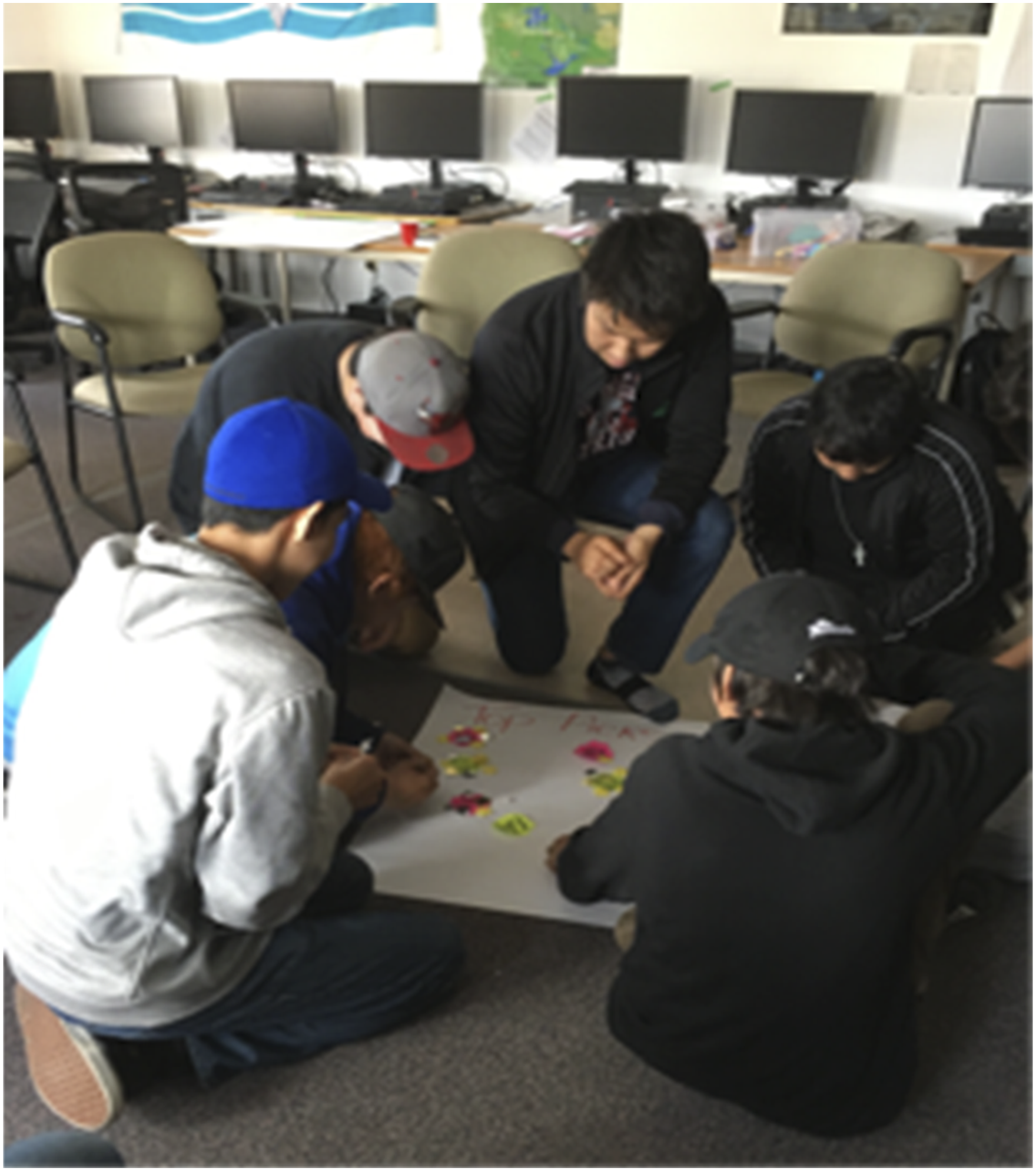
Youths’ Initial 360-Degree Video Scenes (July 6, 2017).

The participants practiced filming these scenes in the second part of the workshop a few weeks later. Using a 360-degree camera for the first time presented its own challenges (such as video stabilization and scene set-up for 360°) and more practice filming was needed. The youth also wanted more context for the assets and to connect them with YKDFN stories, so they asked for time with the Elders to improve their scene development.
Component 3: Refine Strengths by Gathering Contextual Examples
The project continued the following summer, 2018, when the youth had again more continuous hours outside of school to dedicate to the research project as summer students. In this next component, the youth focused on gathering contextual perspectives and subject-specific examples of the prioritized strengths. New and returning youth revisited the research project goal and prepared to gain more perspectives and examples from YKDFN Elders about the subject. During this component, four returning youth participants joined the project as youth co-researchers, led by a new senior youth co-researcher, who had previously volunteered with the research projects. The youth co-researchers were hired as summer students to steer the project and conducted additional research activities, including writing field notes, gathering information, and compiling data. The youth co-researchers started by assessing how closely the data aligned with health risk communication (when people talk about things that may pose a risk to their health). From there, the youth co-researchers thought of primary areas where they could learn more from the Elders. The youth co-researchers valued the Elders’ perspectives because they respected the Elders’ lessons and oral history that helped deepen their subject knowledge.
In line with an Indigenous research perspective, we used a storytelling interview method with Elders and traditional knowledge holders. Storytelling interviews are more conversational and less structured to access knowledge more fluidly by mirroring oral tradition principles (Kovach, 2009), which are prominent in the YKDFN. Elders can control the amount they want to contribute, which signifies respect for the member’s stories in First Nations communities (Kovach, 2009). Interviews conducted in an open-structure fashion best capture the ebb and flow of Indigenous storytelling, as opposed to the more linear structure of direct questioning (Wilson, 2008). The open structure is best suited for storytellers who naturally embed meaning related to the topic throughout and in the overall compilation of the story. The Elders were interviewed at an on-the-land traditional camp to ground the interview in a YKDFN cultural setting.
The youth prepared for the interview by reviewing the asset-mapping, revisiting their initial compiled assets, and recounting experiences. The youth thought the major strengths they wanted to illustrate in their video from the discussions in 2017 were: “respecting the land (giving back to), being self-sufficient on the land, survival skills such as making fire, fishing, and hunting, and being active” (Youth Co-Researcher 1’s Field Notes, June 26, 2018).
With these identified assets in mind, the youth created questions to guide a semi-structured storytelling interview. Specifically, youth developed questions to understand Elders’ thoughts on the YKDFN strengths in communicating and learning lessons.
A community Elders’ on-the-land luncheon provided four youth the opportunity to conduct a modified storytelling interview with eight Elders and knowledge holders, alongside the first author researcher. The youth listened intently during the luncheon, audio-recorded the interview, and wrote critical points in their notes. Following the interview, our research team immediately wrote down our reflections and discussed what was most significant to each listener. The next day, we had a more in-depth discussion regarding our experiences of the storytelling interview with the Elders. The youth used the audio recording of the Elders speaking, field notes, and personal reflections to summarize their interpretation of the YKDFN strengths of communication and learning lessons, as noted below. “stories, experiencing, being on-the-land, listening, only taking what you need, giving back and taking care of the Elders, understanding necessity and taking care of others, and building relationships with people and the land” (Youth Co-Researcher 1’s Field Notes, June 27, 2018).
Youths’ 360-Degree Video Overall Plan (July 10, 2018).

In addition to the overall plan, the youth crafted an individual script for each act that included a detailed plan for each scene (Senior Youth Co-Researcher’s Field Notes, July 10, 2018). The plan included an asset example (which served as the main activity of the scene), Elders to interview, illustrations of scene settings, and potential voiceovers by an identified Elder. The youth also included themes from the asset-mapping and interviews with Elders to translate specific messages into the scenes.
Component 4: Depict Strengths to Plan Future Research
In this component, the participants compiled a knowledge base of translation material to depict strengths to use in research planning. This knowledge base explained the interconnections of their strengths in formats that could be referenced for different audiences or future activities, and included detailed video scenes, interviews with Elders, unused video scenes, handheld filming of the project, and field notes. After planning the video scenes, the youth produced their 360-degree video. We used a participatory video format as a recognized community social justice method (Shaw & Robertson, 1997). The accessibility and ease of this method provide people opportunities to explore issues, voice opinions, and tell their stories, which can be empowering and promote community actions and solutions (Lunch & Lunch, 2006). We specifically used Shaw’s four-stage participatory video process (2017) to solidify the messages in the video, which were: (1) group-forming and building; (2) group exploration and reflection toward collective agency; (3) action through collaborative production; and (4) performing influence through video-mediated exchange (p. 11).
The youth set up, filmed and directed scenes, interviewed Elders for each scene audio (for the scenes with a voiceover), and edited the footage. As a team consisting of the Dechıta Naowo staff, youth co-researchers, and researchers, we narrowed down the videos with the youths’ original themes in mind. We decided on three videos based on the footage captured, the quality of the videos, the relevancy of the interviews with Elders for the voiceovers, and how captivating it was for the expected audience, including future researchers and YKDFN partners and the Canadian Museum of Nature public. Below, one youth researcher described the process. We interviewed many Elders before we saw the footage, so we [moved] the scenes around from what we originally planned. We changed the wording around the scene titles so that it was slightly different but had the same meaning. (Youth Co-Researcher 2’s Reflections, February 24, 2022).
The youth critically considered their messages from the planning to the editing stages to convey the strengths clearly for planning for the larger participatory risk communication project. The first video centred on multiple youths’ themes: Relationship with the Land, Spirituality, and Elders and Knowledge. This video depicted the youth around the fire, where the Elder shared a story about Dene values and connections to the land as they prepared a feed-the-fire ceremony. The second short video illustrated a stage in tanning a moose hide, with a voiceover by an Elder explaining the tanning process and uses of moose hide. This video reflected the identified strengths of Elders and Traditional Knowledge (Learning from our Elders) and Survival Skills/Understanding Necessity/Not Wasting/Appreciation because it showcased a tangible example of traditional knowledge and the necessity of learning a two-week process from an Elder. What the Elder shared was a part of survival skills, including using the land and not wasting any part of the animal. The third video portrayed The Ways of the Dene: Working Together by showing the youth learning boating trails. It started with a voiceover of an Elder narrating about the water they were on and what people learn from each other, followed by another scene with an Elder teaching the youth how to cut fish to make dry fish. The youth planned the video to depict that the basis of working together is that each person brings added value and helps each other to work to the best of their abilities to form a community because Everyone Has a Job and Everyone is a Teacher.
The process of editing the footage took much longer than anticipated due to having to reshoot much of the footage because of the initial unfamiliarity with 360-degree filming, youth turnover, and the lengthy process of editing the 360-degree footage (which was all done by youth). As a result, the videos were not finalized until the summer of 2020. Due to the many COVID-19 measures and restrictions in place at that time, we were cautious about showing the videos in person. The number of virtual reality headsets available and the disinfecting process between uses also limited in-person showings. In November 2020, we first showed the video to all the researchers and Dechıta Naowo staff to receive initial feedback. From there, the youth co-researcher who was editing the videos recommended adjusting the audio and wording for the titles. After discussing with youth and our community partner, we decided to rename the mini videos to “Elders & Knowledge, Cultural Resourcefulness, and Connection to the Land” as it better suited the actions in the final videos and would make more sense for the audience. We looked through the notes of the acts to use the original wording of the youth for renaming them (First Author’s Field Notes, November 24, 2020).
The youth used their experiences from this project to create their next health risk communication project. Specifically, they used their prioritized assets for communicating healthy lessons to plan subsequent projects, (Note: their next project is beyond the scope of this paper and will be published separately). The project was built to be specific to Dene First Nation youth and based on the YKDFN’s strengths. They translated their constructed materials, including video scene plans, identified assets, and interviews, into project objectives, measurement tools, and topics. The youth relied on their developed base of knowledge about the YKDFN strengths for future research planning and focused the next project on the Dene principle of “nezi ts’edee” directly translating to “living a good life,” which is an interpretation of “being healthy”.
Discussion
Summary of Strength-Based Research Approach Components, Steps, Aspects That Reflect a Strength-Based Paradigm, and Examples From Our Research.

In Component 1, we informed and empowered participants by describing the research, establishing our community connections, and engaging them in trust-building activities. This piece aligns with the strength-based process, where participants think about where they would like to go (in research), what strengths or protective factors they might need (Banyard & Hamby, 2022), and increasing participation. Any strength-based approach must start with identifying the strengths. As listening to participants is key to best accessing these strengths (Saleeby, 2008), we started the asset-mapping with youth sharing stories. We outlined the parameters of the population, which assisted in delimiting the project scope, similar to goal-orientated social work methods (Rapp et al., 2005). This structure also emphasized that each population is different and has unique strengths, the premise behind strength-based approaches (Hammond, 2010). To encourage participants to voice their opinions on attributes, inner and communal capacities, and resources, we followed an education strength-based recommendation of talking informally to youth to understand and assist in drawing out their strengths (Epstein et al., 2003). They identified multilayered strengths as individuals and of their family, community, and nation, another tenet of strength-based approaches (Kana’iaupuni, 2005). The youth strengthened their relationships with each other and their community when using visual and tactile Post-its to physically group strengths into themes and discover shared hopes and appreciation of different strengths. As in other strength-based models, the activities of Component 1 aided in shifting the onus of the opportunities and solutions from an individual or group, such as youth, to the larger environment as they further explored assets (McCashen, 2019).
In Component 2, the youth prioritized assets to answer the research question, which created an atmosphere of mobilizing the strengths practically (McCashen, 2019). An essential part of a strength-based paradigm is when members of the population direct the process (Hammond, 2010), which was exemplified when the youth reached consensus on assets for communicating healthy lessons. The youth prioritizing assets was empowering and assisted participants in driving the invention of solutions (Hammond, 2010). Rather than bestowing power, our approach gave individuals the tools to harness the power within themselves (Baron et al., 2019). The youths’ actions aligned with the definition of collective empowerment, focusing on actively utilizing everyone’s knowledge, resources, and skills to find change and take control of the process (McCashen, 2019). Throughout the activities, participants displayed their power by finding a consensus about their strengths and making them more subject-specific. The youth linked the prioritized assets with actions exhibited in their population, translating the strengths into a plan. In drafting their initial video scenes, participants depicted actions based on what has worked and is working well in their community, part of an accepted strength-based definition (Tsey et al., 2007). Interestingly, the asset-based approach resulted in identifying primarily cultural strengths, as frequently happens using a collective approach (McCashen, 2019), such as in Indigenous communities.
One primary consideration of strength-based approaches is that strengths include resources and skills beyond the individual, including those of their family, community, and environment (Baron et al., 2019), and our Component 3 activities provided the opportunity to gather more contextual strengths. New youth participants in Component 3 resonated with the strengths identified by the youth involved in the first year of the research project, which reinforced the strengths of the community and continuity of the themes. Exploring the assets with Elders and knowledge holders through appreciating their wisdom, knowledge, and stories emphasized that strengths can be affirmed by an individual’s networks (Lopez & Louis, 2009). Working with Elders was also culturally significant and appropriate as the Elders connected the assets to the YKDFN oral history and traditional knowledge. As commonly practiced in First Nation cultures, members respect Elders in their role to promote critical thinking and share lessons through storytelling (Archibald, 2008). During this time, Elders and youth had the opportunity to grow their relationships further, another value of strength-based approaches (Lopez & Louis, 2009). Contemplating the context surrounding the strength assists in finding more strengths (Pulla & Francis, 2015). The youths’ comprehension of the strengths grew by talking with and learning from the Elders, as evidenced through their more detailed written scenes about the YKDFN’s communication strengths. In their comprehensive plans, the youth identified different YKDFN competencies, capacities, and capabilities in communicating health lessons, another part of strength-based approaches (Kana’iaupuni, 2005). The youths’ planning led to their ability to direct and film their video and mirrored that recognizing their strengths and abilities increases motivation to act on those strengths (Saleebey, 2008).
In Component 4, youth finished their video products, creating a knowledge base of translational material to be used in research planning. The process of youth transforming their ideas into shareable concepts and videos is a fundamental premise for social change, a goal of strength-based practice (McCashen, 2019). The youth were agents of change in purposefully assembling the video with specific messages about the YKDFN strengths, which in strength-based approaches aligns with participants taking action rather than waiting for the action to be taken on (or for) them (McCashen, 2019). As the youth worked together to create a message about their Dene First Nation, they reinforced their collectivity, self-determination, and resistance strategies as a collective entity. Participants taking deliberate action based on their strengths is consistent with self-determination theory (Ryan & Deci, 2000, as cited in Lopez & Louis, 2009), where participant motivation increases from their opportunities to grow in competence, self-autonomy, and sense of relatedness through collaboration. The youth planned a subsequent research project, drawing on their experiences, which switched the focus to finding solutions for and preventing future problems, a characteristic of strength-based work (Banyard & Hamby, 2022). Recognition of group strengths is connected to growth, wellness, and increased resilience (Hammond & Zimmerman, 2012). The youth utilizing their strengths for future project planning changed the research power dynamic because the subsequent research was now framed by the population, as represented by the youth, instead of researchers (McCashen, 2019). This process reflected the mobilization power of using strength-based approaches to find new actionable solutions (Lopez & Louis, 2009).
Our approach involved planning with a population for research implementation from a collective knowledge base of strengths. While health researchers work to change their mindsets and values to understand the philosophy of a strength-based approach, our shared components, steps, and examples can act as a guide to emulate a strength-based approach to research. In working with youth in particular, our approach has a potential sustainable impact on any future research in the community.
Contributions
One main difference in our health research was that we were not working with patients, as in other health fields, but with partners who functioned as a group of youth and community members rather than siloed individuals. Additionally, we worked with an Indigenous population, purposefully built more trust building opportunities and aimed to culturally ground our methods. As the literature is scant in defining strength-based research approaches in this area and with Indigenous and youth populations, we recognize that our project is not the finished model but a starting point.
Additionally, we were working with members from the YKDFN largely within two different bounded communities of Ndilǫ and Dettah (and some members living in Yellowknife). This provided opportunity for the youth to have common community reference points of time, places, lessons, and people (from both Dettah and Ndilǫ). This common thread was exemplified by the new youth in year two resonating with the same strengths identified by youth in year one and continuing to voice shared experiences, including cultural camps and specific teachings from the Elders.
Our connections to the group also influenced our approach. Part of the successful collaboration of our strength-based approach stemmed from the trust that was built over many years, with the first author being raised in that community and the second author conducting research in the community for over 20 years. This project was also on the tail-end of another project where the youth used strength-based methods to depict health definitions, solutions, and priorities (Lines et al., 2019) and therefore, the community had familiarity with the research goals.
Challenges and Limitations
Developing a strength-based approach specifically for health research was challenging due to the limited literature about strength-based research approaches in this discipline, but the vast literature about strength-based concepts that spanned many other disciplines. Although our approach had similar aspects to strength-based approaches in other fields, with unique considerations, the inconsistent use of strength-based definitions and terminology made it challenging to sift through all of the literature on strength-based concepts. Therefore, we mainly referred to strength-based concepts from social work, psychology, and education. The commonalities we shared with other fields were exploring assets, emphasizing empowerment, using outside environments, and providing opportunities for action. As the uptake of strength-based approaches in health research increases, we welcome additional information or modifications to be made to our components, steps, and strength-based tenets.
One main challenge was the length of time required to edit footage from a 360-degree camera. Because of the unexpected delay in completing the video, we planned our subsequent research project without using the actual video. Instead, the youth shared data and their firsthand experiences of asset-mapping, storytelling interviews, scene planning, and filming. The disruption of our research and ability to interact with community members because of COVID-19 restrictions was an additional challenge because of the delays in completing the research.
Conclusions and Recommendations
Using our four-component strength-based research approach, the youth explored the strengths of the YKDFN and developed a fuller understanding with concrete examples to fit within the scope of research. The layered metaphorical messages about the YKDFN strengths in the videos were part of a knowledge basis of translational materials for future research project planning. On a personal note, we saw the value in a series of research projects as an avenue for youth leadership and mentorship. It was exciting to see the youth develop their unique gifts and strengths, while progressing in their Traditional Knowledge and research skills. Our approach promoted connectivity to the larger environment, inclusivity of multi-knowledge sources, agency in increased empowerment, and practicality in action.
In creating a strength-based approach, we strongly advise partnering with community organizations or groups, in addition to the participants, who are cognisant of the community’s priorities, goals, and customs relating to the research question(s) and methodology. We recommend that researchers collaborate with a community partner to tailor the purpose, research question(s), and methods for the partner population, recognizing life experience (age) and interest. Notably, we collaboratively chose research methods and steps in the components to suit working with the YKDFN community and youth.
Strength-based approaches may be useful in cultures, including Indigenous populations, that recognize the interrelationships of environment, animals, and people (FNIGC, 2020), similar to the one-health model (Riley et al., 2021) and planetary health frameworks (MacNeill et al., 2021). Indigenous populations uphold cultural and social identities distinct and separate from mainstream society (United Nations, 2022). Culture plays a large role in defining what are and are not assets (McCashen, 2019). The youth showcased culturally distinct strengths, which meant that our approach could be used to conduct culturally-grounded research.
Employing strength-based approaches shifts the focus from pathology to healing and resilience (Hammond & Zimmerman, 2012). Strength-based approaches in health that are premised on working with a population, such as ours, offer opportunities for healing from intergenerational traumas through honouring resistance strategies and resilience. As with other strength-based approaches, our research approach can be based on unique cultural assets and offer new indicators, processes, and solutions (FNIGC, 2020) that are relevant and appropriate. However, between 400 and 500 million Indigenous Peoples live worldwide, consisting of 5000 distinctive cultures (Gracey & King, 2009; United Nations, 2023), so Indigenous strength-based approaches cannot be a ‘one size fits all’ approach as each Indigenous population’s history, assets, traumas, and culture differs.
As researchers, we constantly strive to improve our research by changing existing methods/approaches, or developing new ones, to help us find another ‘piece of the research puzzle’. The components and examples of our strength-based health research approach provide a framework for researchers to plan for research implementation based on a strength perspective.
We found researchers’ reflexivity and flexibility was essential in this approach because groups are unique and may require more emphasis on one area than another. Depending on the population and researchers’ connection, the steps in our approach may change or be lengthened. For instance, in the social work field, a strength-based approach must start with establishing trust with clients (Pulla & Francis, 2015). Thus, a researcher who is new to a community may have to spend more time building trust. This allowance may require them to be paired with a community member or answer to an Elders’ council, who can guide them in local protocols and ways of living.
In conclusion, employing strength-based approaches in health is more than a simple ‘switch’ of an approach – researchers must also reframe or shift their perspective and willingness to participate authentically in reciprocal, longer-term relationships based on trust. Many researchers rarely question their approach learned in a non-Indigenous/Western academic environment and instead focus on indicators, methods, or outcomes, often required to meet funding objectives. The remnants from Canada’s history of cognitive imperialism are fully embedded and entrenched in systems layered together in academia and the research world. This cognitive imperialism translates to power being held by one culture and a ‘Western’ worldview being privileged. Strength-based approaches challenge these colonizing norms and create space for more knowledge to be accepted as valid. At the same time, as researchers, we must acknowledge and be actively attentive to the stronghold of Western culture and norms in academic practice and standards of excellence. The strength-based researcher, McCashen (2019), described the role of a strength-based approach in this power struggle as “The opposite of power-over is of course power-with – the essence of the strengths approach. Power-with involves values, beliefs, and actions that do not colonize” (p. 69). Antonovsky (1998) recognized the potential of strength-based approaches in health as transforming the focus to wellness rather than just illness. Perhaps, as researchers, we are finally ready to challenge engrained colonial norms, accept more knowledge sources as valid, and explore the possibilities of strength-based approaches to better develop solutions reflective of community assets and priorities.
Footnotes
Acknowledgments
Mahsi cho to all of the Yellowknives Dene First Nation (YKDFN) youth, Elders, traditional knowledge holders, community members, volunteers, and staff who made this research possible through their support and contributions. Mahsi cho to the first author’s supervisory committee and the reviewers for their validation of our work and helping us improve the manuscript. We would like to offer a special recognition to the YKDFN Dechįta Nàowo Post-Secondary Education Department, YKDFN Environment Department and Canadian Museum of Nature for their encouragement and dedication to the project.
Declaration of Conflicting Interests
The author(s) declared no potential conflicts of interest with respect to the research, authorship, and/or publication of this article.
Funding
The author(s) disclosed receipt of the following financial support for the research, authorship, and/or publication of this article: This project is part of a more extensive three-case study also involving Métis and Inuit youth, where, as a team of researchers and community organizations, we investigated the impact of youth-led risk communication messages for promoting community health and wellness. The research was funded by Canadian Institutes for Health Research (CIHR) FRN 148890. Dr Lines also received support for her research under the CIHR - Vanier Canada Graduate Scholarships.
Disclosure of Relationships and Activities
Dr Cindy Jardine supervised Laurie-Ann Lines in her PhD dissertation work, which included the research presented in this article. Laurie-Ann Lines is a member of the YKDFN. Dr Cindy Jardine has worked with the YKDFN organizations and members for over twenty years.
