



Abstract
There is growing recognition of the importance of reciprocity between researchers and those involved in or affected by research, especially in sensitive field contexts such as disaster settings. Minimal applied guidance exists for researchers about how to practice reciprocity, however, resulting in several questions that have yet to be explored: What are the key considerations for practicing reciprocity in research? What potential unintended consequences should researchers be aware of when engaging in reciprocity? What practical strategies can help prepare researchers to engage in reciprocity and address challenges as they arise? Based on a systematic literature review—reflecting the shift of recent conceptions of reciprocity from transactional to more relational approaches—we offer a new, unifying definition of reciprocity as “an ongoing practice of critical reflection, relationship building, and exchange in which researchers are obligated to strive to produce mutual benefits for the people involved in or affected by the research process.” To motivate the practice of reciprocity, we highlight three key benefits: cultivating trust, addressing power imbalances, and improving research relevance. Additionally, through qualitative analysis of 53 research reports, we develop a typology of reciprocity in hazards and disaster research that clarifies six specific forms reciprocity can take, including: (1) centering participants and communities; (2) being empathetic and mindful of participant diversity; (3) sharing research results; (4) improving research and research team processes; (5) supporting learning, career development, or institutions; and (6) offering compensation. Finally, we outline potential challenges to practicing reciprocity and conclude with practical strategies for enhanced ethical grounding and effectiveness.
Introduction
Social scientists have long highlighted the need for reciprocity between researchers and the people who are involved in research as participants, community partners, or stakeholders (Browne & Peek, 2014; Gupta, 2014; Hart, 2010). However, there is no universally accepted definition of reciprocity. Further, little practical guidance exists in terms of how to engage in reciprocity as part of one’s broader ethical research commitment. This has left unanswered questions, such as: What are the key considerations for practicing reciprocity in research? What potential unintended consequences should researchers be aware of when engaging in reciprocity? What practical strategies can help prepare researchers to engage in reciprocity and address challenges as they arise?
This article aims to further scholarly conversation about reciprocity and its importance to the research process. We use hazards and disaster research—an interdisciplinary field comprising social sciences, engineering, physical sciences, public health, and the humanities that examines the risks of natural hazards and the impacts of disaster events—as a focusing lens to highlight researcher concepts of giving back. We use this lens because it encompasses our own areas of expertise and because of the critical importance of engaging ethically with people vulnerable to or affected by extreme events (Gaillard & Gomez, 2015; Gaillard & Peek, 2019).
While our emphasis throughout is on the hazards and disaster space, our fundamental concern is that researchers who work in difficult or socially disrupted settings have guidance on the promise—and potential pitfalls—of prioritizing reciprocal relationships (Gaillard & Peek, 2019; Van Brown, 2020; West et al., 2022). Further, the strategies and recommendations that we offer are accessible to any researcher interested in reciprocity, regardless of methodological or disciplinary orientation.
In what follows, we offer a new, unifying definition of reciprocity that underscores the ethical obligations involved. We argue that reciprocity—although long overlooked in the hazards and disaster field and other crisis or conflict settings—can increase trust, help alleviate some power imbalances, and strengthen the overall relevance of one’s research.
The information in this article is drawn from a systematic review of available social science methodological literature and selected case examples from several geographic and cultural contexts. Additionally, we incorporate findings from our analysis of 53 ethics statements included in multidisciplinary, multimethod studies funded by the Natural Hazards Center’s research award programs to understand how reciprocity is discussed as part of the commitment to ethical research. Based on these analyses, we present a typology of reciprocity in hazards and disaster research and provide several examples of ways in which researchers have practiced reciprocity, from offering financial compensation to engaging in non-monetary acts of giving. We detail potential challenges associated with reciprocity, explain how those issues can become amplified in the disaster context, and highlight practical strategies that can help researchers more effectively practice reciprocity in hazards and disaster settings and beyond.
Our initial work in this area was undertaken to inform the development of the Reciprocity in Hazards and Disaster Research CONVERGE Training Module (West et al., 2022), which serves as an interactive online companion to this article. The module includes additional activities, learning assessments, and case studies. This article includes original data analyses and a more comprehensive synthesis of the literature. As such, the module and this article are meant to be used in tandem as they are each distinct but also highly complementary.
What is Reciprocity?
Historically, scholars working in Western academic traditions have conceptualized reciprocity as a practice of “giving back” or “repaying” participants for their contributions to research (Adams, 1998; Gupta, 2014). This perspective has been especially prominent within the discipline of anthropology, which has long been concerned with the topic (Becker, 1986). For instance, in his classic work, The Gift, French anthropologist and sociologist Marcel Mauss (1954/2006) argued that the exchange of wealth, tribute, or gifts builds trust and creates lasting social ties between people across cultures.
Recent discussions of reciprocity in field research have begun to shift away from a transactional approach to more strongly emphasize the creation of mutual, equitable benefits for both researchers and participants (Gupta & Kelly, 2014). Indigenous scholars, for example, frame reciprocity as a relational process (Hart, 2010). Indigenous peoples have practiced reciprocity for millennia, emphasizing its centrality to the ability to cultivate and maintain relationships with other people, places, spiritual traditions, and species (Whyte et al., 2016). Accordingly, scholars using Indigenous research methods view reciprocity as emerging from researcher accountability to the people and places where they carry out their studies (Wilson, 2001).
In hazards and disaster research, scholars have cast reciprocity as an ethical imperative and fundamental obligation of field researchers (Browne & Peek, 2014; West et al., 2021). Writing about the importance of practicing reciprocity, Tierney (2019) argues that “a paramount concern is to give back to those who have given their time in order to contribute to the success of disaster-related research projects” (p. 115). Drawing on the philosophical writings of W.D. Ross, disaster researchers Browne and Peek (2014) similarly assert that it is important to move beyond the basic ethical obligations established by institutional review boards to consider a more complex array of moral and ethical principles in ethnographic research. They observe, for example, that reciprocity can both stem from and be rooted in fidelity, reparation, gratitude, justice, beneficence, non-maleficence, and self-improvement in the context of longitudinal field research. In their work in Puerto Rico following Hurricane Maria, West and colleagues (2021) identified reciprocity as one of the core principles for engaging in collaborative risk communication. They observe that when working in disaster-affected communities, it is important to find “meaningful, tangible ways to give back” to project participants “through a practice rooted in gratitude” (p. 50).
Selected Conceptualizations of Reciprocity.

While hazards and disaster scholars have increasingly recognized the importance of considering reciprocity as one form of ethical research practice (Browne & Peek, 2014; Evans et al., 2024a, 2024b; Gaillard & Peek, 2019; Peek, 2022; Van Brown, 2020), there is minimal practical guidance for researchers to follow. Given the number of ethical landmines that qualitative researchers may confront in disaster and crisis contexts (Browne & Peek, 2014), as well as the underlying goal of many researchers to give back to participants, it is vital to address such inattention. In recognition of this, we draw on our review of a rich multidisciplinary body of literature to offer a unifying definition of reciprocity that emphasizes it as a component of one’s broader commitment to ethical research: Reciprocity is an ongoing practice of critical reflection, relationship building, and exchange in which researchers are obligated to strive to produce mutual benefits for the people involved in or affected by the research process.
Our definition is written to be broadly applicable across disciplines, methodological approaches, and research domains. Further, in our review and synthesis of the literature, we identified three key components that contribute to reciprocity: critical reflection, relationship building, and mutual exchange.
Critical Reflection
Engaging in reciprocity in respectful, mindful ways requires “attention to the complex relationship between processes of knowledge production and the various contexts of such processes, as well as the involvement of the knowledge producer” (Alvesson & Sköldberg, 2017, p. 10). Through reflexivity, researchers can foster active awareness of their own social position and corresponding biases in relation to other knowledge co-creators such as local collaborators or research supporters (West et al., 2022). Similarly, the concept of “positional reflexivity” (Macbeth, 2001, p. 38), or positionality, acknowledges a researcher’s position in relation to the people they work with or study—including relative power and other related dimensions such as race, ethnicity, gender, socioeconomic status, and insider/outsider status. Considering one’s positionality helps to account for the influence of these realities on one’s research and reciprocal practices (Evans et al., 2024b). In addition, such critical reflection can help ensure that participants are protected and not asked to assume undue risks in the course of the research process.
Relationship Building
Building and maintaining strong relationships throughout the research process can help ensure that the aims and approaches of the research—along with strategies for giving back—align with the needs and goals of participants. Although a relational approach to research is not a panacea for addressing historical and systemic inequality (Goldberg, 2014), a collaborative approach can help researchers to foster trust and build rapport with those they study by ensuring that participant needs and concerns remain the underlying impetus behind it (Fothergill & Peek, 2015; Villarreal, 2020).
Mutual Exchange
In contrast to some earlier depictions of reciprocity as a unidirectional flow of giving, more recent discussions have emphasized a two-way flow of benefits between researchers and participants. Because researchers rely on participant willingness to engage, they “cannot help but become woven into the fabric of [others’] lives” (Gupta & Kelly, 2014, p. 2). Irrespective of discipline, researchers operate within a network of social relations encompassing the people who provide valuable data and those whose lives might be shaped by their findings. Therefore, reciprocal strategies should reflect the researcher’s participation in meaningful, responsive practices that promote mutually beneficial exchange. For example, in their study of disaster-affected communities, Cox and colleagues (2017) co-presented their findings on child and youth recovery to community leaders. These presentations showcased the data and emphasized young people’s needs and concerns in ways that ultimately promoted more inclusive recovery processes.
Reciprocity as an Ethical Practice in Hazards and Disaster Research: Benefits and Strategies
Reciprocity calls for valuing the needs and priorities of the individuals and communities involved in research. While this practice is important in any research setting, it is critical in hazards and disaster research, which often involves people who are living at risk or who have endured significant harm and disruption. In these contexts, researchers may start by identifying opportunities to help address the specific needs of affected individuals and the priorities of the broader community (Gaillard & Peek, 2019). Depending on the situation, this can sometimes mean foregoing, delaying, or altering one’s research approach to prioritize response and recovery efforts (Louis-Charles et al., 2020). For example, researchers may conduct “virtual reconnaissance” using online technologies before deciding whether it is necessary to enter the field to collect data following a disaster (Tobin, 2020).
We argue that engaging in reciprocity as part of one’s broader ethical orientation to research can enhance both the quality of the data collected and the benefits the findings have for those studied. Integrating opportunities for reciprocity throughout the research process—regardless of whether the research itself is cross-sectional or longitudinal in nature—can therefore help to advance the conduct of ethical hazards and disaster research by nurturing trust between researchers and communities, reducing power imbalances, and improving research relevance.
Cultivating Trust
After a major disaster, numerous researchers often quickly enter the field to collect time-sensitive, perishable data (Adams et al., 2023; Gaillard & Gomez, 2015; Peek, 2022). For those navigating disaster emergency assistance, this influx can lead to confusion where researchers could be mistaken as journalists or government officials offering aid (Fothergill & Peek, 2015). Research activities might be met with suspicion or viewed as exploitative and disruptive, especially by overwhelmed disaster survivors (Gaillard & Peek, 2019; West et al., 2022).
Building strong relationships with socially vulnerable communities at risk to hazards, as well as supporting participants during and after disaster events, can help establish trust. Researchers who are interested in building such relationships should consider forms of reciprocity that align with the interests of affected people and communities—which may differ from the interests of funding organizations, humanitarian aid groups, or even the researchers themselves (Gaillard & Peek, 2019). Enduring relationships may also pay dividends in trust and meaningful exchange in long-term research. For example, when Browne (2015) undertook a nearly decade-long ethnographic study of a large, extended African American family whose lives were upended by Hurricane Katrina, she often went to great lengths to meet the needs of family members. Over the years, she helped participants navigate the confusing disaster recovery bureaucracy, brought food to the homes of interviewees, and gave material gifts for holidays, birthdays, and other occasions.
Addressing Power Imbalances
Because disasters disproportionately affect socially marginalized populations and exacerbate pre-existing injustices, research in this area is often marked by unequal power dynamics between participants and researchers (Peek et al., 2021; Tierney, 2019). For instance, researchers could be cast into the role of helpers or experts by local community members, even if they do not wish to be. Such designations can create a power imbalance in which the researcher might inadvertently appear to hold more power and authority than their participants due to their professional affiliation, social position, or knowledge on specific topics (Diver & Higgins, 2014). These status distinctions can create tensions between participants and researchers, which can inhibit data collection or information sharing (West et al., 2022). These dynamics are even more pronounced in cross-cultural contexts. For example, a researcher from a highly economically developed Western country, such as the United States, who conducts a study in a less developed country may hold a tremendous amount of privilege and power relative to participants and co-researchers in the local community (Aijazi et al., 2021; Jung, 2010). As such, researchers must carefully consider how material acts of reciprocity can affect perceived power differentials. Giving too little may result in participants feeling disrespected or unappreciated, while giving too much may serve to highlight stark disparities, leading to a strained relationship, uncertainty about the researcher’s motives, and feelings of humiliation (Adams, 1998).
Practicing reciprocity can help researchers alleviate the effects of some power imbalances. By practicing humility and claiming the role of a novice—a person new to the community who has arrived ready to learn from locals and without ready-made solutions to offer—researchers can contribute to participants’ sense of agency and power (Wesner et al., 2014). It is also important for researchers to maintain continual awareness of potential individual and collective traumas in the community of study (Eyerman, 2015), as these historical and contemporary experiences may negatively impact participants’ sense of control and agency. Such perspectives can help inform the types of reciprocal acts one might engage in as part of their research. For example, a collective of feminist researchers who carried out long-term studies of displaced women and children after Hurricane Katrina decided to donate their book royalties to a local childcare center that predominantly serves low-income children of color (Weber & Peek, 2012). As they write, this “small redistribution of income from us to this center was one way we reinvested in the [marginalized] communities which drove the research studies from which we professionally, and personally, benefitted” (Pardee et al., 2018, p. 681).
Improving Research Relevance
Hazards and disaster researchers often balance multiple and sometimes competing commitments in their research (Tubaro, 2021). Institutions that fund and support research, for instance, can directly influence the topic and direction of a project, which may diverge from the interests and needs of the people who live in the community (Gaillard & Peek, 2019). Practicing reciprocity from the start of a project can help ensure that the research is structured and framed in a way that centers the needs and priorities of those under study. This also means being willing to pivot or change directions if the research goals diverge from or conflict with community priorities (West et al., 2022). For example, when Adams and colleagues (2022) began their cross-sectional interview-based research in four earthquake-affected school districts in the United States, the research funder was predominantly concerned with understanding if the districts would be interested in adopting newly available earthquake early warning technology. School leaders and teachers, however, were more interested in documenting lessons learned from the recent disasters. In the end, the research team designed interview guides that allowed for the collection of data regarding both topics (Adams et al., 2021; Tobin et al., 2022).
Communities are often willing to share more information with those whom they see as trusted partners (West et al., 2022). As such, taking this type of community-centered approach to one’s research, in which reciprocity remains an underlying focus throughout the project, can help strengthen the integrity and relevance of the research. The ability to access information that may not otherwise be shared can help gain important insights that advance intellectual and practical knowledge. Similarly, framing the research around the community’s voiced needs and priorities can help ensure that the results are applicable and used by those who need it most.
Further, the methods researchers use can contribute to feelings of ownership and support among participants. Participatory research approaches, such as Participatory Action Research, have historically been associated with the democratization of science (Funtowicz & Ravetz, 2003) and supporting community goals of social justice and empowerment (Huisman, 2008). For example, photovoice is a participatory method in which participants share information through taking photos of their lived experiences and engaging in group discussions with researchers to identify issues for change (Sutton-Brown, 2014). Group discussions—including community forums (Becker et al., 2003), the World Café (Jorgenson & Steier, 2013), and focus groups (Krueger, 1988)—that involve researchers, residents, community leaders, or other stakeholders can empower community members to take an active role in shaping research priorities. Because participatory approaches aim to generate knowledge around topics that reflect the experiences, expertise, and perspectives of those directly impacted by community issues, they support and are supported by reciprocal partnerships with research participants, who are actively involved in decision-making and interest in the research.
Reciprocal Acts in Hazards and Disaster Research
What does engaging in reciprocity look like? How do we move beyond the recognition of its importance to the act of ethically practicing reciprocity in cross-sectional and longitudinal research? Such questions are especially important for hazards and disaster researchers. As the previous examples suggest, the highly dynamic nature of at-risk and disaster-affected contexts can influence what types of reciprocal acts are feasible and appropriate. Further, reciprocity can take the form of both accidental and carefully planned acts (for more, see the 2014 special issue on reciprocity in the Journal of Research Practice). The specific nature of these acts will necessarily be influenced by both the immediate and evolving needs of the community and individuals studied.
Although reciprocity can take many forms (Adams, 1998), financial compensation for research participation is one of the most readily identifiable practices for showing appreciation to participants. Compensation provides one avenue for researchers to acknowledge participant contributions by giving back something tangible. Indeed, social scientists have long used cash payments, gift cards, and other financial means to acknowledge and compensate participants for time spent filling out a survey, responding to interview questions, or participating in a focus group. Tierney (2019) asserts that compensation “should be commensurate with what is being asked of research participants in terms of the extensiveness of participation and potential inconvenience, as well as in terms of participants’ resources and capabilities” (p. 116). Some scholars maintain that giving back should be based on participant needs or priorities, not what the researcher believes they need (Finney, 2014; Fothergill & Peek, 2015; Louis-Charles et al., 2020). Ideally, compensation and participation in research should improve the participant’s life while not adding undue burdens or introducing unjust power imbalances (Tierney, 2019).
Reciprocity can also involve non-monetary gifts, such as offering a service. For example, providing free childcare or helping with transportation for errands and appointments can be valuable ways for researchers to support participants. Fothergill and Peek (2015) mailed pictures, books, and other mementos to their interviewees, who had lost a lifetime of such memorabilia in Hurricane Katrina. In disaster research, simply acknowledging an experience or hardship and taking time to hear a person’s story can be perceived as a reciprocal exchange by the participant (Kelly, 2014).
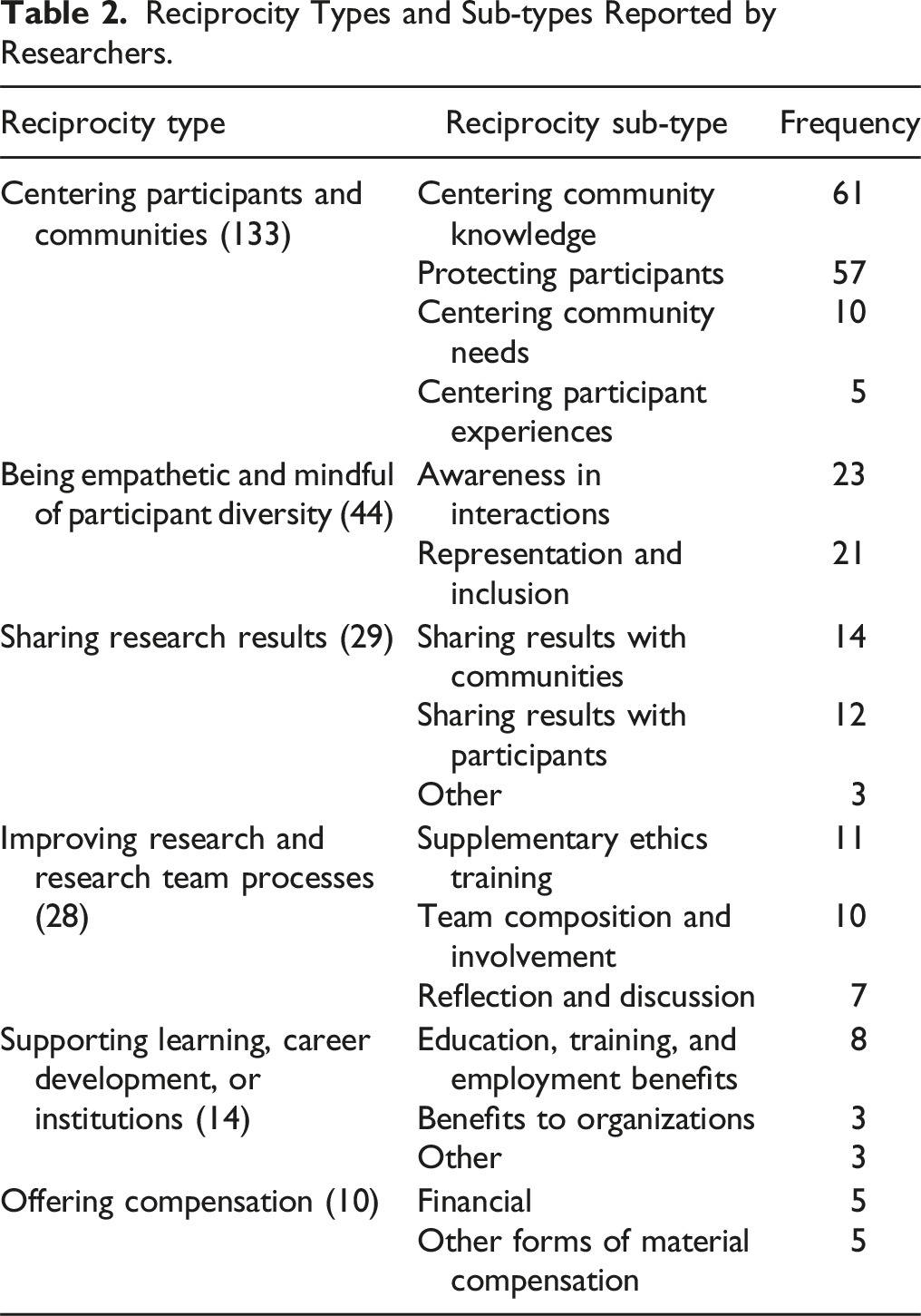
To demonstrate the variety of existing notions of reciprocity—and to create a typology of how reciprocity is practiced in the hazards and disasters field—the following sections offer examples of how reciprocity has been enacted in various research settings. The data are drawn from research reports submitted to the Natural Hazards Center between 2018 and 2023 as a final deliverable for one of four federally-funded research award programs: the Quick Response Research Award Program (54 reports); the Public Health Disaster Research Award Program (34 reports); the Mitigation Matters Research Award Program (15 reports); and the Weather Ready Research Award Program (9 reports). The final dataset includes 112 reports published on the Natural Hazards Center Web site (Natural Hazards Center, 2024). Fifty-nine reports contained no explicit highlight of ethical or reciprocal practices; therefore, the codes below are drawn from 53 reports.
We operationalized reciprocal acts as those actions by researchers in which they were critically reflecting and learning, building relationships, or engaging in forms of exchange meant to produce benefits for the research as well as those involved in the research process. To begin the coding process, we created a document to track report type, article titles, authors, affiliations, publication dates, and relevant text to be analyzed. When we were ready to begin our analyses, we created an Excel spreadsheet to inductively code the articles. After initial coding, we moved our analysis into ATLAS.ti, version 23.3.0, for a second, more systematic round of coding. We then condensed categories into types and sub-types and produced frequency counts for each. For example, the overarching category “Being Empathetic and Mindful of Participant Diversity” and its two sub-categories—“Awareness in Interactions” and “Representation and Inclusion”—initially encompassed more granular codes for individual processes, such as listening to participants’ stories, ensuring participant comfort, ensuring the access of marginalized communities, and practicing cultural sensitivity.
Reciprocity Types and Sub-types Reported by Researchers.
Centering Participants and Communities
We applied the centering participants and communities category to reciprocity statements that indicated a range of careful considerations were incorporated in the design, conduct, and reporting of research. The centering community knowledge subcategory took a variety of forms, including engaging in regular dialogue with community representatives; soliciting local feedback; recruiting local researchers to the project; designing projects with a participatory approach; building relationships with community officials and organizations; and leveraging researcher familiarity with the study area to increase participant trust. The protecting participants subcategory included practices surrounding anonymity/confidentiality, privacy, data security, informed consent, protection of participant health, voluntary participation, minimizing burden, equal opportunity for participation, study withdrawal, and reporting adverse events. Researchers who engaged in the centering participant experiences subcategory reported including participants in study design; prioritizing listening to their stories and voices; and using member checking, which ensures participants’ viewpoints are depicted accurately and fairly in analyses and the presentation of results. Some researchers referenced centering community needs, meaning that they undertook steps to ensure both research and reciprocal acts reflected a community’s stated needs and priorities. In an example of centering both community knowledge and community needs, Roegner and colleagues (2023), who studied the effects of algal blooms on communities in Oregon, “embraced the CBPR [community-based participatory research] model to foster trust and directly address needs and gaps identified as most pressing for the community at hand.”
Being Empathetic and Mindful of Participant Diversity
Some reciprocity statements acknowledged the importance of being genuinely empathetic towards and trusting of research participants, as well as minimizing potential research burdens. Researchers took steps to ensure awareness in interactions by being careful not to overload participants; interacting with compassion; cultivating trusting relationships; actively listening to experiences; providing information about mental health resources; and accounting for participant comfort and convenience. Recognizing that participants’ attention was diverted by the immediacy of their situation, Constance-Huggins and Sharpe (2021) set aside their desire for a larger sample size: “Although we desired a more robust participation, we were careful to respect the needs of individuals and [remain] sensitive to their current context.” In addition, researchers demonstrated awareness that participant experiences and circumstances were not homogeneous. Therefore, researchers prioritized representation and inclusion using actions such as ensuring cultural knowledge and sensitivity; fostering inclusive environments; recruiting representative study populations; and de-emphasizing hierarchical relationships between themselves and participants.
Sharing Research Results
Researchers emphasized the importance of sharing the results of their work with the communities and participants under study. In the sharing results with communities and sharing results with participants subcategories, researchers noted their intentions to return research findings to communities and participants using a variety of formats, including dissemination events, media coverage, and written or graphic reports. In statements coded to the other sub-type, researchers acknowledged that the communities own the knowledge produced and stated their intention to share results with other researchers for greater knowledge distribution. For example, in their work on climate-induced health impacts with tribal governments, Hutton and colleagues (2023) explicitly acknowledged that “the Upper Mattaponi Indian Tribe and the Mattaponi Indian Tribe and Reservation retain the rights to any respective institutional and traditional knowledge collected during this process.”
Improving Research and Research Team Processes
Researchers depicted engaging in effectual and inclusive research practices and assembling an appropriately trained and knowledgeable research team as a form of reciprocity. The supplementary ethics training category encompassed researchers who sought additional education and training surrounding research ethics, including completion of courses offered by the Collaborative Institutional Training Initiative, CONVERGE Training Modules, and other educational bodies. This training was sought out to ensure that the research process itself was ethically grounded and strengthened throughout the research lifecycle. In describing the composition and involvement of their team, researchers noted the importance of interdisciplinarity as well as the active engagement of all team members during the reporting process. In their study of gender and vulnerability in the face of cascading disasters in Puerto Rico, Sanabria-León and colleagues (2021) noted the benefits of collaboration: “As a collaboration between researchers from multiple institutions, disciplinary specialties, and cultural contexts, the results of this study reflect an interplay between multiple theoretical, methodological, and analytical approaches.” In addition, research teams engaged in regular introspective practices, including reflection and discussion about the research process.
Supporting Learning, Career Development, or Institutions
Some researchers described intangible benefits they provided to the communities or participants they studied as demonstrations of reciprocity. For a subset of these researchers, this took the form of education, training, and employment benefits, wherein participants received educational or job training; employment with the research team; specialized knowledge from the researcher; and other benefits to their educational trajectories or careers, such as co-authorship or certification in a skilled domain. For instance, in their research on the post-disaster needs of women with breast cancer in Puerto Rico, Fagundo-Ojeda and colleagues (2022) “hired and trained three women researchers who also met the inclusion criteria to add their lived experience to this research,” simultaneously providing an employment benefit while demonstrating the additional principle of centering participant experiences. A small number of researchers reported providing benefits to organizations, such as working to strengthen their public health capacity or resilience. Benefits offered by researchers in the other category included involving partner university alumni in the project; patronizing local businesses during research; and expressing support and solidarity with participants.
Offering Compensation
Interestingly, only a limited number of the published reports in the dataset indicated specific forms of compensation were provided to study participants. Of those who did, five mentioned financial compensation in the form of cash payments or reimbursement for travel expenses. Other forms of material compensation included distributing printed guidebooks about landslide risk, offering food, and providing face masks. In a gesture of extending reciprocity to the wider affected population, Weber and colleagues (2020) offered homemade masks not only to their participants but to all students quarantined on campus during their COVID-19 research.
Strategies to Address Potential Challenges to Practicing Reciprocity in Disaster Contexts
On the surface, engaging in reciprocal acts in any form can feel good for the researcher or research team involved. Reciprocity fulfills an ethical obligation and can also be emotionally gratifying and practically beneficial in field research. However, knowing how to begin and selecting a strategy for giving back—especially in unfamiliar or unequal situations—can present unique challenges. The ethical dilemmas in, and potential unintended consequences of, practicing reciprocity are particularly pronounced in hazards and disaster contexts (Browne & Peek, 2014). While researchers may try to consider every possible scenario when planning their reciprocal acts, even well-intentioned giving can lead to misunderstandings and serious mishaps in the field (Browne, 2015).
Giving Back Disproportionately
In research settings, there is no consistent way to value intangible goods such as participant knowledge, experiences, and stories. This is therefore one of the biggest challenges in practicing reciprocity in research, as giving back disproportionately can simultaneously feel risky and necessary when participants are situated along a wide economic spectrum (Fothergill & Peek, 2015). Indeed, whether offering financial compensation or some other gift, researchers who give what is perceived as too little may insult participants. At the same time, giving too much can also pose issues, such as drawing attention to the difference in socioeconomic status between researchers and participants or increasing the potential for coercion or undue influence (Adams, 1998; Anderson, 2019; Hoffman & Oliver-Smith, 2020). When unequal giving is apparent in ethnographic contexts involving families or other tight-knit groups, for instance, frustration or even conflict in the research setting can ensue (Browne & Peek, 2014; Sawyer, 2014). For example, when disaster anthropologist Browne financed and organized workers to build a porch for one study participant, other members of the family at the heart of the ethnographic study expressed irritation (Browne, 2015; Browne & Peek, 2014).
It is important for researchers to consider the potential ramifications of their actions when deciding how to give and whether to give disproportionately within a study context. In Browne’s case, she knew she was taking an ethnographic risk in angering some participants, but she decided to take the risk anyway because of the integral role that her key informant had played in her study. In general, financial compensation guidelines should be based on local living wage standards and other available evidence of propriety (Anderson, 2019). In other situations, it may be more appropriate to offer non-monetary forms of compensation, such as childcare for participants or travel aid. Ultimately, giving should be based on participants’ expressed needs or priorities (West et al., 2021). As Finney (2014) explains, knowing participant needs requires a relationship, which can help facilitate reciprocity organically over time. Simultaneously, researchers should be mindful of institutional barriers to reciprocity, including those related to what funding agencies or human subjects boards will allow in terms of research compensation.
Economic and Time Constraints and Giving Over Time
Economic and time constraints are important considerations for researchers when practicing reciprocity. Some researchers have personal or research award funds that allow them to financially compensate their participants, hire local research assistants, purchase meals and gifts, or otherwise give back in ways that researchers of less means cannot. This can be challenging when participants are provided compensation by one study team and are not offered the same benefits from another team, as happened after Hurricane Katrina (Browne & Peek, 2014).
Further, time poses challenges following a disaster in that researchers may wish to enter and exit the field as quickly as possible to continue with the next stages of their research. Whether motivated by funding deadlines, perishable data concerns, or personal constraints, researchers should still anticipate ways to engage in reciprocity with the local community. As Mukherji and colleagues (2014) assert, “the opportunity to collect time-sensitive data in the aftermath of a disaster does not absolve the researcher of the ethical obligation to engage the studied community on a long-term basis” (p. 823). It is important to emphasize that this admonition assumes that researchers are conducting long-term research. However, most disaster research is cross-sectional in nature (Tierney, 2019). In the context of these studies involving data collection at a single point in time, it may therefore be especially important that researchers or research teams are intentional about their reciprocal acts. Otherwise, they may be accused of engaging in hit-and-run tactics of disaster research and doing more overall harm than good (Gaillard & Peek, 2019).
Researchers who are engaged in longitudinal projects may encounter additional challenges in reciprocity as relationships with participants and researcher status evolve over the course of a project (Huisman, 2008). As Browne and Peek (2014) note in their discussion of reciprocity in long-term disaster fieldwork, perceived disparities in disaster response and recovery may cause strain among research participants and complicate researchers’ efforts to give back. Relatedly, additional dilemmas can arise from the fluctuating levels of vulnerability among people in disaster settings over time. Some researchers, for instance, caution that continual giving over a longer-term project may result in participants eventually depending on or asking more of the researcher (Adams, 1998; Fothergill & Peek, 2015). Other scholars, however, have instead found participants to be sympathetic toward both the struggles of their fellow community members and the concerns of the researcher navigating these considerations (Fiorella, 2014).
Researchers should also carefully consider the time constraints of their participants or local collaborators. For example, research teams typically rely on local counterparts to connect them to research participants or familiarize them with the setting. In disaster research, these counterparts might be occupied with critical activities such as emergency response, caring for loved ones, repairing property, or collecting their own data. Researchers should be mindful of community partners’ and participants’ time and plan research accordingly, even if full engagement with community members means proceeding at a slower pace (West et al., 2022) or disrupting traditional research hierarchies (Aijazi et al., 2021).
Heightened Vulnerabilities and Unequal Power Dynamics
Disaster settings are often marked by elevated and shifting levels of vulnerability among survivors. When practicing reciprocity, this introduces uneven power dynamics between the giver and receiver (Brun, 2009). For instance, especially in the direct aftermath of an event, community members may feel that their participation in a study is necessary or even required to access resources such as medical care or shelter. Researchers should never consider the provision of life-saving or necessary humanitarian assistance as reciprocity and should make explicit to potential participants that recovery aid and resources are not contingent on their participation in research (Louis-Charles et al., 2020). It is therefore critical for researchers to think carefully about their own ethical obligations in the context of the disaster setting, and potentially work through a code of conduct that considers the vulnerability of survivors (Gaillard & Peek, 2019). Reflecting on the disaster context in this way can help researchers understand which approaches to reciprocity may be acceptable, expected, and appropriate (West et al., 2022).
Researchers should also consider heightened social inequities among community members. Indeed, those studying disaster events may find themselves at the center of political or social struggles, making their work, or even their presence, a liability for participants (West et al., 2022). In these situations, the provision of gifts or other forms of reciprocity can unintentionally exacerbate existing rifts—which may be especially pronounced in the aftermath of a disaster—between cultural or geographic groups; politicians and citizens; or government authorities from other areas. Understanding these dynamics of the field before entering is therefore an important step for researchers when considering how to best engage in reciprocity.
Limitations
Though reciprocity is a critical element of all research involving human subjects, our analysis focuses on reciprocal actions implemented by a subset of hazards and disaster researchers. This limitation is tempered by the multi- and interdisciplinary nature of the field itself, which encompasses researchers from across the social and physical sciences, as well as engineering and humanities. As in all field work, these researchers must ensure the process centers participant needs, and that they engage in continuous reflection as part of a holistic reciprocity strategy. Still, the forms of reciprocity feasible for hazards and disaster researchers may differ from those available to other researchers. The tumultuous, evolving landscape of the post-disaster environment—and therefore participant needs—can challenge even the most carefully thought-out plans, requiring hazards and disaster researchers to actively anticipate adjustments to their strategies. In addition, continual, heightened awareness of potential emotional trauma among participants must inform researchers as they select appropriate forms of reciprocity. While we believe that these realities do not substantially alter the findings’ applicability to the wider realm of multidisciplinary qualitative research, we would be remiss in failing to acknowledge the potential impacts of the hazards and disaster research setting.
Conclusion
This article defines reciprocity as an ongoing practice of critical reflection, relationship building, and exchange in which researchers are obligated to strive to produce mutual benefits for the people involved in or affected by the research process. In our analysis of available research reports, we identified a typology of six reciprocal acts that researchers described, including (1) centering participants and communities; (2) being empathetic and mindful of participant diversity; (3) sharing research results; (4) improving research and research team processes; (5) supporting learning, career development, or institutions; and (6) offering compensation.
Engaging in reciprocity takes time, emotional intelligence, focus, and commitment. Reciprocity also requires researchers to plan and gather information to create an informed strategy. The extent to which a researcher or research team practices reciprocity may vary by their available financial resources and time, ethical stances regarding disproportionate giving, and the forms of reciprocity that are locally and culturally acceptable.
Reciprocity can result in satisfying, long-term research relationships (Gupta, 2014). However, it also can introduce unforeseen challenges and unintended consequences in the research process. It is important, therefore, for researchers to think carefully about strategies that can inform the giving process. A reflexive approach to research that acknowledges and considers one’s positionality is therefore an important way for researchers to uncover dynamics that inform how they engage in mutually beneficial reciprocal relationships (Macbeth, 2001). Researchers should also consider specific research methods and approaches that can help support and foster reciprocity in their work. Methods that involve reciprocity in their design—such as participatory action research, focus groups, or photovoice—can make it easier for researchers to plan for reciprocal exchanges from a project’s outset.
As climate change, disasters, and conflict affect more people globally, researchers from a wide range of disciplines might find themselves called to do research in socially disrupted settings. Conducting research in disaster and other crisis environments has unique considerations for the practice of reciprocity, which can help refine the concept across a variety of field sites. For instance, researchers who do not typically interact with human subjects, such as engineers, could encounter people who are asking for information or whose ability to rebuild their home could be affected by the research process or outcomes. Because research can sometimes feel one-sided or even extractive to people in host communities, practicing reciprocity can help create trust and space for researchers to recognize the priorities of local residents and identify opportunities to express gratitude or give back (Gaillard & Peek, 2019; Louis-Charles et al., 2020).
While ethical considerations are especially visible to those who navigate the dynamic and sensitive situations often characterized in hazards and disaster research, anyone who studies people whose lives have been disrupted in some capacity should consider the range of approaches to reciprocity introduced here. Regardless of discipline, engaging in this process should be considered a fundamental aspect of one’s ethical commitment throughout the research undertaking. Furthermore, understanding and practicing reciprocity should not only include research participants but also extend to all those who host, accommodate, or help make research possible. In doing so, reciprocity can serve as a North Star to help researchers ethically navigate the complexities inherent to research involving people and their communities.
Footnotes
Acknowledgments
Any opinions, findings, conclusions, or recommendations expressed in this material are those of the authors and do not necessarily reflect the views of the NSF or the USGS. We gratefully acknowledge our colleagues at the Natural Hazards Center at the University of Colorado Boulder who reviewed earlier drafts of the materials upon which this article is based, including the CONVERGE Reciprocity in Hazards and Disaster Research Training Module.
Declaration of Conflicting Interests
The author(s) declared no potential conflicts of interest with respect to the research, authorship, and/or publication of this article.
Funding
The author(s) disclosed receipt of the following financial support for the research, authorship, and/or publication of this article: This research was funded by the National Science Foundation (NSF Award #1841338) with supplemental support from the U.S. Geological Survey (USGS).
