




Abstract
Prior methodological literature on conducting interviews emphasizes the importance of skill development in conducting interviews. However, in contrast to qualitative data analysis, there are few systematic processes in place to guide the interviewer into reflexivity about their role in the interview situation. Here, we present the interview quality reflection tool (IQRT) as a process that we developed from conducting and mentoring semi-structured and unstructured interviews focused on personal lived experiences. The IQRT prompts the interviewer to transcribe each interview question and reflect on how the spoken question served to advance experiential quality in the interview. We illustrate the IQRT itself before demonstrating how we authors used the process to examine experiential quality in three cases conducted in our prior research. Finally, we consider how the IQRT enables researchers to examine the interview situation as a whole, by increasing the self-awareness of the interviewer, and the parts, by commenting on the mechanics of constructing useful questions.
Keywords
Introduction
In this paper, we introduce and demonstrate the interview quality reflection tool (IQRT), a reflective guide we developed to enable researchers to reflect on the quality of their interviews in eliciting individuals’ personal lived experiences of phenomena (Huff & Brooks, 2024). We created the IQRT in response to the first author’s (James Huff’s) need to mentor others in eliciting high-quality experiential data through semi-structured and unstructured interviews (Brooks & Huff, 2023). James, who has developed a trajectory of research in interpretative phenomenological analysis (IPA) (e.g., Huff et al., 2014, 2019, 2021), was particularly interested in how the interview setting could dramatically shape the quality of the text that would later be systematically analyzed through a well-established research methodology. In our work together, we (both authors) came to understand that beyond pursuing quality in our shared habits of in-depth textual analysis, we needed to achieve quality in co-creating–through interviews–the text that we would later analyze.
However, guidance on conducting research interviews tends to emphasize the procedural mechanisms of asking the right questions that are documented in an interview schedule or protocol (Castillo-Montoya, 2016; Grigoropoulou & Small, 2022; Mann, 2016; Weiss, 1995). While such a focus advances high-quality research interviews, we were curious about how we might consider the holistic skillset of interviewing, which includes creating a relational presence in the social interaction of the session (Dordah & Horsbøl, 2021; Roulston, 2011) and posturing oneself as a curious one-sided listener (Smith et al., 2022). As researchers conducting unstructured interviews, we wondered how we might consistently pursue quality in eliciting experiential content through interviews. By experiential content, we refer to not only the narrated and episodic descriptions of how individuals perceive their experiences to occur, but we also refer to how individuals make sense of their experiences through their thoughts, emotions, and orientations toward what happened. Beyond the scripted questions, how could we examine our responsiveness to the participant? How could we evaluate the ways we adapted when participants presented new opportunities to examine their lived experiences? How could we ensure that our interview remained focused on a central phenomenon while also nurturing the idiosyncratic voice of each participant? Here, we address these questions by offering a too examine interactions within the scope of an interview session, all with a particular focus on the skill development of the research interviewer.
Background
As inferred by its name, the IQRT is a tool designed to inspire reflection to advance the quality of interview-based research (Huff & Brooks, 2024). We clarify our assumptions behind each of these relevant terms as a way to establish clarity related to the aims of the tool.
Reflexivity and Reflection as Dynamic Mindsets to Advance Quality
Prior literature on interview-based research calls for a framework of reflexivity (Dordah & Horsbøl, 2021; Mann, 2016; Roulston, 2010). As put by Roulston (2010), “reflexivity refers to the researcher’s ability to be able to self-consciously refer to [themself] in relation to the production of knowledge about research topics” (p. 116). Mann (2016), citing Fook (2002) and Finlay (2012), adds that reflection, or “thinking about something” (Mann, 2016, p. 7) could be connected to a reflexive mindset when directed toward the focus of becoming self-aware. We frame reflexivity as a dynamic mindset rather than a static dispositional trait, a framing that enables the interview-based researcher to leverage reflection build their craft in an intensive examination of self-awareness as they navigate their movements in a particular examination.
Roulston (2012) describes several strategies for developing nascent interviewing skills including interview preparation activities such as theorizing the researcher before and during a study, examining other researchers’ interview practices, and designing a self-led interview project. However, complex skills like managing timing, navigating interactions with interview participants and unexpected behaviors or episodes, conversational skills, and generating interview questions ‘on the fly’, require hands-on practice and reflection. Several studies highlight the benefits of reflexivity in developing interview skills through mentored supervision (McNair et al., 2008), reviewing video-recorded interviews (Uhrenfeldt et al., 2007), role-playing with trained interview participants or student colleagues (Mounsey et al., 2006; Rubin et al., 1992), or through conducting interviews followed by reflective journaling and critique (Charmaz, 2014; Engin, 2011; Mann, 2016; Roulston et al., 2003; Smith et al., 2022). While also endorsing such approaches, we recognized that holistic journaling and observation did not help us advance reflexivity in the particular situation of improving the posture of a novice interviewer, especially within a mentoring relationship.
Thus, we introduce the IQRT as a focused process to create an ecosystem of reflexivity, where the novice interviewer and mentor can collectively hone the positioning of the interviewer as a way to advance the practice of eliciting high-quality interview content. Further, in this paper, we reflect on how we have used the IQRT to examine the quality of three cases of interviews that we have conducted.
The Interview as a Way to Elicit Gems in Experiential Psychology Research
As researchers of personal lived experience, we authors tap into IPA a robust methodology for engaging interview transcripts as texts that invite mindful interpretation of lived experiences on the terms of the participants. Through careful exploratory annotation that engages descriptive, linguistic, conceptual, and experiential documentation (Huff et al., 2014; Smith & Nizza, 2022; Smith et al., 2022), we analyze text in ways that engage what Smith and Osborn (2003) refer to as a double hermeneutic, that is, “The participants are trying to make sense of their world; the researcher is trying to make sense of the participants trying to make sense of their world” (p. 53). In IPA, the double hermeneutic of the study often manifests as the researchers’ dual commitments to both understand the cohesive whole of the findings and the idiosyncratic particular excerpts of qualitative texts. Indeed, in characterizing excellence in IPA research, Nizza et al. (2021) highlight four indicators: • constructing a compelling, unfolding narrative, • developing a vigorous experiential/existential account, • close analytic reading of the participants’ words, and • attending to convergence and divergence.
Such indicators illustrate the complexity of analysis in IPA research where investigators must illustrate findings in a holistic narrative that contains individual complexity of experiences.
As an idiographic approach, IPA is concerned with pursuing contextual depth of personal lived experience. Smith (2011) illustrates the value of a gem in upholding analysts’ commitment to particular insights aligned with a coherent view of the whole in IPA work. He defines the gem as “the thing that stands out in the transcript, . . . The extract that demands attention and further analytic work. . . . [Gems] offer analytic leverage, they shine light on the phenomenon, on the transcript and on the corpus as a whole” (p. 7).
If analytical procedures of IPA function to guide investigators to unearth experiential gems within participants’ transcribed interviews, the interview situation itself creates the environment in which these gems are created. In interviews focused on personal lived experience, the interviewer has the complex task of managing the interactions in ways that allow for them, as an analyst, to later make sense of experiential qualities within the transcript. Without conducting in-the-moment analysis, the interviewer must still evaluate if the conversation focuses on in-depth accounts of personal lived experience, and all without influencing the interview to be theoretically contrived. Such a skillset is demanding on the interviewer and requires a relaxed and confident precision. Thus, while IPA has been well-guided concerning how we conduct textual analysis (Smith et al., 2022; Smith & Nizza, 2022), the IQRT addresses a need to systematically hone the complex skill of conducting in-depth experiential interviews.
Quality in Interpretive Research
Smith & Nizza (2022) guidance for advancing excellence in IPA research align with broader frameworks of understanding quality in interpretive research. We note two central features of quality that prior literature often discusses. First, researchers advance quality by engaging a coherent and grounded dialogue with how they interpret experiential phenomena (Levitt et al., 2018; Yardley, 2000). In their frameworks on understanding quality in qualitative research, Walther et al. (2013; 2017) described the social reality of an investigation as a central focus that undergirds the theoretical and empirical sense-making efforts of a qualitative study (Huff et al., 2020). While interpretive researchers of lived experience may follow a range of qualitative methods, their treatment of social reality occupies the central focus that gives coherence and depth the research design and subsequent reports (Smith & Nizza, 2022).
Additionally, qualitative researchers are concerned with iterative processes of transparency and self-reflection as ways to establish trustworthiness (Guba & Lincoln, 1981; Levitt et al., 2018; Morse et al., 2002). Processes of interpretation are not completed as static checklists but rather as dialogic processes between the researcher, participants, language-based data, and subsequent readers. Interpretive researchers illustrate quality by demystifying the interpretive processes of their sense-making.
The IQRT advances features of research quality by prompting the interviewer to remain intentionally engaged with the social reality of interest throughout the movements of the interview session. Further, the tool itself promotes transparency and self-reflection by enabling the interviewing researcher to improve their processes by thoughtful evaluation of their interview sessions.
Interview Structure
Research on experiential phenomena tends to primarily comprise studies completed by semi-structured or unstructured interviewing (Mann, 2016; Smith et al., 2022). Brinkmann (2020) contends that all interviews fall on a continuum ranging of how structured or unstructured a given interview situation may be. Structured interviews, involve asking participants a standardized set of questions, often in the same order. Unstructured interviews flow without the constraint of a protocol, but they are guided by a purpose (Brinkmann, 2020). Generally, semi-structured interviews similarly use a pre-determined interview protocol based on the phenomenon in question; however, the protocol or schedule serves more as a guide rather than a strict script, resulting in expository questions during the interview (Mann, 2016; Smith et al., 2022).
In this paper, we attend to the adaptive skills required for semi-structured and unstructured interviewing. Rather than only constructing the correct questions for a predetermined protocol, we pursue a skill development that occurs in the margins between the scripted guide of the interview. Given the unstandardized configuration of semi- and unstructured interviewing, interviewers rely heavily on their skills and experiences to manage the dynamics of the interview (Brinkmann, 2020). In our development of the IQRT, we conducted multiple unstructured interviews in IPA in which we interviewers produced various interview questions spontaneously to align with interview goals. Thus, we used the IQRT to not only examine the quality of the questions spoken but also how the interviewer holistically managed the interview situation (Roulston, 2011).
The Interview Quality Reflection Tool (IQRT)
We designed the IQRT to elicit thoughtful reflection from the interviewer concerning their performance in an experiential interview. We envision an interviewer’s performance to include the actual questions that they asked the research participant. However, their performance also includes how they adapted to the participant, selected ways to probe an experience (or not), and used their role to create an open and accessible environment for the participant to share. We intend for the IQRT to serve as a catalyst for an interviewer to develop their skill in the context of a mentoring relationship and offer guidance on how to use the tool based on our experiences rather than prescribing any procedures. The IQRT can adapt well to the interviewer’s need for reflection and skill development.
We created the IQRT using Microsoft Excel to take advantage of the gridded cell format where the rows comprise transcribed interview questions while the columns comprise the IQRT reflective prompts (e.g., Figure 1). As we elaborate elsewhere (Brooks & Huff, 2023), we developed the IQRT during the course of an ongoing research study using IPA to examine lived experiences of shame in engineering faculty. In developing the IQRT, we identified points of reflection that Huff had used to mentor novice researchers in developing their interview questions. Through multiple iterations of using the tool, Amy refined the questions to better elicit reflective information from the interviewer. We then worked with undergraduate research assistants and external collaborators to test the use of the tool for clarity and then modified the wording of reflective prompts based on their feedback. Modified version of the IQRT (Huff & Brooks, 2024).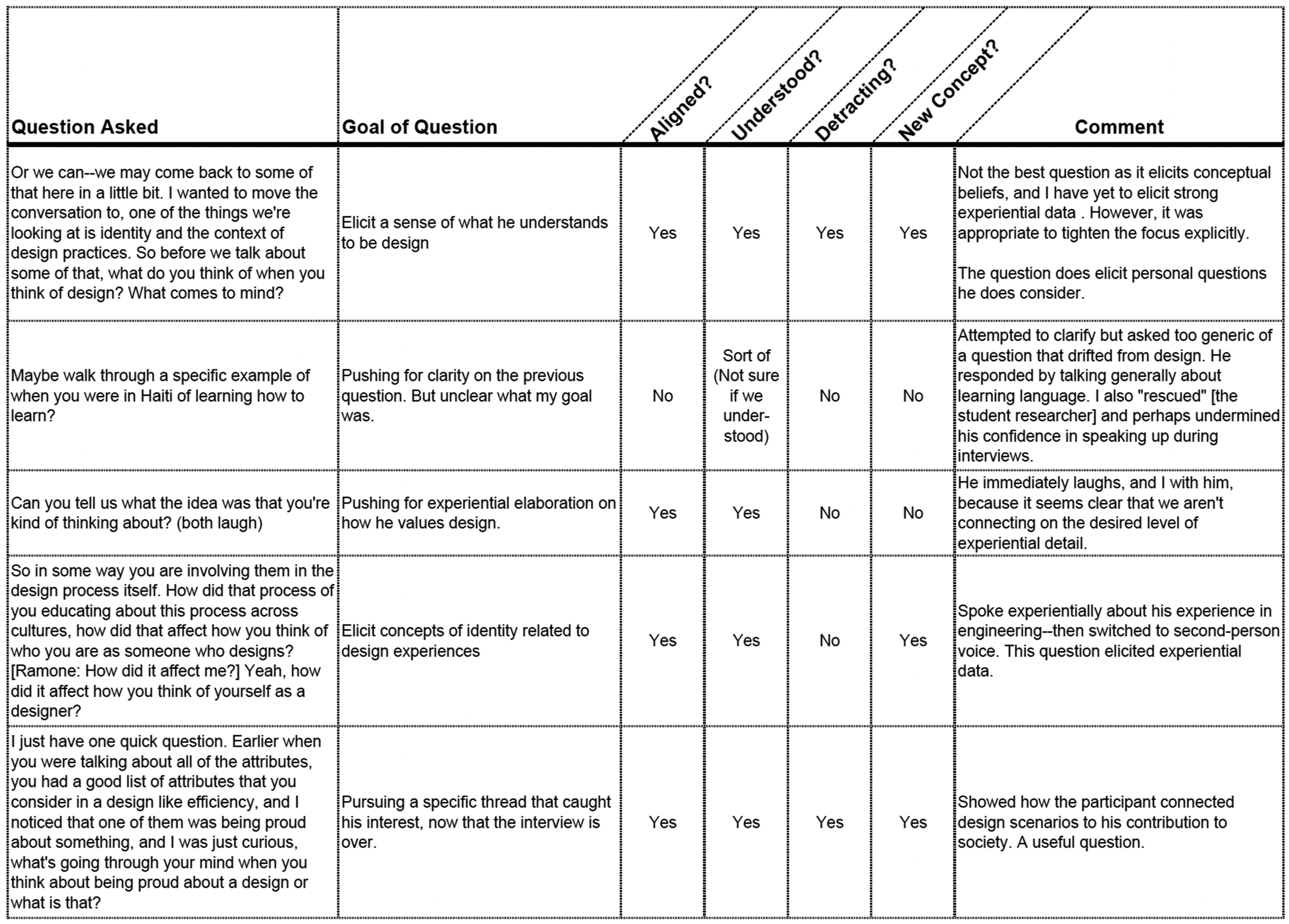
We conceptualized the IQRT based on the function, alignment, interpretation, and impact of interview questions. We first reflected on questions based on their intended functional goals related to the research objectives such as ‘to elicit descriptive content’ or ‘to elicit a chronological sequence of an event’). Then, we examined whether the question asked aligned with the goal and propelled the data collection toward it. To further our understanding, we also categorized whether questions were closed, manipulative, leading, or over-empathetic to foster examination of how language can hamper or foster open and authentic dialogue. Finally, given that interviewing is inherently a co-constructed conversation between two or more people, we examined how the interview questions contributed to the participants’ understanding and thought process. For each question, we reviewed the participant’s response before and after the question to explore whether the question introduced a new concept or detracted from their thinking through both verbal and nonverbal reactions.
Close Listening and Interviewer Transcription
Using the IQRT, an interviewer begins by listening to the audio file of the interview account and transcribing their questions or statements in the appropriate column on the spreadsheet (refer to Figure 1). By transcribing the interviewer’s statements only, we shift the focus of analysis to the quality of the interview rather than the experiential content of the participant’s accounts. Further, such selected transcribing allows for a more focused and efficient exercise of evaluating the quality of the interview than the standard practice of transcribing an entire session. The quality of an interview can be affected by several factors, including how participants can access and express their experience of a certain phenomenon. Selected transcription of the interview statements only allows the interviewer to closely consider their performance in the role of interviewer as a perspective independent of how richly the participant recounted their experience of the phenomenon. In the columns to the left of the question, the interviewer might also opt to note question identifiers, the phase of the interview (e.g., opening, middle, debriefing), the person who spoke the question (if multiple interviewers), and the timestamp.
Independently Evaluating the Interview Quality
After the interviewer has completed the leftmost columns of the IQRT (i.e., ‘Questions Asked’ in Figure 1), they should closely listen to the interview at least one more time. In this second listening, their goal is to evaluate the quality of the questions asked or the missed opportunities. Here, the interviewer should pause the audio file after listening to how the participant responds to an interviewer’s statement and reflect on how their question served to advance the goals of the interview. As noted in the IQRT, we recommend reflecting on the following:
Goal of Question
Here, the interviewer should note the purpose of the question that they asked or the statement that they made. How did it serve to advance the interview in eliciting rich experiential content? These purposes may be noted in the interview guide. For example, in our unstructured interviews, we document a series of goals for each interview rather than a stated question. By reflecting on the purpose of the interview statement, the interviewer can become more sensitive to the utility of their role in the interview conversation. As exemplified in Figure 1, the IQRT led the interviewer to identify the intended goal for each question, as per the protocol, while also noting issues of clarity, timing in the interview, and ad hoc motivations such as ‘pushing for elaboration’ from the participant.
Closed-Ended Evaluations
To the right of the column where the interviewer annotates the goal of the question, we list seven closed-ended questions that allow the interviewer to quickly consider the quality of the question, based on the context of the interview. First, was the question asked aligned with the goal? Considering this brief response can help the interviewer consider how well they aligned their spoken questions with their overall purpose. For example, in our modified IQRT example in Figure 1, the interviewer found one instance where the question did not align with the goal and recognized that the generic question led to a generic, and ultimately less useful, response from the participant.
Second, was the question understood by the participant? By reflecting on this consideration across the entire interview session, the interviewer may realize if they have a pattern of delivering statements that do not connect well with the participant. In our own experiences, we recognize how occasional moments of confusing questions can lead to some rich experiential data in the transcript. However, the interviewer would likely not desire to be misunderstood throughout the interview. In the IQRT shown in Figure 1, the same question that did not align with the intended goal described above also suffered from abstraction (‘learning to learn’), which likely contributed to the resulting ‘generic’ response from the participant about learning a language.
Third, did the question detract from the participant’s flow of thinking? Here again, there is no right or wrong answer to this question. Generally, the interviewer wants to allow the participant space to respond to the experiential phenomenon at the heart of the research focus and skillfully probe the participant in ways that gently lean into the phenomenon. However, at times, the interviewer may need to be more direct in shifting the focus of the conversation. Two instances of detracted flow shown in Figure 1 highlight moments in the interview when the questions may have unintentionally resulted in misdirected responses. For example, in the first question, the interviewer reflects on how the question switched focus in the interview and elicited descriptions of beliefs about design rather than the participants’ comprehension of it. In the last question shown in Figure 1, the interviewer detracted from the participant’s thinking, but in this case, the interruption occurred after the interview ended and sought to return to a thread earlier mentioned by the participant, ultimately serving as a useful question regardless of its direction.
Next, did the question introduce a new concept to the interview? And what concept was introduced? Here, we nudge the interviewer to consider if they are asking about a concept introduced by the participant or by themselves. By considering these questions, the interviewer can evaluate, across the entire interview session, who is driving the conversation. Is the interviewer over-relying on a protocol that introduces theoretical constructs distant from the participant’s experience? Alternatively, does the interviewer miss opportunities to steer the conversation in a more focused direction by refraining from introducing a new concept to the conversation? At times, introducing a new concept is necessary for interviews. In our example IQRT, we note three instances where the interviewer introduced a new concept. In the first instance, the interviewer introduces the concept of design, recognizing that the question focused on conceptual beliefs rather than experiential descriptions, but also reflecting that at the time, narrowing the interview focus on design was necessary. In the second instance, the interviewer introduced the concept of identity in design, ultimately eliciting experiential data. Lastly, after the interview ended but the conversation continued, the interviewer introduced the concept of feeling pride and connection to design in response to the participant exhibiting pride, ultimately detecting a moment when introducing a new concept would have little harm to the integrity of the interview while also drawing out useful experiential and identity-based data from the participant.
Though not shown in the modified IQRT in Figure 1, we include an additional column to identify the type of question, referencing Smith et al.’s (2022) categorization of possibilities: descriptive, narrative, structural, evaluative, circular, comparative, prompts, and probes. On the tool itself, we list adapted definitions for each of these terms from Smith et al. (2022) and use this point of reflection to enable the interviewer to understand the rhythm of their approach to eliciting the participant’s experience. Categorizing the question types this way can be useful in developing an understanding of how to use questions to elicit certain responses and avoid certain question types, like leading, over-empathetic, manipulative, or closed questions that can undermine the authenticity of participants’ responses. Furthermore, by noting the type of questions we ask, we can examine if we are eliciting a balance of descriptive or narrative features of experiences (i.e., what happened) with evaluative or comparative features (i.e., how the participant made sense of what happened). Both features experiential content are needed to elicit robust data that illuminates our phenomenon of interest.
Finally, we include a column for the interviewer to consider if their question was open or closed. While we generally hope for open-ended questions, a closed-ended question possibly opens the space for a rich exploration of experiential content.
Commenting on the Question
The final column in the IQRT perhaps occupies the most central focus of the exercise. After the interviewer considers multiple features of how they asked a question in an interview, they can freely comment on not only the questions that they asked but also, perhaps, the opportunities that they missed. Beyond looking for opportunities to improve, the interviewer should also note positive features of the interview, such as how they built a relational presence or skillfully probed an experiential phenomenon. For example, in Figure 1, we show how the interviewer not only characterized goals and respective responses to questions but also identified an instance where he may have undermined a novice interviewer in training–a consideration carried into future interviews with students. With the tool as a guide, the interviewer can also gently navigate not only the nuances of their questions beyond just the goals, alignment, and concepts; but also the abstract skills of timing and rhythm, relational presence, and sensitivity. For example, the interviewer noted an instance in which both parties joined in laughter over the recognition that there was a disconnect in the interview.
Mentored Evaluation of the Interview
In our use of the IQRT, we have valued its utility in supporting mentored discussions of interview quality. In training novice interviewers, we use this tool to allow space for the interviewer to reflect on how they achieved quality in the interview session before they amplify strong points of how the interviewer upheld their role or advise further points to consider. Using the IQRT allows the mentor and mentee to consider the question, “How did I advance a high-quality interview?” rather than “How did the interview go?” The latter question relies on a range of factors that may be beyond the control of the interviewer. The former allows for both the mentor and mentee to consider the skill development of the interviewer.
Findings
To illustrate the utility of the IQRT, we present three cases of interviews each conducted by the first or second author. We selected the cases to illustrate variations in how the IQRT could be used to help the interviewer reflect on achieving a high-quality experiential interview. The first case, Ramone, comes from an unpublished study conducted by the James and one of his students. They interviewed Ramone concerning his experience of identity amid design situations. We selected this case as it illustrates an interview that, despite James’s experience in conducting IPA research, failed to achieve the experiential depth required for strong IPA textual analysis. Using the IQRT, we were able to identify key strengths and shortcomings of the interview rather than regard the entire interview as a failure.
Second, we examine the case of Owen, an interview conducted by the second author (Amy Brooks) in a study of how engineering faculty members experience shame. At the time of the interview, Amy identified as a novice in IPA research and met frequently with the James for mentoring in IPA. Through Owen’s case, we can examine how the IQRT demonstrated key moments of skill development and pushed reflexive dialogue into meetings held between us, focused on interview skill development.
Finally, we examine the case of Stephen, an interview conducted by James and one of his students on the lived experience of shame in pre-professional accountants (Countess, 2023). In contrast to the case of Ramone, James considers this interview to be one of the most experientially rich interviews he has facilitated. By using the IQRT, we were able to specify clear indicators of excellence that James upheld in the interview while also noting some shortcomings.
Ramone: Identity Experienced by Engineering Design Students (James)
Ramone, a male engineering student who identified as white and Hispanic, participated in a study on how engineering students experience their identity while completing design projects. I, James Huff, served as both the lead interviewer for this study and the supervisor of the student who was leading the analysis. Both the student and I interviewed the participant for two purposes. First, as I often do with novice IPA researchers, I exercised my role as the student’s mentor to model unstructured interviewing. I followed this practice because I recognized from a decade of experience with IPA that while one can learn textual analysis with flexibility, it is far more difficult to achieve an experientially focused and robust interview. Secondly, when I interview student research participants who have experienced me as a professor, we can maximize the approachability of the interview environment with another student in the room. We interviewed Ramone on the evening of a weekday in my faculty office, which I designed to be an approachable space. The office comprised a single round table with shades over the fluorescent bulbs to create a sense of warm lighting in the room. Further, I ensured the space was decluttered and minimized indicators of faculty accomplishment (e.g., certificates, extensive texts, award plaques). I further came to the interview dressed casually, separating myself by time and appearance from the regular rhythm of my faculty role. The student interviewer and I arrived an hour ahead of the interview to prepare our mindsets to be that of curious listeners in a one-sided conversation who were focused on eliciting robust experiential data about identity. We further budgeted time for the student researcher to reflect on the experience immediately after the interview. Thus, we budgeted approximately 3.5 hours for ourselves to complete a 60–90 minute interview. In total, the interview lasted 82 minutes.
Generally, our interview with Ramone was marginally effective in eliciting experiential content about his sense of identity amid design practices. While Ramone would often espouse beliefs about how engineers ought to think about and practice design, he rarely spoke in a way that demonstrated his lived experience. Years later, I remained perplexed by the limited experiential content in this interview, and I used the IQRT to reflect on how we could have strengthened our approach to interviewing Ramone.
Using the IQRT, I gained specific clear insight into why the interview setting did not elicit robust experiential insight into identity. First, I began the interview by framing the experience as one where I would occupy a different role than the professor in which Ramone knew me to be: You and I have deep history, but what we're trying to do is kind of get a full sense of your experience from your perspective, trying to get inside the mind of [Ramone]. . . And so some of the questions I ask are going to, even if we have some shared experience that maybe I know what happened or something like that, I'll still ask as if--with a new set of eyes.
My intention in framing the interview in this manner was to open the space to allow Ramone to speak fully about his experiences without the assumption that I was part of those episodes. However, after analyzing my performance in the interview and Ramone’s responses, I recognize that such a framing undermined the asset of our prior rapport that could have supported his experiential accounts. I intended to open the space for Ramone to respond descriptively to his lived experiences. Instead, I likely inadvertently created an atmosphere where Ramone felt like he needed to respond formally, a posture that progressively stifled how he might speak to lived experiences of identity. Consistently throughout the interview, Ramone would respond to my frequent probing questions to “walk through” a particular experience from his perspective with his high-level conceptual beliefs that were often framed in the second-person voice. For example, at one point in the interview, Ramone had set up the idea of viewing himself as an authentic learner rather than a performer of academic concepts. When I asked him to elaborate on an specific instance, he responded: So to
Notably, he transitions from the first-person voice in the first sentence to generalizing his experience to “everyone.” Then, he proceeds to capture his thinking in the second-person voice, reflecting a distance in the response from his personal lived experience. Such a cadence continued throughout the interview.
Ramone’s responses were relatively lengthy but limited in their treatment of his lived experience. His responses seemed somewhat disengaged from his own account, seeming distracted as he was offering conceptual and distant responses to experiential questions. Using the IQRT demonstrated how my line of probing questions would seek experiential and first-person narrative elaboration (“Can you walk through. . .?“, “Can you elaborate on a time that. . .?“). Ramone would come closer to responding to the interview with the experiential detail of identity that I was seeking, and then, after consistent probing, I asked a question that revealed my own distraction by Ramone’s set of beliefs about engineering design. Specifically, twenty-four minutes into the interview, Ramone had begun to speak to his personal lived experience of design. However, rather than continuing to nurture such an experiential voice, I elicited his general concept of what it means to design: “What do you think of when you think of design? What comes to mind?” Such a move disrupted the flow of Ramone’s speaking to his personal lived experience, and he quickly returned to remaining conceptual in his responses, stating: “So what comes to mind when I think of design is aspects of the different designs that you could possibly make in terms of manufacturability, cost, efficiency, longevity.” While my question was not inherently out of place, it was misaligned with my need to nurture Ramone’s first-person voice related to an account of lived experience. Rather, my move elicited a conceptual and distant response regarding Ramone’s thoughts on design.
Finally, examining the IQRT as a holistic illustration of the interview, I realized the most problematic feature of the interview. We had assumed that students felt a profound connection to their sense of identity within design settings. Ramone’s case demonstrated an example of how it was possible that students were completing design activities as a performance disconnected from their sense of self. Throughout the interview, I attempted to elicit Ramone’s concept of how he experienced himself in design (e.g., “How did [that project] how you think of yourself as a designer?“) only to encounter distantly held beliefs of how people ought to design. At the time of the interview, I believed that we were not effective in eliciting Ramone’s sense of identity in these contexts. While possible, it seems more likely that he did not experience a strong concept of his identity in design settings. Such an insight helps me understand that the personal lived experience we were seeking to understand may not be as consciously lived by participants as we had hoped. It reorients our thinking to question how our framing of a central phenomenon may have been too theoretically influenced by the student researcher and my presuppositions of what it means to design.
Owen: Professional Shame in Engineering Faculty (Amy Brooks)
Our next IQRT case considers an interview conducted as part of an IPA investigation of the experience of professional shame among engineering faculty. Owen identified as a Black male and was a tenure-track assistant professor of engineering. This interview was my (Amy’s) first independently conducted interview as part of the research project led by my mentor (James). I used an unstructured interview approach guided by a sequence of goals developed by the James in prior interviews. However, I also relied on previous questions that James had used in previous interviews to inform the questions I asked. This process promoted flexibility within the guide that supported the co-construction of experiential descriptions with the participant, Owen. The guide associated with the unstructured interview pushed me to elicit five key descriptions from the participant: 1) construction of his engineering faculty identity, 2) perceived professional expectations, 3) experiences of failing to meet expectations, and 4) emotional or behavioral responses to his perceived failures. The fifth objective included direct probing of Owen’s perceptions of and experiences with professional shame, but I refrained from using this emotionally charged word until the end of the interview.
Owen and I met virtually for 92 minutes on a typical weekday. As a novice qualitative researcher, I took several steps to prepare for this first attempt at leading a research interview. First, I deeply familiarized myself with the research study design and the phenomena of shame and guilt based on prior literature (Huff et al., 2021; Scheff, 2003; Tangney & Dearing, 2002). Second, I observed almost twenty interviews led by James as part of the research study, many of which I transcribed and analyzed. Third, I practiced interviewing in a similar virtual setting with a personal contact, which helped me work through formulating questions, developing a rhythm, and reacting to interview responses in real time. Exposure to these three elements of preparation led to a level of fluency with the interview structure, content, and purpose, as well as experience with encountering common interruptions (e.g., phone calls, bathroom breaks, internet disruptions, etc.) and interview deviations such as going off-topic, discussing sensitive topics, and navigating emotional reactions within the conversation. Lastly, knowing that I remained nervous about facilitating an interview independently, I took great care to reduce distractions in my immediate vicinity, limited potential interruptions, and purposefully relaxed and avoided new tasks in the preceding hour of the interview to safeguard my mental and physical space.
In reviewing the interview, the IQRT facilitated my skill development in distinct ways. At the most basic level, the IQRT promoted careful verification that I completed key tasks for successfully initiating the conversation, meeting ethics requirements (e.g., verbal consent, offering to answer questions, etc.), and appropriately debriefing Owen. Though straightforward, these tasks require coordination and care to ensure they are adequately completed both as a courtesy to the participant and to uphold the integrity of data collection. Through reviewing the completion of these tasks, as well as the language and demeanor I used to accomplish them, I initiated the development of my practice and system for successfully organizing an interview within the necessary ethical and structural constraints. In this case, I confirmed that I met most requirements in my interview with Owen, but failed to provide an initial description of the interview process, such as what he might expect from the conversation and its overall format–details that can help to assuage anxiety participants may have as they enter into unknown conversation with a stranger.
Additionally, the IQRT supported a critical review of the interview content, my language and questioning, and how I may (or may not have) guided Owen’s train of thought and interview responses. At first glance, I ascertained from long blocks of Owen’s responses that he and I together developed an atmosphere in which he could speak in depth about his experiences as an engineering faculty and his navigation of professional expectations. I also quickly determined with the IQRT that, although I successfully traversed all of the goals of the interview protocol, I concentrated heavily on one: eliciting his descriptions of failing to meet expectations. The quantity of time spent on this line of questioning illuminated challenges I faced in trying to elicit specificity and detailed descriptions of events, interactions, and emotions Owen experienced about failing to meet expectations as well as discomfort around probing racialized experiences he described. Specifically, I discovered where I stumbled over questions, asked more than one at a time, and switched topics unexpectedly which may have confused Owen or detracted from his thinking. For example, I asked Owen, So what were, so I, this--I’m trying to figure out how to ask this, but like, what was your process or maybe what, what feelings were you feeling in that moment? What was the emotion that you felt when you maybe needed help but you couldn’t get any?
Here, I ineloquently attempted to probe his emotional reactions to a difficult experience of rejection in a time of need, while also introducing a leading term and concept, “emotion,” which may have influenced his response rather than inviting him to respond with originality. Instead, Owen immediately described that his experience “started off–just
In developing my interview skills, the IQRT provided a structured, visual exercise for gently assessing my interview performance. Most beneficially, it facilitated discourse with my mentor, as we worked through my questioning and language in detail. Doing so helped alleviate some of my anxiety and fears about failing to collect robust data or causing a participant any discomfort. For example, James and I discussed how instances of intentional disruption led by the interviewer can be useful in managing the rhythm of the interview and drawing participants back to a topic or event that is salient to the phenomena under investigation. Similarly, after the interview, I found myself ruminating over introducing a new topic of faculty practice (teaching courses) with Owen, and I worried this decision detracted from his thinking about his primary focus of achieving tenure. While Owen expressed generic affection for teaching (“I love teaching”), his construction of faculty expectations largely involved those associated with research funding, navigating collaborations, and publishing. In describing tenure expectations related to teaching, he quickly expressed, “I mean, I’ve never heard of anyone just getting tenure just off teaching.” In an attempt to tease out descriptions of teaching failures that I had previously encountered with other study participants, I later regretted invoking the practice of teaching and worried it reduced valuable interviewing time that I could have focused on the faculty expectations that Owen was more concerned with. However, in discussing my perceived mistake with James, he quelled my worry by pointing out that this line of question emerged near the end of the interview after I had already collected valuable insight into Owen’s identity construction and relevant research expectations. This conversation, facilitated by the IQRT, served to build my confidence in interviewing, identifying areas for improvement, and thinking critically about all the aspects of successful interviewing including verbal and nonverbal actions, expressions, and behaviors.
Stephen: Professional Shame in Accounting Interns (James Huff)
Stephen, a white male accounting student, participated in an IPA study on the lived experience of professional shame in pre-professional accountants. Similar to the previous case, I (James) came into this study as the lead interviewer and supervisor of a student researcher who was analyzing this transcript. For reasons described earlier with Ramone and Owen, the student researcher co-interviewed alongside me modeling the process of unstructured interviewing. We conducted this interview with Stephen in person in the same spatial and scheduling setup as described in Ramone’s case. The interview lasted a total of 138 minutes.
Stephen’s interview was perhaps the richest, most authentic, experiential interview that I have ever conducted. I have remained curious if the depth achieved in the interview was primarily due to my skills as an interviewer or due to the participant’s readiness to examine the emotional experiences of his pre-professional accounting coursework and internship. Using the IQRT, I recognized how Stephen did indeed come to the interview space with readiness to dive into his lived experiences. However, I employed some strategic adaptations to the interview to maximize his experiential detail and to keep the interview focused on the lived experience of professional shame.
Stephen launched our time together most unusually as he immediately dove into an experiential account that demonstrated his appraisal of himself concerning his workplace culture, a key point in understanding shame within professional settings. As soon as he sat down, even before I could initiate my audio recorder, he began to discuss his need to adapt from a “blue collar” to a “white collar” culture in his internship. I quickly asked him to allow me to turn on the audio recorder and began my typical way of initiating an interview by reviewing the informed consent and our commitment to confidentiality. In a typical interview of professional shame, I would tread lightly into the shame phenomenon, gradually eliciting an overall view of the person’s identity, probing where they felt identity-relevant expectations in their professional spaces, and eliciting emotional moments of instances where they fail to meet these expectations. In Stephen’s case, however, I recognized that I would need to adapt my typical rhythm of interviewing to meet his experience on his own terms. In unstructured interviews focused on identity phenomena, I typically begin by eliciting a life-story narrative (McAdams, 2007) to set up moments where we can dive into the experiential features of the narrative. However, rather than following this approach, I simply asked Stephen to continue with his line of thinking: Can you just tell–you said even before the recording turned on, you talked about white-collar behaviors behaving like blue-collar. Can you just kind of walk us through your work experience that you talked about? Who did you work for and tell us–what you're thinking about as you came into this room?
While my question delivery may not have been eloquently spoken, I succeeded in meeting Stephen on his terms. For an unbroken period of nearly 26 minutes, Stephen proceeded to elaborate on an experientially rich account of two internships, walking through not only the details of events that occurred but also how he produced an internal dialogue and navigated the emotions of these events. Analyzing the interview with the IQRT helped me recognize the utility of adapting my initial interview question to connect with the participant’s experience. Rather than diverting the focus of the participant away from his emotional workplace experiences, I adapted my initial question to invite him to lean into those experiences.
The IQRT further helped me recognize a second advantageous, if not unusual, adaptation to the interview: interrupting the participant to prompt a focus on experiential accounts. In Stephen’s rich series of episodic accounts, all contained in his initial twenty-six-minute account, he came to an instance where he had failed to meet his supervisors’ expectations in completing a task for them. At this point, I recognized that Stephen would soon leave this episode to move to a different account of his experiences. I opted to interrupt Stephen when he came to a minor lull in the conversation to ask him: You said that. . . that moment that [the supervisor] would tell you, “Yeah, I told you not to do that” and you would think of tongue-lashing. Can you kind of think of a specific moment that [Stephen: (repeating) Um, a specific moment] and walk us through that?
In my typical mindset as an interviewer, I move to allow for pauses and space, inviting the participant to fill the interview with their experientially rich accounts. Interrupting the participant’s flow of thought ran against my typical mindset as an interviewer. However, such an interruption enhanced the experiential quality of the interview. I accurately recognized that Stephen would feel unabated with an interrupted prompt in the conversation, and when I did so, he moved to focus on his internalized experience of the failure, leading the conversation to discuss his experience of shame, a robust account that included thick description and rich metaphors, such as, “I felt like I was out naked and out in the open. If [one of my co-workers] came up to me right then and there and they’re like, what are you doing? I would lose it. . .”
While the IQRT illustrated specific strategies we used to hone the success of the interview, my analysis of the interview also revealed areas to improve. At one point, Stephen introduced the term shame in his response when illustrating his emotional experience. After conducting many interviews about shame, I rarely have heard participants invoke the actual term so early in the interview. My follow-up question was disjointed, excessively wordy, and confounded. The IQRT illustrated how I stepped aside from my focused role as an IPA interviewer and became overwhelmed with the possibilities of how I could learn more from Stephen. Regardless of my wording, he continued to respond in ways that demonstrated rich reflection on emotional experiences, and we were able to recover a healthy rhythm in the interview.
Overall, the IQRT demonstrated how the research student and I executed skill in allowing the participant to walk at his own pace to the phenomenon of interest, that is, professional shame. As the lead interviewer, I spoke on twenty-one strategic occasions during the first 110 minutes of the interview, before we began debriefing the experience. Only twice did I introduce a new concept to the conversation, and on every occasion, I accurately reproduced the participant’s account to lead into a probing question, inviting him to dive deeper into the emotional experience of shame that accompanied episodic accounts of failure in or because of his workplace experiences.
Discussion
As we illustrated in the above cases, the IQRT allowed us to engage the hermeneutic circle in which we examined the whole of ourselves as interviewers and the parts of the interview situation, as represented by spoken questions (Smith et al., 2022). Using the IQRT enabled us to examine the interview as a holistic blueprint of the entire conversation, orienting us to examine holistic features of how we shaped the conversation. As demonstrated in the case with Ramone, James recognized how their initial framing of the conversation as a research interview, undermining his prior rapport with Ramone, may have contributed to a sense of distancing that Ramone upheld throughout the interview. Further, Amy demonstrated her recognition of how her identity as a white woman affected her sense of fluency in asking Owen to elaborate on his racialized experiences of shame as a Black engineering faculty member. The IQRT enables interviewers to examine the whole of their experiences that they brought to the interview, both by prompting a breadth of analytical memos across the duration of the interview and with depth prompted by the reflective line of questions associated with each interviewer statement.
Yet the IQRT enabled us to examine the particular instances of the interview, such as ways that questions were constructed and how particular movements of the interviewer prompted experientially robust responses, anchored in not only the participants perceptions of how the experiences unfolded but also in rich description of how they made sense of such experiences. By using the IQRT, both the first and second authors illustrated how they could identify the core strengths or shortcomings of particular questions voiced in the interview. Thus, not only did the IQRT elicit a sense of self-awareness in interviewers, but it required the interviewers to evaluate how they might develop specific skills in eliciting the experiential interviews in IPA research.
On a practical level, we designed the IQRT to optimize an efficient process of skill development. By eliciting targeted and specific reflection, the tool enables researchers to focus on their own actions in the interview session rather than a potentially more time-consuming process of holistically reflecting on the entire interview transcript. Further, while using the IQRT causes researchers to expend reflective efforts on the front portion of their interview-based studies, we suggest that such investments will result in time-savings when they conduct data analysis. By honing the skill of interviewing, the researcher using the IQRT opts to become an interviewer that co-produces data that will demonstrate in-depth contextual insight and remain coherently focused on the phenomenon of the investigation.
We recognize that introducing a tool for qualitative research processes creates new questions of ethical issues related to research participation. The IQRT provides an opportunity for researchers to individually reflect on how they can improve in leveraging their presence and spoken to questions to conduct high-quality interviews. The novice researcher and their mentor should use the tool to constructively promote skill development in conducting research interviews. The tool should not be used to punitively evaluate or induce shame in novice researchers. Additionally, no reflective excerpts from this tool be reported in other studies in research without the authors’ consent and with approval of the investigator’s institutional review board (IRB) at their organization.
Future Work
We realize that while we intended the IQRT for interview-based studies of multiple qualitative methodologies (e.g., action research, narrative inquiry, grounded theory, ethnography), we authors have focused the development of this tool using IPA. Our future work involves documented and collaborative inquiry with multiple qualitative investigators conducing semi-structured or unstructured interviews. Through such collaboration, we can better determine the usefulness of the tool in multiple research methodologies and refine it to robustly hone the craft of interviewing across methodological commitments. Such a collaborative inquiry with multiple authors could also examine the medium of the tool, that is Microsoft Excel. The grid cell approach supported by spreadsheets allowed for the authors to visually organize the interviews and easily examine each IQRT question (columns) in relation to each interview question (rows). However, researchers could potentially adopt qualitative research software (e.g., Atlas.ti, MAXQDA, NVivo) to integrate self-reflection within interview transcripts as prompted by the IQRT. but other potential benefits could arise from using annotation functions of qualitative software.
We are additionally enthusiastic about the prospect of examining the use of the IQRT in cross-cultural mentoring dynamics, particularly when a research mentor and novice interviewer communicate in different primary languages. For example, if a novice researcher interviews participants in a shared primary language that the mentor and academic institution does not speak, the IQRT can offer specific moments of reflection that can be translated to the mentor’s language. Such an approach would take significantly less effort than fully translating every transcript. In another scenario, a novice interviewer may need to interview in a language in which they are not fluent. Using the IQRT in a mentored relationship, a mentor could guide the researcher to practice ways of adapting to the interview situation. Such cross-cultural and multi-lingual dynamics are ripe for investigating, and the IQRT could be used to make visible how mentors offer guidance related to the adaptive use of language.
Conclusion
In summary, we demonstrate the IQRT as a flexible tool to facilitate reflexivity in individual and mentored dynamics of interviewing. While developed from IPA research, our future work involves collaboratively inquiring how we may advance quality in eliciting experiential phenomena by working with investigators who adopt other methodologies. We caution that the IQRT is one of multiple tools that can be used in developing interview quality, including observational notes and research diaries (Mann, 2016). However, by providing an efficient yet robust way of engaging interview practice, the tool offers a pathway to nurture interviewers as they sustain a welcoming presence in the interview situation that, beyond the protocol, invites participants to wholly make sense of their personal lived experiences.
Footnotes
Acknowledgements
We are grateful to the anonymous peer reviewers who resonated with the vision of this submission and offered us important feedback to strengthen the article. Thank you for your generous insight. Thank you especially to Degnan Lawrence who co-interviewed Ramone (pseudonym) with James and Grant Countess who co-interviewed Stephen (pseudonym). I felt fortunate to learn from your studies as we learned from the experiences of our participants. Thank you to collaborators Sindia Rivera-Jiménez, Jerrod Henderson, Elliott Clement, Tim Ransom, and Shane Brown, our fellow reflective interviewers in engineering education research. We are grateful for your early feedback on adopting the IQRT in your own studies. Finally, we are grateful to past and present members of the BPI lab for their work in understanding experiential phenomena through interviews. Collaborating with each of you has resulted in a tool that we are thrilled to share in this article. We gratefully acknowledge the contributions of the Beyond Professional Identity Lab members and graduates who provided constructive feedback to the use of this tool: Chelsei Arnold, Olivia Bell, Grant Countess, Halle Miller, Kyle Shanachilubwa, and Amelia Slater.
Declaration of Conflicting Interests
The author(s) declared no potential conflicts of interest with respect to the research, authorship, and/or publication of this article.
Funding
The author(s) disclosed receipt of the following financial support for the research, authorship, and/or publication of this article: This work was supported by through funding by the National Science Foundation (NSF Award Nos. 2045392, 2138106, 2138019). Any opinions, findings, and conclusions or recommendations expressed in this material are those of the author(s) and do not necessarily reflect the views of the National Science Foundation. Additionally, the authors gratefully acknowledge the anonymous reviewers for their constructive feedback, which helped us to sharpen the paper.
