




Abstract
The rhetoric of ‘nothing about us without us’, motivates much disability inclusive research, but meaningful participation of the most marginalised is still rare. There is a tendency to recruit only people with disabilities who are perceived as ‘easier to include’. We reflect critically on recent fieldwork in Bangladesh working with local and international NGOs on a disability inclusive employment project. We focus on inclusion of the most marginalised people with disabilities: those with complex communication, psychosocial, intellectual or multiple impairments, or those who face intersecting inequalities. During a two-stage process, we engaged with 4 small groups of people in 2 sites. The participants were involved in an adapted vocational training programme, and had either both visual and hearing impairments, or were economically disadvantaged young disabled women. We discuss how creative, inclusive, participatory methodologies were combined to explore participants’ experiences of pathways to work through learning a trade. We consider the ethical, methodological rationales for our research epistemologies; including development of local research teams’ and participants’ awareness, confidence and capacities; and what worked and didn’t to enable or constrain inclusion and knowledge generation. We synthesise insights and recommendations about engagement/recruitment, situated ethics, accommodating individual needs, challenging assumptions, building communication capacities and group agency, maintaining inclusive interaction, multi-modal communication, using visual, tactile, narrative and creative methodologies, sequencing and layering methods, generating emotional knowledge, and collective analysis. We discuss the dynamic situated, emotional, interactional, and relational enablers of inclusion, and how participatory methodologies are applicable in research contexts to move beyond working with the ‘usual suspects’ to effectively engage people who are most often excluded.
Keywords
Introduction
The rhetoric of ‘nothing about us without us’ (Charlton, 1998) continues to provide compelling motivation for much disability inclusive and potentially emancipatory research (e.g. Aderemi et al., 2014; Koontz et al., 2022; Stone & Priestley, 1996; Wickenden & Lopez Franco, 2021). Nevertheless, meaningful participation of people from the most marginalised impairment groups is still relatively rare in evaluations and research (Kahonde, 2023; McConkey et al., 2016; Shevlin & Rose, 2022). There is a tendency to recruit those who are perceived to be more ‘capable’, more educated and with greater social capital, or those assumed to be ‘easier to include’ for practical, resourcing, impairment-related, methodological and attitudinal reasons (Shaw et al., 2022). This is especially true in low-and-middle income countries (LMIC) where there may be situational challenges, reduced access to assistive devices and limited awareness about disabled 1 people’s capabilities or the value of their participation (Austin & Holloway, 2022; IDA, 2002). Despite the persuasive global calls for disability inclusion, spearheaded by the disability movement itself (e.g. represented by the International Disability Alliance - IDA) and supported by the ground-breaking UN Convention on the Rights of People with Disabilities (UN CRPD) (UN, 2007), there is a gap in practical knowledge about how this can be operationalised meaningfully during fieldwork. Longstanding contextual and attitudinal challenges continue to put barriers in the way of progress towards this ideal.
We are researchers from the Institute of Development Studies (IDS), UK. IDS is an academic consortium partner, alongside INGOs, IDA and others, collaborating on the Disability Inclusive Development Programme 2 (DID) (2018–2024) (UK government funded). Our input within the DID programme focuses on promoting inclusive, participatory and reflective methodologies for working with people with disabilities who are often the most marginalised due to their impairment types (e.g. intellectual, communication, psychosocial, multiple or complex) (CBM, 2012; Skilton et al., 2018; Wickenden & Lopez Franco, 2021), or who are facing intersecting inequalities due to other economic, geographic or identity-based factors.
We identify as nondisabled white women, with many years of using qualitative inclusive creative methods to work with individuals and groups of people with disabilities during projects and research in diverse cultural contexts. We have previous experience of working in low-income countries in South Asia including in Bangladesh. We are social scientists with disciplinary affiliations to anthropology and social psychology, and work in the disability research team, part of the ‘Participation, Inclusion and Social Change’ cluster 3 at IDS.
In this paper we reflect critically on our experiences while conducting fieldwork in Bangladesh, as the qualitative research input to a larger DID project trialling adaptation of existing vocational training and employment in order to include disabled young people. In collaboration with local and international NGOs, and Organisations of Persons with Disabilities (OPDs
4
), we ran a two-phase research process during fieldwork visits a year apart (2022 and 2023). The purpose was: (i) to develop, model for local partners (NGOs and OPDs), and assess inclusive participatory approaches, methods and tools, including their suitability for research and learning activities with young adults with multi-sensory, and/or intellectual impairments and complex disabilities in contexts of social and economic disadvantage (ii) to collect data through tailored participatory research activities to explore participants’ project experiences (as learners in a vocational training programme), and their broader perspectives on barriers to and enablers of inclusion, in order to inform future inclusive training and employment programming.
The fieldwork comprised 4-day in-depth and small-scale participatory research workshops with 4 targeted groups of participants from the Vocational Training and Employment project run by INGOs in two districts: Rangpur and Rajshahi. All the learners were involved in an adapted intervention outside the main inclusive youth vocational training project (STAR run by BRAC). In Rangpur, participants had both visual and hearing impairments to different degrees (so could be classified as deafblind, though definitions of this vary) (, ndSense International; Wittich et al., 2013), and in Rajshahi the groups were economically disadvantaged young women with various physical, sensory, and psychosocial impairments. Most participants had congenital rather than deteriorating/acquired impairments, so had experienced exclusion and stigma, and the impacts of these on their self-belief, agency and identity, from childhood. Some family members attended as carers or supporters, and some participants attended alone. Our workshop activities were designed to be accessible and inclusive for the individuals involved, and incorporated a range of creative, visual, tactile, performative and narrative methods which we developed tailored to participants’ support needs.
The full details of the research approach and methodologies used are beyond the scope of this paper (for detailed reports see Shaw & Wickenden, 2022; Wickenden & Thompson, 2023). Here we reflect critically on the achievements, challenges and navigations we experienced in operationalising disability inclusive and accessible research in this context with groups of disabled people with the most marginalised impairments and/or significant social and economic disadvantage. There are three methodological aspects we particularly reflect on here: First, how we designed the research approaches to ensure they incorporated multi-modal communication forms to respond to diverse communication and cognitive needs. Second, how we applied creative participatory methodologies to mediate iterative learning processes. Third, as intended, reflection and review of how well the methods worked, including adaptations, to inform their application in other fora, or by the team during and after the workshops.
To support the paper’s purpose in exploring how disability inclusive research can be fostered, we drew on the evaluation data generated during the project interactions. This included detailed observations and reflections that we researchers recorded in our research diaries, and extemporary documentation notes made by the local team members as part of their documentation role as activities were happening. Additionally, there were reflective moments at the end of each day with the participants, as well as review and reflection meetings with the team each day and in a final meeting at the end of each workshop. We recorded these reflective and evaluation conversations verbatim, and those in Bangla were translated for us by the translators in the research team, who also added their observations.
Background to the Research
About 16% of the global population are estimated to be people with disabilities (WHO, 2022), although the proportion identified is dependent on how disability is assessed This is an approximate, extrapolated global figure, and percentages reported are often lower in LMI countries (Mont et al., 2022). Figures for different impairment groups are similarly unreliable. There is also an established connection between disability, poverty and exclusion (Banks & Kuper and Polack, 2017; Banks & Polack, 2014; Groce, Kett et al., 2011), meaning disability inclusion has become a compelling policy imperative globally, particularly during the ongoing implementation of the UN CRPD (Groce, 2018; UN, 2007). This treaty promotes the importance of a disability inclusive approach across sectors. In contrast separate, ‘special’ and segregated facilities, services and activities were historically common, but are now viewed as exclusionary, denying disabled people’s rights and opportunities to participate in everyday life alongside others and fulfil their potential (see Light for the World, 2017 for an explanation of different terms). The latter approaches also deprive non-disabled people of the opportunity to meet and understand disabled people’s perspectives. Strategies which encourage people to meet and exchange understandings are based in ‘contact theories’ and are recognised as powerful in challenging negative assumptions about others (Allport, 1954).
Notably, the Sustainable Development Goals (SDGs) (UN, 2015), which set out 17 key global goals for progress across a range of aspects of human life and wellbeing, ideally to be achieved by 2030, use the term inclusion in a broad way, to refer to tackling exclusion and inequality for all marginalised groups, so disability is included by implication. Disability inclusion is also incorporated specifically in 7 of the SDG goals (see Groce, 2018; UN, 2018; Wescott et al., 2021). These targeted aims are resulting in a gradually expanding number of programmes globally focussed on disability inclusion across sectors such as education, health, employment, livelihoods and community involvement. Perhaps more importantly there is increasing incorporation of a disability component in ‘mainstream’ programmes and activities, so that the wellbeing of disabled people is not siloed but included in broad-based interventions.
However, despite enlightened policy ambitions and good intentions, in many contexts worldwide, implementing disability inclusive programmes to achieve effective, meaningful and sustainable changes in disabled people’s wellbeing and opportunities remains elusive in practice (e.g. re employment Buckup, 2010; Mitra, 2014; Wickenden and Kembhavi, 2014; Shaw et al., 2022). Interventions may be tokenistic or only partially effective. Actions taken may purely tackle physical accessibility because there is insufficient understanding about the wider range of impairments that people have beyond physical/mobility difficulties (e.g. hearing, vision, cognitive, psychosocial). More invisible attitudinal, communication, relational and dynamic barriers to inclusion and the systemic changes, accommodations and adaptations needed to tackle these are often overlooked.
People with a diverse range of impairments and varying experience of disability, with lived experiences of the contextual realities of exclusion, need to be involved in research to generate deeper understanding of these issues from insider perspectives, to assess and improve disability inclusion programmes. An intentional and truly disability inclusive research approach aims to tackle the current inherent epistemic injustices, where methods of data collection which privilege particular cognitive and communication competencies (e.g. verbal expression), often exclude and therefore silence other perspectives and devalue marginalised groups’ knowledge and contribution (Fricker, 2007).
Disability Inclusive Research in Practice
In parallel with growing debates about the realisation of disability inclusion in policy and practical programming, there is increasing interest in the possibilities and practicalities of disability inclusive research (e.g. Barnes, 2003; Kitchin, 2000; Shakespeare, 1996; Stone & Priestley, 1996). This has been theorised for some time, but the challenges of putting it in to practice remain. While discourses about participatory research methodologies have increased over several decades (Bergold & Thomas, 2012; Reason & Bradbury, 2008; Kindon, Pain & Kesby, 2007), adaptions for research collaborations with disabled people have been slower to develop. For examples of specific participatory methods, some of which we have drawn on and written see the Participatory Methods website (https://www.participatorymethods.org/page/about-participatory-methods).
The rationale for including people with disabilities in exploring their experiences and perspectives is clear and convincing. As well as the ethical imperative to involve people who are impacted by programmes in influencing the decisions and actions that affect them, there is considerable evidence about the inappropriateness and failure of top-down interventions that do not incorporate subjective knowledge of those most directly affected by problems (Burns et al., 2013,; Carey & Griffiths, 2017; Shaw et al., 2020).
In response, disability inclusive research prioritises the involvement of people with disabilities as active participants, throughout the research process, from planning and design to the dissemination of results. The term inclusive research originated and has more commonly been used and promoted in relation to research with people with intellectual impairments (see Johnson & Walmsley, 2003; Nind & Vinha, 2014; Walmsley, 2001). The latter authors propose that inclusive research requires that the issue being explored is faced by the disabled participants, the project serves their interests even if not initiated by them, they should participate in research activities through accessible approaches and methods, and also be able to influence what happens within the research process and beyond. Like the term inclusion (see above), the term inclusive research is increasingly being used to encompass research democratisation through the participation of a wide range of excluded groups (Nind, 2014). In this paper we therefore use the term disability inclusive research to distinguish our focus on people with a variety of impairments/disabilities rather than research solely with those with intellectual impairments (Frankena et al., 2015; Kuper et al., 2021).
Disability inclusive research tends to be qualitative (e.g. Watharow & Wayland, 2022) and resonates strongly with the motivations behind the broader practices of participatory research and participatory action research (PAR) (Nind, 2014). It prioritises the lifeworlds of people with disabilities and involves them in sense-making activities for analytical grounding and participant ownership (Chambers, 1997). Disability inclusive research often encompasses a variety of participatory, collaborative and peer-led methodologies, which aim to build expression and research capacities and foster the more equitable research relationships that are necessary for deeper insight, group analysis and co-construction (Gaventa & Cornwall, 2008). In addition, participatory action research (PAR) methodologies may be utilised to drive iterative processes of collective action to effect change, followed by reflective learning about what happened (Reason & Bradbury, 2008). This offers the possibility of promoting the generation of innovative solutions to obstinate social problems through trial-and-error exploration in real-world contexts (Shaw et al., 2024).
However, in practice participatory research and PAR involve inherent tensions, and can be tokenistic or perpetuate existing local and structural power dynamics Shaw et al. (2024), if the intersectional differences between people, and the particular support and access needs of individuals are not recognised and addressed (Harding & Norberg, 2005; Wheeler et al., 2020; Wickenden, 2023a, 2023b).The idea of emancipatory disability research is relevant here, as it is more explicitly political than participatory research in aiming to shift the status quo of research relationship so that disabled people have full ownership and control (Barnes, 2003; Stone & Priestley, 1996). However, the practical steps towards this compelling ideal are not always clearcut, especially in contexts where sensitive navigation around local power dynamics and hierarchies between stakeholders is needed, including within OPDs and between disabled people in research groups (Deal, 2003). This is particularly important when the purpose is the involvement of and accountability to disabled people from the most marginalised impairment groups who may not be members of collectives such as OPDs. Our focus on deliberately and overtly disability inclusive research is important, as it highlights the necessity of gradually evolving processes encompassing developing research partnerships and training partners to enable them to use these methods (Koontz et al., 2022; Watharow & Wayland, 2022). While emancipatory in flavour, we would not claim to have been aiming explicitly for this in this research, as the meanings of emancipation are situated, individual and contested and outcomes often uncertain and hard to assess. We see our work as more likely to achieve conscientisation (i.e. increased awareness and reflection about disability identities and status and how negative aspects of this can be resisted and opportunities improve (Camilleri, 1999).
Our fieldwork research visits set out to understand the experiences of some of the most marginalised participants in the DID adapted STAR project, and this generated exemplars, that contribute to greater understanding about how disability inclusive research might be operationalised practically. We navigated some key challenges in fostering and supporting disability inclusive research processes, such as: partners’ expectations about who to include, their methodological awareness and training needs, resourcing and timeframes in the post-covid context, working across languages and different communication modes, negotiating the power dynamics between researchers, partners and participants, including amongst those with different types, combinations and severities of impairment, generating and sustaining inclusive research interactions (Kahonde, 2023). This required a nuanced approach to accessibility and adaptability in the designing, developing and conducting of activities (Owens, 2007).
Nuancing Accessibility – Practical, Communication and Relational Accommodation and Support
Adaptations required by people with disabilities (including physical, sensory or communication support) are called ‘reasonable accommodations’. These must be complemented by changes in attitudes towards people with disabilities (Bruyère & Saleh, 2018). As well as the more obvious visible adaptations such as ramps, accessible bathrooms, sign language or tactile interpretation, and multi-modal communication forms or specific software, there are more subtle and ‘invisible’ changes in the environment and behaviour of others that may be needed to enable someone to feel fully included. Watharow and Wayland (2022) highlight that the participation of people with disabilities fundamentally changes the interactive environment for everyone present during research activities and this must be recognised, if research communication and methodologies are to be meaningfully inclusive. Here they are perhaps referring to the fundamental changes in relationships that happen when everyone involved is in a way that is adapted to their needs. These authors also usefully propose a number of strategies towards research accessibility, including preparations that go beyond removing barriers to participation, to more actively generating inclusive collaborations; and in-depth consideration of the practical details of how research activities will unfold in context, alongside reflexive adaptation in response to the specific people involved (Watharow & Wayland, 2022). In a truly inclusive environment everyone feels valued and able to contribute and for some this is a rare or even unique experience.
People with disabilities are very diverse - there are many different types of impairments that can affect people in different ways, and these impairment-related impacts intersect with other economic, geographical and identity-based factors (such as gender, race, class, age, education and sexuality) to exacerbate or mitigate the impacts of pre-existing inequality or discrimination. However, intervention programmes and research studies alike often do not recognise or accommodate the diversity in disabled people’s experiences and perspectives, and this can be amplified by the impairment hierarchies that may be manifested in disability movements (Deal, 2003; Wickenden, 2023a). This explains why we aimed to reach and conduct our research with the more marginalised disabled people in the DID context. We felt it was crucial to move beyond the mantras of accessibility and inclusivity, and the more ‘obvious’ accommodations such as accessible facilities and interpreters, to tailor accommodations to individuals’ needs for physical, cognitive and sensory support, and think carefully about particulars, such as what the interpreters (e.g. language, sign language and tactile) and other personal assistants or other people in the research space will do (Jaiswal et al., 2018).
Nurturing Disability Inclusive Research
Project Context
The Disability Inclusive Vocational Training and Youth Employment (adapted STAR) programme in Bangladesh was led by BRAC in collaboration with other DID consortium partners 5 . During the DID programme, BRAC was guided by other INGO partners in modifying their standard programme to include disabled young people who needed more input from trainers and supporters to be meaningfully included. However, the recruitment criteria adopted by the main STAR programme only included young people with mild impairments. Some of the other consortium partners - including IDS and the Centre for Disability in Development (CDD), SENSE International (SI), and ADD International thus collaborated on a parallel project in other districts to involve young learners with a wider range of impairments who needed more time as well as different approaches to benefit. IDS’ research input was co-organised and delivered with these disability INGOs/NGOs, the local implementing partners and OPDs (Dristy Sangstha in Rangpur and Rojoniganda in Rajshahi). This collaborative effort combined our knowledge of inclusive participatory research methodologies, with our partners’ local understandings, and their ongoing support for disabled participants in various interventions. In line with the UNCRPD it also meant that OPD members were able to draw on their own experiences of disability to inform research processes and recruitment. Nevertheless, there were challenges which are discussed below.
Participant Recruitment
In Rangpur, CDD/SI with Dristy Sangstha were implementing the STAR project with deafblind learners, and in Rajshahi, ADD with Rojoniganda focussed on people often excluded from both mainstream and disability programmes due to impairment type or other marginalising factors such as poverty. To achieve our aim to include the most excluded we together developed recruitment guidelines on impairment type, gender, poverty and other socioeconomic aspects, for the in-country partners to follow in selecting a sub-set of learners from their STAR cohorts. We were guided by the INGOs local staff’s perceptions of individuals’ suitability. However, in both contexts we encountered recruitment challenges.
Our criteria specified that the Rangpur group should comprise of 5 or 6 deafblind learners with 50% being women (e.g. at least 3) - a small group due to anticipated support needs. One woman was completely deafblind (no hearing or vision). However, whilst the other participants all had dual sensory impairments, at least one was relatively mild in both Rangpur cohorts, and arguably they would not all satisfy external definitions of deafblindness. Additionally, in both, some had other impairments which impacted on them more than their mild visual and hearing difficulties (e.g. physical, intellectual and or psychosocial impairments).
By comparison in Rajshahi, we had intended to recruit 6-8 participants with intellectual or complex/multiple impairments. However, and significantly, there were insufficient learners in the STAR learner cohorts who satisfied this requirement. Instead, we agreed that partners could recruit young women only, to counter the tendency for more men than women to be included in disability research, and so women’s experiences could be explored. Nevertheless, we still encouraged partners to identify learners with more complex or severe impairments. However, the young women recruited mainly had mild or moderate impairments (see further discussion below). In both the Rangpur (CDD/SI) and Rajshahi (ADD) groups there was a wide range of abilities, communication styles and support needs. Thus, some people were confident to talk and write, others were more comfortable with/or needed visual communication support, such as sign or tactile language, pictures, symbols and gestures.
Overall, these fieldwork participants comprised about half the total number of learners enrolled in the first and second cohorts of the adapted STAR project in each setting and with some accompanied by family members.
Partner Training and Fieldwork Preparation
The first day of each workshop involved training for local INGO staff, research team members and OPD representatives. Although some have extensive experience and knowledge about disability rights and advocacy, they had relatively little research experience. So, the primary aim was to prepare the team for their roles during the participatory research workshop. We set out to raise awareness about participatory and disability inclusive approaches, methodologies, and activities. After introducing the participatory research aims, we covered the main communication approaches and tools, and modelled and practiced some participatory and creative research activities. We wanted the team to get direct experience of some of the activities, so that they would be familiar enough support the participants. Training for the translators and note-takers covered responding appropriately to what they heard, and translating or recording and documenting accurately what was actually said, without interpreting, adding to, or trying to improve participants language. We also intended that some colleagues would gain enough confidence to use similar approaches when running future participatory group activities within their organisations. This was the rationale for also involving some OPD members who are actively involved in advocacy activities alongside the INGOs local teams. We continued to develop awareness and skills through ‘doing’, as we practised active listening and documentation, and discussed related aspects such as the research ethics, and sensitive ways of responding to people and their contributions. It was important that the support team understood that these kinds of activities can unlock or trigger powerful emotional responses from participants, and we prepared them to support participants appropriately if this arose.
On visit one we facilitated a 4-day participatory workshop with participants and carers, supported by the team described above, around the theme ‘Road to Work’.
Visit two (February 2023) involved a similar team but this time we spent 1 day with each original cohort to review what had happened in the last year, and 1 day with the second cohorts. These workshops focussed on the theme ‘World of Work’, as all participants had completed their on-the-job training placements and were moving into employment or developing their own businesses. We then brought the two cohorts together for a joint day of activities which encouraged them to reflect on their new identities as workers, how they had changed over time and their aspirations for the future. In all workshops, the final day was spent with local partners and guests (such as local government officials) to share the outputs and findings from the research and to underline the importance of inclusive employment opportunities for people with more complex impairments and circumstances.
Ongoing Ethical Processes
Our qualitative research process was approved by the IDS research ethics committee and through the BRAC research ethics process in Bangladesh as part of the larger project. To ensure that all participants (learners, carers and staff teams) were safe, fully included and comfortable, we worked in deliberately ethical and disability inclusive ways, being aware that people with disabilities are at increased risk of coercion and abuse Our processes involved making sure that everyone had received adequate information about the workshop (from local staff in advance), so that people had a choice about whether to join in. Their right to opt out was emphasised and as were other key aspects such as privacy, confidentiality, acceptance and respect for others. We regularly revisited ethical matters throughout the workshops to remind people about and check participation choices. Additionally, an activity on ‘group rules’ generated ideas from the group about ways to look after each other, such as respecting others’ needs and listening attentively. The activity then highlighted indirectly an ethos of inclusive ethical practice within the group and reminded everyone of the behaviour we would all expect of each other irrespective of our individual role, identity and status.
Methodological Insights on Operationalising Disability Inclusive Research
Outline of Participatory Workshop Activities for Phase one.
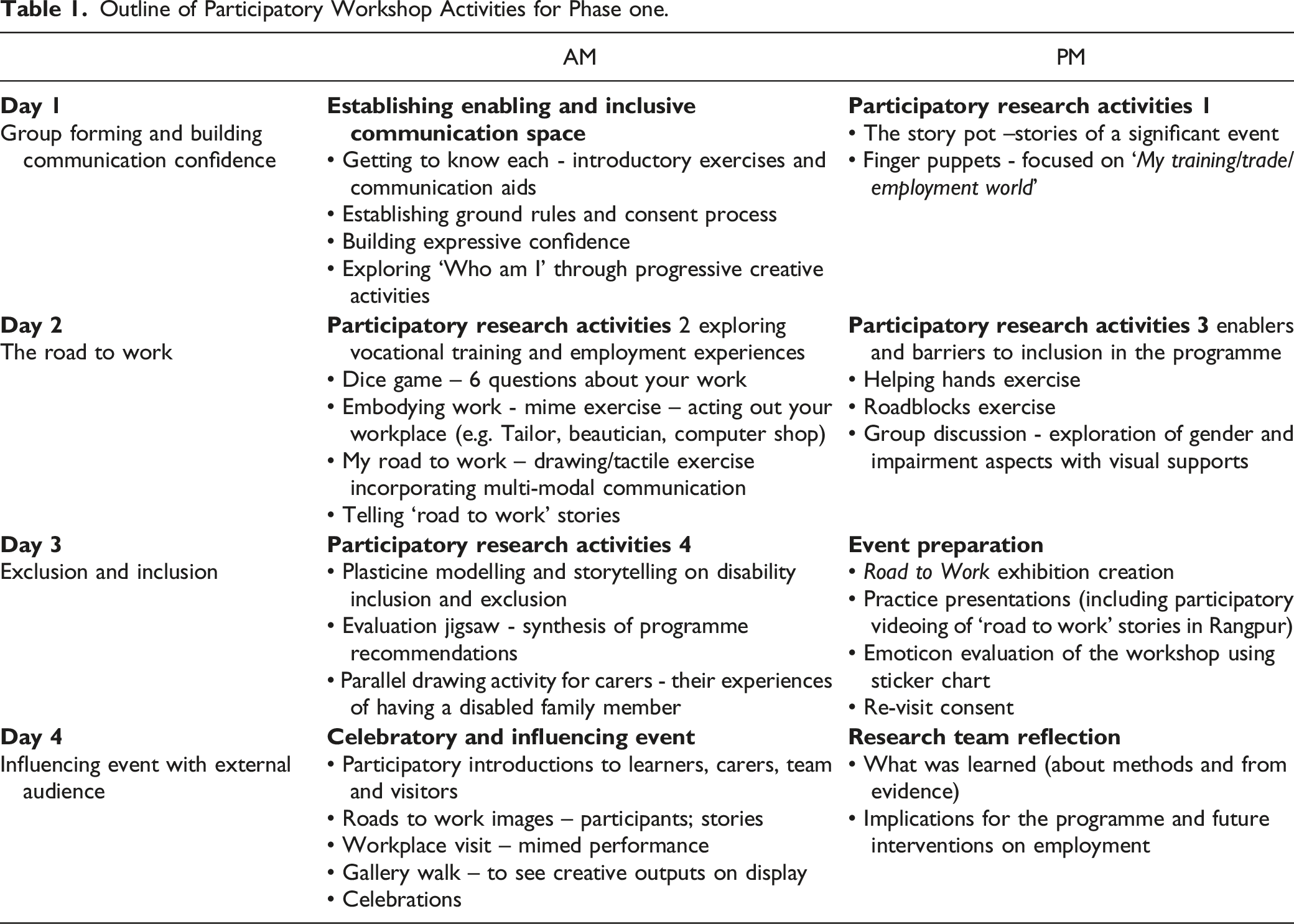
The daily plans during phase two used a similar range of activities but with a focus on the participants’ ‘World of Work’ and them looking at their current work situations and towards aspirations for their futures. It can be seen from the examples given that we did not use ‘classic’ focus group discussions. Each activity built on the previous ones, and the overall aim was to find out about how the learners saw themselves as evolving into potential workers, as well as family and community members with different identities and aspirations. Specific sessions did ask them about how they perceived their training, the support they received from the INGO partners and the workshops we were running. Thus there were many opportunities for expression of opinions, sharing of experiences and indeed evaluative comments.
It is not possible to cover all the activities in detail. Here we draw on examples to illustrate how and why we combined and sequenced activities to build research relations, capacities and confidence, to stimulate interaction, to progressively deepen insight and to involve participants in creating research outputs and influence future programming.
Basic Strategies for Generating Inclusive Interactive Space
Meaningful participatory research processes are often dependent on how the communicative space, or the interactive context for group inquiry, is established at the beginning (Wicks & Reason, 2009). Devoting sufficient time and using effective approaches is necessary to generate and maintain inclusive dynamics between everyone. This avoids the most confident or powerful individuals, or those needing least support, dominating the process (Mistry & Shaw, 2021) and is particularly important when aiming for equitable and enabling research with the most marginalised disabled people.
In preparation, we had aimed to remove barriers to participation (see Watharow & Wayland, 2022) through identifying accessible premises and accommodating individual needs – for example ensuring enough sign and tactile language interpreters, personal assistants, and team members to support generating and documenting research evidence; and providing training in the specifics of roles and research processes. However, fostering inclusive research is not only about preparation or sufficient time, crucial though these are. It is also about the ‘way’ that research activities are facilitated.
First, we aimed to provide enough time for contributions from those whose communication was slower or needed interpretation (e.g. sign language or tactile), avoiding participants or interpreters/supporters feeling time-pressured. We emphasised to the carers/assistants or family members, that although they would have opportunities to express their own perspectives, our main focus was the person they were supporting. Thus, the idea of ‘talking for’ or ‘instead of’ participants was not encouraged. Being supported to talk for themselves was clearly new for some participants and their accompanying supporters needed intervention from us to maintain this. It was noticeable that over the few days, carers became more confident to leave their family member and do a separate activity in another room (as long as appropriate translation/interpretation/support was available for their relative).
There were also some deliberate aspects of our facilitation approach and design of activities, to ensure that participation did not depend on skills or capacities that only some group members had. Importantly, we used a multimodal communication approach as standard. For example, we verbally described everything that was happening for visually impaired participants (which was in turn sign language or tactile interpreted). Furthermore, we used visual modes to aid communication, as augmenting verbal communication through signs, symbols and pictures helps many people, not only those with intellectual or cognitive impairments. For example, we used visual timetables for each day with simple symbols and ‘stick figure’ illustrations to aid understanding (with visuals also described). In the sessions focussed on gender and disability intersections, the verbal discussion was supported by large and small symbols for men and women and for disability, so that participants could look at and hold these to support their understanding of the topic.
Additionally, we used various communication tools during activities. For example, we used a ‘traffic lights’ system (as used in many meetings for people with learning disabilities see Inclusion International n.d.). Each person was provided with 3 large, coloured shapes: a green circle represented yes or good; a red square indicated no, bad or stop; and a yellow triangle for not sure, or to ask a question. Thumbs up or down can be used, but the shapes aid those who are visually impaired as they can select by touch. This provided a way for people to express how they were feeling nonverbally, and when not confident to speak up in a group. Practising using this system early on, asking simple questions, and using it regularly to assess the energy or mood, supported the generation of inclusive dynamics.
Group-building is crucial, and we worked deliberately to generate a sense of group belonging and cohesion. We also encouraged acceptance of diversity by emphasising that everyone is different, but we are a team, and by expressing appreciation for all contributions. In addition, we structured activities so that they enabled participation space. For example, each session started with an icebreaker. Often, we stood or sat in a circle, and each person communicated something following a prompt. for example “What is your favourite food?” This established that the approach was different from the typical teacher/trainer-led approach at school and work trainings, which in Bangladesh which are often quite hierarchical and status focussed. The ‘taking-it-in-turns’ exercise format meant everyone had the chance to contribute and have their views equally valued. It also established through ‘doing’ that there were no right or wrong answers or styles/modes of communication. Similarly, each day ended with a reflection/closing activity in a circle, with each participant, including we facilitators and the local research team, taking turns to comment or feedback on what they had liked, learnt or not liked, to ask questions, or make suggestions for the following days agenda. These reflections contributed to the team’s methodological learning, and also brought people together once more as a group
Some activities were conducted as a large group, and some in smaller groups (see next section). It was therefore important to have enough interpreters, language translators (to and from English and Bangla), and documenters to support the interactive research processes. Pacing is also important to inclusion, planning a mix of high energy, intensive activities and less demanding ones. The sessions followed a rhythm, with energisers (e.g. games, dancing, singing) used after more focused activities to unwind, re-connect and rejuvenate. These energisers (e.g. miming sports activities) were designed so that all could join in (e.g. those with deafness, blindness, physical and intellectual impairments). “I like that we are all together and enjoying together” Carer-Mother
Energisers were conducted as a big group, with no particular attention to one individual. However, participants were invited to lead an activity (e.g. dancing). To ensure this did not advantage only the most confident or capable group members, we also created opportunities for all to take on individual responsibilities through various rotated tasks (e.g. ticking off activities on the visual timetable, ringing a bell for the start and end of sessions). The crucial thing is that taking part was fun and there was joint responsibility, which was an eye-opener to our local partners. “it’s a new experience. The way you are conducting the sessions, the whole session was participatory….. I learned a lot and I feel it will help my future life”. (CDD project lead)
Generating enabling communicative environments is not just about what is done but necessitates relational aspects of facilitation and soft skills that are often overlooked. For example, team members and participants alike commented that we were both so friendly and energetic – not aloof and strict like their experience of teachers, or their image of researchers. We reflected ourselves on not necessarily feeling full of energy - more exhausted from jet lag. There are intrinsically performative aspects of facilitation, which required us to ‘read’ the room, and respond to create calm and relaxation when things got too intense or invigorate when energy levels dropped. This required us to be alert to individual needs or signs that anyone was feeling tired or excluded. There are many subtle balances such as these, which participatory research facilitators must navigate adaptively; for instance, between individual and group needs, group-building and content generation, encouraging different types of expression (more or less verbal, supported visually) and internal reflection, and leading group activities or following participant’s agendas. These are roles that required us to enact vital aspects of ourselves, while leaving our own concerns and egos at the door, to support and encourage participants to do new things. Indeed, we were also aware that a remaining colonial hierarchy, where white foreigners (and researchers) have more status, demanded that we work deliberately to disrupt this by demonstrating being very willing to listen, be flexible and perhaps vulnerable ourselves.
Applying and Adapting Creative and Narrative Participatory Methodologies
Answering any research question effectively requires the use of methodologies that are based in appropriate epistemologies or ‘ways of knowing’. This becomes especially pertinent in disability inclusive research, as there is potential epistemic exclusion if research methodologies or ways of generating forms of knowledge are inaccessible or do not consider participant’s communication needs and undervalued lifeworlds. The kinds of data that may be offered by participants can easily be perceived to be insignificant unless an inclusive appreciation of these is very deliberately demonstrated.
There is increasing interest in the use of creative methodologies for participatory research on neglected perspectives and complex issues. These draw on established visual and enacted modalities, such as drawing, painting, collages, modelling, mind mapping, comics, storyboarding, drama, dance, and song; and include the more recent research methodologies of Photovoice (photography), Participatory Video, Digital Story Telling (DST) and Participatory Theatre. Lewin and Shaw (2021) propose that visual aspects can reveal subjective, emotional and relational insights that may be missed by other methods; and the enacted aspect can enable participants to tell their own stories about their lives to peers or external audiences, with less focus on the verbal. Visual, creative and narrative approaches are also proposed as suitable for inclusive research (see Rojas-Pernia & Haya-Salmón, 2022; Shaw & Wickenden, 2022), as they use modes of expression that are accessible and adaptable to individual communication modes and needs - facilitating more equitable research engagement and co-creation (Owens, 2007).
Thus, we incorporated and adapted creative and narrative methodologies in exploring participants’ experiences of exclusion and inclusion and their journey towards work for both ethical and practical reasons. (For further details see Shaw & Wickenden, 2022; Wickenden & Thompson, 2023). However, the following exercise sequences illustrate how this process began and developed, including methodological adaptions to suit individual needs within the groups.
On arrival, each person was given a small paper cut out figure. They were asked to decorate it to represent themselves. Some used colouring pens, but we supplied various tactile materials to stick on which aided exercise accessibility for those with visual impairments. Personal assistants supported choices in various ways, such as describing colours or materials when needed, but we encouraged assistants not to do the activity for participants wherever possible. Some participants needed encouragement, and some assistants were more natural at facilitating without taking over. After finishing the figures were turned into name badges attached with brooch pins. Everyone introduced themselves one-by-one round the circle with reference to the figure as a first group exercise - including the research team members.
Having established the creative environment, we continued exploring ‘Who am I?’ with a layered exercise. Each participant was supported to outline their body on a life-sized cardboard sheet, and they decorated their own with a range of creative materials. These self-representations were displayed on the wall, and next participants added sticky notes with details such as their likes-dislikes and their dreams. They then made 3D models out of pipe cleaners (accessible tactile medium) of objects representing the trade they were training in. For example, a beautician apprentice made a mirror, lipstick, and brushes; a tailor, a tape measure, scissors, and sewing machine, and a computer technician, a monitor and keyboard. This exercise opened a relaxed way for the research team and participants to get to know each other through chatting as they worked. Participants then attached the pipe cleaner trade objects to their big figures on the wall and took turns to present. Referring to their self-representations helped prompt participants to talk about their chosen trade and their dreams for the future and revealed to us aspects of their identities. It generated initial insight and brought each to attention within the group. It also enabled participants to gain confidence expressing themselves in front of others. In addition to providing a way into narrative research, through practicing ‘telling’ and ‘showing’ their experiences, the large figures also began generating the ‘exhibition’, which was presented to external stakeholders on the last day. Thus, a participatory research activity can have several process and content aims, and each builds iteratively on the previous ones.
The Importance of Methodological Iteration - Progressive Sequencing and Layering of Research Activities
Participants in experientially-focussed workshops are generally unlikely to arrive with fully formed and communication-ready perspectives – it takes time to work through what they think about an issue, 7 as well as to build the trusting relationships necessary for honest reflection, and that is part of the research process (Shaw & Lind, 2022). Furthermore, in addition to group dynamic phenomena such as the Abilene paradox (Harvey, 1988), which causes participants to say what they think others want to hear, marginalised people often lack confidence to express themselves. This can be particularly true for disabled participants who are not often asked what they think or expected to have opinions. We therefore used an iterative approach to generating knowledge, which involved starting fairly superficially, and then sequencing research activities to go progressively deeper into the research topics over the 4 days.
Each day began with something fun and non-challenging - bringing everyone into the present, to frame or introduce the day’s focus. Then as confidence and understanding grew, we progressed to activities which opened opportunities for exploration of experiences and ideas in more depth. For example, the second day was introduced using the metaphorical idea of the Road to Work. Then a series of research activities were sequenced and layered to explore and deepen knowledge about participants’ pathways to work for example their experiences of vocational training and trade learning within the STAR programme. First, a large road shaped piece of green rip-stop nylon was placed on the floor, and we mimed walking the road to work (with verbal descriptions – signed and tactile communicated). The whole group then held onto the ‘road’ and walked together to visit different areas of the space, which we had set up to represent different workplaces for example beauticians’, tailors’ and computer shop. Each learner then mimed the work they do with a few simple props, resulting in an embodied enactment of their transformation into their trade role. “I loved to show my job as a beautician”. (woman, psychosocial
8
)
Even though Khadija
9
is completely deafblind, and we did not visit her in her actual workplace, it amazed everyone to see how much her role had become embodied, as she mimed using her sewing machine (e.g. demonstrating the action of peddling the machine and feeding fabric through). As she expressed: “I like operating sewing machines. I like the rhythm of the sewing machines”. (woman, deafblind - communicated via tactile interpreter)
The example illustrates the importance of valuing different epistemologies, as from watching her (described for those with low/no vision), we were able to perceive how important movement and repetition of a familiar sequence of actions with a purpose was to her pleasure in her role, and how well she was doing at something other’s such as her family members and neighbours, and even her MCP, had believed she couldn’t do. Her family supporter also described how she could discriminate different fabrics through touch and smell.
After the miming activity, the ‘road’ was hung as part of the evolving exhibition materials and turned into a ‘sticky’ wall by spraying it with spray mount adhesive, so that we could add different visual and verbal outputs to it.
Next was an individual road to work drawing exercise. We adapted the well-known ‘rivers of life’ exercise
10
. We first asked each participant to draw a road, with bends, detours and widening and narrowing of the road representing various stages on their journey towards work (e.g. during the training and apprenticeship and beforehand). Then, as a further layer, they were encouraged to add stick figure drawings, symbols and words to highlight important events or feelings over time. Each person then narrated their ‘road to work’ within small groups. This was also a powerful activity, as each group member’s trials and successes were heard and valued. “I loved the drawing part. Everyone understands my words, and this makes me feel so overwhelmed”. (Woman, Deaf)
Many of them appreciated being heard in the group context: “ I liked it most that I got an opportunity to share my feelings with everyone”. (Asma, physical)
Through showing and telling, we not only understood ‘words’, but gained insight into participants lifeworlds both through their drawings and expressive modes (signing, tactile). In a separate room, to avoid the participant-carer power dynamics, accompanying family members also created their own rivers of life. This provided us with important relevant insights into their challenges as carers: “It was mind-blowing that I could reflect on myself…I could draw”. (sister of man with intellectual impairment)
Many said that the workshop was an entirely new experience, and they greatly appreciated the opportunity to communicate their lives and perspectives in various new and creative ways. Several local team members expressed surprise at how much insight was generated about participant’s likes, dislikes, challenges, dreams and recommendations, through what seemed to be ‘light weight’ informal activities. “[we] have got more from these learners than I had observed prior to the workshop. Without even any sort of trainings, just through some play and fun they expressed themselves ……. in a profound way” (staff, NGO partner, Rangpur)
Similarly, they observed how more confident, and expressive many participants were after only 4 days “one carer happened to be illiterate - she was expressing her experience through drawings. It’s really impressive” (partner staff member, lead NGO partner, Rangpur)
Accompanying family members appreciated the opportunity to think about and be witnessed through communicating their stories in new ways.
These examples highlight how we mediated research learning by using participatory methods not as one-off activities, but as foundations that are built on as research engagement progresses. In part this is about building participant’s communication confidence, and this was strongly evidenced when we returned to run the second workshop. Their creative outputs, produced in different media and communication modes, helped us to understand the complexities and challenges of moving from being seen as a non-working, non-productive, non-valued person, to someone who could be respected and have status as a worker and contributor. During this second fieldwork visit, it was very noticeable that cohort 1 participants were immediately comfortable with us and the workshop context and able to share their new experiences more easily as they knew what to expect. Cohort 2 participants of course needed the orientation and slow build-up of trust and confidence that we had used with Cohort 1.
Deepening Insight on the Enablers of and Barriers to Inclusion
We used various other creative activities to generate knowledge on the enablers and barriers to inclusion/exclusion from the participants perspectives. For example, a ‘Helping Hands’ exercise involved each participant drawing or writing on the fingers of white gloves what had helped their inclusion, and similarly the ‘Roadblock’ exercise involved them drawing or writing on cut-out rocks the barriers to inclusion experienced. Most notably, a plasticine modelling exercise (adapted from a method developed by Shaw), aimed to deepen the earlier story-telling or narrative exercises. First, each participant reflected internally to choose a specific event when they had experienced being included or excluded – this is designed to address the tendency to talk in generalities. We asked participants to think of a particular moment that generated strong feelings (e.g. pleasure, frustration, upset etc.), as often emotively affecting happenings or ‘critical incidents’ are productive examples for reflective learning for the story tellers and the listeners (Lewis & Hildebrandt, 2020; Schon, 1990). However, we provided the option to choose a positive experience (inclusion) or negative experience (exclusion) or both, informing them that they would share the event later in a small group, and so they should choose something they were comfortable talking about. This is important, to enable participant’s control and navigate the potential risks of them feeling coerced to reveal experiences that are too painful. Next, each person modelled their remembered event using plasticene (coloured re-mouldable clay). They were told they didn’t need to represent their experiences directly or figuratively (e.g. showing figures, objects, places etc.), but could be more abstract or metaphorical using colour and shapes. This was demonstrated (and verbally described) for clarity. We find plasticine modelling an accessible method particularly for working with those with visual impairments, as it can be done through touch. We encouraged participants to ‘go into’ themselves and work quietly. Modelling (being a somatic method) aids the process of accessing and surfacing embodied or tacit knowledge which may not have been acknowledged, represented or put into words before. Workshop participants often also report that kneading the clay is comforting or therapeutic. Afterwards participants told the stories of their ‘moments’ to each other in small groups. (although with recognition that the physical, visual model was potentially more powerful than words describing it). This was followed by a ‘titling’ exercise, where the group agreed on a name for the story or situation (e.g. exclusion and then inclusion). This is a form of ‘theming’ or group analysis of the main story meaning or message.
As expected, this activity generated important insights into the emotional impacts of exclusion and the attitudinal and relational barriers to inclusion, in the workplace or elsewhere. Social isolation was the most strongly expressed impact. For example, it was striking that many of the stories chosen were about social exclusion - all the deafblind Rangpur participants and about 50% of the Rajashahi young women told us about routine experiences of mocking, bullying or taunting. “My neighbours used to tease me a lot, which made me feel extremely bad” (Woman, physical)
We identified that exclusionary behaviours from other people was a key factor in participants isolation from social contact, in addition to the communication barriers. Participants reported retreating home after experiences of name-calling or unkindness, being frightened and staying at home to avoid it - with enduring emotional impacts: “So, I am now stuck in my house. I feel sad”. “I feel sad often”. (Woman, Totally deafblind )
It is important to recognise that these long-term, routine, discriminatory and stigmatising experiences can have deeply felt and ongoing effects on people’s identity and agency. It can be demoralising to face repeated rejection from peers (Maryam, Rangpur), but people with disabilities may also internalise negative attitudes about their perceived capacities and potential - sometimes called internalised oppression (Reeve, 2014). This effects their power within (Gaventa, 2006), their self-esteem and sense of their own capacities or self-efficacy. We see our inclusive research approaches as supporting more positive identity formations for people who have been excluded, through actively listening to and encouraging them. The work of Honneth and Fraser (Danermark & Coniavitis Gellerstedt, 2004) is relevant here, as it interprets marginalised people as struggling for recognition. It may be only through more equal intersubjective experiences that some will feel heard and understood, and then sense themselves as capable with valuable contributions to make.
This new recognition was reflected in our participant’s stories. For example, his sister related how Sami (intellectual impairment, Rangpur) needed to be reassured he wasn’t mad following negative interactions with other young people. Maryam also told a compelling story of how she became aware that she wasn’t actually ‘crazy’ as people had persistently told her: “I realised further that crazy and people with deafblindness are not the same…. now, when people call me such, I rebuke them…. I ask them whether a crazy can go to school or cook or act. I am not a crazy person”. (Woman, deaf and low vision, Rangpur)
Maryam is an intelligent, outgoing, assertive and friendly young woman with the love and support of her family behind her. Given that she had internalised negative conceptions of herself, this demonstrated that many disabled people, especially those with more severe, complex or less socially understood impairments, need considerable encouragement and support to feel a sense of ‘can-do’ both before and during disability inclusion interventions and in life.
We concluded that these socio-emotional aspects must be tackled, as well as during inclusive research processes, to build inclusive opportunities for the most marginalised impairment groups.
Participant Involvement in Stakeholder Engagement and Influencing Future Practice
Earlier we proposed that disability inclusive research should involve disabled participants in influencing what happens next for them following fieldwork. This intention was built into our research process - the ‘road to work’ and ‘world of work’ metaphors both supported the idea of ‘what next?’ Thus, as the workshops progressed, for example in the first visits, the focus moved from reflecting on the programme experiences so far, towards generating suggestions on improvements and future directions for this programme and other disability inclusive employment projects. For example, a Jigsaw recommendations exercise involved small group discussions to answer 6 questions about the programme: preparation for joining, the process of choosing a trade, technical training, support from MCPs, length of training, and future work aspirations. The discussion was documented, and answers written on jigsaw pieces for each question, which created a whole synthesis. A recommendations report from the cohort 1 participants potentially informed Cohort 2 adaptations.
On each workshop day we built up an exhibition of materials produced. We had attached the life-size participant figures on one wall of the room, and the road (e.g. the green sticky material) on another. We created a different coloured path for each participant on the larger road, and their different creative outputs were stuck on or around it (e.g. the individual ‘roads to work’, the helping hands gloves, the barriers and the trade symbols), and the plasticine models with titles were arranged on a table. This provided a visual (mainly nonwritten) summary of the learning about everyone’s journey to work. Similarly, in Phase 2, the individual ‘world of work’ circles were placed around a joint one for the group, with colour coding of positive and negative aspects. This made a dramatic visual display of this transition in people’s lives. This was an outward, tangible manifestation of the evolving research outputs, and also became the exhibition to supplement the final dialogue and celebration event with external stakeholders.
The invited guests on the last day included the MCPs and technical trainers, and local relevant and government officials and duty-bearers. The purpose was to build awareness, to shift attitudes about what marginalised people disabilities could achieve, to share research insights, and thus to influence future provision. We conducted some icebreaker and participatory exercises with the guests, to establish an inclusive dynamic, to give them a taste of the approach we use and to avoid the usual domination by influential leaders through speech-making. Each participant took an active part in the dissemination day, through structured roles (that they had chosen and practised in advance) for example some introduced themselves with their figures as prompts, some mimed their trades, and some told their roads to work stories. Participants then showed their guests around the exhibitions to prompt more informal interaction between the disabled participants and the guests. The visual materials helped prompt participant’s presentations, and re-position them more powerfully in interactions with the influential stakeholders (who they would probably not usually talk to).
Local team members observed how much confidence some participants had gained compared to the first day, which participants themselves also felt: “I was really shy. I couldn’t speak before others. But now I am confident”. (Man, dual sensory and physical impairment)
The audience enjoyed the event and presentations: “I really like how everyone worked together and disabled people got engaged”. (Woman, Technical Trainer)
Furthermore, one government official in the social services confessed that she had been sceptical that deafblind people could take part and benefit from the programme, but that her she had been surprised and enlightened by what she saw at the event.
The second workshops took place about a year later, after all the learners had finished their apprenticeships and had become (in most cases) workers in a trade. Thus the focus of discussions shifted to what work was like (clustering ideas on the World of Work symbols, into self, family, work, community effects); how participants themselves had changed over time (e.g. self-belief, development of self-image or their trade identity/persona, pride at earning and contributing to household economy); shifting relationships with family, community and customers; ambitions for the future, including detailed discussions about what they need to do next, such as simple business planning. Other issues included the challenges of continued stigma and discrimination at home and outside, gender related aspects (e.g. safety for women, breadwinner expectations for men), financial aspects (e.g. how to save/get a loan, rent a building, buy materials). The focus of the conversations had moved on as had the individual’s identities and aspirations.
Discussion: Insights and Challenges of Disability Inclusive Research in the Bangladesh Programme Context
In this paper we aimed to reflect on the use of participatory approaches and methodologies for disability inclusive research with more marginalised learners in the Bangladesh STAR programme. Overall, both cohorts expressed great enthusiasm about their participation in the research workshops. This demonstrates the contribution of inclusive, participatory methods not only to building new knowledge, but also to bringing about meaningful change for those involved in themselves. However, there were also disconnects between our intentions and the realities, including practical tensions to navigate.
Collaborating with INGO/NGO and OPD Partners in Bangladesh
We have focused on how disability inclusive research can happen in low-and-middle income countries like Bangladesh. We found that despite INGOs and local NGOs commitments to disability related work and their experience in community mobilisation and advocacy, there are still deeply embedded assumptions about what is possible. There has never been much participation from the most marginalised impairment groups, which perpetuates negative expectations. Collapsing of distinctions between or confusion about sensory, cognitive and psychosocial impairments also generates assumptions about people’s capabilities. Knowledge and experience of the kinds of support needed by people with the most marginalised (and often invisible) impairments is still often scant, even amongst disability focussed practitioners.
We are mindful of the paradoxes presented by our positioning as external non-disabled researchers aiming to work collaboratively and shift power dynamics, and the fact that we depended on our partner’s expertise in running the project and knowledge of the context to adapt appropriately. They provided us with valuable information and guidance about local cultural aspects to take into account. However, the limiting expectations of what was possible and programmatic constraints impacted on our research engagement. For example, as explained we had to re-orient our aim to include people with intellectual impairments in the fieldwork, as few were part of the STAR programme, and participants in both the ‘so-called’ deafblind group and the women’s’ group had much less severe or complex impairments than we had expected. We have had similar problems recruiting participants from the most marginalised impairment groups in other DID programmes. Although this project extended awareness towards greater disability inclusion to some extent, clearly engrained attitudes and assumptions will not change markedly without repeated awareness-raising input and demonstration of what can be achieved over a much longer timescale.
There was also unsurprisingly very little prior awareness about the kind of research approaches and methodologies we would be using, despite our many online discussions with our partners and some previous training that we had provided in the early stages of the DID programme. Indeed, the INGO partners suggested that we could run the research workshops online, when we were prevented from traveling during the COVID-19 pandemic, as they had done for other programme elements. We explained that an online approach would not work for people with complex impairments and would have prevented us from using many of our creative, non-verbal, and relational methods effectively. Methodological training and preparation for the partners and local team was therefore a crucial part of our capacity-building input, with staff members commenting afterwards how well they now understood the need for in-person workshops. Awareness of the potential contribution of participatory ways of working developed significantly through seeing them in action, and partners were then keen to apply what they learned in other areas of their disability intervention activities. Nevertheless, the two training and modelling engagements were time-limited, and it is unrealistic to think this is enough to cement a different way of working across the partner organisations.
The short timeframe was in part due to the COVID-19 context, which meant the adapted STAR programme and our input had to be concertinaed into the last programme year. However, there was an additional issue that it is important to highlight. The disability movement (at global and country levels) had a leading role in the DID programme, as it should do, as OPD leaders have lived experience of disability inclusion. However, this created an unintended dynamic, where those leading programme elements lacked knowledge about skills and approaches such as participatory research or inclusive pedagogy that could be helpful in realising meaningful inclusion in practice. The implicit assumption is that people with lived experience of disability will necessarily know how to be inclusive for all impairment groups because they are disabled themselves. However, without input from expert external collaborators and resourcing, this sets OPDs up to fail and exclude some people. Therefore, we suggest a transition to emancipatory disability research must necessarily be progressive, in partnership with allies. We reiterate that specific focussed disability inclusive research training is needed for anyone embarking on this kind of work, in addition to the knowledge about disability awareness and advocacy skills which most of our partners already had.
Another issue related to the local team’s relative inexperience in the documentation and translation roles, which impacted on the research. We generated research evidence through participatory group activities and the subsequent discussions, through one-to-one interactions between participants, and through storytelling and presentations, as well as through observation. Documentation of what is done and said is therefore crucial to participatory research, otherwise the rich learning can be lost, especially when working across languages. Whilst audio-recording devices can be used as back up, it is hard to get good quality sound in a large group environment, and often this generates too much irrelevant material to transcribe. Written (translated) notes of what is said are thus important to capture the most pertinent information in the participants’ words in as much detail as possible. Creative outputs are part of the research data and these need to be photographed. Documentation is a skill. However, ours were inexperienced documenters (mainly Bangladeshi university students studying English), and we had limited time to train them and provide supervisory input during the workshops. Consequently, not everything was documented as fully as intended, leading to less richness in the data than anticipated. There was also a tendency, despite instruction to the contrary, for some documenters to make their own interpretations, or put verbatim quotes into more correct/formal language, rather than capturing accurately what participants said and the way they said it colloquially. The documenters all worked hard, but without prior experience it was difficult for them to understand what was needed in this specific research context.
This was compounded by the problems of language translation. The local team all spoke good English, but we UK researchers needed English/Bangladeshi translators so we could facilitate the workshop and get enough insight into what participants said in the moment to be able to prompt and guide activities. Again, these local translators were either new to the role, or to the participatory way of working. There is often an issue created when using untrained translators for research, as its not certain whether what was said has been accurately translated or is what the translator thinks you want to hear. In this context, we also had layers of language to navigate, through the sign and tactile interpretation happening in parallel. Despite these challenges, the fieldwork generated important new insights, supplemented by our own reflective research diaries, but we were certain there was much we missed.
The Use of Visual and Creative Methodologies for Disability Inclusion
Most participants greatly enjoyed working creatively. For example, Badaya and Dana most liked the drawing activities, whereas Ibithaaj (who is deaf, and illiterate as she had no education) said she especially loved the modelling as it made her happiest showing her work to others. She had had very few opportunities outside the home, and people had assumed she couldn’t do much, so she valued being able to demonstrate otherwise and gain recognition. Others mentioned particularly liking the ‘road to work’ the storytelling and miming, or the chance to exchange experiences, ideas, opinions and feelings in a group. We concluded that the range of approaches and communication modes used, with alternative materials (such as tactile modelling clay, textiles, and pipe cleaners) available when needed, maximised the opportunities for everyone to communicate in accessible ways that suited them.
Participation choices are a foundation of ethical research. However, if you ask someone if they want to try something new, when they lack self-belief, or have been previously ridiculed, they may decline through fear of something unknown. Enabling people to step outside their comfort zone and providing appropriately tailored relational and practical support so that they can succeed, is an important participatory researcher skill. Moreover, whilst recognising the fundamental right to refuse, gentle encouragement without coercion can shift a participant’s sense of ‘can-do’ and their future aspirations. For example, initially Badaya, who is a wheelchair user with restricted manual dexterity, and mild learning difficulties, was unsure about trying to draw, and couldn’t easily hold the felt pen and make marks. The young local facilitators assumed they should draw for her. Yet, after we modelled how to support her, one local facilitator became a natural enabler. It seems possible that Badaya said she most liked drawing, because she achieved something she didn’t think she could do. Similarly, some of the illiterate carers/mothers were using pens/pencils for first time, and it was a revelation and source of pride to them that they could express themselves through drawing. Finally, it is necessary to tackle the automatic expectation that blind people cannot or will not want to do visual activities. Often it is just assumed to be inappropriate, without any awareness that they may want to take part (with suitable accommodation support). This was reflected when after the first day Khadija who is completely deafblind said she most enjoyed the drawing (with her tactile interpreter’s support). We must remember that blind people may have very good internal visualisation skills as they need them to get around and avoid restricting people’s participation opportunities by deciding for them what they can and will want to do.
Navigating the Ethical Risks of Storytelling/Narrative Research About Sensitive Issues or Emotional Effects
We used participatory narrative methods as an accessible way to learn about participants’ lived realities. Narratives prompted by exercises like the ‘roads to work’/‘worlds of work’ and modelling clay exercises generated rich insights into the emotional, relational and dynamic aspects of inclusion. However, it is important to consider the timing, process and support for exercises to mitigate the ethical risks.
One of the potential benefits to participants, was the chance to talk about what had happened to them including the emotional effects. However, when working with marginalised participant living difficult lives, it is always possible that very challenging or traumatic past experiences may come up, even if the exploration topic is not sensitive. This may evoke strong emotions at the time, or distress afterwards. At the same time, telling others about hard or painful experiences may be therapeutic for some people, or they may want to share these so that people know what is going on and to contribute to research learning. Therefore, for us there was an ethical balance to strike between ‘doing good’ through surfacing previously hidden or neglected knowledge on the disabled participant’s realities and avoiding or mitigating potential harm.
Preparations for this are important, and during the training days we and the local staff and research team reflected on what we would do if someone was upset. For example, to pause or end activities to comfort the person, but also to resist the temptation to try to stop them from crying or expressing feelings, as overt expression of negative emotions may be a beneficial release. If handled supportively most people who do experience strong feelings during such participatory activities, recover their composure and are glad that they have had the opportunity to be witnessed.
Upset did arise during the workshops. For example, in Rangpur one OPD participant got very upset as she told her life-road story during the training day. It is important to have enough facilitators - in this case one of us was able to take her somewhere private to recover, whilst the other supported the rest of the group in processing and continuing. We UK researchers also have many years of experience of supporting marginalised people, plus knowledge and skills in trauma-informed approaches, which are part of our ethics mitigation strategy. The long-term project context (with the INGO and OPD partners continuing to be involved with the participants) also meant support was available afterwards if needed.
With the local team during training at visit 1 and with cohort 2, we facilitated circles of storytelling focused on inclusion and exclusion. This generated powerful stories and some tears. One father shared a story about his disabled daughter’s traumatic experiences and became very upset. However, he said afterwards that he was glad he had shared their story. The group members appreciated the cathartic value of the act of sharing a story, despite the challenges of expressing negative experiences. After such occurrences we conducted full debriefings with the research teams about how to respond, and when these methods are suitable to use and when not. For example, we had already emphasised providing choices in what is shared, informing participants that they can stop at any point if they like, and ensuring that activities likely to be emotive are not too scheduled too early in the workshop. We also discussed with partners the need for referral routes in case safeguarding or ongoing psychological issues emerge. Using participatory approaches also helps minimise ethical risks, because of the time spent building trust and an inclusive environment. However, we would not recommend using these approaches on such short-term research workshops unless, as in this case, they were embedded in longer-term engagement grounded in local partnerships so that ongoing support was available from the NGOs and OPDs.
Methodological Contributions to Tacking Inclusion and the Challenges
The methodologies we used generated knowledge on enablers and barriers to inclusion in the context of work. However, there was also evidence of the contribution of inclusive, participatory approaches to building inclusion in themselves. As previously described, we generated evidence on the psycho-social impacts of exclusion which it is necessary to address to achieve disability inclusion. For example, many disabled people are conditioned to believe that they are incapable or worthless, and these negative external attributions about their personhood (value as a person as seen by others) influences their internal ‘selfhood’ (picture of themselves). Alternatively, they may see themselves as deserving of attention and support, whereas others see them negatively, which denies their value and sometimes their humanness. This dissonance is the source of anger and frustration for many people with disabilities. Creative and expressive activities can provide evidence for others (the onlookers/audience) of the person’s self, in a way which is humanising. It provides new insights into who the person is, can be and what they can do. This kind of exposure is similar to the impact claimed by ‘contact theories’ (Allport, 1954) mentioned above, where a nondisabled person meets a disabled person and begins to see the world from their perspective.
Arguably, learners were experiencing increased recognition through gaining a trade identity in their families and community. However, our research suggested intervention is needed to increase learners’ self-confidence, self-belief and agency before and as part of the programme. Otherwise, it is possible that an intervention will only manage to include participants who are already more confident or have higher social capital or family support. The shifts in self-belief, self-awareness, and self-confidence that occurred during the research through participants achieving in new roles and having their opinions valued demonstrated a way of enabling this process. “people from outside are always having negative talks regarding [those who are ] deafblind….. But, after this workshop, they will definitely grow this confidence that they too can-do things”. (Woman, documenter)
Our research also highlighted the social isolation that participants had experienced, and the importance of supportive relationships and social dynamics in building inclusion. In Rajshahi, most of the learners knew each other, either because they had apprenticeships in the same setting or because ADD or their OPD had brought them together in other ways. In Rangpur, the participants had not worked together in person before, and building new relationships was a valued aspect of the workshop for some. “I feel ecstatic meeting with new people”. (Woman, Deaf and low vision). “I don’t have many opportunities to go out. But I feel excited being here”. (Man, Partial deafness and low vision).
Furthermore, our methodological approach contributed to building inclusive interactions, teamwork, solidarity and mutual purpose amongst participants. Our partners recognised that generating peer relationships in these ways could contribute to addressing participant’s social isolation and increasing their collective influence.
However, disabled people within a group are all different, and negotiating the power dynamics between researchers, partners and participants, including amongst those with different impairments, to generate and sustain inclusive research interactions can be challenging (Kahonde, 2023). This requires a nuanced approach to accessibility and adaptability in the designing, developing and conducting of research processes, and our experiences suggested (counter to the rhetoric), that it is much harder to maintain inclusion when working with a very mixed group (whether by impairment, gender, age, class, education or economics, for instance).
For example, we observed strong bonds and support between 3 of the 4 young women in Rajshahi who were learning tailoring at the same venue, especially as they were all deaf, or able to sign. However, Badaya, who had physical and cognitive impairments was more left out, despite having a placement at the same tailors. Similarly, two more cognitively ’able’ young men in Rangpur built a good relationship during the research. However, the completely deaf-blind woman who had extra communication barriers, and Sami (intellectual impairment) both gave signals suggesting they wanted to keep to themselves apart. Our NGO partner also highlighted a cultural-class barrier, as Sami’s is from a relatively more affluent higher-middle class family and perhaps rather protected from mixing freely with others. Before joining this programme he had been more isolated than other participants and was very dependent on his sibling who accompanied him. However, he did increase in confidence, and we might interpret positively his comment that ‘I have spent significant time here. I like it’, as he tends to get frustrated and leave social settings in anger.
These examples reflect how structural power can be sustained through micro-level interactions (Foucault, 1980), which is one of the primary challenges in operationalising inclusive participatory research and is one of the reasons why more homogenous groups are often recommended, but this counters the ideal of disability inclusion enshrined in the UNCRPD, where the intention is to involve people with different impairments and capacities in the same process.
Conclusions and Future Directions
This paper has reflected on our experiences developing and operationalising disability inclusive research methodologies to explore participants’ perspectives on taking part in the adapted STAR employment training and apprenticeship programme in Bangladesh as part of the DID programme. We have discussed theoretical justifications and basic strategies for generating disability inclusive research space and interactions; the adaptation of participatory and creative methodologies incorporating multi-modal communication modes; and the importance of iterative knowledge-building to deepen insight. We have also exemplified how we sequenced and layered research activities, addressed some ethical aspects and involved participants in influencing duty-bearers and programme leaders to improve disability programming for inclusive employment.
We succeeded in raising local awareness of the possibilities of these approaches, through providing training input for our local colleagues and modelling inclusive methodologies in practice, demonstrating that this kind of research is both possible and important. Nevertheless, we don’t underestimate the challenges of transforming the engrained constraining assumptions and attitudes towards people with disabilities in this context. We have also highlighted the emotional barriers to inclusion, and the relational power dynamics both between non-disabled and disabled people and between different impairment groups. Additionally power gradients exist within and between OPDs and NGOs/INGOs that will need multi-level intervention work and shifts in attitudes and behaviour over an extended period to achieve the desired societal changes.
Although we visited Bangladesh twice, we were there for short periods, and we question whether the approaches and practices we developed and trialled could be sustainably embedded without further extensive support. Shifting to truly inclusive practices is a slow and gradual process, requiring major reconceptualization for many people. Aspirations to include everyone, including those perceived to be ‘difficult to include’ (usually those at the bottom of the impairment hierarchy), are often abandoned because of a lack of researchers’ confidence, skills or resources. Gathering the views of the most marginalised disabled people may be seen as costly and perhaps unnecessary.
Despite these major caveats, new knowledge was generated from the perspectives of people who are not usually engaged. Gaining insights from ‘the inside’(Shotter, 2006) that is from people facing issues themselves is potentially of benefit for all stakeholders (e.g. participants with disabilities and their families/allies, intervention partners, OPDs, the wider society including in this case employers and trainers).
Furthermore, we argue that our input not only generated evidence about learners’ experiences of the vocational training programme, but that these methodologies contributed to building inclusion in themselves, because they valued participant’s perspectives and concerns. This then is part of reversing the epistemological injustice which discounts disabled people’s lives. “you are on this journey….. [with] the purpose of collecting data, but you have gradually built confidence among the learners as well as the carers”. (Documenter’s Observation)
We researchers and the intervention partners (DID consortium partners) gained skills and insights through learning about participant’s lives and programme experiences. The experience underlined for us the value of spending time with participants and using a variety of creative multi-modal methods, so that people had several different opportunities to tell their stories and share their concerns. Our insights into their experiences were much deeper and more nuanced than a shorter more verbal engagements such as traditional focus groups would have been. We got to know and understand them as people and they us. We anticipated that the participants themselves would gain from taking part in the research. In addition to having their views heard and being actively involved in research and influencing what happens next, bringing people together and building solidarity and group agency began to tackle the social isolation that they expressed We might interpret this as a form of prefigurative political action 11 (see Fians, 2022).
Overall, we have exemplified and discussed innovative ways of doing disability inclusive research with marginalised disabled people living in difficult circumstances. We have described a range of new or adapted methods that we have used to achieve this. Their enjoyment and appreciation of the process is itself a testament to the benefits. In addition, importantly, our project contributed to shifting participating development agencies’ and visiting government observers’ orientation to marginalised disabled people - from seeing them as non-productive victims and beneficiaries to active citizens who could contribute to their families and society.
We recommend and seek to promote further use of disability inclusive participatory methodologies to explore diverse aspects of disabled people’s lives in ways which really include them meaningfully. This requires imaginative, flexible and creative practices and perhaps above all respect for each individual’s potential to participate and provide interesting and otherwise unrevealed knowledge.
Footnotes
Acknowledgments
We would like to thank all the participants in Bangladesh for their enthusiastic participation in the project, for being open to trying new things and telling us about their lives in interesting ways. We would also like to thank our fieldwork team, the partners, INGOs and OPDs, the Master Crafts people and Technical trainers, and others involved in the TO12 DID programme in Bangladesh for their support and collaboration in this work.
Declaration of Conflicting Interests
The author(s) declared the following potential conflicts of interest with respect to the research, authorship, and/or publication of this article: We confirm that Jackie Shaw and Mary Wickenden, the co-authors of the paper, have both agreed to the submission. The article is not currently being considered for publication by any other journal. There is no conflict of interest.
Funding
The author(s) disclosed receipt of the following financial support for the research, authorship, and/or publication of this article: Our qualitative fieldwork in Bangladesh was an arm of a larger project TO12, part of the Disability Inclusive Development Programme (2018–2025) funded by the UK FCDO (Inclusive Futures). We are grateful for their financial support.
