




Abstract
This paper aims to identify possible actions universities can undertake to promote Insider Action Research (IAR) in a Doctor of Business Administration (DBA) program. DBA programs are an ideal setting for senior managers with intellectual curiosity willing to bridge the gap between academia and industry. These practitioner-scholars can benefit from using IAR, a methodology that fosters rigorous knowledge creation and practical relevance of management research conducted within the researcher’s own company or industry. We conducted a series of semi-structured interviews with a sample of senior executives enrolled in a DBA program at a Spanish university. This sample gave us an ex-ante perspective of practitioner-scholar perceptions of the methodology’s suitability and the four challenges to IAR identified in the extant literature (pre-understanding, role duality, managing ethics and politics, and community of inquiry). Based on the insights derived from these interviews, this paper proposes a series of actions universities can undertake to promote IAR in the context of a DBA, organized around three axes: education and training, the role of the dissertation advisor and other faculty, and communication. In this manner, we contribute to closing the gap between industry and academia. We also provide empirical evidence, analysis, and nuances of the interviewee’s perceptions of the abovementioned challenges.
Keywords
Introduction
Recent disruptive revolutions in the marketplace have increased the importance of actionable research, leading companies to search for knowledge applicable to the firm’s challenges but created outside the firm and pointing to a need for increased collaboration between firms and universities (Perkmann et al., 2013; Salimi et al., 2015). This collaboration significantly contributes to national economies by fostering knowledge production, technological advancements, and economic growth, thus facilitating knowledge exchange and innovation (Cantner et al., 2024; Skute et al., 2019). However, there is also a need to identify the main drivers for the success of such collaborative projects (O'Dwyer et al., 2023; Rybnicek & Königsgruber, 2019), with cognitive distance being one of them (Rodriguez-Ferradas et al., 2023). At the same time, discussion and research on the gap between academia and practitioners in the field of Management have grown significantly (Bartunek & Rynes, 2014; Tkachenko et al., 2017). In this context, there is a need for a figure with a double profile: a professional willing to study a real-world problem in a real-world context, as well as an individual with intellectual curiosity willing to generate, expand, and transfer rigorous knowledge. These individuals are referred to as practitioner-scholars. The practitioner-scholar may bridge the rigor-relevance gap (Salipante & Aram, 2003), consistent with evidence-based management (Tranfield et al., 2003). They are also more likely to elicit action in response to research as they can influence their peers more successfully than academics due to the respect they have garnered for their managerial achievements (Creaton & Anderson, 2021).
In agreement with Alfaro-Tanco et al. (2021), we claim that practitioner-scholar doctorate research may leverage the potential of Action Research (AR). This research can be undertaken in professional or practice-based doctorates, such as the Doctor of Business Administration (DBA), designed for practitioner-scholars, or even in classic Ph.D. programs. AR comprises many forms of action-oriented research that integrate theory and practice (Shani & Coghlan, 2021), so 'research informs practice and vice versa' (Avison et al., 2018, p. 177) and is, in its many variants, an appropriate choice for the practitioner embarking on a doctoral thesis (Coghlan et al., 2019) that can be implemented as an umbrella process with qualitative and quantitative methodologies (Erro-Garcés & Alfaro-Tanco, 2020).
The methodology of Insider Action Research (IAR), where researchers are engaged in AR in their own organizations (Coghlan, 2019), is particularly promising for a manager pursuing a doctoral degree. Although the insider researcher can potentially occupy any position in an organization (Coghlan et al., 2014), in the context of professional doctorates, they are likely to be managers (Coghlan, 2007) who can generate synergies between actions taken within the organization, discipline knowledge, and competencies in rigorous research and knowledge transmission (Coghlan, 2007; Coghlan et al., 2019) that allow for the applicability of insights in other scenarios (Coughlan & Coghlan, 2002). Insider Action Researchers face a number of challenges identified by the literature (Coghlan, 2019; Coghlan et al., 2019), namely: (i) potential bias introduced by their pre-understanding, (ii) how they manage their dual organizational and researcher roles, (iii) issues derived from managing ethics and organizational politics, and (iv) how to create a community of inquiry successfully.
This paper’s ultimate goal is to contribute to closing the industry-academia gap by promoting the use of IAR in DBAs or other professional doctorate programs. It empirically studies candidates’ perception of the IAR methodology’s suitability and its above mentioned four challenges before beginning their dissertations. Based on the insights provided by this analysis, it proposes actions universities can undertake to minimize these challenges and foster the use of IAR.
In this context, DBAs are particularly fruitful programs for the promotion not only of IAR but also of the more general AR methodology. The kind of managers who attend DBAs want to become practitioner-scholars and can use the methodology not only for their theses but also, later in their working life, as part of AR project teams inside their companies or industries. This can contribute to convincing firms and academic researchers of the value these methodologies have for identifying and addressing relevant organizational issues, creating generalizable knowledge in the process. Therefore, eliciting the views of senior managers is essential, as due to their position, they have much influence and power when it comes to transmitting knowledge to firms, even more so once backed by a research degree such as the DBA (Foster et al., 2023).
Previous empirical studies, such as Alfaro-Tanco et al. (2023) or Avison et al. (2018), identify success factors and barriers to using AR in a doctoral thesis or applying it as a methodology for research and publication and suggest ways to overcome them. Our study differs from them in three key aspects. First, our work focuses exclusively on IAR, whereas the abovementioned papers focus on a global view of AR. Second, previous works provide an ex-post perspective derived from answers by individuals who had already defended or supervised an AR-based thesis, authored papers demonstrating empirical action research, or were editors of journals that published AR papers. Our study provides an ex-ante perspective by interviewing candidates who can potentially apply IAR in their doctoral research but have not yet chosen to do so. Finally, all the subjects in our study are senior managers enrolled in a DBA, as opposed to previous works that focused on Ph.D. dissertations and publications in academic journals.
The structure of this paper is as follows: after the introduction, a theoretical framework is presented; then, the methodology is described, followed by the presentation and discussion of results. Then, a proposal for promoting IAR is presented. The final section concludes.
Theoretical Framework. Insider Action Research and Challenges
This section introduces the fundamentals of AR methodology, explores the conceptualization of IAR, and examines the four challenges inherent to IAR. Finally, it introduces the theoretical framework that serves as the rationale for our empirical study.
Action Research Methodology
The term Action Research (AR) denotes many forms of action-oriented research that integrate theory and practice (Shani & Coghlan, 2021), so 'research informs practice and vice versa' (Avison et al., 2018, p. 177). It aims to address important organizational or social issues in collaboration with those who experience them rather than on or for them. AR works through a cyclical and continuing process of planning, taking action, and evaluation that leads to further planning. It is a participative process of co-inquiry in which members of the system under study collaborate actively with the researchers, which generates robust and actionable knowledge. AR requires holistic understanding and deals fundamentally with change (Coghlan et al., 2023; Coughlan & Coghlan, 2002; Shani & Coghlan, 2021). Avison et al. (2018) remark that AR researchers and practitioners gain a shared understanding of a complex problem and can communicate this knowledge to the academic and practice communities through collaboration.
Alfaro-Tanco et al. (2021) argue that AR allows practitioners and researchers to develop relationships that promote empirical research in management, particularly operations management, with a dual practical and research contribution. The authors also propose several infrastructures to support long-term AR projects, including the development of educational programs, and cite studies that corroborate the benefits of the AR methodology in doctoral theses. Coughlan and Coghlan (2002) caution that for these programs to train successful action researchers, they must provide training in analytical frameworks, organizational behavior, self-awareness, and interpersonal skills. Shani and Bushe (1987, cited in Shani & Coghlan, 2021) claim that AR has been helpful to practitioners but has seldom generated valid knowledge. More recently, Shani and Coghlan (2021) concluded that the contribution of a sample of peer-reviewed AR articles in business and management to knowledge creation was limited. They posited that the problem might stem from a lack of rigorous reflection on choices made on, for example, contextual analysis, design, or implementation by action researchers. At the same time, Eden and Huxham (1996) propose some contentions for an AR project to be considered quality research.
Insider Action Research Conceptualization
Traditionally, AR has been understood as a collaboration between an internal manager and an external researcher. Nevertheless, there has been a growing number of executives conducting action research in their own organizations, often in the context of a professional doctoral degree (Coghlan et al., 2014). This phenomenon, where the researcher conducts AR in an organization of which they are a member, is termed Insider Action Research (IAR). IAR is a subtype of AR that provides a distinctive perspective on the organization being studied because the researcher offers a unique point of view and a deep understanding of the organizational context by being part of the organization under study (Coghlan et al., 2014). IAR can generate scientific knowledge about an organization by considering its evolution and dynamics more thoroughly than other kinds of AR, while simultaneously contributing answers to its problems better tailored to its idiosyncrasies. The insider researcher can potentially occupy any position in the organization. For example, in Coghlan and Casey (2001), insider research was conducted by a nurse in a hospital. However, the advantages of this methodology accrue if the researcher’s position is relevant to the question being researched. For studies in the field of management, insider researchers are thus likely to be managers.
According to Coghlan et al. (2014), the IAR approach is eminently suitable for executive education programs, as it provides substantial benefits for the development of managers, generates new knowledge, and develops capabilities for change leadership. Coghlan (2007) also examines the use of IAR by executives doing doctoral studies and how this research contributes to actionable knowledge. He also outlines considerations for designing executive doctoral programs that want to consider action research as an approach for undertaking the executive’s doctoral dissertations.
Challenges to Insider Action Research
While IAR shares many relevant issues with action research performed as an external agent, executives conducting action research within their own organizations face distinct dynamics that set IAR apart from the external researcher approach (Coghlan, , 2007). Following Coghlan et al. (2019) and Coghlan (2019), we identify four challenges to IAR: (i) pre-understanding, (ii) managing role duality, (iii) managing ethics and organizational politics, and (iv) the formation of a community of inquiry.
Pre-understanding refers to insider action researchers’ knowledge (explicit and tacit) and experience of the system being studied before they engage in the research (Coghlan, 2019). According to Coghlan (2007, 2019), pre-understanding has several advantages and disadvantages. Amongst the advantages, the researcher has valuable contextual information about informal structures and organizational culture; knows whom to go to for information; understands the organization’s jargon and what can and cannot be talked about; can see through window dressing; can draw on personal experience for better interview questions and follow on for richer data.
On the other hand, there are several disadvantages to IAR. The first is that it may prove challenging to achieve the requisite distance and critique the culture, being a part of it. Furthermore, the researcher belongs to a specific area and not the whole organization, which may generate biases and complicate access to data due to internal politics. When conducting interviews, insiders may assume too much and not probe interviewees as much as an outsider researcher may. Insiders may also think they know the answer and thus not challenge their frameworks enough. In order to tackle these challenges, manager-researchers need to exercise rigorous introspection and reflection to expose underlying assumptions.
Role duality refers to the two concurrent roles that the researcher holds: One of action researcher and another of a worker inside the organization with its associated power dynamics (Holian & Coghlan, 2013). The first augments the second and may affect the existing relationships between the researcher and other members of the organization (Adler & Adler, 1987, cited in Coghlan, 2007). Insider action researchers will likely encounter role conflict and get immersed in the effects of conflicting loyalties and identification dilemmas. Maintaining both roles simultaneously can be complicated and confusing (Coghlan, 2019).
Ethical issues and organizational problems are especially relevant in IAR projects and can differ markedly from other forms of action research because of role duality (Holian & Coghlan, 2013). Issues concerning the reporting of findings can be contentious and may clash with matters of commercial and personal confidentiality. Even if the action research activity is part of the researcher’s work description, changing this action into research for dissemination requires ethical approval (Brydon-Miller & Greenwood, 2006).
Internal company politics may generate resistance to change and hamper research efforts (Nugus et al., 2012). Engaging in action research is an intensely political activity that may threaten existing organizational norms (Coghlan, 2007). Therefore, according to Buchanan and Badham (2020), insider action researchers need to become 'political entrepreneurs' within their organizations, maintaining credibility as agents of change. Researchers must know how to manage their superiors and colleagues to sustain a project’s legitimacy and control the agenda (Coghlan, 2019).
Given the collective nature of action research, the insider researcher should form a community of inquiry comprising communities of practice formed by all involved actors whose internal functioning and evolution may affect the quality of the action research (Coghlan et al., 2019). This community should reflect on the outcomes of the action (intended and unintended), not just focus on the best way to make it happen, as this reflection is the key to actionable knowledge cogeneration. Therefore, choosing the proper members of the community of inquiry and establishing dynamics that foster true collaboration is paramount.
The process of IAR involves one-on-one interactions with colleagues and other stakeholders that probably constitute a big part of the researcher’s day-to-day job. Challenges generated by these interactions will, through self-reflection, induce learning about the project and the researcher and draw implications that can be generalized to other contexts (Coghlan et al., 2019). These three practices of personal self-learning, effectively working with others, and generating actionable knowledge for a wider audience form an integrated framework and are referred to as first-, second-, and third-person inquiry practice (Coghlan et al., 2014).
Managing the four challenges outlined above determines the success of an IAR project (Coghlan, 2007, 2019). However, these challenges also affect the number of IAR projects that are even attempted. Potential IAR researchers weigh their perception of the challenges they are likely to face and the suitability of the methodology to their particular goal before even deciding to embark on an IAR project. Figure 1 describes this process and explains the rationale behind our empirical study that investigates how practitioner-scholars perceive the suitability of the IAR methodology and its four associated challenges. Based on the insights gathered from this analysis, we propose a series of actions universities can take to foster the use of IAR in a DBA or other practitioner-focused doctoral program. Practitioner-scholar’s perceptions and their decision to undertake an IAR project.
Methodology
An exploratory and inductive qualitative methodological design based on semi-structured interviews has been developed in this paper. Qualitative interviews allow the researchers to understand how the interviewees experience the world and learn about their feelings and motivations. Semi-structured interviews “can make better use of the knowledge-producing potentials of dialogues, allowing much more leeway for following up on whatever angles are deemed important by the interviewee” (Brinkmann, 2013, p. 21). The semi-structured interview, conducted in an informal conversation, poses specific questions from a script used as a reference, providing flexibility to explore other related topics mentioned by interviewees. The advantages of data collection using semi-structured interviews (Saunders et al., 2016) depend on (i) the purpose of the research, (ii) the importance of establishing personal contact, (iii) the nature of the data collection questions, and (iv) the length of time required and completeness of the process. All of them apply in our case, as the research objective is to understand the perceptions of DBA students (practitioner-scholars in top management positions) willing to collaborate and share information through one-hour interviews.
Data Collection Method
Individual semi-structured interviews have been prepared and conducted according to Kvale (1996), Vallés (2002), and Saunders et al. (2016). Based on the literature review, an interview script (see summary in Appendix) was developed using more colloquial language. Three pilot interviews were conducted with three professors (scholars) with much experience in the industry (practitioners) to test the suitability of the questions, the quality of the potential answers, and the interview duration, resulting in a review of the interview script.
The number of interviewees was determined based on the principle of theoretical saturation (Glaser & Strauss, 1967). According to Guest et al. (2006), six interviews could be enough to reach information saturation if the research objectives are clearly defined and the interview population is homogeneous and expert in the field of study. The research team decided to extend the sample to 10 interviewees to have data from a more diverse population from different backgrounds and industries. All the interviews were conducted online and recorded by one of the research team members (co-author of this paper). Thus ensuring a homogeneous interview protocol throughout the whole process (planning for the interview, execution, and activities after completion) and a standard manner of communicating with interviewees, asking questions, taking notes, and focusing on specific aspects. The same researcher transcribed the interviews, and a second person (paper co-author and research team member) double-checked. Because data quality depends on the interviewees’ willingness to collaborate, serious ethical obligations towards them were incurred (Kvale, 1996; Rubin & Rubin, 1995; Vallés, 2002). Ethical decisions in this investigation have been considered in different stages throughout the research process: thematizing, designing, interview situation, transcription, analysis, verification, and reporting (Kvale, 1996). A formal research project was prepared and received ethical approval from the Universidad Pontificia Comillas Ethics Committee (approval number 16/22-23). This committee (composed of ten members of experts in ethics, including an external advisor) evaluated ten substantial ethical dimensions of the project. Informed consent, confidentiality, and consequence documents were signed by all interviewees, guaranteeing that the information from the interviews would only be used for research purposes, and that the names of the interviewees and their companies would not be disclosed.
Description of Sample
We interviewed ten candidates enrolled in the DBA in Management and Technology program of Universidad Pontificia Comillas in Madrid. The program is part-time, has a blended format, and is aimed toward training senior executives (a minimum of 15 years of experience is required) to become practitioner-scholars while they continue their management careers. We chose a sample of DBA candidates for this study because they are practitioners who have already demonstrated a high intellectual curiosity and interest in scholarship. DBA programs aim “to provide research-based development for those who are in, or who are destined for, senior management positions” (Bareham et al., 2000, p. 397). Candidates interviewed are in the process of writing a dissertation and are, therefore, prime candidates to use the IAR methodology. The focus of the Comillas DBA program on innovation and organizational transformation is also very well suited to the kind of investigation where ‘research informs practice and vice versa' (Avison et al., 2018, p. 177) typical of AR. Furthermore, the fact that the sample under study is composed of senior executives is especially interesting, as only IAR conducted by senior practitioners can shed light on how certain decisions are taken to which only senior managers are privy. Processes of corporate change and innovation are often among these.
Description of interviewees.
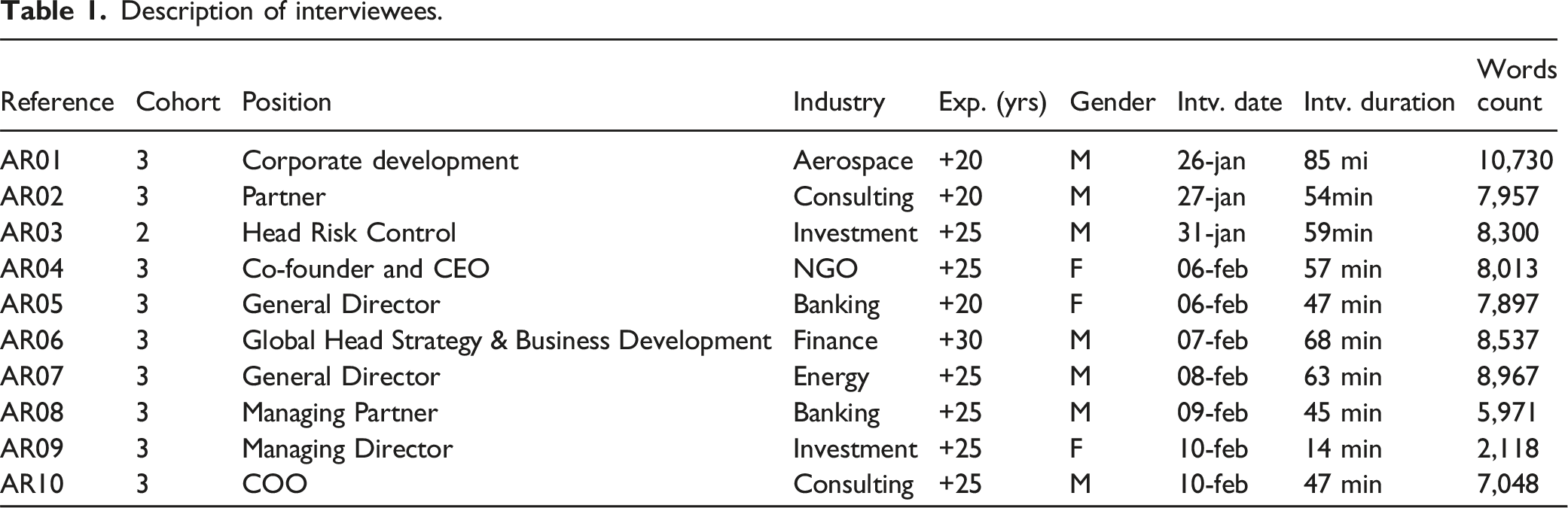
The vast majority of interviewees hold the most senior positions in their organizations, consonant with the fact that over 80% of candidates in the DBA program hold C-suite positions in their firms. Furthermore, candidates belong to some of the largest companies in Spain in their respective industries, many listed on the stock exchange. Precisely the people whose active participation, or at the very least support, is critical for the successful undertaking of any AR project, especially in the context of large companies.
Of particular importance are the reasons our sample of senior managers had for enrolling in a DBA. The DBA is not an official degree in Spain -where only the Ph.D. is recognized- and cannot give access to academic positions. Consequently, access to an academic career was not among the reasons interviewees gave for their enrolment. The interviewees appreciated the program’s combination of academic rigor with a practical approach, and, consistent with the existing literature (Creaton & Anderson, 2021), the source of value unanimously reported was the contribution to individual self-actualization. The DBA filled their need to continue learning and to face intellectual challenges. Most interviewees also agreed on the DBA program’s value to their professional careers, helping them grow or diversify activities (including consulting or teaching opportunities). Some considered it could benefit their companies, industries, and society. The research of most DBA candidates concerns itself with issues in the industries in which they work and, in some cases, their own organizations.
To the best of our knowledge, this is the first empirical investigation into the views on IAR of potentially interested executives before deciding whether to undertake the project. The nature of the sample (top managers in predominantly large companies) and the time of the interview (while enrolled in a professional doctorate, but before deciding whether they even want to embark on an IAR project) are unfamiliar to the literature. However, gathering the perceptions of such a sample on the challenges and advantages of IAR is especially relevant for promoting this methodology. Whereas questioning practitioners already involved in IAR projects may lead to proposals that help successfully conduct IAR, if we want more IAR projects to be undertaken, we need to address the positive and negative elements that go into an insider’s calculation of whether such a project is worth it before embarking on it. This can only be achieved by asking practitioners when they make that choice. Thus eliciting the views of those who think the endeavor is worth it and those who do not. Furthermore, the perceptions of benefits and costs of AR that senior managers may have are important not only in their role as potential insider action researchers but also as insiders in a conventional AR project or, even if not involved as part of the AR team, as a key stakeholder whose approval must be gathered before any AR project may commence.
Data Analysis Method
Following McLellan et al. (2003), interview transcription was carried out, and its quality and truthfulness were guaranteed by a second-person double-check. Then, in-depth category and interpretative content analysis of our interviewees’ responses were conducted, and coding was done by extracting the concepts and identifying the categories (Corbin & Strauss, 2008) with the help of NVIVO software. Literature review and script elaboration allowed the research team to identify some categories as the basis for interview coding, all divided into sub-categories. The main categories were Reasons for DBA, Thesis, Insider AR in the thesis, Individual issues, Organizational issues, Methodological issues, Preunderstanding, Managing role duality, Managing organizational politics, and Inquiry practice. The coding process helped researchers identify the nodes central to answering the research questions and disregard others. The primary central nodes were Suitability of IAR,Preunderstanding, Managing role duality, Managing organizational politics, and Inquiry practice. The content was extracted, evaluated, and compared among the different interviews. Findings were documented by detecting alignment or discrepancies in interviewees' responses.
Findings and Discussion
We obtained two kinds of results from the codification of the interviews, which we discuss below. Results (i) on the suitability of the IAR methodology to a DBA program; and (ii) on the challenges to IAR, some confirming the established academic consensus and some that can be considered new contributions to the literature.
Suitability of IAR in a DBA Program
Interview quotes about suitability of IAR in a DBA program
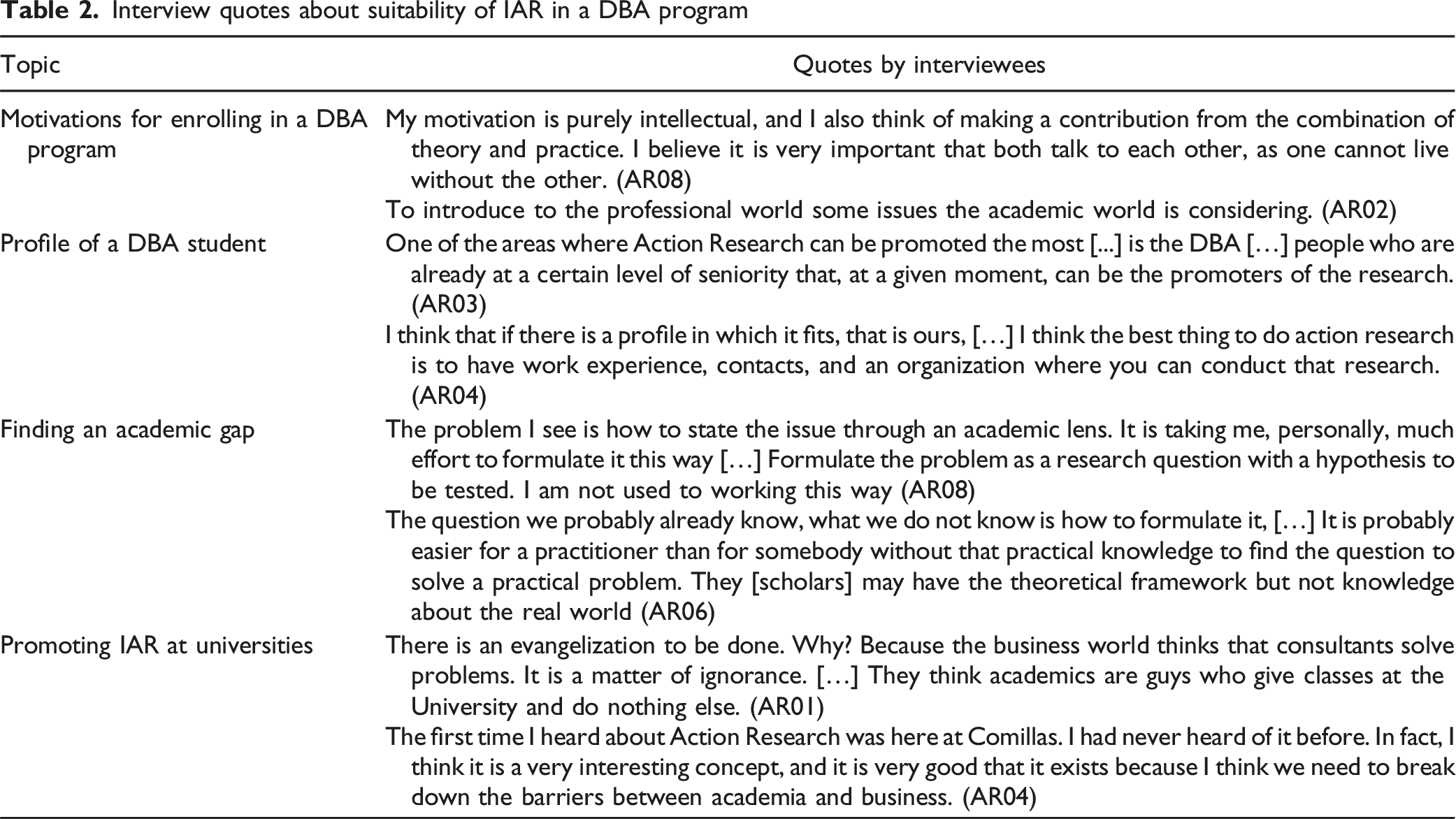
Moreover, the general perception of interviewees is that the profile of a DBA student is the most conducive to IAR. This perception aligns with the extant literature that reports projects being researched in DBAs are, in most cases, specific managerial issues being experienced by organizations at the time (Banerjee & Morley, 2013) with the expectation that the research would lead to a change in management practice (Bourner et al., 2000) through the application of the research findings of the DBA candidate (Bareham et al., 2000). Indeed, some DBA programs already teach the AR methodology, considering it more suited to practice-oriented research (Banerjee & Morley, 2013).
Although candidates’ views on the difficulty of finding a research question that addresses an academic knowledge gap relevant for practice are varied, most were comfortable with the second part and thought finding an academic gap was more of a challenge. This difficulty underscores the critical role of the dissertation advisor in guiding students through this complex task, emphasizing the necessity of the specific training provided by the doctoral program. Coghlan et al. (2019) noted that candidates must formulate research questions that can be explored through active engagement in the field. This articulation is pivotal in bridging the gap between theoretical knowledge and practical application, requiring the support and direction of experienced advisors to be effectively navigated.
Furthermore, according to interviewees, universities should act as ambassadors of the IAR (and indeed the more general AR) methodology, stressing its role as a way to bridge the gap between practice and academia. A DBA program is the ideal context for this. Through education and training, universities can promote IAR as a research methodology for candidates' dissertations and communicate adequately to firms what an IAR project is, its differences from consulting work, and the advantages of the methodology for the companies involved. Promoting IAR amongst the kind of practitioners required for its successful implementation further underscores the potential value academia can add to solving relevant real-world problems.
Perceptions About the Four challenges to IAR
Interview quotes confirming aspects of the four challenges of IAR identified by the extant literature.

Interview quotes about new contributions to the perception of the four challenges.

A relevant contribution from these interviews is the relative weight senior managers give to each of the four challenges to IAR. Interviewees considered role duality and managing organizational politics the most concerning and dedicated most of the interview time to discussing them.
Interviewees recognized the advantages and disadvantages associated with pre-understanding, but almost all interviewees in our sample agreed that the advantages outweighed the disadvantages. To the best of our knowledge, this is the first reported evidence of a valuation of the balance between advantages and disadvantages that pre-understanding brings to IAR.
In line with the extant literature, candidates perceived that role duality could result in a conflict. Of particular interest is the answer from interviewee AR03 (see Table 4), who recognized that the conflict, if present (for example, when there is pressure to obtain a particular result), would be resolved on the side of the practitioner and not the researcher. Given that almost all of our sample chose to enroll in the DBA for intellectual reasons and are likely to maintain their careers as practitioners, this is likely a general concern. This issue highlights the necessity of continuous dialogue with the dissertation advisor. Coghlan (2007) emphasizes that such interaction brings together different perspectives and enables the practitioner-scholar to navigate a process of inquiry, reflection, action, and theorizing.
Probably, the most important issue for managers involved in IAR who want to progress in their organizations is managing organizational politics (Coghlan, 2007). Thus, gathering the views of senior managers, who deeply understand those politics by their position and career progression, is particularly relevant. In line with the existing literature, interviewees were concerned about resistance to change. An answer from AR07 (see Table 4) qualifies this point by highlighting the issue that when an organization aims to discover opportunities for improvement, these can, by their very nature, be conceived as mistakes that need rectification. This conceptualization leads not only to the already identified resistance to change but also to the search for a scapegoat, generating stress and defensiveness amongst the people involved in the processes to be improved.
A second important issue for many of our interviewees (AR01, AR06, AR07, AR08, and AR09) is the risk of peers or supervisors thinking the researcher dedicates too much time and resources to a 'pet research project' instead of working. Recognizing the weight our interviewees place on the opinions of peers and even subordinates is crucial. One might think that because all of them hold very senior positions in their organizations and often require no additional approval to undertake the project but their own, they would not put much stock in the views of others. It appears this is not the case. Probably, candidates -especially those in large organizations where internal politics are complicated and the balance of power is in constant flux- do not want any perception of abuse of power. This may occur if colleagues think they are using their position to divert company resources to projects in which they hold a personal interest.
The quotes from Table 4 that support the previous argument could alternatively be interpreted in terms of differences in cost-benefit calculations of an IAR project introduced by the seniority of insiders. Top management’s time and attention span is a limited and valuable resource. More valuable, the more senior a manager is. As long as undertaking a project using IAR methodology is more time-consuming and/or requires more attention on the part of the manager, the additional benefits from using IAR must be more significant for more senior practitioners, as the opportunity cost of their time and attention is higher.
The third insight about managing organizational politics all interviewees agree on is that a clear and transparent definition of the IAR project’s scope, resources, and objectives may alleviate some of the abovementioned concerns (see Table 4). In order to solve these problems, the research question must be relevant to the firm, as is the consensus in the established literature (Alfaro-Tanco et al., 2023; Coghlan, 2007), and the candidate should have the skills to convince other stakeholders of this relevance.
The above discussion underscores the need for doctoral programs focused on practitioners to help foster their communication skills. Alongside the ability to present the complexity of the research in ways understandable to practitioners and academics (Coghlan et al., 2019), practitioner-scholars should develop the capability to effectively communicate the benefits of the (change) project at all levels of seniority within the company. This type of communication will help avoid the perception of the IAR project as a personal campaign.
Concerning the formation of the community of inquiry that the literature considers key to a successful IAR project (Coghlan et al., 2019), our interviews reveal that its potential members may be more motivated by creating and disseminating knowledge as part of an IAR (and more generally AR) project than by the usual incentives to participate in consulting projects (see Table 4).
Interviewees agree with the extant literature on the dissertation advisor’s role in establishing a rigorous approach to research and minimizing bias. They attach particular importance to creating a forum where they can share experiences with other DBA candidates whom they recognize as scholar-practitioners like themselves, with the same outlook and facing the same problems. This proposal is aligned with Coghlan’s (2007) suggestion that participants should regularly present progress reports to their class group and faculty.
Interviewees also mentioned the importance of guides and protocols for first-, second-, and third-person inquiry practice, which aligns with Coghlan (2019) and should inform DBA training dynamics. However, their discussion focused on the efficiency gains these protocols could generate, especially regarding time savings, which are essential to candidates who maintain demanding careers while pursuing the DBA.
Proposal
This section details our proposal to reduce the industry-academia gap by promoting IAR in doctorate programs focused on practitioners, such as a DBA. The DBA provides a setting that allows practitioner-scholars to appreciate academia’s role in resolving relevant real-world issues, contributing to the “cooperative eye-to-eye relation between the university and the company in which the Ph.D. thesis is carried out” (Alfaro-Tanco et al., 2023, p. 795) that constitutes a success factor for doctoral theses based on any kind of AR (including IAR).
Actions universities can undertake to promote IAR.

The implementation of this proposal will contribute to closing the university-academia gap through two channels. First, it will foster the use of IAR in DBA dissertations. Second, it will add IAR and AR to the methodological toolkit of practitioner-scholars who may employ this methodology in the future, even if they write their dissertation using other methods.
Education and Training
Education is critical to promoting IAR-based dissertations. However, it is also paramount to integrate IAR and AR as part of the practitioner-scholar methodological toolkit, even for those who do not intend to use these methodologies in their dissertations. As interviewees suggest (see Table 2), senior managers trained in these methodologies by the DBA can act as ambassadors of the methodologies in their organizations. They can foster all kinds of AR later in their professional life when deciding to participate in or even approve an AR project and serve as advisors on IAR-based dissertations. It is crucial to make students aware that some of the concepts used in IAR (such as first-, second-, and third-person inquiry modes) can be very useful to managers in their day-to-day jobs, even if they are not pursuing an IAR project.
The need for training in AR has already been pointed out by previous literature (Alfaro-Tanco et al., 2023; Avison et al., 2018). However, our experience running a DBA program leads us to posit that candidates need different kinds of training at different moments throughout a DBA program and that training timing is critical. Given the hectic nature of a typical senior manager pursuing a DBA while working a full-time job, training must be provided early enough to help in decision-making but close enough to the moment when choices must be made.
At the program’s start, candidates first need information to choose a research question and then decide whether IAR is the appropriate methodology for them. This is the time for introductory training that brings AR and IAR to candidates’ attention. Before deciding whether to use IAR as a methodology (or meta-methodology), candidates must be provided with a detailed description of the challenges associated with IAR and the typical strategies to overcome them. This will help them with immediate choices regarding their theses and later in their professional life when deciding to participate in or approve an AR project. According to our interview results (see Table 4), special attention must be given to challenges emanating from managing politics and the dual role of the insider action researcher.
Considering the senior profile of DBA candidates, we believe that using examples and case studies as a teaching methodology after a short introduction to IAR would bring significant benefits. Showcasing issues actual IAR research projects have faced that can help candidates assess the risks for their investigation associated with pre-understanding, role duality, ethics, and organizational politics, and the need for a rigorous process of reflection to ascertain them. The work of Marin-Garcia et al. (2022) and Perea and Brady (2017) recognizes the important role that case reports can have in bringing research results closer to business practitioners.
Candidates are generally confident they can find gaps in practical knowledge, but they recognize that it is a struggle for them to frame issues using an academic lens (see Table 2). The fact that a problem is relevant for practitioners does not immediately mean that it has the potential to generate new academic knowledge. The results of our study show that this is a significant challenge for DBA candidates. Therefore, it is crucial to provide them early in the program with general training on identifying an academic knowledge gap and framing problems, innovation opportunities, or other organizational issues identified in practice into generalizable research questions.
Once candidates have decided to embark on an IAR dissertation and have an approved research proposal, they advance to the research phase of the DBA. Training at this stage should focus on how to conduct an IAR project successfully. Interviewees value the provision of guides and protocols for this (see Table 4). The DBA program will initially refer candidates to the works of Coughlan and Coghlan (2002, 2009), Coghlan (2019), or Zhang et al. (2015) as a general basis for guiding them in the completion of their IAR project. As the number of theses using the IAR methodology grows, frequently asked questions and best practices will be compiled and made available as supplemental protocols.
The role of the Dissertation Advisor and Other Faculty
Dissertation advisors play a critical role in successfully completing an IAR-based dissertation. Given interviewees’ lack of confidence in framing their research questions (see Table 2) in academic terms, the advisor’s first role should be to offer individualized help alongside the program’s team to guide candidates through the process of settling on a research question that is relevant from both the practical and academic points of view, helping them translate a real-world organizational issue into a research question that addresses a gap in the academic literature. In contrast, in some other Ph.D. programs, candidates adhere to an established academic research agenda. This situation has several consequences for the program, in line with Coghlan et al. (2019). First, the dissertation advisor must be aware that a problem being relevant for practitioners does not immediately mean it has the potential to generate new academic knowledge. Second, given that practice-inspired research opportunities do not map easily over academic areas, the dissertation advisor or other faculty member advising candidates while settling on a research question must have a cross-disciplinary perspective.
Furthermore, our experience suggests that dissertation advisors could counsel candidates on the effects of confidentiality and potential conflicts of interest identified by the literature and confirmed in our interviews (see Table 3) on the research questions being considered, helping them choose wisely.
Following Coghlan (2007) and our interview results (see Table 4), we propose that candidates regularly present reports on their progress to a working group of interested class members, dissertation advisors, other faculty, and guest experts. These presentations should not merely be reports on events but be true first- and second-person reflections on the challenges to IAR implementation candidates have faced and how to deal with them. Three primary benefits result from these presentations: regular follow-up of the progress of the theses (identified as a success factor in Alfaro-Tanco et al., 2023), tempering the inherent biases of IAR while maximizing the benefits of its access (Coghlan et al., 2014; Saabye et al., 2022), and learning from the experiences of their peers. In this process, the dissertation advisor is critical in helping insiders maintain objectivity and navigate the potential challenges associated with role duality and organizational politics management. Especially if we take into account that our interviewees recognized that if faced with a conflict between their dual roles, this would be resolved on the side of the practitioner and not the researcher (see Table 4).
Communication
Based on the results of our interviews (see Table 4), as mentioned in the previous section, we conclude that communication of the project at all levels within the company plays a key role. Interviewees were concerned that others in the organization may consider the IAR research a 'pet project' of the insider, which has significant implications for promoting IAR and, more generally, AR. Having a “change project” (Coghlan, 2007, p. 303) that is relevant for the firm will not be enough. Successful undertaking of any kind of AR project will require an evangelization effort that encompasses the whole organization and will probably necessitate training the project’s insider in communicating with others at all levels of seniority within the firm (superiors, peers, and even subordinates, whether involved in the project or not) and incorporate the design of an effective and transparent communication strategy.
Once the research yields results, the communication strategy should focus on knowledge transfer. The advisor and the DBA scientific community are essential in helping the candidate transfer the knowledge created to the firm and the wider industry. Publication in practitioner journals, conference presentations, and visibility in professional media are all avenues for this transfer, allowing for the presentation of the complexity of the research in ways understandable to practitioners and academics (Coghlan et al., 2019). This is, in fact, one of the stated aims of DBA programs in general (Bareham et al., 2000) and the way to ultimately bridge the gap between university and industry and promote the use of the IAR methodology amongst practitioners. Furthermore, being presented with successful IAR projects can help candidates see the advantages of the methodology firsthand. Practitioner-scholars do not only need to communicate knowledge to the industry but also to the academic world. The experiences of DBA candidates published in academic journals using academic language can fill gaps in the literature that would otherwise be overlooked.
Conclusions, Implications and Limitations
By eliciting practitioner-scholars’ views, our study concludes that DBAs are suitable programs for IAR, stressing the methodology’s potential to bridge the rigor-relevance divide. Furthermore, universities should act as ambassadors of IAR, underscoring the value academia can add to solving relevant, real-world problems. In order to promote IAR, the three key elements universities should focus on are education and training, the role of the dissertation advisor and faculty, and communication.
Our paper contributes to the theory of IAR and the practice of DBAs.
We provide empirical evidence that senior practitioners think the four challenges identified by the extant literature to the implementation of IAR projects are also relevant ex-ante, with some nuances, and take them into account when deciding whether an IAR project is worth undertaking. Furthermore, we also provide evidence that, for this calculation, issues surrounding role-duality and managing organizational politics are the most concerning, while pre-understanding is considered net positive.
We contribute to the practice of DBA programs by proposing a detailed series of actions that universities can undertake to promote IAR by fostering its use in DBA dissertations and integrating it as part of the practitioner-scholar methodological toolkit, even for those who do not intend to use this methodology in their dissertations.
This paper has significant implications for university-business relationships. Our proposal will help practitioners become aware of a methodology that will allow them to meet the managerial challenges currently facing businesses more rigorously. At the same time, universities benefit from increased access and a source of relevant research questions that would otherwise remain unasked, thus contributing to closing the gap between industry and academia.
This paper contains some limitations that could be addressed in further research. The study has been carried out in a specific program at a specific university in Spain using ten semi-structured interviews. It could, therefore, be extended to different universities and countries, thus increasing sample size and heterogeneity. Finally, implementing the proposed measures within the Comillas DBA will allow us to investigate their impact on the gap between relevance and rigor in the practice of DBA students.
Footnotes
Declaration of Conflicting Interest
The authors declare no potential conflicts of interest with respect to the research, authorship, and/or publication of this article.
Funding
The author(s) received no financial support for the research, authorship, and/or publication of this article.
Ethical Statement

Data Availability Statement
The datasets generated during the current study are not publicly available due to confidentiality clauses in the consent documents signed by interviewees. A suitably anonymized version of their contents is available from the corresponding author on reasonable request.