




Abstract
The Epistemic Competence of the Researcher is a critical success factor for ethical, rigorous, and creative research performance, but it requires a deep epistemological and methodological mastery, however, the current scientific literature has not yet achieved a conceptual arrangement, that allows researchers and educators to have a comprehensive theoretical framework for a holistic understanding of this competence. The objective of this study was to build a comprehensive theory on the epistemic competence of the researcher. A qualitative approach was used, deploying an open interview and the grounded theory method. Ten experts in social science didactics from 7 Latin American universities and 3 Spanish universities participated. The interviews were processed manually and with the support of ATLAS.TI software, finding 23 emerging categories that were contrasted with the results of a term co-occurrence network of 6081 studies imported from Scopus. From the cross-check of empirical and theoretical results, the following concepts were selected to coincide. Finally, the theoretical framework established was made up of the following concepts: 1.- knowledge building and conceptual change, 2.- epistemological beliefs, 3.- concept mapping and knowledge creation, 4.- conceptual understanding, 5.- conceptual framework, 6.- concept formation, 7.- epistemic beliefs, 8.- science education (learning science and science teaching) 9.- cognitive complexity, 10.- personal epistemology, 11.- virtue epistemology, 12.- formal logic, 13.- epistemic cognition, 14.- nature of science, 15.- epistemic emotions. A proposal for teaching and learning science from this epistemic perspective is established. Future studies should continue to explore the concepts and categories that this work leaves open.
Keywords
This study stems from an international project with the mission of providing innovative didactic orientations to guide the logic of scientific research (research practice) and the logic of scientific text (scientific writing), specifying concrete routes for reflection and action (Deroncele-Acosta, 2022). Given this, especially for the guidance of research at the master’s and doctoral level, counselors need a more comprehensive understanding of the methodological, axiological, praxeological, ontological, and epistemological bases of the researcher’s epistemic competence, which is the integrating nucleus. A broader framework is needed to operate, however, today the scientific literature does not sufficiently provide an organized and detailed systematization of these bases, hence the decision to develop this study, to capture the essence of the researcher’s epistemic competence.
Delimiting the scientific epistemological context of the Researcher’s epistemic competence (REC) allows to broaden the analytical framework to achieve a more comprehensive vision in its approach and to make informed decisions with a positive impact on the didactics of research and on the research process itself. Research processes, especially in the social sciences, are increasingly broad and complex, requiring the development of REC to have a critical, proactive, and creative approach to this diversity of topics and lines of research. The epistemic competence of the researcher is directly related to research competence; however, it has its specificities as it constitutes a meta-reflective strategy for the creative, critical, and proactive contextualization of research, being a tool for research that is concretized in reflective research performance.
By legitimizing the interdisciplinarity associated with the concept of epistemic competence, we are dealing with a complex construct, that deserves a more comprehensive approach that allows transcending epistemic circularity (Sosa, 2007, 2009), and disciplinary biases (Hofer, 2000). However, the area of social sciences is predominant, especially from the disciplines of philosophy and psychology, a high percentage is managed from other fields, so a comprehensive review allows a more comprehensive view, providing feedback on the current knowledge that researchers and educators have about REC.
From the above, it is even possible to access the understanding of false epistemic beliefs (Perner et al., 2023), to avoid possible biases in the research process; in this regard, the scientific literature demonstrates relationships between scientific epistemic beliefs, conceptions of science learning and self-efficacy in science learning (Tsai et al., 2011), Therefore, it is projected that epistemic competence has potential for the didactics of research, for which it must incorporate instruction in scientific argumentation. (Nussbaum et al., 2008), focusing on the interplay of science teaching and learning (Geelan et al., 2021; Larkin, 2022), and recognizing the role of epistemic emotions in personal epistemology and self-regulated learning (Muis et al., 2018).
Leading Authors in Specific Research on Epistemic Competence.
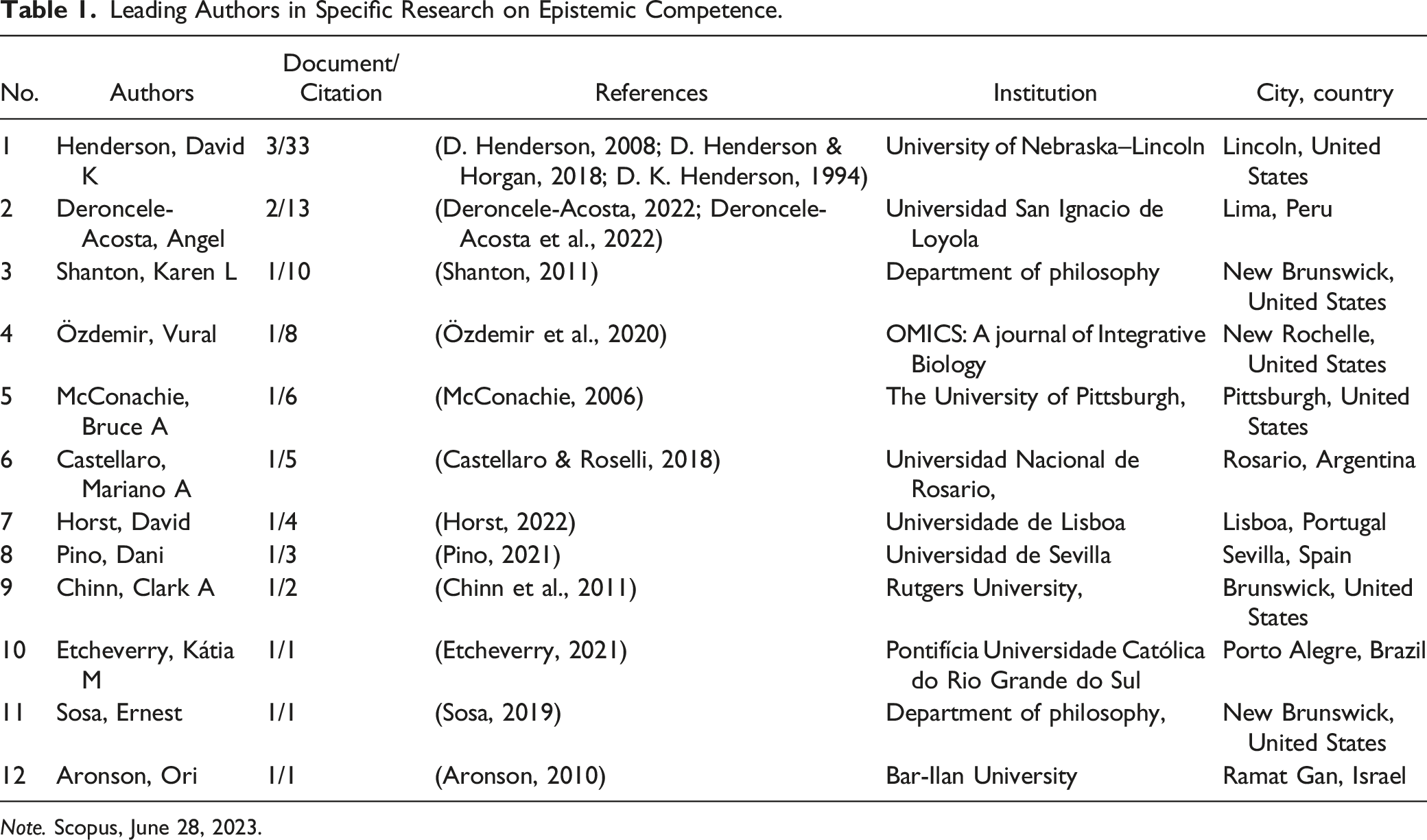
Note. Scopus, June 28, 2023.
This field of study is relatively new, and so far, few scientific productions specifically address this topic. Research in this area is in its early stages, and it is expected that more significant contributions will be generated in the future as the scientific community explores and deepens this emerging field. With only 19 studies stating “epistemic competence” explicitly in the title, the production is scarce and unstable, since the first study by Henderson in 1994 (D. K. Henderson, 1994) five continuous years of production have been achieved for the first time in the period 2017-2022
Methods
The present research was developed from a qualitative approach because of its relevance for the examination of the meanings and meanings, as well as the dialogic interaction between the participants in the study. The grounded theory method was used, considering that deep interactions are a prerequisite for the interpretation of qualitative data, in particular, in the generation of grounded theory (Maher et al., 2018). It is argued that through a process of symbolic interactionism, in which generations of researchers interact with their context, moments are formed and philosophical perspectives are interpreted in a manner congruent with the essential methods of grounded theory, this is called the methodological dynamism of grounded theory (Ralph et al., 2015).
Several rigorous methodological strategies were adopted to ensure reflexivity and reliability during the study. In terms of reflexivity, researchers kept a field diary where they recorded their thoughts, interpretations, and possible biases throughout the research process. This allowed for constant self-evaluation and adjustment of perspectives to minimize the influence of personal biases in interpreting the data. In addition, periodic meetings of the research team were held to discuss and reflect on emerging findings and methodological decisions, promoting a critical and collaborative view of the research process.
Regarding reliability, triangulation methods were used for both data and researchers. Qualitative data obtained through open-ended interviews were contrasted with an analysis of the co-occurrence of terms in a database of 6081 studies imported from Scopus, which allowed corroboration of emerging findings from multiple sources of evidence. In addition, the use of ATLAS.TI software for qualitative data analysis facilitated systematic and replicable coding. The participation of ten experts from various universities also contributed to the reliability of the study, as it provided a diversity of perspectives and experiences that enriched the analysis and interpretation of the data. In addition, a thorough review of the existing literature was conducted to ensure that the emerging categories were consistent with previous theoretical knowledge, thus strengthening the validity and robustness of the theoretical framework developed.
Participants
Ten experts in social science didactics were interviewed, 5 women and 5 men, 7 from Latin American universities and 3 from Spanish universities, all of them PhDs, with more than 15 years of experience in thesis advising and teaching research, and with a great passion and openness to reflect on research.
To clarify what we mean by social sciences, we begin with the recognition that several social science disciplines are currently recognized (Petticrew & Roberts, 2008) and although there are also recognized boundaries between them, there is a consensus that the social sciences include economics, political science, sociology, anthropology, psychology, human or social geography, history, among others (Bainbridge, 2003; Lamont & Molnár, 2002) its importance in the explanation of social behavior (Elster, 2015). At the same time, we recognize that the social sciences are not free from methodological biases (Podsakoff et al., 2012), Therefore, we believe that the epistemic competence of the researcher can offer a solid framework to confront these biases and continue to open the way towards a more solid, rigorous and reflexive social research.
The participating experts are from the following areas: psychology, sociology, anthropology, history, political science, economics, education, communication, demography, and geography. It is worth noting that two of the experts, in addition to the above, have extensive experience in philosophy and philosophy of science, which contributed greatly to the study.
The experts positively viewed diversity in their disciplinary backgrounds as a crucial element to ensure a wide range of perspectives in the study. In selecting the participants, we sought to include professionals from different universities in Latin America and Spain with diverse specialties within the social sciences and didactics. This disciplinary diversity allowed the analysis of the researcher’s epistemic competence to benefit from multiple approaches and experiences, enriching the final theoretical framework.
Precisely, the experts recognized this diversity as a strength and a positive element of the study. The participants, although they have extensive experience in their respective fields, valued the opportunity to incorporate the experiences and knowledge of their colleagues, which led to the formation of an epistemic community. In this community, the constructs were based on both the personal experiences of each expert and the collective learning derived from group interactions. Mutual respect was meticulously guarded, ensuring that no criteria were imposed and that everyone felt free to express their opinions. This collaborative and open environment facilitated an enriching exchange of ideas, promoting a deep and multifaceted analysis of the researcher’s epistemic competence.
Instrument and Procedure
The interview technique was used as a vehicle for theoretical sampling in grounded theory, especially from the integration of co-construction of interview data and grounded theory (Foley et al., 2021). The following moments were designed for this purpose:
1. Epistemic-referential dimension 2. Semiotic dimension 3. Hermeneutic dimension 4. Procedural dimension 5. Dimension of scientific-research leadership.
Ethical Considerations
The ethical considerations of the study were rigorously addressed to ensure integrity and respect for the participants. Regarding confidentiality and data protection of the participants, it was ensured that all information provided during the interviews was treated anonymously. The names of the participants and any identifying data were encrypted and securely stored to avoid any possible identification. Only members of the research team had access to the coded data.
Informed consent was an essential component of the ethical process. Before participating in the study, each expert received a detailed explanation of the research objectives, procedures, and intended use of the data collected. They were provided with a consent form detailing their rights as participants, including the right to withdraw from the study at any time without any negative repercussions. Participants signed this form to indicate their understanding and acceptance of the conditions of the study.
As part of the ethical procedure, a mutual agreement was established for periodic meetings between all study participants. This agreement was reached through a process of consultation and coordination that considered the availability and preferences of each expert involved. Meetings were planned and scheduled at times that were convenient for all participants, considering the different time zones of the Latin American and Spanish universities represented in the study.
Results
The
From the solid foundation provided by the first moment, we transitioned to the 1. How would you define the epistemic competence of the researcher? 2. What do you consider have been the most relevant challenges in your research career and your research teaching work? How have you addressed and overcome them? 3. What are the fundamental knowledge and skills that a researcher must possess to develop a solid epistemic competence? How do you approach the transmission of these elements in your role as a teacher or advisor? 4. How do you integrate the ethical dimension into your research work and research teaching? Can you provide specific examples of ethical situations you have faced and how you have managed them to preserve scientific integrity? 5. What would be the qualities of a scientific research process from an epistemic perspective? How would you describe the attitude of a researcher with solid epistemic competence?
After the analysis of the interviewees’ responses came the The semantic network of emergent categories processed with ATLAS.TI.
In the central and left part of the ATLAS.TI semantic networks are in the emerging categories that coincide with the theoretical concepts found in Scopus. For the theoretical comparison Term co-occurrence network of 6081 studies imported from Scopus.
At the same time, we have identified an important group of concepts, which although they have a lower level of relationship with epistemic competence than the previous ones, future studies could go deeper into them, especially because of their direct connection with the teaching-learning of science, this starts with the concept of science itself and goes through other important concepts such as epistemology, collaborative learning, collaborative research, learning communities, interactive learning environments, scaffolding, design-based research, reflective evaluation, epistemic reflexivity, epistemic reflexivity, epistemic thinking, engagement, critical thinking, epistemic agency, epistemic attitude, metadiscourse, semiotics and logic.
Discussion
For the discussion section, only the concepts that coincided with the theory were taken from the interview
Knowledge Building and Conceptual Change
Current science needs to continue to develop, so researchers must be willing not only to look at science from a contemplative perspective, but also to be willing to increase existing knowledge, this sometimes implies transcending traditional aspects and moving towards innovative aspects, so it is important to think of decolonizing methodologies as a resource for knowledge construction and conceptual change. In this sense, decolonizing methodologies imply questioning the dominant conventions in research, thus an incremental approach to the research process and the subsequent knowledge generated provides the opportunity to challenge the conventions that typically dictate research praxis (Lipscombe et al., 2021), which may allow for the construction of new theories (Subramani, 2019) and thus generate theoretical contributions with practical utility and scientific usefulness (Corley & Gioia, 2011). A recent study outlines these two terms in a related way: knowledge construction and conceptual change, revealing the strategy of self-explanation as a crucial element. These authors identified four self-explanatory approaches: restricted explanations, elementary explanations, inferential explanations, and strategic explanations. The findings suggest a relationship between the type of example worked, students’ approaches to self-explanation, and their conceptual change and problem-solving skills. (De La Hoz et al., 2023).
Knowledge Building
The concept of knowledge construction transcends the traditional approach to education centered on the acquisition and reproduction of information. It focuses on promoting higher cognitive skills, such as critical thinking, problem-solving, effective communication, and metacognition, to foster a deeper understanding of issues and collaboratively enhance knowledge. This approach is based on the premise that human knowledge is collaborative and dynamic, where people work together to create, share, and improve knowledge in a learning community “collective epistemic state” (Deroncele-Acosta et al., 2022). Knowledge building involves researchers not only focusing on their own interests or individual projects, but actively and openly collaborating with other colleagues to share ideas, information, findings, and theories. This approach fosters a collective mindset of continuous knowledge improvement. Some key aspects include: 1.- sharing and collaboration; 2.- dialogue and discussion, 3.- joint review, 4.- continuous construction, and 5.- focus on meaningful problems.
Conceptual Change
In the field of researcher epistemic competence, conceptual change refers to the process by which a researcher modifies or replaces his or her previous conceptions, beliefs, or mental models on a specific topic with new, more accurate, and coherent concepts or understandings. It involves being open to considering new evidence, theories, or perspectives that may contradict or extend previous conceptions. Researchers, like any individual, may have preconceived ideas, assumptions, or ingrained beliefs about a topic, and conceptual change involves the willingness and ability to review and revise those beliefs in the face of new information or stronger arguments. Some key aspects of conceptual change in the field of epistemic competence of the researcher include 1.- openness to change, 2.- evaluation of scientific evidence, 3.- revision of mental models, 4.- reflective thinking, and 5.- motivation. In this regard, an interesting study offers an analysis that goes beyond “cold conceptual change” and emphasizes the role of motivational beliefs and classroom contextual factors in the process of conceptual change. (Pintrich et al., 1993), but moreover, this is not even a single phenomenon, but rather scientific evidence reflects “various forms of collective and individual conceptual change, particularly in the history of science and the corresponding approaches to science education” (Van Haaften, 2007, p. 59). Four general motivational constructs (goals, values, self-efficacy, and control beliefs) are suggested as potential mediators of the process of conceptual change. In addition, there is a discussion of the role of classroom contextual factors as moderators of the relations between student motivation and conceptual change. The article highlights the theoretical difficulties of a cold, or overly rational, model of conceptual change that focuses only on student cognition without considering how students’ motivational beliefs about themselves as learners and the roles of individuals in a classroom learning community can facilitate or hinder conceptual change (Pintrich et al., 1993, p. 167)
Concept Mapping and Knowledge Creation
Knowledge creation and concept mapping are closely related to the processes of conceptual understanding, conceptual framework, and concept formation. In the field of research epistemic competence, conceptual understanding, conceptual framework, and concept formation are interrelated processes in the way researchers acquire, develop, and organize knowledge in their area of study. A recent study mentions that, although there are ways to help students apply and develop their understanding of scientific concepts, there is a need to continue deepening (Subramani, 2019), therefore, the idea of continuing to nurture a model-based pedagogy in conceptual understanding to promote scientific reasoning skills and attitudes towards science is sustained (Malone, 2023).
A deep understanding of a concept (conceptual understanding) can be generated in and from the structure that organizes these concepts within a domain (conceptual framework), which in turn allows the acquisition and development of new concepts (concept formation). The following is a comprehensive explanatory synthesis of these processes from the systematization and resignification of established scientific knowledge.
Conceptual Understanding
Conceptual understanding refers to a deep and meaningful understanding of fundamental concepts and principles in a field of study. Researchers who have a solid conceptual understanding of their field understand the key concepts, their relationships, and their relevance in the broader context of the field. This understanding goes beyond simply memorizing definitions; it involves the ability to apply, explain, and relate concepts in different situations and contexts. Researchers with a good conceptual understanding can use knowledge to solve complex problems, generate new ideas, and formulate meaningful research questions. It is a solid foundation for developing rigorous research and contributing to the advancement of knowledge in their field.
Conceptual Framework
The conceptual framework refers to a theoretical and conceptual structure that guides research in a specific field. It is a way of organizing and relating concepts, theories, and variables to better understand a particular phenomenon or problem. It provides a solid basis for the research design and interpretation of the results, allows delimiting the scope of the study, identifies the scientific categories or key variables to be studied, and establishes logical relationships between the different elements of the research problem. It also helps to situate the research work within the existing theoretical context and provides a guide for developing hypotheses or research questions.
Concept Formation
Concept formation refers to the process by which researchers acquire new concepts and categories in their field of study. It involves recognizing and classifying the shared characteristics and attributes of different objects, events, or phenomena to group them into meaningful categories. This process of concept formation is fundamental to the acquisition and development of knowledge in any field of study. As researchers acquire new concepts, they can organize and structure their knowledge, allowing them to better understand the relationships and connections between different elements in their area of research.
Epistemological and Epistemic Beliefs
In the field of epistemic competence of the researcher, epistemological and epistemic beliefs refer to the beliefs and conceptions that the researcher has about the nature and structure of scientific knowledge, as well as beliefs about how knowledge is acquired, justified, and used in the context of research. These beliefs can influence how the researcher develops his/her research, paradigms, and approaches, and can affect his/her research practice, as well as how results are interpreted, validated, and communicated. These beliefs also have an impact on the decisions the researcher makes, the methods he/she uses, and the procedures for analyzing information, and can also influence collaboration among researchers and how knowledge from other research is evaluated and integrated into one’s work, which is why it is increasingly necessary to manage learning through interdisciplinary dialogue to overcome epistemological divisions (Brown et al., 2023).
Researchers need to be aware of their own epistemological beliefs and how they may influence their work. Reflection on these beliefs can help researchers maintain an open and critical attitude toward knowledge, consider multiple perspectives, and improve the quality and relevance of their research. In this regard, important current developments such as the examination between scientific epistemological beliefs, critical thinking skills, and beliefs about the distinction between science and pseudoscience of teachers are recognized (Küçükaydın et al., 2023), the relationships between scientific epistemic beliefs, conceptions of science learning, and science learning self-efficacy (Tsai et al., 2011), and the role of epistemic beliefs and scientific argumentation in science learning, an interesting study where the results are discussed in light of instruction in scientific argumentation, conceptual development and change, and epistemic beliefs (Nussbaum et al., 2008).
Science Education
In the field of epistemic competence of the researcher, all these concepts are closely related and refer to different aspects of the educational process in the field of science. Science education refers to the general field of education that focuses on the teaching and learning of science. It involves the design, development, and implementation of educational strategies and curricula that promote understanding and mastery of scientific concepts, skills, and methods. This area of education aims to develop epistemic competence in students, that is, their ability to acquire and use scientific knowledge effectively and reflectively.
A recent book published in Scopus brings together a wide range of international studies in science education, focusing on the interaction of science teaching and learning, hence its great importance. The studies discussed in this volume focus on presenting different opportunities for teaching these complicated topics to find simplicity within complexity and make it accessible to students (Geelan et al., 2021). For this topic, an interesting study in the journal “Science Education” was also evaluated (Larkin, 2022). This study after reviewing Hewson and Hewson’s description of an “appropriate conception of science teaching”, details how the field of science education has advanced, based on Cohen’s notion of teaching as an “impossible profession”, highlights how conceptions of science teaching compete with other popular models of science teaching and learning, finally after reviewing Fenstermacher and Richardson’s distinction between successful teaching, it is shown that even science teaching that is considered successful and good remains embedded in a constrained system where well-considered classroom practices can still lead to cumulative negative consequences. The essay concludes with a discussion of complexity in science teaching, which can be incorporated in a more intentional and planned way to support the researcher’s epistemic competence for the didactics of research.
Cognitive Complexity
A recent study with great influence in the scientific community addresses executive functions and theory of mind to analyze the distinction between cognitive complexity and functional dependence, and argues that cognitive complexity is required for executive control and understanding of false beliefs (Perner et al., 2023); therefore, it is an aspect that should be developed as part of epistemic competence to avoid epistemic circularity and installed beliefs that have a direct impact on research performance and may bias the researcher’s analysis.
In the field of researcher epistemic competence, cognitive complexity refers to the level of complexity and sophistication with which a researcher approaches problems, research questions, and data analysis in his/her field of study. A researcher’s cognitive complexity is related to his or her ability to handle and understand complex information, integrate knowledge and theories from diverse sources, and apply sophisticated approaches and methodologies in his or her research work. A researcher with high cognitive complexity can critically analyze information, identify patterns and relationships, and develop deep and reflective reasoning in his or her field of study. 1.- critical thinking: the researcher with high cognitive complexity can analyze existing literature, question assumptions, and evaluate the soundness of theories and findings, 2.- synthesis and connections: the researcher can synthesize information from different sources and establish connections between different ideas, theories, and studies, 3. - creativity and originality: the ability to develop new ideas and original perspectives that can enrich knowledge in their field, 4.- advanced methodological approaches: the potential to use sophisticated and appropriate methodologies and approaches to address complex research questions, 5.- problem-solving: related to the ability to face problems and challenges in their research, proposing effective and relevant solutions.
The cognitive complexity of the researcher can significantly influence the quality and scope of his/her research. A researcher with high cognitive complexity can conduct more rigorous, creative, and valuable research for the advancement of knowledge in his or her field. In addition, cognitive complexity also relates to the ability to effectively communicate and share research results with the scientific community and the public. It is important to note that cognitive complexity is not an innate and static ability but can be developed and improved with time and experience.
Personal Epistemology
One of the most cited articles in Scopus on personal epistemology suggests that epistemological development is not a general domain and that epistemological beliefs differ according to discipline (Hofer, 2000), therefore, personal epistemology is deeply rooted in our disciplinary training (psychology, engineering, medicine, etc.) hence the importance of developing epistemic competence as an interdisciplinary competence, promoting a culture of collective epistemic dialogue (Deroncele-Acosta, 2022). A growing body of work addresses the nature of epistemological development and epistemological beliefs: how people come to know, the theories and beliefs they hold about knowledge, and how such epistemological premises are part of and influence the cognitive processes of thinking and reasoning (Hofer, 2000).
In another of the most prominent studies on personal epistemology, it is argued that the ideas individuals have about knowledge and knowing have been the subject of research programs with disparate names, such as epistemological beliefs, reflective judgment, ways of knowing, and epistemological reflection, all of which appear to be part of a larger body of work. on “personal epistemology.” Epistemological perspectives feature prominently in numerous scholarly experiences, are related to learning in a variety of ways, influence reasoning and judgment throughout our lives, and have implications for teaching. However, this work has remained outside the mainstream of educational psychology and cognitive development. This paper addresses three main questions: (1) What is personal epistemology research and how is it conceptualized? (2) How do individuals’ conceptions of epistemology relate to learning and instruction? (3) Given what we know about personal epistemology, what might educators do? (Hofer, 2001).
Some key aspects of personal epistemology in the field of epistemic competence of the researcher are related to the assumptions of epistemological and epistemic beliefs, about: 1.- objectivity and universality of knowledge, 2.- justification of knowledge, 3.- nature of scientific knowledge, 4.- role of the researcher, and 5.- change in knowledge. From this premise, the researcher’s epistemology can influence the choice of methodological approaches, the interpretation of data, how results are communicated, and the adoption of new theories or approaches in the field of study.
Virtue Epistemology
The main assumptions assumed about this theory for the present study are based on the postulates of the eminent philosopher-scientist Ernest Sosa, of the Department of Philosophy, in New Brunswick, United States. The epistemology of virtue is intimately related to reflective knowledge (Sosa, 2007, 2009), which constantly requires the practice of reflexivity from an ethical and methodological point of view in the construction of theories (Subramani, 2019), understanding the challenges involved in the act of theorizing (Hammond, 2018) to avoid the epistemic circularity that occurs when someone attempts to demonstrate or validate an idea, but that demonstration relies on the very idea that is supposed to be demonstrated. As a result, there is no true independent justification or valid argument to support the claim. In the context of epistemic competence, epistemic circularity is a major problem because it undermines the credibility and reliability of the results. Researchers should strive to avoid any type of circular reasoning, as it may lead to biased or erroneous conclusions. To avoid this, it is essential to use rigorous methods and approaches and to subject the results to review by the scientific community to ensure that the conclusions are supported by solid, well-supported evidence. Some key aspects of virtue epistemology in the field of REC include intellectual virtues, ethical values, cognitive integrity, epistemic accountability, epistemic humility, and open-mindedness.
The “virtue as skill” or “virtues” versus “skills” debate has had several approaches (Annas, 1995; Horst, 2022, 2024; Paul, 2014; Stichter, 2011, 2016), being a debate that is becoming more and more widespread in the scientific context. For our study, we assume the position of David Horst, who argues that epistemic competencies are more similar to virtues than to skills (Horst, 2022).
Este autor sostiene que las competencias epistémicas son crucial y relevantemente diferentes de las habilidades y que una persona virtuosa es alguien que está dispuesta a desempeñarse bien de manera incondicional con respecto a los objetivos característicos de la virtud (Horst, 2022). In his recent work “Moral worth and skillful action” David Horst makes us reflect on the manifestation of virtue in an unconditional manner (Horst, 2024), this suggests not only the ability to do things right, but especially to do what is ethically right; this requires emphasizing the moral compass and virtues of the individual in scientific activities, for a more ethically motivated science (Khort, 2024).
Based on the above, it is argued that the epistemic competence of the researcher is committed to truth, scientific integrity, and intellectual honesty. Epistemic competence (unconditional) cannot be equated with research ability (conditional) since epistemic competence is more holistic. It is not only based on doing (associated with skills) but also on knowing (knowledge) and being (values); therefore, this competence integrates knowledge, skills, and values. At the same time, epistemic competence is not only based on methodological elements, more directly associated with research skills, but is also based on axiological, epistemological, praxeological and ontological elements, as specified in the epistemic mapping of the researcher (Deroncele-Acosta et al., 2021) aligned to the five philosophical anchors (Ponterotto, 2005), axiology, linked to values and virtue, epistemology, linked to scientific knowledge and justification, praxeology, linked to reflective practice and action, ontology, linked to the nature of being and reality, and methodology linked to research procedures. Thus, the epistemic competence of a researcher is a complex amalgam of practical skills, theoretical knowledge, and ethical values, which together promote rigorous and morally responsible research. This holistic perspective emphasizes that excellence in research depends not only on technical ability but also on a deep commitment to the ethical and philosophical principles that guide the pursuit of knowledge, highlighting the unconditional character of epistemic competence associated with the epistemology of virtue and the conditional character of research skills, associated with the epistemology of abilities.
The Unconditionality of Epistemic Competence
Epistemic competence is unconditional in the sense that its principles and values are applicable in all circumstances of scientific research. Regardless of the context, available resources, or specific challenges that may arise, a researcher with epistemic competence will maintain a commitment to truth, honesty, and scientific integrity. This unconditionality ensures that the researcher’s actions and decisions are always guided by sound ethical and epistemological standards, without being influenced by external factors that may compromise the quality and ethics of his or her work.
Conditionality of Research Skills
Research skills are conditional because their effectiveness depends on several contextual and external factors. These skills include the mastery of specific techniques, the use of tools and technologies, and the application of experimental methods. However, their effectiveness may vary depending on the availability of resources, the quality of data, access to laboratory equipment, and the work environment. For example, the ability to perform complex data analysis may be limited if the researcher does not have access to appropriate software or a well-structured data set.
Formal Logic
Functional logic interprets the acts of thinking, applied to research, and provides us with tools to interpret scientific thought; in this regard, a recent study provides a formal logic for the theory of formal categories (New & Licata, 2023), which is of important analysis in the field of the epistemic competence of the researcher and the processes of categorical construction that are carried out from there. Formal logic as a science that studies the acts of thinking in the field of the epistemic competence of the researcher refers to a formal system of rules and principles used to reason and evaluate arguments in a precise and rigorous manner, hence more and more routes are provided to investigate that express a logic with scientific rigor (Deroncele-Acosta, 2022).
Formal logic is an important tool for researchers, as it allows them to assess the coherence and validity of statements and reasoning in their field of study. It facilitates an objective and systematic analysis of arguments and contributes to informed evidence-based decision-making. Some key aspects of formal logic in the field of epistemic competence of the researcher include 1.- identification of premises and conclusions, 2.- assessment of argument validity, 3.- detection of fallacies, 4.- structured analysis, 5.- deduction and reasoning. Formal logic is also useful in the elaboration and revision of scientific theories, the interpretation of data, and the clear and coherent presentation of research results. In this sense, formal logic provides epistemic resources for the analysis and evaluation of scientific constructs and arguments, including their re-signification.
Epistemic Cognition
One of the most prominent studies on epistemic cognition notes that psychological and educational researchers have developed a burgeoning research program on the epistemological dimensions of cognition (epistemic cognition). They point out that contemporary philosophers investigate many epistemological issues that are highly relevant to this program but have not appeared in research on epistemic cognition and argue that integrating these issues into psychological models of epistemic cognition is likely to enhance the explanatory and predictive power of these models. To this end, they propose a philosophically grounded framework for epistemic cognition that includes five components: (a) epistemic goals and value; (b) the structure of knowledge and other epistemic achievements; (c) the sources and justification of knowledge and other epistemic achievements, and related epistemic stances; (d) epistemic virtues and vices; and (e) reliable and unreliable processes for achieving epistemic goals (Chinn et al., 2011).
In the field of researcher epistemic competence, epistemic cognition refers to how researchers think about knowledge, how they acquire it, how they evaluate it, how they use it, and how they reflect on their thought processes about knowledge acquisition and use. It encompasses a range of mental processes that influence how researchers approach knowledge-seeking, decision-making, problem-solving, and assessing the validity and reliability of information. Some key aspects of epistemic cognition in the field of researcher epistemic competence include 1.- metaknowledge: The ability of researchers to reflect on their thought processes and recognize the need to acquire or revise certain knowledge to address a problem or research question, 2.- evidence evaluation: Researchers must be able to critically evaluate the quality and strength of evidence that supports a scientific argument, theory, or finding 3.- epistemic decision making: Researchers face decisions about which sources of knowledge are most valid and reliable for their research purposes and how they should approach complex research questions, 4.- knowledge application: Researchers must be able to apply acquired knowledge to address specific problems and generate new ideas or theories.
Nature of Science
The present research acknowledges the work of the author Norman G. Lederman, from the Illinois Institute of Technology, Chicago, United States, an outstanding scientist in studies on the nature of science and science education, and author of several articles on the subject. He has recently presented his work “Handbook of Research in Science Education: Volume III” which presents interesting research on the teaching, learning, and assessment of the nature of science, offering a comprehensive and cutting-edge study that highlights new and emerging research perspectives in science education (Lederman et al., 2023). The budgets of Toma and Lederman are also rescued (Toma & Lederman, 2022), who conducted an exhaustive review of instruments to measure attitudes towards science. From there, the importance of the epistemic competence of the researcher in the formative processes of research and its potential to promote these positive attitudes toward science is recognized.
In the field of epistemic competence of the researcher, the nature of science refers to the understanding and appreciation of how the scientific process operates, how scientific knowledge is constructed and what are its fundamental characteristics. The nature of science is not limited to discipline-specific scientific content but focuses on the epistemological and philosophical aspects that govern scientific inquiry.
It involves an understanding of the object, methods, values, principles, and limitations of science, which allows researchers a broader and more critical perspective on their work and that of other scientists. Some key aspects of the nature of science in the field of epistemic competence of the researcher include: 1. nature of the object: it involves knowing the structural aspects that shape the nature of the object, from an ontological perspective that addresses both the theory of that object and the history of its theory. This analysis offers epistemic resources to the researcher to determine the most coherent characteristics and ways to approach the object of science, 2. Scientific methods: to understand and apply the methods and procedures used in scientific research, including observation, hypothesis formulation, experimental design, data analysis, and peer review, 3. - review process: recognize the importance of the peer review process in validating and improving the quality of scientific knowledge, 4.- uncertainty and change: recognize that science is always subject to uncertainty and that scientific knowledge is constantly evolving and changing as new data and theories are generated, 5. - objectivity and bias: be aware of the importance of objectivity in scientific research and the need to avoid bias in the interpretation and presentation of results, 6.- values in science: recognize that science is influenced by social, ethical, and cultural values, and that these values can affect the direction and priorities of research. Understanding the Nature of Science is crucial for researchers to address research questions more rigorously and ethically, to critically evaluate the scientific literature, and to communicate their results more effectively.
Epistemic Emotions
In the field of epistemic competence of the researcher, epistemic emotions refer to the emotions and feelings experienced by the researcher in the context of the process of acquisition, evaluation, and use of scientific knowledge. An important study highlights the role of epistemic emotions in personal epistemology and self-regulated learning, specifically, they presented five antecedents of epistemic emotions and five consequences of those emotions during learning. The five antecedents are control, value, novelty, complexity, and epistemic goal attainment. The five consequences are effects on planning and goal setting, motivation, cognitive and metacognitive strategies, learning outcomes, and antecedent reviews; they then concluded with a discussion of educational implications and future directions for research (Muis et al., 2018).
Epistemic emotions express the feelings of attraction, repulsion, and even indifference of the researcher about knowledge or its construction process and play an important role in the correct acquisition of knowledge. Among the aspects that condition the researcher’s emotions, we can find: 1.- correspondence between the scientific content being valued and the research interests or needs of the individual valuing it, 2.- the personality, origin, or reputation of the author of the content being valued, 3.- the epistemological foundations or the identity of the school of reference of the authors of a given scientific result, 4.- the methodology, procedures or instruments used to obtain the scientific result, 5.- the context of publication or dissemination of the scientific results, 6.- lexical and structural characteristics of the work in which the scientific knowledge is disseminated.
Epistemic emotions can be both positive and negative and can influence the way researchers approach their work, make decisions, assess the validity of evidence, and deal with challenges that arise during their research. These emotions can arise at different stages of the research process and can affect the quality and focus of scientific work. Some examples of epistemic emotions in the field of researcher epistemic competence include: 1.- curiosity: a positive epistemic emotion that drives researchers to explore new questions and areas of study, and to seek creative answers and solutions, 2. - confidence: a positive epistemic emotion that arises when researchers feel that their methods and approaches are sound and that their findings are supported by reliable evidence, 3.- surprise: an epistemic emotion that may arise when researchers find unexpected results or contradictions in their data, which may open up new lines of inquiry, 4. - frustration: a negative epistemic emotion that may arise when researchers face difficulties, obstacles or problems in their research, 5.- skepticism: an epistemic emotion that may arise when researchers critically evaluate the claims or results of others, especially when there is insufficient evidence or support, 6.- professional pride: a positive epistemic emotion that may arise when researchers make significant advances in their field or make important contributions to scientific knowledge.
Researchers need to be aware of the epistemic emotions they experience and how these emotions can influence their approach and decisions during the research process. Epistemic emotions can provide positive motivation for exploration and discovery, but they can also affect objectivity and rational decision-making. Therefore, recognition and appropriate management of epistemic emotions can contribute to more effective and rigorous research practice. In addition, consideration of epistemic emotions can also help to create a healthier and more collaborative working environment in the scientific community, where researchers can share their experiences and support each other in the research process.
A Proposal for Teaching and Learning Science From This Epistemic Perspective (Fifth Moment)
Active methodologies should be implemented for REC didactics, especially from the combination of decision-based learning with emphasis on conditional knowledge (Plummer & Swan, 2023), inquiry-based learning (Pedaste et al., 2015), and active learning (Freeman et al., 2014). With conditional knowledge, conceptual and procedural knowledge are intertwined from an iterative perspective. The statement that conceptual and procedural knowledge develop iteratively means that these two types of knowledge are not acquired statically and linearly, but evolve through a repetitive process of learning and refinement (Rittle-Johnson et al., 2001), energized by conditional knowledge. Conceptual is understood as the knowledge of the concepts, theories, and models of a domain and responds to the WHAT, procedural as the knowledge of “how to do” something; it responds to the HOW, and procedural as the knowledge of “when” or “under what conditions”; it responds to the WHEN, and procedural as the knowledge of “when” or “under what conditions”; it responds to the WHEN.
To teach research, teachers must have a deep understanding of their epistemology, their epistemic emotions, and their epistemic cognition (Feucht et al., 2017; Hofer, 2017). Increasing evidence shows that teachers’ epistemic cognition is related to how they conceive of and engage in teaching; therefore, teachers need to develop adaptive epistemic cognition. It is shown that explicit reflection on epistemic cognition can be a useful way to promote change; reflexivity involves critical thinking that evaluates multiple perspectives in context and leads to specific actions in the classroom (Lunn Brownlee et al., 2017).
This allows guiding the student’s orientation in concept formation, based on intrinsically motivated learning supported by multimodal experiences (Mannella & Tummolini, 2022). For this purpose, formative actions should be implemented and classroom roles should be promoted that allow students to promote the construction of knowledge through metadiscourse and the understanding of epistemic discourse. (Tong & Chan, 2023), since, as a hallmark of authentic scientific practices, students must implement epistemic agency in shaping key aspects of their research work (Zhang et al., 2022); This will enhance the epistemic skills that enable conceptual change (Huang et al., 2017; Pfister, 2019; Yazbec et al., 2019).
REC didactics must start by recognizing the value of the philosophy of science in science education (Shi, 2023), highlighting the need to rethink how we prepare science education researchers in an era of great advances in computational power and access to machine learning methods (Kubsch et al., 2023), students should also be involved in understanding the nature of science as this correlates positively with their metacognitive awareness (Goren & Kaya, 2023). Aligned with the above, science education, especially in an educational context of digital transformation, requires the teacher to integrate pedagogical, technological, and disciplinary knowledge, promoting their digital competencies while promoting their teaching commitment, to boost learning in research in these virtual and hybrid scenarios.
REC didactics should encourage researchers to develop new theoretical models based on established scientific knowledge (Deroncele-Acosta, 2022). As noted by authors Rost and Knuuttila (Rost & Knuuttila, 2022), models are the core of scientific reasoning and science education, so they are committed to identifying modeling as representation, while approaching models as tools, as epistemic artifacts; this allows researchers not only to repeat and assume things that exist, but also to redefine the theory, to advance science, contributing from an incremental originality and/or revelatory, from a scientific and/or practical utility (Corley & Gioia, 2011).
However, for a new model to be comprehensible, it must be built from a scientific method that guides the researcher to epistemic transcendence (Deroncele-Acosta, 2022) the virtuous mechanism here cognitive complexity, related to the comprehensibility of the code (Lavazza et al., 2023), to decipher these codes and offers routes, because the code that is difficult to understand is also difficult to inspect and maintain, so the idea is to achieve new models, but not only to make them novel or innovative but essentially to make them useful to humanity; this “encrypted discourse” that sometimes accompanies science, must be purified and turned into tools to build a better world.
This is greatly aided by the projective phase of the theoretical construction method (Deroncele-Acosta, 2022), which helps in the process of mental representation of the processes being modeled, understanding that formal diagrams and schemas have been an essential part of semiotic research since its beginnings (Tarasti, 2022); For this reason, a transversal aspect in REC didactics is undoubtedly formal logic, since it empowers researchers to construct inferential arguments. In formal logic, when it is said that inferential arguments represent possible inferences, reference is made to the idea that an argument is designed in such a way that it shows how a series of propositions (premises) can lead to a specific conclusion using a valid logical process (McKeon, 2022).
A semiotic resource of the researcher in different phases of the research process has to do with partial information decomposition (PID), which seeks to decompose the multivariate mutual information contained in a set of source variables on a target variable into basic parts, the so-called “information atoms” (Gutknecht et al., 2021). Each atom describes a different way in which sources can contain information about the target. Thus, the idea of an IDP is developed based on two of the most elementary relationships in nature: the part-whole relationship and the logical implication relationship; however, this is not devoid of personal epistemology, embodied in two dimensions: the nature of knowledge (what one believes knowledge to be) and the nature or process of knowledge (how one comes to know) (Erixon & Hansson, 2023; Hofer, 2000), and epistemic emotions.
So a didactics of REC is a didactics that explicitly recognizes the involvement of psychological aspects in the research process; it is therefore fundamental to understand the relationships between scientific epistemological beliefs, epistemic emotions, and argumentation (Bahcivan, 2019). A recent study contributes to the understanding of the relationship between emotions and the development of scientific understanding by examining how students perform in scientific sense-making and what kind of situational epistemic emotion trajectories students exhibit when making sense of phenomena. Results indicate that students’ inability to make relevant observations is significantly related to experiencing boredom. Moreover, students who perform better at making sense of the phenomenon are more likely to experience surprise, curiosity, and confusion. This implies that getting students to be curious when observing and testing predictions is an important mission for curriculum designers and teachers in practice. The findings underscore the importance of epistemic emotions in educational settings and the complexity of the interplay between cognitive and affective factors in learning situations (Vilhunen et al., 2023).
Finally, we close this block of REC didactics by highlighting the importance of promoting a virtue epistemology in this formative process, from the budgets of Alkis Kotsonis, College of Arts, Humanities and Social Sciences, Edinburgh, United Kingdom (Kotsonis, 2021), two fundamental postulates are considered: 1.- epistemology is a normative discipline, and 2.- intellectual agents and communities are the main source of epistemic value and the main focus of epistemic evaluation. From the perspective of virtue epistemology, when we say that epistemology is a normative discipline it means that it focuses on evaluating and promoting the acquisition and exercise of beliefs and knowledge in a proper, justified, and virtuous way. In other words, virtue epistemology is concerned with determining how people should seek and acquire knowledge in an ethical and virtuous way, rather than simply describing how people acquire knowledge in practice.
Virtue epistemology is based on the idea that it is not just about having true beliefs, but about having beliefs that are acquired and maintained in epistemically virtuous ways. These epistemic virtues may include intellectual honesty, intellectual humility, epistemic responsibility, and impartiality, among others. On the other hand, from the epistemology of virtue, it is emphasized that the valuation of knowledge should not only focus on the truth of beliefs but should also consider the intellectual virtues of individual agents and the dynamics of epistemic communities. This reflects a broader concern for the quality and integrity of the process of knowledge acquisition and not only for the final result of the truth or falsity of beliefs, this is an essential basis of epistemic competence, from where it is considered that the research process is not exact, rigid or mechanical, but requires constant decision making, not only researching “per se” but reflecting on how to research, therefore a didactics of REC bets on a reflexive knowledge (Sosa, 2007, 2009).
Recommendations, Limitations, and Conclusions
Among the main recommendations, it calls for the development of additional studies to validate the proposed theoretical framework on epistemic competence in various contexts and disciplines within the social sciences, and it is essential to continue fostering interdisciplinary collaborations to integrate knowledge from other fields in the study of epistemic competence. It also calls for the development and application of educational programs that explicitly address the development of epistemic competence among researchers and educators.
Future studies should examine some concepts that, although they were not analyzed in this study because the coincidence of the empirical and theoretical results was taken as a criterion, are concepts directly related to the epistemic competence of the researcher and may allow further expansion of this theory. Other important concepts such as epistemology, collaborative learning, collaborative research, learning communities, interactive learning environments, scaffolding, design-based research, reflective evaluation, epistemic reflexivity, epistemic reflexivity, epistemic thinking, engagement, critical thinking, epistemic agency, epistemic attitude, metadiscourse, semiotics, and logic.
Among the main limitations, it is recognized that although the participation of several experts from different disciplines has been achieved, the findings may not fully represent the variety of perspectives and experiences in the social sciences, which requires caution when generalizing the findings, and the findings of the study may be influenced by cultural and contextual factors specific to the participants and settings, although one of the strengths and positive points of the study was precisely the intercultural and interdisciplinary approach.
Finally, it is argued that the study has contributed a comprehensive theoretical framework on the researcher’s epistemic competence. The results underscore the importance of cultivating this competence for ethical, virtuous, rigorous, and innovative research practices, providing a solid foundation for future research. Ultimately, strengthening researchers’ epistemic competence can lead to advances in both scientific research itself and research teaching.
Footnotes
Acknowledgments
To Universidad San Ignacio de Loyola.
Author Contributions
All authors contributed to the design, data collection, data analysis, and writing of the article. All authors have read and agreed to the published version of the manuscript.
Declaration of Conflicting Interests
The author(s) declared no potential conflicts of interest with respect to the research, authorship, and/or publication of this article.
Funding
The author(s) received no financial support for the research, authorship, and/or publication of this article.
Ethical Statement

Data Availability Statement
The data used are available; please contact the corresponding author.