




Abstract
Grounded theory has become one of the most commonly used qualitative research approaches. Since its first introduction, grounded theory methodology has taken on different iterations and evolved a number of variants. This review examined highly-ranked educational journals to determine grounded theory methodologies used most frequently by educational researchers. A total of 210 studies from 15 education journals were analyzed across 18 years of publication. A coding scheme was developed and used to categorize studies by type of methodological approach and inclusion of common grounded theory elements. Increasing variability in the types of grounded theory approaches was found in educational research over the last two decades. While educational researchers appear to prefer Straussian approaches to the design and analysis of grounded theory studies, Charmaz’s constructivist approach has increased in popularity over the last decade. In addition, most educational researchers used grounded theory as a data analysis technique rather than as a complete methodological approach. Only a small proportion of the 210 studies (29.5%) delineated a “grounded theory.” Finally, despite their publication in highly-ranked educational journals, methodological inconsistencies and descriptive cloudiness were evidenced across many of these grounded theory studies.
Grounded theory has become one of the most commonly used qualitative research methodologies (Birks & Mills, 2015; Bryant & Charmaz, 2007; Morse, 2009; Timmermans & Tavory, 2007). While it shares a number of characteristics with other qualitative approaches (e.g., coding, categorization, and inductive analysis), grounded theory is distinct as it aims to generate theory that is grounded in data. Some grounded methodologists argue that theory, either substantive or formal, should always emerge from analysis (e.g., Birks et al., 2019; Glaser, 1992; Holton & Walsh, 2017), while others (e.g., Charmaz, 2014) conceptualize theorizing as an interpretive practice in that “…researchers may use grounded theory methods to pursue varied emergent analytic goals and foci instead of pursuing a priori goals and foci such as a single basic social process” (p. 180).
Grounded theory is often used in educational research, as well as across a wide range of other academic disciplines, including anthropology, management, medicine, nursing, social work, sociology, and psychology (Creswell & Poth, 2018; Glesne & Webb, 1993; Holton & Walsh, 2017; Tarozzi, 2011; Timmermans & Tavory, 2012). Barney Glaser and Anselm Strauss first wrote about grounded theory methodology in 1965 as part of their joint study Awareness of Dying. Glaser and Strauss subsequently published The Discovery of Grounded Theory (1967) which described a systematic methodological approach that differed from hypothesis-driven deductive approaches that used data to verify existing theory and, instead, derived theory from data gathered by the researcher. In their conceptualization, Glaser and Strauss (1967) described beginning a study without a preconceived theory in mind, rather building theory that was “grounded in” data collected and analyzed for a particular study.
Common Characteristics of Grounded Theory Methodologies.

Comparison of Different Variants of Grounded Theory.

Growth in Grounded Theory Research
Since the seminal publication of Glaser and Strauss’ 1967 work, thousands of articles have been published that employ grounded theory methodologies. The growth in usage of this qualitative methodology has been rapid. A Web of Science search found only six studies using grounded theory in the 1980s, but by 1999 the number had grown to 134 articles, and in 2009 a total of 555 articles using grounded theory were found (Tarozzi, 2011). Grounded theory appears to have become the dominant qualitative methodology in sociological publications by the late 1980s (Timmermans & Tavory, 2007). Between 1991 and 1998, grounded theory methodologies received 2622 out of 4134 citations in the Social Science Citation Index—nearly 64% of the total (Titscher et al., 2000). By 2006, Tarozzi (2011) found grounded theory had surpassed ethnography as the most commonly used qualitative method, also outnumbering phenomenology (1180 vs. 3410 grounded theory studies), discourse analysis (2146), and narrative inquiry (218) as the most popular qualitative methodology in the Web of Science database. Examining the Scopus database, Holton and Walsh (2017) found over 1400 grounded theory studies published in 2013, compared to less than 250 articles per year in 1999.
Grounded Theory in Educational Research
Grounded theory approaches also have become widely used within the discipline of education (Bogdan & Biklen, 2007). The majority of highly-ranked educational journals publish grounded theory research and grounded theory studies are presented frequently at educational research conferences (Stough & Lee, 2019). Grounded theory approaches also are commonly taught in qualitative research courses within colleges of education (Glesne & Webb, 1993; Onwuegbuzie et al., 2012) and appear in qualitative research textbooks used in graduate education courses (refer to Creswell & Poth, 2018; Hesse-Biber, 2017; Patton, 2014).
A number of factors have likely contributed to adoption of grounded theory by educational researchers. Grounded theory approaches are well suited for studying learning and cognition, as well as for studying classroom interactions and processes. Grounded theory is compatible with different epistemological positionalities used by educational researchers, including constructivism, critical approaches, and post-positivism (Birks & Mills, 2015; Denzin, 2019). Research on teaching and learning uses various types of data sources, including verbal data, observations, and test results; and grounded theory is compatible with a wide variety of data sources, even statistical data (i.e., Holton & Walsh, 2017; Glaser, 2008). Emergent design and theoretical sampling provide flexibility in grounded theory designs, thus helpful in school-based studies where availability to participants and classrooms often fluctuate. Finally, grounded theory analytical methods are compatible with a number of qualitative methodologies including ethnography, case study, narrative, and phenomenology (Birks & Mills, 2015; Timmermans & Tavory, 2007) – all used frequently within the field of education. However, it should be noted that some grounded theory methodologists take issue with decoupling grounded theory analytical techniques from the use of the methodology in its entirety; Glaser (2002), in particular, refers to such approaches as “Qualitative Data Analysis” and argues such studies should not be considered grounded theory research at all.
The purpose of this study was to examine types of grounded theory methodologies used in educational research. Given the evolution and divergence of grounded theory methodologies, we were particularly interested in what variants educational researchers currently were using, as well as in how usage has changed over the last two decades as new grounded theory variants emerged. In addition, we examined the descriptions of common grounded theory methods and analytical techniques used in these studies.
Method
Journal Search and Selection
We completed a systematic, comprehensive search for all research articles mentioning grounded theory across an 18 year period of time within a selected group of research journals (see Figure 1). First, we identified high quality journals in the field of education using the 5-year impact factors for journals listed in the 2017 Journal Citation Reports (JCR). To do so, a ranking of the top 20 educational research journals was generated by including the JCR subcategories of Education and Educational Research, Special Education, and Educational Psychology. We restricted our sample to high-ranking educational journals as (1) we assumed the grounded theory studies published in them would tend to be of higher quality and (2) to keep the total number of articles analyzed for this study manageable (given a total of 10,554 articles across 317 educational journals in the JCR mentioned “grounded theory” in the years 2000–2017). Journal identification and article selection process.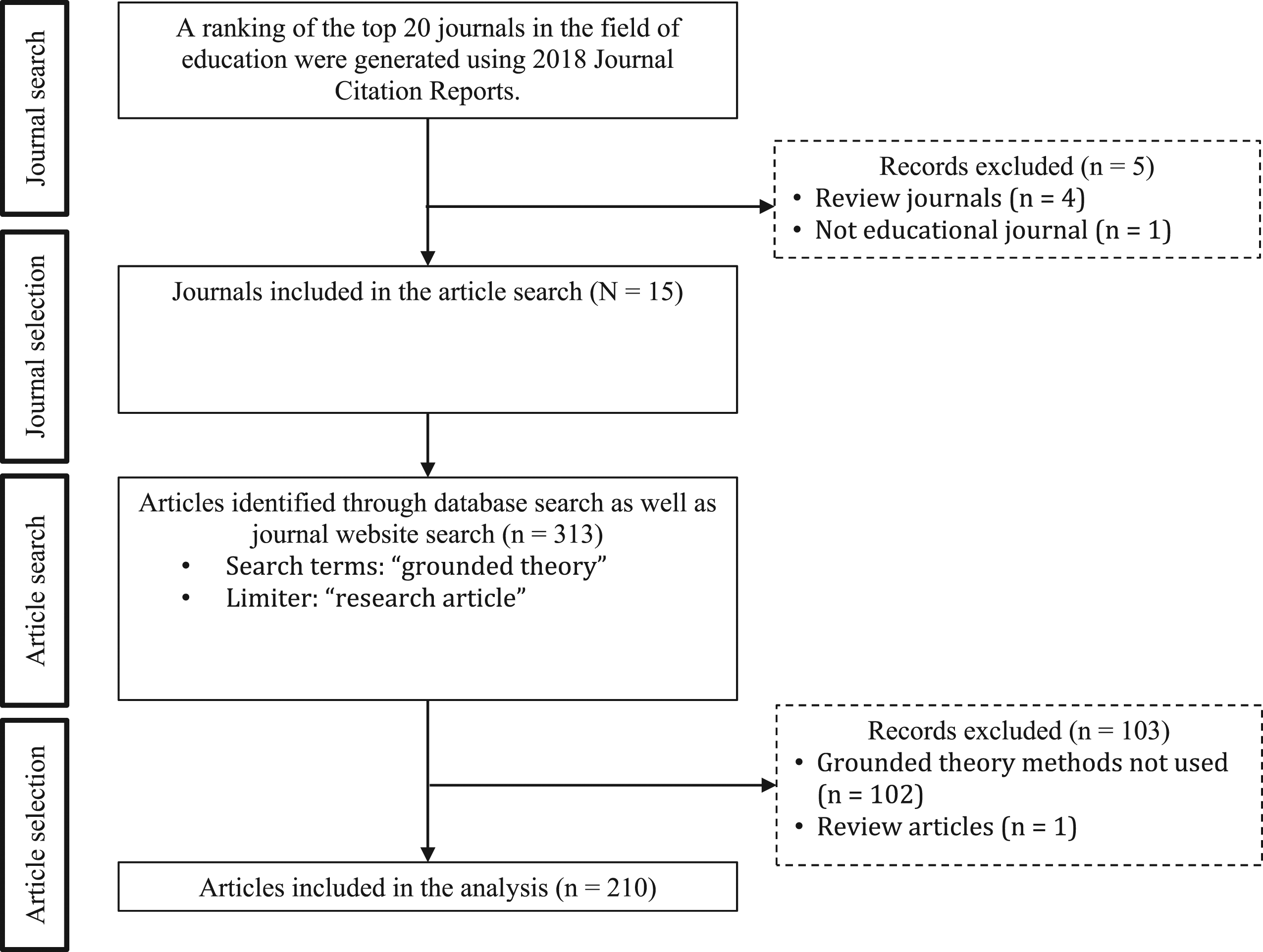
We visited the editorial websites of each of the 20 journals to ensure they published qualitative studies. We excluded four journals (i.e., Review of Educational Research, Educational Psychologist, Educational Research Review, and Educational Psychology Review) as they published primarily review articles than data-based studies. We then consulted with three discipline-area experts about the nature and scope of several journals with which we were less familiar (i.e., Computers and Education, Journal of Counseling Psychology, Internet and Higher Education, and Academy of Management Learning and Education) to ensure these journals were commonly used by educational researchers. We excluded the journal Academy of Management Learning and Education as our discipline-area expert identified its primary disciplinary focus as management, rather than education. As a result, the final number of journals included in our systematic analysis was 15.
Article Search and Selection
To identify research articles that employed grounded theory methodologies, we conducted a database search followed by a confirmatory search. We used the Education Resources Information Center (ERIC) and PsycInfo databases to search within articles published 2000 to 2017, using the 15 selected journal names as additional limiters. To be as comprehensive as possible, we used the keyword phrase “grounded theory” to scan for mention anywhere within these published articles. When a refined search function for article type was available, we included “research article” to excluded editorials, reviews, commentaries, or other types of monographs, and “English” to obtain only articles in English. We set the range to include the years 2000–2017 for two reasons. First, the types of grounded theory methodologies used increased in variation after Charmaz’s publication in 2000 on constructivist grounded theory (Clarke, 2019). Second, the 2018 JCR finalized at the initiation of this study indexed articles up to and including 2017. To confirm we had located all articles within these parameters, we conducted a supplemental search within the websites of each of the 15 selected journals, using the same range of years and keywords as used for the database search. We thus confirmed the number of articles identified through the database search and Web site search was the same.
Our search yielded 313 articles from the 15 included journals. The text of each of these 313 articles was read in full and independently by both the first and the second author to determine if they should be included in our in-depth analysis. To be included in our in-depth analysis, articles had to meet the two following criteria: (a) data had been collected and analyzed for the study, and (b) grounded theory was identified as either the primary methodology or was used as a method for the analysis of the data. Articles referring to “grounded theory” generically or citing grounded theory publications but not employing the approach methodologically or analytically were not included. After comparing the independent coding of the 313 articles by the two authors, 19 disagreements were found. The authors then jointly reviewed and discussed these 19 articles until agreement was reached regarding whether or not they met the criteria. A final total of 210 articles met criterion for inclusion for in-depth analysis. 2
Article Coding
Examples of Categorization of Methodologies Cited in Articles.

Reported Methodological Approaches Categorization.

aOne article incorrectly cited “Glaser, B., & Strauss, A. (1979). The discovery of grounded theory: Strategies for qualitative research. Hawthorne NY: Aldine.”
bOne article incorrectly cited “Strauss, A. L., & Corbin, J. (1995). Basics of qualitative research: Grounded theory procedures and techniques. Newbury Park, CA: Sage.”
cOne article incorrectly cited “Corbin, J., & Strauss, A. C. (2007). Basics of qualitative research: Techniques and procedures for developing grounded theory (3rd ed.). Thousand Oaks, CA: Sage.”
dThree articles incorrectly cited “Strauss A., & Corbin, J. M. (2008). Basics of qualitative research: Techniques and procedures for developing grounded theory (3rd ed.). Thousand Oaks, CA: Sage.”
eOne article incorrectly cited “Corbin, J., & Strauss, A. (2014). Basics of qualitative research: Techniques and procedures for developing grounded theory (4th ed.). Thousand Oaks, CA: SAGE Publications.”
fOne article incorrectly cited “Charmaz, K. (2007). Constructing grounded theory. A practical guide through qualitative analysis. London: Sage Publications.”
Each of the 210 articles was then read a third time, this time focusing on the methodological details and analytical steps described within each article. The coding scheme was based upon common characteristics of grounded theory approaches typically referred to by methodologists (see Birks et al., 2019; Bryant, 2019b; Fassinger, 2005; Kenny & Fourie, 2014; Thornberg, 2017) as well as grounded theory characteristics common across variants of grounded theory (refer to Table 1). In addition, we coded whether each study used grounded theory as a “methodology” or “for analysis only.” Following Bogdan and Biklen (1998), methodology was conceptualized as guiding theory, general logic or the theoretical perspective of a research project while analysis viewed as referring to the concrete techniques or procedures the researcher engaged in to analyze data. Accordingly, studies referring to grounded theory as the overall methodological approach or to grounded theory as part of their design or data collection (in addition to analysis) were coded as using grounded theory “methodology.” Studies that included grounded theory only in reference to analysis of the data were coded as using grounded theory “for analysis only.”
Each author was assigned half of the 210 articles to code independently. Interrater reliability between the two authors was checked halfway through the coding process (86.1% agreement was found) and disagreements discussed to further refine the coding process. After coding all articles, we then checked each other’s coding of each article. All disagreements were then resolved through discussion. As a final check of our coding process, we noted any inconsistencies in patterns in the data (for example, articles that did not use coding or categorizing at all as part of their analyses) and reexamined these instances jointly.
Analysis
Our analytic approach was descriptive. We calculated frequency and percentages separately for articles that used grounded theory as methodology (n = 56) and for articles using grounded theory only for analysis (n = 154). In addition, we calculated the total frequency of each coded description or characteristic and then calculated its percent as part of the total number of articles (n = 210) coded.
Results
Number of Articles by Educational Journal (n = 210).

a “Rank” reflects ranking based on 5-year impact factors from the Journal Citation Report 2017.
Number of Articles by Type of Grounded Theory Approach (n = 210).

Six of the studies attributed grounded theory approaches to methodologists who actually were not grounded theorists (i.e., Boyatzis, 1998; Yin, 2003) or to general qualitative textbooks (e.g., Creswell, 2007; Patton, 2002) that provided overviews of various methodological approaches and summarized a range of grounded theory approaches. Four studies stated they were using “grounded theory analysis,” “elements of grounded theory,” or “a grounded theory approach” but did not cite or refer to a grounded theory methodologist anywhere in the article.
In 112 of the 210 studies, researchers reported using other methodological approaches in addition to grounded theory. Most commonly researchers (n = 62) reported using case study along with grounded theory in either their design or their analysis of the data. Methodological approaches used in other studies included action research, critical theory, discourse analysis, ethnography, evaluation study, hermeneutics, life history, mixed methods, narrative research, oral history, phenomenology, quantitative analysis, and rhizoanalysis.
Grounded theory studies were found across all publication years included in our analysis. Again, Straussian approaches were the most popular across all 18 years (see Figure 2). However, we detected a change in the pattern of citations across time. Between 2000 and 2002, no citations for Charmaz were found, but starting in 2005, educational researchers increasingly began to cite her work. By 2009, Charmazian approaches were cited more often than were Glaserian approaches (with the exception of in 2015) and this trend continued through 2017. Glaser and Strauss’ (1967) original work on grounded theory was also consistently cited across all 18 publication years, sometimes more than, sometimes less than Charmaz’s work. Number of articles by type of grounded theory methodology by year (n = 210).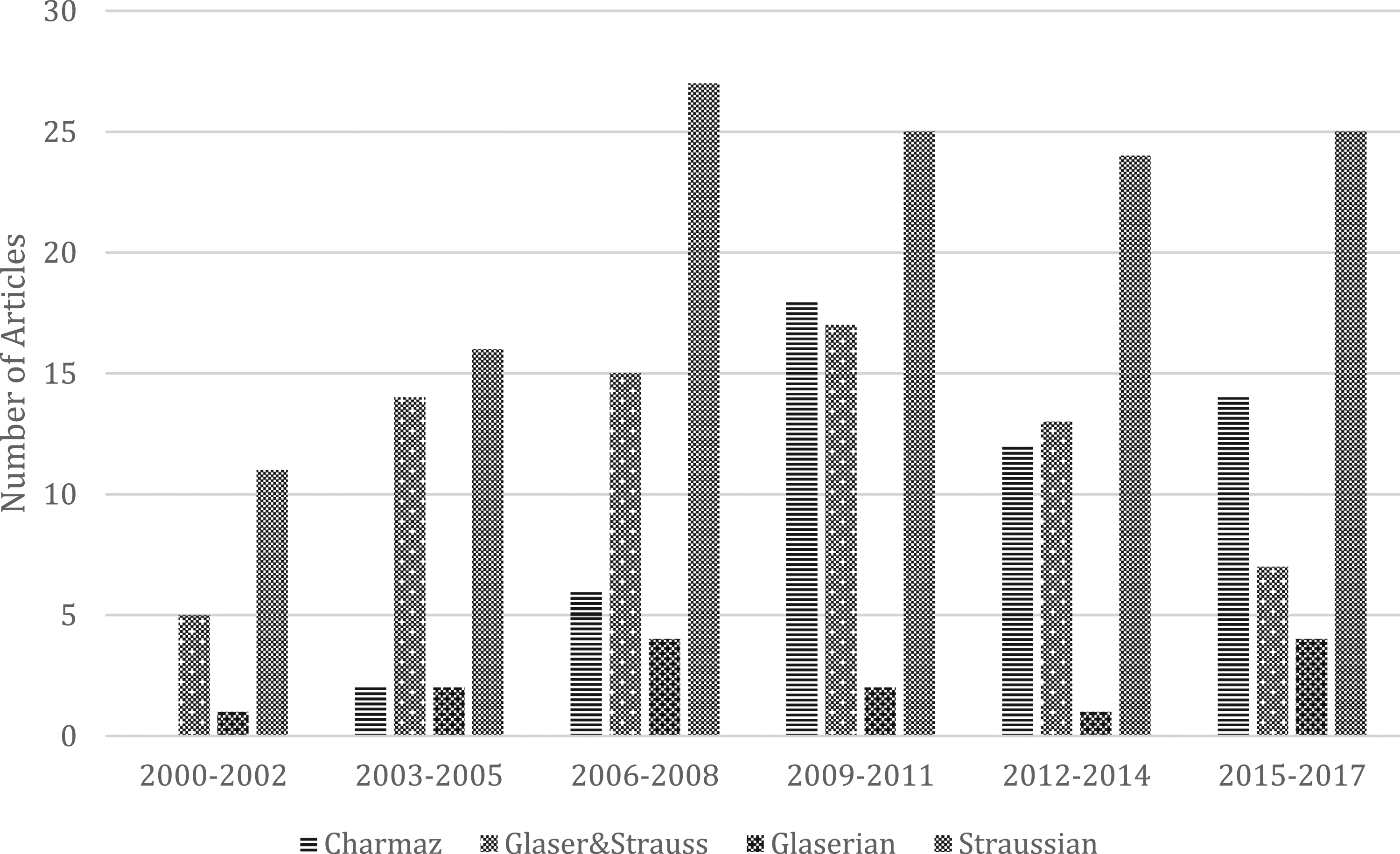
Grounded Theory Elements Found across Articles.

The majority of the studies (73.3%, n = 154) used grounded theory as an analytical approach, rather than as methodology. As may be expected, these studies reported using design and data collection elements of grounded theory at a lower rate; Few referred to analytical memos (18.2%), simultaneous data collection and analysis (13.9%), or theoretical sampling (3.0%). In contrast, some common elements pertinent to analysis were reported relatively more frequently, for example, coding (83.6%) and categories (66.1%). Other analytical elements were reported much less frequently, for example, constant comparison (37.6%) and saturation (7.9%). However, in 34 (22.1%) of the articles using grounded theory only for analysis, only two or fewer characteristics of grounded theory were mentioned.
Sixty-two of the 210 studies (29.5%) presented and described a grounded theory resulting from the analysis of their data. As might be expected, the majority of these studies (82.1%, n = 51) were those using grounded theory as a methodology. Proportionately, studies published in the Journal of Educational Psychology (100%, n = 6) were the most likely to present a grounded theory resulting from data analysis, followed by the Journal of Counseling Psychology (86.4%, n = 19), Educational Researcher (50%, n = 2), and Exceptional Children (40%, n = 6).
Discussion
The publication of qualitative studies in the educational research literature has increased substantially over the last 50 years. A large number of these studies have incorporated grounded theory, either as a methodology or as an analytical method. However, variations on Glaser and Strauss’ (1967) original conceptualization of grounded theory have emerged across time, some becoming so distinct it is argued they are incompatible (Jones & Noble, 2007; Kenny & Fourie, 2014). Methodologists also have noted inconsistencies in studies employing grounded theory, including violations in use of the methodology or misattributions of its methodological procedures (Apramian et al., 2017; Greckhamer & Koro-Ljungberg, 2005; Suddaby, 2006). Jones and Noble (2007) described such confusions in the management research literature, cautioning that grounded theory within that discipline was “…in danger of losing its integrity” (p. 98). Given the widespread use of grounded theory in the education literature, understanding which grounded theory variants have been adopted by education researchers, as well as how grounded theory has been implemented within this discipline, is warranted.
As expected, grounded theory methodologies were used frequently in qualitative studies published in highly-ranked educational journals. However, three journals accounted for half of these articles while the majority of the journals included six or fewer grounded theory articles across 18 years of publications—representing considerable variability in the proportion of grounded theory studies published across educational journals. Interestingly, the two journals containing the largest number of grounded theory articles (Computers and Education and Science Education) differ considerably in topical focus, suggesting grounded theory holds appeal even across disparate educational sub-disciplines.
In our analysis, the grounded theory methodology most frequently referenced across the last two decades was a Straussian approach. Furthermore, when educational researchers cited a mixture of grounded approaches, most also included a Straussian approach. Several methodologists have associated the rise in popularity of grounded theory with the publication of Strauss’ (1987) and Strauss and Corbin’s (1990) works (Bryant, 2019b; Timmermans & Tavory, 2007). With respect to educational research, we suggest that Strauss and Corbin’s methodological frame, with its paradigmatic tendency toward symbolic interactionism, was compatible with interpretivist paradigms that gained popularity in educational research in the 1990s. In the studies analyzed here, Kathy Charmaz’ (2000) constructivist approach to grounded theory was first referenced in 2007 and received an increasing proportion of citations in later years. By the end of the 20th century, constructivism had become the preferred qualitative paradigm across multiple disciplines, including education (Clarke, 2019; Perkins, 1999). Charmaz’s textbooks, published in 2006 and 2014, provided new material on grounded theory and educational researchers appear to have found Charmaz’s constructivist approach compatible with their own paradigmatic leanings. However, our findings also reveal the original Glaser and Strauss (1967) text continues to be referenced frequently across time—more than five decades after its first appearance in the literature.
Results from the analysis of usage of the elements of grounded theory in these studies were surprising in several aspects. First, most educational researchers used the approach as a data analysis technique rather than as a methodological approach. We suggest three possible reasons: (1) grounded theory provides a method for analyzing qualitative data that is compatible with many other qualitative approaches used in educational research, (2) few other analytical approaches can be similarly “decoupled” and used with another qualitative methodological approach, and (3) grounded theory has become accepted as a generic approach to analyzing qualitative data. Other methodologists have noted the trend by researchers to use grounded theory as a means of analysis, rather than as a methodology (e.g., Greckhamer & Koro-Ljungberg, 2005; Timmermans & Tavory, 2007). Glaser (2019) recently commented on the increase in studies that produce “grounded description” (p. 441) rather than abstracted concepts that lead to theory construction. Educational researchers appear to be following the trend of using grounded theory as an analytical tool rather than as an overall methodology.
Even in studies that did adopt grounded theory as a methodology, some did not report using common characteristics such as codes, categories, constant comparison, or saturation in their analyses. As our analysis relied on study descriptions, it could be researchers simply did not report these procedures in text. However, the omission in reporting these essential elements of grounded theory analysis is puzzling. A majority of studies also failed to mention memos, theoretical sampling, properties, or theoretical sensitivity. Again, these are common elements of grounded theory approaches, but researchers simply did not reference them. Other authors have similarly noted the limited or lack of description of methodology in grounded theory studies (e.g., Bryant, 2019b; Suddaby, 2006). We postulate some researchers either were not knowledgeable about essential grounded theory elements or simply failed to provide a complete description of their analytical processes.
Results revealed other inconsistencies. Some studies using grounded theory only as an analytical technique reported using theoretical sampling- which is actually part of grounded theory design and data collection. In some of these cases, theoretical sampling was used conjointly with another methodology; in other cases, the term incorrectly referred to another process (for example, snowball sampling was incorrectly referred to as “theoretical sampling”). In some studies, concurrent data collection and analysis took place as part of another methodological approach, such as case study or ethnography. However, in some instances description was lacking detail and we could not determine if concurrent data collection and analysis were part of the grounded theory approach or another qualitative approach.
Only a small proportion of the 210 studies (29.5%) delineated a “grounded theory.” Jones and Noble (2007), in an analysis of grounded theory studies in the management literature, similarly found only 34.4% of 32 studies produced an overall theory. While the express purpose of the original Glaser and Strauss (1967) methodology was to produce a theory based on data, later methodological variations have not insisted on producing a grounded theory as a result of the analytical process. For example, Strauss and Corbin stated “...some will use our techniques to generate theory, others for the purpose of doing very useful description, or conceptual ordering [classifying and elaborating]” (1998, p.9). Further, Charmaz (2006) has argued that grounded theorizing can occur throughout the analytical process and it is not obligatory for a grounded theory study to produce a substantive or formal theory as an outcome.
Despite their publication in highly-ranked educational journals, our analysis of these 210 stuides found cursory and insufficient descriptions of elements of grounded theory methodology. Even when researchers used grounded theory as a methodology, many did not detail steps they used to analyze the data. In addition, when other qualitative approaches (e.g., case study, ethnography, phenomenology, etc.) were used in conjunction with grounded theory, many articles were unclear which qualitative approach was used for the study design and did not detail how grounded theory was used in conjunction with other approaches. Such “method slurring” in grounded theory is not new, having been described by Baker, Wuest, and Stern as early as 1992. In a number of studies, only a single sentence was used to describe the analytical process. These findings were unexpected and dismaying. We agree with other methodologists (i.e., Bryant, 2019b; Holton & Walsh, 2017) that considerable attention needs to be paid to claims by researchers that they are using grounded theory approaches–either as a methodology or as an analytical tool. We concede that the majority of these educational journals, while highly-ranked, publish primarily quantitative, rather than qualitative studies. However, editors of research journals should ensure that studies using grounded theory methodologies receive careful evaluation by qualified reviewers with expertise in the methodology.
Limitations
Our analysis was limited by several factors. First, we relied on researchers’ own identification and written description of the methodology and analyses used in these studies. Many researchers identified multiple grounded theory approaches, making it necessary to code these studies as using “mixed” approaches. In others, the methodological approach was not clearly identified and we had to rely on in-text citations to determine the grounded theory approach used. In some articles, elements from conflicting analytical approaches (for example, Strauss & Corbin (1990) versus Glaser & Strauss, (1967)) were used and cited. In addition, some studies cited methodologists who were not, in fact, grounded theory methodologists and had to be coded as “other” in our analysis. Several researchers referenced qualitative methodology textbooks as a whole, in which cases we could not determine the specific grounded theory methodology used and thus were also coded as “other.” In a handful of cases, no specific grounded theory approach could be determined at all as the researchers did not cite a methodologist nor an approach to the data, necessitating a code of “not specified.” Given that our coding was by necessity based on sometimes unclear or incomplete descriptions written in these articles, calculations of the relative use of these methodologies may have been skewed.
Conclusion
This study provides a refined analysis of how grounded theory, as either as a methodology or as an analytical method, is being used in educational research. We found increasing variety in the types of grounded theory approaches used in educational research over the last two decades. And, while educational researchers appear to prefer Straussian approaches in designing and analyzing grounded theory studies, Charmaz’s constructivist approach has increased in popularity over the last decade. Finally, we found considerable variability in these studies in the usage of grounded theory, both as a methodology and as an analytical method. We concur with Bryant, 2019a observation that grounded theory “is simultaneously enormously popular and widely misunderstood” (p. xxv). While grounded theory approaches were used frequently by educational researchers, we found methodological inconsistencies and descriptive cloudiness to be commonly evidenced across studies—even within highly-ranked educational research journals.
Footnotes
Declaration of Conflicting Interests
The author(s) declared no potential conflicts of interest with respect to the research, authorship, and/or publication of this article.
Funding
The author(s) received no financial support for the research, authorship, and/or publication of this article.
