




Abstract
The article details how Ubuntu was incorporated into each step of the research project, shares the authors’ experiences and key learnings, and provides recommendations for researchers utilizing Ubuntu as a research paradigm. Ubuntu is an ancient African philosophy emphasizing a way of life grounded in interdependence, collaboration, harmony, and community. In recent years, researchers have incorporated Ubuntu as a research paradigm to decolonize research in a sub-Saharan African context. The present article used international collaborative qualitative research conducted virtually during the COVID-19 pandemic to demonstrate the application of Ubuntu as a research paradigm for conducting research in the African context. Some of the key takeaways include technological factors to consider, establishing connections during the planning stage, and ultimately nurturing productive collaboration within virtual groups.
Keywords
Introduction
Teacher knowledge enactment reflects teacher competence and effectiveness (Alvermann & Guthrie, 1993; Borti, 2019a; Darling-Hammond, 2006; Eutsler, 2022; Hallman et al., 2022; König et al., 2022; Neuman & Danielson, 2021; Reutzel & Dole, 2005; Shanahan & Tochelli, 2014). Further, exploring Newly trained teachers’ (NTTs) literacy knowledge and their opportunities for learning the required knowledge (Borti & Jones-Mensah, 2023) is paramount to teacher development and student success. In exploring what NTTs know about literacy content knowledge (CK) and pedagogical content knowledge (PCK) and their opportunities for acquiring such knowledge, we engaged in an intrinsic qualitative case study design (Stake, 1995), using Ubuntu as a research paradigm. Ubuntu is an ancient African philosophy that emphasizes community, sharing, and mutual caring for all (Abdi, 2012; Chinouya & O’Keefe, 2006). In subsequent sections of this methodological article, we discuss Ubuntu and its tenets.
This present methodological article builds upon our previous study (Borti & Jones-Mensah, 2023) to explore and present how Ubuntu can be incorporated as a research paradigm in qualitative studies to explore a phenomenon in the African context. We start by offering a brief overview of the previous study. Then, Ubuntu is described as a philosophy and research paradigm. Further, the article details how Ubuntu was incorporated into each step of the research project in a step-by-step process. Finally, the authors share their experiences and key learnings and provide recommendations for researchers utilizing Ubuntu as a research paradigm. By doing so, this article intends to provide an argument for using Ubuntu as a valuable research paradigm for conducting educational research in Ghana and across Africa, particularly in the context of conducting research virtually.
Overview of the Study With NTTs in Ghana
The study in Ghana explored how mediating agents who are NTTs and their senior colleague teachers within and outside their learning community functioned to support new teachers’ opportunities for literacy-related knowledge development. The participants were 15 NTTs, aged between 21 and 28, in their first or second year of teaching, and spread across five regions in Ghana: Volta, Greater Accra, Western, Upper East, and Northern. The research began with Borti maintaining contact with three individuals from her dissertation since May 2019. These three individuals helped to employ snowball sampling to include an additional 12 NTTs by November 2020. Eventually, 31 NTTs showed interest, but only 15 actively participated in the study by engaging in interviews and focus group discussions via Zoom, Google Meet, and WhatsApp. The finding indicated how NTTs considered their senior colleagues in their various schools as mediating agents who supported them in conceptualizing and identifying opportunities for learning literacy CK and PCK. Additionally, NTTs’ interactions during the research also reflected how NTTs considered themselves as mediating agents for learning literacy CK and PCK.
This study in Ghana underscored the enactment and importance of Ubuntu principles throughout the study process. To conceptualize Ubuntu, the authors used Abdi (2012) and Chinouya and O’Keefe’s (2006) explanation of Ubuntu as an ancient African worldview that prioritizes the interconnectedness of beings. It is grounded in the essential goodness of human beings and the importance of community (Abdi, 2012; Chinouya & O’Keefe, 2006).
In recent years, social scientists have explored Ubuntu as a research paradigm for conducting studies in the African context (e.g., Chilisa, 2012; Mkabela, 2005; Muwanga-Zake, 2009; Seehawer, 2018). These studies were mostly conducted in the South African context and relied on face-to-face communication. However, our study in Ghana was an international qualitative research study conducted virtually during COVID-19. Therefore, the present methodological article expands the current understanding and knowledge related to Ubuntu as a research paradigm.
Ubuntu Philosophy
Ubuntu is often associated with the phrase “I am because we are.” In other words, a person becomes a person through others (Khoza, 2006), which captures the idea that our individual identities and abilities are formed and maintained by our interconnectedness or the relationships we have with others. Ubuntu is not only about positive human qualities but the very human essence itself that enables human beings to live in daily self-expressive work of love and efforts to create harmonious relationships in the community and the world beyond (Khoza, 2006). Key tenets of Ubuntu include (a) considering individual success as a collective effort, (b) putting others first, (c) considering great and effective leadership as service and support to others, (d) lending assistance as enabling, (e) eschewing a competitive spirit, and (f) lifting others as one rises (Caracciolo & Mungai, 2009; Khoza, 2006).
Ubuntu is deeply rooted in African culture and has been passed down through generations as a way of life. It is a holistic approach to existence that recognizes the interconnectedness of the physical, emotional, and spiritual realms of human experience (Chigangaidze, 2021). Ubuntu emphasizes the importance of empathy, respect, and kindness in all interactions with others and the need for communal harmony and cooperation (Chigangaidze, 2021). Ubuntu philosophy has gained recognition beyond Africa, inspiring movements for social justice and human rights worldwide (Chinouya & O’Keefe, 2006). Its principles have been applied in fields such as conflict resolution (Mnyaka & Motlhabi, 2015; Swanson, 2007), education (Swanson, 2007), business (Khoza, 2006), health care (Chinouya & O’Keefe, 2006), sociopolitical contexts (Swanson, 2007) leadership (Khoza, 2006), and environmental sustainability (Etieyibo, 2017), highlighting the universal relevance of this ancient worldview (Khoza, 2006).
In fact, Caracciolo and Mungai (2009) maintain that Ubuntu, with its focus on humanism, collectivism, and non-linearism for reading the world, could reflect the inadequacies of the epistemic constructions of the Western world, which have dominated the fields of science, research, and philosophy for the past half a century or so. At the same time, an important aspect of Ubuntu philosophy that has not been explored fully in the research literature is how its usage promotes indigenous knowledge, which has been marginalized by the colonial enterprise. Larsen and Johnson (2017) refer to the healing process that is possible through celebrating indigenous knowledge and how such knowledge could help people repossess what they lost during colonization. Re-discovering Ubuntu, an African philosophy, and identifying its potential as a research paradigm reaffirms its importance in the African socio-cultural and historical context. In other words, it is a celebration of non-Western indigenous knowledge dispossessed through colonization.
When discussing the re-discovery of Ubuntu as an anti-colonial research methodology, it is also important to locate it within other similar indigenous knowledge systems such as Kaupapa Māori (Smith, 2021) and “Yarning with Country”' (Hughes & Barlo, 2021). Ubuntu shares similarities with these two methodologies in relation to the shared emphasis on relationality, community engagement, and cultural sensitivity, even though they are distinct research methodologies originating from diverse cultural contexts and embodying unique principles. However, Kaupapa Māori, emerging from the Māori culture of New Zealand, focuses on empowering Māori communities, challenging colonial paradigms, and integrating Māori ways of knowing into research. In this regard, Kaupapa Māori distinctively prioritizes Māori culture and ways of knowing. “Yarning with Country,” an indigenous Australian approach, emphasizes storytelling, dialogue, and deep listening in research, recognizing the land as a teacher and prioritizing indigenous perspectives in Australia. Despite these shared principles, Ubuntu is different from the two methodologies because of its unique focus on humanness and interconnectedness among human beings to the extent that individual existence is interpreted and maintained through the collective in Africa.
Moreover, Larsen and Johnson (2017) refer to the decolonizing potential of communal spaces that bring people together, which can be used for their cry for freedom. Similar to Ubuntu, the indigenous people referenced in Larsen and Johnson immersed themselves in coexistence with different places that seemed to be altered by European settlement. Ubuntu focuses on communal harmony and emphasizes the collective construction of knowledge in Africa. Humanness and becoming human are the results of everyday knowledge creation and knowledge building founded on the concept of Ubuntu. These concepts align with Larsen and Johnson’s (2017) communal and decolonizing ideologies. In the African context, many colonial powers, such as the British, used a policy of divide and conquer in their colonial endeavors. Therefore, Ubuntu, with its emphasis on unity, humanness, co-construction of indigenous and commitment to indigenous knowledge, creates decolonizing spaces that resist the colonial efforts to create division and disharmony among the indigenous populations. Similarly, these decolonizing spaces may facilitate anti-colonial/decolonizing efforts by uniting the indigenous people against colonial oppression.
Ubuntu as a Research Paradigm
To decolonize research in sub-Saharan Africa, social science researchers in recent years have worked toward developing Ubuntu as a research paradigm by focusing on the philosophical assumptions on the nature of social reality (ontology), modes of knowing (epistemology), and ethics and value systems (axiology) under Ubuntu philosophy (Chilisa, 2012; Mkabela, 2005; Muwanga-Zake, 2009; Seehawer, 2018). Based on her observations as a researcher conducting participatory action research with a group of five science teachers in Grahamstown, South Africa, in 2015, Seehawer (2018) advocated using Ubuntu as a research paradigm. Seehawer (2018) claimed that using Ubuntu as a research paradigm helped her develop a more nuanced understanding of the research process, outcomes, and relationship between the researchers and participants. Further, by adopting Ubuntu as a research paradigm, Seehawer (2018) highlighted the critical decolonizing potential of Ubuntu and how Ubuntu-based research could be complementary to the typical Western, Eurocentric research method commonly used in research. In this section, we explored the use of Ubuntu as a research paradigm, focusing on its ontological, epistemological, and axiological assumptions and its methodological approaches.
Ontology
In Ubuntu, reality is socially constructed through communal discourse and shared experiences (Mucina, 2011). Unlike Cartesian epistemology, which emphasizes objectivity and individualism, Ubuntu ontology recognizes the subjective and relational nature of reality and emphasizes the interdependence of living and non-living things (Seehawer, 2018). Under Ubuntu ontology, knowledge is generated through collaboration and the sharing of diverse perspectives (Seehawer, 2018). This Ubuntu ontological perspective challenges the notion of a single, objective truth and promotes a more inclusive and nuanced understanding of reality.
Epistemology
Unlike Cartesian epistemologies, which led to the development of the modern scientific approach to knowledge generation through objective observations, the Ubuntu paradigm emphasizes that knowledge is generated through communal discourse where each individual contributes and adds to the context of the knowledge (Mkabela, 2005; Mucina, 2011; Seehawer, 2018). Therefore, knowledge is subjective and cannot be claimed as universal. Another key aspect of the Ubuntu paradigm is the idea of knowledge generation and sharing. While in a typical qualitative study, individual interviews are used as a method for sharing and generating knowledge, group interviews/focus group discussions are a more fitting method for Ubuntu research paradigm because Ubuntu recognizes that knowledge is generated through communal discourse (Mucina, 2011).
Axiology
The core of Ubuntu’s axiology is relational ethics, which is grounded in humble togetherness and emphasizes the importance of mutual respect, reciprocity, and collaboration between researchers and collaborators (Chilisa, 2012; Seehawer, 2018). We refer to our participants as collaborators due to our commitment to Ubuntu. In this study, all collaborators’ names are pseudonyms. This research paradigm intends to contribute to becoming “more fully human” (Shutte, 2001, as cited in Metz & Gaie, 2010, p. 275) by entering deeply into the community with others. This approach replaces the traditional notion of the researcher as an objective observer with a shared understanding of the research process in which both parties are active collaborators.
The relational ethics of Ubuntu drive the entire research process, including access and consent, data collection, analysis, sharing of results, and relational codes after the research process has ended (Seehawer, 2018). Therefore, researchers must build personal relationships with collaborators before presenting them with consent forms to sign, emphasizing the importance of building trust and establishing a sense of community (Seehawer, 2018). During the research process, the collaborators are not only informants of the phenomenon under investigation but also learners and supporters of one another through the relationships that have developed over the research process (see Borti & Jones-Mensah, 2023).
Furthermore, the Ubuntu paradigm acknowledges the involvement of ancestors, spirits, or some form of a supreme being in the research process (Anderson & Braud, 2011; Mpofu, 2016; Seehawer, 2018; Wilson, 2008). According to Wilson (2008), spirituality is an integral aspect of the worldview of indigenous people. For example, Wilson shared how his uncle was having trouble with his computer during a research process, and Wilson asked his uncle, “Well, have you prayed?” (Wilson, 2008, p. 90). He concluded that after his uncle prayed, the computer never had any problems again because his uncle had “corn meal [a spiritual symbol] around the sides [of the computer], and it has these ochre crosses—four directions [a spiritual symbol], all around it [the computer]” (Wilson, 2008, p. 46). Wilson recognizes how the computer played a crucial role in the research process of his uncle in connection to planning, data collection and analysis, and writing the research report and dissemination. Wilson indicated that he and his uncle “talked further about the use of technology in religious ceremony” such as their research, and his uncle indicated that “This machine here is made from mother earth. It has a spirit of its own. This spirit probably hasn’t been recognized and given the right respect that it should” (Wilson, 2008, p. 46).
Further, Anderson and Braud (2011) recommend researchers use mindfulness practices (e.g., attention, present moment awareness, and quietude), leverage multi-sensory approaches (using visual, auditory, visceral, and movement), and personal intuition to connect deeply with their research collaborators to enhance depth and authenticity of inquiry. In addition, they also recommend researchers reflect on their own spiritual beliefs and experiences as part of the research process.
Wilson’s (2008) and Anderson and Braud’s (2011) recommendations resonate with Ghana because of the role spirituality plays in what Ghanaians do. For example, Borti and Jones-Mensah, who are from Ghana, are spiritual people and always pray about their research plans, implementation, research report writing, and publication. The same can be said of all the collaborators in Ghana who alluded to happenings during the research processes to the control of a supreme being. Also, the collaborators referred to God most of the time in seeking the success of this research. For example, under the section incorporating Ubuntu in sampling and data collection, we indicated how enacting and conducting research and collecting data using the Ubuntu epistemology aligned with spirituality. We also provided examples of how our collaborators demonstrated this aspect of aligning Ubuntu to spirituality.
Additionally, in relation to axiology, the collaborative learning, shared experiences, and friendships that develop over the course of the research process continued after the research project was completed, with researchers committing to supporting the community after completing the research project (Borti & Jones-Mensah, 2023; Seehawer, 2018).
Other key methods related to relational ethics in the Ubuntu research paradigm include storytelling (Mucina, 2011), sharing circle (Lavallée, 2009), dialogue (Muwanga-Zake, 2009), and participatory action research (Khupe, 2014; Malcolm et al., 2009; Muwanga-Zake, 2009). Storytelling is part of oral traditions in many African cultures, where storytelling is used to communicate, preserve, and impart knowledge. Storytelling aligns with the fundamental values of Ubuntu in that the story is a continual process with no definitive end and evolves through the people involved. Further, while individual contributions are essential to the story, they are also significant in relation to the larger community that encompasses members from past, present, and future generations (Seehawer, 2018). The participatory action research method and Ubuntu share a common research focus: they foster personal growth through a community-based approach to generating new knowledge and learning. In the next section, we discuss the application of Ubuntu as a research paradigm to unpack the exploration of newly trained Ghanaian teachers’ opportunities for learning literacy CK and PCK in relation to research planning, sampling, data collection, and analysis, and incorporating Ubuntu in relation to ethical considerations.
Application of Ubuntu as a Research Paradigm
In the previous section, we explained the philosophy of Ubuntu and its potential application as a research paradigm. In this section, we illustrate the practical implementation of the Ubuntu philosophy in the research process through a study conducted by Borti and Jones-Mensah. We demonstrate how each step of the research aligns with the principles of Ubuntu (see Borti & Jones-Mensah, 2023).
Incorporating Ubuntu During Research Planning
After some background work, Borti planned to embark on an in-person collaborative international qualitative research study in the summer of 2020. Note that Borti and Jones-Mensah are Ghanaians, and the second and fourth authors are from two emerging economies, India and Sri Lanka, respectively. However, due to COVID-19, this in-person research plan was canceled, so the plan submitted to our institutional review board was revised to conduct the research study virtually, which was approved. Motivated by her own experience as a new assistant professor in her first four years working at a U.S. university and her findings about the challenges faced by new teachers transitioning from colleges of education to become novice teachers, Borti extended her line of scholarship by using a case study to explore NTTs’ lived experiences in relation to their opportunities for learning literacy CK and PCK within Ghana.
Borti’s decision to explore novice teachers’ opportunities for learning during the period of their career when they seem vulnerable and face the challenge of retention (Tait, 2008; Whalen et al., 2019) aligns with the tenets of Ubuntu. Note that these tenets of Ubuntu include considering individual success as a collective effort, considering great and effective leadership as service and support to others, lending assistance as enabling, and lifting others as one rises. For example, during the planning and implementation of our study, Borti consistently worked with research collaborators to find suitable interview and focus group discussion times, dates, and virtual platforms that worked for the collaborators. Before the interviews and the focus group discussions started, Borti discussed with the collaborators the virtual platforms that worked for them effectively and efficiently, indicating the researchers’ intentionality not to impose their views and plans on the collaborators.
For example, in trying to find a suitable time to meet and discuss the collaborators’ teaching philosophy, which they needed help with, Inusa stated “I think we can still put it across [sic: the] board to get their feedback” when one of the researchers indicated “there was no consensus, so we can plan for early Nov. 2022.” Our enactment and construction of social reality in relation to planning and setting meeting times represent the Ubuntu ontology, where the researchers considered the collaborators’ views, availability, and peculiar situations. Based on Inusa’s suggestion, Borti followed up with the collaborators, who later decided to hold the meeting during the first week of November 2022. Thus, the initial planning of the research and subsequent planning of our meetings were collaborative and collective.
In using Ubuntu to unpack how Ghanaian novice teachers and their collaborators engaged virtually in collaborative international qualitative research, we sought to draw on the African perspective of collaborative research by enacting, practicing, engaging, and upholding the tenets of Ubuntu. This commitment is essential for the development and promotion of the African ethos, and our commitment is well captured in Envuladu et al.’s (2022) statement that “The group was established on the premise of wanting to promote collaborative research in Africa by Africans” (p. 6).
Incorporating Ubuntu During Sampling and Data Collection
Fifteen collaborators were recruited through purposive and snowball sampling. The collaborators were located across five regions of Ghana: Volta, Greater Accra, Western, Upper East, and Northern Ghana. As the norm in Ghana, NTTs in the government sector are posted by government agencies or are assigned schools with which they must work. Fourteen of the 15 collaborators in our study were posted to rural areas. Three collaborators in this study were involved in Borti’s dissertation research (Borti, 2019b). We used snowball sampling through Borti’s dissertation collaborators and their former instructors to recruit additional NTTs since Borti and her dissertation collaborators upheld the tenets of Ubuntu and were still in touch even after the dissertation was completed.
In November 2020, Borti received the names and contacts of interested NTTs and documented them. By the end of 2020, 31 NTTs agreed to participate when Borti communicated with them individually via Skype and WhatsApp. However, 15 NTTs continued the process and engaged in the initial interviews and focus group discussions using Zoom, Google Meet, Telegram, and WhatsApp on various occasions. The use of various virtual platforms was influenced by accessibility and the tenets of Ubuntu, such as considering individual success as a collective effort and ensuring that every collaborator was comfortable with the virtual platforms to be used. Each interview averaged 1 hr. Each participant was interviewed twice until saturation was reached and the information provided contained no other new information needed (Hennink & Kaiser, 2022; Saunders et al., 2018).
Later, Borti engaged in two focus group discussion sessions with the interviewees, and each session lasted for about 1 hr and 50 min. A focus group involves organized discussion (Gupta, 2023; Kitzinger, 1994), collective interaction (Gupta, 2023; Kitzinger, 1995), and shared engagement and experience (Powell et al., 1996) to collect data. In our case, we used virtual focus group discussions, which are characterized by the use of an “online environment, using conference calling, chat rooms or other online means” (Nyumba et al., 2018, p. 25).
Focus groups exemplify a principle of the Ubuntu paradigm that highlights knowledge generation through communal discourse where individuals contribute to and influence the context of the knowledge (Mkabela, 2005; Mucina, 2011; Seehawer, 2018). The use of focus group discussion became necessary when Borti noticed that there were common themes and threads in the statements of the collaborators while interviewing them individually. Also, focus group discussions were used to promote and commit to the tenets of Ubuntu in creating communal knowledge that offers an in-depth understanding of the collaborators, their attitudes, beliefs, and dispositions. During the focus group meeting, we enacted tenets of Ubuntu such as (a) considering individual success as a collective effort, (b) lending assistance as enabling, (c) eschewing a competitive spirit, and (d) lifting others as one rises.
According to Nyumba et al. (2018), focus groups promote “the indigenous knowledge systems developed by a community to obtain indigenous knowledge-based information” (p.27). Similar to Nyumba et al.’s (2018) use of focus groups, we used focus group discussion to gather and honor collective indigenous knowledge from indigenous collaborators in Ghana, and this practice aligns with the philosophy of Ubuntu.
Additionally, the tenets of Ubuntu were enacted through the use of and commitment to community engagement and interconnectedness, respect for diverse perspectives, collective problem-solving, empathy, and compassion. In the following paragraphs, we discuss how these tenets were exemplified in our study.
First, regarding community engagement and interconnectedness, Ubuntu underscores the value of community and collective welfare. Likewise, focus group discussions promote community engagement by bringing together collaborators with diverse experiences and views to share their understandings and perceptions on a topic. Ubuntu underscores the interconnectedness of individuals within a community. Equally, focus group discussions emphasize the interdependence of collaborators’ experiences and viewpoints, demonstrating how individual perspectives contribute to a broader understanding of the topic under discussion. For example, in our study, NTTs were intentionally selected from diverse backgrounds, schools, and geographical locations in Ghana to share their diverse views on NTT’s opportunities for learning CK and PCK in literacy.
Second, Ubuntu upholds respect for every individual’s innate self-esteem and value. In focus group discussions, we encouraged collaborators to express their views openly and respectfully, creating an environment where diverse perspectives are valued and acknowledged. For example, Kofi, one of the collaborators, joined our first focus group meeting late after we had discussed the conceptualization of literacy and established that literacy is beyond reading and writing. However, when he defined literacy, Kofi indicated, “I define literacy as the ability to read and write.” While he was talking, no one interrupted him. When he finished, one of the collaborators informed him that we conceptualized literacy in an expanded manner according to the International Literacy Association’s conceptualization of literacy.
Third, Ubuntu highlights the significance of collective problem-solving and mutual support within communities. Focus group discussions offer the space for collaborators to collaborate, exchange thoughts, and jointly recognize solutions to mutual concerns. This collective problem-solving reflects empathy and compassion, where collaborators are encouraged to listen actively to one another, show empathy regarding different opinions, and participate in constructive conversations that nurture understanding and communal respect. For example, during our focus group discussions, the women were quiet, and the men held the floor most of the time, which is typical in the traditional Ghanaian context characterized by patriarchal and male-dominated societies. After some time, some of the men encouraged the women to talk by saying, “Ladies, we noticed you are too quiet; take the floor and talk.” The men mentioned the women’s names one after the other and invited them to make contributions. The men made sure that the women were not denied the opportunity to share their perspectives. These gestures represent the enactment of Ubuntu’s tenets, such as collective problem-solving, respect, mutual support, empathy, and compassion within communities.
In gathering information about NTTs’ opportunities for learning literacy CK and PCK, the researchers and the NTTs first sought to create a safe and brave space (Aroa & Clemens, 2013) by building a community where members became comfortable and brave sharing their experiences and opportunities and cared about one another, reflecting the African philosophy of
Ubuntu. Being vulnerable and open to criticism is what we call a safe and brave space. We referred to the research participants as collaborators who construct knowledge and social reality through communal discourse and shared experiences. In the spirit of Ubuntu (i.e., considering individual success as a collective effort, considering great and effective leadership as service and support to others, lending assistance as enabling, and lifting others as one rises), the researchers supported the collaborators by providing them funds to support their purchase of Internet data as our collaboration and meetings were virtual and Internet-dependent. Collaborators who had challenges with the Internet in their villages were offered funds for transport to move to towns with better Internet connectivity anytime we needed to hold our virtual meetings.
Other examples of enacting and conducting research and collecting data using the Ubuntu epistemology that aligned with spirituality are as follows. During our research collaboration with the novice teachers, many of them, both Christians and Muslims, alluded to their success and ability to perform their duties as effective teachers to the help and enablement of God or a supreme being, thereby acknowledging that their ways of knowing are not only academic but spiritual. They do not shy away from their spirituality. e.g., on April 9, 2022, Felix, a collaborator, texted the general research WhatsApp platform, “Happy Easter ooo, May the resurrection power continue to take care of us and cause us to move from victory to victory in our research and professional development that we plan to engage in as a result of this research collaboration!” Inusa, another collaborator, also indicated “by the help of Allah, we will succeed as novice teachers when we continue to support one another during this research and beyond.” Their statements align with Wilson’s (2008) assertion that spirituality is an integral aspect of indigenous research.
According to Seehawer (2018), when Ubuntu is integrated into research, the collaborative learning, shared experiences, and friendships that develop over the course of the research process are expected to continue after the research project is complete. This expectation was realized in our research. e.g., our research collaboration did not end even after data collection in August 2022. Our relationships have developed beyond research and data collection to healthy and sustained sisterhood and brotherhood that have metamorphosed into an effective professional learning community where the researchers and the collaborators share ideas and instructional materials about literacy instruction and professional development, depicting the spirit of Ubuntu.
Incorporating Ubuntu During Data Analysis
Data sources included videotapes of interviews and focus group discussions via Zoom, WhatsApp, Telegram, and Google Meet. Artifacts such as agendas, planning text messages pertaining to past and upcoming meetings, group chat courtesy, and collaborators’ demographic information were also gathered. During the interview and focus group discussions, data analysis began with journaling during the interviews and the focus group discussions to document observations, reflections, and common trends among the collaborators. During transcription, data analysis continued with transcribing, reviewing, and cataloging all data sources (e.g., journals, transcripts, documents, and text messages via WhatsApp).
Thus, in analyzing our data, we borrowed ideas from Richie and Spencer’s (1994) data analysis framework as shown below in Figure 1. Five-step process in Framework Analysis, based on Ritchie and Spencer (1994).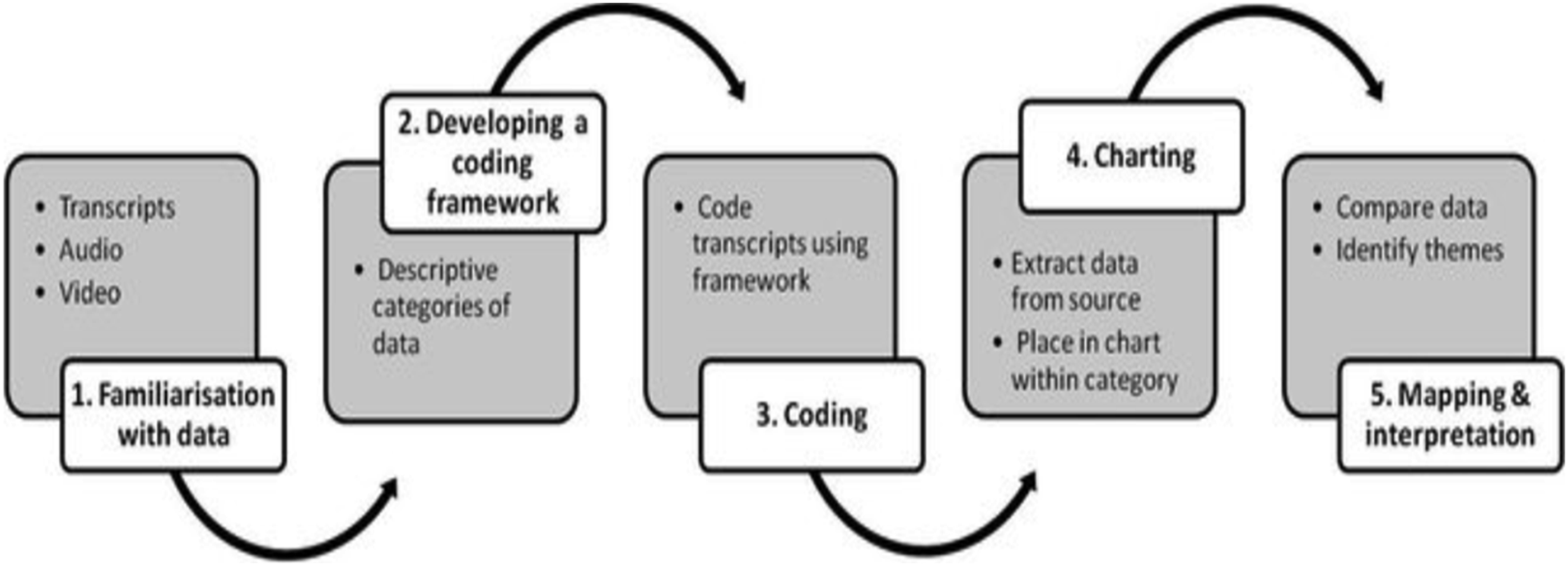
Once all data were organized and video/audio recordings were transcribed, we reviewed the transcripts of two collaborators again to identify more common patterns and documented them. We created a chart to categorize the questions and their responses from the 15 collaborators. Next, Borti and Jones-Mensah met virtually (note that Jones-Mensah is in Ghana) to discuss our initial thoughts about our observations in relation to the categories we created as a result of our initial readings. Then, we individually coded each transcript based on the research question and themes of learning opportunities. That is, researchers sought to explore the topics discussed during interviews and the focus group discussions. Opportunities for learning co-constructed within each interview, across the interviews from the 15 collaborators, and during the focus group discussions were documented in the chart.
Meeting the collaborators more than once enabled the researchers to build rapport to strengthen the relationship between the researchers and the collaborators, leading to increased trust and openness. The dual interview promotes in-depth knowledge and the richness of the data. The second interview was an opportunity to collect additional information from the collaborators. Further, it enables us to identify and close gaps and areas of ambiguity. Conducting interviews with collaborators more than once offered a more comprehensive, enhanced credibility of the findings and contributed to the overall quality of the research. A way to enact Ubuntu during the data analysis process was to engage in member checking. The collaborators had the opportunity to correct information and interpretations that might not have been representative of the collaborators’ views and dispositions. Because we still met for our professional development, it was possible to provide them with the transcripts to check the data. We were intentional about committing to the statement “Do no harm,” which aligns with Ubuntu.
After we achieved consensus on codes to be applied to the transcripts of the two collaborators, each researcher was assigned transcripts of seven collaborators to code, meaning Borti and Jones-Mensah had extra collaborators’ transcripts in common to code. Our next step was meeting every week to corroborate our codes and reach a consensus to discuss any coding questions and/or concerns. After coding the transcripts of the 15 collaborators and agreeing to the codes, we analyzed the codes and ascribed the theme to what we noted (see Borti & Jones-Mensah, 2023).
In discussing their co-constructed opportunities for learning literacy CK and PCK, the following themes were constructed based on the data. These themes are categorized under two broad captions: (a) opportunities for learning literacy CK and PCK during their training at the colleges of education and (b) opportunities for learning literacy CK and PCK during NTTs’ time on their current job (see Borti & Jones-Mensah, 2023).
The themes focused on opportunities for learning literacy CK and PCK during their training at the colleges of education included (a) exposure to lectures and course syllabi at their respective colleges of education, (b) teacher assisting and student teaching, and (c) study abroad program for students pursuing courses in the teaching of French. For the themes related to the NTTs’ opportunities for learning literacy CK and PCK during NTTs’ time on their current job, the following themes were discussed: (a) interaction with mentor teachers who are their senior colleagues, (b) a few professional development workshops and seminars, (c) peer interactions and collaborations, (d) the use of instructional videos and educational resources retrieved from the Internet, (e) real-life experiences in their current classroom, and (f) the interviews and focus groups discussions during this research (see Borti & Jones-Mensah, 2023).
In analyzing the data, we were mindful of committing to the tenets of Ubuntu, such as considering individual success as a collective effort, putting others first, and lifting others as one rises (Caracciolo & Mungai, 2009; Khoza, 2006). In interpreting the data, we were thoughtful of the representation of the collaborators’ information. We were careful not to interpret the data in a manner that dehumanizes our collaborators. We made sure not to present their information and the interpretation of the data from a deficit point of view, and in so doing, we aligned our data analysis with the tenets of Ubuntu, which is focused on considering individual success as a collective effort. The application of these tenets means that we see our success as researchers as dependent on the success of our collaborators; therefore, the manner in which we interpret and analyze the data reflects our collaboration and collectivism in our attempts to succeed as a research team.
We also endeavor to put our collaborators first in our data analysis, and one question that guided us during the data analysis was, “How would our collaborators feel when they read our interpretation of the data? Considering how the processes in our data analysis support our collaboration and help us lift our collaborators as we rise as educators and researchers, another question that guided our interpretation of data was, “Do our data analysis, coding categorization, and interpretations align with the tenets of Ubuntu?” For example, when the male collaborators were intentional about encouraging the women to share their perspectives about the topic being discussed, we categorized their dispositions and statements as aligning with collective problem-solving and mutual support within communities, two tenets of Ubuntu. We considered the men as collectively solving the problem of a culture of silence.
Incorporating Ubuntu in Relation to Ethical Considerations
We, the researchers, interrogated our lived experiences through our ethical conscience while we considered the best interest for engaging implicitly with our collaborators, their cultures, and lived experiences. Using culturally responsive relational reflexive ethics (Lahman et al., 2011), we acknowledge that, as researchers, we might not be aware of and comprehend the several cultural perspectives that exist in our research community; thus, being reflexive, reflective, and mindful of our own bias and dealing with it were necessary for conducting ethical research, a tenet of Ubuntu. Thus, we continually reflect throughout the study and even after the study since our limited understanding of our collaborators’ lived experiences calls for our flexibility and openness in examining ethical issues in relation to our stories, the stories of others, our cultures, and the culture of others. Our approach to ethical considerations and commitment aligns with the tenets of Ubuntu that include (a) considering individual success as a collective effort, (b) putting others first, and (c) lifting others as one rises (Caracciolo & Mungai, 2009; Khoza, 2006).
We were committed to Ubuntu’s axiology as relational ethics, grounded in humble togetherness, and emphasizing the importance of mutual respect, reciprocity, and collaboration between researchers and collaborators. Evidence of Ubuntu’s axiology includes researchers and collaborators embracing levels of vulnerability, mutual respect, and relational ethics in humility needed to share and construct their identities and knowledge in this new, safe, and brave space. To exemplify humility, vulnerability, and being safe and brave, one of the collaborators, Kofi, was prepared to learn how to install the Zoom app on their phones to participate in the interviews. He shared in the research chat group how he was new to this technology and was struggling but determined to get it right.
Others tried using Zoom privately with the researchers to ensure they knew how to use it before the meeting date and time, although one person suggested, “I think we should just log in on the set date and time that will be suitable for you.” One thing worthy of note is how the speaker used “we” to speak on behalf of the group when he was not delegated. Although he was not delegated, the other collaborators did not disagree with him or restrain his communal approach in his discourse. These values and relational ethics show how collaborators were willing to share, seek, and offer help without judgment. We saw collaborators as equal partners who were co-constructing communal knowledge with us. There was no point of tension because Borti and Jones-Mensah were from Ghana and had many things in common with the collaborators. We did not present ourselves as the more knowledgeable others but as a team working and learning together. For example, the NTTs will often want to defer knowledge and decision to Borti because she has a PhD, but Borti always said, “We are all learners, and we are learning together.” The humility exhibited by Borti and Jones-Mensah encouraged the NTTs to be open to talk and be critical when needed. Thus, they were fearless in sharing their perspectives and making mistakes.
In the next section, we discuss our learning outcomes and recommendations for researchers, focusing on technological considerations, developing connections during the planning phase, and fostering effective virtual group collaboration.
Learning Outcomes and Recommendations for Researchers
In the subsequent section, we delve into learning outcomes and provide suggestions for researchers, including technological factors to consider, establishing connections during the planning stage, and ultimately nurturing productive collaboration within virtual groups. Last, we discuss some limitations encountered during the study.
Technological Considerations
As evident in the previous section, using the Ubuntu research paradigm in a virtual medium while conducting research requires considerable planning and effort. Technological issues must be carefully considered by researchers, such as ensuring that the Internet and appropriate virtual communication technologies are accessible to all parties involved in the research study. It is worth noting that even if the Internet is available in a remote area, it may not be fast enough to support video or audio meetings. In addition, researchers must reflect on ways to support research collaborators in accessing the necessary technologies and fast Internet through financial support.
Further, providing traveling-related support is important if collaborators need to travel to different places to access fast Internet for virtual meetings. It is also important to recognize that different apps and platforms are popular in different countries. For example, in Ghana, WhatsApp and Facebook Messenger are more commonly used for video calls than Zoom or Snapchat, which are more popular in the United States. Therefore, researchers must be mindful of these differences in technology use and availability across cultures and geographic locations.
Developing Connections During the Planning Phase
Developing healthy and sustainable connections and relationships with indigenous people whose community a researcher wants to work in is crucial. Although Borti and Jones-Mensah are Ghanaians, they worked with partners in Ghana who assisted them in planning and recruiting collaborators. Some of these partners were Borti’s dissertation research collaborators who, using snowball sampling method, helped recruit other committed collaborators for the current study. Former instructors of these initial dissertation collaborators also supported in recruiting current collaborators. For example, those partners provided valuable insights and recommendations on recruiting participants from the local communities and the five regions in Ghana. They offered suggestions on how to overcome language barriers because Ghana is a multicultural and multilingual country with more than 60 Ghanaian languages (Dolphyne & Kroppe-Dakubu, 1988). Suggestions were also offered on how to addressed issues related to cultural differences, and other logistical challenges that may have arisen.
Although the study described in the previous section was conducted virtually during the COVID-19 pandemic, the partners and collaborators in Ghana played significant roles in planning, recruitment, and meetings in terms of logistics, providing local knowledge about time zones, holidays, climate issues, and other scheduling considerations that might impact the research team’s ability to collaborate effectively. Thus, having local and indigenous people on the ground involved in virtual research collaboration was essential for the research project’s success.
Fostering Effective Virtual Group Collaboration
In fostering effective virtual group collaborations, respectful relationships must be built. The following tenets of Ubuntu must be enacted and upheld: (a) considering individual success as a collective effort, (b) putting others first, (c) considering great and effective leadership as service and support to others, (d) lending assistance as enabling, (e) eschewing a competitive spirit, and (f) lifting others as one rises (Caracciolo & Mungai, 2009; Khoza, 2006).
Without building a community committed to collective success, supporting one another, and lifting one another, virtual collaborations cannot ensure ethical relationships and success. To enact these tenets of Ubuntu and ensure effective virtual collaboration, the researchers have become coaches to the collaborators, and Borti’s mobile number is accessible to all the collaborators. The collaborators reach out to Borti as and when needed before, during, and after the data collection. For example, a collaborator texted Borti through WhatsApp in November 2022, saying, “Happy birthday, wishing you long life and God’s blessings so that we will continue with our professional learning collaboration.” Note that this text was written after data collection ceased and was unrelated to our research. Thus, with Ubuntu, the collaborative learning, shared experiences, and friendship that developed over the course of the research process continued after the research project ended.
Also, on December 20, 2022, another collaborator sent a text that exemplified the Ubuntu spirit and the relationship that has developed and continues to thrive even after the study. The collaborator stated, “Good evening doc, I called my lecturer that’s Mr L, of Bill College of Education, to greet him, and he asked of you. I told him you are fine and that we even had a discussion on Sunday. So, he said you should try and add him for our next discussion.” To give context, the Sunday meeting referred to was the professional development meeting that developed due to the need to support one another in their careers, especially novice teachers.
More evidence of our commitment to lifting one another and building long-lasting relationships beyond research is evident in the text message Borti received from one of the collaborators in Ghana on April 29, 2023. In the text, Victor stated: Good evening, Doc. How are you? Please, if I do my first degree in Ghanaian language (Ewe) and the Second Degree in English Language (Applied Linguistics), would I be able to teach in any of the tertiary institutions in Ghana?
Victor was seeking counsel in relation to his master’s program and future professional development. This collaboration and commitment hold in high esteem the notion of “do no harm”; hence, research collaborators are considered collaborators and partners before, during, and after the research process.
We acknowledge some limitations in celebrating the success stories of using Ubuntu as a research paradigm. For example, virtual collaboration poses Internet and technology challenges. As mentioned in this paper, there were times when collaborators needed to travel to another town to have stable internet connectivity to join the meetings. Further, Borti was in the United States, and the collaborators were in Ghana, meaning there were challenges with meeting times that were suitable for all the collaborators and Borti due to the different time zones. Further, with the high cost of Internet subscriptions in Ghana, it was financially difficult for some collaborators to pay for their Internet subscriptions for virtual collaboration. Thus, researchers must be willing to support collaborators in purchasing Internet data during virtual collaborative research.
We acknowledge that Ubuntu has been used across different disciplines such as social justice and human rights (Chinouya & O’Keefe, 2006), conflict resolution (Mnyaka & Motlhabi, 2015; Swanson, 2007), education (Swanson, 2007), business (Khoza, 2006), health care (Chinouya & O’Keefe, 2006), sociopolitical contexts (Swanson, 2007), leadership (Khoza, 2006), and environmental sustainability (Etieyibo, 2017). However, researchers using Ubuntu should be cognizant of the dynamics in different disciplines and cultural contexts among indigenous cultures, even in Africa. Thus, caution must be taken to interrogate the applicability, suitability, and logistical affordances before using Ubuntu as a research paradigm.
Notwithstanding the limitations, we assert that the learning outcomes from our study allow us to recommend the use of Ubuntu as a research paradigm in other disciplines and fields (e.g., medicine, social work, counseling, technology, agriculture, geography, environmental studies) in Ghana across Africa.
Footnotes
Declaration of Conflicting Interests
The author(s) declared no potential conflicts of interest with respect to the research, authorship, and/or publication of this article.
Funding
The author(s) received no financial support for the research, authorship, and/or publication of this article.
