




Abstract
Employing a grounded theory approach, this study conducts interviews with 30 scholars and government officials actively involved in extensive study and practical endeavors within the domains of Sport City and sports events. The inquiry aims to elucidate the factors driving the promotion of the construction of Sport City facilitated by hosting major sports events. The results indicate that major sports events demonstrate a “cumulative effect” in fostering the construction of Sport City. Influential factors encompass the function of Sport City, the economy of Sport City, the resident well-being of Sport City, and the soft power of Sport City. Furthermore, the promotional influence of hosting major sports events on one facet of Sport City positively impacts the development of other facets.
Introduction
Throughout the transition from “walkable cities” to “industrial radial cities,” sport has consistently played a pivotal role in the social structure of human-populated urban regions (Riess, 1991). Concurrently, the economic, cultural, and spatial characteristics of cities have provided a fertile foundation for the development of sports (Pujadas, 2012). The contemporary origin of the construction of Sport City can be traced to older industrial cities strategically utilizing sports to catalyze urban transformation in response to the urban decline resulting from the industrial revolution (Jones & Stokes, 2003; Mules & Faulkner, 1996; Pye et al., 2016; Smith, 2005). Pragmatically, major global sports events such as the Olympics and the FIFA World Cup have emerged as crucial catalysts for the development of international Sport City (Gold & Gold, 2023; Nikolaou et al., 2023). Whether grounded in urban economic development or the resolution of social conflicts, the construction of Sport City should consistently be accompanied by profound humanistic considerations (Bale, 1992). Over the long term, the developmental trajectory of Chinese Sport City has entailed adopting and emulating strategies from Western developed countries, where hosting major sports events is viewed as an essential pathway in constructing Sport City. After the 2008 Beijing Olympics, Cities in China such as Beijing, Shanghai, Wuhan, Nanjing, Guangzhou, Shenzhen, Chengdu and Hangzhou have sequentially articulated the visionary goal of constructing an international Sport City.
At the practical level, major sports events have undeniably emerged as a crucial catalyst for the development of Sport City. However, at the theoretical research level, there is a notable absence of targeted research on the pathways through which major sports events promote the development of Sport City. Accordingly, the objective of this study is to concentrate on the query “How do major sports events enhance the construction of Sport City?” by utilizing grounded theory, scrutinizing the factors by which major sports events impact the development of Sport City. Theoretically, by constructing models to elucidate the relationship between major sports events and the development of Sport City, it is possible to extend existing research outcomes to a certain extent. Practically, it can provide decision-making references for the government regarding the construction of Sport City, improve the quality of products and services associated with major sports events, and optimize the developmental trajectory of Sport City. It is crucial to clarify that Sport City, as proposed in this study, does not exclusively refer to venues such as sports stadiums, sports parks, sports museums, or recreational areas (Smith, 2005, 2010), but rather symbolizes the urban type or brand that a city aims to establish.
Literature Review
Sport City
In tracing the historical evolution the formation and development of cities have spanned a considerable period. Cities has evolved from the initial notion of “locations where human trade transpired periodically or irregularly,” to “cities fortified with moats and walls,” and has advanced to contemporary city typologies, including tourism cities (Judd & Fainstein, 1999), steel cities (Kobus, 2015), mining cities (He et al., 2017), commercial financial cities (Mollan & Michie, 2012), and comprehensive cities (Branch, 2018).
In historical retrospect, the concept of Sport City originated from the first recorded Olympic Games in 776 BC in Olympia and the Delphi Games in 586 BC (Decker, 2008; Smith, 2010). The development of modern Sport City is attributed to the global expansion of professional sports (Pye et al., 2015). As early as the late 19th century, Indianapolis, the state capital of Indiana, sought to inspire urban vitality and facilitate urban transformation by hosting sports events and fostering professional sport clubs (Jones & Stokes, 2003). Subsequently, traditional industrial cities such as Sheffield, Manchester, and Birmingham successively embraced sport as a catalyst for urban development (Jones & Stokes, 2003; Mules & Faulkner, 1996; Pye et al., 2016; Smith, 2005). Although the term “Sport City” has become conventional, its concept lacks a uniform definition. Its application typically takes two forms: either a city designates a certain section as a Sport City, or the entire city is transformed into a Sport City (Smith, 2005). On an international scale, sport villages, sport zones, sport centers, and national Sport City, are collectively referred to as Sport City. In the assessment of Sport City by external organizations, such as the Association of European Sports Capitals and SPORTCAL, various evaluation criteria are employed, but a clear definition for Sport City is not provided (Pye et al., 2015).
Concerning the theoretical research on Sport City, scholars have concentrated on several aspects, the first being the use of sports as a resource for city tourism (Mules & Faulkner, 1996; Rosentraub et al., 1994; Salgado Barandela et al., 2023). Secondly, the political and social benefits of sport can enhance a city’s international image and boost the participation of city residents in sports activities (Pye et al., 2015; Smith, 2010). The third aspect is that cities use sports events as a springboard for economic growth (Crompton, 2002; Gratton et al., 2006; Presenza & Sheehan, 2013).
Major Sports Events and Sport City
World Expos started to give way to sports events as the main significant urban icon in the 20th century (Silk & Amis, 2013). Sports events hold promotional value, bringing joy, pride, and non-utilitarian positive impacts to urban society and culture (Mules & Faulkner, 1996). Governments globally employ sports events for urban redevelopment and regenerating “abandoned” areas (Gratton & Henry, 2002; Sam & Hughson, 2013).
Disregarding the potential negative effects, hosting major sports events can bring excitement and stimulation to cities. Therefore, many Sport Cities vigorously compete for the opportunity to host major sports events, aiming to enhance their urban image (Pye et al., 2015). When evaluating Sport City, international institutions consistently regard both the quantity and the quality of hosted major sports events as crucial indicators. Practically exploring the development of Sport City, the researchers observed that cities facing economic decline and striving for urban transformation, such as Indianapolis, Sheffield, and Melbourne (John & McDonald, 2020; Jones & Stokes, 2003; Pye et al., 2015; Smith, 2010), along with tourist-oriented cities like Barcelona, Sydney, and Athens (Gratton et al., 2016; Mules & Faulkner, 1996), share a highly similar path in the construction of Sport City. The overarching goal of developing Sport City is to reshape the urban image through major sports events, attract tourists and foreign investments, and stimulate urban economic development. Historically, the development path of Chinese Sport City involved borrowing and imitating Western developed countries, where hosting major sports events was considered an essential step in building Sport City. Cities like Shanghai and Chengdu, in particular, employed slogans such as “City of Events” and “City of Sporting Excellence” to symbolize their status as Sport City.
Major sports events are essential for accelerating urban development. Although major sports events are short-term and singular occurrences, their enduring positive externalities for the host city are evident (Rappaport & Wilkerson, 2001; Roche, 1994). This encompasses substantial contributions to the growth of the host city’s tourism sector (Baade et al., 2021; Solberg & Preuss, 2007; Ziakas, 2023), the augmentation of international prominence (Jeong & Faulkner, 1996; Johnston et al., 2023), and the improvement living standards of residents (Kaplanidou et al., 2013; Mair et al., 2023). Nevertheless, research on the impact of major sports events on the development of Sport City lacks thoroughness and comprehensiveness. A notable absence exists in terms of targeted research results on the factors through which major sports events foster the development of Sport City. Accordingly, employing grounded theory to examine the impact factors of major sports events on the development of Sport City, this study aims to investigate the question, “How do major sports events enhance the development of Sport City?” In theoretical terms constructing models to elucidate the relationship between major sports events and the development of Sport City can extend existing research to a certain extent. In practical terms, it can offer decision-making references for the government in the development of Sport City, improve the quality of products and services related to major sports events, and optimize the trajectory of the development of Sport City.
Method
Currently, there are few systematically mature theoretical models available for the study of major sports events and Sport City. The objective of this study is to explore how hosting major sports events promotes the construction of Sport City. As a process-oriented study to explore specific theories, quantitative research is inapplicable. Grounded Theory, introduced by American sociologists Barney Glaser and Anselm Strauss in 1968 (Glaser et al., 1968), is a qualitative research method. Through systematic analysis and inducting empirical data, it progressively establishes concepts and theoretical models that reflect the essence. Serving as a bridge for empirical data to evolve into theoretical construction, grounded theory can provide researchers with a scientific, standardized, and rigorous research paradigm. Therefore, this study is appropriate for employing grounded theory to explore the theoretical model of how hosting major sports events promotes the construction of Sport City.
Participants and Coding Strategies
This study utilized a semi-structured interview method to conduct informal interviews with participants, acquiring materials and cases for qualitative research. Semi-structured interview requires representative participants. Therefore, the interviewees selected for this study must meet the following conditions based on the research purpose. Essentially, interviewees are required to have knowledge and experience in areas such as hosting major sports events, constructing Sport City, and urban marketing, and they must be able to answer the researcher’s questions. In the second place, interviewees who actively participate in the interview should be willing to share their experiences and opinions. Besides, interviewees should also be able to communicate well and be able to express their opinions clearly.
In this study, 30 scholars and government officials actively involved in relevant research and practical work in the field were selected for interview surveys.
Semi-Structured Interview Outline.

To ensure standardization and accuracy of the entire research process, this study adopts the following data analysis strategy. An interview group consisting of four members with extensive experience in the field of sports events research (2 professors and 2 PhDs) was formed. Prior to the commencement of research, the interview group conducted a workshop to ensure members achieved consistency in defining and standardizing coding. Each member conducted one-on-one in-depth interview with the participants and recorded their individual coding processes and results. After coding was completed, members of the interview group exchanged and compared their results to develop a common coding system. Finally, for concepts and categories that proved challenging to generalize, members of the interview group engaged in repeated coding, conducting thorough analysis, comparison, and discussion until a consensus was reached.
Data Analysis and Procedures
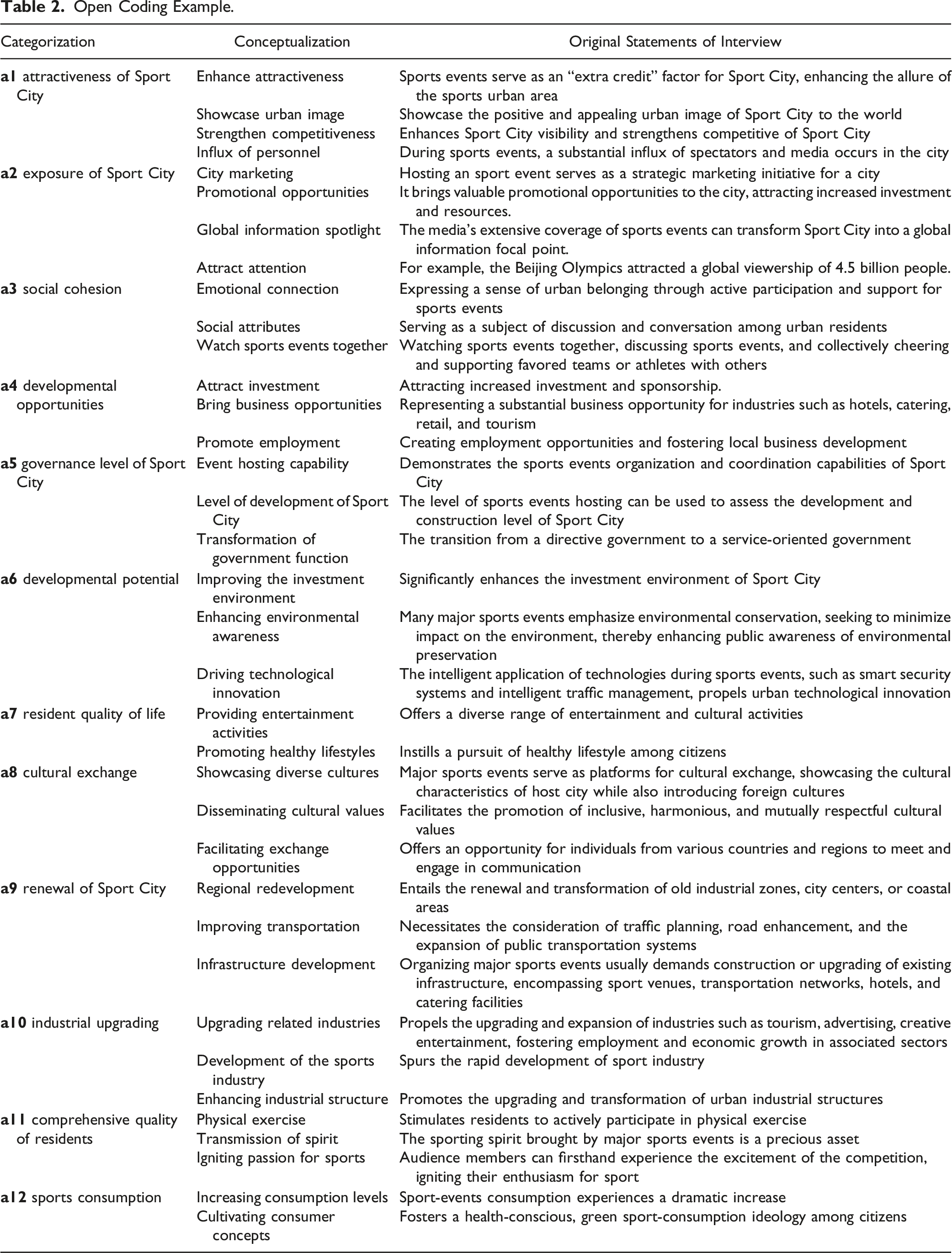
Open Coding
Open Coding Example.
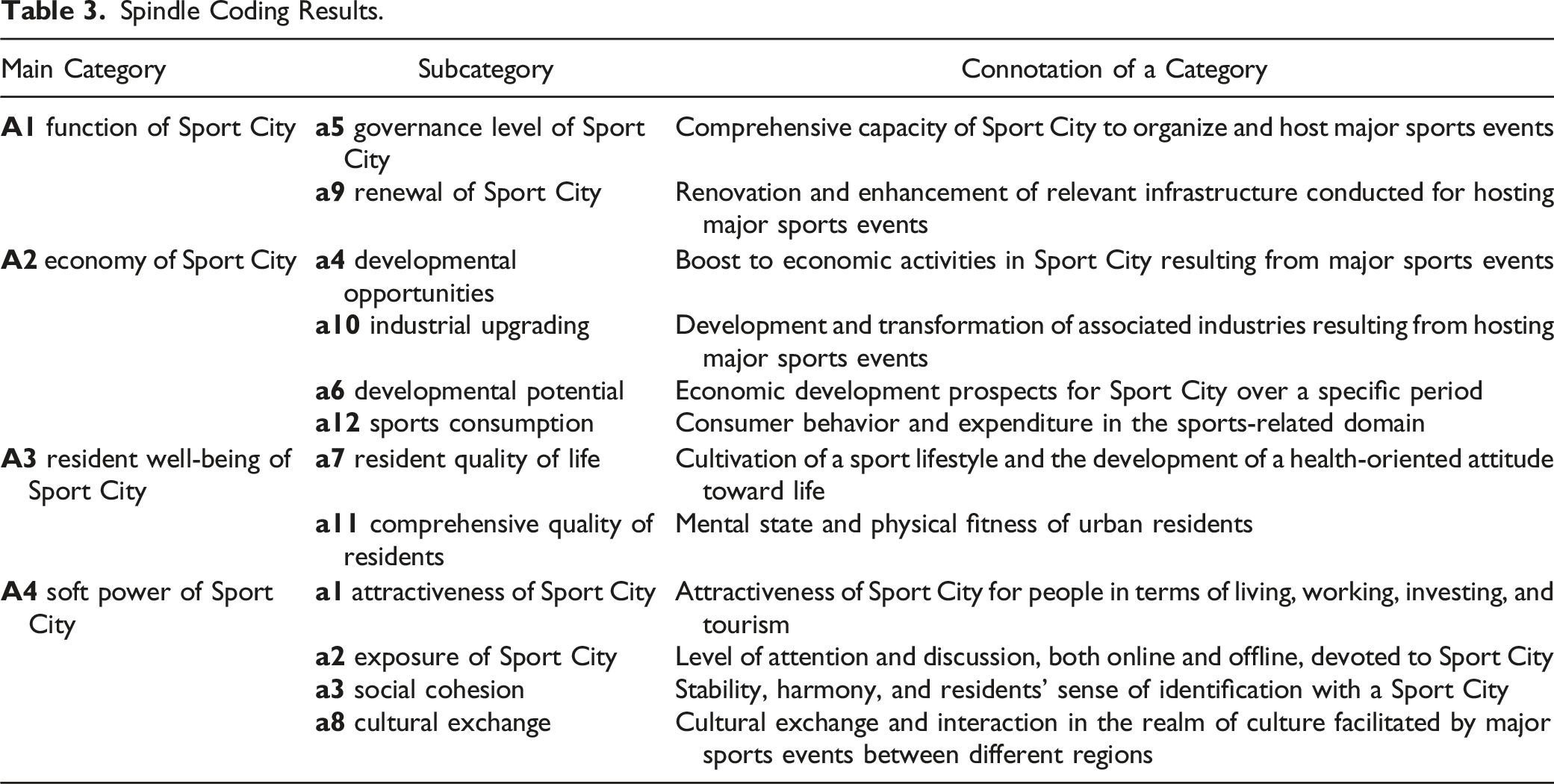
Axial Coding
Spindle Coding Results.
Selective Coding
In selective coding, core categories are extracted from the main categories and refined (Vollstedt & Rezat, 2019). This study conducted an exhaustive systematic analysis of the four main categories and twelve subcategories, integrating original interview data, to extract the core category of “Major Sports events promoting the construction of Sport City.” From a narrative perspective, major sports events drive the enhancement of functional capabilities in Sport City, promote economic development, elevate the resident well-being of Sport City, and bolster the soft power of Sport City, thereby fostering the overall development of Sport City. Under this paradigm, enhanced Sport City functionality is a direct result of major sports events. Conversely, the increased well-being among residents of Sport City represents an indirect outcome of hosting major sports events. The economic advancement of Sport City reflects the economic benefits stemming from hosting major sports events. The strengthening of the soft power of Sport City signifies the societal benefits resulting from hosting major sports events. Throughout our investigation, we consider “function of Sport City,” “economy of Sport City,” “resident well-being of Sport City,” and “soft power of Sport City” as the four variables within the core category of “facilitating the construction of sports cities through hosting major sports events.” We construct an illustrative theoretical model for the promotion of Sport City development through major sports events (refer to Figure 1), and through further exploration and establishment of connections among primary categories, we aim to investigate the factors through which major sports events facilitate the construction of Sport City (refer to Figure 2). The theoretical model of major sports events promoting construction of Sport City. Inherent drivers of hosting major sports events promote the development of Sport City.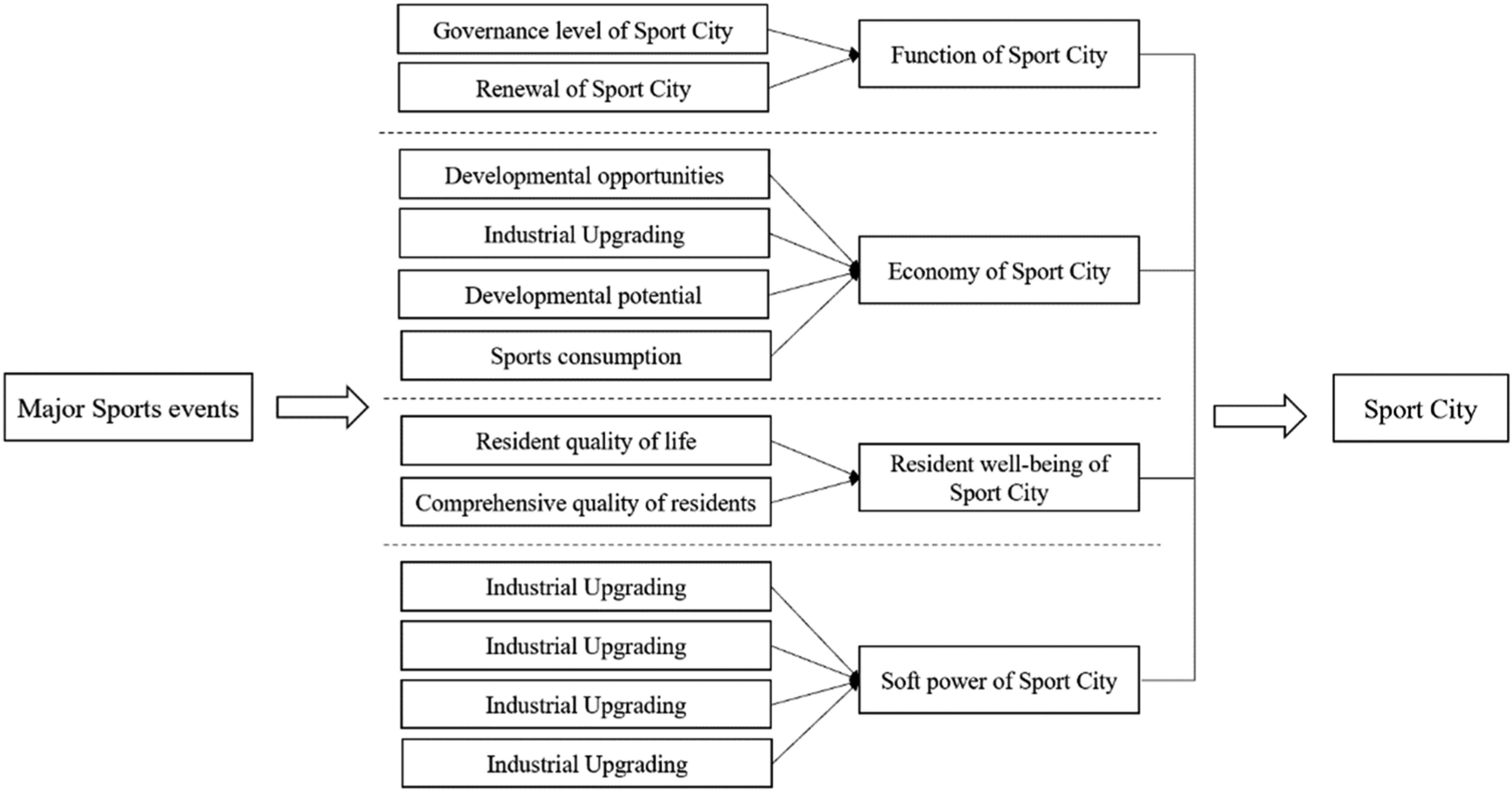

Theoretical Saturation Testing
Saturation tests evaluate the richness and adequacy of the data collected by researchers. Researchers analyze new data incrementally, assuming theoretical saturation is reached when no new information or concepts emerge. At this stage, researchers can stop collecting data and begin organizing, interpreting, and formulating the already established theory. Following the operational requirements of saturation testing, this study conducted a sentence-by-sentence analysis and extracted dimensions from 10 interview transcripts, resulting in 34 initial concepts. After comparison with the existing coding results and cross-validating among interview group members, the results showed that no new information or concepts were extracted from the new interview data. Therefore, the theoretical model presented in this study, illustrating how hosting major sports events promotes the construction of Sport City, successfully passes the saturation test.
Findings
Theoretical Model for Advancing the Development of Sport City through Hosting Major Sports Events
Function of Sport City
The enhancement of Sport City’s function is a direct outcome of major sports events that promote both the construction and renewal of the city, operating at two dimensions: the governance level and the overall revitalization of Sport City. Regarding the governance level of Sport City, hosting major sports events necessitates coordination and cooperation among multiple departments. Advanced planning is conducted before, during, and after the sports events to mitigate various risks, highlighting the management skills and service orientation of urban administrators. Therefore, the organizational and hosting capabilities of major sports events serve as benchmarks for evaluating the management and service level of Sport City. The quantity and caliber of hosting major sports events are critical criteria for assessing the construction level of Sport City. Agencies evaluating Sport City regard major sports events as pivotal indicators of development. Regarding the renewal of Sport City, Sport City commonly undergoes substantial urban transformation and infrastructure development in old industrial areas, city centers, or coastal regions before hosting major sports events. This includes the construction of sport venues, transportation facilities, hotels, and tourism amenities. Such investments not only provide excellent venues and facilities for sports events but also lay the groundwork for the long-term development of Sport City.
Economy of Sport City
The economic benefits derived from major sports events undeniably play a crucial role in fostering the development of Sport City. These economic advantages primarily manifest as opportunities for development and potential for growth, catalyzing the industrial upgrading of Sport City and activating their vitality in sport consumption. In preparation for major sports events, Sport City often requires substantial investments in relevant supporting facilities and event service levels, creating diverse business and employment opportunities. Additionally, the positive “brand promotion” effect of major sports events, combined with the upgrading of city infrastructure, becomes a crucial tool for improving the investment environment of Sport City. Embracing principles of event organization that focus on environmental protection, resource utilization, technological innovation, and social inclusiveness can propel Sport City towards more sustainable and environmentally friendly development, thereby increasing their developmental potential. Lastly, major sports events significantly stimulate the implementation of sports projects, thereby broadening the development space of the sports industry. Hosting major sports events, functioning as temporary resource allocation centers, leads to a rapid influx of population, capital, and information, directly propelling the upgrading and expansion of city-related industries such as hotels, catering, retail, and tourism, bringing about immediate economic benefits for the development of Sport City.
Resident Well-Being of Sport City
The enhancement of the resident well-being of Sport City is a manifestation of the non-market value function of major sports events. This enhancement is attributed to an improved quality of life for the residents in Sport City. In particular, major sports events offer residents in Sport City compelling and enjoyable entertainment, immersing them in the intense event atmosphere. Watching sports events can stimulate residents’ awareness of health and exercise, fostering positive intentions for increased exercise frequency and participation in team sports. This positive health behavior contributes to improving residents’ physical health. Additionally, residents in Sport City are not just spectators. Throughout the sports events, they play the role of “hosts” by participating in volunteer services, subtly enhancing the basic essence of residents. For residents in Sport City, the greatest spiritual wealth derived from major sports events lies in transmitting the spirit of sports, cultivating awareness of teamwork, emphasizing sports ethics and fair competition, promoting cultural awareness and international exchange, stimulating interest in sports, and the pursuit of excellence. These aspects have a positive impact on the comprehensive improvement of the fundamental essence of residents.
Soft Power of Sport City
The enhancement of the soft power of Sport City constitutes a social benefit resulting from major sports events promoting the construction of Sport City. Concerning the allure of Sport City, major sports events serve as a high-quality communication medium, attracting people from around the world like a powerful magnet. They provide a grand stage for Sport City to showcase their image and features. The atmosphere, intense competition, and unique experiences of the matches inject distinctive charm and vitality into the development of Sport City, adding to the attractiveness. The allure of hosting major sports events not only offers benefits to residents but also significantly contributes to the development and increased international competitiveness of Sport City. In terms of the exposure of Sport City, major sports events are special occasions with strong social attention and information dissemination, typically attracting media coverage from around the world. This implies that Sport City will have the opportunity to globally showcase its urban image and features. “Hosting an event, marketing a city” is not merely a slogan but has become the tangible practice of many Sport City in urban marketing. Regarding social cohesion, major sports events can foster shared experiences and emotional resonance among residents of Sport City. Residents express a sense of belonging to Sport City by participating in and supporting events, thereby strengthening community cohesion and unity. This shared emotional experience can prompt people to resonate and connect, enhancing social cohesion. Regarding cultural exchange, major sports events provide an opportunity for people from different cultural backgrounds to communicate and interact. This cross-cultural exchange can occasionally break down barriers, promote friendship, enhance mutual trust between countries, and contribute to the promotion of inclusive, harmonious, and mutually respectful cultural values.
Inherent Drivers of Hosting Major Sports Events Promote the Development of Sport City
Based on grounded coding results and interview descriptions, an interpretative analysis is conducted to elucidate the inherent drivers by which hosting major sports events promotes the development of Sport City. The analysis reveals that hosting major sports events can impact the construction of Sport City in four main categories separately, and these categories can also mutually influence each other. Essentially, driving the functional upgrade of Sport City, fostering the economic development of Sport City, elevating the resident well-being of Sport City, and enhancing the soft power of Sport City represent the direct or indirect benefits arising from hosting major sports events for the construction of Sport City. The interaction between these four categories amplifies their mutual influence, contributing to the heightened value and functionality of hosting major sports events and driving the construction of Sport City.
In the drivers of promoting the construction of Sport City through hosting major sports events, the improvement and upgrading of the function of Sport City are fundamental prerequisites. Hosting major sports events will inevitably drives Sport City to enhance its hardware facilities and software services. This includes not only the renovation of sport venues, transportation, communication, hotels, and tourism facilities but also poses challenges to the governance level of Sport City in various aspects. Enhancing the infrastructure, public services, and urban planning of Sport City can significantly update their urban appearance, enhance visibility and image, and strengthen the soft power of Sport City. Simultaneously, upgrading the function of Sport City can yield various benefits, including increased employment opportunities, an improved investment environment, and the development of related industries, thereby promoting the economic development of Sport City. For residents of Sport City, upgrading the function of Sport City and economic development can create a favorable living environment and offer a higher quality of life, thereby enhancing the resident well-being of Sport City. This well-being will further bolster the social image of Sport City and the residents’ sense of identity and belonging, consequently increasing the soft power of Sport City. The role of the soft power of Sport City is to provide residents with additional sports resources, events, and cultural experiences, consequently augmenting residents’ participation and the quality of their sports experiences. This, in turn, contributes to enhancing the resident well-being of Sport City. Therefore, there exists a positive mutual relationship between the resident well-being of Sport City and the soft power of Sport City, jointly promoting the comprehensive development of Sport City. Additionally, enhancing the soft power of Sport City will assist in attracting investment, promoting international exchanges and cooperation in Sport City, and contributing to the sustainable development of Sport City.
The hosting of major sports events has an evidently promoting effect on the construction of Sport City. This is evident not only in the direct or indirect benefits of improving and upgrading the function of Sport City, developing the economy of Sport City, the resident well-being of Sport City, and strengthening the soft power of Sport City but also in the “cumulative effect” inherent in major sports events. In the drivers of how major sports events promote the construction of Sport City, upgrading the function of Sport City can directly drive economic development and enhance the soft power of Sport City. Each of these aspects positively influences the enhancement of the resident well-being of Sport City. Enhancing the resident well-being of Sport City subsequently has a positive impact on strengthening the soft power of Sport City. Strengthening the soft power of Sport City creates a solid foundation for the economic development of Sport City, fostering prosperity and sustainable economic growth.
Discussion
Conclusions
In the current academic landscape, scholars have undertaken comprehensive studies on major sports events, exploring them from diverse perspectives, with a particular emphasis on their profound impact on urban development (Baade et al., 2021; Gratton & Henry, 2002; Johnston et al., 2023). This study has led to substantial advancements in understanding the intricate relationship between major sports events and the development of urban areas. Within the realm of Sport City research, a wealth of information pertaining to the origin, significance, and impact of Sport City is accessible from existing studies, contributing to a comprehensive understanding of this dynamic field (Decker, 2008; Gratton et al., 2006; Pye et al., 2015; Smith, 2010).
From a practical standpoint, it is noteworthy that cities worldwide often utilize the strategy of hosting major sports events as a fundamental element in Sport City development. This strategy is applied regardless of whether the events are comprehensive, such as the Olympics, or singular and major, like the World Cup (Koch, 2022). Simultaneously, international evaluation institutions acknowledge that hosting major sports events is a pivotal criterion in assessing Sport City (Pye et al., 2015). Evidently, hosting major sports events has become a crucial and pivotal theme in the implementation of Sport City development.
This study affirms the early research findings regarding the relationship between major sports events and urban development. It reveals that upgrading the function of Sport City directly stems from major events promoting the construction of Sport City. Previous studies have demonstrated that one of the most direct effects of hosting major sports events is the improvement of the infrastructure in sports cities (Eisinger, 2000; Gogishvili, 2018; Gold & Gold, 2023). Furthermore, hosting major sports events has yielded significant economic benefits for the development of the Sport City economy. On one hand, hosting major sports events can yield positive effects on the city’s international reputation, tourism industry, public welfare, employment, and external investments, thereby enhancing the economic vitality and overall economic environment of the city. On the other hand, during the planning of major sports events, prioritized development areas attract substantial investments to enhance their appeal to event visitors and increase their real estate value post-event (Broudehoux & Sánchez, 2016; Gratton et al., 2016). Our study aligns with these perspectives, providing additional support to the assertions of previous studies. Beyond these two factors, in exploring the role of sports in enhancing urban brand construction, John and McDonald (2020)emphasized that sports events can subtly impact the cultural atmosphere of Sport City. Expanding upon this perspective, this study provides additional evidence for the role of hosting major sports events in promoting the cultural soft power of Sport City. Additionally, major sports events have the functions of fostering residents’ awareness of exercise and health, enhancing residents’ quality of life, enriching residents’ recreational activities, and more. Therefore, hosting major sports events can also enhance the resident well-being of Sport City (Grix & Houlihan, 2014).
More importantly, this study posits that hosting major sports events not only exerts a promotional effect on a specific aspect of Sport City but also plays a crucial role in generating positive impacts on various other facets of its development. It can be asserted that the promotional impact of major sports events on the development of Sport City manifests a form of “cumulative effect.” Throughout this process, function, economy, residents’ well-being, and soft power interact and mutually influence one another centered on hosting major sports events.
Practical Implications
The results of this study indicate that hosting major sports events can foster the development of Sport City. Based on the research findings, we propose the following recommendations:
Sport City should actively bid for major sports events. Firstly, they should strive to host major comprehensive sports events with profound impacts, ensuring a positive influence on the function, economic development, residents’ well-being, and soft power. Secondly, in contrast to major comprehensive sports events, international single-sport events feature a greater number and variety of competitions. Sport City should choose single-sport events that align with their urban development, ensuring a coordinated development approach while maximizing the socio-economic benefits of the events.
Sport City should comprehensively enhance the services and security capabilities of sports events. Sport City should establish a comprehensive event organizing structure and event security measures, coordinating and managing various aspects of sports events hosting and developing detailed sports events plans. They should also enhance event marketing and promotion by utilizing channels such as social media and advertising to promote sports events, increase visibility and attractiveness, and enhance the brand value of sports events.
Limitations and Future Research
This study significantly enriches the research framework of Sport City by exploring how hosting major sports events contributes to the development of Sport City. Nevertheless, the study has some limitations.
The coding materials used are derived solely from interviews, limiting data diversity by not incorporating materials from alternative sources. Simultaneously, following the grounded theory coding process, this qualitative research is unable to address its limitations through employing empirical research on the theoretical foundation constructed based on grounded theory.
To address these shortcomings, future studies should expand data collection channels. Collating and analyzing textual materials from diverse sources, including official reports, social media, on-site surveys, and expert interviews, to obtain a more comprehensive and multi-dimensional understanding, thereby increasing the breadth of the studies. Aiming to complement and enhance the theoretical model of how hosting major sports events contributes to the construction of Sport City. To enhance the scientific and objective nature of the studies, future studies should incorporate quantitative research methods. Employing a systematic and quantitative approach to examine the factors under discussion ensures their reliability and effectiveness in both theoretical analysis and empirical research. The application of quantitative research methods enables a precise and comprehensive understanding of the relationships between various factors, thereby enhancing the theoretical understanding of the studies topic. Moreover, future studies can explore the conclusions from various perspectives and methods to further refine and deepen our understanding.
Footnotes
Acknowledgments
We would like to express our gratitude to the 30 interviewees for their assistance in this paper.
Declaration of Conflicting Interests
The author(s) declared no potential conflicts of interest with respect to the research, authorship, and/or publication of this article.
Funding
The author(s) disclosed receipt of the following financial support for the research, authorship, and/or publication of this article: This research was supported by the Sichuan Provincial Philosophy and Social Science Foundation Project titled “Research on the Construction of Chengdu as a World-renowned Sports City Based on Urban Marketing Strategic Orientation” (Grant Number: SCJJ23ND75).
