




Abstract
Fictional narratives are increasingly analyzed by scholars to improve our understanding of the ‘human condition’, because fiction gives access to the deeply personal experiences, perceptions, and struggles of individuals. This methodological literature review explores current fiction-based research practices in organization and management studies, identifies methodological shortcomings, and finds emerging methodological conventions. After searching for fiction-based research in 26 leading organization and management journals, I found 69 articles that used fictional narratives. My analysis demonstrates that fiction is increasingly used by scholars to make theoretical contributions to six research themes: organizational life, leadership and resistance, change, ethics, gender and race, and organizational analysis. Fictional narratives are treated both metaphorically and as representations of organizational reality. The article shows recurring shortcomings in the literature and formulates recommendations for future fiction-based research. Specifically, scholars are encouraged to justify their selection of fictional sources, use multiple fictional narratives, consider including other (qualitative) data, describe the data analysis procedure, and provide longer passages or direct access to present their (fictional) data. While this review focuses on organization and management studies, it aims to be of use to the broad range of scholars in the social sciences and humanities by showing recent developments in fiction-based research and by offering tools to experiment with this innovative method, so that fictional narratives might inspire their work and enrich their research.
Keywords
Introduction
The ‘human condition’ has attracted increasing interest in management studies. Since a large part of our lives is spent at work and in other organizational contexts, it only makes sense to attend to the experiences, perceptions, and struggles of organizational members. Employees may have been treated as anonymous and interchangeable ‘human capital’ in the past, but the daily lives of individual members are currently gaining increasing attention. Often, there is still a predilection for studying managers and executives, but there is a growing interest in lower-level personnel too. They feature prominently in research on empathy, violence, alienation, gendered practices, disruptions, domination, and inter-personal relations in organizations. These themes, albeit crucial to all our lives, are often difficult to study in practice.
Indeed, the information that is required for studying the human condition in organization is deeply personal. It requires researchers to delve into the inner lives of organizational members and explore intimate questions. It is therefore no surprise that scholars resort to qualitative methods for data collection. But still, people might not readily share this private information with colleagues or acquaintances, let alone researchers whom they do not know. One might even wonder whether it is morally acceptable to ask them questions about these issues in the first place (Czarniawska, 2018). Similarly, observations in organizations may offer some insight into practices of resistance and enactments of identity, but do not tell us how members give meaning to these actions themselves, nor provide insight into their thoughts and feelings. Fictional narratives have emerged as an alternative source of data that enables scholars to gain deep insight into the human condition in organizational settings.
To investigate current practices and main research themes in fiction-based research, I conducted a critical review to classify and integrate existing studies, closely following best-practice recommendations for (methodological) literature reviews in the process (Aguinis et al., 2023; Celik et al., 2023; Hiebl, 2021; Koseoglu et al., 2022; Kunisch et al., 2023). In total, I reviewed articles in 26 leading organization and management journals and identified 69 relevant publications. The outcomes of this review highlight how scholars use fictional narratives in their research projects by exploring which fictional data they selected and how they analyzed it. I also identify the main research themes, to which fiction-based research contributes and describe how it adds to more conventional research methods. As such, this review brings together fragmented practices in fiction-based research, identifies methodological shortcomings in current research, and finds emerging methodological standards or conventions. Ultimately, my review offers an overview of how fiction helps us to better understand the human condition in organizations and provides recommendations for future fiction-based research. Obviously, scholars in many other disciplines share an interest in the human condition. Similar trends towards the increasing use of fiction-based research are to be found in sociology, anthropology, and other disciplines (DeVault, 1990; Leavy, 2016; Singer, 2011). This review focuses on organization and management studies, but aims to be of use to other researchers who wish to learn more about recent developments in fiction-based research and search for tools to experiment with this innovative method.
Theory
Fiction, in this paper, refers to a (narrated) story in which characters, plot, and events are invented by the author(s). Examples include novels, movies, plays, poems, and TV series. A fictional story can be loosely based on the author’s own life or largely imagined, but readers are generally able to empathize with (or at least grasp) the experiences of the main characters. Indeed, fiction offers us a rare insight into what it means to be human and, in many cases, what it means to be an organizational member (Phillips, 1995). Even though fictitious, such stories demonstrate the lived experience of work or organizational membership that will be familiar to most of us (Czarniawska-Joerges & De Monthoux, 2005). They show inter-personal relations and conflicts that are similar to the ones that we have all experienced or witnessed. And they highlight emotions and doubts that we confront on a daily basis, but find hard to put into words. As such, fiction contributes to our knowledge on the inner lives of the people who inhabit organizations.
Scholars have increasingly recognized the usefulness of employing fiction for organization and management studies. This is facilitated by the fact that the linkages between fiction and organizational analysis are manifold. For one, there is the belief that any organizational text is to some extent fictional. Executives come up with narratives to justify their decisions to stakeholders, managers invent stories that will help them convince their subordinates, and members frame issues to influence their superiors. In turn, scholarly texts in our field do not present objective truths, but are socially constructed artifacts that fit certain paradigms (Astley, 1985; Holt & Zundel, 2018; Rhodes & Brown, 2005). This realization led scholars to reject the sharp distinction between science and fiction.
But fiction authors and organizational scholars share more. Both are committed to grasping and describing (organizational) life. They also provide insight, albeit through a different process, into organizational contexts and social phenomena (Czarniawska-Joerges & De Monthoux, 2005; Phillips, 1995). Authors usually offer a more complete account of daily organizational life in fictional accounts due to their attention for common experiences that are generally ignored in the scientific literature. Indeed, their stories can serve as “thick descriptions” of complex organizational realities. Concrete perceptions and strong emotions, for instance, will be rationalized, abstracted or filtered out in most organizational theories, even though these are of major importance to individuals and (therefore) feature prominently in fictional accounts. As such, ‘fiction can provide insights into issues and topics that are relevant to real individuals in real organizations’ (Phillips, 1995, p. 639). Despite a growing interest in fiction-based research, a review of how fiction is used in organization and management studies is still lacking.
Methods
Scope of Literature Review
Number of articles in selected journals.
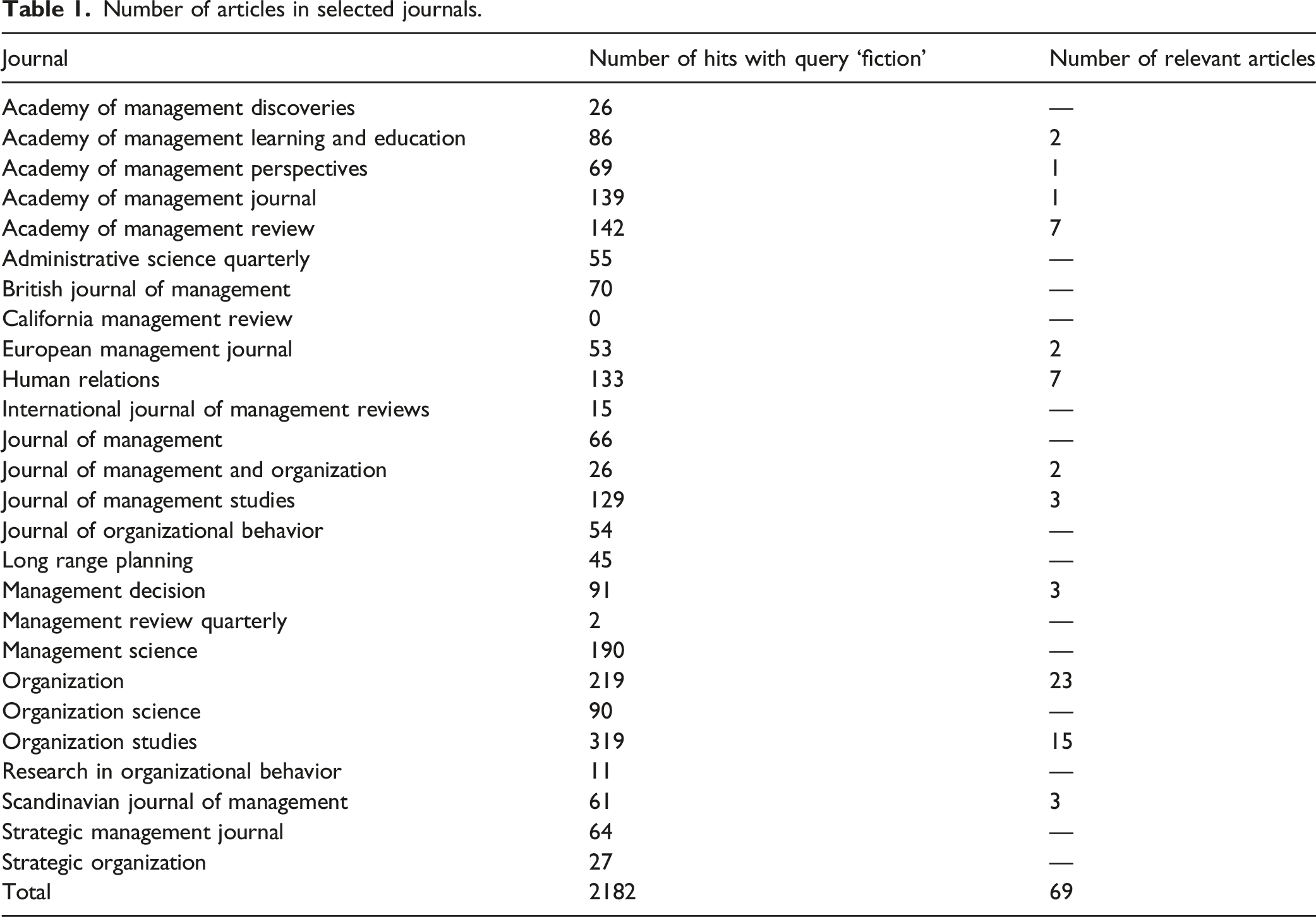
To identify relevant articles for the literature review, I used the search query fiction in the online databases of these journals. For all journals combined, this returned a total of 2182 articles. Using other queries (e.g. film, novels) did not return additional relevant publications. I scanned the titles and/or abstracts to select relevant articles. The resulting articles were downloaded and read to make a decision on whether to include them in the review. I used several inclusion criteria in this process. First, there are a few ways in which organizational scholarship has employed fiction in the past (De Cock & Land, 2006; Rhodes & Brown, 2005). Some scholars, for example, have written their own fictional stories to present their theories and findings in a more accessible and lively manner (e.g. Knights & Willmott, 1999) or for self-inquiry purposes (Barnes, 2014). Other scholars have assigned works of fiction to students for educational reasons, such as business ethics education (e.g. Michaelson, 2016). Finally, fictional accounts can be treated as data or inspiration for theorizing. In this review, only articles using this latter approach are included. Both empirical and non-empirical articles were included as long as fictional narratives were used in a substantive way. Articles that only used fiction as context rather than delve into fictional content itself (e.g. which novels do people buy?) are excluded. In other words, significant engagement with the fictional narrative is required for inclusion. Within these parameters, there were no restrictions on the fictional medium, quantity, or analytical approach of the articles. In total, 69 articles met the requirements and were incorporated in this methodological literature review.
Analysis
While reading the full-texts of the included articles, I formulated a one-sentence summary of the article’s theoretical contribution. I also documented the nature of the fictional narrative (e.g. novel, movie, TV series), the quantity of fictional data being used (e.g. number of books or episodes), and what alternative data was used in the study (if any). Next, I analyzed the content of the articles by means of a thematic analysis (Braun & Clarke, 2006), employing an inductive, iterative approach as befits the study of relatively new phenomenon (Aguinis et al., 2023). More specifically, I noted down one or two codes for each article that best captured the phenomenon under study, staying close to the original phrasing in the text. After all articles were coded in this way, I compared these to find recurrent themes and continued integrating and ordering these until six main research themes emerged that were sufficiently distinctive and coherent. The themes resulting from this analysis process were: Organizational life, Leadership and Resistance, Change, Ethics, Gender and Race, and Organizational analysis.
Articles on Organizational life provide insight in the subjective experiences of organizational membership. It shows how workers and other members perceive their daily lives and make sense of their organizational environment and their own identity. Leadership and Resistance refers to the attitudes and practices of senior figures in the organization, the impact of their interventions on subordinates, and the reactions of lower-level personnel to leaders. Articles on Change assess transformative shifts over time in organizational environments through analyzing impactful developments, such as climate change and technological innovation, and analyze how individual members experience such changes. Articles with a focus on Ethics are concerned with moral emotions, ideals, and (im)moral behaviors in organizations. Studies related to Gender and Race focus on stereotypical representations, discriminatory practices, and resulting biases and exclusion in the workplace. Finally, under the theme Organizational analysis, articles use fiction to formulate critiques of existing research approaches and widely-held assumptions before suggesting new ones.
While analyzing the selected articles, it became clear that there are two very distinct ways in which articles use fictional narratives for theory-building. Some articles treated the fictional accounts as illustrating actual organizational realities. Typically, authors choose realistic contexts and describe situations that are clearly recognizable to readers. These articles analyzed fiction as if it were empirical data similar to data collected through observations and interviews. New insights emerge through (inductively or abductively) analyzing these thick descriptions of situations that could exist. Articles that took this analytical approach were categorized as Representation. Other articles took a very different approach and used fiction as inspiration for new ways of seeing and thinking about organizational phenomena. In this case, authors often choose fantasy or science fiction to infer their contributions or use these narratives deductively to illustrate their argument. Fiction, then, portrays organizational realities in a hyperbolic, absurd, or phantasmagoric way, which helps scholars to present findings and contributions in an accessible manner. In these publications, a fictional narrative was therefore employed as a Metaphor.
Most of the articles could be easily allocated into either one of the categories. Generally, articles categorized as Representation read like stories that are set in today’s world or in the recent past and take place in existing or familiar organizations, while metaphorical stories are typically set in speculative or futuristic organizations. The fictional data could be replaced by traditional forms of data collection in the former but not the latter category. And the goal of the fictional narrative is also different, because articles focus on understanding ordinary organizational phenomena in the representation category, while metaphorical stories aim to amplify and showcase organizational phenomena. There were only a few difficult cases in the categorization process. For instance, some articles combined a metaphorical story with other (realistic) qualitative data, like interviews or documents, but as long as the fictional narrative was metaphorical, the article was classified as such (e.g. Hjorth & Dawson, 2016; McCabe, 2014). Additionally, some stories were set in the future and events in the story were inductively analyzed as if they might happen, but as long as these stories were speculative rather than realistic, the article was categorized as metaphorical too (e.g. Hällgren & Buchanan, 2020).
Paradoxically, many authors seemed to feel obliged to justify in great detail why they chose to use fiction-based research, but spent little to no effort on specifying the methodological approach or process. The justification of using fiction-based research consists of extensive explanations regarding the merits of analyzing fictional narratives and an overview of the historical tradition of fiction-based research in organization studies, including recurring references to key publications (e.g. Czarniawska-Joerges & De Monthoux, 2005; Phillips, 1995). Yet, few articles provide insight in the data selection process or mention what methodological approach was adopted by the researcher(s) to move from fictional accounts to theoretical contributions. Next, scholars are still exploring ways to be present this data, but as of yet there is little reporting of the considerations on why certain forms of data presentation are applied in fiction-based research.
Findings
Due to the comprehensive search strategy in this review, a general overview of fiction-based research practices can be provided. Noteworthy, there are many outlets for this type of research, but some journals lead the way, including Organization (23 articles), Organization Studies (15 articles), Academy of Management Review (7 articles), and Human Relations (7 articles). This indicates the popularity of fiction-based research in critical management studies, but it also makes clear that mainstream management journals are publishing this type of work as well. In fact, twelve of the selected journals have published articles based on fiction-based research.
Initial analysis also demonstrates that the use of fiction in research articles continues to increase (Figure 1). The first article that I found, was published in the early eighties (Newton, 1983). Several journals date back longer, but no relevant papers were identified. Using timeframes of a decade, it becomes clear that the number of articles using a fiction-based approach has steadily increased. The latest timeframe has not been completed yet, but 30 fiction-based articles have already been published since 2015. The clear upward trend means that the approach is likely here to stay and gain in popularity. Use of fictional narratives in articles.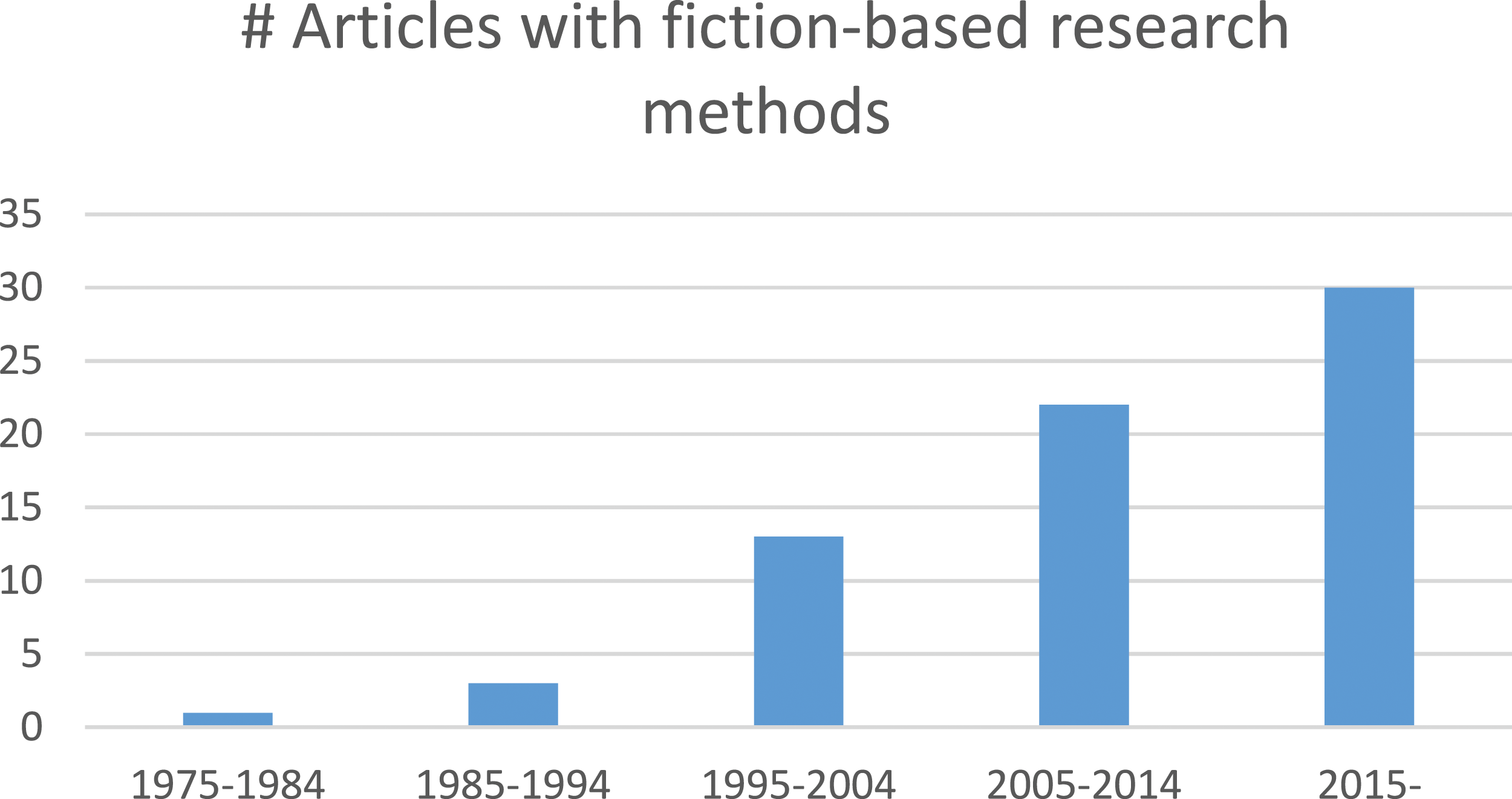
Supplementary file 1 offers more information on the articles that have been incorporated in this literature review. This overview shows that most of the included articles focus on Organizational life. It is also clear from the table that all themes have been studied over several decades, so there is lasting agreement between scholars that these themes can be usefully studied by means of fiction-based research.
Supplementary file 2, next, gives more insight in the type and quantity of fictional data that were used in the articles. The majority of included articles (36) make use of novels. Movies (14) and TV series (9) are also fairly common sources of information. Some scholars have even resorted to using plays, a myth, a poem, or religious works. In many cases, the quantity of fictional data that was used is small: 30 articles use one narrative (e.g. one novel, one episode of a TV series). Of the remaining publications, about half (20) rely on fewer than five sources. The limited amount of fictional data indicates that much of the fiction-based research publications are of an exploratory character. Additionally, eleven articles report the use of other data to complement the fictional narratives. In five cases, this additional data is of an (auto-)biographical nature (e.g. auto-ethnography, author letters), which befits the deeply personal focus of much fiction-based data. Finally, it also specifies how scholars analyzed the fictional data. When possible, I noted the approach they reported for moving from fictional narrative to analysis and looked at how they presented the analysis procedure. Oftentimes, however, such choices are neither made explicit nor justified. In terms of how data was used, the majority of articles (44) used fictional narratives in a metaphorical sense, while 25 articles treated it as representative of real-life situations. Together, the supplementary files give an overview of the included articles.
In the next sections, I discuss the articles in this review. I highlight the main research themes to which fiction-based research contributes and summarize the contributions. For every research theme, I exemplify fiction-based research methods by providing more elaborate examples of metaphorical and representative uses of fictional narratives. In this way, the review provides a comprehensive overview of fiction-based research themes and practices.
Organizational life
Nineteen fiction-based articles shed light on organizational life and provide insight in the subjective experiences of members. These articles contribute to the literature by sharing the perceptions and struggles of workers and express in an accessible, aesthetic manner what it means to be an organizational member. In contrast to the rational, sanitized, and ordered image of organizations in much of the established literature, fiction-based research shows the deeply personal, emotional, and complex reality of organizational life. In practice, these studies draw on fictional organizational ethnographies and biographies to portray a more complete, empathetic understanding of organizational lives (Beyes et al., 2019; Holt & Zundel, 2014). In novels ranging in genre from literary realism to Kafkaesque and science fiction, organizations appear as absurd and alienating, while their members are involved in non-rational and ambiguous decision-making processes, turning organizational operations into events of miraculous chance (Case, 1999; Caygill, 2019; Grey, 1996; McCabe, 2016; Warner, 2007). As a variety of fictional (and non-fictional) sources show, this also sets limits to sensemaking, because pervasive ambiguity and noise challenge the idea of an ordered world, so plausible understandings cannot always be created and organizational members struggle to grasp what is happening around them (Kalkman, 2020; Munro & Huber, 2012; Patriotta, 2016). Bureaucracies also affect human relations on the work floor by creating inter-personal distance and reducing mutual empathy (McCabe, 2015), to the extent that older employees are easily denigrated and discarded as sacrificial objects (Riach & Kelly, 2015). Fictional accounts also attend to the role of emotions in organizations, for instance in coping with uncertain work arrangements, catalyzing action, and influencing organizational realities (Otto & Strauß, 2019; Patient et al., 2003). Emotions bear on employees’ perceived meaning of work too, because these workers often grapple with the purpose of their career, but also confront issues of boredom on a daily basis (Culié et al., 2022; Newton, 1983). This perceived meaning of work is further affected by socio-cultural influences. Notably, interpretative analysis of Disney animations, which make children ‘ready’ for organizational life, paint a dark and bleak picture of work life (Griffin et al., 2018). Finally, fictional narratives shed light on existential questions, such as struggles with dilemmas, that are crucial to people themselves but remain often ignored by scholars (Learmonth & Humphreys, 2012; Starkey, 1990).
Metaphor
Organizations are often assumed to be stable, ordered entities, characterized by logical decision-making in the rational pursuit of certain predefined goals. McCabe (2016), instead, presented a radically different image of organizations. He used Alice’s Adventures in Wonderland by Lewis Carroll as a sensitizing device to highlight that ‘absurdity, irrationality, uncertainty and disorder are part of the everyday experience for many’ organizational members (McCabe, 2016, pp. 946–947). The article draws parallels between Alice’s experiences in the novel and the experiences of organizational members in real-world situations, helping scholars to move beyond the rational model.
Representation
In their study of envy in the workplace, Patient et al. (2003) argue that fiction offers plausible, nuanced, and detailed accounts of people’s inner emotional experiences, even when these are complex or controversial. The authors adopt an interpretative approach to analyze three relevant passages of Richard Russo’s Straight Man. More than conventional research could, this fiction-based study emphasizes the deeply personal experience of envy and showcases its paradoxical effects of catalyzing action and reproducing the status quo.
Leadership and Resistance
Another main research theme, on which eighteen articles focus, is leadership and resistance. These articles contribute to the literature by offering new insights into the workings of authority, power, control, and resistance in organizations. The interaction with bosses, managers, and subordinates is key to the daily experiences of many organizational members, so an instrumentalist perspective on how to effectively influence others and achieve goals ignores much of the experiential side of hierarchical practices. Frequently, extreme and metaphorical examples are selected. For instance, Scarnati (2002) infers lessons from the Godfather movies (in addition to his own experiences as CEO) on how leaders can effectively reform a dysfunctional organization for long-term success, while Kociatkiewicz and Kostera (2012b) present Sherlock Holmes as an exemplary case of why management thinking needs not only rationality but also imagination. Jack Reacher, next, is portrayed as a model leader, teaching readers to have a flexible attitude to rules and authority (Bathurst & Chrystall, 2019). The morally contentious nature (or ‘dark side’) of leadership has also been given its fair share of attention in fiction-based scholarship. Egan (2000) treats ruthless opportunism, manipulation, and dirty politics as inevitable elements of effective leadership. Generally, there is considerable skepticism towards the idea of good leaders, with fictional stories suggesting goodness is just an empty label or something that does not last long anyway (Kociatkiewicz & Kostera, 2012a). With similar skepticism, critical scholars write about the complex, hidden ways in which organizational members are subjugated by the organization (Huber, 2019; Ten Bos & Rhodes, 2003; Willmott, 1993). However, subordinates also influence their superiors, who are at the same time disciplining themselves as well, so they are stuck in a particular role (McCabe, 2014). Other scholars zoom in on this power from below and rely on fiction to shed light on resistance against control and morally indifferent managers (Parker, 2009; Sementelli, 2020; Srinivas, 1999; Willmott, 2013). Clearly, organizational spaces harbor a contest between planned, ordered and lived, resisting spatial processes (Zhang et al., 2008). Even the theoretical fundaments of leadership are criticized by means of fiction-based research, as leadership research is criticized as futile, leadership notions are viewed as unnecessarily sacralized (Śliwa et al., 2013), and leadership constructs are described as ultimately paradoxical (Watson, 2013).
Metaphor
A strong corporate culture was firmly believed to produce excellent organizational performance by leading to higher personnel commitment and flexibility. But critical assessment of its moral implications remained scarce. Willmott (1993) uses Orwell’s Nineteen Eighty-Four to formulate a critique of corporate culturalism. He argues that there are clear parallels between the norms of corporate culturalism and the Orwellian dystopia. Corporate control, in his analysis, functions like thought control. Paraphrasing Orwell, Willmott (1993, p. 527) describes corporate culturalism with the slogans: ‘slavery is freedom’ and ‘strength is ignorance’.
Representation
Violence in bureaucracies has rarely been studied. The negative connotations of workplace violence means that it remains out of scope or is immediately problematized by most scholars. Lindebaum and Courpasson (2019), however, wanted to know how violent leadership practices in bureaucracies influence individual performance. To this end, they analyzed the movie Whiplash, and specifically the subjection to sustained violence by a music instructor who pushes his prodigy towards excellent performance. They show that bureaucracies, contrary to our theories and ideas, are deeply emotional spaces.
Change
Ten articles focus on the manifestation and impact of change in and around organizations. Periods of change are defined by uncertainty and equivocality that render it hard to comprehend or predict, so scholars draw on fiction to make sense of these changes. Fictional data sheds light on the direction and processes of grand transformations in organizational environments, but also offers knowledge on the individual meaning and adaptation to change by organizational members. The end of an organizational era, for instance, is interpreted as an interplay between objective and subjective elements, thus combining real events with concrete experiences and representations in defining era transitions (Tasselli, 2019). One example of such an environmental transformation for organizations results from technological innovation and its potentially dystopian effects (Corbett, 1995). Another example is provided by humanity’s overindulgence, threatening to produce an apocalyptic cataclysm (Dobrogoszcz, 2017). And looking back, the 9/11 attacks transformed the world dramatically too, moving it towards potentially more equitable political and economic systems, more prudent business practices, and a sense of calling as primary work motivation (Michaelson & Tosti-Kharas, 2020). Apart from these environmental transformations, societal trends are also relevant to organizations, such as the changing perception of efficiency experts from harmless to despised individuals (Lee, 2002) or the shifting expectations and position of graduates in society (Watt & Costea, 2020). Change may occur from within organizations too. It can be generated by change practitioners who will be most effective when communicating not just a single grand narrative, but coexisting stories that might speak to different relevant audiences (Bryant & Frahm, 2011). Since changes are dramatic moments in our lives, these events are characterized by intense emotions. For example, family business succession is not just a transfer of power, but a dramatic and often disillusioning moment (Hjorth & Dawson, 2016). And Japanese employees underwent near-traumatic experiences due to changes in the economic system, including globalization, as they struggle to maintain their cultural integrity and self-identity (Matanle et al., 2008).
Metaphor
The academic literature focused primarily on motivation and performance when studying technology-organization relations and was generally optimistic about the future of technological development. But Corbett (1995) argued that it is useful to analyze science fiction (SF) accounts and explore a wider array of potential outcomes of this development. Analyzing visions of the technological future in 39 futuristic SF movies, a historical analysis shows a clear shift in societal views towards growing dystopian fears. We can use these narratives as a call to ensure that we personalize and retain control over technology.
Representation
Environmental disruptions are often presented as singular events or jolts, but such disruptions can also be the result of a chain of connected events. Roulet and Bothello (2022) illustrate how a chain of micro-level, psychological reactions produce macro-level, systemic transformation by analyzing historical and fictional texts on bubonic plague outbreaks. The novels offer first-person, emic insights into the individual experiences of the disastrous chain of disruptive events and allows us to grasp the micro-level roots of change.
Ethics
With five articles, fiction-based articles on ethics are relatively rare, but three of these publications appeared in the last decade, so may set a trend. The papers on ethics give primarily insight in the lived experience of ethics in organizations, addressing moral emotions, codes of ethics, and contentious actions. People often fail to live up to identity ideals (i.e. virtue gap) and many feel a need to lie to uphold their reputation. This hypocrisy, reinforced by the fiction of norm abidance, produces a growing sense of moral guilt and anguish (March, 2007). Next, moral anger is not necessarily a psychological or social disorder, but can also signal that a moral code is at stake that energizes members into action to defend it (Lindebaum & Gabriel, 2016). This also evokes the question how to deal with harm doers. In theory and practice, there is an emphasis on retributive approaches, but reconciliation can also end conflict and restore justice (Remington Abramson & Senyshyn, 2010).
Metaphor
Organizing after apocalyptic events is hard to study. Most problematically, the existing research focuses on contexts that are radically different from the doomsday settings in which Hällgren and Buchanan (2020) are interested. They decided to study the 131 episodes of the television series The Walking Dead, focusing on survivor groups in the aftermath of a zombie apocalypse. This piece of speculative fiction, ultimately, offers a sobering account of moral behaviors in a doomsday context.
Representation
Police work is characterized by considerable discretion, which problematizes the analytical framing of members’ behaviors in terms of control and resistance. Dallyn and Marinetto (2022) propose instead to study the various normative orders (i.e. general, value-based rules and practices) in and around which bureaucrats work and which feed into individual members’ ethical codes. They do so by studying the series The Wire, which offers rich, realistic insight in social relations and shows the complexity of organizational members’ ethical codes and conduct.
Gender and Race
Ten of the articles in this review contribute to the study of gender and race in organizations. These publications address cultural gender constructions and practices in organizations, the impact of discrimination on workplace relations and interactions, as well as the actions of marginalized individuals. Fiction-based research is useful, because stereotypical representations and exclusion mechanisms are discernibly reproduced (or challenged) in works of fiction. Papers show the ambiguous approach to gender representations and roles in fiction. In some cases, such as the movie Jarhead, cultural resources reproduce stereotypes. Here, cyborganization (i.e. organism-machine hybrids) is viewed as potentially undermining military masculinity, as it undercuts traditional warfare practices that require male military bodies (Godfrey et al., 2012). Another study of cyborgs shows that it might make us rethink the nature of humanity, but mostly reinforces traditional gender preconceptions (Czarniawska & Gustavsson, 2008). Sometimes, however, these images are more nuanced. Films on management present both stereotypical portrayals of managers (i.e. macho men) and organizational heroes that counter patriarchal discourses through resistant masculinity (Panayiotou, 2010). Fiction can also be used to outright challenge patriarchal gender norms, such as when parody displays attunement to the struggle against oppression (Pullen & Rhodes, 2013). Problematically, as most literary analyses use masculine narratives with male protagonists, it ignores gendered leader expectations and enactments as well as women’s experiences in leadership positions (Martin et al., 2018). Critical narrative research shows that workplace relations are asymmetrical in general, as evidenced by mentoring systems that appear meritocratic but achieve little more than a perpetuation of the gendered order (Buzzanell & D’Enbeau, 2014). Still, marginalized groups can also exercise power. For instance, sexuality and emotions can be used for domination, but can also be employed as a means of resistance (Román, 1994). In addition, exclusion is a recurring phenomenon in innovation contexts, like in other organization environments, but marginalized groups still shape innovation from the margins (Pecis & Berglund, 2021).
Metaphor
Animations, through their portrayals of work life practices, build expectations of organizational life among young viewers. Griffin et al. (2017) analyzed Disney animations to explore the gender norms that these express and convey. Specifically, they studied the ‘Disney Animated Canon’, consisting of 54 classic films. From the qualitative content analysis, it is clear that Disney offers a paradoxical image of women in organizational life is circulated by these animations.
Representation
The Chair was a popular Netflix series among academics, because of its painfully accurate portrayal of academic life. Prasad (2022) analyzed the series as illustrative of the model minority’s position in the workplace. The protagonist, department chair Ji-Yoon Kim, faces institutional racism in her role that hinders her inclusion and leadership in the organization, thereby demonstrating that both substantive inclusion and leadership acceptance are impossible for model minorities in many workplaces.
Organizational analysis
A final set of articles, seven in total, contribute to organizational analysis. These articles metaphorically use fiction to propose alternative ontological or epistemological viewpoints and urge scholars to move beyond commonly held assumptions. Fiction serves as an exemplar of new ways of thinking and theorizing. In one study, fiction is used to argue that metanarratives (i.e. grand theories) are often pursued, but not legitimate in describing organizational phenomena, as these unduly ignore the epistemological limits of social science (Phillips & Zyglidopoulos, 1999). Indeed, the standard scientific way of seeing and interpreting organizations, consisting of formal reasoning to produce singular explanations of reality, creates blind spots (De Cock, 2000). More specifically, scholars have employed fiction to redirect organizational research towards new assumptions and metaphors that are characterized by ongoing, socially constructed flows (Pick, 2017), and emphasize processes of ordering in a continuously transforming world characterized by endless relationships and no clear boundaries (Tirado et al., 1999). But scholars have also employed fiction to provide concrete suggestions. For instance, even though there are good reasons to be critical of professional service providers, it shows that individual professionals, who are struggling and fallible, may deserve our sympathy (Ellis, 2008). Fiction can also help us to imagine new futures of a climate-changed world that produce affective knowledge to shape a different future (De Cock et al., 2021).
Metaphor
Organizations, such as Disney, tell stories to make sense of themselves and direct others’ sensemaking of them. A story can take the form of a monological grand narrative that is portrayed as the definitive account of the organization’s history. But in practice, organizations harbor multiple, diverse narrators with competing stories, reflecting the chaotic and indeterminate complexity of organizational reality. Boje (1995) studied Disney as a storytelling organization and used the play Tamara to indicate plurivocality in organizational storytelling.
Discussion and Conclusion
This paper has aimed to provide insight into fiction-based research practices. It showed how fiction-based research can shed light on the human condition in organizational life and how authors use fictional narratives in their research. Specifically, I analyzed 69 articles that were published in 26 leading organization and management journals. The findings demonstrate that fiction is increasingly used by scholars for making contributions to six research themes: organizational life, leadership and resistance, change, ethics, gender and race, and organizational analysis. These themes fit the research approach, because fictional narratives are particularly suitable for research on deeply personal issues, existentialist questions, and daily work experiences. In the majority of articles, fictional narratives are treated as metaphors, but there is a fair share of publications that view fictional works as representations of real organizational life too. The use of fiction in organization and management research allows for a better understanding of the subjective experiences of organizational members, thereby enhancing our knowledge of the human condition in organizations.
These fiction-based articles differ from more conventional studies by formulating more nuanced contributions. Examples include: leaders’ need for both principles and opportunism (Egan, 2000), the ambiguous socio-cultural representations of women (Griffin et al., 2017; Panayiotou, 2010), the view on sexuality and emotions as means of control and resistance (Román, 1994), behaviors as motivated by rational and non-rational motives (Case, 1999), and the dualism of academic identity (Learmonth & Humphreys, 2012). Clearly, organizational reality is messy, complex, and uncertain. It is therefore no surprise that fictional narratives have repeatedly inspired criticism of grand theories and universal knowledge claims (Boje, 1995; De Cock, 2000; Phillips & Zyglidopoulos, 1999). Indeed, fiction-based research shows that our theories need to be nuanced and modest or else become ‘fictions’ of themselves.
The categorization of articles’ use of fiction (i.e. Representation or Metaphor) proved a useful heuristic device for demonstrating the two main ways in which fictional narratives are currently employed by organizational scholars. It shows that fiction can be used as empirical data (Representation) or as inspiration for new ways of thinking and theorizing (Metaphor). The two distinct approaches result in very different articles. For instance, articles that use fictional data metaphorically are more likely to focus on predicting (future) trends and their impact on organizations, as exemplified by studies on the increasing role of technology, ongoing climate change, and doomsday behaviors (Corbett, 1995; De Cock et al., 2021; Hällgren & Buchanan, 2020). When fictional narratives are used as representative data, historical trends tend to be captured and scrutinized instead (Lee, 2002; Watt & Costea, 2020). Metaphorical fiction is analyzed for its sociocultural representations of gender (Czarniawska & Gustavsson, 2008; Griffin et al., 2017), while representative fiction is more likely to reveal the emotional struggles of discrimination and exclusion (Pecis & Berglund, 2021; Prasad, 2022). And fictional narratives, as metaphors, criticize epistemological and methodological assumptions in organizational and management studies (De Cock, 2000; Phillips & Zyglidopoulos, 1999), while representative fictional narratives provide deeper insight in the lived experiences of work life and organizational membership (Culié et al., 2022; Patient et al., 2003). These illustrations serve to show that there is a clear distinction in fiction-based research between metaphorical and representative uses of fictional narratives that enable contributions to very different theoretical debates.
Recommendations for fiction-based research

One of the main surprises in the analysis process was the lack of methodological explanation in many articles. In the majority of articles (58 out of 69), there is no description of how the author(s) moved from reading or watching the narrative fiction towards the analysis and theoretical contributions. Similarly, there are no methodological articles outlining data selection, collection, or analysis techniques. Many publications seem to rely on a ‘lay’ reading of the fictional narratives, but the process of analysis (including if and what software package is used) often remains clouded in mystery (DeVault, 1990; Sliwa & Cairns, 2007). This is all the more surprising since transparency and accountability are of major importance in current scholarship. As the use of fictional narratives becomes more common, justification of methodological choices deserves more attention. Some helpful examples of close readings of fiction-based research are provided by scholars using an interpretative approach (Griffin et al., 2018), deconstruction (Boje, 1995), and discourse analysis (Panayiotou, 2010). These articles share a systematic approach to the fictional narratives, which are read and coded in a thorough manner to provide compelling analyses. Clearly, it is important to match the methods to the research subject. For example, a novel phenomenon can be analyzed inductively through a grounded theory approach (Kalkman, 2020), while a narrative approach might help us to grasp human experiences and the significance of events in their (life) stories (Hjorth & Dawson, 2016). Authors can elaborate the methodological approach to provide readers more insight into how they moved from the original stories to their analyses.
Similarly noteworthy is the amount of data that authors used for their analyses. Many articles (30 out of 69) use only one fictional narrative. For metaphorical use, this may be sufficient for making the argument. But when articles use fictional data as a representative source of information, more data might offer more in-depth knowledge about the phenomenon under study and enable theory construction. Still, nine out of 25 articles in this category rely on just one source. While there is no golden standard for the required quantity of qualitative data, it begs the question whether a single novel or film suffices for generating broader insights. In fact, it seems that articles relying on multiple novels, films, or episodes provide useful insights that would otherwise have missed, for instance regarding trends in organizational life and socio-cultural perceptions of it (Griffin et al., 2017; Lee, 2002), character evolution and complexity (Dallyn & Marinetto, 2022; Ellis, 2008), and the diverse range of group behaviors (Hällgren & Buchanan, 2020). In short, more extensive data pools might boost the persuasiveness of fiction-based theorizing.
It can also be advisable to include other (qualitative) data alongside fictional data. Only a small minority of articles combine different data sources, but a comparison between fictional and traditional data sources is useful for understanding the type of knowledge or findings that data sources offer. In my own reading of these articles, it struck me that most of the narratives were pessimistic. The future of the world is viewed in dystopian and apocalyptic terms (Corbett, 1995; Dobrogoszcz, 2017), bureaucracy and managers are almost inevitably subjectifying and alienating organizational members (McCabe, 2015; Willmott, 1993), and work life is a frustrating struggle (Matanle et al., 2008; Otto & Strauß, 2019). Maybe fiction writers generally lean to the dark side of organizational existence, as a recurring focus on death, deception, and danger suggests (Griffin et al., 2018; Kalkman, 2022; Kociatkiewicz & Kostera, 2012a). But it is also possible that dealing with the dark side of life is best captured in fictional stories and missed in traditional data sources. As such, combining and comparing various sources of data can enable balanced analyses and help us, over time, to find the most appropriate source of data for specific research questions.
The presentation of fictional data deserves further attention as well. Currently, some articles only provide a summary of the story or short quotes before sharing their analysis, particularly when the narrative is used metaphorically. But there are also authors who prefer to use vignettes in order to draw the reader into the story and characters’ lives, just like fictional authors do themselves (Patient et al., 2003; Pecis & Berglund, 2021). Vignettes also highlight the complexity and paradoxes of organizational life, thereby countering the rationalized, segmented ordering of life that typifies academic scholarship. For films, TV series and cartoons, however, there is the question of how to incorporate visual elements of the narrative. Images may be included (Matanle et al., 2008) or authors may provide hyperlinks, so readers can watch a scene or episode themselves (Watson, 2013). This has its challenges though. Tellingly, a decade later, none of the links provided by Watson (2013) are working, at least one of which was removed due to copyright infringement. Clearly, longer passages and direct access to fictional narratives (‘show, don’t tell’) are preferred ways to enhance credibility and maintain the aesthetic beauty of the original fictional narrative, but practical issues remain to be tackled.
As scholars across the social sciences and humanities are displaying an interest in fiction-based research (Calvard, 2019; DeVault, 1990; Kalkman, 2023; Leavy, 2016; Singer, 2011; Ward & Shortt, 2020), they can learn from this literature review. First of all, it shows that this type of research is particularly helpful when exploring the human condition or lived experiences of individuals. Themes like ethics, change, and leadership are prominent in fictional works and can therefore be studied by scholars in other disciplines through fiction-based research too. Next, the literature review demonstrates that theories have to be nuanced, because reality is messy and complex, so fiction-based research can be employed to put grand theories into perspective. Finally, this review also demonstrates different ways of using fictional narratives (representative or metaphorical) and displays existing research practices, from which scholars in other fields can learn. Consequently, it offers insights into current developments in fiction-based research and provides tools for using narrative fiction in other disciplines.
Research Agenda
Apart from fictional narratives, there is an opportunity for analyzing other art forms that do not contain a narrated storyline as well. Such arts-based research includes studies involving paintings, dance, and poetry (Visse et al., 2019). Another early example of arts-based research is to be found in a special issue of Organization Science (in 1998) that focused on the use of jazz as a metaphor for improvisation. This did not herald a dramatic increase in similar arts-based research methods though, so there is much to be explored by scholars. Arts, including fictional narratives, are crucial to who we are and how we see ourselves, so a comprehensive understanding of the human condition requires us to take art seriously and recognize it as a valuable source of information for research purposes. This review intends to encourage researchers to experiment with these innovative methods, so that exposure to fictional narratives and other arts will inspire scholars across various disciplines and enrich our research.
Supplemental Material
Supplemental Material - Exploring the Human Condition: A Methodological Literature Review of Fiction-Based Research
Supplemental Material for Exploring the Human Condition: A Methodological Literature Review of Fiction-Based Research by Jori Pascal Kalkman in International Journal of Qualitative Methods
Footnotes
Declaration of Conflicting Interests
The author(s) declared no potential conflicts of interest with respect to the research, authorship, and/or publication of this article.
Funding
The author(s) received no financial support for the research, authorship, and/or publication of this article.

Supplemental Material
Supplemental material for this article is available online.
References
Supplementary Material
Please find the following supplemental material available below.
For Open Access articles published under a Creative Commons License, all supplemental material carries the same license as the article it is associated with.
For non-Open Access articles published, all supplemental material carries a non-exclusive license, and permission requests for re-use of supplemental material or any part of supplemental material shall be sent directly to the copyright owner as specified in the copyright notice associated with the article.
