




Abstract
There is a profoundly troubling history of research being done on Indigenous peoples without regard for their priorities and accompanying calls to decolonize health research. Storytelling methods can privilege Indigenous voices in research. Indigenous people’s knowledge systems have existed for millennium, where knowledge is produced and shared through stories. Our collaborative team of Indigenous and non-Indigenous researchers, and Indigenous Elders, patients, healthcare providers, and administrators, conducted a participatory, scoping review to examine how storytelling has been used as a method in Indigenous health research on Turtle Island (North America), Australia, and Aotearoa (New Zealand). We searched key databases and online sources for qualitative and mixed-methods studies that involved Indigenous participants and used storytelling as a method in health research. Reviewers screened abstracts/full texts to confirm eligibility. Narrative data were extracted and synthesized. An intensive collaboration was woven throughout and included gatherings incorporating Indigenous protocol, Elders’ teachings on storytelling, and sharing circles. We included 178 articles and found a diverse array of storytelling approaches and adaptations, along with exemplary practices and problematic omissions. Researchers honoured Indigenous ways of knowing, being, and doing through careful preparation and community engagement to do storywork, inclusion of Indigenous languages and protocols, and Indigenous initiation and governance. Storytelling centered Indigenous voices, was a culturally relevant and respectful method, involved a healing process, and reclaimed Indigenous stories. But it could result in several challenges when researchers did not meaningfully engage with Indigenous peoples. These findings can guide respectful storytelling research that bridges divergent Indigenous and Western knowledge systems, to decolonize health research.
Keywords
Background
Indigenous stories happened a long time ago, and people are still experiencing them now. There are stories for everything, and it would take months and years to tell them all. For all of creation, there is a story – our names, how things were created, and how we got corn and wild rice. Indigenous stories are more relevant today than ever and show us how to live and get through anything we are challenged with. Stories connect the past, present, and future, it is all intertwined – you can still learn from what happened 100 years ago and apply it to the future, it is not static. The English language is so limited. You would understand the spirit, heart, mind, and body of stories if you heard them in my language. Stories illustrate beliefs and values and how we see our worlds. There is always a moral to the story but often no conclusion, so stories welcome your interpretation. Stories are medicine – stories are sacred. If there is a trauma, go back to your people’s stories, and it will be smoothed down. The story will be a healing medicine and connecting to the land and water will smooth the trauma down.
– Elder Mabel Horton and Elder Sherry Copenace
We are grateful for these teachings from the Elders on our team, who are living libraries in our midst. They know that when settlers say “story,” it is an English word that does not come close to what storytelling (ST) brings to the minds and hearts of many Indigenous peoples. “Story,” a thing of children too young to conceptualize the abstract. “Story,” a thing to illustrate for developing minds. And so, we start with acknowledging the importance and potency of Indigenous ST, while realizing that what we studied in academic research was often a dim reflection based on a divergent worldview at best and a thinly disguised paternalistic parody at worst. As a team, with a good portion of us being Indigenous, we set out to understand how Indigenous ST was located within health research, and engaged in shared learning about Indigenous ST. We brought together both Western and Indigenous perspectives to synthesize how ST has been used as a research method. But once we got into the literature, we realized a disconnect with how the Elders described ST. This disconnect is a function of colonial structures and epistemological racism that silence Indigenous ways of knowing, being, and doing, and journal restrictions. Thus, what we present here is different from what our Elders spoke of regarding ST, as it is a product of many layers of colonial structures influencing health research.
That being said, the Elders we partnered with encouraged us to elevate ST as a method in Indigenous health research, as they believe that ST offers a way forward to decolonize health research and address the Truth and Reconciliation Commission’s calls to integrate Indigenous knowledges and wellness practices into healthcare systems (Truth and Reconciliation Commission of Canada, 2015). Western research approaches have often been used to understand Indigenous perspectives, resulting in findings and policies which fail to address the priorities and health needs of Indigenous peoples (Chambers et al., 2018; Hyett et al., 2018; Smith, 2012), primarily due to tensions arising between the two worldviews and epistemic racism. It has long been recognized that research approaches that privilege Indigenous worldviews and voices are needed (Rieger et al., 2021). Of note, we recognize that the term “Western” is a social construct but use it as it is widely employed in this field. However, it arises from Euro-Western knowledge systems which were viewed as Western compared to the views of those living in their East (Tremblay & Martin, 2023).
As the Elders shared, Indigenous research and ST have existed since time immemorial as ways to generate and share knowledge (Sinclaire et al., 2021; Starblanket et al., 2019). ST has emerged in Western science more recently as a research method that acknowledges Indigenous oral traditions, creates spaces to share holistic knowledge about health and illness experiences, and invites community involvement (Archibald & Parent, 2019; Caxaj, 2015; Fontaine et al., 2019; Iseke, 2013; Kovach, 2010). ST aims to privilege the voices of those often silenced within society; thus, it can be a decolonizing approach to address epistemic hegemony and trouble health inequity narratives (Archibald & Parent, 2019; Reimer-Kirkham & Anderson, 2002; Rieger et al., 2021). ST methods open a space to listen, and “actively learn not to silence” Indigenous voices (McGibbon & Mbugua, 2019, p. 61).
Given the profoundly troubling history of research being done on Indigenous peoples without regard for their priorities (Hyett et al., 2018), reflexive actions to identify and critically examine how ST methods are used is imperative. ST can be a decolonizing research method when grounded in Indigenous ways of knowing, being, and doing (Chambers et al., 2018). Indigenous and Western worldviews are two legitimate, valid, yet divergent worldviews that drive science and knowledge generation (Fraser & O’Neill, 2021; Sinclaire et al., 2021). The emergence of ST in health research holds potential to open a space where both can be heard and seen (Rieger et al., 2021). However, if the oppressive dominance of Western worldviews is not acknowledged, the resulting epistemological bias will shape ST research to continue privileging Western ways of knowing (Archibald et al., 2019). So how do we ensure that there is deep respect for multiple ways of knowing in ST? Critically and systematically exploring the guardianship and interpretation of stories in research is necessary, to disrupt colonial harms. Our liaison librarian for Indigenous health conducted a search and found no other current or planned reviews on ST in Indigenous health research. Thus, to elevate ST grounded in Indigenous ways of knowing, being, and doing, we undertook a scoping review to advance evidence to guide the respectful, reciprocal, and meaningful incorporation of Indigenous ST into health research.
Research Purpose and Objectives
Our collaboratively developed review purpose was to identify and examine how ST has been used as a method in Indigenous health research on Turtle Island (Weaver, 2014) (Canada and the United States), Australia, and Aotearoa (New Zealand). Our objectives were to: 1) determine the extent, range, and nature of ST as a method within Indigenous health research and 2) identify exemplary practices and/or problematic omissions in the respectful use of ST in Indigenous health research.
Methods
We designed a critical, participatory scoping review by drawing on Bassett and McGibbon’s adaption of Arksey and O’Malley’s scoping review methodology (Arksey & O'Malley, 2005; Bassett & McGibbon, 2013). The focus of our scoping review was to examine and map the range, scope, and nature of ST as a method in Indigenous health research, which aligns with this review approach. Our study was guided by Two-eyed Seeing (Bartlett et al., 2012; Martin, 2012; Peltier, 2018) to support working with both Indigenous and Western worldviews, and the SPOR patient engagement framework (Arksey & O'Malley, 2005; Bassett & McGibbon, 2013; Canadian Institutes of Health Research, 2015a, 2015b) to support the involvement of patients/public as active partners in research. The published review protocol (Rieger et al., 2020) has been registered (https://osf.io/rvf7q), and the PRISMA Extension for Scoping Reviews (PRISMA-ScR) structured this review report (Moher et al., 2015; Tricco et al., 2018).
A scoping review typically involves consulting stakeholders, and we wove a more intensive and meaningful engagement with our Relational Network throughout all review stages. We are a collective of Western trained academic researchers, and Indigenous scholars, Elders, patients, healthcare practitioners, and policymakers residing and working in Treaty 1 territory on Turtle Island in what is now known as Winnipeg, Manitoba. We held relational gatherings at key points that we framed as “Gathering with our Relations,” which involved Indigenous ceremony, talking circles about ST led by our Elders, sharing meals (if COVID-19 restrictions allowed), and discussions about review processes and findings. We gathered at key points to 1) refine the scoping review objectives and discuss the meaning of ST to Indigenous peoples, 2) develop the search strategy, 3) create the data extraction form, 4) discuss data synthesis, 5) refine the preliminary review results, and 6) plan the review report and other KT products. This dialogue resulted in nurturing relationships which supported collective interpretation to map and critique this literature (Chambers et al., 2018); a decolonizing action to support Indigenous and Western worldviews coming together in conversations. Thus, our review had two strands which were interwoven: 1) synthesizing the academic literature and 2) incorporating the insights gained about review processes, study contexts, and interpretation from our team members’ rich perspectives. It also enabled a shared governance model, to address ethical concerns and recognize and respect the principles of Indigenous ownership, control, access, and possession of research as crucial to doing our work in a good way (First Nations Information Governance Centre, 2022; Phillips-Beck et al., 2019).
Identifying Relevant Studies
An academic health sciences librarian (JL) designed and carried out the searches for academic literature. Team members advised on keywords and concepts to be used in conjunction with subject headings in each of the databases. Online databases searched were MEDLINE, Embase, and PsycINFO (each on OVID); Scopus; CINAHL, AgeLine, Academic Search Complete, Bibliography of Native North Americans, and Canadian Reference Centre (all on EBSCOhost). Databases were searched from the earliest record indexed to the date of search (June 2020). Refer to PRISMA flow chart (Figure 1) and search strategy details (Supplemental File 1). Searches were carried out using Google Advanced search techniques to identify grey literature published online. Additionally, core Indigenous health and research journals were selected to review the tables of contents for issues published within the dates searched to identify articles that are not indexed well in the academic databases. This was done to ensure optimum coverage that would not overlook Indigenous authors. Prisma Flow Diagram.
Study Selection
Inclusion Criteria.

Charting (Extracting) the Data and Reporting Results
To collate and summarize the data, we engaged in an iterative data analysis process that involved conversations with our Relational Network. First, data were extracted in Covidence by one reviewer with a pre-designed data extraction form developed by our diverse team, and checked by another. We piloted our data extraction form with five studies and then revised it (Supplemental File 2). Consistent with scoping review practice, we did not conduct quality appraisals; however, we appraised the studies with the Spectrum of Engagement Tool (Horrill et al., 2019) (Supplemental File 3) to evaluate the level of engagement with Indigenous peoples. Data synthesis included two phases to address our research objectives (Hannes & Lockwood, 2012). We described our included studies and identified and catalogued the array of ST research methods. Then, two reviewers conducted an analytical synthesis of the extracted data, and we refined our results through team review and discussions. Our reporting of results follows scoping review practice and includes narrative mapping, visual representations, and thematic summaries of the extracted data.
Results
Through our systematic search, we retrieved 7531 articles (Figure 1). An additional 22 articles were retrieved by searching the grey literature (n = 5) and hand searching Indigenous journal articles (n = 17). After removing 3,074 duplicates, we screened 4,479 titles/abstracts for eligibility in Covidence. We excluded 4,016 articles which did not meet our inclusion criteria. We then excluded 285 of these articles after closer examination of full texts (see reasons in Figure 1), or because we could not retrieve the full text. This selection process resulted in a final sample of 178 included articles. See Supplemental File 4 for a description of included studies.
Description of Included Studies
Characteristics of Included Studies (N = 178).

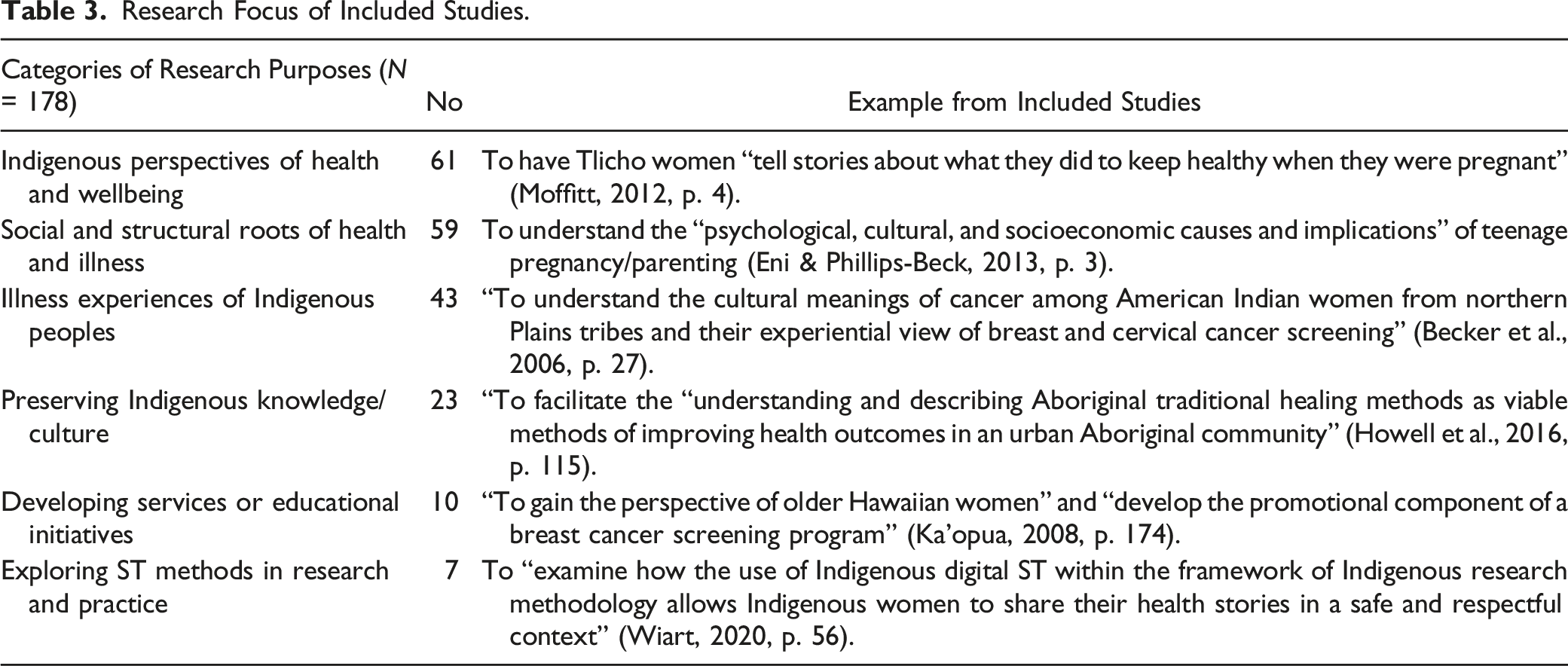
Research Focus of Included Studies.
There were varied research methodologies within which ST methods took place. Most research teams used an Indigenous methodology (32.0%) or a version of participatory action research (28.7%), and clearly began with Indigenous methodologies at the centre. There are innumerable Indigenous methodological approaches, with many specific to a territory or nation, but common elements include valuing the interconnectedness of animate and inanimate beings, relational knowing, lands-based knowledge, engagement and reciprocity with communities, incorporating ceremonial practices, self-location and reflexivity about colonization, and Indigenous initiation or governance (Kovach, 2010; Smith, 2012; Wilson, 2008). 20.3% of researchers used another qualitative methodology such as grounded theory, phenomenology, ethnography, case study, or narrative inquiry, and 12.9% used a qualitative methodology but did not clearly state which one. The remainder of the authors stated that they used an arts-based (2.2%) or a mixed-methods (2.2%) methodology, or did not state their methodological approach (1.7%). Although 34.3% of studies did not clearly state their philosophical orientation, 31.5% of studies were informed by an Indigenous or decolonizing lens and 6.2% by an Indigenous lens combined with another perspective. The remainder were guided by constructivist/constructionist perspectives (6.7%), critical perspectives (1.1%), or some other theory (20.2%) such as the Health Belief Model (Ka'opua, 2008).
Mapping the Diverse Storytelling Approaches and Adaptations
We extracted and analyzed data to determine what was meant when researchers reported that they were using ST methods. We found there were diverse ST methods and researcher preparation and facilitation approaches, and notable adaptations such as integrating cultural protocols and Indigenous languages. The key patterns below demonstrate ways to make more space for Indigenous ways of knowing, being, and doing in ST research.
Types of Storytelling
Types of Storytelling Approaches.

Researcher Preparation to Work With Indigenous Stories
Archibald et al. (2019) writes about the importance of researcher preparation to work ethically and respectfully with Indigenous stories. Although 70.8% (n = 126) of the articles did not provide specific details about researcher preparation, when they did, we noted several approaches which prepared researchers to honour Indigenous worldviews and disrupt their erasure. Some engaged in more than one type of preparation. Importantly, researchers described prior experience collaborating with Indigenous peoples/communities as essential preparation for storywork (n = 3, 1.7%), especially for those who were non-Indigenous. Some researchers received training in ST (n = 8 studies, 4.5%) or digital ST (n = 4 studies; 2.3%) methods. In one study, the researcher received training on how to visually document stories on digital media and create a visual representation to share them (Absolon, 2020). Researchers also discussed engaging in an inner dialogue, fostering cultural humility, and gaining literacy in Indigenous worldviews and/or cultural protocols (n = 28, 15.8%). Brown (2016) wrote of how they engaged in critical reflection on “the impact of structural power on the research process” (p. 112). Some received mentorship or training from Indigenous peoples in culturally appropriate research methods (n = 14, 7.9%). For example, one researcher (Mehl-Madrona, 2009) received training in the “art of listening” from Elders. As well, researchers engaged in Indigenous ceremony or traditions (e.g., prayer, spiritual practices) to prepare their whole being for this work (n = 6; 3.4%). One researcher (Absolon, 2020) harvested and stored tobacco, and gathered blueberry jam to later use in the ST sessions. There were also other unique research preparation approaches (n = 3; 1.7%) and one group purposefully did not receive training in digital ST to not influence the Indigenous ST process (Cunsolo Willox et al., 2013).
Facilitation of Storytelling
ST methods often require a facilitator, and there were notable adaptations. Although 64.6% (n = 115) of ST was facilitated by the researcher(s) and 16.3% (n = 29) of authors did not clearly state who the facilitator was, in 10 studies, an Elder or Indigenous community member co-facilitated ST alongside the researchers. In some studies (6.8%; n = 12), an Elder or Indigenous person facilitated the ST alone. Indigenous facilitators carried the advantage of first-hand awareness of the barriers to authentic ST. They created safer spaces in which to share stories; thus, illuminating Indigenous voices. For example, in a study about sexual abuse, local and respected Indigenous Elders and facilitators who had knowledge about sexual abuse clinical work led the meetings (Maranzan et al., 2018). Of note, 12 studies had people other than researchers or Indigenous community members facilitate, such as a digital ST facilitator (Cunsolo Willox et al., 2013; Flicker et al., 2019) or a professional filmmaker and producer (Loebach et al., 2019).
Indigenous Language Use
A crucial consideration for ST in Indigenous health research is honouring Indigenous languages (Galla & Goodwill, 2017). However, 88.8% (n = 158) of our studies did not state that an Indigenous language was used in ST, with some noting reading and writing English as an inclusion criterion. A few authors (n = 20; 11.2%) wrote about how Indigenous languages were used, which are examples of privileging Indigenous ways of being. For example, Ireland et al., (2011) invited participants to share their stories in their preferred language. When stories were shared in both English and an Indigenous language, stories told in the Indigenous language were translated into English (Baker & Sewell, 2016; Freeman et al., 2020; Galla & Goodwill, 2017). Alternatively, sometimes stories were told primarily in English, but participants used Indigenous words or phrases which were then translated (Castleden et al., 2017).
Cultural Protocols Used Within Storytelling
Another notable adaption of ST methods was the incorporation of cultural protocols, which were described in 130 studies (citations and examples in Supplemental File 5; Sawatzky et al., 2016). These researchers actively set out to make spaces for Indigenous ways of knowing, being, and doing within the ST research process. Determining the appropriate protocol often involved seeking input from an Elder, advisory panel, or community members, and realizing that each community has unique protocols. Researchers frequently incorporated traditional or spiritual ceremonial practices in the opening and/or closing, which included introductions/greetings, prayers, smudging with traditional medicines (e.g., sage), teachings, a feast, and specific ceremonies such as fire-keeper, berry and water, or sweat lodge ceremonies. There were also various cultural activities integrated throughout the ST process. For example, Andrews (2020) describes incorporating possum skin cloaking as a significant cultural practice that facilitated ST and notes that it “became the ceremonial means with which to “hold” the story,” both for the women in their journey and for the research design (p. 114).
Engagement With Indigenous Peoples in Storytelling Research
A crucial aspect of decolonizing and respectful research is authentic engagement with Indigenous peoples and communities (Canadian Institutes of Health Research, 2018). This relational accountability disrupted the dominance of Western worldviews and approaches in ST research processes (Sinclaire et al., 2021). We used the Spectrum of Engagement Tool (Horrill et al., 2019) (Supplemental File 3) to assess Indigenous engagement and found that in 35.4% of studies, there was evidence of Indigenous leadership, and in 35.4% of the studies, researchers collaborated with Indigenous peoples. In the remaining studies, there was evidence of involving (12.9%) or consulting with (6.2%) Indigenous peoples; however, 2.2% of the researchers report only informing Indigenous peoples, and concerningly, 7.9% report no clear Indigenous engagement in the research process. Beyond categorizing the level of engagement, we also analyzed the engagement approaches used by researchers and noted several effective approaches in 123 articles (citations and examples in Supplemental File 6). For example, the visiting way (Gaudet, 2018) was essential to centre and build relationships, receive guidance from Elders and community, and create a safe ST space (Fontaine et al., 2019). Researchers shared meals with Indigenous peoples; took part in cultural activities and harvesting; attended community events; visited sacred lands; and learnt about language and customs while visiting outside of formal research processes. This relational approach was especially important given the history of research atrocities with Indigenous peoples (Beltrán & Begun, 2014).
Research Initiation and Governance
We also specifically looked at research initiation and governance and were troubled that 77 studies (43.2%) did not describe who initiated the research and how it was governed, as a key component of decolonizing research is Indigenous people shaping where and how research is conducted (Sinclaire et al., 2021). For authors that did clearly state their governance model, 15 studies (8.4%) stated that it was community initiated/led, 21 (11.8%) that there was a shared governance model, and 13 (7.3%) that academic researchers or the university initiated/led the research. Other statements related to this aspect included discussions on forming an advisory group (n = 30; 16.9%), communities having an approval process for the research in addition to ethics approval (n = 16; 8.9%), funding being awarded to the community (n = 1; 0.6%), and having a formal research agreement (n = 6; 3.4%).
Participant or Community Role in the Research Procedures
In many studies, Indigenous participants or community members took an active role in research procedures, which disrupted colonial research practices, centrally located Indigenous voices and ways, and enhanced study trustworthiness. They assisted with recruitment (n = 25), data collection (n = 11), data analysis (n = 64), reviewing/confirming findings (n = 74), co-authoring/preparing the study manuscript (n = 25), and knowledge translation initiatives (n = 27). For example, Becker et al. (2006) hired and trained seven American Indian women as members of the analyses team to “enhance the rigor of qualitative analysis” (p. 28).
The Impact of Storytelling Methods on the Research Process and Findings
ST had undeniable positive impacts as a culturally appropriate method when used in a good way but could also result in several challenges, especially when used by settler researchers.
The Positive Impact of Using a Culturally Appropriate Method
When ST methods opened spaces for Indigenous voices, they transformed and decolonized the research process to reclaim and illuminate Indigenous stories (citations and examples in Supplemental File 7).
Centering Indigenous voices to disrupt dominant practices and narratives
The main impact (n = 140 studies) of ST lay in that it was a participant-driven, relational method which allowed people to share the experiences that they wanted to share in a way they were comfortable with. When ST was done in a respectful way, inherently it was about centering Indigenous voices which are often relegated to the margins. This resulted in rich, personal, and contextual data to explicate meaning not possible with other Western methods. It also enabled the presentation of stories as a whole to avoid misinterpretation or misrepresentation. Nuttgens (2013) wrote about how ST can “preserve intact” the human experience, and “reveal the temporal, relational, and positional contexts” (p. 3). Galla and Goodwill (2017) further highlighted the importance of language, and how the storyteller can “be intimate with their ancestral languages and share the significance of their stories while maintaining control of the meaning making” (p. 3). As well, ST provided opportunities for multimodal (e.g., narrative, photo, video) expression. For many Indigenous peoples, the arts are an integral part of their culture and provide a nonverbal outlet for expressing feelings without the need for verbalization, which might be particularly important with trauma narratives. ST allowed for chaotic narratives and unexpected accounts to be shared in a meaningful, safe way (Reeves & Stewart, 2014).
Through centering Indigenous voices, research hierarchies and colonial narratives were disrupted. Authors in 26 studies described how ST was emancipatory in that it disrupted traditional research hierarchies which privileged the researchers’ expertise. ST facilitated a more fluid data collection approach with fewer interruptions and less censorship from researchers, shifting control to the storyteller (Cunsolo Willox et al., 2013; Houkamau, 2011). McMannus and colleagues (2010) gathered Maori Women’s life stories of sudden infant death syndrome, and found a life story method allowed participants “to set the pace and control the direction of the narrative with the interviewer taking a gentle, guiding and clarifying role” (p. 644). People were able to speak freely and emphasize issues of importance to them (Mbuzi et al., 2017). Researchers had to learn to listen deeply. This shift created a safe and meaningful “meeting place” for Indigenous ways of knowing and Western academic knowledge (Reeves & Stewart, 2014) and transformed the research-participant relationship. Data from 41 studies revealed that ST disrupted dominant narratives as a decolonizing, strengths-based approach, which led to a “rewriting and rerighting of Indigenous perspectives” (Twance, 2019, p. 1322). Stories were elevated as a valid form of knowing, which aided in a deeper and more accurate understanding of Indigenous peoples’ perspectives, knowledge, and culture. Stories became a form of resistance which “corrected erroneous histories and colonial mythologies, thereby setting the record straight through amplifying the ‘other’ less publicly known side of the story” (Lawson-Te Aho, 2014, p. 188).
Storytelling as culturally relevant and respectful research method
In 88 studies, authors discussed how ST is a culturally appropriate, relevant, and respectful research method when it centres Indigenous voices. ST created a supportive space that honoured Indigenous oral traditions. Hampton et al. (2010) stated they used ST to gather Elders’ perspectives on end-of-life care because it has “historically served as a vehicle for transmitting protocols used by Aboriginal communities” (p. 3). This approach offered a familiar and safe way of sharing knowledge; (Moffitt, 2012) thus, allowing a “respectful and robust exploration of a select research topic” (Carlin et al., 2019, p. 3). Spiritual practices and ceremonies were often included in the research. Brown (2016) wrote of how ST fostered connections with each other and “to language, land, and spirit” and concluded that “this research is ceremony” (p. 119). Thus, ST ensured that “Aboriginal cultural knowledges and ways of seeing the world” were captured during data collection (Marriott et al., 2019, p. 4).
Cathartic, healing, and satisfying process for participants
Authors described an important by-product of ST methods – it was a therapeutic way of collecting data for Indigenous peoples and benefited many participants personally (n = 35 studies). As Lawson-Te Aho (2014) observed in their study of Five Māori women’s stories of multi-generational trauma, “The language-ing of trauma experiences by way of narration and ST can be a powerful catalyst for healing” (p. 188). ST acted as a medicine and could advance personal meaning making and fill “in the gaps of the self and show us who we are” (Flicker et al., 2019, p. 252). In a study employing a Māori approach (Ware et al., 2018), researchers found that a “layering of meaning and experience can be achieved through kōrero (telling stories) which allows people to locate themselves in the world, both figuratively and in relation to their ancestors and future descendants” (p. 5). Authors noted that participants had a feeling of satisfaction and success, especially when creating a tangible product, such as a digital story.
Reclaims, preserves, and illuminates stories
ST reclaimed, preserved, and illuminated Indigenous knowledges (supported by data from 69 studies). Stories became an evocative way to pass on collective memory, values, customs, and culture and a powerful key to cultural survival. Beltrán and Begun (2014) write how ST “is a transformational tool for reclaiming knowledge and highlighting resiliencies despite legacies of colonisation and ongoing discrimination” (p. 162). In some studies, stories became part of resources that were shared beyond the study findings (Brandenburger et al., 2017; Castleden et al., 2017). Brandenburger et al. (2017) gathered American Indian traditional stories and developed a nutrition/physical activity curriculum which integrated the stories. Reclaiming stories also fostered relationships within Indigenous communities by enabling intergenerational learning. For example, Dennis and Momper (2012) used ST within talking circles to facilitate discussions on substance abuse between different age groups and allowed Elders to pass down stories to youth. ST privileged relationality as a critical component in knowledge development as it generated shared understandings (Latimer et al., 2018). Illuminating stories and coming to shared understandings developed a sense of collective agency amongst community members (Andrews, 2020) and inspired action.
Navigating Ethical Complexity and Other Challenges
ST clearly had compelling benefits; however, researchers also discussed ethical and other challenges, which are critical to consider when planning future research. Many of these challenges related to tensions arising from bringing divergent worldviews together and disrupting the dominance of Western worldviews within health research.
Ethical considerations specific to using ST
We noted that authors described five primary areas of ethical concerns (citations and examples in Supplemental File 8). Authors in 18 studies discussed ethical concerns related to the nature of ST data. Some Indigenous groups’ cultural protocols dictated that pictures of the deceased cannot be shared in ST (Kildea et al., 2009) or that it was inappropriate to record stories with audio or visual means (Colby et al., 2012). Thus, giving participants choice in how data were recorded and stored was crucial. In one study (Reinschmidt et al., 2016), Elders shared stories of historical trauma and could choose to be video recorded or audio recorded, with one Elder requesting that the audio recording be destroyed following transcription. Second, many researchers (n = 79 studies) discussed the importance of considering Ownership, Control, Access, and Possession (OCAP) (First Nations Information Governance Centre, 2022) and participants determining how, when, and where stories were shared. Researchers described using flexible ongoing consent, or multiple forms of consent for data collection and sharing of stories publicly. At times, upholding these principles meant that participants needed time to sit with their stories before sharing them, amend stories prior to dissemination, or reflect on their story and the ramifications of it being shared publicly. In one study that used digital ST (Flicker et al., 2019), participants had the option of giving consent for sharing of the story in some contexts but not others, and no stories were shared publicly until 6 months after completion “to ensure youth had an opportunity to really reflect on the meaning and potential impact of sharing their story” (p. 329).
Third, researchers (25 studies) discussed the need to do things in a good way with community, not just individual participants. There was often cultural knowledge shared in stories and some researchers asked for community permission to publish stories, in addition to individual consent (Braithwaite, 2018). Fourth, there were ethical concerns related to historical research harms and 47 studies described considerations for decolonizing ethical procedures with relational and cultural practices, building trust, and ensuring accessibility. Researchers discussed the need to develop cultural safety plans (Holliday et al., 2018) and seek ethical approval from community (Pazderka et al., 2014). Ethical procedures were also adapted, for example, by obtaining consent with tobacco or during a ceremony (Bruner et al., 2019). Some researchers explained the ethical procedures in oral and written forms, shared information with participants in their traditional language, and offered a verbal consent option, to address cultural and literacy requirements and support access (Hunt et al., 2020).
Fifth, researchers in 16 studies clearly recognized the potential for harm in regard to re-traumatization and perpetuation of stereotypes. It is widely acknowledged that ST can provoke deep emotional responses (West et al., 2022), and researchers expressed concerns about the possibility of re-traumatization and developed strategies to mitigate it, such as having an Elder available to talk with participants, and referrals to various community services (Maranzan et al., 2018). Some researchers carefully selected data collection procedures and pre-screened participants to avoid harm (Reeves & Stewart, 2017). Further, Cunsolo Willox et al. (2013) stated they were “confronted with the burden of representation” and were ‘acutely aware’ of the “potential for perpetuation of stereotypes” when considering where/how to distribute the digital story as they “wanted to ensure that through sharing…we did not structure the stories to glamorize, pathologize, and/or neutralize the voices and lives of the Inuit” (p. 140).
Stated challenges of ST methods
Researchers discussed challenges with using ST methods, beyond ethical considerations (citations and examples in Supplemental File 9). Most were especially pertinent for settlers who were using ST methods and highlight the dedication needed to work in good ways. First, the cultural understanding of sharing stories sometimes differed from the researchers’ approach to ST (n = 7 studies). Wexler (2011) used digital ST to investigate cultural resilience but wrote, “after a series of failed attempts to follow digital ST protocol, I was told that what I was asking of the youth was culturally inappropriate and unnecessary” (p. 254), and they adapted the method accordingly. Second, were challenges with the researcher-participant relationship (19 studies) related to both being an outsider (e.g., language barriers, not understanding the culture of participants, or not feeling safe for participants) and being an insider (e.g., participants assumed researchers’ knowledge and thus, did not share in a research context). Thus, resulting in personal, sensitive, or in-depth information not being shared.
Third, there were challenges related to data analysis (six articles), such as analysis resulting in the segmentation of stories and the potential of losing the “richness of the relationships and the power of the experiences” (Rahimian & Pach, 1999, p. 1995). Some researchers discussed the challenge of attempting to analyze data from different Indigenous groups as one dataset (Bruner et al., 2019; Grandbois & Sanders, 2009), and some expressed concern about removing multiple contextual layers from the stories as this “is not consistent with an Indigenous oral tradition that does not detach what was said from speaker, context, and audience” (Madden et al., 2013, p. 226). Fourth, a related concern was the transferability of particular stories to other Indigenous groups (n = 10 articles), and the need to still honour each story and the different contexts from which they arise. Lastly, there were challenges related to the practical resources needed for ST which can create barriers to its use (n = 8 articles). Some ST approaches can be expensive, and time and labour intensive. Researchers also reported the need to identify appropriate and accessible technology for participants and develop their skills in digital technology for digital ST.
Discussion
Our scoping review identified 178 studies that used ST as a method in health research to map how researchers are using this method and highlight exemplary practices and problematic omissions to inform future decolonizing research. Guided by Two-Eyed seeing, our participatory approach wove relational gatherings throughout the review stages to improve our methodological process and analysis. Indigenous and Western perspectives blended, which resulted in a particularly rich and nuanced understanding of ST methods. There were undeniably many benefits of using ST – it was a flexible, relevant, and resonant approach for Indigenous peoples and communities. These benefits were a result of opening spaces which honored Indigenous ways of knowing, being, and doing, and realizing that both Indigenous and Western worldviews bring important perspectives on health and healthcare decisions. But the use of ST was also problematic, and there were notable concerns such as the overall lack of preparation for ST, limited incorporation of Indigenous languages, missing details regarding research governance, and few knowledge translation approaches other than publication. There is much room for growth. The Western worldview has its own notions of ST, and if this is not acknowledged it will erase Indigenous knowledge systems in ST and reify epistemic racism and health disparities (Sinclaire et al., 2021).
One of the main challenges we encountered in this work, was determining if a study met the inclusion criteria of using ST as a method. Many researchers used the word “ST” or “story,” yet there was no description beyond that of a standard qualitative interview. There were clearly varying assumptions as to what could be deemed as ST (Archibald et al., 2019; (Archibald et al., 2019; West et al., 2022). There is a need for researchers to differentiate between qualitative/narrative work and using ST as an Indigenous research method (Fraser & O’Neill, 2021), and the differing commitments that are needed to truly engage in storywork (Archibald et al., 2019). For example, Indigenous ST demands careful preparation and community engagement, centres the storyteller’s voice, and does not result in certainty (Fontaine et al., 2019). Part of our challenge was that we could only assess articles based on what authors wrote, and often there was minimal description of ST and the related philosophical standpoint (assumptions). The resulting ambiguity is most likely rooted in the ongoing, unacknowledged dominance of Western worldviews (Sinclaire et al., 2021). Continued learning of good ways that Indigenous and non-Indigenous people are working together within colonized systems will likely shed light on the ambiguity. Some journals are changing requirements for Indigenous research, and we believe that this is one important way forward. For example, the Canadian Journal of Public Health now requires a description of Indigenous engagement and governance to be included in submissions to their journal (Canadian Journal of Public Health, 2022). A framework to guide researchers using ST in this field is also needed.
Incorporating ST methods challenges what has conventionally been viewed as reliable knowledge to inform healthcare policy and practice. The Western world, and particularly healthcare, is looking for answers and certainty (Sinclaire et al., 2021). However, as our Elders taught us, ST does not do that. A story is relevant within the context in which it was told and for what is happening today, but stories will shift and change and are interpreted differently by different people. The notion of truth is divergent between Indigenous and Western perspectives (Chilisa, 2012a; 2012b), which may seem like an insurmountable divide. Healthcare overwhelmingly relies on evidence that is rooted in biomedical or Western perspectives which underpins many policy-driven health disparities (Reimer-Kirkham et al., 2007; Sinclaire et al., 2021). Alternatively, Gehl (2012) proposes the Debwewin journey which provides insights into the value of ST. This ancient Anishinaabe way of knowing connects one’s circle of heart knowledge and circle of mind knowledge to foster “a personal and holistic truth that is rooted in one’s heart” (Gehl, 2012, p. 53). Scholars (Fontaine et al., 2019; Rieger et al., 2021) assert that ST provides a culturally safe and ethical method for connecting these two circles for Indigenous peoples, to authentically share perspectives and experiences that can provide transformative and previously silenced insights. Stories can hold this integrated truth; they are much more than myths and elicit a valid form of knowledge to inform biomedical health systems and advance health equity (Kovach, 2010; Sinclaire et al., 2021). As Kimmerer (2013) writes about the honouring of Indigenous ways of knowing and Western science in Braiding Sweetgrass: “I envision a time when the intellectual monoculture of science will be replaced with a polyculture of complementary knowledges. And so all will be fed” (p. 139). ST offers researchers a way to disrupt colonized “intellectual development and continued marginalization of Indigenous knowledges” (Sinclaire et al., 2021, p. 60) and move towards reconciliation ((Fontaine et al., 2019).
Few included articles described knowledge translation approaches beyond publication, and we argue that key opportunities to influence practice and policy are being missed. Stories are an artform, yet few authors engaged in arts-based knowledge translation which can engage the heart and minds of community, practitioners, and policymakers and inspire action (Cooper & Diedger, 2018; Rieger & Schultz, 2014). Giving back to the community in meaningful, relevant, and manageable ways is also a pillar of reciprocity in Indigenous health research (Crosschild et al., 2021; Smithers Graeme, 2014). Snow et al. (2021) developed a guide for the use of ST in policy arenas: ST for Systems Change: Insights from the Field. They write how stories foster system change by providing compelling insights which result in perspective transformations, and can also be used to evaluate, understand, and showcase the change that is occurring. One example is a project that some of our team members were involved in, in which the digital stories were shared widely through the National Collaborating Centre for Indigenous Health website (National Collaborating Centre for Indigenous Health, 2019).
This review has several limitations which need to be considered. We included studies that had a majority of Indigenous participants to understand the use of ST across Indigenous groups; however, this limited our ability to account for the particularities of different nations and groups. As well, most studies were located on Turtle Island and thus our findings may not be relevant to all settings. We focused on academic literature reporting studies using ST methods and extracted data about creative KT approaches found in the articles, but authors may have used other platforms to share their findings and thus, their work would not be captured here. Although a librarian that specializes in Indigenous health research designed our search, there is a possibility of missed studies due to inconsistent indexing or studies being excluded that were not in English. As mentioned, screening was challenging related to the limited descriptions of ST in some articles, and we were constrained by what the authors wrote. We also examined many types of ST and not all findings may apply to all types of ST.
Our findings highlight the need for future philosophical, methodological, and empirical work. There is a need for a critical exploration of how Indigenous ST differs from the Western view of ST, and the differing epistemological commitments required of researchers. Further research with novel and local ST approaches is needed and timely, given the growing interest in decolonizing and participant-orientated research methods. Researchers embarking on projects employing ST should consider process evaluations and writing methodological papers, to continue elevating and advancing this decolonizing method. Based on our review findings, we plan to create a framework to guide the respectful use of ST as a method in Indigenous health research for teams comprised of Indigenous peoples and non-Indigenous peoples. As well, a methodological paper about our Relational Network and its challenges and opportunities could advance knowledge about participatory reviews. Further, our findings are situated in health research, but they may have implications for other fields and disciplines. We believe this review can contribute to dialogues about how to engage in ST research in respectful ways and inspire future interdisciplinary methodological work about ST. ST also holds potential as a method for systematic reviews. Hendricks et al. (2022) developed a Synthesis by Storyboarding method for their qualitative evidence synthesis, which involved nine steps to synthesize elements from 47 primary research studies. They created images of meaning derived from the extracted data and used a storyboard to develop nine storylines about young people’s experiences with antiretroviral therapy. The use of ST methods for systematic reviews and researcher-created stories for reporting findings could be explored in future work. A scoping review of ST methods reported through creative approaches beyond the academic literature would also be highly valuable.
Conclusion
Our intention with this scoping review was to advance our understanding of how academic researchers are taking up ST within health research concerning Indigenous people. Through our rich relationships and teaching shared within our Relational Network gatherings, we have shed light on respectful ways for using ST in Indigenous health research. A research team with a synergistic and broad mix of substantive, methodological, and experiential expertise worked collaboratively to develop a rich and nuanced understanding of ST as a decolonizing research method. These findings can help researchers to work across divergent Indigenous and Western knowledge systems and disrupt colonial narratives about Indigenous peoples. Respecting and elevating ST in research is an act of decolonization and will advance evidence which meaningfully incorporates Indigenous ways of knowing, being, and doing into systems and services, to benefit Indigenous communities and move towards reconciliation.
Supplemental Material
Supplemental Material - Elevating the Uses of Storytelling Methods Within Indigenous Health Research: A Critical, Participatory Scoping Review
Supplemental Material for Elevating the Uses of Storytelling Methods Within Indigenous Health Research: A Critical, Participatory Scoping Review by Kendra L Rieger, Mabel Horton, Sherry Copenace, Marlyn Bennett, Mandy Buss, Anna M Chudyk, Lillian Cook, Bobbie Hornan, Tara Horrill, Janice Linton, Kim McPherson, Jennifer Moore Rattray, Kealy Murray, Wanda Phillips-Beck, Rebecca Sinclair, Olga Slavutskiy, Rebecca Stewart, and Annette SH Schultz in International Journal of Qualitative Methods
Footnotes
Acknowledgments
We would like to thank Nate Allison and Monica Friesen for their work on this project.
Declaration of Conflicting Interests
The author(s) declared no potential conflicts of interest with respect to the research, authorship, and/or publication of this article.
Funding
The author(s) disclosed receipt of the following financial support for the research, authorship, and/or publication of this article: This work was supported by the Canadian Institutes of Health Research. Dr. Kendra Rieger is the grateful recipient of a Michael Smith Health Research BC Scholar Award which provides support for her research program.

Supplemental Material
Supplemental material for this article is available online.
References
Supplementary Material
Please find the following supplemental material available below.
For Open Access articles published under a Creative Commons License, all supplemental material carries the same license as the article it is associated with.
For non-Open Access articles published, all supplemental material carries a non-exclusive license, and permission requests for re-use of supplemental material or any part of supplemental material shall be sent directly to the copyright owner as specified in the copyright notice associated with the article.
