




Abstract
The COVID-19 pandemic forced a shift in long established participatory visual qualitative methods. Some researchers adapted photovoice— which traditionally happens in-person—and used technology to connect with participants referred to as “digitally mediated photovoice”. Collective knowledge about best practices for digitally mediated photovoice to support and enhance research with older adults is in its infancy. Thus, to advance the field, we describe our approach to digitally mediated photovoice with older adults for a study in Vancouver, Canada. We explore participant and researcher reflections with data generated during three sessions over two-and-a-half years during the COVID-19 pandemic. The first two virtual interview sessions used photo elicitation, and the third session was an in-person interactive photography exhibition. We identified three central benefits to using digitally mediated photovoice. This approach 1. built rapport through the shared experience of navigating technology; 2. allowed a rich exchange of information despite physical distancing; and 3. facilitated opportunity for participants to exercise their agency. As we consider constraints for in-person data collection, digitally mediated photovoice may offer an avenue to establish mutually beneficial researcher-participant relationships with older adults. We add to the growing body of literature that addresses how qualitative researchers incorporate technology into the research process to reshape how we understand intimacy and access.
Keywords
Background
The COVID-19 pandemic forced a shift in traditional approaches of long established participatory qualitative research methods. Physical distancing measures and lockdowns disrupted in-person engagement and created new challenges for researchers seeking to establish trusted relationships with their participants (Hall et al., 2021; Tremblay et al., 2021). Some researchers embraced digitally mediated methods (Breny & McMorrow, 2022; Humphries et al., 2022); including photovoice (Chen, 2022; Ferlatte et al., 2022; Golden, 2020; Rania et al., 2021). These innovative qualitative approaches are especially crucial during health and social crises. They provide a means to explore lived experiences in-depth and generate knowledge to inform effective strategies to mitigate harm for individuals and groups most negatively impacted by global crises (Teti et al., 2020; Tremblay et al., 2021).
Although the use of digitally mediated photovoice gained traction during the pandemic, (Chen, 2022; Rania et al., 2021), collective knowledge about its ‘best practices’ is in its infancy. Generally, for digitally mediated photovoice, participants and researchers discuss and share photographs virtually via digital communication technology (i.e., computer or cellular phone), whereas with traditional photovoice, these activities happen in-person (Breny & McMorrow, 2022). Advancing knowledge about digitally mediated photovoice will help to define and refine approaches, especially with equity deserving groups such as older adults. Digitally mediated methods may hold value for any research conducted with people who are unable to engage with researchers in person, such as those who are older, have health or mobility impairments, and/or live in remote places or far from the research team— as well as during a time of global crisis. Thus, we need to better understand participants’ and researchers’ experiences who engage with digitally mediated participatory methods, such as photovoice.
To further the field, this article describes our use of digitally mediated photovoice with older adults during the COVID-19 pandemic. We critically reflect on participants’ and researchers’ experiences of digitally mediated photovoice to explore older adults’ social connectedness during a time of global upheaval. Our study uniquely incorporates participant interview and photo-elicitation data, virtual and in-person participant observations, and researcher reflexive memos collected at three time-points over two-and-a-half years. Our findings illustrate how digitally mediated photovoice may preserve and extend the strengths of traditional photovoice when in-person contact is restricted: guided by feminist and participatory action-research principles, digitally mediated photovoice built rapport with participants, generated richly illustrative data, and facilitated opportunity for participants to exercise agency. We add to the growing body of literature that addresses how qualitative researchers incorporate technology into the research process to reshape how we understand intimacy and access in researcher-participant relationships (Chen, 2022; Ferlatte et al., 2022; Hein et al., 2011; Rania et al., 2021; Teti et al., 2020).
Photovoice
Photovoice is a well-established participatory visual research method (Catalani et al., 2010; Mysyuk & Huisman, 2020). Researchers refer to photovoice inconsistently as a method and a methodology, as it involves both a philosophy and a set of practices (Chen, 2022). For simplicity, we refer to photovoice as a method. Informed by feminist theory and participatory-action research (PAR) principles, the method has both core and adaptable elements (Wang & Burris, 1997). Participants take photographs that represent their experiences, needs, strengths, and challenges (Mysyuk & Huisman, 2020). Researchers then use photographs to facilitate discussions with participants in a group setting, or less commonly, one-on-one (Mysyuk & Huisman, 2020). The use of photographs to guide discussions is referred to as photo-elicitation (Richard & Lahman, 2015).
Photovoice enriches qualitative data production (Rose, 2016). Photography stimulates multiple human senses and reveals authentic and illustrative social and environmental context details coupled with embodied experiences (Biglin, 2021; Orr & Phoenix, 2015; Petteway, 2019). When used in research, photography also invites participants to use metaphor (Leavy, 2015). Compared to an entirely verbal approach to data production, photovoice provides tools to penetrate beyond superficial understandings and more deeply explore the multiple layers of social reality (Mannay, 2015; Rose, 2016; Spencer, 2011).
Photovoice may also benefit participants on personal and collective levels (Hergenrather et al., 2009). Photovoice participants, who are commonly from equity deserving groups, share power with researchers as collaborators and knowledge producers (Catalani et al., 2010; Reyes et al., 2022; Wang & Burris, 1997). The method provides the therapeutic opportunity for participants to express their experiences and a platform for their voices to be heard and validated (Leavy, 2015; Mysyuk & Huisman, 2020). This can increase participant and their peers’ feelings of empowerment, confidence, and self-worth, and invoke a sense of community and connection with others (Liebenberg, 2018; Sutton-Brown, 2014). However, some researchers have contested the degree to which photovoice can empower participants to impact social change (Liebenberg, 2018; Walsh, 2016). These same researchers suggest that to have substantial individual and societal-level impacts, longer-term collective efforts towards social justice must accompany and buttress the potential of photovoice (Liebenberg, 2018; Walsh, 2016).
Still, from a social justice standpoint, photovoice is well suited for research conducted with older adults. Older adults’ perspectives are often overlooked in society and in research (Mysyuk & Huisman, 2020). Conversely, photovoice positions older adults as the authority on their personal lived experiences (Ferlatte et al., 2022; Mysyuk & Huisman, 2020). Ample evidence supports that photovoice is also an effective method to illustrate how older adults interact with their home and neighbourhood environments (Mahmood et al., 2012; Mysyuk & Huisman, 2020; Novek & Menec, 2014; Thandi et al., 2018).
Researchers have experienced a range of challenges while engaging older adults in photovoice; technical issues are common (Mysyuk & Huisman, 2020). Many older adult participants require training and support to use cameras and capture relevant data (Mysyuk & Huisman, 2020). Digitally mediated photovoice may compound the technical challenges associated with older adults and photovoice (Ferlatte et al., 2022; Rania et al., 2021). The technical knowledge required to access and operate virtual platforms, such as Zoom, commonly used for digital mediation may prove a barrier for older adult participants (Mysyuk & Huisman, 2020). Finally, researchers may be reticent to implement studies that require substantial technical support for older adult participants (Quan-Haase et al., 2018), making digitally mediated photovoice seem less feasible.
Digitally mediated photovoice also challenges researchers who wish to build and maintain rapport with participants (Black & Faustin, 2022). Rapport refers to the quality of the relationship between researchers and participants (Black & Faustin, 2022; Reyes et al., 2022). Traditionally, effective in-person communication allows rapport to bloom (Black & Faustin, 2022). Body language and gestures like handshakes, and direct eye-contact affirm meaningful connections and establish trust; trust is essential for rapport (Jenner & Myers, 2019). On a pragmatic level, researchers associate good rapport with higher quality data. More importantly, as PAR principles that underpin photovoice advocate for a democratic knowledge production process, good rapport means that researchers are attuned, respect, and deeply-listen to the experiences of participants (Black & Faustin, 2022; Liebenberg, 2018).
Despite potential challenges, some researchers endeavored to use digitally mediated photovoice with older adults during the pandemic when in-person contact was restricted (Chen, 2022; Ferlatte et al., 2022). While gathering data, researchers underscored how navigating technology and building rapport with participants took time, troubleshooting, and concerted effort (Chen, 2022; Ferlatte et al., 2022). They agreed that there is still much to learn about effective approaches to digitally mediated photovoice, especially from the perspective of participants (Ferlatte et al., 2022; Hall et al., 2021).
The study of traditional and digitally mediated photovoice methods with older adults warrants further attention. Most research on this method is descriptive, and lacks considered analysis of strengths and limitations (Mysyuk & Huisman, 2020). Also, there is a dearth of knowledge about using photovoice to collect data on older adults’ experiences at multiple time-points. In general, using photovoice with older adults is less common compared with its use in other equity deserving groups (Bryanton et al., 2019; Chen, 2022; Mysyuk & Huisman, 2020). Thus, potential benefits of using digitally mediated photovoice for research with older adult groups has yet to be fully realized.
Methods
Contextual Details
We developed our community-engaged research project in partnership with the West End Seniors’ Network (WESN). WESN is a community-based organization located in Vancouver’s West End neighbourhood (West End Seniors Network, 2015). The study context is the City of Vancouver (Vancouver), Canada and adjoining West End and Downtown neighbourhoods. These high density neighbourhoods are dominated by rental and long-term lease apartments (City of Vancouver, 2020b). Fifteen percent of West End residents are older adults; 61% live alone (City of Vancouver, 2020b). This proportion of older adults who live alone is twice as high as the city average (29%) (City of Vancouver, 2020b). Almost all older adults in the neighbourhood live in mid to high-rise apartments; 26% are classified as low income (City of Vancouver, 2020b).
In Vancouver, as in much of the world, initial COVID-19 cases escalated to a state of emergency in a short time span. Canadian public health officials announced the first presumptive COVID-19 case on January 25, 2020. 6-weeks later, March 11, 2020, the World Health Organization declared COVID-19 a pandemic (Cucinotta & Vanelli, 2020). In accordance with provincial public health measures, Vancouver announced a state of emergency on March 19th, 2020; Vancouver banned large gatherings, restricted occupancy of public city premises, and closed restaurants, workplaces and recreation centers (CBC News, 2020, City of Vancouver, 2020a). On May 19, 2020 municipal officials began “Phase II Reopening” to minimally relax restrictions and lift lockdown measures incrementally (City of Vancouver, 2020a). Vancouver reopened some small businesses and parking lots, but public health officials stressed that people should physically distance in all indoor and outdoor public spaces and travel only if essential (City of Vancouver, 2020a).
Recruitment
We recruited individuals via WESN’s email list serve. In the email, the first author, CO, explained: “the purpose of the study is to learn about how COVID-19 physical distancing measures have impacted your day-to-day life and wellbeing. We are specifically interested in any challenges you have to maintain social and physical activities and strategies you may use to overcome these challenges.”
Eligible people were those aged 55 years or over and who were able to understand basic English. CO recruited and interviewed participants on a rolling basis May 11-June 7, 2020, during the early first-wave of the COVID-19 pandemic. Individuals self-selected into one of two cohorts: 1. Interview via telephone or, 2. Photovoice via FaceTime or Zoom. The photovoice cohort required access to an analog or digital camera (including a smart phone or tablet), the ability to use FaceTime or Zoom, and send photos via computer or smart phone independently or with telephone assistance from our research team. Nine people consented to participate in the photovoice study; 22 people consented to participate in the telephone cohort.
In this study we focus on the experiences of the 9 photovoice participants. We published a companion study elsewhere, that explores social connectedness, loneliness, and isolation experiences of all thirty-one study participants (Ottoni et al., 2022).
Data Collection
Our team collected data with the photovoice cohort during three engagement sessions which took place over two-and-a-half years [Figure 1]. CO collected all data as per University of British Columbia Research Ethics Board physical distancing guidelines. During active data collection for all sessions the research team held bi-weekly meetings to debrief after interviews and discuss critical reflections and emergent themes. Data-collection timeline.
We conducted 80% of Session-one interviews during “Phase I lockdown”. Twenty per cent of interviews were conducted at the start of “Phase II Reopening”, a week after pandemic restrictions were minimally relaxed. We conducted Session-two follow-up interviews two years later (May 2022). Vancouver had withdrawn strict pandemic guidelines, although people were asked to mask indoors. We hosted Session-three, the photography exhibition and facilitated discussions, in fall 2022 when indoor masking was optional. We describe activities during each session below.
Session-One: Initial Interviews, and Photo-Elicitation Follow-Up Interviews
The first session comprised an initial semi-structured interview and a photo-elicitation follow-up interview (three-weeks-later), both via Zoom. The interview guide included questions about participants’ typical day, current social and physical activities, perceived impacts of physical distancing, challenges to maintain desired social and physical activities, and strategies to overcome these challenges. Interviews lasted 50–75 minutes. At the end of the interview, CO verbally administered survey questions to capture demographic characteristics, and explained the next steps for photovoice.
CO encouraged participants to use photography as a way to broadly reflect on day-to-day experiences. They explained the overall intent of the photographs was to direct researchers to what was important for their well being during the pandemic. CO also invited participants to use prompts from the photo-log, informed by Wang’s SHOWeD framework (Hergenrather et al., 2009). These prompts were open ended questions such as: 1. What matters for your health and wellness right now? 2. What represents a feeling or time when you felt socially connected? 3. What represents a feeling or time when you felt socially isolated? CO invited participants to take as many photos as they liked over two weeks and requested that two days prior to the follow-up interview, participants email four to eight photographs that they felt best captured their experiences. When the initial interview was complete, a research assistant mailed participants a $25 drugstore gift card.
For the follow-up photo-elicitation interviews, CO met one-on-one with each participant via Zoom. After a general introduction, CO shared their screen and used the photographs as prompts to guide discussion (photo-elicitation). The interviews took 40–60 minutes. All Session-one interviews were recorded via Zoom and transcribed verbatim via a professional service. Directly after each interview, CO recorded reflective fieldnotes in a running memo format. These entries included visual observations of emotional cues, details of participants’ environments, critical reflections of personal reactions, assumptions, and biases and analytical points of interest.
Session-Two: Photo-Elicitation Follow-Up Interviews
Two years later, CO invited the photovoice cohort to participate in a second follow-up photo-elicitation interview. All nine participants consented via email. CO conducted interviews via Zoom (May 2022), after health authorities had lifted indoor mask mandates (Steacy, 2022). After general inquiries about participants’ day-to-day lives, CO repeated the same interview process as in the Session-one follow-up interviews. CO added questions about how the photograph’s significance had changed or endured. Although participants had already provided written consent, at the end of the session CO reaffirmed verbally if participants would be willing to display their photographs and share their experiences at an online or in-person community forum. All data were recorded and transcribed via Zoom; participants were sent a $25 drugstore gift card following the interviews.
Session-Three: How are you? In-Person Photography Exhibition
Guided by PAR principles of collaboration and reciprocity, CO conferred with WESN’s Program Manager (PM) to assess next steps. Based on WESN’s interests and priorities, and as pandemic restrictions had eased, CO and PM decided to co-curate an in-person interactive photography exhibition. Over 2 months CO liaised with photovoice participants to select one or two photographs that reflected their experiences and encapsulated salient themes. After photographs were selected, CO asked participants if their written descriptions from Session-one accurately represented the meaning of their photograph(s). Participants confirmed that the text was accurate. However, CO worked with a few participants to wordsmith text to clarify meaning.
The photography exhibition, titled “How are you?”, was hosted at WESN’s main community hub in a heritage building in fall 2022. Fourteen photographs lined the front hall, stairwell, and upstairs landing. A white label with the participant photographer’s first name and their written description of the photo was displayed beside each photograph. “How are you?” was open to the public for 3 weeks. The event was promoted through WESN, researcher email, social media networks, mainstream media print, and a television evening news feature interview. An estimated 240 attendees toured the exhibition, and were invited to comment on a poster board, or write reflections on paper and place them in a comment box. Signage displayed feedback prompts: What in your life right now helps you feel socially connected? What priority actions should we take to foster greater social connectedness for older adults? Attendees included participants, affiliate researchers, and WESN community partners (N = 25) who were invited to an in-person launch event. They reflected on the photographs via comments on a poster board, and during a facilitated discussion in a circle.
Data collected during Session-three were observational notes from the launch event and guided tours, and anonymous comments submitted by attendees. For the observational notes, via pen and paper, CO and a research assistant recorded what people said, ethnographic details, and reflective fieldnotes. They later transcribed these notes onto a computer. Once the exhibit closed, the research assistant collated attendees’ comments and organized them based on descriptive content. When the public photography exhibition ended, CO gave printed photograph(s) from the exhibition to participants.
Results
Our approach to digitally mediated photovoice benefited our research in three central ways, it: 1. built participant-researcher relationships through navigating technology; 2. facilitated an effective exchange of illustrative information despite physical distancing; and 3. enhanced participants’ sense of empowerment and value of their experiences. Below, we share data that illustrates these themes.
Navigating Technology
At the start of data collection, researchers and participants were novice users of the telecommunication platform Zoom; however, they connected over this shared experience. Participants indicated that they either had just recently started using Zoom to connect with friends and family members, or were trying it out for the first time to participate in the study. Research team members had started using Zoom just two months prior to data collection, at the start of the pandemic. CO shared with Marilyn how she is new to digitally mediated data collection: CO: Let me just make sure I’m recording here. I’m going to move the microphone closer to me. All right, and if I’m talking too loud or too quiet-- M: Yes, okay. CO: I have so many boxes open on my screen. M: That’s what happened to me. I was going, oh, [inaudible, laughing]. CO: Yeah, and I’m used to interviewing in-person [with] paper. I’m new to this digital stuff as well. So why don’t we just start with-- what a typical day looks like for you.
In a few instances, CO guided participants via telephone how to log on to Zoom and navigate the camera and microphone. Larry struggled to position his dual screen set-up so that his face showed on the camera: L: I’m just going to go, clip into the screen, I think. CO: There you go. L: Am I going this way or this way? CO: That way and that’s-- yeah, that’s perfect. That works. L: Is that-- sort of? CO: Yeah, so just so your whole face is showing-- is that possible or no? -- there we go, that’s perfect. Yeah. L: Okay, I just got to stick something behind this [inaudible]. There we go, how’s that? CO: There you go. That’s perfect, thank you. L: Okay. CO: All right. So today we’re just going to go through the photos and talk about the photos. And then ask some final follow-up questions.
At the outset, CO felt awkward while one or both parties adjusted their technical set-up. However, these minor mishaps were easily resolved and accompanied by laughter that helped both parties settle and relax into the interviews. The easy flow of conversation and depth of personal information shared by participants during the interviews suggests that the minor technological learning curve for CO and participants did not impede data collection. Rather, it provided an opportunity for human connection.
Some participants welcomed the opportunity to learn a new technology. At the end of her interview, Marilyn shared: “Being creative and just getting onto your Zoom, you know, is creative as well. I have to say thank you for that too, because every time I do something I’m learning something new. And at 84, that is special. I’m not stuck. I always say my mind is so open.”
Nancy actively sought out new learning. Already comfortable with digital photography, she was motivated to capture a photographic image with a scanner (Figure 2). “Covid gear: I did this scan because I knew the transparent gloves, irksome and slimy to put on, would look good in a scan. Also, I wanted to teach myself to scan. I needed to focus on myself for a day. The Covid gear is awful, so I was coming to terms with it. No social aspect, no physical aspect. Just the desire to make an image nicer looking than the gear”.
During Session-two, two interviews were impacted by poor Internet connectivity. CO reported in their field notes journal:
Although the transcripts were useable, the frequent freezing of the Internet connection impeded the potential of the researcher-participant exchange to feel like a natural conversation. Nonetheless, CO reflected that during most Session-one and Session-two interviews the quality of information was at par, and sometimes had greater personal depth, compared to transcripts from in-person interviews in previous studies (Ottoni et al., 2016, 2021).
A Window to What Mattered for Participants
Digitally mediated photovoice provided tools for participants to recall, share, and express to researchers what mattered for their health and well being during the pandemic, despite physical distancing. Some participants reflected how taking photographs and writing in their photo-log journal increased their awareness of the places and people that made them feel safe and connected. It also revealed new insights for participants. Allen noted (Figure 3): “When I started this I thought, most of the pictures would be a lake or the river or birds, or whatever…I surprised myself in my choices a little bit…I actually chose things that I thought were more meaningful than beautiful.” “While not normally a fan of truck traffic, I reached [name of street] at the end of [name of park] to see this wonderful stretch of trucks and I appreciated those who have kept the supply chain going keeping us with food and supplies every day”.
Through digitally mediated photovoice participants identified and shared the interconnected social, environmental, emotional, and embodied factors that comprised their experiences. For example, they captured photographs of spaces in their homes and intimately described what they did and how they felt in those spaces. Some participants leaned into metaphors to express nuanced meaning of their pandemic isolation. Ruth, who lived alone, likened herself to a lone goose asserting themselves, in an otherwise empty park (Figure 4): “This goose was creating a huge racket as I was walking through the park. It was as if she were saying, “I’m still here!” I often feel I could be saying that, also”.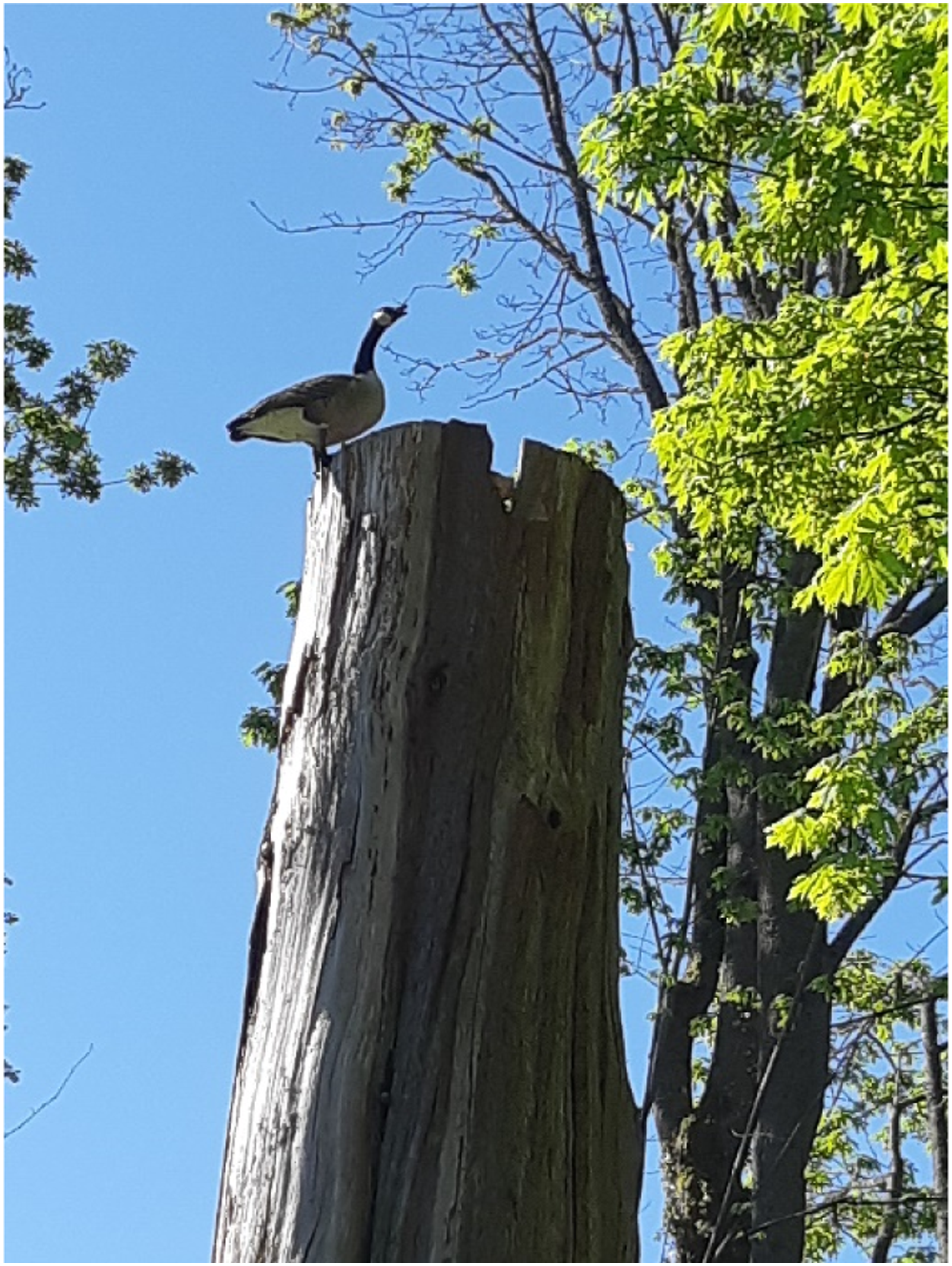
Other participants articulated difficult, negative sentiments they had not previously expressed to others. Larry captured how his neighbourhood had become “dead empty” and described the eeriness he felt walking down the street (Figure 5). “This is very much how I’ve felt every time I have left my apartment. It’s a cold bitter feeling adding an even more apocalyptic disaster feel to the entire City.”
Larry remarked at the end of the interview “this has been great to share my feelings and photos…some of the items we went through today, I haven’t even discussed with my partner. That was a surprising realization to me…”
Photovoice aided participant recall during Session-one and Session-two. However the method’s strength to focus discussions on what participants identified as important were underscored during Session-two follow-up interviews. Allen stated sharing photographs from two-years previous was useful as his “memory bank is not great now [laughs].” Similarly, at the end of her Session-two interview Marilyn said, “[The photographs were] good triggers yes. Thank you, and what a good way of doing that to be able to assess how people are feeling.”
During Session-two interviews the photographs helped some participants reconnect to emotionally poignant experiences from the early pandemic. As one example, when viewing his photograph of downtown Larry commented: “I remember how desolate that felt [out on the street] – it was like—what happened? It reminds me how one thing can grind everything to a halt, worldwide and that’s what is astonishing to me.”
The photograph allowed Larry to pinpoint how he felt during the early pandemic. CO used this as the launch point to explore Larry’s current sentiments about his life and neighbourhood.
Taken together, photo-elicitation during Session-two highlighted the temporal aspects of environmental and social factors identified by participants as meaningful for their social connectedness. An in-depth exploration of these content themes is outside the scope of this paper, as we seek to focus on methodology. However, below we briefly share a few examples. While discussing photographs, some participants stated that their lives and feelings had remained relatively consistent over the two years of the pandemic. Others explained how their daily routines and feelings about places they identified in Session-one as meaningful, had shifted—sometimes dramatically. They discussed how walking routes had become obstructed by natural disaster, places they loved now felt crowded and therefore unsafe, and neighbours with whom they had close relationships with during the early pandemic had moved, fallen ill, or returned to work, and thus they no longer saw them.
To illustrate a pronounced change, during Session-one, Susan shared a photograph of her balcony garden and expressed how important tending plants was for her wellbeing (Figure 6). “Enjoyment growing tomatoes etc. Very satisfying to smell & witness ‘my babies’ growing up.”
At Session-two, Susan described how she got rid of her plants for the safety of her new cat: “I had to sacrifice [my patio plants] and also indoors all my plants, I have now I have all imitation plants, some of them are really good and. But I know she’s safe and…you know [my cat] is worth it.”
A location and pastime that Susan identified as meaningful in Session-one, was no longer as important for her wellbeing in Session-two.
For a few participants, discussing the photographs at two timepoints outlined some challenges they experienced. Nancy described how at the start of the pandemic she took playful pictures because she thought the pandemic would be “short”. Two years later her optimism and creative energy had waned. When asked how it was to revisit the photographs, Hillary explained, “The hardest one, of course, was Benny, but yeah, it’s just…it seems like such a long time ago, and yet it all has passed in a flash.”
Her dog (her primary trusted, close companion) featured in her Session-one photograph, had passed away (Figure 7). “Coronavirus Companion: Benny often spends his time standing like this staring at me. He insists on being close to me. When I am cooking or cleaning he stands like this. When I sit to read, he curls up on a cushion on the floor next to me. He seems to like it when I read aloud to him.”
By reflecting on her photograph, Hillary shared a poignant and emotionally vulnerable example of how her life changed over the 2 years of the pandemic. Photovoice encouraged participants to deeply reflect on their current lives and consider what was meaningful early on in the pandemic and what may have changed over time: “So really and truly you’ve made me think about my physical conditioning and as well as my emotional response to [the pandemic]. And taking the photographs is a lovely way of being able to share a little bit.” -Marilyn
Personal-Level Benefits for Participants
All participants expressed that their photovoice experience was positive. For many, this was linked to how study participation increased people’s sense of purpose compared to their ‘regular’ day-to-day pandemic lives. William, who struggled with depression, commented: “I think [the photovoice study] is rather important. One feels very isolated. I actually got dressed today for the first time in three days which is not like me at all. I think the one time I actually go and talk to people is--every Friday.”
A few others mentioned that they signed up for the study because they like “keeping busy” and “being productive.” Susan used photovoice as an avenue to facilitate social interactions with her friends and neighbours. She described the qualities she appreciated about the photovoice study: “I really enjoyed this [photovoice study]. I mean, I like to be kept occupied anyways. But it’s a very thoughtful project, and I’ve been talking to other people about it--when do you feel isolated? How do you keep in contact? All that sort of thing. And sometimes my friends would say, I never thought of that.”
She also remarked on her photography subjects’ experience: “I think my neighbours enjoyed having me take their picture. One of them brushed his teeth and put on clean clothes.” Susan engaged her friends and neighbours in both the overall study content and the photography.
Participants shared that they were attracted to the study for the opportunity to take photographs. Nancy used the photovoice project to jumpstart her photography practice which had been put on hold: “Well, I mean, it was a bit naughty on my part. But part of the reason I signed up was because I haven’t taken photos for two years just because [caregiving for] my daughter has been all consuming. …So I thought, okay, if I do the photo piece, it’ll make me start again. And it has made me start again, so that was a real positive.’
Nancy suggested this creative outlet was especially important given the heightened stressors of the COVID-19 pandemic (Figure 8): “I felt the senior thing and how vulnerable you are and everything very much. And then of course I heard the rumour that they were calling COVID ‘The Boomer Remover’…I found that it was very hard to do anything during the period [of the early pandemic] because I didn’t want to get depressed and anxious…And I mean, I guess that was another thing about the photography thing. I just got into that, and it was much better for my head space.” “Fleur des Masques: This flower of masks was made just for fun and photographing it was easy. There is no meaning, really, but the masks, although uncomfortable, are not made of ugly material like the gloves. A bit of grace in gruesome times.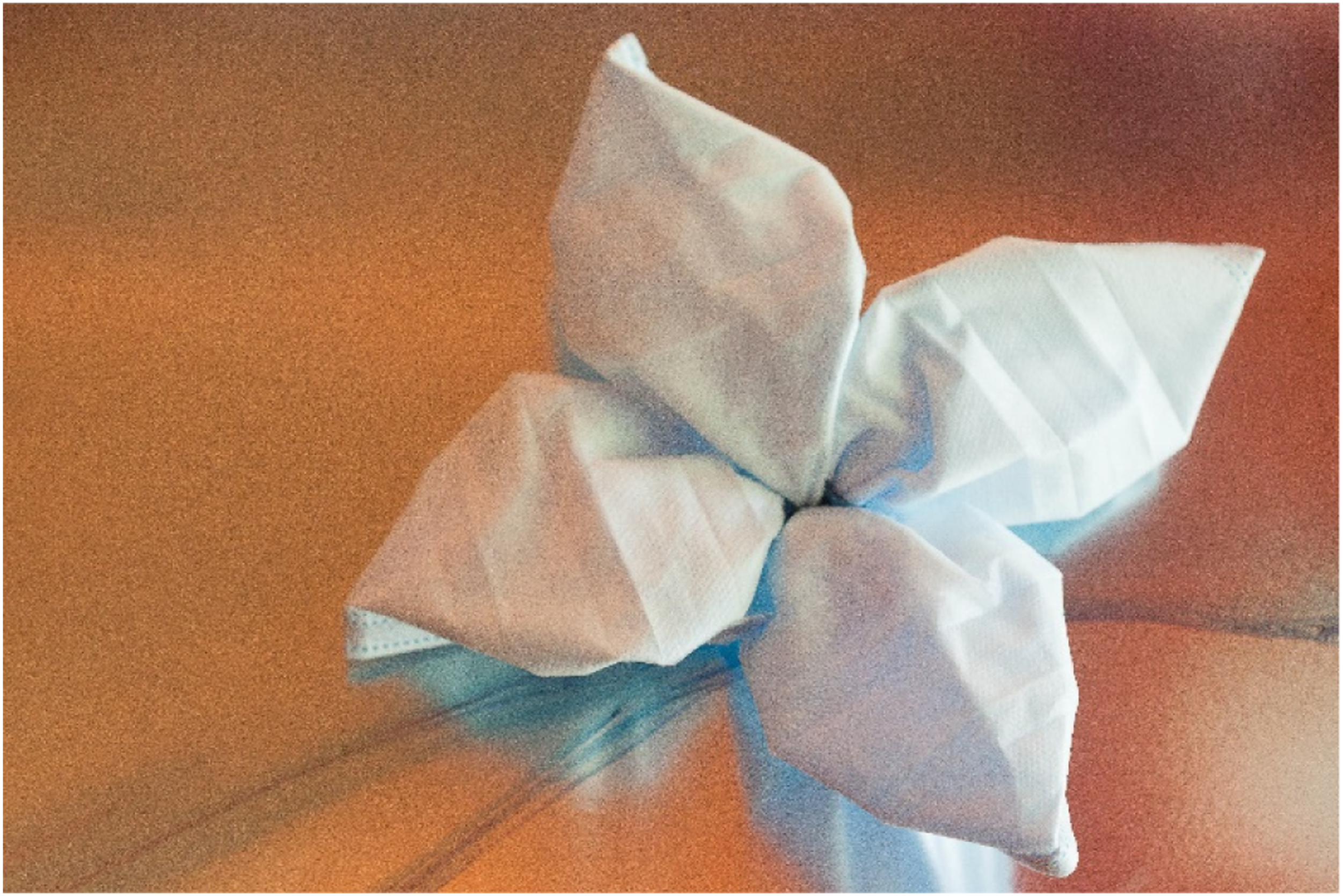
Nancy dedicated an entire day to solely taking photographs for the study, which she described as “very liberating.”
Two and a half years after the initial interviews, participants’ sense of purpose was reinforced during the in-person photography exhibition. Most participants attended the launch event. During the group discussion a few participants shared how they enjoyed taking photographs as part of the study. Larry shared, “I can’t remember now how CO got in touch with me, or how it happened, but she called me and asked for an interview – and made me feel really comfortable – and I just really enjoyed being part of it.”
Susan reflected how the study increased her awareness of isolation. It motivated her to reach out to neighbours who may be isolated. Although not expressed explicitly, CO observed through body language and how they engaged with attendees, how participants exhibited pride and confidence in sharing and discussing their photographs in a public setting (Figure 9). Participant comment written on poster board at exhibition launch.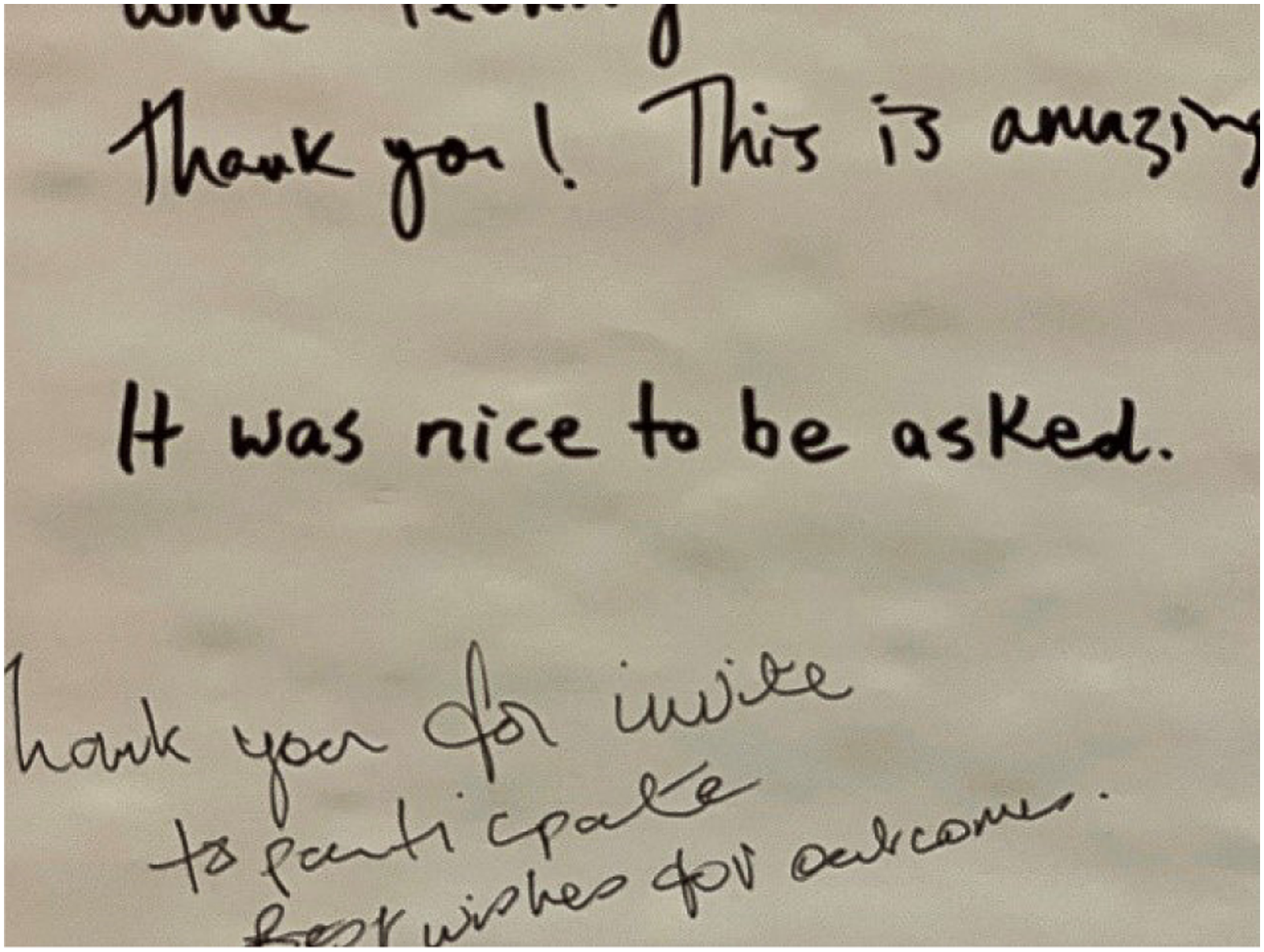
Discussion
At the outset of the pandemic, our research team considered how to safely collect data with older adults without compromising the photovoice method. We adapted our approach to include digitally mediated photovoice. Despite many potential challenges identified in previous studies, and some minor technical hiccups encountered in our own, digitally mediated photovoice was a positive experience for researchers and participants. Here we elaborate on three key findings to show how digitally mediated photovoice was of benefit.
Our first key finding is that participant-researcher engagement with technology built rapport. Through troubleshooting technology fumbles, participants and researchers shared authority, established a human-connection, and built trust which cultivated rapport. This finding is significant as it complicates the idea that technology only hinders participant-researcher relationship building. Our results add to the growing body of literature that suggests if guided by PAR principles of mutual respect, opportunities for human-connection may still flourish across virtual platforms (Black & Faustin, 2022). Opportunities to cultivate participant-researcher relationships may occur in sometimes unexpected incidences—like technology fumbles—but they still happen if both parties are open to connection.
Study participants’ engagement with technology also challenges ageist stereotypes. The way that many participants embraced familiar and new digital technologies counters the limiting idea that older adults are inept or unwilling to engage with technology (Jen et al., 2021; Lopez et al., 2021). This finding is important as it may encourage more researchers to try digitally mediated photovoice with older adults.
Our second key finding is that digitally mediated photovoice extends the benefits of traditional photovoice as an effective method to gather rich, illustrative data, when in-person contact is restricted. This is important as at the start of the pandemic, qualitative methods were particularly relevant to capture “new and fragile lived experiences of place” that confronted older adults (Shareck et al., 2021, p. 2). Yet, researchers were concerned about how physical distancing guidelines would limit the depth of information they could gather. Our results suggest that digitally mediated photovoice gave participants and researchers a tool they could use to more deeply delve into participant experiences, compared with what may have been possible at a distance or with words alone. Participants’ expressed how home and neighborhood places were entwined with moments of joy, ease, struggle, and despair to inform their experiences of social connectedness. In this way digitally mediated photovoice was an effective proxy for in-situ research.
Ruth’s use of metaphor provides one example of how participants conveyed intricate ideas about social connectedness through digitally mediated photovoice. Ruth related herself to a lone goose to depict her difficulties and how determined she was to connect with others. Metaphor helps individuals move embodied knowledge—sensations people experience in their bodies that may not be fully conscious—into ideas they can articulate with words (Modell, 2009). How quickly the pandemic disrupted everyone’s lives may have challenged people to digest and communicate their experiences to researchers on a non-superficial level. In this environmental context, the way participants used metaphor in digitally mediated photovoice was particularly beneficial.
Our approach to digitally mediated photovoice also illustrated temporal aspects of participant experiences. Participants clearly identified how social, environmental, and emotional factors, important for their social connectedness or lack thereof, were maintained, shifted, or changed dramatically over time. By adapting photovoice in this way, we targeted an important knowledge gap—the need to explore how the pandemic impacted older adults’ social relationships and wellbeing beyond the first wave of the pandemic (Bloom et al., 2022).
Our third key finding is how digitally mediated photovoice personally benefitted participants. During the pandemic, digitally mediated photovoice offered participants agency and authority to express their experiences through words and photographs. This outlet was especially significant to counter dominant mainstream media and social narratives which amplified ideas of older adult vulnerability and passivity during the pandemic (Jen et al., 2021). The act of documenting their day-to-day pandemic lives to generate insights for a greater social good added value and purpose to participants’ experiences. Taken together, the participants who shared how their involvement in the study resulted in newfound insights, emotional release, and increased confidence highlight the personal benefits that digitally mediated photovoice can generate. This finding is an extension of traditional photovoice.
The confidence and authority exhibited by participants at the photography exhibit demonstrated the positive impact that digitally mediated photovoice had on them. Attendees publicly acknowledged and appreciated the valuable insights about the social reality of the pandemic that participants shared. During the group discussion on how to mitigate social isolation and loneliness by promoting social connectedness, both groups engaged in thoughtful and meaningful conversation. Participants also shared that after they participated in the study, they actively reached out to more isolated friends and neighbours to offer support and create opportunities for social connection. While our inability to assess the collective-level social impacts of this project is a shortcoming of our study, we clearly show that there were individual-level benefits for participants.
Limitations
We acknowledge that our study has limitations. First, there are important topics that pertain to digitally mediated photovoice with older adults that we did not discuss. These include ethics of representation, sharing data online, and ongoing participant consent. The latter is increasingly recognized as important for longitudinal participatory research. Second, our results reflect a unique study context and conditions. Our findings are shaped by the social circumstances of the early- and mid-COVID-19 pandemic time points, and may not be as relevant in other environmental contexts. Third, our results may reflect recruitment bias that favoured older adults who were comfortable navigating technology. Technological barriers have impacted older adults negatively during the pandemic, and older adults with limited access to technology are more at-risk of isolation (Bloom et al., 2022; Hall et al., 2021). Thus, we were motivated to include a low-technology barrier option for participants in the telephone cohort. However, interpretation of our data may have been affected if older adults who self-selected into the photovoice cohort had pre-existing digital-device comfort, literacy, and access.
Conclusion
Participatory visual qualitative research methods, such as photovoice, can uncover aspects of lived experience that might remain concealed through other research methods (Murray & Nash, 2017). We urgently considered and adapted the positive attributes of photovoice at the start of the COVID-19 pandemic to gain insight into the social impact of the pandemic for older adults. By using digitally mediated photovoice we abided by public health guidelines, while advancing the utility of traditional photovoice.
Although we critically reflected on how and why to engage with innovative research strategies (like digitally mediated photovoice) that illustrate the range and richness of older adult experiences, there is no clear roadmap. Herein, we sought to broaden discussions of how digitally mediated photovoice can be used with older adults, especially during times of crises, to capture their experiences. However, future studies using this approach that delve into how best to integrate participatory and virtual techniques to engage diverse older adults in different settings (place and context), and explore how their experiences may shift overtime, are desperately needed. This confluence of topics will gain relevance as the global population ages and the use of technology becomes more entrenched. With thoughtful planning and resourceful creativity, digitally mediated photovoice with older adults—or other groups who experience barriers to in-person contact— may contribute to research with mutual benefits (Black & Faustin, 2022; Chen, 2022). However, this is only true if participatory action research principles like power sharing, participant-led discovery, and rapport, anchor and guide researcher actions.
Footnotes
Declaration of Conflicting Interests
The author(s) declared no potential conflicts of interest with respect to the research, authorship, and/or publication of this article.
Funding
The author(s) disclosed receipt of the following financial support for the research, authorship, and/or publication of this article: This work was supported by the Canadian Institutes of Health Research (F19-04918).
