




Abstract
This article explores how the use of participatory visual methods can enhance and promote a mind-set of elicitation for researchers throughout the research process. By exploring five case studies that used images at varying stages, the authors analyzed these cases exploring how the use of images demonstrates a valuable mind-set of elicitation at every stage of the research process. This article explores how the use of participatory visual methods and an elicitation mind-set can, by way of summary, promote recruitment, enhance deeper data collection, further engagement by community members in research, and support richer knowledge intermediation back to a community. This article explores how the nature of images used in research in smaller Prairie-based or rural and Northern communities did, through the use of visual and participatory methodologies, expand the success, impact, and reach of elicitation in research.
Introduction
Community buy-in for research participation is enhanced, supported, and motivated through the use of photos and images. We see through ongoing research practice that research participation is often viewed cautiously, if not even skeptically, by members of the general community. This article will explore how the nature of research conducted in smaller Prairie-based or rural and Northern communities did, through the use of participatory visual approaches, expand the success, impact, and reach of research, with a focus on how images promote elicitation processes specifically. Expanding the notion of elicitation beyond its ties to “photo elicitation” toward a unique mind-set for researchers, we explore the use of images in five case studies. 1 This article examines how visual research methods (VRMs) simultaneously deepen and promote a broad sense of elicitation both as a process and as a mind-set. We explore how the image becomes a helpful bridge for richer research participation by community members thereby maximizing the success of the elicitation process in key stages of research production. This article argues that this invitation through the photo or image contributes to a valuable elicitation mind-set and thus better overall engagement with the research process and outcomes.
Visual imagery in the public domain is expanding (Aungst, 2017); it is becoming increasingly more accessible as it crosses linguistic and national boundaries, and even in less well-developed nations, we see its impact. According to McMaster (2017), this comes as no surprise since there has long been an indisputable power of the image through photography. Increasingly, methodologists conducting evidence-based research are also reporting that the proliferation of images worldwide represents a new kind of knowledge and knowledge creation (Banks & Zeitlyn, 2015; Margolis & Pauwels, 2011; Roger, 2017; Roger, Wetzel, Penner, 2017). Certainly, we have seen images discussed in the arts and the humanities for many years, but now, the question of integration with health research and other evidence-based fields is growing (Boydell et al., 2016; Rose, 2011). In our article, most attention will be paid to photography, in part because of its popularity and perceived ease of use, but also because it highlights aspects of visual approaches that can be adapted to other visual media (Harper, 2002). Within VRMs the emphasis on photos aligns with that of Rose (2011), but she also acknowledges that VRMs may involve diagrams, relational maps, time lines, self-portraits, films, video diaries, collages, maps, memory books, drawings, graphic novels, and photo diaries (p. 25).
In a smaller Prairie-based city surrounded by rural and Northern communities, attaining rich and deep data by a representative sample can be an issue for a number of reasons. For example, seeking responses through interviews requires the same group over long or repeated periods of time. People become more familiar with us and our research questions through interviews or focus groups, and seeking participants on a familiar topic can result in participant fatigue or even attrition in participation. Furthermore, research is not always looked upon favorably in our rural and Northern communities for reasons that are important to consider—the real length of time it takes to complete, the abbreviated outputs that cannot be immediately applied, research is rightly seen as exploitative by some communities that have been on the receiving end of historic exploitations, and research can be seen as too elitist to a community member at large. Research by some may be seen as inaccessible literature housed in academia speaking to the converted. These viewpoints can lead to a community member’s lack of inspiration or willingness to provide time, deep and rich responses, and enthusiasm for responding to a research question within the data collection process. However, by initiating modalities that elicit responses beyond the survey, interview, and focus group, the image can act as one very welcome yet familiar tool through which a wide range of community members are much more likely to consider participation in research.
We explore in this article how the use of photographs and other images in five diverse studies enhanced, supported, and motivated community participation in health research and thus reinforced strong visually based elicitation processes and thus elicitation as a research mind-set. Each case is highlighted through a primary theme, which reflects the main contribution that the use of visual approaches made to that study.
Conceptual Frames
When a researcher uses participatory visual methods having a mind-set that is open, fluid, and responsive, serves the “complexity of the entanglement of photographic objects in human social relations” (Banks, 2001, p. 88) and thus the research project more broadly. A mind-set describes the “established set of attitudes held by someone” (“mindset,” n.d., para. 1), and in recent years, the concept has been popularized in educational circles through the work of psychologist Carol Dweck (2015). A fixed mind-set is an orientation to the world that is nonreceptive to change in contrast to a growth mind-set that is open and recognizes and responds to fluidity (Dweck, 2015). We are all “a mixture of fixed and growth mind-sets, we will probably always be, and if we want to move closer to a growth mindset in our thoughts and practices, we need to stay in touch with our fixed-mindset thoughts and deeds” (Dweck, 2015, p. 3). For researchers engaged in visual approaches, the openness to being open is necessary in part due to the polysemic meanings that infer images, especially photographs, and the creative unpredictable processes that making photographs and images involve.
Elicitation, we propose is part of a researcher’s mind-set because we need at every stage of a study to be conscious of what we are eliciting, how, and why. In a general sense, to elicit as it is commonly practiced and known is an act that will “evoke or draw out (a reaction, answer, or fact) from someone” (Elicit, 2018, para. 1); yet there is also the archaic definition: “to draw forth (something that is latent or potential) into existence” (para. 2). Both the current and more archaic usage relate directly to the Latin elicit meaning “drawn out by trickery or magic” and from the verb elicere and its relationship to lacere, meaning to “entice, deceive” (para. 3). For researchers, the current definition may inform the research proposal yet the older meaning of drawing forth something that is latent or unknown is highly relevant and may occur at any time during the researcher’s work with participants. Through the process of elicitation within participatory visual methods, unpredictable ideas, connections, and insights can be triggered, sparked, or rekindled. Indeed, the old definition of elicitation suggests that we do not always know what path our elicitation processes will take. This “drawing forth” speaks to the unpredictability of the results of elicitation in research and perhaps even more for the results related to visual methodologies. Ironically, photography has its own history of being viewed as capricious, simultaneously both fact and fiction, polysemic albeit with a preferred reading (Rose, 2016). Here, we can see that elicitation processes can yield surprising results in any research, and the photo or the image may deepen or sustain what is drawn forth.
More specifically, Harper (2002) defines elicitation as the insertion of an image, frequently a photograph, into a research interview. He explicates a continuum of photo elicitation purposes and the types of photographs used with one end of the continuum beginning with anthropological field studies and scientifically oriented visual inventories of artifacts. Collective and institutional photos depicting work or schooling hold another part of the continuum. As a visual sociologist, Harper identifies a third area of intimate and social photos, such as family or one’s body, and the continuum thus reflects the personal to the social, historical, and cultural. Photo interviewing originated in the late 1950s as part of an anthropological study conducted by John Collier (1957) and since that time photo elicitation has changed and evolved.
Within visual anthropology, Collier’s 1957 study with his query “how can you apply photographic imagery to direct research [emphasis added]?” (p. 843) marked a shift in the use of photographs for research purposes. Since that time, sociologists, educational researchers, arts-based health researchers (ABHRs), and others have also turned to the photographic image (Banks, 2001; Boydell et al., 2016; Collier & Collier, 1986; Mitchell, De Lange, & Moletsane, 2017; Rose, 2016). With this adoption of the photograph as part of research methods, a variety of photo-elicitation approaches have evolved, including photovoice, moving images through video, and digital extensions of the image (Rose, 2016). In tandem with the growth of VRMs has been that of participatory research whereby research participants, frequently members of a community, are deeply involved with the creative and interpretative work of research (Rose, 2016). Depending on the discipline and topic, the rationale for selecting visual methodologies varies but frequently rests in the fecundity of the image, and its ability that “mines deeper shafts into a different part of human consciousness than do words-alone interviews” (Harper, 2002, pp. 22 and 23). Harper further notes that photo elicitation “thrusts images into the center of a research agenda” (p. 15). Photographs highlight both their pragmatic usefulness as well their ability to decenter authority, in this case the conventional power position of a researcher (Banks, 2001). Images made by research participants “jolt” (Harper, 2002, p. 21) a new awareness of social existence and, in the lineage of anthropology, make the familiar strange. Photographs are multivocal, assist in the teasing out of complex social relations, and reduce awkwardness in the word-based interview stages of research, as the images may act as a “neutral third party” (Banks, 2001, p. 88). Additionally, the making of the photographs, then the sharing, followed by the talking about them, all work to increase the degree of intimacy between the researcher, the images, and the image makers (Banks, 2001). Photographs bridge culturally distinct worlds and “unlike many research methods, photo elicitation works (or does not) for rather mysterious reasons” (Harper, 2002, p. 22).
Although visual methods are becoming more popular as part of a research study (Boydell et al., 2016; Rose, 2016), researchers, to some degree, have elided the significance of the thinking that accompanies the making of visual artifacts, the understanding of visuality, and the use of their own visual literacy skills (Rose, 2014). Different from physiologically based vision, visuality is “how vision is constructed in various ways” (Rose, 2016, pp. 2 and 3). A dynamic process, the constructing of visuality occurs through informal and formal education as well as complex social processes; additionally, the saturation of images in the Western world has brought forward the concept of ocularcentrism (Jay, 1993) that privileges the sense of sight and conflates vision with knowledge and knowing. Such aspects of visuality and what it means for participatory visual methods relate not only to photo elicitation and photovoice but may also influence researchers interested in using other visual methods.
An example of the importance of understanding visuality appears in the recent critiques of photovoice where Liebenberg (2018) importantly identifies visual skills as being central and relevant for researchers. Despite the acceptance that the visual can be data, and in effect a catalyst for deeper discussions related to the research topic and focus, photographs and what they mean do not yet receive pronounced attention in the articles published. As Evans and Rosemberg (2016) found from their overview of 21 qualifying articles from 2008 to 2013, photovoice research authors frequently did not reveal how participant discussions shaped the data analysis process. Evans and Rosemberg did note the efforts of researchers to include participant input in the selection of photographs for exhibitions; however, participant involvement in selecting images for journal publication was a noticeable absence. Building further on a critical examination of photovoice, Liebenberg (2018) brings forward the importance of researcher awareness of the questions and actions of visual curation and points to Latz (2017) to provide a movement toward understanding visuality and its implications for VRMs. Because of the choices made when making a photograph, the photographer is creating a frame to simultaneously include and exclude, to simultaneously draw attention, and to direct attention away and is therefore constructing and composing meaning from one’s life. Visual literacy skills along with understanding the concept of visuality are both necessary attributes for researchers as this enables how photographers/research participants develop a “reflective consciousness…for the moments they spent thinking of the prompts, taking the photos and then narrating the photos during the interviews” (Latz, 2012, p. 54).
Additionally, within photo-elicitation approaches, there have been recent critiques of how photovoice has been applied by researchers (Evans-Agnew & Rosemberg, 2016; Liebenberg, 2018). As the flexibility of image work continues to flood our digital realms, how researchers take up the use of images requires attention. “[P]hotovoice as a participatory method has become increasingly accepted, [but] what is still not understood is how researchers make decisions regarding the development and dissemination of participant voice [emphasis added]” (Evans-Agnew & Rosemberg, 2016, p. 1021). Understanding the research decisions within photovoice and other participatory visual methods, we would argue requires an ongoing awareness of how images work within the process of an elicitation mind-set.
When using participatory visual approaches as part of VRMs, ABHRs have additional challenges (Boydell et al., 2016). In questioning the “hegemonic conventions” (p. 681) of established academic research, these authors enumerate four challenges to ABHRs: the weight and influence of positivist medical and health research that requires linear structures in opposition to the more fluid, open, and relational aspects of ABHRs; the dominating and established academic expectations regarding rigor, accuracy, and truth that clash against ABHRs with its orientation toward critical and interpretivist epistemologies; measuring the impact of ABHRs; and lastly, for the researchers and their careers, the academic currency of such research bodes differently (Boydell et al., 2016). Academics not familiar with ABHRs may view a visual approach merely as an intervention rather than a means for creating or sharing research, and thus may question ABHRs rigor, and downplay the various risks involved.
Although each research project is unique, photo-based researchers tend to follow similar steps that include consulting with the community (i.e., if part of participatory action research); planning the project and recruiting; preparing participants to use photography (e.g., camera and photography skills); visual data collection and analysis; disseminating results (e.g., photo exhibits or websites); and potentially social and policy change. These steps provide guidance yet it is the research decisions and the elicitation mind-set iteratively working together from the beginning until the end, in tandem with understanding how image-making works that draw forth unexpected and complex results.
Visual data do matter but so do the processes of making, sharing, and viewing, which are all integral to an elicitation mind-set. When research participants are “entrusted” (Wang & Burris, 1994, p. 369) with the task of documenting their lives as informal photojournalists, as untrained, citizen visual anthropologists, and then engaged in discussions that explicate those images, they as image creators “define those images…[and in] discussing the images that they have produced…they give meaning to, or interpret, their images” (Wang, 1999, p. 186). As with all interpretative moments, there is a hermeneutical impulse at work, and in viewing and reviewing an image, the photographer/creator is always a somewhat different person in the viewing moments from when the image was first created. Sometimes the interpretations are identical, but sometimes through the percolating effect of thinking over time, new insights, a new reading of the previously viewed photograph is possible (Gadamer, 1989). In this manner, visual participatory methods are a creative process, and like all processes there is no clearly demarcated start and stop, and instead there is a predictable unpredictability about it all. The combination of an open mind-set and the recognized potential for images to elicit fecund “visual data” suggests that participatory visual researchers flexibly respond to their research contexts. An example of such flexibility occurred while researching Vietnamese girls with disabilities, when the researchers (Nguyen, Mitchell, De Lange, & Fritsch, 2015) made “an on-the-spot decision…to combine photovoice and drawing” (Mitchell et al., 2017, p. 23).
In this way, we argue in this article, the profound power of using the photo and the image exists for research purposes, and in particular, when the researcher from the outset has an open habit of mind, borne from experience and purposefulness for the contributions wrought from and through the image and from the people involved in the image-making processes.
Five Case Studies
The following case studies each employed the use of images at every stage of the research process in a way which we know deepened elicitation processes to elicit recruitment and community participation, to elicit deeper interview data collection, and to elicit community interest through eventual knowledge translation. Each case having been published was then analyzed for the purpose of deriving key themes related to elicitation. Since the use of images was central to the success of these studies, conceptualizing the value of the images within the frame of “elicitation” led to a rich analysis. In our analysis of the studies, we asked questions by way of example such as, “how did the use of images garner interest in the community for this study?” “did the use of images promote the research question in a way which deepened data collection?” and “did the use of images impact on research participation and if so, in which ways?”
Through an adapted form of Braun & Clarke’s (2013) 15-point criteria for “good thematic analysis,” the coauthors defined the parameters of the case studies and use of images first and then we used the publication of each study as our formal field notes for analysis. We individually reviewed each study through its publications and came up with initial emerging themes on the use of images in the context of elicitation. This was followed by a discussion regarding overlap and divergence in our emerging themes. In our analysis, we applied the approach of theoretical sensitivity, given both of our expert knowledge of the methodological field and its related literature. By way of peer review with each other, we then elaborated on the following five themes in regard to elicitation as a mind-set with the use of images as a central approach. While we could have added more subthemes, we elected to focus for this article on one core theme per study. These highlighted the role images played in what we deemed to be the main aspects of elicitation present at each stage of the research study.
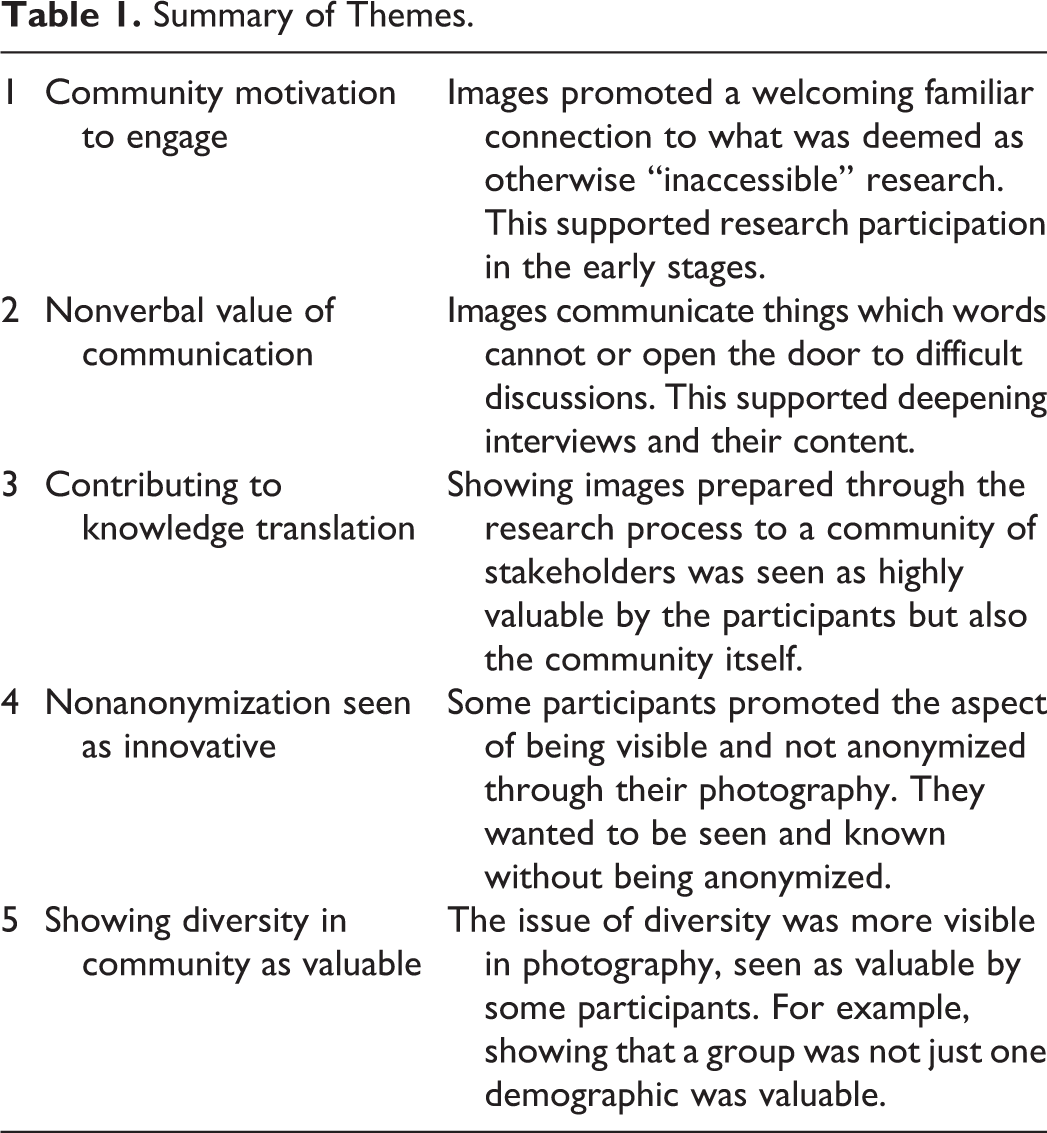
The following themes (see Table 1) were derived from the five case studies that used images as part of their research. These contributions have been laid out chronologically as we see them occurring in the research process, and they reflect the interplay of researchers’ elicitation mind-sets with meanings visually drawn forth by both participants and researchers: Theme 1. Community motivation to engage: Visual data/photos allow the community to feel that they can engage as participants in a research context, which by some or many is perceived to be intimidating or foreign. Images became the vehicle for improved elicitation on a topic; Theme 2. Nonverbal value of communication: Visual data/photos allow for nonverbal communication on challenging topics, in particular around the issues related to difficult life experiences, and may assist in elicitation of valuable data. Images enhanced the doorway to improved verbal elicitations related to the research topics; Theme 3. Contributing to knowledge translation: Images were used to report on data to a community. In this way, visual data/photos allowed community members to feel engaged with research and to see through the display of images that they have valuable knowledge to share for the benefit of others in a modality they were familiar and comfortable in; Theme 4. Nonanonymization seen as innovative: Visual data/photos allow participants to be seen, visible, and not anonymous if they chose. Not all participants saw value in being anonymous, and images allowed them to be more visible to their own communities; Theme 5. Valuing diversity in community as valuable: Visual data/photos can express the actual diversity (or lack thereof) of a group or community. It is possible to “show and tell” diversity in a richer and possibly deeper way.
Summary of Themes.
Case #1—Community Motivation to Engage
The research team in this study asked women who were aboriginal and living with HIV but also acting as caregivers to others in their lives, to take photos of items and aspects in their lives that gave them hope or inner strength (Roger, Migliardi, & Mignone, 2012). This study focused on the caregiving networks of people living with HIV/AIDS in two small centers in the Prairies in Canada, focusing specifically on the experience of women. The study used an adaptation of photovoice methodology to explore the lived experience related to social support and care among vulnerable women (Wang & Burris, 1997). No issues emerged about cameras and the fear of needing to be an expert photographer for participation, as it did in other studies. In fact, the participants were very keen to take part in this study due to the element of photography, and they were keen to show through photography what parts of their worlds gave them strength—rocks, trees, a favorite quiet place. Photography became a vehicle or doorway through which they eagerly wanted to engage in this research, since research appeared foreign or unfamiliar to them. It was the familiar act of taking pictures which encouraged these women to become excited about depicting some image or aspect of their lives which gave them strength in an otherwise challenging situation. Research and possibly us as researchers had become stigmatized, as these women belonged to an urban Indigenous community, members of which had a great awareness of the abuses and historic colonization associated with research engagement (Fiola, 2015).
One can argue here for the benefits of photography as a way in which it can engage communities that have traditionally historically been marginalized through the processes of colonization. Indigenous cultures have not been in a position to have their knowledge heard due to colonial exploitations (Fiola, 2015); however, through alternative methods of communication which (in part) include the image, they have communicated knowledge about their culture for hundreds of years. As an example, Inuit art and the value and power of that for Inuit peoples can be an example of how imagery is important for Inuit people, communicating their history and culture, their values and practices. Visual ethnographies (see journal by that name) are an excellent example that includes work that focusses on landscapes and how these define health, and this theme of health and our environments was central to the study described.
Visual anthropology has examined the social use of images for many decades and offers that “there is a particular ‘laminated’ quality to photographs: a layering of image, affect and physical presence that combines to make them highly complex, and deeply social, objects” (Edwards as cited by Deger, 2016, p. 115). In efforts to designate the thick description (Geertz, 1973) of digitized, software app enhanced photographs, Deger (2016) uses thick photography to describe these remediations that “signals a concern with questions of aesthetics and interpretation in relation to acts of ‘light writing’ [i.e. photography]” (p. 114). Although the images from the HIV/AIDS study were not remediated through digital add-ons and manipulations, they brought forth rich and layered, mediated and relational, contextual and land-based meanings, a thick photography, an intertextual reading relating to the photographers/participants’ identities, the natural world, and cultural conceptions of wellness and health.
Case #2—Nonverbal Value of Communication
In a second study, a clinical tool called the Life story Board (LSB) was used to work with individuals who had experienced trauma, and here images of another kind were central (Mignone, Chase, Medina, Roger, & Ens, 2016).
The innovative play board and kit called the Vidaview LSB combines features of the genogram, ecomap, and time line for the use with therapy clients. The goal of one study was to explore and understand the experience of clients and therapists during and after therapy sessions using the LSB, with particular focus on the disclosure of difficult life events. The LSB is a visual interview tool that uses a colorful board, sets of cards, markers, and a notation system to construct a multidimensional of a person’s life situation. The board facilitates the “translation” of narrative life stories into a “life-scape representation” through a process of co-construction between the client and the therapist.
The study took place in a small Prairie-based center in Canada in 2013 involving staff of a counseling program of a nonprofit community health center that provides services to inner city residents; clients were mostly newcomer Canadians, and First Nations and Metis. Clients created a visual representation of their difficult life events and experiences in an organized way in a process of co-construction with the therapists, achieving effective communication. Its contrast to other visual methods used in psychotherapy was reviewed. The LSB facilitated clients’ disclosure and gave them personal relief by depicting a number of factors that affected their life.
In this way, using pictorial symbols placed thoughtfully on a prepared map by the participant (chronological of life), the placed symbols pictured events of the participant’s life story as an invaluable tool to elicit narratives of life stories. The use of images and symbols here, while not virtual or online, further demonstrates the invaluable mechanism that nonverbal imagery can be for inviting participants to feel comfortable to discuss difficult experiences, if they so choose. Images in this case became a gateway to collect important data about such experiences but also to hear the stories or success and resilience that may not have emerged in the same way based only on verbal interviews or survey data collection. Participants would have decided whether they wanted to engage in the exercise in advance, knowing that nonverbal imagery was key to the process.
In this study, the use of images and chronology intertwined in a manner that evokes the photonovel and photo novella albeit without photographs but with pictorial symbols. Exploring the difficult topic of trauma requires health researchers to consider research methods that relate to other disciplines, and in this case, art therapy with its concerns on emotional expression conveyed through the process of meaning-making with the polysemic vocabulary of pictures and visual expressions (Pink, Hogan, & Brid, 2011). Art elicitation methods may help to inform a thoughtfulness in calling forth and giving voice to visual expressions that inform research unlike in other nonvisual approaches.
Case #3—Contributing to Knowledge Translation
An affiliated study used photos and images in another way. The principal researcher had asked men with depression and suicidal ideation (Man Up Against Suicide, n.d.) to take pictures and narrate the picture in captions. A powerful photo exhibit resulted with the help of a curator. This led to the exhibit to be shown across the country in many urban and rural settings, providing a doorway through its profound imagery, for a discussion about men and suicide. We led five 1-month-long showings of this photo exhibit through different rural areas of Manitoba by partnering with community centers in order to stimulate both discussion about depression and suicide in men but also to share the knowledge that these men had so carefully accrued through challenging life experiences made available through their use of a single selected image. The participants were honored that the exhibits were being shown around the country in a way that shared their knowledge and stimulated discussion about an otherwise taboo topic. Without the initial men’s photos, the promotion of this issue, through many small and rural communities, could not have occurred in such an accessible and powerful manner.
As well, it turned out that the undergraduate and graduate students, who were engaged in this exhibit through summer research awards, were highly enthusiastic to use photos as a way to engage with such emotional research, and they stated that the photos helped them to feel that this was an issue that also mattered to them. The photos paved the way for knowledge translation in smaller and rural communities to make a powerful difference on a taboo topic. Learning and discussion occurred through the use of photography in this exhibit for the students involved as well.
This third example highlights how images circulate (Rose, 2016); they moved from the initial site of production to where they landed and, in this case, became a photography exhibition that traveled. This conversion of knowledge translation to becoming a physical site where an audience views the research data—that is the photographs (curated and reproduced for exhibition) extend the concept of photo elicitation as an ongoing process. The initial making of the photograph as a response to the researchers’ request has drawn out something that was latent and potential and speaks to the unpredictability of image-making. The traveling exhibition involves the concepts of audience, and the site of viewing, as extensions of photo elicitation and visual research practices and to the evocative readings of thick photography.
Case #4—Nonanonymization Seen as Innovative
In this fourth case, the researchers asked older participants living with Parkinson’s to take pictures of their daily lived experience that would show ways in which they felt invisible, as people living with Parkinson’s (Roger, Nurmi, Wilson, MackKenzie, & Oliffe, 2016). Based on previous community research findings, we had prioritized the need to better understand how experiences and feelings of invisibility by those living with Parkinson’s could be shaped by relational dynamics, interfacing with service provision and social forces, with the overarching view of better understanding the experiences of participants living with Parkinson’s disease. A photovoice methodology was employed.
Firstly, potential participants had many questions about whether they needed to have expert cameras or needed to have previous training in photography. These were initial recruitment discussions that at first, seemed to deter this cohort from participating at all. However, in subsequent work, we found that social media and visual data (such as photography) deeply supported research participation. The key issue that emerged in this study was, ironically no less in that we were studying invisibility, that while we had said we would not name individual names or show faces, the participants who did take part in our study were very clear about wanting their faces and names used. This aspect of photo use and the idea of being visible and named as a choice being a participant had initially inspired them to participate in the study. One couple insisted that we provide their real names in the article and so we had discussions with the ethics committee about the request. The ethics committee felt strongly that we ought not to post/show their faces in publications, since the participants may not feel the same way later on in years to come. This challenged us as a research team since we wanted to honor the freely made request by these informed participants. Ultimately, we discussed the ethic committee’s decision with the participants and did not post/show the participant faces in the article; however, it felt that this was going against their true autonomy and research participation overall and something we wanted to read more about.
Subsequently, we found the work of Allen (2015) who problematized the process of anonymization, by saying that it could reflect ethical principles of the ethics committee but may not always or appropriately reflect the participant’s wishes for anonymity. Furthermore, the International Visual Sociology Association (Papademas & International Visual Sociology Association, 2009) states that anonymity is not always required, depending on the situation, and the need for a detailed code of ethics for visual researchers has been established in part because of the potency of the image. Here again, the unpredictability of visual participatory methods eliciting something that is latent and potential was demonstrated by participants requesting authorship over images they had made. The reticence of participants questioning their abilities as photographers evolved over time to become an ethical discussion of great import (Allen, 2015). Researchers went into the project pursuing invisibility and unpredictably, visibility became a strong discussion point. What role did photography play in eliciting this desire to be known, to be seen, to have a voice?
Case #5—Valuing Diversity in Community
A growing body of research (Nurmi, Mackenzie, Roger, Reynolds, & Urquhart, 2016) points to men’s groups as a benefit to communities because of their volunteerism and community-based programming. Little research, however, has explored groups for older men from a community development perspective. Here, we describe a case study using photovoice methodology with two men’s groups from Canada and two from Australia (Roger et al., 2016). We discussed men’s group participants’ perceptions of their groups’ contributions to the well-being of their members and the broader community, from a community development approach using photos as a key part of the study. Findings revealed older men’s volunteerism toward events and maintenance of community parks and museums, as well as mentorship activities, contributed to a profound sense of well-being for a range of community members while fostering a sense of accomplishment, friendship, and other indirect health-related benefits (e.g., discussing personal reactions to prostate cancer).
One of the questions that emerged was the diversity of the group. The preparation of visual images in a range of publicly available documents was intended to reflect the possibility of a diverse community (Indigenous, gay men, a man in a wheelchair). The images came under scrutiny when the pictures were seen to be “too diverse” for the more homogenous cohort. Visual representation here became a key question, governed by what some felt should be an accurate representation of the actual members in this group (e.g., White, heterosexually presenting men, who liked to do traditional masculine activities such as carpentry). Although all men were ideally welcome in the group, it did not appear to be a diverse demographic. The question arose—should photos be used for promotion to create more welcome imagery to all kinds of men? Or, should photos be used only to reflect “who” was already attending? The issue of the photographs selected became an important discussion for the promotion of the group through public materials, based on research activities.
This example highlights how the history of documentary photography may have influenced the questions above. Rose (2016) summarizes this history of documenting the poor or marginalized frequently by photographers championing reformist projects as a means to instigate awareness of the relatively powerless by those more privileged. Wang and Burris (1994, 1997) purposefully tie photovoice to documentary photography and Latz (2017) as part of her photovoice handbook provides a detailed discussion of this genre of photography. Documentary photography has weathered numerous questions regarding who and what is represented within an image. The men and their photographs highlight how researchers need to consider the empowering aspects of participant-generated photographs and to “reflect in more detail on the complex dynamics between researchers, research participants and the broader contexts in which research is undertaken” (Rose, 2016, p. 316). Again, participatory visual methods may elicit and incubate an ongoing involvement in the images as they are creative and interpretative expressions that reinforce the unpredictability of image work.
Discussion
It is our proposal that elicitation is a unique mind-set for researchers which begins at the beginning of a study and continues until the knowledge has been translated or transferred back to its community stakeholders. We have explored how the image matters to elicitation processes within participatory VRMs because images enhance the ability to “draw forth” valuable knowledge from the participant specifically through the visual. Our participants can provide us with rich knowledge, in particular because so much of our everyday world is composed of seeing and translating “seeing” into behaviors, feelings, and actions. By way of example, it is well-known by early childhood developmental psychologists that the role of vision in the development of an infant’s cognition is vital and that the development of sight is linked to the infant’s emerging interaction and engagement with the world as a newborn (Groves, 2008). This is knowledge creation.
It cannot go unnoticed that our virtual world and social media today are filled with photos and images, used by people across the life span. Instagram and Snapchat, as two examples, are followed by millions of people relaying vital information about their experiences, activities, preferences, and dislikes. We argue that this process of downloading, engaging with and interacting through photos or images online, is an unprecedented form of knowledge creation and sharing never seen before. Some have argued that the image could be the great equalizer in a posttext society (Aungst, 2017).
The five case examples discussed here reflect the value of bridging the two worlds of community and academia through the use of images and, importantly, through the process of elicitation. As we have described it, elicitation is not a single act, or one aspect of the research study—rather, we conclude that elicitation is a process and a mind-set which matters at every stage of our work. Creating a bridge for the community member to academia through the use of images is a way of extending a hand to those who may want to further engage in research and otherwise might not. The image also conversely bridges what academics may not know, and want to find out about, from the community.
This leads to our next point. Community members in our studies were motivated to engage with research specifically by engaging them first with images. Visual data allowed community members to feel that they could respond with depth in a research context, by many seen to be intimidating or foreign. We also found that visual data inspired participants to consider that they were actors in a study—even more, they wanted to be visible and not anonymous in the research reporting. Images alongside the findings were considered to be fresh and interesting. As our discussion revealed, participants felt that interacting with visual images as part of the elicitation process allowed for nonverbal communication on challenging topics in particular around the issues related to difficult life experiences. Knowing that images were part of a study’s process could assist someone to access deeper responses on troubling or traumatic topics. Visual data were also of value to some participants, when they thought that their images showed experiences that would benefit nonacademic community members, demonstrating the power of visuality in knowledge translation to their communities. It was found that knowledge translation was more effective in the community with the use of a photography exhibit. Finally, showing diversity through photographs was seen by some as highly valuable. Images can express well the actual diversity (or lack) of a group or community, especially in ways that pertain to the research question or the community being represented.
If as researchers we understand elicitation simultaneously as a process and a mind-set which permeates throughout a research project, then the use of images conducively supports such synchronal thinking. By appreciating the value of the image, photographic or otherwise, as a means to draw forth participant’s knowledge and experiences about their everyday lives and experiences, participatory visual researchers help build the bridge of knowledge intermediation.
Footnotes
Declaration of Conflicting Interests
The author(s) declared no potential conflicts of interest with respect to the research, authorship, and/or publication of this article.
Funding
The author(s) received no financial support for the research, authorship, and/or publication of this article.