




Abstract
Qualitative researchers who need to interview people with cognitive disability, including intellectual, developmental, mental disabilities and Autism Spectrum Disorder (ASD), can experience limitations in implementing an inclusive research approach using conventional methods like verbal communication. In this paper ‘proxy intervention interview’ is shown to be an inclusive research approach for incorporating the voices of artists who cannot articulate their thoughts or describe their own experiences concerning their career development. The author introduces a step-by-step process for implementing this method, including such aspects as research design, recruitment, and informed consent. Five key ethical considerations are suggested for designing an appropriate inclusive research approach to encourage the participation of people with cognitive disability, regardless of their level of capacity.
Background
For many researchers, having access to the voices of people with cognitive disability, including intellectual, developmental and mental disabilities and Autism Spectrum Disorder (ASD), can be a challenge in terms of research design, ethical considerations, and obtaining informed consent. However, it is important for people with cognitive disability to be engaged in research that involves them, and it is possible to design a supportive approach that will also help them to enjoy the process of research participation (Fullana et al., 2013; McDonald et al., 2013). Being able to participate will also give people with cognitive disability the benefits of improved self-esteem and intellectual stimulation (Inglis & Cook, 2011).
In the 1960s social science researchers introduced the concept of an inclusive research approach to reflect the voices of people with cognitive disability who suffer social inequalities and who are vulnerable to a lack of respect for their human rights (Joint Committee on Human Rights, 2008 cited in Fullana et al., 2013; Goldsmith & Skirton, 2015). Additional measures are required to ensure people with cognitive disability receive equitable treatment ‘with the same dignity and respect as any other member of society’ (Goldsmith & Skirton, 2015, p. 436). Inclusive research has been used as the term to embrace a range of research approaches such as ‘participatory,’ ‘action’ or ‘emancipatory’ (Walmsley & Johnson, 2003).
According to Frankena et al. (2016), there are three main reasons why some methods of inclusive research succeed while others fail. Firstly, there are no clear guidelines on how to include people with cognitive disability in the research process, because much depends on the severity and condition of their disability. Secondly, there is a lack of understanding of the important characteristics of inclusive research. Lastly, expected or experienced outcomes of inclusive research are not explicitly assessed or evaluated in terms of using inclusive research methods. People with cognitive disability have a wide range of conditions and different levels of cognitive functioning. When designing an inclusive research approach for targeted participant groups, researchers need to acknowledge these different levels of cognitive disability (Brown & Brown, 2003; Petry et al., 2005).
People with a mild level of cognitive disability can provide informed consent independently, and they can take an active part in research by sharing their lived experience and knowledge in conventional ways, such as by direct verbal communication. On the other hand, some people with a profound level of cognitive disability, who may not be able to speak or articulate their thoughts and feelings, would find active involvement difficult. Such people would need extra support, or alternative methods of research, to enable their participation.
Most inclusive research studies tend to focus on those who can provide informed consent independently and take an active part as a co-researcher or in an advisory or leading role (Bigby et al., 2014b, 2014a; Frankena et al., 2016; Grundy et al., 2003; Johnson, 2009; Nind & Vinha, 2012; Strnadová & Walmsley, 2017; Walmsley & Johnson, 2003). There is a lack of discussion about how to involve those who cannot provide independent informed consent and have limited understanding and ability to communicate due to the severity of their cognitive disability (Brown & Brown, 2003; Petry et al., 2005). Interviewing people with profound levels of disability is not an option because this group does not have the required skills to express their subjective experiences through verbal communication (Brown & Brown, 2003; Petry et al., 2005; Selai & Rosser, 1993). Therefore, an inclusive research approach needs broader consideration, involving transparency, adequate facilitation and evaluation to include people with cognitive disability at any level (Frankena et al., 2016; Petry et al., 2005).
There are several key issues that researchers must take into consideration when designing an inclusive research approach. These include recruitment, consents, and ability to participate in the research study (Calveley, 2012; McDonald & Kidney, 2012; Taua et al., 2014). 1. Identifying the capacity of people with cognitive disability who can independently give informed consent to participate in research. 2. Identifying the capacity of people with cognitive disability who require the role of proxies such as parents, family members or primary caregivers to support their individual needs. 3. Recognising the role of proxies who have been granted legal power to make decisions on behalf of individuals with cognitive disability, such as giving informed consent for them to participate in a study.
People with cognitive disability who are unable to give informed consent independently, and who do not have a legal proxy in place with the power to give consent, cannot be recruited as participants.
Bigby et al. (2014b, 2014a) suggest three different ways of including people with cognitive disability by doing inclusive research: (1) the advisory approach, in which people with cognitive disability are given advice about what to do; (2) the leading and control approach, in which people with cognitive disability lead and control the research; and (3) the collaborative group approach, in which people with and without cognitive disability work together as a group with different roles based on their individual interests and skills.
The first and second approaches can be appropriate for those who are able to give informed consent independently and can participate in research as active participants. However, researchers need to be aware that there is some risk of unintentionally creating a situation that disempowers participants with cognitive disability (Ellis, 2018). Ellis (2018) explains that ‘This [inclusive research involving the participants with disability] was not done to exert my social power over the co-researchers, thus deliberately disempowering them, but in order to maintain the opportunity as a whole and to ensure the project remained viable’. To avoid such situations, the researcher must be insightful and respectful, building trust and a rapport with potential participants. Proper preparation and adequate time are required to establish a depth of understanding with them before conducting direct interviews or involving them in research.
The third approach, including people with and without cognitive disability as a collaborative group, can be used for those who cannot give informed consent independently. Walmsley and Johnson (2003, p. 148) suggest that ‘co-researching implies an equal partnership, where researchers work with people with learning disabilities to pool expertise but frame the non-disabled researchers as the helper.’ The concept of co-researcher is differently interpreted by Bigby et al. (2014b, p. 8). Rather it refers to ‘partnerships or collaborations in which people with and without cognitive disability work together [regarding research topics] have both shared and distinct purposes which are given similar attention and make contribution [to research] are equally valued.’ There are three alternative ways of collaborating with people with profound levels of cognitive disability or communication challenges: (1) making use of non-verbal means of communication; (2) direct observation; or (3) working with respondents (proxies) who are acquainted with those people (Brown & Brown, 2003; Petry et al., 2005). In the collaborative group approach involving proxies in inclusive research, it is important to create an equally valued partnership for the participation of primary caregivers, art staff or people who have known people with cognitive disability and communication challenges.
However, there are researchers who query the value of using a proxy approach because the potential bias of proxies can be imposed on the lived experience of people with cognitive disability. Some studies using a proxy approach found that the information given by people with cognitive disability regarding their quality of life turned out to be in strong disagreement with that given by their proxies (Heal & Sigelman, 1996; Rapley et al., 1998; Stancliffe, 1995 cited in Petry et al., 2005). However, in some circumstances, ‘it remains an open question as to whether findings of agreement between proxies and self-reports from verbal individuals can be generalised to non-verbal people with profound mental disability who cannot respond for themselves’ (Stancliffe, 2000, p. 90).
Deciding who can speak as proxies for people with cognitive disability can be the most critical process in designing proxy intervention research. There are several key considerations for selecting proxies: (1) the closeness of the relationship with individuals with cognitive disability - how regularly and consistently potential proxies have spent time with those individuals; (2) the trustworthiness and transparency of the proxies – answering what they know rather than what they think; (3) thinking of those individuals with cognitive disability for their best interests rather than proxies’ opinions or interests; and (4) previous experience of decision making for those individuals (Dunn et al., 2013; Shepherd et al., 2018).
Researchers can use multiple ways of collecting information to measure the quality of life for those who have cognitive disability and communication challenges. For example, participatory observation as well as a proxy approach can provide data triangulation to compare observed information and answers given by proxies (Brown & Brown, 2003; Petry et al., 2005). Alternatively, making use of non-verbal means of communication such as an art-based research approach can be appropriate for some people with cognitive disability at any age. Art-based research includes visual, performative and collaborative forms of enquiry to mobilise and stimulate individuals and communities to reflect and engage (Levine, 2004; Thorburn & Hibbard, 2008; Ward & Shortt, 2020). Ward and Shortt (2020, p. 2) emphasise that ‘art has the capacity to engage with tensions and ambiguities whilst holding open possibilities for critical reflection, reconstruction, sense-making and change’, which can be a non-verbal means of communication. Researchers often work with experiential ‘art therapists’ to outline how to engage participants with its process and procedures as a group of the companioning relationship with participants (people with cognitive disability), the co-therapists and co-researchers (Levine, 2004; Thorburn & Hibbard, 2008).
When research involves people with a cognitive disability, extensive ethical considerations must be followed in order to avoid possible unintended consequences. It is possible to discriminate against people with cognitive disability who are participating in research if researchers do not make efforts to avoid abuse and perceived obstacles in the research process (Goldsmith & Skirton, 2015; Iacono, 2006). Ethics committees must have a conservative research approach and high ethical standards in order to avoid any risk of exploitation and potential harm (Iacono, 2006; Czymoniewick-Klippel et al., 2010). The high standard set for ethical considerations and the complexity of implementing the principles of inclusive research can be a hurdle for some researchers (McClimens & Allmark, 2011; Fullana et al., 2013; Czymoniewicz-Klippel et al., 2010).
An inappropriate approach can result in unintended outcomes, or in discrimination. One example of such a result is provided by an economic study of professional artists in Australia (Throsby & Petetskaya, 2017) that includes the voices of artists, with and without disability, describing their artistic experience in terms of social, cultural and economic challenges and values. The research method employed surveys and phone interviews, which could be an economically effective way to involve a large number of participants. However, the results of the data collection are assumed to include only the voices of those artists who could articulate their opinions verbally and exclude those who, because of their disability, could not speak or hear over the phone. Such results cannot be a representative study of artists with disability as they exclude the voices of those artists who could not participate in the research (Brown & Brown, 2003; Yoon et al., 2020). Inclusive research needs to broaden its methodological spectrum to encourage the participation of people with profound cognitive disability who are unable to articulate their thoughts and experiences.
This paper aims to reconsider the inclusive research approach by sharing the author’s experience of implementing ‘proxy intervention interview’ as a way of including the voices of artists with cognitive disability who have challenges in communication and social interaction in terms of their career development. The research questions focus on career building, professional development, and environmental setting (i.e., studio setting, attitudinal approach, and networks). Proxy intervention interview is not commonly used as an inclusive research approach because it can be seen as a passive way of collecting data, excluding the direct voice of people with cognitive disability. Brown & Brown (2003, p. 133) address the view that ‘practitioners need to recognise that information from proxy measures may well be very useful, but it is not the same thing as information from individual themselves (people with cognitive disability)’. Despite such issues, this study looks at ways of implementing proxy intervention interview as potentially a successful way to explore the artistic experiences of those artists who cannot speak or articulate their thoughts and expression directly through verbal or written conversation.
Research Aims and Objectives
The study explores the experiences of two people with cognitive disability who are developing professional careers as artists in order to identify and understand the following: • Challenges around access to artistic supports such as an art studio, space and context, artistic peers, capacity for building and developing technical artistic skills, mentoring, peer review, creating art with guidance, and/or building a recognised connection to the mainstream art establishment. • The role of enablers for artists with cognitive disability who support their artistic aspirations to a professional career level, such as producers, supporters, and mentors, or members of the community, and providers of social or community support.
Method
Ethics Approval and Consent Process
The study aimed to meet ethical standards throughout the entire research process of working with all participants involved either directly or indirectly. The researcher used approaches that were respectful and inclusive, and brought a deeper understanding of research values and motives for participants both before taking part and during data collection, analysis, and report writing (Nind, 2008; Petry et al., 2005; Saks & Allsop, 2013; Wood et al., 2014). Ethics approval was granted for the involvement of vulnerable people who have a form of severe cognitive disability, by including the following key processes. 1. Explicitly describe different groups of potential research participants, outlining their roles and how they would be involved (directly and indirectly). 2. Identify the different capacities of individuals with and without cognitive disability for giving informed consent. 3. Describe how the researcher would explain the procedure and methods of the research project before conducting interviews with participants. 4. List any potential risks that could occur before, during or after the interviews with research participants, and show how the researcher would aim to resolve or manage such risks. 5. Ensure that prearranged permission letters (submitted with the ethics application) have been received from two art organisations, indicating their agreement to cooperate with the researcher in supporting the recruitment process as well as participating in the research project.
All participants were informed about the research, including the topic, aims, public benefits, consents, confidentiality, and the process of the participation based on health-care ethics: ‘autonomy’, ‘beneficence’, ‘non-maleficence’, and ‘justice’ (Green & Thorogood, 2014, p. 66).
The process of obtaining consent from artists with cognitive disability who could not provide consent fully independently was not only complicated but also took longer than that used for people without disability. Before the interview, consent forms were sent to potential participants who were the caregivers of the two artists with cognitive disability, and the caregivers had a discussion with the artists, in their preferred way of communication, in relation to participation in the research.
The interview participants, including art staff, artists with cognitive disability, and the artists’ caregivers, agreed to de-identification by using pseudonyms.
Study Design and Procedure
The proxy intervention interview method used in this qualitative study to reflect the voices of artists with cognitive disability consisted of an interview with a primary caregiver who has spent considerable time with the person involved, using the caregiver as a proxy to explain the life experience of that person on his/her behalf (Brown & Brown, 2003; McDonald & Kidney, 2012; Yoon, 2019). The semi-structured interview questions focused on practical aspects and issues to give an in-depth understanding of the artists’ experiences in terms of building their artistic careers to a professional level beyond that of individual satisfaction and artistic value. The study objectives explored included the following: • How to develop artistic skills and broaden artistic interests. • How to promote the artwork of artists with cognitive disability in the public marketplace. • How to make an artist agreement regarding intellectual property, copyright and licensing if the artists with cognitive disability work with collaborators, mentors or commercial companies. • How to manage the complexity of the government disability pension and extra income, if any. • How to share profits from the sale of artwork between art organisations and artists with cognitive disability. • How to involve artists with cognitive disability in collaborative projects or commissioned works if the artists have challenges with communication.
Due to the communication challenges and behavioural differences of the individual artists involved, the principal researcher had them participate in the project indirectly through their caregivers and artistic supporters (Brown & Brown, 2003; Petry et al., 2005). The interviewees (caregivers) were selected to act as proxy to convey the artists’ responses to the researcher on their behalf.
Before or during the interview, building rapport is particularly critical for individuals with cognitive disability and their caregivers to increase the probability of more open and detailed responses (Beresford, 1997; Buttimer & Tierney, 2005; Goulding, 2011; Nind & Vinha, 2012). It is vital for interview participants to feel comfortable during the interview. Conversation can be candid and good-humoured, particularly when sharing common ground and having prior knowledge of the interview participants (Goulding, 2011; Nind & Vinha, 2012).
Interview questions were previously provided to the caregivers to enable them to collect information. The caregivers obtained some personal responses from the artists themselves by conducting the interviews in a comfortable environment and using language appropriate to the artists’ level of understanding. Some of the questions could not be answered by the artists but were answered instead by their caregiver or by art staff. The different levels of communication skills of individual artists with cognitive disability were taken into consideration.
For the study at least two proxies were selected to interview on behalf of each artist with cognitive disability: one person who was a caregiver or family member, and one person from art staff, or a mentor who had worked closely with the artist (Brown & Brown, 2003; Couture et al., 2012; Petry et al., 2005). Interviews were conducted for approximately 60 minutes. Before the interview, the proxy interviewees were given information about the process of the interview, including potential questions, consents, audio recording and confidentiality agreements. The interview questions were built around two concepts related to developing the art career of artists with cognitive disability: ‘challenges’ and ‘enablers’. Questions also focused on their personal lived experience as artists (Punch, 2009; Green & Thorogood, 2014). This was expected to provide ‘a snapshot of the behaviour or perspectives of a hard-to-reach or stigmatised group inaccessible via other methods’ (Lambert et al., 1995 cited in Saks & Allsop, 2013, p. 109).
Recruitment and Proxy Interview Participants
This study aimed to investigate opportunities and challenges for artists with cognitive disability and communication challenges to develop their art practice and careers, taking into consideration such things as accommodation, individual support needs and funding at the individual, systemic, and societal levels. Studies on the experiences of these artists are currently under researched. As a group, they are not adequately reflected in the economic study of professional artists in Australia as mentioned in the background section (Throsby & Petetskaya, 2017). Therefore, the purposive sampling of this study was targeted to reach artists who are living with cognitive disability and communication challenges, who have pursued their artistic careers for more than three consecutive years, and who have experience of participating in public exhibitions and selling artwork.
As the research participation process using proxy intervention interview can be relatively complicated for some caregivers to understand, the researcher contacted some art organisations to search for potential participants. Five art organisations in Australia were asked to invite artists with cognitive disability to be potential participants: two art organisations in South Australia; art organisation A in Sydney; art organisation B in Melbourne; and another art organisation in Melbourne. The sampling technique involved six steps in a purposive recruitment approach: Step 1. The researcher sent emails to the targeted art organisations with a letter of introduction for the research project and the project brochure in PDF. Step 2. The researcher followed up by emailing the organisations to confirm receipt of the original emails and to ascertain the level of interest in participating in the research project. Step 3. The researcher sent further information via email, including information sheets, consent forms, and interview questions. The organisations discussed the project with potential participants, including the caregivers of artists with cognitive disability and their art staff supporters. Step 4. Before deciding to participate in the interview by proxy intervention on the artist’s behalf, the caregiver and the art staff talked with the artist to establish their willingness to be involved as an indirect research participant, and the caregiver signed the consent as a co-participant. As the caregivers and art staff had already earned the trust of the artists and formed a relationship with them, they were able to explain the research project and the way in which the artists could participate in the research indirectly. Step 5. Once the artists with cognitive disability and their caregivers had agreed to participate in the research, they contacted the art staff of the art organisation in which they were involved. Step 6. If the participants had any concerns or questions, they could email the researcher directly or through the art staff who had initially contacted the participants.
Reaching out directly to individual artists with cognitive disability or their primary caregivers (family members) was difficult because art organisations did not allow access to the contact details of artists without consent from them to share with a third party.
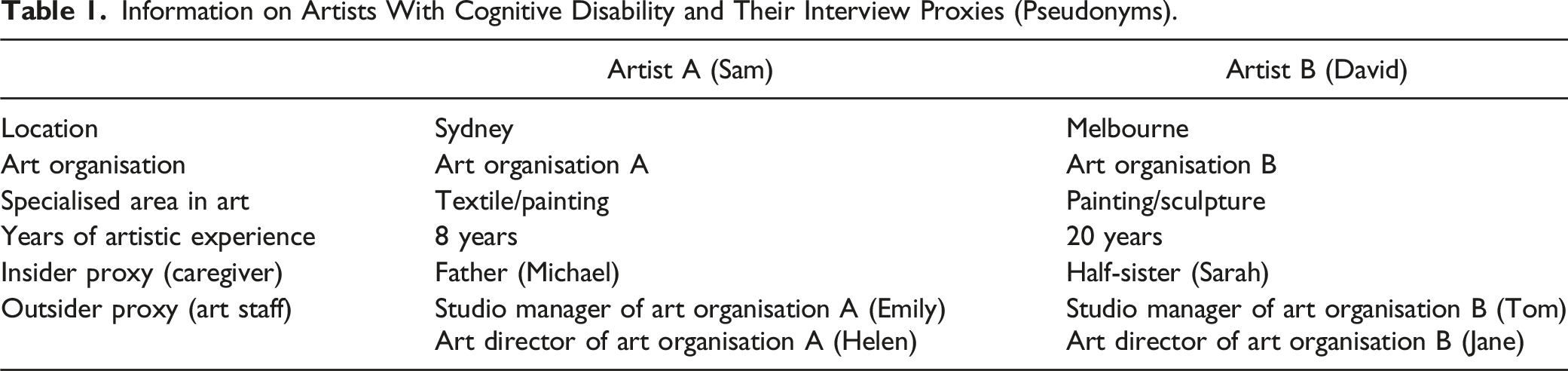
Two of the art organisations approached, art organisation A in Sydney and art organisation B in Melbourne, were able to help potential participants understand the aims of the study and the process. Some potential participants felt more comfortable talking with staff at the art organisations rather than contacting the researcher directly. Senior staff (e.g. the art co-ordinator or director) were tasked with recruiting potential participants because they had the greatest knowledge of the individual artists, including their art activities, intent, artistic potential, and individual needs and strengths. Two artists with cognitive disability and their caregivers agreed to participate in the research directly and indirectly: one artist (Sam) with a Chinese ethnic background from art organisation A in Sydney, and one artist (David), a Caucasian from art organisation B in Melbourne. Both artists use verbal communication, but their caregivers say they have some challenges in their articulation of thoughts, feelings, or explanation of procedures. According to Sam’s father, Sam takes time to start conversations with new people because he often becomes nervous and anxious. When the researcher met Sam in the studio, he did not say anything, but looked nervous. When the researcher attempted to start an informal conversation, Sam walked away. David can be articulate about what drives him, but according to his caregiver he is not a driven person. The researcher did not have a chance to meet David because he did not come to the studio when the researcher visited.
Information on Artists With Cognitive Disability and Their Interview Proxies (Pseudonyms).
Data Analysis
The data collected from the proxy intervention interviews with the proxies of the two artists were transcribed and sent back to them for confirmation of correctness and any necessary clarification. Critically, this allowed the interview participants to decide if they wanted anything changed or removed before publishing publicly. Once the confirmation of the transcripts was received, the data were analysed using a thematic and interpretative phenomenological approach as a foundational method for qualitative research (Braun & Clarke, 2006; Tonon & Alvarado, 2012). Thematic analysis of the study followed the sequence of identifying, analysing and reporting patterns based on major themes, which also were categorised under subthemes within data (Braun & Clarke, 2006; Tonon & Alvarado, 2012). The study used a constant comparative and iterative process to analyse data collection in order to conceptualise thematic categories by identifying both the challenges and the enablers of artistic experience and career development at individual and organisational levels.
Thematic analysis focused on the concept of ‘life-world existential themes’ as an interpretative phenomenology based on four aspects: ‘lived space’, ‘lived time’, ‘lived body’ and ‘lived human relations’ (Tuohy et al., 2013). The data analysis revealed how artists with cognitive disability experienced the process of developing their art practice in real life, and the impact of challenges and enablers on their career development. The results of the data analysis revealed the relationship between the artistic supporters and the artists, as well as giving a ‘life history’ of the artists through proxy intervention interviews with both insiders and outsiders.
Results
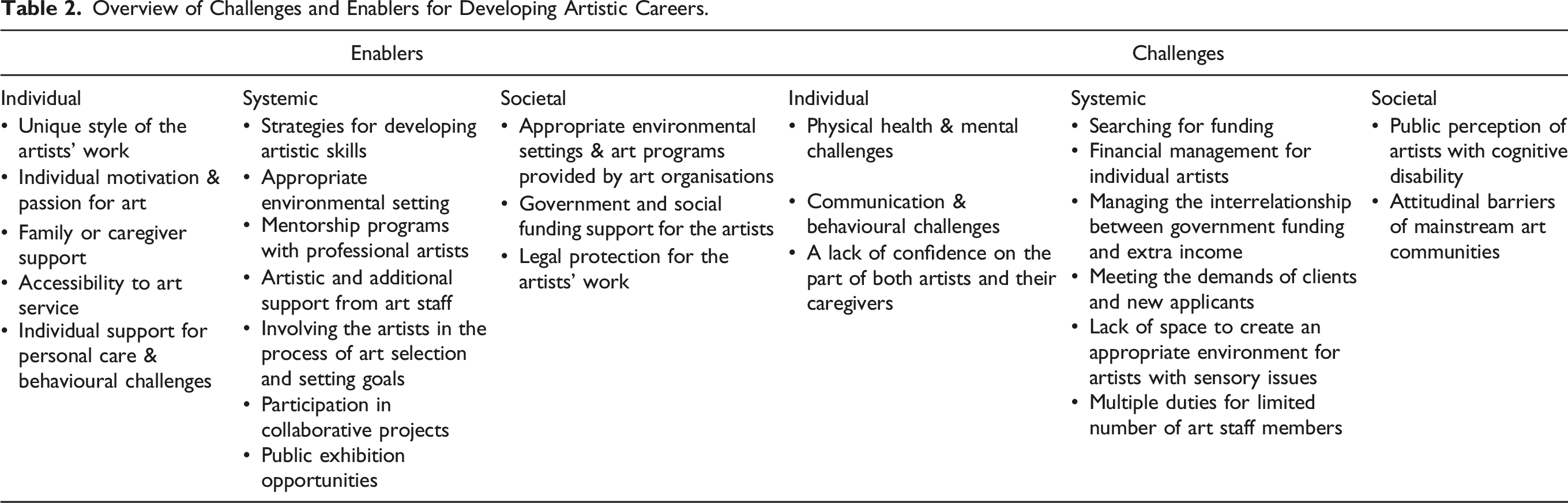
Overview of Challenges and Enablers for Developing Artistic Careers.
‘Enablers’ at Individual, Systemic and Societal Levels
Three aspects of enablers emerged from the proxy intervention interviews: individual, systemic, and societal levels of positive influences and support for the artists in helping them to develop their art practice and careers. All proxy participants described the motivation and passion of both David and Sam for their art practice, and their aspiration for developing their professional careers. Individual self-motivation and the unique style of their art were the essential foundations of their artistic careers. David always has his ability. But now he is very definite about what he wants to do with it and what his hopes would be. He’s developed a huge knowledge of the art world and he really could see where he would like to position in it… but David is quite ambitious in some ways. He likes the prestige of it and he’s got an ego. (Sarah, a half-sister of David) Sam now calls himself an artist and he is very proud of his work. (Michael, father of Sam)
As caregivers, both Sarah and Michael provided core support for the artists: emotionally, behaviourally, financially, and in helping them communicate. They were also proud of the artists’ achievements, as any family would be for the achievements of their children or family members. Family or caregiver support can make a significant difference in terms of accessibility for art services and funding sources, because the artists often experience difficulty in finding good art services for themselves. Both Sam and David were introduced to art organisations A and B, respectively, by their parents. The art staff of these organisations also provided appropriate support for individual needs such as behavioural management, medication, and personal care. Individual support enabled the artists to access ongoing art services regularly.
Systemic enablers included all the artistic support provided by art staff and art organisations in order to develop art practice and careers for the artists, such as art programs, strategic professional development, mentorship, networking, and a creative environmental setting. Art organisations A and B provided systemic supports and settings for professional development, which are similar to those of conventional education systems like tertiary education. This strategic system was different from the therapeutic or recreational art programs designed for people with cognitive disability. Art organisations and art staff also focused on encouraging active participation in productive opportunities such as public exhibitions, commercialisation, and collaborative projects with professional artists from mainstream art. David and Sam had ongoing mentorship experiences with different artists, and these often extended to become long-term friendships. The artists also learned new skills or were exposed to new ideas through mentorship and projects aimed at collaborative exhibitions. We certainly don’t direct the artist. It’s all about the artists being encouraged with mentorship and feedback to find their own ‘thumbprints’, their own artistic creative voice. We offer[many] opportunities to lead, for them to involve [themselves] in the studio programs, and we offer various disciplines in order for them to find that…. We have a lot of goals that we set with them or on their behalf, about their aspiration, what they would like to achieve with their art practice. From [setting] those goals… we then try to implement the activities to make the goals achievable (Tom, studio manager of art organisation B)
Interviews with art staff as outsider proxies of artists with cognitive disability provided an overview of how the artists could develop their capability and their careers through systemic support from art staff and art organisations at both individual and organisational levels. This information was important in building effective strategies or frameworks for the professional development of people with cognitive disability in arts as well as other fields.
A significant finding concerned the role of societal enablers, including the impacts of social infrastructure, public funding support, and social policies. All the proxy participants emphasised the importance of funding in terms of creating accessibility, sustainability, and inclusivity for artists with cognitive disability. Both Sam and David participated in the National Disability Insurance Scheme (NDIS), the Australian funding system for people with disability, and they could pay for art services from NDIS funding. I’m referring to his current NDIS services (Sarah, a half-sister of David) Sam has a NDIS package which supports him to pay the studio fees. (Michael, father of Sam)
According to the interviewees, all artists with cognitive disability participating in art organisations A and B, as well as David and Sam, had NDIS funding that allowed them to access art programs and services. This demonstrated that a level of social support is necessary to create an inclusive and accessible working environment for artists with disability, and for arts organisations to provide appropriate programs and services.
‘Challenges’ at Individual, Systemic and Societal Levels
The multiple perspectives of the proxy interviewees provided multi-dimensional insights into the many challenges beyond the individual ones faced by artists living with a significant cognitive disability. As insider proxy interviewees, the primary caregivers talked about personal challenges such as behavioural issues, communication difficulties, emotional challenges, a lack of social interaction, and financial circumstances. The outsider proxy interviewees interpreted the challenges within a spectrum broader than the individual. For example, Jane, the art director of art organisation B, was concerned about financial management for those artists with no family or close relatives. She raised the issue that there is no monitoring system for those artists who access trustee company services. I wonder… because most of them don’t manage their own money, some don’t really understand it but their family do. But when they are managed by a trustee company, I often wonder if it goes to the trustee company who manages their money…
She did not give details of any incidents or examples, but she raised her concern about how the money paid from the sale of artwork has been used for those artists who are under the financial care of trustee companies. One benefit of having outsider proxy perspectives would be to expose some critical issues which family members might not consider.
All outsider proxy interviewees described the systemic and societal levels of challenges for the artists in terms of developing their art practice and careers. It was their belief that the artists were capable enough to be recognised as professional contemporary artists regardless of their cognitive disability. All the art staff emphasised the ways in which systemic and social support could facilitate the artists’ capability and potential. Tom, the studio manager of art organisation B, explained that the top two artists in the studio were both nonverbal, but they were invited to international and national exhibitions. Jane mentioned that one of them earns ‘between $5,000 and $25,000 a month on his artwork’. Jane also raised the issue of disability pensions, saying that if the artists earned a certain amount, they would lose their pension. Some family members did not understand the complexity of disability pensions and extra income.
Overall, the proxy intervention interviews with insider and outsider people related to the artists with cognitive disability showed in detail the experiences of these artists at the individual, systemic and societal levels. Such qualitative research revealed the dynamics of the individual lives of those living with cognitive disability even though they could not convey this in their own words.
Discussion
Cognitive disability is an umbrella term covering a wide range of disabilities that impact on cognitive and emotional processes such as mental, learning, developmental, intellectual disabilities and autism (Olney & Kim, 2001). When designing a research method for interviewing people with a cognitive disability, a researcher must understand the complexities of the condition. However, directly involving people with cognitive disability as the only way of implementing an inclusive research approach is a linear method that will eliminate nonverbal people or those who are identified as having a severe or profound level of disability. Designing an inclusive research method requires the use of multi-dimensional approaches to consider the full range of disability conditions. The success of a research approach to include people with cognitive disability is essentially associated with recruitment, the process of proxy intervention, and ethics approval, including an appropriate inclusive research design and procedure as well as ethical considerations.
Five Ethical Considerations for Including People With Cognitive Disability
This article suggests five ethical considerations to be taken into account when designing an appropriate inclusive research approach for inviting people with cognitive disability, regardless of their level of capacity, to participate.
Researcher Attitudes
In the presence of all research participants researchers must demonstrate a respectful manner: bias-free, non-coercive, engaging and patient. They must provide well-prepared information about the research project at an appropriate language level such as Easy English, or give pictorial cues if needed, to outline the research topic, aims, public benefits, consents, and confidentiality. The research process must be based on healthcare ethics: ‘autonomy’, ‘non-maleficence’, and ‘justice’ (Green and Thorogood, 2014, p. 66).
Avoiding Coercion
The entire research process requires a detailed explanation to ensure the full understanding of all participants. In the process of recruiting these participants (people with cognitive disability and their proxies), the principal researcher must devise a way of approaching them in a non-coercive manner (Haines, 2017). For example, the researcher needs to allow enough time for the interviewees to respond by avoiding prompting comments, which can make interviewees feel guided or anxious.
Informed Consent
Consent is always provisional, which means that the researcher must follow the model of ongoing and repeated informed consent to check and re-recheck that there is a continued wish on the part of the participants (people with cognitive disability and their proxies) to remain involved with observations and interviews (Dewing, 2007).
Observing
During observations and interviews the principal researcher must pay attention to details in communication and in the behaviours of participants (people with cognitive disability and their proxies), such as body language revealing visible discomfort (Haines, 2017). In such cases the researcher needs to offer to pause or terminate the interview. For example, a participant might give permission to use the content of their interview, but their body language might show that they are not comfortable with that content being used in public (Haines, 2017). The researcher must observe those participants (people with cognitive disability) with a respectful understanding of what their behaviour reveals.
Communication
The researcher must consider the different ways of communication used by individual participants, such as limited verbal language, sign language, body language or Augmentative and Alternative Communication (AAC), which uses an electronic device (e.g., iPad, Proloque2Go). Some potential participants who do not have any verbal language might only be able to communicate with behaviours. Thus, details of their body gestures and movements might indicate ‘distress or unwillingness’ (Haines, 2017, p. 227). The researcher needs to respond to those behaviours by withdrawing the participant from the study or personally withdrawing from the research, as appropriate (Haines, 2017).
Fullana et al. (2013) suggest using visual aids like photographs, pictures, and drawings to provide opportunities for people with severe cognitive disability to participate in research. Additional visual support can be an alternative way of engaging with those participants who have difficulties with concentration in conversation or articulating their thoughts.
The approach outlined here is about implementing the concept of an inclusive method in research processes to involve the participation of all people with cognitive disability (Fullana et al., 2013; Shields et al., 2007). Diverse and innovative approaches need to be considered and developed to provide appropriate support for individual needs.
Key Approaches for Using Proxy Intervention
Collecting information using proxy intervention in inclusive research inevitably has a risk of potential bias imposed by the proxies’ perspectives because the information has not been directly collected from the individuals with cognitive disability (Brown & Brown, 2003; Petry et al., 2005; Shepherd et al., 2018). Researchers must recognise this potential when designing research methods in order to minimise any such risk. This paper suggests three key approaches to consider.
The first approach involves holding proxy intervention interviews with people from ‘insider’ and ‘outsider’ groups, at least one of each, to build multi-dimensional perspectives on indirect research participants with severe to profound cognitive disability. A benefit of having insider and outsider perspectives is that it allows information provided by both sides to be cross-checked, thus reducing the chance of having incorrect information or enabling misinterpretation.
The second approach centres on the selection of proxies who are qualified to speak on behalf of individuals with cognitive disability (Petry et al., 2005; Shepherd et al., 2018). Proxies should have spent enough time with the artists to picture accurately their overall life experiences– what activities they do on daily basis; their financial situation, and how it is managed and by whom; their strengths and challenges, likes and dislikes, personal networks, and so forth. Family members like parents or siblings can be the most accessible potential candidates. However, researchers should not assume that family members know everything about their children because not all individuals with cognitive disability are living with their family. In many cases, adults with cognitive disability live in a separate accommodation with others or independently with 24-h support from support workers (Dunn et al., 2013; Shepherd et al., 2018). Before recruitment it is important to explore the circumstances of each potential participant by visiting their home environment or the community they belong to. Through this process researchers can identify the most appropriate candidates for proxies to speak on their behalf.
The third approach involves participant observation, which is an option for building a rapport with people with cognitive disability who are challenged by social interaction (Dennis, 2002; Ellis, 2018; Gold, 1958). For this approach a researcher becomes an ‘observer as a participant’ to take field-notes about participants with cognitive disability, recording such things as their daily routine, emotional and behavioural changes, and casual conversations (Gold, 1958, p. 217). Participant observation can be used with proxy intervention approach to verify that the information collected from proxies is the same as that observed by the researcher. Field observation can be especially useful, providing information collected from natural settings around individuals with cognitive disability, non-verbal forms of communications such as paintings and behaviours, or, if accessible, written documents related to the individuals concerned.
Limitations
This study was conducted with a small sample of male artists with cognitive disability and their proxies within limited conditions (unequal gender balance and a lack of time for depth of observation). The recruitment for purposive sampling targeting artists with cognitive disability and communication challenges was difficult because primary caregivers (family members) were hesitant to participate in the research study. After a few attempts on the part of the researcher, the two artists and their family members agreed to the research participation. Although the data in this study is limited, having interviews with multiple proxies for each artist provided rich information and a detailed overview of the artistic and personal experiences of both artists at multiple levels.
When interpreting the information collected from proxies, researchers must keep in mind the possibility of potential bias on the part of proxies describing the life experiences of individuals with cognitive disability. The information they give is not the same as direct information from the individuals themselves (Brown & Brown, 2003). In order to minimise the potential bias of proxy perspectives, interview questions should be based on objective matters and phenomena rather than on the subjective opinions. For example, the semi-structured interview questions in this study focused on the following: What accommodations and support, such as mentorships or technical supports, have the artists received for developing their art practices? Has the artist sold any paintings? How much profit do artists tend to make from selling their artwork? These sorts of questions are based on actual situations, and do not involve proxies’ views or thoughts. By using the inclusive research approach and minimising any potential bias of proxies, it is possible to include in research the voices and lived experience of people with severe to profound cognitive disability from a broader perspective.
An important limitation in the present research was that the researcher did not have enough time to establish an individual rapport with the two artists concerned before conducting the proxy intervention interviews. Consequently, the study does not reflect the artists’ individual personalities or characteristics. One of the two artists who participated had a Chinese ethnic background, and the other artist was Caucasian. Regarding questions of accommodation and support from family members, or any other aspects, it was not possible to identify cultural differences due to the time constraint and a lack of rapport between the artists and the researcher. The sample size was too limited to compare differences between two artists in terms of ethnic diversity. In future research, the researcher would consider designing a more extensive long-term period of inclusive research. This would involve gender balance, ethnic diversity, and establishing a rapport with potential participants in order to examine appropriate systemic and societal support and creative settings.
Conclusions
An inclusive research approach involving the participation of people with cognitive disability entails considerable time and effort, complex processes, and a high level of ethical considerations. Additionally, researchers need to pay extra attention to understanding social positions, attitudes, and problems with communication in order to avoid any possible ethical conflicts or unintended disempowering situations. These requirements can make researchers feel challenged or overwhelmed when involving the participation of people with severe or profound cognitive disability in their research process. Such concerns could become the reason for excluding the voice of people who cannot speak or express their thoughts and opinions. This study demonstrates one way of including their voices by sharing their lived experience as artists. The findings reveal the conditions that have enabled or challenged the development of their artistic careers at individual, systemic and societal levels. The results of the study provide dynamic insights into current phenomena and social agendas in the lives of artists with cognitive disability in Australia. The method described is accessible, and it can be adapted for use with people with cognitive disability at any level. When the researcher appropriately and creatively adopts an inclusive research approach with a holistic understanding of the strengths and challenges of potential research participants, the outcomes can be insightful.
Footnotes
Declaration of Conflicting Interests
The author(s) declared no potential conflicts of interest with respect to the research, authorship, and/or publication of this article.
Funding
The author(s) received no financial support for the research, authorship, and/or publication of this article.
Ethical Approval
To conduct this study, ethical approval was obtained from the University’s Social Behavioural Research Ethics Committee (SBREC) (Project No. 8168).
