




Abstract
Trauma-informed (T-I) approaches to working with vulnerable people have gained popularity in practice but are rarely used in academic research and little is known about the challenges of conducting a T-I approach to participatory research. This paper reflects on our experiences of a participatory peer research project involving unaccompanied young people seeking asylum (16–25 years) during the Covid-19 pandemic. Whilst the project adhered to a robust ethical framework, it became apparent at an early stage in the empirical phase that our methods needed to acknowledge and accommodate the trauma of those involved in the project much more thoughtfully and effectively than our ethical framework suggested. With this in mind, we set about identifying the key elements of a T-I approach to research and how these might add value to research with vulnerable and marginalised populations. Our model of a T-I approach to peer research is framed around five core principles: working reflectively with those with lived experience; contextualising trauma; nurturing trust; showing care; and empowering those involved in and affected by the research.
Introduction
Trauma-informed (T-I) approaches have gained popularity across various professional disciplines in the past 10 years, including but not limited to education (Petrone & Stanton, 2021), the justice process (James, 2020), health (Raja et al., 2015) and social work (Levenson, 2017). Trauma-informed approaches also have important implications for policy, as Randall and Haskell (2013, p. 501) remark: becoming T-I “entails becoming more astutely aware of how traumatised people have their life trajectories shaped by their experience and its effects, and developing policies and practices that reflect this understanding.” Indeed, such is the acknowledged effectiveness of a T-I approach that it has now been adopted by the UK government as a framework for the development and delivery of public services (Office for Health Improvement and Disparities, 2022). Such models generally revolve around a set of core principles, including: safety; trust; choice; collaboration; empowerment; and cultural consideration. In particular, they have shown the benefits of holistic and individualised approaches to trauma and of including clients and service users with ‘lived experience’ in the design and delivery of services for specific communities (Asquith et al., 2022; Champine et al., 2019).
At the same time, participatory research methodologies have been increasingly embraced and celebrated in social science, including research with older adults (James & Buffel, 2022), children (Collier, 2019), and those with intellectual disabilities (Di Lorito et al., 2018). Across these studies, authors have suggested that participation can help challenge dominant and negative stereotypes, build partnerships with all relevant stakeholders of the research (including family members, peers and practitioners) and challenge power structures embedded in the research process. Participatory methods also elevate the voices of those with lived experience who have been otherwise routinely marginalised or silenced, enabling them not just to respond to pre-determined research and policy agendas, but to set those agendas in the first place (James & Buffel, 2022). The growth in such participatory methodologies has raised important questions around ethics, and specifically how researchers can simultaneously empower and protect research participants, particularly those who are deemed ‘vulnerable’ and/or who have experienced some form of ‘trauma’. Such questions have been largely addressed by adherence to strict ethical protocols relating to consent, safeguarding, withdrawal, disclosure, anonymity and confidentiality (Campbell et al., 2019). Indeed, even with these protocols in place, it can be difficult to obtain ethical approval for research for fear that participants may be simply too vulnerable or susceptible to further traumatisation (Stalford & Lundy, 2022).
As crucial as ethics are to protecting and promoting the interests of those involved in empirical research, few attempts have been made to explore how ‘trauma’ can inform different stages of academic research (notable exceptions include Nonumura et al., 2020; Petrone & Stanton, 2021). This paper offers an initial attempt to address this gap, to explore how we might transplant the T-I approaches that have emerged in a practice context into a research context, and to articulate more clearly what a T-I approach might add to standard ethics-based approaches to research. Specifically, we reflect on our efforts to embed a T-I approach within a participatory research project involving young unaccompanied asylum seekers after its inception as a means of enhancing our otherwise robust and approved ethics framework. In doing so, we will highlight how a T-I approach to research should recognise how trauma may affect participants’ responses to different aspects of the research, and how research methods might be developed in ways that can better acknowledge, accommodate and protect them from the outset of a research project.
Research Context: The Lives on Hold, Our Stories Told Project
Our attempts to define and develop a T-I approach to research took place in the context of a participatory research project exploring the impacts of Covid-19 on unaccompanied young peoples (aged 16–25). We focused, in particular, on how the pandemic impacted on their experiences of the asylum process, access to services and support (Lives on Hold our Stories Told (LOHST) Jan 2021-July 2022. 1 It is important to note that our study was conducted primarily online in the somewhat unique context of Covid-19 emergency lockdown periods. We conducted 69 online (zoom) conversations with unaccompanied young people seeking asylum and 53 semi-structured online interviews with practitioners from the social care, health, education, civil society and legal sectors, as well as Home Office representatives. Working in partnership with a support charity, we appointed and trained 11 young (primarily Albanian) people seeking asylum as peer researchers. They all had direct and ongoing experience of the UK asylum system, in common with the population participating in the project, and assisted with each stage of the research, including determining the research questions and methods, applying for ethics approval, designing project-specific documents, and as research participants, interviewers, interpreters, data analysts and disseminators.
The project adhered to strict ethical guidelines, and we designed (in partnership with our peer researchers) user-friendly information about the project and clear protocols around informed consent, anonymity, confidentiality, and safeguarding. These were approved by the University of Liverpool’s ethics committee. We conducted training sessions with our peer researchers on the practical application of research ethics and methods and explored ways of managing any distress they or other participants might experience during the course of the empirical phase. This included offering the young people opportunities to take a break, to reorient the interviews to other topics, or to stop the interview altogether. We also ensured that there was an appropriate representative available from the charity through which the participants had been recruited to check in on them before and after each interview.
In spite of these safeguards, however, as the fieldwork progressed, we became aware that the peer researchers in particular were struggling with different aspects of the research in ways we had not anticipated. Some were becoming very distressed during or after interviews with other participants. Many were reluctant to take part in follow-up interviews during the second phase of the empirical research; and some struggled to engage with the project at all as their own personal struggles became more acute (discussed below s.4). Six months into the study, and following discussion with the peer researchers, we decided that we had to go beyond our ethics protocols and do more to better understand and accommodate the different ways in which trauma is experienced and expressed in the course of research. We therefore started to explore how we could adapt our methods to be more sensitive and responsive to trauma for the remainder of the project. We began by reviewing the literature relating to T-I approaches. Most of this is located in the practice field but we could identify clear synergies between practice models and the research process. We also devoted some time to reflecting on different aspects of our methods might be interacting with their own experiences of trauma during our weekly online catch-ups, and we organised a residential research retreat to tease out how they defined trauma, and how this might be reflected in different aspects of the research moving forward.
Drawing on this literature and on our reflections as a research team, we propose a T-I approach to participatory research based on five key principles and approaches: (1) contextualising trauma; (2) working with people with lived experience; (3) nurturing trust; (4) showing care; and (5) finding ways to empower those involved in and affected by the research.
Reflections
Contextualising Trauma
An initial important element of a T-I approach entails establishing what we mean by ‘trauma’ in the context of the research themes and participants’ lives. The definition of trauma commonly cited in a practice context is that of the Substance Abuse and Mental Health Services Administration (SAMSHA). This describes trauma relatively abstractly as “…an event or circumstance resulting in physical harm, emotional harm, and/or life-threatening harm which has a lasting adverse effect on the individual’s mental, physical and emotional health as well as social and/or spiritual well-being”.
More recent T-I models have sought to move beyond the dominance of biomedical articulations to acknowledge broader structural, social and cultural determinants of trauma (Chafouleas et al., 2016; James, 2020; Theisen-Womersley, 2021). This corresponds with a shift away from asking what is wrong with you? Towards questions of what has happened to you? (Pinson & Arnot, 2007). This recognises that the same traumatic event will be experienced and expressed differently according to the cultural context and other social and psychological factors unique to individuals and to the communities they come from (Elliott & Urquiza, 2006). And so, identifying and interrogating the structural, cultural and social factors of relevance to those involved in research is important for contextualising their trauma.
In developing a T-I approach to the current research, we wanted to arrive at a shared understanding of how our peer researchers understood and defined trauma. We first invited them to post words, definitions, feelings and images they associated with trauma on a board over the course of a research residential workshop approximately 8 months into the project. Crucially, most of their words and definitions were related to the physiological, psychological and emotional impacts of trauma alluded to in the SAMSHA definition (Figure 1). A word cloud of the peer researchers’ reflections on trauma.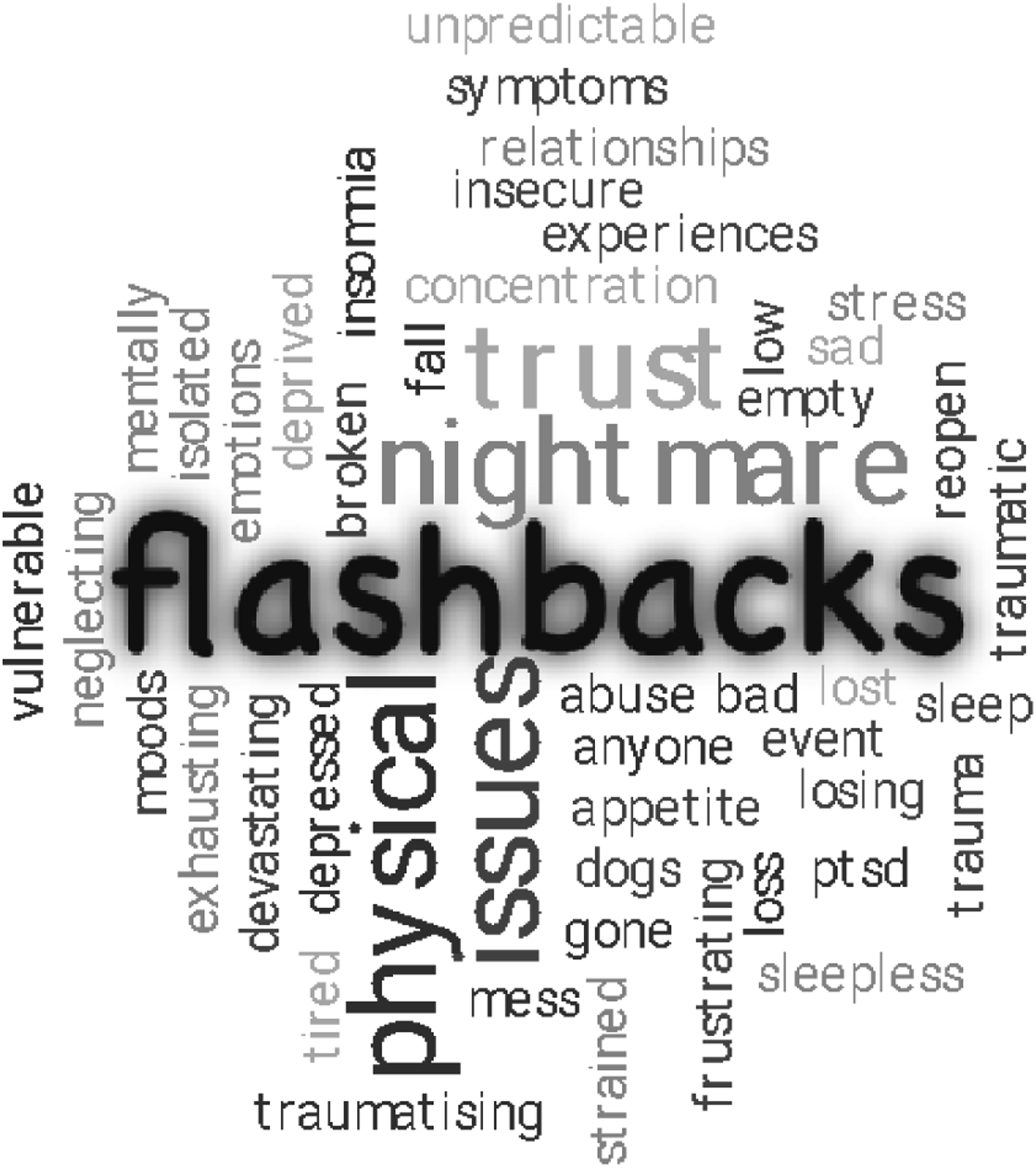
In a separate reflective exercise, the peer researchers were asked to discuss in more depth their understanding of trauma. Adriel, one of the young female peer researchers, described trauma as: “[A] response our body gives to something….an unpleasant event that has happened to that person’s life, and that response can be emotional or physical”.
She went on to describe what it feels like to experience trauma: “[Y]ou keep those problems for a very long time, and that chronic trauma becomes threatening for your life… You start to realise it’s like a bottle that gets filled with water. You keep adding the water, but somehow that water is going to spill out of the bottle because it’s going to get too full. That’s when that person is sent to the hospital because that person is suicidal, and all that trauma has built inside of that person”.
Trauma as Structural
To say that trauma includes a structural dimension typically refers to the emotional and psychological damage brought about by the inequity people experience at the hands of public services, authorities and processes (Chase et al., 2022). Individuals can experience profound trauma by virtue of their membership of a particular community, and because of deeply entrenched institutional and social prejudice towards that community (Schock et al., 2015). This certainly became evident in our sample of young people, all of whom were seeking asylum in the UK. The trauma arising from the persecutory events and experiences that caused them to seek asylum in the first place were just one part of the picture. Many described routinely encountering structural trauma via their engagement with the Home Office and other services as part of their asylum process. Intersectional factors, such as age (e.g., young adults), gender (notably men) and nationality (such as asylum seekers from Albania) were found to compound existing hostilities and prejudice on the part of the authorities, the public and the media, and amplify previous incidents of trauma associated with migration. The extent to which young people seeking asylum described being traumatised by their engagement with the UK asylum system was contingent not only on the asylum policy enacted at the time of the research, but also on the stage in which the applicant was at in their asylum case - such as the substantive interview stage, the appeal process or becoming appeal rights-exhausted and subject to removal. Those whose cases had been delayed indefinitely and who had encountered multiple refusals, interviews, and reporting sessions, were more likely to reflect on how they were traumatised by asylum-related structural factors than those who had more recently arrived.
Although we constantly reassured participants and peer researchers of our neutrality and independence from the Home Office, we had to be cognizant of how our research process might reflect and reinforce inherently traumatic, formal asylum processes conducted by Home Office staff. Similarly, Herlihy et al. (2002) found from their work with a sample of Kosovan and Bosnian refugees that asked them to remember and retell events associated with their asylum claim intensified their trauma. They therefore recommended finding novel and innovative ways in eliciting the data without interviewing the refugees.
Many peer researchers’ accounts indicated how their lives as young people seeking asylum are structured significantly by the Home Office and the routine processes and procedures associated with claiming asylum. Many of these procedures require applicants to retell their trauma narratives as evidence of their credibility in seeking protection in Britain (Schock et al., 2015; Stalford, 2018). We had already decided not to ask the participants or peer researchers any questions about the factors or experiences that led them to claim asylum to minimise the likelihood of re-traumatising them through the research, we started to pay more attention to the subtleties of language and phraseology used, and specifically to the implications of deploying the standard term and format of the ‘interview’. With that in mind, for the remainder of the empirical work, we framed research interviews as ‘conversations’ or ‘discussions.’ Some of the peer researchers highlighted the benefits of this subtle shift. As Clara notes: “One of the reasons that it was really important for me, and the other young people is because we know what it feels like to be interviewed about your life and have to say things that you might not want to keep repeating. After all, you are trying to move on from that.[…]. So, we know that…it’s quite a difficult process, and quite stressful – traumatising as well, in a way. So, I think that's why we tried our best to say they are ‘discussions’, not ‘interviews’ […] We tried our best to not make it feel like an interview, like, they’re being asked about their lives, and we say that they don’t have to answer and say everything. That’s why we try and make it like a conversation and make them feel more comfortable while they are being understood and listened to. I think it’s important, so that they don't feel like they’re being interrogated or asked things that they might not want to answer and hurtful things”.
Trauma as Cultural
Emergent holistic understandings of trauma have begun to consider the influence of culture (James, 2020; Theisen-Womersley, 2021). Specific cultures (such as certain indigenous communities, and African American communities) have been shown to experience widespread collective trauma linked to systemic factors such as discrimination, poverty, and exclusion (Ivec et al., 2012; Roberts, 2014). Cultural norms and socialisation, including the value attached to family loyalty and religious communities, may also heavily influence how people reveal, express and seek help for trauma (Graves et al., 2010). An important objective of T-I practice, therefore, has been to achieve a level of ‘cultural competence’ both to better understand how and why individuals respond to trauma in the ways that they do, and to create culturally-sensitive opportunities for such people to be heard (Williams, 1999, p. 213).
The cultural sensitivity of a T-I approach is seen as increasingly important in a legal context, such as criminal justice, child protection, or asylum and immigration, all of which involve intrusive, sometimes adversarial interviews. For example, research has found that Polish men’s adherence to traditional constructs of masculinity has created a significant barrier to them engaging with mechanisms to identify victims of modern slavery – notably the National Referral Mechanism - and disclosing their experiences of labour exploitation (Shankley, 2021). Indeed, a T-I approach is now regarded as particularly instrumental to identifying and protecting those from diverse cultures who are subjected to forms of modern slavery (Asquith et al., 2022).
With this in mind, we started to engage more thoughtfully with the cultural background of participants. Our peer researchers primarily came from Albania where there is a strong adherence to traditional hegemonic gender roles (Çaro et al., 2012). We recognised that this cultural dimension might not only shape young people’s motives for claiming asylum, but also create cultural barriers to them disclosing their experiences. For example, young people repeatedly spoke of how mental health is rarely discussed in Albanian society, especially by men. Disclosing weakness and vulnerability is counterposed to cultural constructs of masculinity and may evoke feelings of shame, likely to hinder any disclosure of mental health difficulties or trauma (Dolezal & Gibson, 2022).
Reflecting on how growing up in Albania had shaped his response to trauma, one of the young male peer-researchers, Besnik, described trauma as: “Being little, being raised in a household where you go through difficult stuff. Where you’re not taken care of, you’re not talked through it; what you’ve gone through is not explained; you’ve just been told to put your head down and keep all of it inside. This is what trauma is. It’s keeping it inside and never talking about it; just being raised with it and making it eat you, and your space in your head, and never, ever actually talking it out; never actually having it taken care of”.
Similarly, Gezim, for example, said: “The people in Albanian don’t see mental health. They think if you have these types of issues then you are crazy or stupid. They won’t treat it in the way it should be treated…if people experience these types of things, they keep it secret and they don’t want people to say stuff about them”.
This chimes with the cultural and gendered constructs prevalent in other countries across Central and Eastern Europe that underwent rapid democratisation in the 90s (e.g., Shankley, 2021).
An important further contextual factor was the Covid-19 pandemic which fundamentally shaped the research. Beyond the anxieties and potential trauma of being subjected to immigration controls and the asylum system, peer researchers and participants repeatedly referred to the additional anxieties and proscriptions arising from Covid-19. For instance, the suspension of key services and lockdown measures during the pandemic triggered painful memories of the isolation and fear of being in hiding in their country of origin for weeks or months on end. Their Covid-triggered trauma was further compounded by the acute disruption to key mental health services and integration opportunities, significantly impacting their wellbeing and recovery and their ability to engage with the research (Chase et al., 2022).
These insights reveal how trauma reflects and responds to a web of intersecting factors and events. Establishing a shared understanding of the trauma that is based on the lived experience and realities of the population participating in the research is thus critical. Armed with a deeper understanding of the structural, cultural and psychosocial elements of trauma, and of the fact that trauma fluctuates, we were able to intuit more easily whether to persevere with or pursue interviews with participants who did not show up or who were reluctant to speak. We also devised different roles in the project for the peer researchers that would best suit their personal needs and interests and encouraged them to express themselves through some of the more creative elements of the project, such as designing the Web site, creating the animations, and helping with the filming and editing of the final research documentary. 2 Interestingly, it was predominantly the young men in the research team who took up these roles, whilst the young women took more of a leading role on dissemination and public presentations.
Working Reflectively With Those With Lived Experience
The Value of Working With Peer Researchers
According to Knight (2015), participatory methodologies can be used to engage populations with experience of trauma by directly consulting them not only about the ways in which they think their trauma can be mitigated but also about their understanding and definition of trauma. Peer research is one approach to participatory research which recognises and values grass-roots expertise on health and social issues. It is based on a commitment to working closely with community members as researchers to generate situated and subjective understandings of the social issues they are facing and to ultimately enhance health and societal wellbeing (Bell et al., 2021). Emerging from a participatory research paradigm which understands people as experts in their own lives and capable of formulating solutions to social problems (Freire, 1975), peer research is also closely linked to political activism, particularly when involving participants who have been subjected to oppression and marginalisation (Smith, 2021). Thus, it is concerned with decentring the power of the expert (Rosen, 2021), valuing knowledge from below and decolonising knowledge production which is dominated by Western thought (Smith, 2021). Whilst having many strengths, notably enhancing the quality and depth of insights into social issues from an ‘emic’ perspective, democratising the research process and promoting greater epistemic, social, and economic justice through research, peer research also raises important challenges. These are both procedural, related to ensuring rigour and professional competence (Kelly et al., 2020; Lushey & Munro, 2015) and ethical, including the dilemmas associated with drawing on social and emotional ties to promote participation (Haile et al., 2021); boundaries of confidentiality and, of relevance to this current paper, the inherent risks of reawakening feelings of trauma through the research process (Kelly et al., 2020).
As a participatory, peer research project, we had already built collaboration with those with lived experience into the fabric of our project. We recruited our peer researchers through a charity that supports young unaccompanied asylum seekers and had already built up a strong relationship of trust with them, through weekly online meetings initiated 12 months prior to the project starting when the initial research questions and methods were being conceived. When the project received funding and officially started, we continued our weekly meetings, involving them in all stages of the project design and implementation.
The peer researchers were instrumental to our thinking around a T-I approach. They were crucial partners in thinking through how the research might create safer spaces for them and other research participants to acknowledge, express and manage any thoughts and feelings relating to their trauma as they arose. Having already established a relationship and regular contact with them made it easier for them to express how their past trauma was impacting on their engagement with the project; to identify the potential for the research to trigger or compound their trauma; and to explore together how we could make our research methods more trauma-sensitive. We invited them to reflect on these issues during our weekly online meetings and discussed at length how our methods could pivot to accommodate fluctuations in young people’s feelings, cognitions and wellbeing as their everyday feelings, asylum claims (and, indeed, the vagaries of the pandemic) unfolded. Our notes of these discussions, including direct quotes from the young people, are woven into our reflections (detailed below) on how to achieve a more T-I approach.
The Value and Challenges of Engaging With Those With Lived Experience Online
The ongoing restrictions imposed by Covid-19 meant that our empirical work had to be conducted almost entirely online. This presented opportunities as well as additional challenges and required some careful rethinking as we went about how best to conduct research in a T-I way (Konken & Howlett, 2022). Indeed, the context of our project offers some useful insights into how online methods could be harnessed to mitigate trauma in a research context in the future. The online setting meant that we could meet more regularly with peer researchers than would have been possible face-to-face and bring in other collaborators and speakers at short notice. One of our peer researchers, Edon,
3
notes: “The good things are that you have the time to think about things and if something affects you then you can switch off your camera. You feel more comfortable doing these things when you’re alone at home than you would in a face-to-face situation…there isn’t a stranger there seeing you cry.”
Although conducting research discussions online was different to what we had originally planned, the peer researchers still felt close to the academic researchers, and we, in turn, felt as connected with them as we might have done in less frequent face-to-face meetings. These reflections chime with other research: Jenner and Myers (2019) conclude that working online is not inferior to face-to-face engagement nor does it necessarily result in a loss of intimacy; rather it can support rapport building and create a helpful distance between actors in the research process, allowing participants to discuss more sensitive and personal topics than in-person interviews, giving them more control around when and how to withdraw, and protecting their identity. Erion, for example, commented: “I think it was better to do the interviews remotely because of the pandemic and restrictions…The benefit of conducting them online is that we stay anonymous, so we don’t know who is talking. I found this aspect very helpful as it protected my identity and made me feel safe”.
A number of peer researchers felt the online interviews actually created not only physical distance but also psychological distance – a healthy barrier between them and participants. They felt this reduced the extent to which hearing traumatic stories impacted them. In this way, the online space acted as a buffer against some of the potentially harmful effects of hearing other young people’s accounts.
Working online offered more practical benefits too, enabling us to conduct project meetings and research interviews in the evenings, to work around study and other commitments. But this also brought some emotional challenges: often interviews would finish late in the evening and the abrupt end to zoom meant that the peer researchers and participants were on their own once the interviews had finished. Our ethics protocols provided that accompanying academics on the project and staff from our partner organisation would routinely check in (via zoom or a phone call) with peer researchers after the interview had finished, but it was not always possible ‘from a distance’ to ascertain the impact the interview might have had or to respond to signs of distress. The fact that some participants chose to have their cameras off during interviews to protect their anonymity also made it hard at times to read how they were feeling and to react accordingly.
Reflecting on how online interviews can be conducted in a way that is more T-I was challenging. Almost all of the T-I models reviewed presumes that engagement is face-to-face, enabling practitioners (or researchers in our case) can draw on an array of behaviours, verbal cues, and facial expressions to detect distress (Crooks et al., 2021). Online working, on the other hand, restricts these opportunities. Instead, we relied extensively on verbal cues and on peer researchers and participants feeling able to communicate to us at moments when they felt distressed, a possibility largely contingent on the investment we had already made in building a relationship with them. We also used our weekly catch-up meetings to reflect as a group on how the past week’s interviews had gone, and to invite any suggestions for changes to forthcoming interviews, including who would co-conduct them, when they might take place, and whether our partner charity would need to offer more support either before or after the interview.
Nurturing Trust
Trust has been identified as a crucial element of any T-I approach insofar as it nurtures and reflects transparency in decision-making and seeks to restore some of the ‘broken promises and betrayals’ that characterise trauma (Ellison & Walton-Fisette, 2022; Kimberg & Wheeler, 2019, p. 40). We were fortunate to have already established a strong and trusting relationship with our team of peer researchers, through weekly online (zoom) meetings initiated many months before the instigation of and throughout the project. We used these meetings initially to determine the aims and scope of the research based on what the peer researchers prioritised, to define the research themes and questions, to design and deliver training on the methods and ethics, and to identify a potential sample of respondents. As the empirical work unfolded, we used the sessions to reflect on the interviews, both in terms of the substantive issues arising and the peer researchers’ experiences of being interviewed themselves and interviewing other young people seeking asylum. When Covid-19 restrictions were lifted, we arranged a 3-day residential research retreat in mid-Wales to analyse the initial set of empirical findings and to reflect in more depth on how we might better accommodate and acknowledge trauma within our methods. We used break-out groups and post-it-note boards to explore their own (varying) reflections on definitions and expressions of trauma and discussed how such perspectives could feed into the analysis, reporting and dissemination stages of the project. Importantly, we allowed a lot of space and time to get to know one another. We cooked for the young peer researchers; they in turn, cooked Albanian food for us. They taught us how to do Albanian folk dancing, we played games and listened to Albanian music and went on long walks, talking about all manner of things unconnected to the project. We maintained our weekly online meetings after the residential, during which we refined our understanding of a T-I approach as we progressed through different stages of the project. We also set up a WhatsApp group for more ad hoc queries and attended events organised by the Albanian community to mark cultural festivals and other celebrations. All of this helped to break down social, cultural and professional barriers and achieve a working dynamic that was more relaxed, more familiar and more trusting. This, in turn, provided us with rich insights into the complex range of experiences and factors that may influence trauma and how it is expressed and responded to across time and place.
Showing Care
The principle of ‘do no harm’ is a defining feature of research ethics and, in a qualitative research context, can generally be achieved through robust protocols around informed consent, anonymity, confidentiality, disclosure, referral and other forms of support. The principle extends to all those implicated in the research (British Psychological Society Code of Ethics and Conduct, 2021).
The hybrid status of peer researchers as both participants (interviewed about their own experiences as part of our sample) and co-researchers (involved in interviewing others and assisting with all other aspects of the research), raised immediate questions as to whether our own ethical framework was sufficiently responsive to these shifting roles and expectations (Haile et al., 2021). Cognizant of the fact that almost all of the peer researchers were still awaiting a decision on their own asylum claims, we wanted to achieve an effective balance between enabling them to participate in all aspects of the research whilst also safeguarding them from further distress or trauma. We established what we believed to be sturdy safeguarding protocols that had been adapted to accommodate the fact that the interviews were conducted exclusively on zoom throughout Covid-19 lockdown.
For each research conversation with young people seeking asylum, a peer researcher was partnered with a senior member of the academic research team. They could decide freely whether or not to take part in the conversation if they knew the respondent personally. Similarly, the respondents were given a choice of whether or not a peer researcher would be present, and whether they had a preference in terms of the peer researcher’s gender. Participants and peer researchers alike could decide whether to conceal their face by switching their camera off, and either party was free to leave the interview or request a break at any point. We met the peer researcher in advance of each research interaction to check they were ok and to determine who would ask which questions and in what order. We also stayed online with the peer researchers after the research discussions for a debrief. It helped that the charity through whom we had recruited them were on hand to check-in on all participants – including the peer researchers - before and after their participation in the research. It was also significant that the peer researchers were already heavily embedded in a weekly programme, provided by the charity, of support and social engagement, and had developed strong bonds with one another and with the charity representatives.
However, there were moments during online fieldwork discussions when listening to other young people’s accounts of their experiences triggered powerful emotions in the peer researchers. In some cases, they became more distressed than the respondents, and so managing the distinct needs of both parties simultaneously was both unsettling and challenging. Bora, for example, said: “When they talk about their asylum process it automatically links back to what you’ve been through, and it makes me feel a bit stressed or sad in a way…but that’s not to do with the questions we asked, just the situation”.
Critically, all peer researchers reflected on how their participation in the research was contingent on how they were feeling about their asylum claims. They participated actively in the project on some days, but then retreated and disengaged at other times. One peer researcher, for example, was heavily involved in the planning and design of the project, but suddenly became withdrawn and participated less when it came to collecting data. We later discovered that their withdrawal coincided with the Home Office rejecting their asylum claim, impacting considerably on their mental health and desire to participate in the research. Several other young people engaged sporadically throughout the research process, unable to sustain their involvement when the stresses and pressures of their asylum situations overwhelmed them. Although not related to the involvement with our project, a few reached a crisis point with their mental health during the course of the research, which was not to do with our research but required clinical intervention and support.
We had to adapt our methods not only as a practical response to the fluctuating availability of our peer researchers and participants but also to minimise any risks that our methods of collaboration contributed to the participants’ trauma and vulnerability. For example, our project was initially designed to chart the impacts of Covid-19 on progress in their asylum claims over time, and so we had initially built into the methods an opportunity to revisit respondents at 6-month intervals for an update on their situation. However, it quickly became apparent that this approach merely caused many of them to dwell on the lack of progress on their cases, which compounded their sense of helplessness and hopelessness. We, therefore, decided to abandon the follow-up phase.
A T-I approach, we argue, offers new insights into how best to care for and protect not just research participants, but the researchers too, especially peer researchers for whom the emotional labour associated with the research may prove overwhelming. While the context and intensity of professionals’ experiences and needs may differ, the now abundant guidance relating to secondary traumatic stress of personnel working with those who have experienced trauma emphasises the importance of: setting limits to their work commitments; ensuring there are sufficient opportunities for relaxation and self-care; ensuring access to a counsellor to enable researchers to identify and process symptoms of distress; journaling; recognising positive achievements; and maintaining hope and a sense of progress through regular, positive review and reinforcement (Osofsky et al., 2008).
We were fortunate that all of the peer researchers had access to a programme of counselling via the charity through which they were recruited. However, the counsellor was employed by the charity rather than the project, and so could not guarantee his availability at particular points in the research when the peer researchers might have benefited from his expert support. We continued with regular online group catch ups throughout the project, but on reflection, we could have more consciously designed these to support wellbeing and to mitigate the effects of trauma rather than to review the practical/organisational aspects of the project. Had it not been for the restrictions imposed by Covid-19 we would have allowed for many more face-to-face encounters, in settings that are amenable to relaxation and restoration. We would, in future, move beyond simply referring young participants to relevant support services following the interview; operationalising a genuinely T-I approach to protecting peer researchers and participants should involve serious attempts to cost-in dedicated counselling support, and more regular one-to-one supervision with each peer researcher (Earle et al., 2017).
Empowering Those Involved In and Affected by the Research
A T-I definition of empowerment implies nurturing people’s ability to successfully access the skills and resources needed to effectively cope and grow notwithstanding their trauma (Hipolito et al., 2014). In both a research and practice context, it is commonly associated with giving voice to the seldom heard and enabling individuals to speak out against the conditions that most significantly impact on their mental health and well-being.
These empowering objectives underpinned our research project from the outset: we consulted the peer researchers over a period of several months prior to even conceiving the project or securing funding so that their experiences and wishes informed our research questions and design. We ensured that peer researchers were meaningfully consulted on and engaged in all stages of design and execution of the research as well as data analysis, according to the level of their desired involvement. We granted them considerable autonomy in the design of the project Web site, the branding/logo, the animations and the final project documentary, and appointed an independent film-making company to assist them in realising their vision of these outputs.
Yet we had to tread a fine line at times between empowering and protecting the peer researchers where it became apparent that exposure to certain aspects of the research might undermine their wellbeing. Specifically, we were aware that almost all of the peer researchers had open asylum claims and that hearing and reading unsympathetic and negative attitudes from within the asylum regime had the potential to at least cause some distress. In particular, some practitioners and Home Office staff spoke vividly about the heightened complexities and contested nature of Albanian asylum claims compared to other nationality groups, with some explicitly refuting their legitimacy. Consistent with an empowerment approach, we decided to share our concerns with the peer researchers, to enable them to determine what would be in their own best interests. We came to an agreement that they should at least be given the option to participate in all aspects of the fieldwork and analysis, provided they were fully appraised of the difficulties they might face given the subject matter.
As it turned out, none of the peer researchers felt comfortable enough to participate in any of the practitioner interviews out of concern that they might react adversely to some of their accounts.
4
Three peer researchers wanted to contribute to the analysis of the anonymised transcripts, however. We therefore agreed to include a title page that summarised the key points of each interview, enabling the peer researcher to make an informed choice about whether or not to continue reading the transcript. We also agreed that if they felt any discomfort during the analysis that they could stop, and we would undertake a debriefing session where they could discuss their responses and feelings. Clara reflected on the success of this practice. “I think it was good… I think it’s important to kind of give that option. kind of like letting you know beforehand what this person talks about. I think it’s good to be given the option [to participate in the analysis]. Maybe there might be young people that don’t want to get involved […]; or maybe they want to see how we are seen by some professionals, from their perspectives”.
The young people’s reflections highlighted the importance of continued communication and consultation when any of these matters emerged, and of the symbiotic relationship between promoting agency and protecting welfare.
Conclusion
Our aim in this paper has been to explore how to develop a T-I approach to research. Our proposed approach hinges on five core principles: contextualising trauma; working reflectively with those with lived experience; nurturing trust; showing care; and empowering those involved in and affected by the research.
Working reflectively, responsively, and creatively with people likely to have experienced trauma is crucial. The participatory research design offered us a preferred model in which to engage with research participants’ lived experiences of trauma dynamically and interactively. Our participatory framework provided a strategy for a T-I approach in that ongoing consultation with peer researchers, which was integral to the research design, enabled us to adjust the project as required to ensure it remained sensitive and responsive to the contingent and evolving trauma of peer researchers and participants. The participatory approach facilitated a deeper understanding of how young people’s experiences of trauma were complex and dynamic, shaped over time by intersecting factors including their previous experience of and reasons for migration, their encounters with the UK asylum regime and the effects of the Covid-19 pandemic.
Contextualising trauma enables researchers to avoid seeing trauma as a static construct and prevents them from imposing a top-down understanding onto a research population. This approach enables sensitive engagement with lived experiences of trauma. In our study, we invested considerable time working with peer researchers to ensure we devised a shared understanding of the precise dimensions of their trauma. This co-constructed understanding of trauma meant that any strategies we devised to minimise re-traumatisation aligned with their lived experiences and expressions.
Nurturing trust requires sufficient resources and time as participants and peer researchers need to feel comfortable communicating how trauma impacts their lives and how it can emerge through the process of research. For example, in our study, peer researchers faced ongoing precariousness linked to their unresolved asylum claims. Spending time nurturing trust enabled young people to openly reflect on the complex nature of trauma and their experiences of it and allowed the research to be more responsive to these insights. We equally emphasise the central role that support staff and third-sector support organisations played in our project. They helped to ensure peer researchers had an additional layer of support and thus should be adequately costed into any future work.
Demonstrating care is a critical component of any T-I approach to research, involving careful listening and willingness to respond flexibly to the multidimensionality of trauma and what may be the constantly changing needs of people who have encountered it. In our study, this was particularly important given the complex research positions adopted by peer researchers. It required investing substantial time in developing a research process that was sensitive to the, often, unknown manifestations of trauma across all those involved in research. Finally, involving and/or consulting peer researchers in all stages of research design and related decision-making is critical in amplifying the voices of people who are often marginalised. Moreover, such open and ongoing collaborative discussion with peer-researchers helps to break down any potential power imbalances that are often inherent in research.
We suggest that using a T-I research design is beneficial to all involved in research, including the researchers and peer researchers and participants. It enhances the quality of research overall and can offer more appropriate outcomes for policy and practice. We recognise in practical terms that adopting a T-I approach to participatory peer research is a complex and labour-intensive process and requires that researchers are flexible and adaptive throughout the research journey, and this is not always possible. Nonetheless, we advocate that, irrespective of the research design, that initial consultation with representatives from potential research populations is carried out to develop a shared and contextualised understanding of trauma which is then used to develop a protocol for reducing trauma throughout the research process.
In sum, we hope this paper acts as a useful starting point for those wishing to undertake and develop a T-I approach to peer research. While we do not offer definitive solutions for researchers, we trust it will act as a useful methodological resource for researchers to locate some of the thematic challenges we encountered in the process and help steer future methodological developments for participatory research with populations likely to have experienced trauma.
Footnotes
Acknowledgments
We are eternally grateful to Shpresa Programme for all their support and assistance on the LOHST project. We also want to personally thank all the peer researchers who contributed to this paper.
Declaration of Conflicting Interests
The author(s) declared no potential conflicts of interest with respect to the research, authorship, and/or publication of this article.
Funding
The author(s) disclosed receipt of the following financial support for the research, authorship, and/or publication of this article: We want to acknowledge the Economic and Social Research Council (ESRC) for funding the Lives on Hold Our Stories Told (LOHST) project. [Grant: EP/V047086/1].
