



Abstract
Previous scholarship in qualitative methodologies commonly classifies researchers’ status in the field into insiders or outsiders. However, the prevalence of participatory observation in numerous social science disciplines has blurred the insider/outsider dichotomy and highlighted that the levels of researchers’ involvement in the field are becoming context-specific and far more complex than just insider or outsider. Inspired by this tendency in fieldwork methodology, this paper seeks insights from a theory in communication studies, role theory, to understand researchers’ status regarding the roles they adopt in their interactions with research participants. Through reference to relevant sociological and psychological schools of thought, this paper highlights discourse as a crucial instrument for researchers’ role-making in fieldwork. This study draws on the author’s experience conducting fieldwork in a Central China city to demonstrate how a researcher engages in shifting field contexts by intentionally assuming numerous roles. To explore state-firm relations in local development, the author recruited two groups of research participants: government officials and business managers. The author actively learned and employed comparable discursive techniques in interactions with each group of participants, thereby assuming various roles in different contexts. These findings underscore the purposeful self-presentation and intentional role-playing/change as effective means for human geographers and researchers in extensive disciplines to be involved in participant groups for gathering data more efficiently. Meanwhile, the author’s self-reflection also illuminates the consequent impacts on research outcomes and ethical issues due to the involvement of researchers in their participants, therefore highlighting the necessity for detachment.
Introduction
Insider and outsider are two common terms used to describe the status of social science researchers in the field (Dwyer & Buckle, 2009). However, a growing number of scholars’ reflections on their fieldwork experiences have shown that this dichotomous classification is insufficient for a fuller account of researchers’ efforts to modify their status for better interactions with their research participants. In fieldwork, researchers continually place themselves into constantly shifting contexts, as evidenced by the variation in study locale, cultural environment, characteristics of the participant groups, and numerous other factors influencing fieldwork design, conduct, and outcome (Phillips & Johns, 2012). Following these shifting contexts in fieldwork, researchers are likewise continually shifting their status, and this is a prevalent practice among researchers in disciplines such as human geography that entail long-term participatory observations.
Fieldwork can be considered as a series of communications with various research participants concerning particular research topics. Provoked by the ideas of a perspective in communication studies, role theory, this paper aims to conceptualize researchers’ status in fieldwork regarding the roles they assume to accomplish research objectives. Scholars in role theory define the role as a label reflecting others’ expectations for individuals’ behaviors and articulate the roles of individuals as co-formed by social structures and interpersonal interactions (Van der Horst, 2016). In addition, individuals may adopt new roles due to a mismatch between their previous roles and the desired outcomes (Turner, 1990). This research focuses on individuals’ roles in communication behaviors as an entry point and incorporates ideas from related schools regarding interpersonal interactions into the views of role theory. In doing so, this paper identifies discourse as a primary instrument for making and altering roles in communication behaviors (Bamberg et al., 2011).
Then, this paper applies the integrated framework to track the fluidity of researchers’ roles in fieldwork. Reflections on the fieldwork experiences of scholars from various social science disciplines have illuminated a way to move beyond the outsider/insider dichotomy and investigate the roles of researchers from a dynamic and contingent perspective. This paper addresses the following three questions to provide a more comprehensive understanding of the roles of researchers in the field: (1) Why do researchers take varying roles in different contexts? (2) How do researchers create and switch their roles? Furthermore, (3) what outcomes can researchers achieve through role changes?
To tackle these questions and contribute to the qualitative approaches applied in human geography research, this paper serves as a personal reflection on the author’s fieldwork for his PhD study. From Sep 2018 to Jul 2022, the author conducted fieldwork in a Central China city 1 (hereafter City C) for 17 months to investigate how the local government and firms interacted to develop a high-tech industry. This fieldwork heavily relied on the participatory observation approach, and the author conducted interviews with approximately 70 participants, who can be categorized into two general groups: government officials and firm managers. In interacting with various groups, the author intentionally adapted his discursive styles based on the contingent contexts, thereby assuming multiple roles. By unpacking dynamic changes in the author’s roles in fieldwork, this paper illuminates that a researcher’s roles are significantly more diversified and nuanced than insider or outsider.
After this introduction, the rest of this paper is structured into three sections. The second section revisits the scholarship of role theory and related views on researchers’ insider/outsider statuses to verify their applicability to understanding researchers’ roles in fieldwork. The third section presents how the author made and played multiple roles in his fieldwork. Conclusions and implications are drawn in the final section.
Understanding Researchers in Fieldwork from the Perspective of Role Theory
Role theory provides a scope to analyze communication as a behavior of individuals in different social contexts (Shumate & Fulk, 2004). Multiple social science fields, including sociology, psychology, business, and international relations, have contributed to role theory and developed several concepts since the 1930s (e.g., Anglin et al., 2022; Klose, 2020). While fieldwork aims to investigate specific research issues through communication with various groups of people, the framework offered by role theory assists us in analyzing the evolving roles of researchers in the field.
Despite the diverse definitions of role provided by various disciplines, there are generally two basic approaches to understanding the origin of role: the structural and interactional approaches. The former defines the role as the expected behaviors of a person associated with that person’s social position (Linton, 1936; Banton, 2004), which involves a set of social norms, including rights, duties, and obligations (Merton, 1957). Society expects the person in a specific position to comply with certain norms and behave accordingly. In this sense, a person’s role is described by the effects resulting from the position she/he occupies, and societal expectations provide a structure to link the role player’s actions to her/his social position (Biddle, 1986).
The interactional approach agrees with the structuralist that individuals assuming specific roles must confront others’ expectations correspondingly (Turner, 2001). However, interactionists contend that the expectations of others are not necessarily determined by an individual’s social position but are instead identified and imagined based on the behaviors adopted by the individual in interpersonal interactions (Stryker, 2001). A significant pilot scholar in the interactionist school of role theory is Erving Goffman, who focused on how individuals, in interpersonal interactions, present themselves and manage their impressions in others’ eyes. In his featured book “The presentation of self in everyday life”, Goffman (1959) argued that individuals might use various tactics and strategies to present themselves to others. In turn, these self-presentations can help individuals create desired impressions and maintain positive images, or rather to say, roles in the eyes of others. Departing from these ideas, interactionist scholars argue that individuals consistently deliver different symbols to others. In this way, individuals can adjust their behaviors and play roles matching the contingent contexts of interactions instead of mechanically playing a position-based role regardless of the context changes (Fischer, 2010). Consequently, the role is no more a fixed collection of certain behaviors connected with an individual’s social position but is nevertheless patterned by contingent behaviors for more effective interactions in particular contexts. On the context-specific and interactional natures of role, Turner (2001) emphasized that (original emphasis): “Role is a sort of ideal folk conception that constrains people to render any interaction situation into more or less explicit collections of interacting roles. […] the process is not only role-taking and role-playing, but role-making”.
While the interactional approach has critically undermined the significance of social constraints in role-making, a subsequent strand in role theory has advocated for the merger of structural and interactional approaches (Callero, 1994). This school of thought contends that roles are co-shaped by society’s inherited structures and individuals’ self-presentation in interpersonal interactions (Hilbert, 1981; Stryker, 2004). Individuals can intentionally exhibit particular aspects of their personalities to alter the expectations of others and subsequently make new superficial roles that extend their original structural roles (Roberts & Donahue, 1994).
From the structural perspective, being a researcher means maintaining a distance from research participants and investigating relevant issues neutrally. However, from an interactional view, researchers’ purposeful self-presentations significantly impact how their research participants view them. To maintain neutrality in their investigations, some researchers opted to do fieldwork in an outsider fashion by behaving as an observer in the field (e.g., Gold, 2017). Meanwhile, the line between the observer and the observed is blurred. Based on various relationships with the research participants, many researchers have conducted their fieldwork as an insider in the participant groups, and they have revealed that an insider status can help researcher gain the trust and openness in the participant groups and gather in-depth data for research (Behar, 1996; Hurworth & Argirides, 2005; Dwyer & Buckle, 2009).
Nevertheless, becoming an insider in participant groups is never simple for researchers. Indeed, whether researchers can be considered insiders is often not determined by the researchers but is heavily influenced by the common identity, language, and experiences shared between the researcher and their research participants (Dwyer & Buckle, 2009). Talbot (1998-1999) discusses the tensions that arise when researchers seek to gain insider status in participant groups that have experienced pain and grief, thereby revealing that some participants may refuse to respond to researchers who lack empathy and sympathy for the participant groups. Even within a single research project, researchers may have trouble determining whether they are insiders or outsiders due to a mismatch between their understanding of their positions within the participant group and how the participants perceive them (Serrant-Green, 2002). Furthermore, when researchers are insiders within their participant groups, the ethical and practical dilemmas arising from their interplay with research participants would become more complicated. For example, when interacting with researchers as insiders, participants may not provide in-depth explanations of some questions because they presume that researchers have already thoroughly understood shared experiences. Likewise, the researcher’s own experiences and perceptions would heavily cloud and bias some data (Law, 2019). In addition, when conducting research with participant groups with other non-research relations, researchers might face higher ethical risks of losing participants’ trust (Asselin, 2003). For example, when nurses conduct research with their patients, the patients may mistrust the researchers’ original nurse role. To address such issues, researchers need to explicitly declare their positions in research and carefully keep participants’ confidentiality (McConnell-Henry et al., 2019). Therefore, after successfully achieving an insider status, researchers have to face such a problem – how to balance between these three aspects that are potentially conflicting: (1) the easy accessibility of high-quality data as an insider; (2) the bias in research outcomes due the over-similarity of the researcher’s personal experiences and those of participants; and (3) the potential ethical consequences, such as the threat to objectivity, insufficient confidentiality, and power struggle with research participants (Greene, 2014). Overall, the insider status is complex and nuanced, requiring careful consideration and reflexivity on the part of the researchers.
Based on the balance of all the difficulties and ethical issues, researchers have prioritized distinct aspects and taken different approaches when immersing themselves in the participant groups (Bachmann, 2011). For instance, while the difficulty in accessing the field was a primary concern of researchers studying Chinese politics, these scholars frequently function as consultants to engage in the Chinese government and provide knowledge and resources for local projects so that these researchers can “collect materials more quickly and efficiently” from the government (He, 2006, p. 168). Similarly, some ethnographers and sociologists often spend a long time living with local communities to observe some participant groups with specific characteristics. Being aware that their relations with their participants may lead to biased research outcomes and loss of objectivity, these researchers often remind themselves to avoid being involved in the private affairs of research participants (e.g., Yan, 2003; Zhang, 2001). All these researchers can be regarded as insiders, but they are involved in their participant groups to different degrees. Ruane (2005, p. 165) draws a spectrum of four levels of involvement: “complete observer, observer as participant, participant as observer, and complete participant”. This spectrum drives us to move beyond the insider/outsider dichotomy and examine the connections between researchers’ roles and their nuanced behaviors at the interactional level.
For this exploration, we must tackle such questions: (1) why do researchers switch roles throughout fieldwork? Moreover, (2) how do researchers realize the shifts in roles? These questions are related to another concept in role theory – role change, defined as “change in the shared conception and execution of typical role performance and role boundaries” (Turner, 1990, p. 88). Turner and Colomy (1988) identified several reasons for role change, and two are highly related to the obstacles revealed by previous scholars in their fieldwork. One is that those old roles cannot satisfy the intended task demands (dysfunctionality), as demonstrated by scholars’ emphasis on the difficulty in gaining access to participant groups without reciprocity between the researcher and the researched (e.g., Jordan & Moser, 2020). Another is that the image evoked by an old role is not favorable to participants (unacceptable representationality), as exemplified by participants’ reluctance to disclose sensitive information when they are aware that the talks are for research purposes (e.g., Maryudi & Fisher, 2020).
In contrast, roles that give others better expectations of benefits can make it easier for researchers to approach research participants, as evidenced by Shao’s (2013) success. When Shao was studying the Shanghai residents influenced by demolition actions in the 2000s, she actively introduced the value of her research and explained how she could help these residents fight for their rights in the long run. This friendly stance made her a trustful friend of those residents and encouraged many people to narrate their tales. Another theory in communication studies can help explain this favorable effect of an appropriate role for fieldwork – social penetration theory (Bylund et al., 2012). This theory focuses on developing interpersonal relations and argues that self-disclosure is a crucial strategy for individuals to strengthen relations with others (Carpenter & Greene, 2016). This perspective has been widely applied in many areas concerning interpersonal interactions and verified that the more an individual discloses her-/himself, the easier it is for her/him to acquire the trust of others and form closer bonds with them (Mangus et al., 2020). Following this logic, we can imply that those who assume roles with higher degrees of self-disclosure are more inclined to be trusted by others in communication. In line with this inference, scholars in role theory have identified two types of roles preferred by individuals in communications: roles with consensus shared by an individual and others to view her/him and roles gaining more favorable evaluations awarded by others (Turner, 1978).
So, what are the approaches of researchers to make such roles in fieldwork? While face-to-face interviews and other communicational methods accomplish the vast majority of data collection in fieldwork, discourse is an essential agency for researchers to disclose their ideas and collect the viewpoints provided by participants. Psychologists have revealed that discourses are essential for constructing individuals’ identities (which can be understood as equal to the role in this paper) in communications (Benwell & Stokoe, 2006). Based on how and what the speaker says, the recipients “come to a reading of the speaker’s intentions and ultimately to a reading of how speakers present a sense of who they are” (Bamberg et al., 2011, p. 182). Applying this account to the discussion of fieldwork, discourse (and the discursive styles in which information is delivered) can signal participants to recognize the roles of researchers (Goebel, 2019; McLaren, 1990). For researchers, changing discursive styles can be a practical way to adjust roles according to shifting fieldwork contexts, such as multiple cultural settings coexisting in a city (Milroy, Li, & Moffatt, 1991).
As a summary of the discussions above, it has been a common practice for researchers to go beyond their original role and assume other roles by adapting discursive styles to the changing contexts in the field, thereby drawing close to their participants and gathering data more efficiently. While this section has referred to the reviews of earlier scholars on researchers’ insider status, we also notice that the diversified roles assumed by researchers can involve them in participant groups more deeply and lead to some ethical issues. The perspectives of two widely discussed concepts – involvement and detachment, provide additional support for this phenomenon. As Elias (1956) highlights, the role of the researcher and the corresponding degree of involvement and detachment in the field can significantly impact the outcomes of their investigations, and the distinction between involvement and detachment may raise ethical concerns. On the one hand, researchers who make and play roles that enable them to have higher levels of involvement in the field are more liable to gain trust and build rapport with their participants, leading to a deeper understanding of the field context as well as richer and more nuanced data (Takyi, 2015). However, it is also essential for researchers to maintain a certain level of detachment from the participant groups to avoid bias and ensure objectivity when interpreting the data they gain through their involvement (Baker, 2006). Based on the observations and debates above, this paper intends to make the following argument: by carefully navigating between competing forces and adapting discursive styles as needed in contingent contexts, researchers could effectively balance their roles between involvement in and detachment from participant groups, thereby producing high-quality data for research and addressing ethical issues appropriately. To verify this argument, the following section reflects on the author’s fieldwork and presents several roles as examples to interpret the author’s communicational strategies in fieldwork.
Roles of a Researcher in the Field: the Story of a Human Geography Fieldwork
According to Goffman’s (1959) views on the interactional approach of role theory, individuals may adopt different roles depending on the context in which they must present themselves and create positive images before others. The expectations and demands of others in specific social contexts can influence the role that individuals adopt. Researchers’ roles can be particularly complex as they must navigate multiple social and cultural contexts and adjust their behaviors accordingly to achieve effective data collection and maintain objectivity.
To illustrate how the role theory has provided valuable insight into fieldwork and helped us understand the complexities of conducting research in a real-world setting, this section reflects on the author’s experience with participatory observation during his PhD fieldwork and is presented from a first-person perspective. My research aimed to examine how state-firm interactions contributed to the development of a high-tech economy in City C. Accordingly, I recruited two groups of participants for my research: government officials and corporate managers, who represent two fundamentally different contexts.
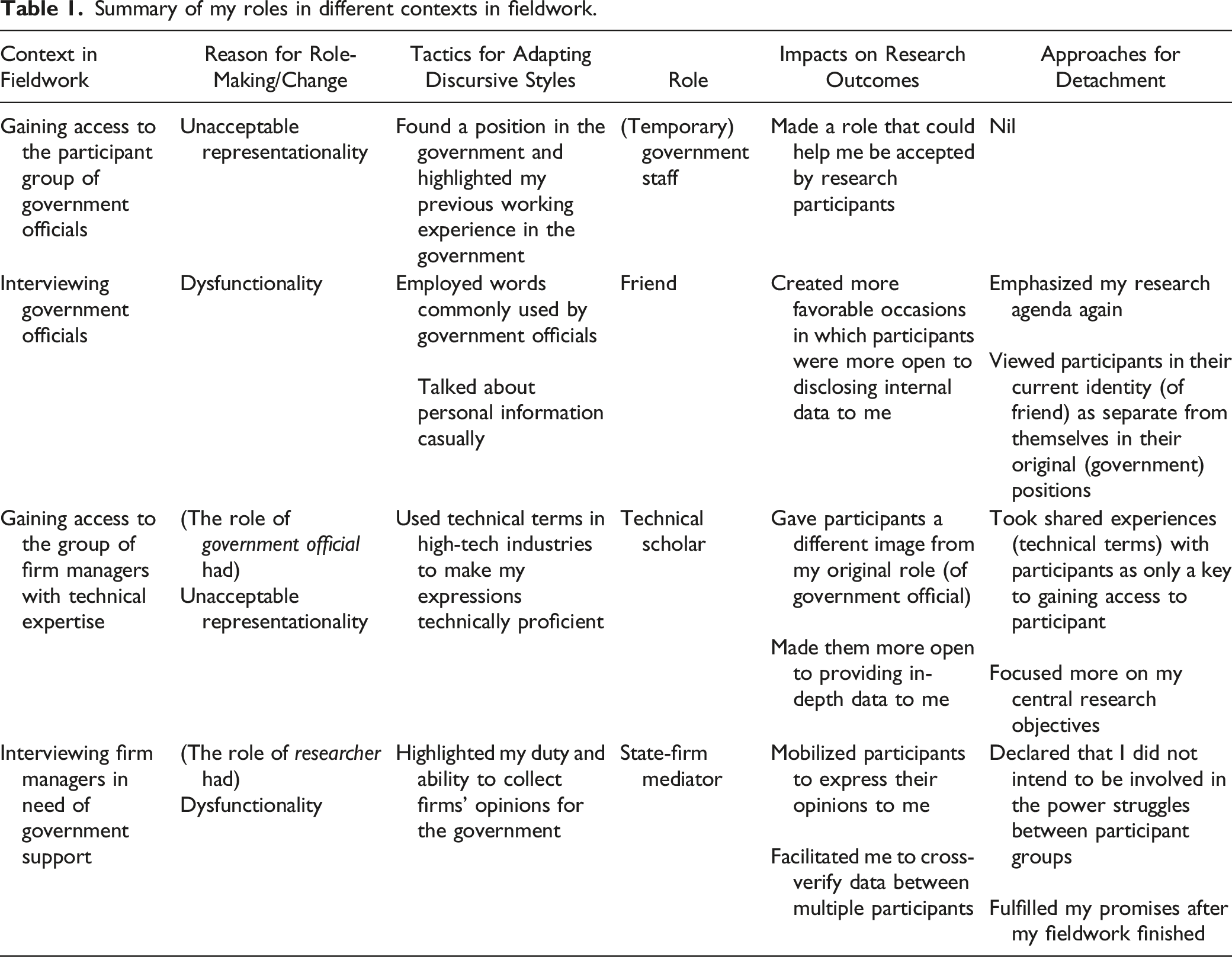
Summary of my roles in different contexts in fieldwork.
Gaining Access to the Field with an Acceptable Role
The city (City C) where I conduct fieldwork is a second-tier Chinese city and is relatively under-investigated by human geographers, although first-tier Chinese cities have garnered the most attention from scholars (Xu et al., 2022). Therefore, conducting fieldwork in City C can be challenging for human geographers who lack connections to the local population and institutions. However, in my case, I had the advantage of being involved in my research participants more quickly because I have previously worked as an intern in the government sector of City C for a year. This experience allowed me to develop valuable connections with people in relevant local institutions, and these connections facilitated me to gain access to the participants who could provide in-depth data for my current research.
Numerous scholars have revealed that Chinese government officials are cautious and reluctant to be interviewed by unfamiliar researchers (e.g., Tu, 2014). Although I have worked in City C for a year, I still could not reach all the necessary participants needed in my research only based on my previous social network, and for participants whom I had never met before, I was a stranger to them. To be involved in the broader group of government officials, I first needed to develop a self-representation acceptable to my participants again. Thanks to the social connections built in my previous internship experience, I approached a friend who worked in the government of City C and informed him of my fieldwork plans. In response to my request for a reasonable identity in the government, he offered me a temporary assistant position in his department. I thought that this assistant position would make my presence in the government more justifiable and allow me to adopt a non-researcher role when approaching new participants in the government. Therefore, I pleasantly accept this offer without payment.
Thanks to the temporal assistant in the government, I met many government officials and enrolled some of them as participants during the first several months of my fieldwork. However, I was also clear that the prefix “temporary” was noticeable in the eyes of my participants, particularly those in similar and nearby departments, who might become suspicious of me and hesitate to accept my interview. To appear more like an insider in the government, I frequently mentioned my previous 1-year experience in City C and highlighted my knowledge of the government unit where I worked to enhance the shared experiences with my participants. All these intentional self-presentations and self-disclosures convinced my research participants that I was a government member. Based on this shared identity, I managed to build an acceptable representationality among my participants in the government, even though I had been unknown to some new participants before.
For ethical reasons, I informed each participant that I would use the information they provided for research purposes, but they still preferred to view me as an insider of the government instead of a researcher as an outsider. Many aspects can evidence this. For example, when I appointed timeslots for interviews with my participants, they often said, “it is up to your schedule”, and indicated that I could select a slot within a broad period. When the appointed time arrived, they were also open to discussing broad topics with me, and some of my participants were even willing to spare a half day to talk with me during their working hours and invited me to have lunch with them. In addition, most participants tended to respond to questions concerning government policies from their own perspectives rather than reiterating media-disseminated official statements. All these indicators have shown that my participants did not consider our conversations something that required extreme caution.
In sum, upon entering the field, I made the initial role of a (temporary) government official, which helped me gain favorable expectations from the participant group of government officials. Although ethical considerations prevented me from concealing the temporary nature of my position and my research purposes, I still used discursive tactics (i.e., emphasizing my long-term membership in the government) to strengthen the identity shared with my participants and dilute the temporality of my role. With these tactics, I managed to be involved in the participant group of government officials. Nonetheless, I must acknowledge that this approach to gaining access to the field might over-involve me in my participant group and pose challenges to ethical issues and research outcomes. Therefore, the following subsection will elaborate on how I overcame these challenges through detachment from my participant group.
Shaping Friendships with the Participant Group of Government Officials
My initial role only ensured that my participants would accept me, but it was insufficient for me to develop close relations with them and gather as much data as I expected. There was an interesting but embarrassing episode that highlighted this point. In June 2020, I approached a government official for the first time, and since I did not know her position, I called her by her full name upon entering her office. She hesitated for several seconds and then responded to me with a stumbling tone, “yes… I am.” I sensed her embarrassment at once but was unaware of the specific problem. After that face-to-face interview, I sent her several Internet messages to confirm some details but only received her inactive replies. A few weeks later, I finally realized what was wrong when I noticed that it is customary to address a government official as “surname + director” (zhu ren 主任) if her/his exact position is unclear. In the Chinese government, the title “director” is a vague reference to positions at various levels. This title allows people to avoid addressing government officials impolitely with their full names and show courtesy to their positions in the government.
I have recalled this episode for times and wondered whether I could have communicated with that participant more agreeably once I called her more politely. Also inspired by this encounter, I recognized that my discursive style would significantly impact how others view me. To make my interactions with government officials more productive for my research, I must adapt to their discursive styles and change my role accordingly. After months of observing the discursive styles of government officials and reading government documents, I gradually became accustomed to the words often used in the government and incorporated these words into my everyday language. My efforts were quickly praised by my participants in the government, for they were surprised that a PhD student who works in English could communicate with such proficiency in a Chinese government bureaucratic tone.
At this juncture, imitating discursive styles of government officials enabled me to share consensus with them on the experiences of government affairs. Consequently, more people became interested in me and my research, and they often engaged me in brief conversations when we periodically crossed paths in corridors or the dining hall. I was especially pleased to talk in such relaxing settings since I could seize opportunities to tell them more about my personal information. Thanks to such regular disclosures of my personality, I built and strengthened rapport with some participants in the government and became “friends” with them. The friendship, or rather to say, the rapport between the researcher and the researched, made these participants more open to providing me with more authentic and internal data only known to government members. In addition, as a friend of my participants, I would feel free to re-emphasize that I was only temporarily a government member and was indeed more of a researcher. After viewing me as a researcher again, these participants would consider me unfamiliar with government affairs and provide me with more in-depth data to facilitate my understanding of their work. On some occasions, they even told me some stories which were different from the public information, and for such stories, they always reminded me to keep confidentiality with such statements: “there is no problem to tell you about this story in this conversation between us two, but you should not disclose it to others”. Such statements always convinced me that my participants had shown their openness to me to a large degree, and I would keep their information confidential. If I needed to use such information in my research, I would cross-verify with other participants and not mention where I had heard the information before. Meanwhile, regarding honesty and authenticity, cross-verification was necessary before I used the internal and sensitive data in my research because such data were usually clouded with participants’ opinions. In the following subsection, I will introduce how I adopted other approaches to test the authenticity of such information.
However, as previous scholars have revealed, friendship, as a very close personal relationship, may lead to biases in research outcomes (Law, 2019) and ethical issues such as mistrust (McConnell-Henry et al., 2010). Indeed, my strategies for addressing these problems were identical to those I have employed to involve myself in the participant group. Because of my friendship with the participants, I could flexibly change my role from a government official to a friend of my participants. Through this role change, I proactively detached myself from the insider status and became relatively an outsider for the group of government officials. On my part, I would intentionally regard my participants as separate from themselves in their government positions, reserving my empathy for the friend side of my participants. While my research agenda concerned only a part of my participants’ daily work instead of the participants themselves, this detachment could mitigate the bias caused by my insider status in the group of government officials to a reasonable extent. In terms of ethical issues, my detachment from the insider status in the government also meant that I did not engage in competing interests within the group of government officials. In this way, I could maintain objectivity when recording and interpreting data as much as possible. For my participants, their openness to me and trust in me did not decrease since my detachment signaled that I would not harm their interests.
Being Detached from the Government and Involved in the Group of Firm Managers
The second group of my research participants was firm managers in the high-tech industry studied in my research. Many firm managers I interviewed previously served as technical specialists in the automobile industry or other relevant sectors, and they are particularly interested in discussing technical topics with me. While I usually approached these participants with my position in the government and through my contacts in the government, some firm managers would regard me as a government official. In their previous interactions with government officials, firm managers once found that many officials lacked a complete understanding of technologies, so they had difficulty explaining technical details to government officials, or sometimes chose not to do so. For this reason, some firm managers also presumed that they only needed to introduce some general knowledge about their firms to me. Based on this first observation, I realized that my representationality based on my position in the government was somewhat unacceptable to some firm managers with an unfavorable image of government officials. With this position, I could only guarantee that they would not reject me but could not ensure that they were open to providing in-depth data to me. Therefore, to gain the trust of my participants as firm managers, I needed to detach myself from the role of government official again and adapt myself to other new roles.
This insight motivated me to form some consensus with these firm managers by featuring my discursive style with technical topics familiar to this group of participants. To ensure that my expressions were technically proficient, I collected extensive knowledge from various sources, such as firms’ official websites and technical messages from media, to understand how to describe and inquire about my participants’ business in a manner familiar to them. In addition, I purposefully incorporated high-frequency words and expressions commonly used by prior interviews into my conversations to impress my participants that I was aware of the updated trends in the high-tech industry. Consequently, I was able to adjust my discursive style to better suit the technical expertise of my participants as firm managers, and this practice benefited my fieldwork in two aspects: for one thing, through proactively showing interest and knowledge of the technical business of my participants, I earned the respect of these firm managers, and they became more open to providing me with in-depth data. For another thing, based on my knowledge of the technical issues, I could sensitively notice the keywords mentioned by participants in interviews and further excavate crucial data relevant to my research. For example, some participants once said, “you have done a good job in pre-investigating this industry. Please feel free to ask me what you want to know”, and they even welcomed me to visit their firms once again for further communication. Indeed, after the first interview, I met some of them face to face twice or contacted many participants online to check some details. In such communications, all the participants showed a friendly and open stance to answer my questions in detail.
With all these efforts, I changed my role from a “government official” to a “technical scholar” in the participant group of firm managers. In this case, my discursive style featured with technical terms that endowed me a shared membership with my research participants and enabled me to be somewhat involved in this participant group. For the consideration of the research outcome, my involvement made my participants more open to telling me in-depth technical and business details. From an ethical perspective, this involvement did not make me an insider in this participant group because I was never a real technical scholar, and all I knew was only some basic knowledge in this industrial field. My involvement was based on the comparison to other genuine government officials in the eyes of firm managers. In addition, I was interested in firms’ interactions with the government, meaning that I only used technical terms as keys to gain access to the group of firm managers, and the subsequent topics beyond the technical sphere were the actual goal of my investigation. In this vein, my role as a technical scholar did not lead to bias or loss of objectivity in my research, since my shared experiences with the group of firm managers were neither sufficient to mislead my perception of data nor much related to my fundamental research topics.
Balancing the Benefit and Ethics Carefully as a Mediator between the State and Firms
Since the government plays an essential role in fostering the development of my case industry, most firms in this industry have ties with the government and rely on the resources provided by the government. For this reason, many firm managers were active in learning the government’s considerations and attracting the government’s attention to acquiring support from the government. However, in their early development stages, many firms had difficulties establishing effective channels between them and the government. Meanwhile, the local government also desired to know the firms’ demands but lacked competent personnel to investigate each firm. In my interviews, many participants, from both the group of government officials and the group of firm managers, once expressed the intention of inviting me to be a mediator between the state and firms and facilitate the information exchange between the two parties. If I continued to declare my research agenda was only for academic purposes, some of them would be upset and lose interest to continue talking with me. So, I realized that my role as a government official was dysfunctional in winning these participants’ trust and openness.
I viewed this gap between the government and firms as an opportunity to arouse the interests of government officials and firm managers in my research. So, I voluntarily proposed to author a report for the government leaders’ reference. My immediate leader (the friend who offered me a temporary position in the government) permitted me to write this report and authorized me to conduct my interviews in the name of this duty (i.e., writing the report). With this title, I emphasized that, once my fieldwork is complete, I would assist in conveying the needs of firms to the government by writing firm managers’ opinions into the report. So, when I conducted my interviews with those firm managers seeking government support, I changed my role once more, and my new role was similar to a combination of “government official” and “technical scholar”. I name it a “state-firm mediator”. This role generated evident facilitative impacts on my research, for my participants considered our relationship reciprocal and felt more relaxed to comment on government policies with me, allowing me to hear their honest opinions about the government.
Nevertheless, the role of the state-firm mediator had its drawbacks in my fieldwork as well. This role provoked me to rethink my status among the two groups of my research participants – government officials and firm managers. My participants, especially the firm managers who were eager to seek governmental support, definitely became very open to complaining about their difficulties and anxiously hoped that I could soon convey their requests to the government officials. However, honest expression of their opinions did not necessarily mean that the data they provided was authentic. Indeed, the information provided by such participants was usually not sufficiently authentic because firm managers tended to selectively introduce their firms’ business by exaggerating achievements or avoiding talking about failures to convince me that the government needed to support the growth of their firms. However, their practice might lead to misleading data for my research.
As a researcher who understood the logic of both the government and firms, I did not expect to gather completely authentic data from any single participant. Even if the data were authentic, I would still not use the data in my research before I conducted cross-verification between interconnected participants. As I mentioned in the subsection concerning the friend role, I once gathered some internal data from my participants as government officials, but I could not directly use that batch of data because my participants asked me to keep their personal information confidential. The work of cross-verification just allowed me to re-excavate such data because I could mention the relevant topics when I interviewed interconnected participants from the group of firm managers (without mentioning the source of the topic). Once I could gain consent from any participant, I could have an alternative data source and use the data ethically. Besides, while each participant’s statement was blended with personal opinions and emotions, I could identify the differences between multiple participants’ comments on the same topic and find more reasonable interpretations in my research. Even though my research outcome might still present an uncertain answer, I could unpack tensions and interactions between participants from the two groups (i.e., government officials and firm managers) based on their conflicting statements, which was exactly a central objective of my research.
From the ethical perspective, the role of state-firm mediator enabled me to be detached from both of my participant groups. However, as a mediator between them, I could easily hear both parties openly speaking of their relations with the other party, and this possibly involved me in the power struggles between these two groups. Hence, as a mediator between the two groups, I had to be cautious about becoming too involved in the ongoing business of any party, as it could compromise my objectivity as an observer. To avoid my loss of objectivity due to this kind of over-involvement, I would honestly tell the firm managers that I would help them convey their opinions to relevant government departments, but I should do that after I complete all my investigations.
Conclusion
While previous human geographers generally term their status in fieldwork as insiders or outsiders, the specific roles of researchers remain an under-investigated topic in the literature on fieldwork methodology. This paper focuses on communication as the primary behavior of researchers in fieldwork and conceptualizes researchers’ statuses with an insightful perspective in communication studies – role theory. Theoretically, this paper integrates extensive views in related disciplines into the scholarship of role theory in articulating how the roles of individuals are made and changed through intentional self-presentation and the active employment of discourses in interactions. In addition, previous researchers’ reflections on their fieldwork experiences have revealed that they have adopted various roles to adapt to shifting fieldwork contexts and gather data more effectively.
For a fuller understanding of a researcher’s role in the field, the second half of this paper adopts a context-specific and discourse-based scope to reflect on the author’s participatory observation in a Chinese city for research on state-firm relations in local development. This reflection unravels how the author intentionally learned and employed the discursive styles of government officials and firm managers, making several roles to better interact with the two groups of research participants. Based on this personal reflection, this paper intends to contribute to the debates on human geography methodologies and illuminate practical means for future researchers to overcome the challenges they might confront in the field.
However, this paper only demonstrates several examples of specific roles in certain spatio-temporal and socio-economic contexts. These roles can be classified into more general typologies, but they are not comparable to Ruane’s (2005) four levels of involvement or any other identities of researchers in broader social settings. Indeed, although the examples illustrated in this paper are far less sufficient to depict a general view of researchers’ behaviors in their fieldwork, this paper has at least fueled the burgeoning debate on the insider/outsider dichotomy by revealing its insufficiency to portray how researchers position themselves in the field concisely. With the role as a label of researchers’ behaviors and the corresponding impacts on research participants and outcomes, this paper intends to show some specific contexts in which researchers can navigate their positions contingently to realize more efficient data collection and address ethical issues better.
In a context featured with government officials and high-tech firm managers as two major participant groups, the roles illustrated by this paper have drawn a spectrum for the author’s status changing in the space between the insider and the outsider. Indeed, for each specific context in research, the researcher may find a specific spectrum consisting of her/his specific roles therein. In this sense, there remains a long way for the further exploration of roles assumed by researchers in more complex fieldwork contexts. While the future works can further provide more context-based possible scenarios and draw the spectrums, I believe we can have a fuller picture of the broad space between the insider and the outsider and then really develop a more general understanding of continuous insider-outsider model instead of the dichotomous insider/outsider view (Dwyer & Buckle, 2009).
The roles assumed by the author eventually helped him earn the trust and openness of research participants and collect sufficient and high-quality data for his research. However, while these roles have driven the author to be involved in some participant groups, ethical issues should also be addressed. In general, the author has detached himself from his roles and from the participant groups timely and flexibly to refrain his research from loss of objectivity, mistrust, and bias due to the author’s own experiences. For the power struggle issues within the participant groups, the author has accomplished what he had promised to his participants until his fieldwork finished so that the conflict of interest between the researcher and the researched could be somewhat mitigated. Nonetheless, we must acknowledge that not each researcher is that fortunate. The relations between the researcher and the researched represent only a tiny episode in both parties’ lives. For this reason, researchers only assume some roles momentarily for particular research objectives and have scarce contact with participants after their research projects finish, not to mention completing their obligations to research participants. However, while some roles of researchers may stimulate participants to expect or desire compensation from researchers, we must consider such an ethical issue: should researchers honor their commitments to participants after we have realized our research objectives? If some obligations are beyond our capabilities, how can we balance the advantages of assuming a favorable role and the duties that come with it and actualize the reciprocity between ourselves and the researched?
Footnotes
Declaration of Conflicting Interests
The author(s) declared no potential conflicts of interest with respect to the research, authorship, and/or publication of this article.
Funding
The author(s) received no financial support for the research, authorship, and/or publication of this article.
