




Abstract
This work begins with a simple premise: (re)imagining a healing space for social inquiry. I briefly highlight the work of a critical participatory action research collective—composed of Maya community members, nonprofit staff, and a university-affiliated researcher—and how we explored whether research could provide a restorative function for those experiencing trauma, abuse, and everyday restrictions on free will. We revisited our co-constructed conceptual framework—restorative validity—which paints inquiry as interconnected orientations rooted in relationships, justice, and liberation. By presenting our experiences as counternarratives, I describe how our axiological commitments act in opposition and resist methodological obligations, illuminating Pratt’s conceptualization of contact zones—in this case, a social space where co-researchers’ ethics and values clash with hegemonic research practices. These counternarratives offer a reflexive example of the ethical and axiological considerations that should be examined as collectives approach inquiry as a healing and restorative space. The aim is to educate those interested in questioning dominant paradigms, as well as critically exploring the necessary conditions for restorative validity. These reflections act as an open call: Are we simply too preoccupied with being scientific enough to the detriment of freeing ourselves to imagine, co-construct, and commit inquiry as a healing space? It questions whether our communities of research and practice hold sufficient freedom: Freedom from dominant paradigms. Freedom to challenge methodological practices and empower ourselves to create new forms of inquiry. Forms of inquiry that seek to heal and restore, rather than simply prove a point.
Introduction
This article begins with a simple premise: (re)imagining a healing space for social inquiry. A space that sheds the postpositivist preoccupation of “appearing to be ‘scientific enough’” (Stanfield, 2006, p. 723) by shedding light on the restorative functions of inquiry. I begin this article by crediting the work of Stanfield (2006), who first questioned whether researchers could free themselves of their commitments to (post)positivism by seeking to “understand the healing and the restorative value of qualitative methodologies that facilitate the emotional and social healing of the researcher as well as the researched” (p. 726). In this manuscript, I present an open call, asking researchers and practitioners: Are we simply too preoccupied with being scientific enough to the detriment of freeing ourselves to imagine, co-construct, and commit inquiry as a space for healing?
I briefly describe the work of a critical participatory action research (CPAR) collective — composed of Kaqchikel Maya community members in San Juan Comalapa, Guatemala; nonprofit staff, specifically forensic anthropologists, investigators, and geneticists based in/near Guatemala City; and myself, a university-affiliated researcher based in the United States (Dazzo et al., 2023). In our collective, we explored whether research could provide a restorative function for those experiencing trauma, abuse, and everyday restrictions on free will. Drawing on Stanfield’s work, our collective revisited a conceptual framework that we previously co-constructed — restorative validity — that paints inquiry as interconnected orientations rooted in relationships, justice, and liberation (Dazzo, 2022). These three research orientations all coalesce around a final purpose: inquiry that restores and humanizes researcher and researched alike.
As I explored whether inquiry could heal, it soon emerged as a dialectic attempt to counter narratives within the typical dominion of validity theory and trauma studies. Beginning with an overview of literature and the conceptual framework, I present various interpretations of validity, from the unified theory of construct validity (Messick, 1995) to relevance validity (Stanfield, 1999), and how these may be counter/productive when working with individuals who have been subjected to trauma, abuse, and other forms of oppression. For example, in her summary of Stef Craps’ work, Andermahr (2015) notes how the ethical commitments of trauma studies have suffered due to what could be observed as an overreliance on limited and colonial interpretations of validity, reliability, and relevance: “despite its laudable ethical origins, which sought to foster cross-cultural solidarity, trauma theory has largely failed to recognise the sufferings of non-Western others” (p. 501). With the move toward trauma-informed approaches in research (Day, 2018; Isobel, 2021), I trouble how these approaches, which typically focus on strengths and empowerment (Chafouleas et al., 2016; Wolpow et al., 2016; SAMHSA, 2014) may inadvertently favor dominant paradigms, especially if culturally relevant (Ladson-Billings, 2014) and sustaining practices (Paris, 2012; Paris & Alim, 2017) — which foreground how culture shapes ways of knowing, seeing, and being — are not illuminated.
Moving on to findings and discussion, by focusing on co-researchers’ narratives I offer a reflexive example, outlining the ethical and axiological considerations that should be examined as research collectives approach inquiry as a healing and restorative space. We shed light on our journeys of becoming a community, one with value commitments aligned to the restoration of all co-researchers — regardless of affiliation (e.g., community member, nonprofit staff, academia). The purpose of this manuscript is a reflection on the ways in which our ethical and axiological commitments may not coincide with dominant methodological approaches. The following questions guided this process: • What methods and conditions in the academic superstructure do we need to problematize to maintain ethical and axiological commitments toward restoration and healing? • If we imagine validity from its original etymological root, meaning strong and healthy: What is the strength and health behind our practice when we collaborate and engage as co-researchers? • What does our research do to reclaim and restore the humanity of researched and researcher alike?
In presenting co-researchers’ narratives in unfractured ways, I did not seek to create themes, but to interpret and authenticate our experiences as whole.
As a collective, we imagined, as Stanfield (2006) did, whether we could “bring about healing, reconciliation, and restoration between the researcher and researched” (p. 725) to “create a safe place for both to explore, discover, recover and restore the other” (p. 726). By examining our collective, I demonstrate co-researchers’ experiences as they reflected on what was needed for inquiry to move away from suffering and provide a space for healing by questioning the inherent power dynamics and differentials present in research and our typical paradigms. This is a project in problematizing “the universal validity of definitions of trauma and recovery that have developed out of the history of Western modernity” (Craps, 2013), as well how validity may manifest as a “‘relevance gap’ between (a) what social scientists do successfully for career building and (b) how much their data and interpretations are isomorphic with the experiences of real people” (Stanfield, 1999, p. 418). We conclude by noting how reflecting on restorative validity may alert us to the mis/application of research and the opportunity to bridge these relevance gaps as we seek to restore the humanity of researcher and researched alike, and the research process itself.
Literature Review and Theoretical Framework
In this section, I present literature on the convergent and divergent paths within and across three areas: trauma research and research that heals; and the axiological commitments and methodological obligations that grapple for power.
Trauma Research←→Research That Heals
For those conducting inquiry with survivors of trauma, abuse, or other forms of oppression, inclusive of those in clinical settings and those who may not have training or a current role in ordering diagnostic assessments, there is an ethical responsibility to understand trauma theory—i.e., how individuals may express symptoms and responses after traumatic events—and how this may affect the research process. As Thompson (1995) notes, when working alongside those who have experienced trauma,, methodological challenges occur that require “continued exploration about why and how questions of ethics and methods are intertwined in trauma research” (p. 55). Specifically for clinicians, Carlson (1997) notes there is a responsibility to assess an individuals’ psychological problems to provide effective and efficient care. However, this goal of understanding an individual’s response to trauma has led to the prevalence of diagnostic and assessment tools, which may privilege speed and cost-effectiveness (Carlson, 1997). While Carlson (1997) notes the increasing inability of ordering a full psychological evaluation, much like Thompson (1995), she asserts another tension: that efficiencies may cause researchers and practitioners to not consider the effects that culture may play on how symptoms (e.g., anxiety, intrusive thoughts) and responses (e.g., reexperiencing, avoidance) are expressed; in turn, leading to issues in understanding, representation, and healing.
For social scientists and psychiatrists, Thompson (1995) notes that several perpetual concerns in the research process illustrate how culture requires a reappraisal of how ethics and power affect the methods we use. These include insider-outsider relations, i.e., how one’s status compared to those they study affects the research process (Collins, 1986; Miled, 2019; Milner, 2007); (over)identification, i.e., a technique that requires the researcher to actively listen, while not minimizing the agency of the survivor by trying to interrupt or over-relate to their traumatic experiences; blocking, minimizing, and forgetting, i.e., coping mechanisms that the survivor and researcher may employ to minimize the trauma of memories; and last, circuitous narrative structures, i.e., the researcher relaxing control so participants can take charge of their storylines when narrating their experiences. As noted by Thompson, while these are concerns in the research process, they also illuminate techniques that trauma survivors utilize when retelling their stories. As asserted by Bernice Johnson Reagon (1986), “culture offers a process, the way things were to be done, the way material was to be collected, assembled, presented; that maybe the culture offered a methodology” (p. 77). In relating research techniques and concerns to how trauma survivors present and retell their stories, Thompson (1995) shows how Reagon’s early work on culturally relevant methodology “may be helpful to conceptualize survivors of trauma as having particular ways of seeing, acting, and presenting themselves in the world… understanding that culture provides a method for studying survivors of trauma” (p. 61).
As an example, in a critical ethnography focusing on the bereavement narratives of two mothers, Campesino (2007) notes that while researchers may not be conducting therapy, there is a necessity to show empathy, respect, and tolerance as a therapeutic relationship may often develop between participants and researchers in trauma research. Like Thompson (1995) and Reagon (1986), Campesino (2007) reflects on her multiple identities and how they affected her position as an insider and outsider compared to the bereaving mothers, while also taking care to journal her own feelings and experiences after interviews to reduce the occurrence of blocking, minimizing, or forgetting participants’ traumatic experiences. Regarding culturally relevant methods, Campesino (2007) and her participants alternated interviews between their own homes and prepared meals during these visits, embracing “simpatía, or interpersonal warmth, congeniality, and hospitality” (p. 545). As they shared their stories, Campesino also did not assume a neat, linear trajectory of healing, but noted circuitous narrative structures (Thompson, 1995) of “ongoing cycles of intense emotional, mental, physical, and spiritual suffering that were interspersed with periods of relief” (p. 62). The dehumanization that trauma survivors may experience—from judicial systems, simplistic media narratives, and the “historical and structural systems of domination located in race, class, and gender”—can aggravate suffering, while “the therapeutic use of self in the narrative process can serve as an intervention that may creatively facilitate inherent healing capacities” (Campesino, 2007, p. 552).
Contact Zones: Axiological Commitments←→Methodological Obligations
As social researchers facilitate understanding, tensions arise as methodological practices deemed valid may stand in opposition or grapple with one’s axiological commitments, especially those concerning the healing of researcher and researched. Prior to writing about the restorative justice functions of inquiry, Stanfield (1999) raised the issue of relevance validity: “Even if the design and data meet the reliability and validity standards of… a particular social scientific or policy-making community, do the data fit the realities of the people it supposedly represents?” (p. 419). This incongruency between validity and values aligns to the issues noted by Thompson (1995), reiterating the enmeshed nature between ethics and method.
The inherently intertwined nature of ethics and methods are on full display as Stanfield (2006) speaks to the “restorative justice functions of qualitative methodological techniques” (p. 725). In his work, Stanfield (2006) notes how discussions of validity were dominated by (post)Enlightenment values, and that those who did not subject themselves to the rules of positivism—i.e., “operationalization, measurement, and devising and implementing principles of reliability and validity to induce objectivity” (p. 723)—meant that one could lose legitimacy. In Stanfield’s view, however, replacing the arrogant myth of objectivity with impartiality with reflexive practices that make explicit the researcher’s biases and limitations allows for the type of relationship-building and trust that precede the restoration of researcher and researched. Just as Campesino (2007) noted the humanizing and healing potential of the narrative process for the grieving mothers in her study, Stanfield (2006) ascertained that it may be possible to establish methodological practices where “understanding and explaining help people move away from lives amputated by dehumanizing others to new lives of interconnections not based on dehumanizing social markings” (p. 726). Drawing on the work of Maxine Greene (1988), Stanfield saw the restorative justice functions of qualitative inquiry as a space where researchers could elucidate their axiological commitments and free themselves of domineering paradigms.
The tensions of dominant methodological practices clashing with the value commitments of researchers and practitioners presents a theoretical contact zone, i.e., “social spaces where disparate cultures meet, clash, and grapple with each other, often in highly asymmetrical relations of power” (Pratt, 1991, p. 4). Discussions of validity are often aligned to Eurocentric discourse, which have traditionally been based on an ontological privileging of academic expertise over community experience, and criteria that are not based on the realities of those who are being studied or where the research is being conducted (Castleden et al., 2015; Scheurich & Young, 1997; Torre et al., 2012). This dominant paradigm stands in opposition to those who may prefer to privilege impartiality, restoration, and healing (Stanfield, 2006). Torre et al. (2008), much like Stanfield, drew on the work of Maxine Greene (2003) to show how the democratizing practice of CPAR provides researcher and researched the freedom to collectively formulate agendas and questions, and make decisions on data gathering and analysis. Torre extends Pratt’s notion and theorizes CPAR as a contact zone, which “underscores the ways subjects are constituted “in and by their relations to each other,” and also the multi (ple/peopled) constructions of knowledge and research” (Torre, 2006, as cited in Torre et al., 2008, p. 25).
Conceptual Framework
Pratt (1991) and Torre’s (2006) interpretations of contact zones are used to frame the findings and discussion, which will be further discussed in the methodology section. For this article, contact zones were seen as a vital heuristic to not only understand context—a social space where Indigenous Kaqchikel values grapple with Western and colonial interpretations of justice and memorialization—but also method—a social space where research collectives that value relationality (e.g., humility), justice (e.g., recognition), and liberation (e.g., self-determination) may grapple with methodological ideologies (e.g., objectivity, distance) deemed valid by academia and society.
Restorative Validity
Within our CPAR work, our collective sought to explore whether the conceptual framework of restorative validity (Dazzo, 2022; Dazzo et al., 2023) provided an outlet to act on our value commitments—i.e., relationships, justice, and liberation. Through a research orientation that privileges relationships, we err on the side of ignorance and claim humility (Limes-Taylor Henderson & Esposito, 2017). By employing an ethic of caring and an ethic of personal accountability (Collins, 2010), researchers and practitioners must understand how dominant research paradigms propped up by majoritarian/Eurocentric views of neutrality and objectivity may cause some community members to question their own constructions of knowledge, research, and self. Guided by respect, we move toward a research orientation toward justice, which calls for the acknowledgment of wrongdoing in daily life (e.g., stolen land, genocide) but also recognizes the harms that have occurred through extractive research and evaluation practices (e.g., stolen ideas, appropriated customs) (Tuck & Yang, 2012; Tuhiwai Smith, 2012). Last is an orientation toward liberation, which questions how we think about the transformative and emancipatory acts of inquiry, or what Lather (1986) termed catalytic validity.
By acknowledging the expertise of community members and placing value in their everyday ways of knowing and doing (Martín-Baró, 1994), it requires collectives to construct spaces where co-researchers can actualize their potential as agents of change who (re)formulate knowledge and method, moving beyond objects who provide data. Restorative validity is an assemblage that actively resists and refuses limited definitions of validity, which conflate methodological and social values with statistical scores (Cronbach & Meehl, 1955; Messick, 1989; 1995) or equate truth with a static reality that often aligns with dominant views (Huber, 1995). It requires researchers and practitioners to ask: If research does harm, what are we doing to right those wrongs?
As others have contemplated trustworthiness and quality in qualitative research (Creswell, 2007; Guba & Lincoln, 1989), restorative validity honors the multitude of critical theories and models that have sought to further discussions on transformational validity (Cho & Trent, 2006), i.e., one which requires research processes to contribute toward social change. This is consistent with the critical consciousness sought in catalytic validity (Lather, 1986), the objective of understanding what research is useful to communities in relevance validity (Stanfield, 1999), and the fairness (i.e., negotiations of power and communication between parties) and tactical nature (i.e., the power to act on findings) outlined in (Guba & Lincoln, 1989) authenticity criteria. For more on how restorative validity draws on the longstanding discussion of rigor and relevance in qualitative research and evaluation, see Dazzo (2022, forthcoming).
Context and Methods
This research is situated within the context of a project conducted by the Fundación de Antropología Forense de Guatemala (Forensic Anthropology Foundation of Guatemala, FAFG), and one of its community partners, Coordinadora Nacional de Viudas de Guatemala (National Coordination of Widows of Guatemala, CONAVIGUA). Our collective includes an intergenerational group of Kaqchikel Maya individuals, many of whom are also members of CONAVIGUA; and forensic anthropologists, investigators, and geneticists from FAFG. For several decades, FAFG has worked alongside Indigenous community members to document disappearances that occurred during the country’s 36-year armed conflict (1960–1996). This includes community consultations, active investigations, identifying mass grave sites, exhuming remains, matching DNA with living family members, and returning remains so families can hold traditional funerary rites and ceremonies. Although we have a transnational inquiry collective, our work has primarily taken place on a memorial commemorating the lives of the disappeared: the San Juan Comalapa Memorial for Victims of Enforced Disappearance. The main objectives of our work were threefold: the improvement of the memorial site based on Kaqchikel priorities; understanding Indigenous views of justice; and exploring co-researchers’ interpretations of inquiry and its restorative potential. This article, more specifically, presents findings on the last aim: understanding whether research can restore and heal.
Data Gathering and Interpretation
Interview Protocol
As we sought to understand whether inquiry could humanize and heal researcher and researched alike, in line with our conceptualization of restorative validity, we began holding a series of discussions during and after our data gathering and analysis sessions. Through co-researchers’ input, I formed an interview protocol with a limited number of questions, with the aim of providing space for individuals to tell their stories (Carspecken, 1996). Co-researchers also posed questions to Giovanni, pushing for a more reciprocal dialogic process and to ease the usual researcher-researched power dynamic where a university-affiliated researcher asks questions and receives responses. My words are supplemented by texts from my fieldnotes, memos, and presentations. Utilizing Carspecken’s (1996) critical ethnographic approach to interviews, the protocol began with the use of a lead-off question—i.e., a grand-tour question in ethnographic research—based on a broad topic domain. The following illustrates a lead-off question for our conversations: Topic Domain: Exploring the restorative potential of inquiry; views of participation Lead-off question: “When the group met back in July 2019, you participated in a few participatory data collection and analysis processes. Could you tell me what you remember most from these sessions?”
Interpreting Contact Zones
I present a series of theoretical and practical contact zones that co-researchers in our collective observed. For each contact zone, I first provide an overview of our CPAR activities and the questions that co-researchers were speaking to during our discussions. Co-researchers’ narratives are presented as they examine their experiences of how inquiry was used as a tool to promote peace, justice, and healing in our collective. Drawing on the use of storytelling in critical race theory (Bell, 1987; Crenshaw et al., 1995), co-researchers’ words are presented as counternarratives (Milner, 2007; Solórzano & Yosso, 2002) alongside dominant narratives—e.g., academic literature on methodology and validity.
These counternarratives, rather than being presented as spaces of marginality and deficit, are transformed into opportunities, “a central location for the production of a counter-hegemonic discourse” (hooks, 1989, p. 20). Co-researchers’ words illuminate how their axiological commitments act in opposition to and resist methodological obligations, illustrating Pratt’s (1991) conceptualization of contact zones—in this case, a social space where co-researchers’ ethics and values clash with hegemonic research practices. I then discuss the implications this had on our research process, drawing on Torre’s (2006) notion of contact zones to “witness a textured understanding of human interaction across power differences” (Torre et al., 2008, p. 23) beyond simplistic binaries (e.g., oppressor/oppressed, researcher/researched).
Findings and Discussion
Co-researchers’ axiological commitments are presented as counter-stories, on the left. Alongside these counter-stories, I have reproduced the type of dominant narratives that students, researchers, and practitioners may see in textbooks or proposal guidelines on methodology and validity. The aim: To educate those interested in not only questioning dominant paradigms, but critically exploring the necessary conditions for restorative validity.
Contact Zone 1: Commitments to Restoration←→Dominant Forms of Validity
In this first section, I present co-researchers’ views on the topic of validity, what we expressed as strong and healthy ways to produce knowledge and research. These counternarratives are presented alongside the text a researcher or practitioner may see when they review academic literature subscribing to dominant ideologies of validity. In the counter-stories presented below, co-researchers spoke to their previous involvement in research, which led to comparisons of why the process in our collective differed from typical practices viewed as valid.
Axiological Commitments: Restorative Validity←→Dominant Definitions: Validity.
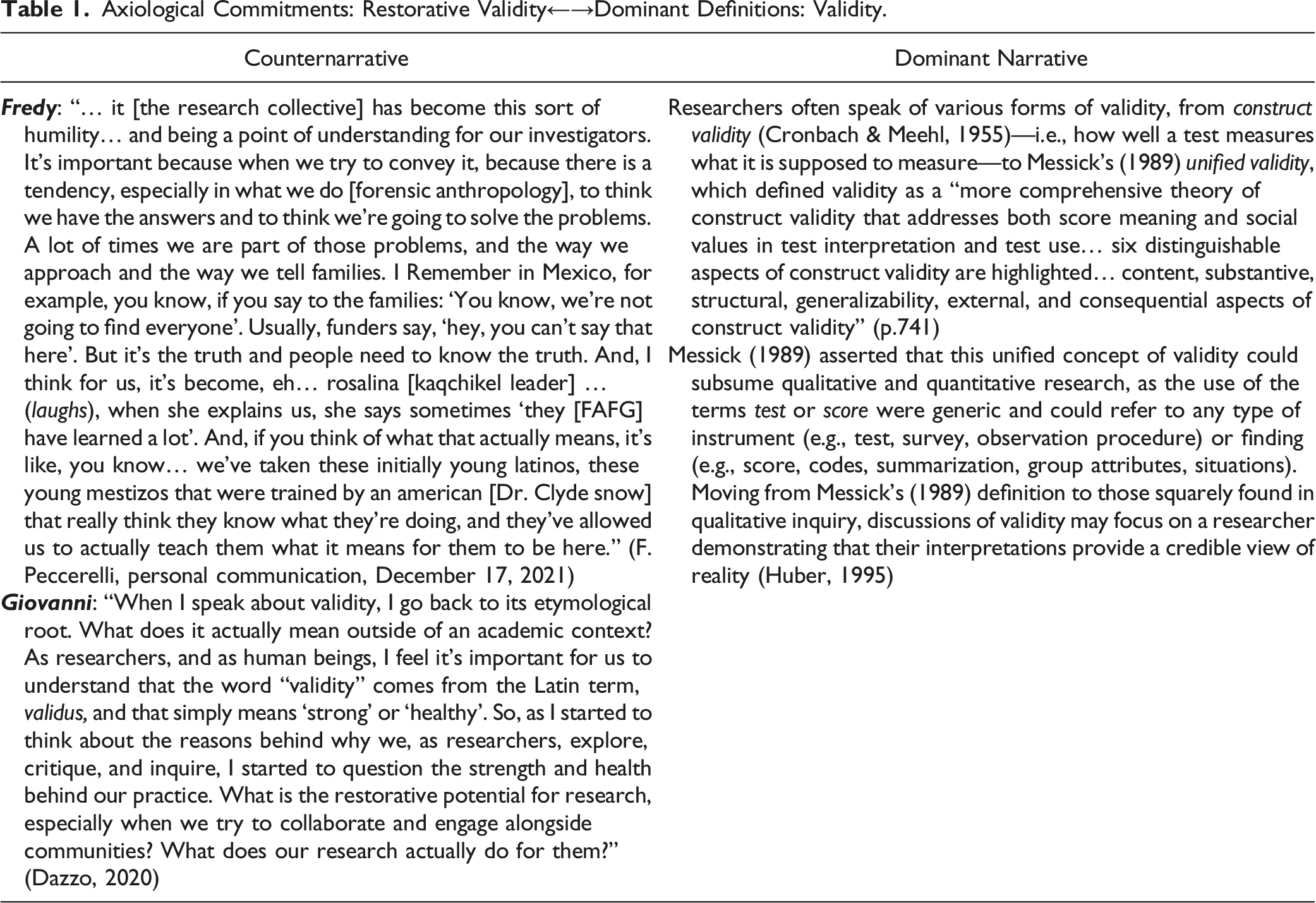
For myself, my words were drawn from several discussions and fieldnotes that were then used to compose a conference presentation (Dazzo, 2020), one in which I asserted how deliberative dialogue and collaborative moments—i.e., common occurrences in CPAR projects—could be utilized to question dominant definitions of validity. During our first collective activities in Guatemala in July 2019, we engaged in traditional forms of storytelling, consistent with Maya oral tradition (Carey, 2001), to explore what the Kaqchikel community had gained from the forensic anthropology process, as well as structured and interactive data gathering and analysis activities (e.g., ripples of change, ActionAid, n.d.) that were used to explore co-researchers’ hopes for the San Juan Comalapa Memorial over the next 5 years. These activities recognized the expertise of all co-researchers, from long-established traditions of storytelling to interactive activities that sought to promote participation and self-actualization (Dazzo, 2022). Drawing on the work of Lather (1986), these activities were meant as a form of catalytic validity; specifically, the restoration and reclamation of participants’ identities, memories, and cultures, in line with the liberation psychology of Martín-Baró (1994).
As we all debriefed together after our data gathering and analysis activities, several Kaqchikel and FAFG co-researchers noted how the process led to a collective sharing of experiences and a collective responsibility for the memorial—natural processes to heal wounds. These activities led to a sense of transformation for some, but I should note that although Fredy invited me to Guatemala in July 2019 to facilitate this process, he was initially apprehensive: “When we began down this road, I was really skeptical and I said, well, let’s see what happens” (F. Peccerelli, personal communication, 17 December 2021). During our discussion, however, Fredy noted why our collective activities changed his view. Rather than seeing himself, and his organization, as distanced and objective purveyors of valid scientific solutions, he began to see they were there to accompany one another: It has definitely opened many doors that I didn't know existed, and it kind of feels like I've been in a dark room doing my work and then somebody turned the light on, and it was like, holy crap, there's all these other people in here… I think that's probably the most important thing. That we come in here thinking that we're going to solve something, we're not. We're just here to do what we can and to accompany them in that process (F. Peccerelli, personal communication, 17 December 2021).
Contact Zone 2: Commitments to Participation←→Assumptions of Empowerment
Axiological Commitments: Restorative Validity←→Dominant Assumptions: Empowerment.

The curious facet of this contact zone is the identification and placement of texts on the participatory paradigm and CPAR within the dominant space, especially as participatory inquiry has often been defined as radical (Fals Borda & Rahman, 1991). This is not to say the participatory paradigm occupies the same dominant space as (post)positivism. The argument is that practitioners of C/PAR—if not reading texts closely and critically—may assume participation is a given, rather than questioning the inherent power differentials that reside in the research process. As researchers and practitioners, it requires that before we talk about participation, dialogue, and inclusion, we must question whether community members feel they hold sufficient power and control to participate alongside us. As Stanfield (2006) notes: “even those researchers who claim to belong to the participatory research perspective … inadvertently forget this fact of power… even the participatory researcher tends to embrace the norms of positivistic science as a means to gain recognition in his or her core disciplinary community (p. 724).
However, while FAFG has promoted culturally sustaining practices (Paris, 2012) by integrating the Maya Cosmovision, rituals, and languages in their scientific forensic process (Peccerelli & Henderson, 2022), from Carmencita’s words, many researchers who visit the Kaqchikel have not critically appraised how ethics and power are intertwined with the methods they use to understand and document the trauma experienced by the Maya.
From Stanfield’s (2006) view, this presents an example of how qualitative inquiry falls prey to (post)positivistic priorities that favor being scientific enough, as opposed to seeing a site that can offer a healing and restorative space. It is for this reason restorative validity explores how critical theory and restorative justice principles can be (re)conceptualized when working alongside communities. It requires critically questioning power dynamics and the potential harm produced through research, to promote peace, justice, and healing for researcher and researched alike.
Of course, these power dynamics cannot be erased. During one of our discussions, Fredy noted the difference between our collective effort and his previous involvement in research: I think that's one of the biggest things that in the other efforts, there is a hierarchy of power incorporated in the research process. Here we are very clear that although it's difficult to wipe it out because I mean, you know, the Italian gringo that comes from Washington, D.C. already comes with that. But in the process, you kind of wash it away… you become invisible in the process and the process actually really comes out. And, I mean, so do we, we come from the city, but that becomes irrelevant, especially over time when you build, because I think, this has to become sort of a more, it can’t just be a one-off (F. Peccerelli, personal communication, 17 December 2021).
In this exchange, Fredy speaks about my identity (i.e., Italian gringo) as well as his (i.e., coming from Guatemala City), and how these come with power when organizing and facilitating research alongside Indigenous communities. In this critical assessment of power, Fredy speaks to how dynamics are somewhat washed away through prolonged engagement. Alternatively, Carmencita speaks to how female community members’ gendered fears, resulting from decades of discrimination, subsided through prolonged participation, moving toward self-determination and self-actualization.
In this contact zone, it is vital to remember that, for community members, the power dynamics within the typical hegemonic research process may also be at play within CPAR. For this reason, Carmencita’s words—i.e. “When you are asked to participate, but no one has ever asked you before, you are afraid”—are an important rejoinder when considering restorative validity. As we seek to adjust our orientations toward a research process that privileges relationships, justice, and liberation, it is necessary to ask: Who has been harmed by research and evaluation? How can we address past (un/intentional) harms enacted by other researchers? How do power and privilege affect participation and inclusion? (Dazzo, 2022).
Contact Zone 3: Commitments to Solidarity←→Project-Based Mindsets
Axiological Commitments: Restorative Validity←→Dominant Thinking: Project-Based Mindset.

The dominant narrative is presented simplistically, however, from my experience conducting research and evaluation in/for donor-funded organizations, this is often how guidelines are presented. While practitioners are focused on social change, many do not have the time, resources, or power to question donor guidelines. As mentioned by Fredy in Contact Zone 2, he was initially skeptical of our collective activities due to previous experiences leading to superficial findings. Below, Fredy brings up an experience where his organization received a report from an external researcher/evaluator, and how this differs from our CPAR work: I remember when, that report that we presented to you… and you told us, this is by far the worst thing we’ve ever seen. You know why? The reason for that is because we weren't involved in it. We had, it had nothing of us. It had an external person trying to be like a good gringo, trying to sort of like say, you guys are great, I'm a fan and everything you do is wonderful. And check, check, check, check, check. We got nothing from it. Nothing. And from that to now, it's not about the report. That's irrelevant. It really is irrelevant. It's about the understanding of it. And this is me, I mean, I've never been a person that talks about these things, I've been like, I get very skeptical about these things because I'm like, that's irrelevant (F. Peccerelli, personal communication, December 17, 2021).
Fredy counters the common hegemonic refrain that an external expert is objective. Although the Office of Management and Budget (OMB) memo (2018), referenced in Contact Zone 3, refers to the use of internal evaluations, it is important to note one word from that source: “complementary”. Rather than noting internal evaluations can supersede external evaluations, the guidance is presented after the text on external evaluation. Although it is but one word (complementary), it creates a hierarchy of power that politicizes who can produce valid and objective evidence.
In her counternarrative, Erica speaks to how our process has integrated restorative justice principles within the research process. Within the field of restorative justice, there is an understanding that justice is a long-term process, one that does not solely end with criminal trials or offender sentencing. It requires understanding how harm is addressed, how survivors can determine their own needs and outcomes through participation (Zehr, 2002/2015), and justice that calls for healing (Monture-Okanee, 1995). As Zehr (2002/2015) notes, a “process of justice maximizes opportunities for exchange of information, participation, dialogue, and mutual consent between victim and offender” (p. 67). Regarding research and evaluation, it becomes necessary to heed Torre’s (2006) advice to theorize beyond simplified binaries and to understand how we may all play into the politics of evidence based on our own academic or experiential socializations. As Erica mentions, rather than thinking of typical reporting guidelines, she no longer sees her research and evaluation work as an end goal that simply complies with donor requirements, but a solidary process: It is an indefinite conversation they will be having alongside communities who own the process. As a CPAR project, we were interested in ensuring that our approach did not simply see solidarity and decolonization as metaphors (Tuck & Yang, 2012), but one that “specifically requires the repatriation of Indigenous land and life” (p. 21). For this reason, co-researchers redistributed their own funds or worked on grant proposals, aiming to secure land and resources to continue the search for the disappeared near the memorial. It is the reason that, throughout this manuscript, I use the phrase ‘our CPAR work’, rather than ‘our CPAR project’.
As Erica speaks back to the strict temporality of project-based thinking, Carmencita spoke of the sanctity of our work—a characteristic not often attributed to trauma studies, or research and evaluation in general. Through our collective, we sought a process rooted in restorative practices. For Carmencita, these opportunities to set research agendas, honor Kaqchikel culture and ancestors, and act on the community’s priorities for the San Juan Comalapa Memorial were not simply seen as a job. Rather, as they often note when speaking of the search for their loved ones, it was ‘a journey’ (el camino): For me, this was very important, that the participation of each one depends on us, the women and the young people. The ideas we contributed were very important. That no, it was not, let's say, a job like any other. But, for us, this job was very important, it was very valuable, because it was very sacred work for us, because in everything we did it is also part, shall we say, of our culture. It is part, let's say, of the history, of our town, of San Juan (C. Cúmez, personal communication, 30 November 2021).
Conclusion←→A Journey
By presenting co-researchers’ words, there was an interest in privileging their axiological commitments to counter and trouble dominant interpretations of methodology, objectivity, and validity, as we moved toward restorative validity—i.e., an inquiry whose purpose is judged by the strength of its ability to reclaim, restore, and heal (Dazzo, 2022, forthcoming). The objectives of our collective work were grounded in co-learning, utilizing co-researchers’ diverse ways of knowing: storytelling, i.e., Kaqchikel oral traditions; participatory techniques, i.e., Giovanni’s socialization (Dazzo, 2022); the presentation of forensic evidence, i.e., FAFG’s scientific work (Peccerelli & Henderson, 2022). We sought, as Thompson (1995) notes, to privilege trauma survivors’ epistemological, ontological, and methodological commitments. Rather than simply studying trauma survivors though, we worked alongside Kaqchikel community members to understand how our collective journey could promote peace, justice, and healing. Guided by our conceptual model of restorative validity, we reflected on our methodological practices and how we engaged with one another.
Rather than concluding, I speak to how this CPAR work has taken me on a journey. It will continue to lead me as I question the complicated connection between validity and ethics, as well as power, freedom, and healing in inquiry. As Stanfield (2006) did, I draw on the work of Maxine Greene (1998), observing freedom not as a question of doing whatever we please, but as a space that allows us to shed our scientific propensity for one of humanistic integrity. As Greene (1988) documented, there is a notion that “freedom of mind and freedom of action were functions of membership and participation in some valued community” (p. 43). This is not an end, but a means, a journey where “we need to be continually empowered to choose ourselves, to create our identities within a plurality… something we could never do meaningfully alone” (Greene, 1988, p. 51). In part, it seems that Carmencita now feels that she holds sufficient power and control to participate alongside researchers and practitioners. As researchers and practitioners, however, I question whether our communities hold sufficient freedom: A freedom from dominant paradigms. A freedom to challenge our methodological practices and empower ourselves to create new forms of inquiry. Forms of inquiry that seek to heal and restore, rather than simply prove a point.
Footnotes
Acknowledgments
This article would not have been possible without the knowledge, labor, and care of co-researchers from the Fundación de Antropología Forense de Guatemala and the Coordinadora Nacional de Viudas de Guatemala.
Declaration of conflicting interests
The author(s) declared no potential conflicts of interest with respect to the research, authorship, and/or publication of this article.
Funding
The author(s) disclosed receipt of the following financial support for the research, authorship, and/or publication of this article: This work was supported by the Portions of this research were funded by a doctoral fellowship granted by George Mason University. CONAVIGUA received compensation for the knowledge, time, and labor shared by their Indigenous Kaqchikel members.
