




Abstract
The aim and purpose of this article has been to advocate for autobiographical investigation and identification of positionality when non-indigenous researchers engage in indigenous methodologies. My experience as an international adoptee from a Romanian orphanage who experienced unsafe research practice shaped my emancipatory positioning and interpretive lens. It is from this positioning and experience of marginalisation I was concerned with finding a research paradigm that positions participants not as objective objects; but rather as rivers of knowledge with stories that determine the tide of the research. The lens of tangata tiriti (people of the treaty) from which I base my practice in Aotearoa, New Zealand; invites a positionality of neighbourliness, thus prioritising de-colonising/re-indigenising methodologies. The focus for my research project explored the disconnection between teachers who hold a Biblical world view and their students who experienced feelings of agitation and frustration. The participants contributed insights about teachers’ pedagogy drawn from responding to two prompts: “what is happening when you were empowered by your teachers to flourish?” and “what is happening when you feel disempowered by your teachers?” The chosen research method Photoyarn, is a recently emerged form of photo-elicitation created by Jessa Rogers that honours aboriginal yarning circles. This article makes the case for recognizing our ontological and epistemological positioning thus maintaining authenticity in research and holding steadfast the ethical disposition intention of doing no harm.
Keywords
Introduction
The focus for my research project developed from a tension I observed when working in Christian Education. My research project explored the disconnect between teachers who hold a Biblical world view and their students who experienced feelings of agitation and frustration. This misalignment often led to student’s misbehaviour and disengagement which in turn, agitated and frustrated their teachers. This study provided space for me to step back and question educational epistemologies, the effectiveness of prevailing pedagogies and rethink the purpose of Christian education (Cox, 1966; Freire, 1970; Watkins, 2008). The participants contributed insights drawn from responding to two prompts: “what is happening when you were empowered by your teachers to flourish?” and “what is happening when you feel disempowered by your teachers?”.
As an emerging researcher in this qualitative journey, it is right to introduce myself as Romanian. I was born in Fortul 13 Jilava, a political prison from which I was transferred to Casa de copii numero uno (an orphanage) during the years of the Romanian revolution where I remained until I was 3 years of age. Born cross-eyed, I was considered ‘deficient’, as the Soviet science of defectology (D’iachkov, 1968), view this condition as unsalvageable. This marginalization left me extremely vulnerable, and the lasting impact of this trauma positioned me with a deep awareness of how institutions can “diagnose their students’ condition, thus determining the nature of their remedy” (Palmer, 1998, p. 47).
I was internationally adopted at 3 years of age and brought to Aotearoa New-Zealand. Since my adoption, I have discovered that intercountry adoption is a point of fascination for many onlookers. The spectrum of curiosity ranged from gentle murmurings about language barriers and my olive complexion through to blatant interrogation about culture suppression. Throughout my life, people on multiple media platforms, have supressed my voice, stole my story and twisted it to suit their objective. For example., when I was 11 years old; I remember one PhD candidate reading out statements she had written, asking me to nod in agreement while she egregiously and clumsily assumed my voice to justify her research. My research positionality has come from such experiences, and I orient my choices to reflect one that dwells in the borders of marginalisation, choosing research paradigms that meets with others also on this border.
As tauiwi (immigrant to Aotearoa New Zealand), I am non-indigenous and deeply aware that so often, research involving indigenous participants has been fraught with tension due to the “open cast mining’ of seeing, taking and destroying” (Smith, 2012, p. 118) and the impact of such invasive research continues the effects of colonisation. However, my obligation to Te Tiriti o Waitangi (a framework that sustains the rights of mana whenua in Aotearoa New-Zealand) compels to me operate my research from understandings of decoloniality (Walsh & Mignolo, 2018) as discussed by Mafile’o et al. (2022) in their work on humanizing participants through dialogical relationships. Indigenous epistemologies such as Māori and Aboriginal consider research as kaitiakitanga; a holistic principle of community guardianship and stewardship (Smith, 2012; Tiakiwai, 2015). To illustrate this disposition from which I approach my research; I use Munro’s (2016) articulation of Sister Suzanne Mary Joseph Aubert’s positionality in her own work with vulnerable orphans in New Zealand: “Suzanne’s vision of large-hearted spiritual neighborliness call it arohanui (much love; with deep affection) was an open vista. Bridging gaps was what Suzanne Aubert did best, and with an inviting confidence she directed those around her to do just the same” (p. 401–402).
Methodological Journey
Qualitative methodology was considered radical in its conception in the early 90s (Loftus & Rothwell, 2010) as its interpretive lens supported the constructivist theory of gaining knowledge and meaning making from participant’s experiences through transparent inquiry rather than measuring data for comparison (Bryman, 2001; Burns, 2000; Denzin & Lincoln, 1994; Erickson, 2013; Miles & Huberman, 1994). Exploring phenomena such as emancipation, transformation, social justice, and oppression (St Pierre, 2014), qualitative research resists quantification and objectification. Such research is not to solve problems, but to gain insight and seek to deeper understand the experiences of others. This paradigm employs methodologies that ask questions and listens to participants share from who they are and the perceptions they hold (Cohen et al., 2000; Hutchings et al., 2011; Rose, 2016; Wellington, 2000).
My research recognises the analytical framework of intersectionality (Crenshaw, 1989); that describes the intersection of oppression instigated by institutions on race, gender, sexuality and power with the common element of supressing the voice of those effected. Inspired by Paulo Freire’s (1970) pedagogy of the oppressed, I have used this framework to consider how this project can draw from notions of liberation (Kendall et al., 2013; Thorne, 2010). Engaging with such a lens has called me to assume a humble, reflective, self-aware stance as I consider the effectiveness of my practice (Gibbs, 1988; Palmer, 1998; Smith, 2018; Smith & Smith, 2011). It is with this disposition I acknowledge that with the advent of social media, a new standard of self-liberation and emancipation has presented a platform to anyone with a story and a voice. Hashtags like #sayhername #metoo #survivingrkelly #blacklivesmatter represent movements that call out perpetrators and demand justice in a way that policy makers and stakeholders cannot silence (Crenshaw & Ritchie, 2015). These powerful social movements embody Freire’s (1970) hope that liberation can be led by the oppressed for the oppressed. Being led from within, these movements call attention to discrimination and marginalisation with the intimacy and depth of the first-person narrative that a third-party qualitative researcher could only ever hope to gain access. However, rather than positioning myself as a researcher that stands apart from mobilisation of ‘voice’ it is my privilege be a good neighbor and ‘Throw a plank across the stream for us to cross to the other side: Kahu papangia te awa ki te rākau kia whiti tātou ki tērā taha’” (Munro, 2016, p. 401–402).
Visual Research Methodology
Comprehension of social and psychological phenomena can be accessed through Visual Research Methodologies (VRM) as the richness of the reflection and evaluation processes seek to make implicit knowledge accessible (Clark, 2010; Reavey, 2011). Many visual research methods exist today because, as de Lange et al. (2007) note, “over the last three decades, an increasing number of qualitative researchers have indeed taken up and refined visual approaches to enhance their understanding of the human condition” (p. 2). Visual Research Methodology includes the use of visual artefacts combined with communication where participants share insights from their experiences and context with the researcher in an interview or dialogue (Emmison et al., 2012; Harper, 2002; Norsworthy, 2008; Rose, 2016). Examples of visual research methods are: Photo Voice (Wang, 1999); Autophotography (Thomas, 2009); Photo Elicitation (Harper, 2002) and Photodocumentation (Rose, 2016).
Social research values VRM as it elicits deep and interesting talk about subjects otherwise too complex to explore (Birkeland, 2013; Guillemin & Drew, 2010; Harper, 2002; Pink, 2012; Rose, 2007; 2016). The data is not the image itself but rather the dialogue interpreting the visual images collected (McIntosh, 2011; Rose, 2013). The discussion phase is based on Freire’s pedagogy (Freire, 1970), whereby a reflexive dialogue (Allen, 2008) takes place between the researcher and participant, bridging their worlds through an image which acts as a metaphor that they both understand (Harper, 2002) and helps “to make sense of important concepts” (Guilherme & Souza de Fretas, 2018, p. 947). Clark (2010) describes this dialogue as “visual listening” (p. 165) where participants are invited to share their experiences with reference to metaphors within images (Olivier et al., 2007; Patton et al., 2011; Rose, 2016). The metaphor embedded in participant photographs enable rhizomatic exchanges with the researcher that unlocks latent interpretations of the world (Allen, 2008; McIntosh, 2011, Moss, 2013; Torre & Murphy, 2015; Werts et al., 2012; Yates et al., 2010). Metaphors are powerful tools used to communicate worldviews as “the way we think, what we experience, and what we do every day is very much a matter of metaphor” (Lakoff & Johnson, 2008, p. 124).
Considering David Smith’s lament that less than 4.8% of the 9000 peer reviewed journal articles from 1970–2017 identified “the pedagogical process or the way students experience and interpret learning” (Smith, 2018, p. 3), it is important to note that while qualitative methodology and VRM accesses participant voice, so often it is the educational systems and policy makers that need to hear these experiences. Failing to do this; education would be as Postman (1997) describes a “mirror of social belief, collecting, amputating and distributing its narratives (p. 59)”. Discovering which approach listens to participant voice, with the data contributing to teacher agency can only be described as “rigorous confusion” (Lather, 2007, p. 137). Each consideration became an existential crisis of thought that wove its own tunnel of justification. However, what became imperative in my decision making was that it wasn’t about what I wanted from the research, but rather how myself and other educators could listen to the participants. The approach I used in my research positioned my participants not as objects of knowledge but rather as “provocateurs, as lines of flight that take us elsewhere” (St Pierre, 2011, p. 620).
A recent method of incorporating visual listening into the research design is Photoyarn (Rogers, 2017). Rogers (2017) developed Photoyarn; an arts-based Indigenous method as a modification of Photo Voice (Wang, 1999). Instead of the terminology, dialogues or discussions to describe the process of interpreting the photos, it honours indigenous values and principles by using yarning circles in the meaning making process. Described as a “fluid ongoing process, a moving dialogue interspersed with interjections, interpretations, and additions” (Geia et al., 2013, p. 6) yarning circles are an important part of the Aboriginal and Torres Strait Island culture. Yarning reflects on past, present and future experiences, so to ensure there was no control in the direction of the dialogues thus compromising ethics, it is important to maintain dispositions of openness and neutrality (Bamblett et al., 2010; Rogers, 2017).
As Tangata Tiriti (People of the Treaty), there is a responsibility to mitigate institutional and structural oppression on students through re-indigenising practice. This research considers Kovach’s (2018) notion that “Story is how we will decolonize teaching and research” (p.49) in the decision to choose Photoyarn; a methodology that invites participants to weave their stories and experiences using their intuition and spirit thus enabling meaning-making through cycles of reflection (Rogers, 2017). To demonstrate decoloniality through the weaving stories, one participant sat with their school dean and had an open dialogue about their different perceptions of what occurs in the classroom: “I actually had a big heart to heart with a dean on this very conversation. Just about student’s v’s teacher’s perspectives, it was on my mind from doing this. It was so good because I understood where they were coming from, it gave me much more understanding”.
Research Design
This Photoyarn research project had three phases. At the heart of each phase was the use of metaphors to access the internal dialogues of the participants (Kellock, 2011; McIntosh, 2011). The planned data collection process took place over 5 weeks with data gathered from individuals and groups in three different phases. The study gained ethical approval from the supervising institution. As a part of this process, approval to conduct the research at Victory Academy (pseudonym) was given via the school board under the assurance that included in the Consent Form was that students’ and teachers’ names and photos would be kept at “arm’s length from the study” (School principal). Participants were selected via an email invitation sent to all Year 12 and 13 students who attend Victory Academy and who were currently enrolled in any of the creative arts subjects of whom I did not currently teach. They were given 1 week to register their interest. Six students became self-selected participants, and all were involved in the study’s three phases. These six participants were each given pseudonyms to protect anonymity and communicated their lived experiences teacher’s pedagogy. Of these six participants, two are indigenous to Aotearoa New Zealand and experience intersectionality (Crenshaw, 1989). Mafile’o et al.‘s model of interacting with Kimberlé Crenshaw’s (1989) intersectionality framework further confirmed the importance of choosing tools of inquiry that allowed me to hear the participants stories of “intersectionality, interdisciplinarity, and experiences of time and space” (Mafile’o et al., 2022, p. 1).
The data was collected face to face and the choice was made to audio record the yarns rather than taking notes. This was to ensure that body language and inflection was noted, and the yarn was not hindered with participants distracted by note taking (Barbour, 2008; Harding, 2013). Audio recording each phase of the research project not only aided the flow of the yarns but preserved the original data (Seidman, 2013). Intentionally creating secure systems to organise and store the data protected the authenticity of the subjective nature in this qualitative research (Lofland, 1971). Keeping the data collection and analysis separate (Miles & Huberman, 1994) ensured that analysing the data and drawing conclusions did not occur till all the data was collected (Seidman, 2013) and that the participant’s ideas led the direction of the research.
Phase One
After the participants accepted the invitation to join this research, a Participant Information Sheet and a written Consent Form were emailed to them and consequently signed. After the participants signed and returned the written consent via email; they met together at a nominated space and time selected for the initial kōrero (discussion). During this kōrero, the two prompts were shared: “what is happening when you were empowered by your teachers to flourish?” and “what is happening when you feel disempowered by your teachers?”. A 2-week time frame was given to create their visual artifacts as a response to the prompts. An explanation of the ethical considerations took place, noting that any photos taken wouldn’t include students or teachers, wouldn’t published by participants to any social media platform. The Consent Form indicated the yarns would be audio recorded/transcribed with opportunity for the transcripts to be sighted and signed by participants during phase three of the project. The option was given for participants to have another person present during their yarn. Space was given for those who had questions to ask them. The Consent Form was signed by all participants. The school counsellor was present during Phase One to ensure that there were no concerns about influence/direction or coercion.
Phase Two
The Second Phase consisted of one-on-one yarns where each participant responded to the two prompt questions: “what is happening when you were empowered by your teachers to flourish?” and “what is happening when you feel disempowered by your teachers?” using their visual artefacts. Some participants chose to take the photos themselves, while others curated their photos from the internet-specifically typing into the search engine the metaphor they wanted to encapsulate. Some students chose to use one photo to represent their experience while others chose multiple images. Each participant was invited to choose a safe space in which these yarns would occur. Small attention to details enabled an inclusive, relaxed, and comfortable environment such as: entering the room after the participant so they could sit in a place of their choice and, when the audio had begun recording, the phone was placed face down with no other distractions present. This phase did not have a time limit, allowing time for each participant to yarn in a relaxed and comfortable environment thus enacting Rogers’ (2017) design intention for the yarns to meander as the participants tell their stories (Bessarab & Ng’andu, 2010). It is important to note that the images as metaphor are not the data, but rather what it elicited through yarning is the gold from which findings were drawn.
Phase Three
The final phase was a group yarn with all participants over kai (food). This was a space in which all participants were able to contribute and reflect on their shared experiences together. Initial themes were revealed as participants shared commonalities and made connections. As shared in the Participant Information Sheet, the transcripts from the individual yarns were distributed for the participants to read and sign them after verifying that they were a true and accurate representation of the Phase Two yarns. The participants then shared how participating in this research had been for them which further led to thematic connections and mutual insights. To conclude these phases, and especially this hui (group yarn) in which all participants were together, was done by karakia (prayer).
Coding and Thematic Analysis
The inductive process of open coding collated and organised the data. Transcription of each Participant yarn (approved as accurate by the participants) allowed familiarity to develop and was an example of Seidman’s (2013) claim that, “there is no substitute for total immersion into the data” (p. 136). The initial coding process identified preliminary codes within the transcriptions (Figure 1) that were drawn from questions within the yarns such as “How did that make you feel?” with numbers associated to each of the six participants. The descriptors of these initial codes included such things as: connection, care, safety, empowerment, awareness of teacher. These were then grouped in ‘units of meaning’ which focused on: the teacher, degree to which student felt known or not known by teacher, the environment, participating in the research project and then extra notes for consideration later (Figure 2). These codes were identified on each transcript by colour (Figure 3). The transcripts were re-read to check if that similar ideas were represented by the same code or whether there were other codes/units of meaning needed to authentically represent participants’ ideas (of which, no changes were made). Preliminary codes within the transcriptions. Units of meaning. Codes on transcript.


Words and Phrases that Reference Empowerment or Disempowerment.

Word count for Empowerment and Disempowerment.

Findings
Themes Drawn from Yarns.
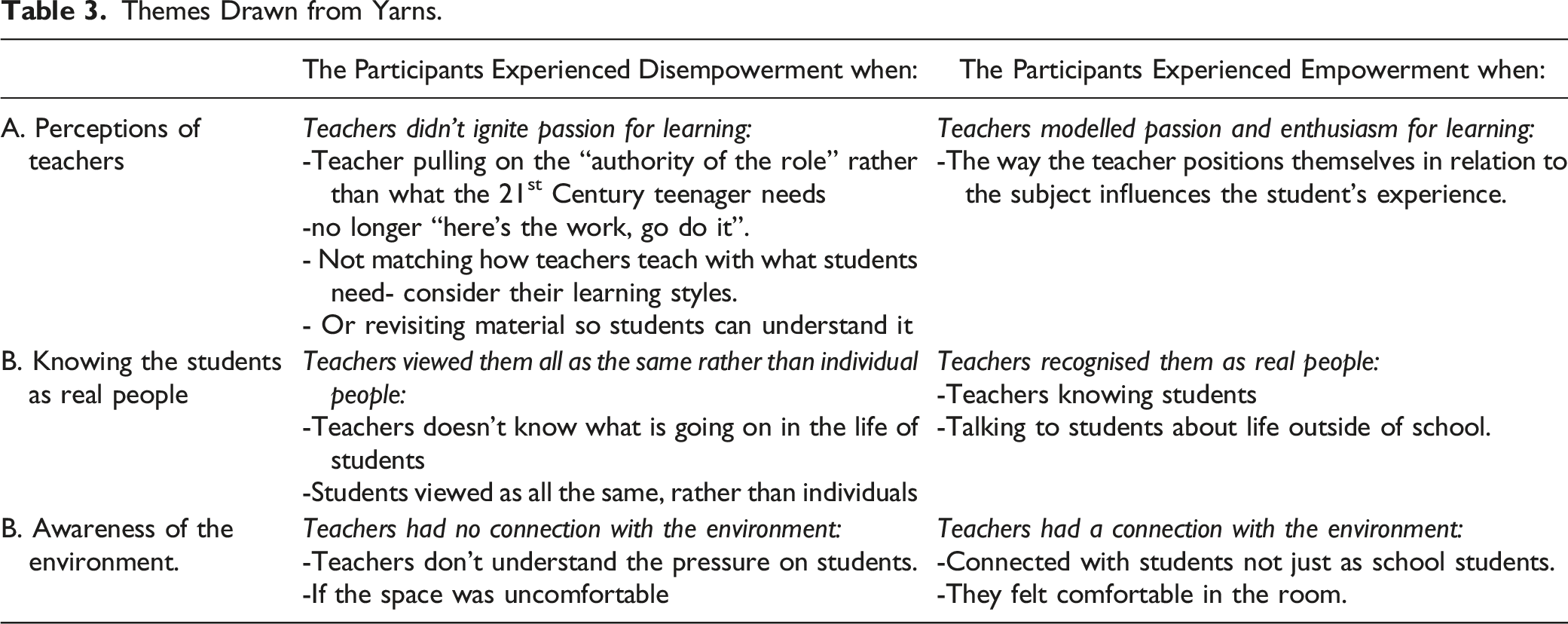

Common themes: Disempowered.

Common themes: Empowered.
Suggestions for Further Study
Studying the disparity between the way teachers teach and student experiences of such; I consider the limitations and make two suggestions for further study. To ensure that this research was truly congruent with indigenous epistemology, (Cajete, 1994; Ermine, 1995; Hoffman, 2013; Rosales, 2021) a consideration for further study would be to incorporate participant partnership in all the coding and dissemination of the data (Nicholls, 2009; Nind, 2011; Rix et al., 2022). Another consideration for further study would be to extend the phases in this project beyond student voice to include teacher voice. This could then open an additional phase for student and teacher exchange with the potential to: ‘kia whakamana ngā ao e rua kia hono’; honour and respect both worlds so that they come together in meaningful relationships.
Conclusion
This article has explored how non-indigenous researchers might engage with indigenous methodologies whilst maintaining the ethical disposition of doing no harm. This disposition begins with positionality. Through recognising our ontological and epistemological positioning, we find ourselves drawn to certain research approaches. The chosen research design in this project drew in part from my experience of marginalisation as an adoptee from a Romanian orphanage. Understanding that research is a journey in self-exploration, qualitative paradigms where we are invited to consider self in the research design is a natural choice over objective tools of inquiry (Taikwai, 2015). The tears shed during the design of the research methodology speak to the autobiographical nature of de-colonising/re-indigenising research. Wolterstorff (1980) describes how the marginalised rarely have their voices heard and the injustice they experience is often enforced on them by those in authority. The participants in this project are students' within a Christian institution who were asked to share their experiences of their teachers’ pedagogy. Investigating the most appropriate tools to honor these participants who chose to participate in this research was integral to the decision-making process. The aim and purpose of this article has been to advocate for autobiographical investigation into what research paradigm and methodology would honour and hold well, participant voice.
Footnotes
Declaration of Conflicting Interests
The author(s) declared no potential conflicts of interest with respect to the research, authorship, and/or publication of this article.
Funding
The author(s) received no financial support for the research, authorship, and/or publication of this article.
