




Abstract
Under the best of circumstances, learning to conduct qualitative research is challenging, both intellectually and emotionally. Engaging in such learning in difficult situations, such as a global pandemic, may heighten challenges while creating opportunities for truly deep learning. The purpose of this paper is to provide methodological insights to guide the growth of new qualitative researchers and inform the design of introductory methods courses based on the learning experiences of a group of graduate students conducting their first qualitative research projects. We present students’ experiences with choosing and planning a project, navigating relationships with study participants, and conducting observations and interviews. Explicit connections to qualitative methodology are offered for every stage of student research engagement. An analysis of the student authors’ experiences highlights the associated learning and innovation necessary to adapt to adversity when conducting qualitative research. Advancements in research reciprocity and human connection are presented, as experienced by the student authors. We conclude with implications and insights for teaching and learning qualitative research and ethical considerations that transcend pandemic circumstances. It is the intent of this manuscript to support the development of deep reflexive practice for new qualitative researchers, effective instructional approaches for those who teach research methods, and an insight into the power of diverse student researchers learning new skills together for the global research community.
Keywords
The global COVID-19 pandemic created tremendous upheaval at universities, interfering with most operations and particularly teaching and research processes (Teti et al., 2020). For qualitative research especially, the prohibitions around human interaction undermined some of the most basic tools an in-person researcher possesses. Facial expressions were covered by masks. Body language was obscured by video conferences. Social dynamics were distorted by social distancing. These important and necessary health precautions were disruptive to daily life and to many kinds of qualitative research.
Given the value qualitative research places on the interpersonal, these impediments were experienced acutely by a group of graduate students in an introductory qualitative research methods course in which they conducted their first qualitative research projects. In addition to the challenges that any new researcher might experience in a first project, the added pandemic safety measures and corresponding uncertainty transformed the learning experience for the students. Yet, the circumstances provided unique opportunities for learning, nuanced skill development, and adaptability that are useful to researchers of all experience levels.
The purpose of this paper is to present the experiences of novice researchers (graduate students) learning to conduct qualitative research during a pandemic. Guided by the principles of collaborative autoethnography (Chang et al., 2016), our collective experiences provide valuable insights for those navigating qualitative research under any circumstances. In the following section, we present literature on teaching and learning qualitative methods that informs this work, followed by methods, findings, and discussion. Finally, we present implications and recommendations for invoking a paradigm shift by exposing student researchers to the value and rigor of methods outside of a positivist perspective.
Literature Review
Literature on teaching qualitative research is limited in comparison to that of conducting qualitative research (Drisko, 2016; Eisenhart & Jurow, 2011) and very few studies focus on the learning experiences of students (Wagner et al., 2019). Still, themes include the importance of experiential learning (Cooper et al., 2012; Lapadat, 2009; Onwuegbuzie et al., 2012), intense student emotions (Hein, 2004), and shifts in paradigmatic perspectives (Richards, 2011). These themes inform both the design of the course at this study’s center and our subsequent analysis of our experiences. Teaching and learning qualitative research does implement, in essence, the same principles as conducting qualitative research (Hazzan & Nutov, 2014).
We build upon 10 principles of teaching and learning qualitative research posited by Hazzan and Nutov (2014) with particular attention to: Principle 5: Trust is built between the teaching staff and the students and among the students; Principle 6: Reflection is integrated into the learning process; Principle 9: Awareness to the researchers' emotions and to their role in the research is raised. (p.8)
Given that our teaching and learning occurred within the context of a global pandemic, we additionally highlight tenets of developing community and engaging in collaborative reflexivity.
Methods
This study leverages an interpretivist perspective (Glesne, 2016) on the collective experiences and perceptions of the author team’s student members, all of whom are both participants and researchers in this study. We began this work immediately upon conclusion of an introductory qualitative research course, when we were still closely connected to our reflective writing, learning experiences, and one another.
This study was guided by the elements of autoethnography, and specifically collaborative autoethnography. Roy and Ukesa (2020) recommend collaborative autoethnography as a particularly powerful approach for studying the experiences gained during the “methodologically challenging time” (p. 383) of the pandemic. Autoethnography is useful for critical reflection on the choices, behaviors, errors, and achievements we experienced in the course (Chang et al., 2016) and is designed to “retrospectively and selectively write about epiphanies that [stemmed] from, or [were] made possible by, being a part of a culture and/or by possessing a particular cultural identity” (Ellis et al., 2011, para. 8). In this study, the “culture” was that of the graduate class described in the following section; as members of the class, the researchers possessed that cultural identity in addition to their disciplinary and personal identities. Our collaborative autoethnographic approach enables us to “combine [our] energy and data to create a richer pool of data from multiple sources” (Chang et al., 2016, p. 89).
Research Context
To understand the context that influenced this collaborative autoethnography and resulting epiphanies (Ellis et al., 2011), it is essential that we detail the contexts relevant to this study. We begin with the course, which frames the timing, learning goals, and formal assignments that influenced the class and its participants. We then present the social context, a global pandemic, and briefly summarize the external circumstances that impacted instructional decisions and student learning.
Course Context
The course at the center of this study is a doctoral-level introduction to qualitative research methods, although some masters-level students were enrolled. Originally scheduled to meet in-person for three hours weekly, the course was moved to Zoom. The School of Education, which offers the course, requires this course for its PhD students and it is optional, but recommended, for doctoral students in other departments. The result is an interdisciplinary class representing a variety of research philosophies and priorities.
Glesne (2016) was the primary course text, chosen for its accessible and practical, but comprehensive, approach to conducting qualitative research. Additional readings, too numerous to fully represent here, included conceptual works (e.g., Braun & Clark, 2006; Creswell, 2018; Emerson et al., 2011; Geertz, 1973; Lapadat & Lindsay, 1999; select chapters from Denzin & Lincoln, 2005) as well as empirical papers demonstrating variety in qualitative approaches (e.g., Haddix, 2012; Muñoz & Maldonado, 2011; Sandoval, 2014). The course objectives were to: (1) Articulate the basic philosophical principles and primary constructs of interpretive inquiry and qualitative research; (2) Conduct, write, and present a qualitative research study as a reflective and reflexive researcher; and (3) Effectively critique and evaluate qualitative research reports and publications.
The purpose of this paper, to explore student research experiences, aligns primarily with the second objective. To achieve that objective, students conducted a research project of their choice, designed to repeatedly enact a cycle of experiential learning (Kolb, 1986). Topics were established via brief proposals that were reviewed by peers and approved by the instructor. Data collection included an observation phase followed by an interview phase. Students kept research journals in which they recorded personal reflections and project-related activities and notes. Students were never asked to share the entirety of their journals and submitted only excerpts.
Additionally, students wrote two major reflection papers, one focused on observations and one focused on interviews. Collectively, the research journals and reflection papers were designed to develop students’ reflexivity (Stevens & Cooper, 2009), specifically building the awareness one needs to navigate qualitative research (Emerson et al., 2011); those documents comprise this study’s dataset, described in detail in the Methods section.
Other key qualities of the course included early project selection and a course philosophy that explicitly encouraged low-stakes projects and learning from mistakes. Given that this course was the first exposure to qualitative research for many students, the project acted as a research sandbox, in which students could build confidence in observation and interview skills without undermining a funded project or future publication. The course design prioritized ethical research with deep respect and consideration for participants, alignment of research purposes, questions, and designs, in addition to iterative feedback and refinement.
Course meetings were highly interactive; a large portion of class was dedicated to discussion of progress on projects and navigating research processes. Activities included regular one-on-one and small group peer-review, the entire class “workshopping” a key component of one student’s work, and extensive time for open discussion and troubleshooting. The student group’s interdisciplinary nature was evident in these discussions, creating opportunities to compare and contrast disciplinary expectations and research designs.
Social Context
This study was conducted during the height of the COVID-19 pandemic, which resulted in almost 15 million deaths worldwide between January 2020 and December 2021 (World Health Organization, 2022). This study’s data were generated August through December of 2020 and subsequent research steps were conducted in January through August of 2021. During this time, our university, and much of the world, was closed to in-person activity for fear of disease transmission. As a result, we experienced fear, anxiety, and social isolation while continuing to teach, learn, and maintain our personal lives.
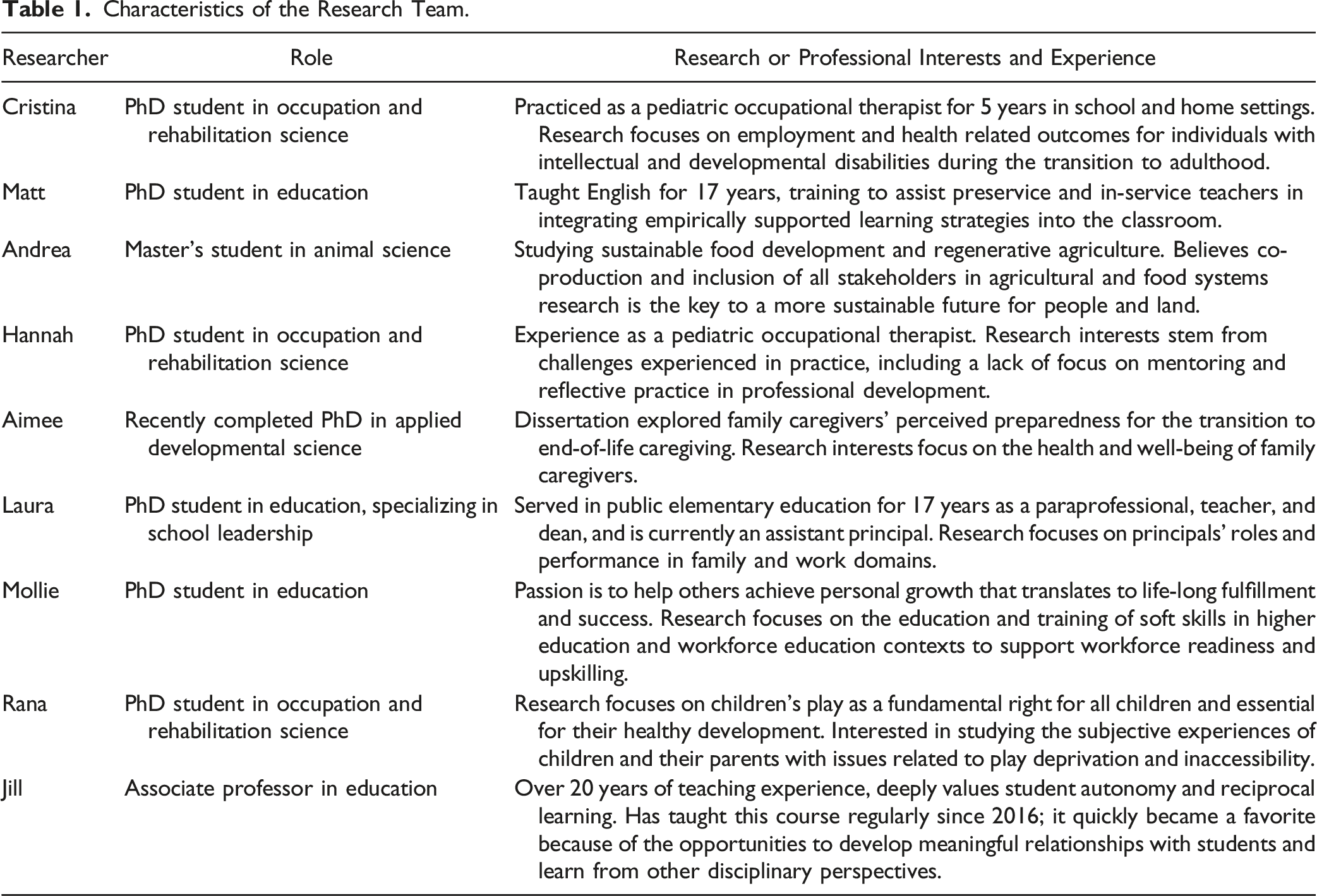
The Participant-Researchers
Characteristics of the Research Team.
Description of the Research Team’s Course Projects.

Data Sources
Our data set consists of combined, self-generated materials from the course, primarily text from our research journals (Emerson et al., 2011) and reflection papers. Each student-researcher reviewed their materials and decided what to contribute. The data represent student-researchers’ perceptions of research activities, engagement with research processes, and personal reflections.
In the process of building the collective data set, we redacted from our personal data any information about non-author classmates or participants in our semester projects. In the next phase, we read over the materials shared by other members of the team and marked any questionable content. The original contributor then completed the redaction to preserve meaning.
Ethical Considerations
Although this study does not report on students’ semester projects and our university’s Institutional Review Board (IRB) specifically discourages students submitting projects for review that are conducted entirely for a class under the supervision of a trained faculty member and not intended for publication, we proffer this manuscript as an exception to standard practice. For researchers at any level intending to publish their work, we suggest familiarity with your own IRB and erring on the side of caution to ensure the ethical conduct of the work.
Beyond IRB guidelines, our team engaged in several practices to ensure ethical collaboration as researcher-participants; We established an internal code of ethics regarding communication, how our collaboration would function, and what data we would use and when. As Jill stepped back from a leadership role and Cristina took on first author responsibilities, the project was student-led and student-centered, with the freedom to withdraw at any time and control over how our personal data were represented in text.
Data Analysis
The analysis process was conducted through shared online text documents. Student-researchers uploaded their chosen materials to files the whole team could edit. We generally followed the thematic analysis process of Braun and Clark (2006). After everyone familiarized themselves with the data set (phase one), our analysis began with a group brainstorm of important components of the research experience. Jill created an initial list of a priori themes (phase two) based on the initial discussion and her perceptions of the team’s collective semester works. Next, we iteratively expanded and revised the themes in an open group discussion and returned to code our own writing and organize data around those themes (phases three and four, searching for and reviewing themes). As part of this process we reviewed our data for missing themes.
For each theme, we worked in small groups to make sense of the body of data, as aligned with phase five, defining and naming themes (Braun & Clark, 2006). In some cases, this meant moving data from one category to another or including it in multiple categories. Through iterative discussion in phase six to develop our findings section, presented next, we refined a theme’s description or central idea, situated themes as distinctly different, and supported each with examples and quotes from our writing. Finally, we reflected on each theme’s connection to our methods course.
Findings
In the following sections, we present the themes derived from our analysis, beginning with the dilemma of choosing a reasonable and relevant semester project and selecting appropriate participants, then moving through foundational components of the research process: situating oneself on the participant-observer continuum, observing, and interviewing. At the end of each theme’s section, we present a description of how the issues comprising the theme relate back to the course or learning experiences, entitled Course Connections.
Choosing and Planning a Research Project
While researchers may have a general idea for their inquiry, selecting an appropriate topic requires significant forethought (Glesne, 2016). The study topic must be of interest to the researcher, but not be too narrowly focused and/or personal in nature. The scope of study must also be considered in mundane terms such as the time and money it will require to complete the project (Glesne, 2016). An additional challenge for many of us was positivist-leaning discipline backgrounds, meaning we had to (re)learn how to identify an appropriate research purpose and questions for a qualitative project. This section elaborates on the ways the pandemic presented even further challenges in getting started with our research projects.
Project Site Limitations
In addition to being confronted with selecting and planning research projects using a new-to-us research methodology, we experienced a number of distinct challenges selecting project sites. Due to physical distancing limitations, many of us had difficulty identifying observation sites that were open to the public and would provide adequate opportunities to observe social interactions. Aimee struggled to identify sites where older adults would congregate. As a high-risk population, many locations, such as senior centers, were closed or severely restricted in access. Rana had similar difficulties identifying locations to safely observe parents with playing children. Laura, researching and working in public school settings, noted that all local students and school employees were learning and working remotely. Andrea found complications in keeping observations and interviews consistent as the business hours of the cafe she chose fluctuated with public health guidelines. Factoring in the restrictions related to the pandemic added an unusual element of consideration and planning as we chose sites for our research projects.
Burden of Seeking Out Participants
Amid government-imposed restrictions and the subsequent rearrangement of everyday life, we were cognizant of the challenges that individuals, families, businesses, and communities were navigating. Rana and Andrea both found that approaching strangers to observe was more awkward and difficult because of the transmission risks. Laura knew that her coworkers (teachers and other school employees) were already distressed and felt her project would only work if she relied on those with which she had strong pre-existing relationships. Without exception, we struggled with the reality of burdening participants during an already trying time.
Delayed Consent Responses
Another challenge we encountered during the planning phase was the extended amount of time required to contact and communicate with potential sites and participants. Cristina reached out to a disability employment organization associated with a local children’s hospital but did not receive a response until 1 month after her request due to the extra resources and planning required to run the program within health and safety guidelines. It took Aimee almost 2 months of back-and-forth communication between herself, a manager, and an executive director to arrange for her observation at a long-term care (LTC) facility. Aimee’s site was particularly and understandably hesitant to welcome an outside researcher and all involved wanted to ensure proper procedures were followed. Given the time constraints of working within the boundaries of a class semester, we had to persist in our planning and communication as well as remain flexible to alter plans if arrangements took too long to coordinate or to receive approval.
Flexibility of Researchers and Participants
Despite the challenges associated with choosing and planning a research project, we and our participants demonstrated flexibility in adapting our approaches. Knowing her initial observation request with a local children’s hospital probably wouldn’t work out, Cristina quickly pivoted to a chain thrift store with the mission of employing individuals with disabilities and an essential business status. Similarly, Rana had to rethink how to obtain permission to observe parent-child interactions when most locations/organizations (e.g., daycares, schools, sporting events) were off-limits. Her flexibility in reconceptualizing her research goals led her to a community playground where she was able to establish relationships with parents, ultimately obtaining permission to observe parent-child play and interview parents.
Laura, reflecting on her own experience, marveled at her participants' willingness to adapt to shifts in learning environments (from in-person learning to online-learning) as well as her own adaptability in planning and executing her research project. Laura typically would have been able to choose any group of same-grade teachers to observe and interview. However, due to pandemic-related staff turnover, she had to identify a group of teachers that had remained relatively stable. We each learned the value of flexibility in planning and respecting the wishes and safety of potential participants while working to pinpoint our research purposes and questions.
Course Connection
The process for deciding on project topics and sites was supported by in-class discussion and check-ins over the first few weeks of class, and by a project proposal that received peer and instructor feedback. At this time students made major leaps in shifting outside of positivist comfort zones and this decision-making process set an important baseline for a classroom culture of support and problem-solving. Ultimately, choosing a research project at this time presented unforeseen challenges, which were overcome in a largely collective manner. Despite having individual projects, weekly in-class opportunities to detail struggles, vent frustrations, and receive timely feedback from a supportive professor and engaged classmates strengthened resolve during the learning process. In addition to helping us select and improve our projects, this collegial support was especially important in helping one another clarify understandings of the spectrum of relationships with our participants.
Spectrum of Relationships with Participants
Engaging in qualitative research requires varying levels of relationships with participants. Glesne (2016) identifies that no matter the aim and method, a level of rapport and possibly even trust is necessary. Qualitative researchers must navigate between balancing power and building relationships with participants. When conducting research with strangers, qualitative methods often mimic the experience of building new relationships, with periods of intense active listening and reciprocal engagement (Eide & Khan, 2008). This process can be beneficial, but also cause potential challenges when disentangling from the research project. Conversely, when conducting research with peers, “researchers must be mindful of their dual roles and make appropriate plans and decisions about how best to manage these” (McDermid et al., 2014, p. 33). Our author team began relationships with participants differently, which impacted our own learning experiences.
Depth of Collected Data
We reflected on the dynamics and intricacies of our researcher-participant relationships, which influenced the breadth and depth of the data we gathered. On one hand, those of us who conducted research with colleagues noted the opportunity for increased depth in data due to the existing relationship. For example, Laura was able to probe her interviewees about the changes she observed in them from last year to the time of her research during COVID-19, which would not have been possible without their shared history. Laura stated, “Because I know the teachers so well and had been through this crisis with them, I felt like the interviews were really meaty and honest.” Existing interpersonal relationships allowed for a level of comfort and a space for in-depth conversations between researcher and participants.
On the other hand, those who were conducting research with strangers expressed difficulty in having to start at the beginning with participants. Aimee noted that it was difficult to make requests to speak with family members of LTC residents who had no idea who she was; she wrote, “I believe my observations would have been much more successful… if I had had even more time to set the project up, get to know families.” Since Aimee was unable to spend unscheduled time getting to know residents and their families, she felt limited in building depth in her project. Andrea felt similarly about her site at a cafe. She knew that conducting interviews on the fly was already difficult but interrupting what might be someone’s only chance to be out of their house made it hard to engage in the genuine interactions that lead to rich data collection.
Use of Positionality
Across the researcher-participant spectrum, we found ways to leverage positionality to support data collection. Those who were strangers to their participants noted using other connections to participants to accelerate the development of trust. For example, Rana wrote, “I decided to draw on my insider status, introduce myself as a parent, and bring my son with me to the park. Having something in common helped me to have natural ongoing interactions with parents.” Aimee leaned into the personal challenges she shared with participants: “I think we are all a little starved for personal connection, and this project, even during COVID-19 restrictions, provided an opportunity for that connection.” Andrea leveraged her acquainted relationships with café employees to make it easier to engage with strangers. She noted a visible ease in her participants' stature after sharing an exchange with both an employee and herself prior to research interviews. These experiences demonstrate ways we worked harder to find common threads and build relationships with unfamiliar participants.
Alternatively, those who were close colleagues with participants found themselves thinking harder about their positionality more than using it to their advantage. Hannah identified that her previous relationship to her participants “required additional interrogation of positionality to make sure [she] didn’t make incorrect assumptions based on prior knowledge.” With limited qualitative experience, special attention was required to check assumptions in research where it would have been easy to feel confident. Laura identified that her knowledge of participants’ lives outside of her research project impacted the research itself. Further, as an administrator she needed to be conscious of power dynamics when making requests of teachers. Laura wrote, “I have come to realize that my research goals must be practical and hold some meaning for others that I work alongside.” Within various contexts, the shifts in our course and research challenged us to contemplate positionality and consider different ways of interacting with participants.
Course Connection
The spectrum of relationships we maintained within our own research domains and our prior research training heavily influenced discussions of how we wanted to relate to our project participants (Glesne, 2016). Concerns were expressed both ontologically in planning our career trajectories and practically in completing the semester-long projects. Bringing details to class each week about our respective positionalities and the individual paths we faced establishing and/or maintaining relationships with participants anchored us during a tumultuous semester. On many occasions, students would come to class overwhelmed with concern about safely and compassionately navigating participant relationships. On as many occasions, those same students would leave feeling confident they were engaging in meaningful work. Bolstered by incisive and constructive advice on how to caringly work with participants, guidance that came in part from Jill, but first and foremost from one another, we more confidently navigated unfamiliar research terrain.
The Participant-Observer Continuum
Although oxymoronic as a term (Glesne, 2016), participant observation is a necessary method for conducting qualitative research. As students, we learned participant observation is a continuum to be navigated throughout fieldwork. Fox (2004) describes participant observation as “a dynamic equilibrium between participation and observation - a continuous balancing and rebalancing of involvement and detachment” (p. 314). The appropriate point along the continuum can be influenced by the nature of the research question, the paradigm of inquiry, characteristics of the researcher, as well as point in time of the fieldwork process.
Glesne (2016) describes four points of the participant-observer continuum in qualitative research. On the observer end of the spectrum, people do not necessarily have awareness they are being observed by a researcher who uses methods like blending into surroundings or observing through one-way glass. Next is observer as participant, in which the researcher primarily remains an observer, but interacts a little bit with participants. As researchers increase their contextual levels of interaction, they shift towards participant as observer, moving closer towards being a member of the group they are studying. The final point on the continuum is that of full participant, where a researcher acts as both investigator and group member. Typically, the delicate balancing act of moving along this spectrum would prove challenging for novice qualitative researchers, and the pandemic presented further opportunities and challenges for learning to traverse the line between participant and observer.
Observer as Participant
The observer as participant was a common starting point on the continuum for us. For example, Matt was a quiet observer, but this changed during his third observation when the class instructor asked him to explain a concept in which he has expertise. After sharing, Matt was drawn into the group; students included Matt in their discussions, and he had more opportunities to participate during observation periods. Later, when Matt sought students to interview, the process seemed more natural and comfortable for both parties.
In similar fashion, Hannah was also professionally experienced in the setting she was observing, but she had to consciously balance her responsibilities as a researcher with her competing interests as a clinician. Hannah wished to remain clear in her research purpose and therefore started towards the observer end of the continuum. Unfortunately for Hannah, and other researchers hoping to maintain anonymity, there is no one-way glass in a virtual meeting room. Yet, as time went on, Hannah found her participation was encouraged by other clinicians: “I practiced being more of a participant [which made] me feel more like part of the group.” In addition to feeling more comfortable in the room, Hannah observed that her participation made others more open to her presence. When she later asked for interviews, participants had context for her research purpose and were inclined to accept. Participating in group meetings also gave Hannah insight into some of her interviewee responses and interviewees appeared to have greater confidence that Hannah understood their perspectives and would portray them accurately.
Participant as Observer
In contrast to Hannah and Matt, Rana began observations as participant as observer, interacting naturally with potential study participants. This allowed her to gain a unique and intuitive understanding of the community culture and how parents relate to each other. Participant as observer was an effective way to grasp some nuances embedded in interactions in a play environment and engage parents to talk about sensitive topics. However, engaging as more of a group member was not without its challenges. Rana had to be aware of how her own experiences might influence her interpretation of her observations. As she positioned herself towards the participant end of the continuum, juggling her roles as group member and researcher meant she needed to pay extra attention and continually bring herself back to her research purpose. Rana remarked, “my intention was not to separate myself from my research, but rather, to encourage myself to be reflexive and mindful of my own personal biases and not be resistant to what I observe.” Rana, like others of us, used her relationship to her participants as a starting point to reflect upon her positionality as a researcher.
Unlike Rana, Mollie did not have ‘insider’ status with her research subjects. She sought a participant as observer role during observations and was interested in exploring the continuum by attempting to assimilate and personally connect with her participants. Reflecting on her experience, she stated, “I knew I wanted to create trust with these participants” and “I wanted them to see me as part of the team.” Utilizing this position on the continuum allowed Mollie to develop meaningful relationships with her participants as well as goals for her interviews.
Course Connection
Navigating the participant-observer continuum was an individualized process, yet by bringing these experiences to share with classmates, we gained insight into choices and experiences outside of their own projects. Further, we were pushed to appreciate the fluidity of the researcher role in qualitative projects by the encouragement of our peers. Through individual and group reflexive practices, we began to truly understand and value the influence of the participant-observer continuum on the nature of knowledge within our respective research contexts. The broad range of disciplines and study topics presented an opportunity for learning about choices that differed from one’s own and seeing the value of a variety of approaches to observation and participation.
Conducting Observations
Observation is a fundamental data collection approach in qualitative research (Smit & Onwuegbuzie, 2018). Glesne (2016) described observations as a process of observing “everything that is happening” (p.70) and noting “what you think and feel as well as what you see and hear” (p. 71). Likewise, McKechnie (2008) characterized observation as a method that entails “collecting data using one’s senses, especially looking and listening, in a systematic and meaningful way” (p. 573). Here we detail our experiences conducting field observations during the first year of the pandemic.
Virtual Observations
Researchers who conducted virtual observations found it challenging to move along the participant-observer continuum, particularly related to the difficulty of capturing non-verbal communication. Hannah noted that virtual observations enabled her to observe non-local participants, which was beneficial, but she found it difficult to attend to anything other than the verbal contributions of participants. She wrote that she yearned for more “use of my other senses” expressing frustration that she could not experience the true meeting environment. Specifically, she felt unaware of group interactions occurring beyond the virtual meeting space.
In a similar vein, Mollie reported, “Many of the subtle nuances that would constitute a description of human interaction are lost when communicating over a virtual call.” While she indicated observations had become “monotonous” with “scarcer” new observations, she recognized a need for new approaches to build trust and engage with participants. Mollie then evolved her observational approach through “engaging early on by asking questions and chiming into team conversation.” By moving along the participant-observer continuum to connect with participants, Mollie was open to the experiences that became accessible to her and flexible with her approach to virtual observations to accommodate for the lack of nonverbal cues. Our experiences of virtual observations align with those described in Rahman et al. (2021) in that the types of data collected virtually differed from that of in-person observations.
In-person Observation
For those who were with participants in-person, changes in the physical environment added a layer of complexity to observations. While it was not our intention to study the pandemic and its impact, our field observations were influenced by these environmental changes. As such, Matt’s notes include “many descriptions of people’s hair, clothes, and masks. Not much description about their faces nor their expressions.” However, because of this, we learned to pay closer attention to other aspects of human communication, such as participants’ tone of voice, to corroborate our interpretations and to maintain elements of thick description (Geertz, 1973).
The limited social and physical interactions resulted in feelings of discomfort and obtrusion among researchers. Aimee described that with “the distance between each visitor, the face masks, the interrupting staff member, and my awkward intrusion, it was almost laughable that this passed as an opportunity for family connection.” Rana noted, “some parents were overprotective of their children… I felt uncomfortable approaching some of them.” Matt felt similarly. He found it “difficult to hear what was being said by more soft-spoken groups farther away from my seat. Furthermore, I did not feel comfortable roaming the classroom to observe small groups due to the pandemic and wanting to respect students’ concerns about infection.” Matt therefore had trouble effectively conducting observations in a socially distanced classroom.
Course Connection
Whether in-person or virtual, almost all of us began the observations as an exploratory process before deciding on a specific research purpose or question. Instead of “what influence does x have on y?” we began to inquire “how is this phenomenon experienced?” In the field sites, many of us tried engaging in various roles along the participant-observer continuum as possible. Class discussion and feedback from peers was critical as we grappled with the questions “what am I looking at/for?” and “how does this inform my research?” More broadly, we engaged in constructive, open dialogues with classmates about using/modifying different observational approaches to gain familiarity with participants and contexts. Peer reviews of our raw observational data and frequent, collective discussions concerning descriptive and analytic notes helped us improve our observational skills and ability to home-in on what was important in the field. Subsequently, we learned to expand our capacity to understand participants’ behaviors and deal with the discomfort and awkwardness as we engaged in our field observations and started transitioning to the interview phase (Erickson, 1973; Glesne, 2016).
Conducting Interviews
As interviewing is a critical component of qualitative research to develop insight and understanding, students were expected to conduct interview sessions in this course to complete their chosen project. Glesne (2016) describes interviews as the opportunity to “stimulate verbal flights from respondents who know what you do not. From these flights comes information that you transmute into data □ the stuff of dissertations, articles, and books” (p. 97). Though interview sessions were successfully conducted by each student, we were each forced to adapt the interview processes to social and public health requirements. As a result, these interview sessions were unusual in terms of environment, participant cues, and research reciprocity.
Setting the Interview Environment
Glesne (2016) suggests the researcher should take care in creating the interview environment by seeking a quiet, private, and physically comfortable space. During this time, visiting someone’s home posed a risk, and many businesses and public spaces were closed, unavailable, or open with limited seating. We were each faced with a difficult decision to conduct virtual interviews (by phone or video) or evaluate how to safely conduct interviews in-person. Aimee conducted in-person and virtual interviews, two of us conducted interviews virtually, and five of us interviewed entirely in-person.
Those of us who conducted in-person interviews worked to find quiet and physically safe public spaces. Matt reported a lack of choices on the college campus, as he attempted to make meeting locations convenient and safe for students. Matt shared “we met in the foyer of the same building where they had class…[the] interview was repeatedly interrupted by other students…milling around and chatting in between classes.” In contrast, Mollie reported that social distancing was an asset to her in “creating a faux private interview space, as the tables were widely spread throughout the restaurant.” Mollie and Matt’s experiences highlight the constraints and opportunities of safe, public settings suitable for conducting interviews.
Though virtual participants could choose a comfortable space for themselves, interruptions and distractions were unexpected. Hannah, who conducted virtual interviews, reported she was “unable to control distractions or pulls for attention during the interview,” as one interviewee interacted with colleagues in close proximity. During a telephone interview, Aimee wrote that when “a participant paused, I didn’t know if it was because they were deep in thought, emotional, or distracted by something in their environment.” She judged that the participant’s level of engagement was lacking compared to her in-person interviews. These experiences represent the struggles incurred due to lack of control over the environment.
Loss of Nonverbal Cues
Glesne (2016) suggests the researcher must constantly watch for nonverbal cues and listen to the spoken words, while also paying attention to inflection and tone of voice, surroundings, time, and other factors. Interview participants’ nonverbal cues allow access to deeper understanding and are important to document throughout interview sessions. However, nearly every team member reported that their inability to observe nonverbal cues hindered their ability to interpret participant behaviors during sessions, and likely limited their data collection.
For in-person interviews, researchers had difficulty catching nonverbal cues due to participants’ face masks, which hid mouth movement and muffled voices. Matt said masks “made it more difficult to pick up on some expressions and nuances of in-person communication.” Rana found the masks hindered her ability to clearly understand and interpret what participants were saying. While this was also a challenge for observations, in interviews there was less context for responses, and tasks that competed with recording nonverbal cues.
Researchers who conducted virtual interviews faced the challenge of a limited view of participants, usually shoulders up. Hannah reflected, “some interpersonal nuance (connection, emotional expression, small gestures) is lost in virtual interactions.” The limited view may have meant lost cues about interest and engagement during the interview, such as a participant fidgeting in their seat. Researchers who conducted phone interviews were further hindered by being unable to see their participants at all. Aimee, who conducted a telephone interview, stated “phone calls make it impossible to see facial expressions, body language, emotional responses, etc.” which caused ambiguity regarding how the participant was reacting to the interview.
Qualitative researchers gain insight from nonverbal communication (Beattie & Shovelton, 2011; Holler, et al., 2009), but some researchers from this course lost opportunities to capture such subtle nuances significant to interpretation. To make up for the loss, researchers inherently focused on less obvious cues and signals (e.g., eye contact and inflection of voice) and uncovered meaning beyond the spoken words of participants despite the challenges.
Research Reciprocity
Reciprocity can be considered a social “give and take” between the researcher and participants and is judged by the researcher in terms of appropriateness in every research setting (Schwandt, 2015). Jill required us to reflect upon how we might convey reciprocity during our studies. Some of us chose to offer participants small gift cards or buy them a beverage as a tangible thank you. We learned later of the intangible reciprocity the interview sessions provided for participants during the pandemic’s loneliest times.
Many of us had participants who expressed appreciation for the meaningful conversation and human interaction the interview sessions provided. Matt reported “more than one interviewee expressed gratitude for the opportunity to meet in person as they had been following protocols and staying at home.” He also had one participant who felt “being able to come out to meet me for the interview offered her purpose […] the interview…had given her a renewed sense of normalcy - being able to come out to a public space and chat. “Similarly, Rana experienced a heightened connection with her participants during interviews. She felt “like these participants were craving some social interactions and wanted to talk to someone who could listen to them. It felt like these interviews provided them with an opportunity to destress and disconnect their minds” from the worries of the pandemic.
Aimee reflected on interview experiences, recalling how appreciative her interview participants were to talk about their frustrations with the current situation for LTC residents. She noted, “In two different interviews… my participants had to pause at the start of the interview because they were both overcome with emotion about being able to talk to someone about what they were going through.” Aimee provided a safe space for these participants to express their frustrations and recalled her experiences providing comfort to them as well: “One of the things I tried to communicate with each participant was that the things they were experiencing and the frustrations they had were shared by many of the individuals I talked to. I believe my engagement as a researcher and facilitator of the interviews brought some relief in the form of recognizing they were not alone.” Though Aimee was unable to meet all of her participants in person, she was able to offer comfort and support when they needed it most.
For many participants, especially those without local family, isolation was their new normal. One of Mollie’s participants expressed that the in-person interview was “the first time he had talked with someone face-to-face in over 4 months.” During the interview, he shared personal obstacles and divulged “details of his recent break up alongside the feelings he suffered of loneliness and isolation.” Though only scheduled for an hour, she talked with this participant for 2.5 hours about “topics pertinent to both the interview questions and his personal life.” Mollie skillfully navigated this intense emotional territory and experienced a deep understanding of how intimate participant-researcher relationships can be, a lesson directly attributable to research during COVID-19. Reciprocity was intangible and did not hold monetary value but came as an opportunity to connect as human beings during trying times.
Course Connection
These interview experiences exemplify our collective learning regarding the interview environment, nonverbal cues, and reciprocity. In class, we practiced interview skills and piloted our interview protocols with peers, acting as both interviewer and interviewee. This pilot time together was invaluable given our perceived lack of control over interview environments. We gained instant feedback on our interview preparations and, by doing so, we all experienced the vulnerability on each side of the conversation. As interviewers, we felt the power and burden of asking prying questions and the vulnerability of being dependent on another person to achieve our research goals. As interviewees, we experienced the awkwardness of trying to tell someone what they want to know. Though unexpected, we learned a greater lesson through the simple acts of asking and answering questions: the power of human connection.
Discussion and Implications
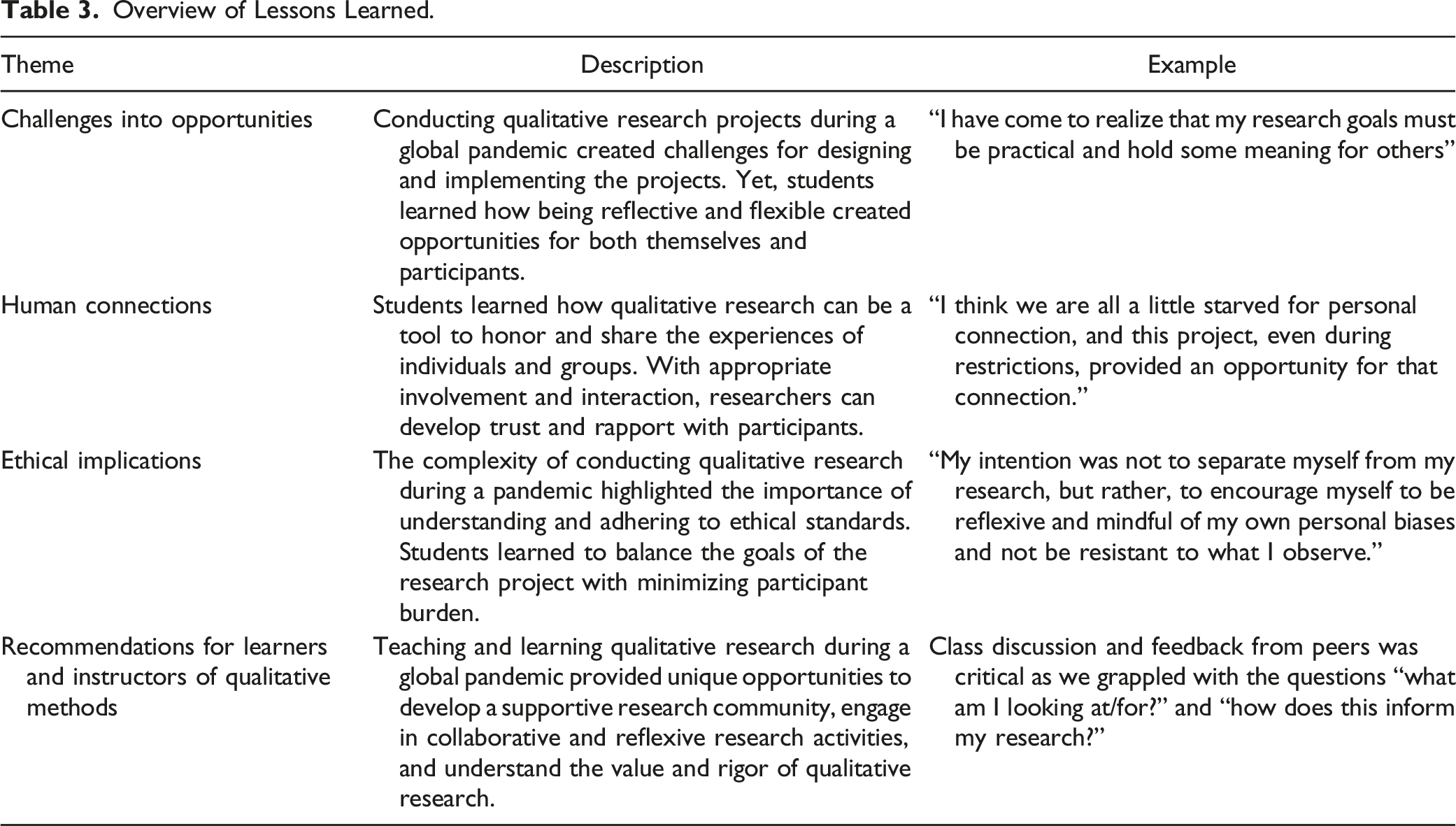
Overview of Lessons Learned.
Challenges Into Opportunities
Students new to qualitative methods may feel uncertain about developing and implementing their first research project. As we learned, with effective training, guidance, and trust, as aligned with Hazzan and Nutov’s (2014) principles, they can experience qualitative research methods as intensely rigorous but inherently flexible. Newman et al. (2021) emphasize the “thoughtful and deliberative approaches” required of researchers to navigate virtual research methods (p. 8). Developing strong reflexive thinking skills can aid students in making project decisions (Hazzan & Nutov, 2014; Stevens & Cooper, 2009) while considering ethical, feasibility, and contextual factors. Offering qualitative method courses to interdisciplinary cohorts promotes a breadth of experiences where students can benefit from unexpected commonalities and more opportunities to learn from each other (Bass et al., 2022). Novel experiences developing their own qualitative study can push students to explore their research domains through a new lens as they worked through repeated cycles of experiential learning (Kolb, 1986). As students design and implement qualitative studies (Hazzan & Nutov, 2014), they learn how to seek alternative and creative approaches while preserving research quality (Creswell, 2018; Tremblay et al., 2021).
Human Connections
Glesne (2016) encourages new qualitative researchers to engage with participants by developing rapport, expressing gratitude, and being reflexive in questions and interpretations. As reflexivity was part of our learning process (Hazzan & Nutov, 2014), we gained appreciation for diverse perspectives, especially as we found ourselves at different points along the participant-observer continuum. Novice researchers may be surprised to find interaction with others welcomed and, in some cases, as we experienced, desperately needed. The pandemic-based isolation coupled with our qualitative research training helped us meaningfully connect with participants, attending to our own emotions as well as those of our participants (Hazzan & Nutov, 2014).
For example, although some traditional communication cues were lost during virtual interviews or obscured by masks in person, human relationships were not deterred. Laura experienced a deeper connection with her participants/colleagues as she probed their pandemic-related resilience. Rana enjoyed natural and playful interactions with her participants/other parents at a park. Matt and Hannah describe being drawn into the group by engaging in content-specific conversation with their participants, with mutual enjoyment. Aimee reflected with her participants on the experiences of finding new ways to connect with family remotely. Mollie gained a friend, explaining “I really learned that my role as a humanitarian does not have to be diminished when I step into the role of a researcher; I can be both simultaneously. In fact, this has shaped my perception of what kind of researcher I aspire to be.” Cristina was inspired to write a new grant following her project’s completion. Andrea is pioneering the use of qualitative methods over traditional quantitative approaches in her field. The paradigmatic shifts we experienced as a result of this course are clear. We attribute our valuable learning experiences to the vulnerability and accountability we shared in our introductory course, as aligned with Hazzan and Nutov’s (2014) principle five. A pandemic was a unifying event for this group of novice researchers, but the insight we gained applies to all students and teachers of qualitative research.
Ethical Implications
Ethical issues are foundational to all qualitative research (Traianou, 2014). Conducting projects during the pandemic created ethical challenges and subsequent learning opportunities relevant to all new qualitative researchers. For example, in addition to privacy and consent (Archibald et al., 2019; Lobe et al., 2020), qualitative researchers must consider how to best respect participants’ health, livelihood, and emotional states. A heightened awareness of stressors can attune learners to avenues of flexibility and respect for persons that establish rapport between researchers and participants. Qualitative researchers must consider if the benefits of the study outweigh the burden that participation may carry for individuals balancing family and employment roles, health challenges, economic insecurity, and racial and ethnic injustices (Santana et al., 2021).
Additionally, researchers must extend awareness of stressors beyond individuals. For example, businesses and other organizations were challenged with capacity and distancing restrictions, stringent cleaning precautions, and an economic downturn. Researchers must assess community, cultural, and societal implications of their research conduct. Ultimately, the challenges student learners face ensuring adherence to research ethics will strengthen their ability to identify unique ways to answer complex research questions.
Recommendations for Learners and Instructors of Qualitative Methods
Learning qualitative research methods is paradigm shifting, as it exposes researchers to the value and rigor of research outside a positivist perspective (Hein, 2004; Wagner et al., 2019). Preparing students for research is the goal of methods courses regardless of societal or historical context (Eisenhart & Jurow, 2011). To advance the scholarship of teaching and learning qualitative methods, we recommend principles of developing community and engaging in collaboratively reflexive activities.
With guidance from teachers, students should establish a classroom community (regardless of modality, whether in-person or virtual) with norms and agreements about how to work together and support each other in the learning process. When sharing learning challenges and personal struggles, the class becomes a place of comfort and support. Student-to-student relationships develop from the collaborative learning environment (Bass et al., 2022; Hazzan & Nutov, 2014). This connection will naturally extend to teachers who facilitate these opportunities (Richards, 2011). Together, students and teachers can embrace the clash between the personal and professional. This human connection may change how instructors think about teaching and how students think about learning, making it easier to be vulnerable. Learning to understand more nuanced and vulnerable communication with one another will extend into fieldwork with participants. As we experienced, this supportive environment for learning, or a “safe to fail” classroom, supports deep and meaningful learning processes for students.
Collaboration is integral to the learning process. As students discuss their collective breadth of research activities, individual projects are supported and students learn about diverse approaches to research methods. While reflexivity is an important tool students can learn to wield through private reflection and journaling, providing time for discussion both during class and in assignments yields a mechanism for synthesis of qualitative methods and supports thoughtful professional practice (Stevens & Cooper, 2009; Schön, 1983, 1987). Teachers can encourage active learning by allowing for peer feedback and problem solving before sharing their feedback. Such peer interaction encourages skill building, as in Vygotsky’s (1986) zone of proximal development, which highlights the difference between what a person can achieve alone versus with the support of others. Strong emotions are expected when encountering qualitative methods for the first time. Our feelings of anxiety were pronounced due to the global social context, but through collaborative reflection, we moved quickly from fear towards acceptance and further to confidence. We recommend that making space for developmental and problem-solving conversations, which have a value distinct from seminal readings and conceptual discussions, is paramount in supporting students to navigate shifts in their paradigmatic approaches to research.
Conclusion
“Though history is unlikely to record their names, some men have undoubtedly been driven to desert science because of their inability to tolerate crisis” (Kuhn, 2012, p. 79). While the interruptions caused by a pandemic were more contextual than the scientific crises Kuhn writes of, they were no less disruptive. This paper extends the findings of others adapting to the COVID-19 pandemic (Archibald et al., 2019; Lobe et al., 2020; Newman et al., 2021; Rahman et al., 2021) by demonstrating that the flexibility of approaches in qualitative methods are beneficial to novice researchers learning to design projects during crisis. We discovered that collaboration aids in learning principles of qualitative research and reflexivity. With these foundational tenets, students can design and implement qualitative research projects with restrictive environments, limited resources, and few participants. For qualitative research instructors and those who mentor new researchers, this paper serves as a reminder of the value of careful consideration of teaching methods for qualitative research and creating a safe space for students to learn, grow, and build connections with others. Ultimately, our experiences, findings, and the lessons we shared will help advance the scholarship of teaching and learning qualitative research methods.
Footnotes
Acknowledgments
The authors wish to extend their gratitude to the diverse group of individuals who gave of their time to participate in graduate student research projects during the COVID-19 pandemic.
Declaration of Conflicting Interests
The author(s) declared no potential conflicts of interest with respect to the research, authorship, and/or publication of this article.
Funding
The author(s) received no financial support for the research, authorship, and/or publication of this article.
