




Abstract
The respect for ethical principles is required during the entire scientific research process, including the dissemination phase. Due to the dynamism of qualitative studies, there are often adverse ethical situations. The aim of this integrative review was to analyze and synthetize ethical dilemmas that occur during the progress of qualitative investigation and the strategies proposed to face them. The search for studies used LILACS and MEDLINE databases with descriptors “research ethics” and “qualitative research”, originating 108 titles. Upon reading all titles, 42 articles were elected according to the inclusion criteria. The main conflicts were related to confidentiality breach, disregard of autonomy, potential damages, confusion about the roles of researcher/therapist/friend, and impasses in the Research Ethics Committees. Various types of conflicts may occur in a research. The solutions proposed are based on self-awareness, reflexivity, continuous consent, and ethical mindfulness.
Keywords
Introduction
Qualitative methodologies originated from human and social sciences are increasingly used in the health area due to the need of a multidisciplinary approach for problems arising in this field of knowledge. From an ethical viewpoint, conducting research with vulnerable populations requires protection for them because data collection methods, such as in-depth interviews with sensible themes, can delve into interpersonally and politically charged matters, which can create potentially conflicting situations (Peter, 2015). Finding the best way to deal with such situations in order to ensure the protection of participants without jeopardizing the quality of the research is not always an easy task.
Every scientific research conducted with human beings must have a clear and relevant justification, participants must be freely and properly informed about the research including its risks, benefits, and consequences, and their agreement on participating must be given without them being coerced or convinced. Confidentiality must be respected and occasional damage must be repaired (Webster et al., 2014).
The ethical principles that guide a scientific research are based on the assurance of human freedom and dignity. They are expressed in ethical codes and guidelines used by Research Ethics Committees (RECs), which are the instances that regulate research conducted with human beings. The purpose of these regulations is to protect participants and ensure research ethicality along its entire development (Kottow, 2008). However, a number of unexpected situations may arise during a qualitative research, which require making decisions that are not comprised within the basic ethical principles. Qualitative research is a dynamic process and unpredictable events can occur; thus, it is crucial that the researcher is able to foresee possible hindrances and prevent them from happening. As a consequence, ethical codes and norms do not always suffice for the solution of problems that appear in the research practice. Many emergency dilemmas arise within a given context and therefore require situational solutions, always keeping in mind primarily the participants’ needs.
Qualitative research is a thorough and complex activity because the researcher is a subject inserted in the society under study; he/she performs the research and simultaneously suffers its influence, being thus confronted with ethical issues. Because studies are conducted with human beings and not on human beings, there is an influence from the context, often requiring from the researcher the adaptation of ethical rules and norms to the situation being experienced, sometimes leading to a dilemma. Therefore, the ethics of a research is not limited to respecting norms, directives or the approval of an ethics committee, as many researchers seem to believe (Morse, 2015). The ethical integrity of the research is under the responsibility of the researcher and is undissociated from its scientific quality. If ethics fails, there is no quality in data and vice-versa. Ethical issues are present in the entire trajectory, from the selection of the object, going on to the definition of the theoretical bases, objectives, methodological framework, and continuing into the interpretation and dissemination of outcomes, whether to the researched persons, scientific community, managers or the entire society (Webster et al., 2014). A qualitative study, though not involving procedures of direct risk to participants, includes the possibility of causing harm to the human being’s physical, psychic, moral, intellectual, social, and cultural dimensions, at any one of its phases, as a result of it or a posteriori (Kottow, 2008).
In view of these observations, it becomes evident that in the development of qualitative research, diversified situations may occur that can lead to ethical conflicts. The main motivation for the authors to undertake this review study was the questioning about what are the main conflicts faced by researchers in their practice and how have they been dealing with them. The main objective of the study is to analyze and synthetize the existing set of knowledge on ethical conflicts in qualitative research with the purpose of facilitating its dissemination among researchers, but also to inform those who are not aware that research ethics is not limited to the approval from a research ethics committee.
Method
An integrative review was conducted of articles published in scientific journals indexed on bibliographic databases LILACS (Latin American and Caribbean Health Sciences Literature) and MEDLINE (Medical Literature Analysis and Retrieval System Online), via PubMed. These databases were chosen because they aggregate the greatest number of scientific journals in the health area. The following stages were followed: identification of the research theme and question; definition of inclusion criteria; data collection; data analysis and classification in categories; interpretation of outcomes in dialogue with the literature; and synthesis of the produced knowledge (Mendes et al., 2008).
The search was made on September 22, 2020 using the descriptors “research ethics” and “qualitative research” with no time frame, originating 108 titles. The inclusion criteria were: full text available; original article resulting from empirical research with human beings, on the theme of ethical dilemma; in the languages Portuguese, Spanish, and English. After reading the titles and abstracts, 20 texts were excluded for the following reasons: six were editorials; two were commentaries; two were conferences; five were books; four were theses; and one was in the veterinary area. From 88 articles fully read, 46 were excluded because: 24 were not based on empirical studies; eight focused on other themes; seven were review articles; and seven did not have the full text available. Finally, 42 articles were elected, fully read twice by two researchers, independently. The content analysis was made with the classification into categories. Then, together the two researchers debated convergencies and divergencies in their interpretations, constructed the classification of ethical dilemmas presented in the outcomes, and made the synthesis of the knowledge resulting from the analyzed studies in debate with the scientific literature. Figure 1 shows the flowchart of the review. Study selection chart. Adapted from the PRISMA group 2009 flowchart.
Besides the articles of this review that will be presented on tables in the results, another 19 titles were included in the introduction and in the discussion of data.
Results
The 42 analyzed articles are distributed in five tables according to the main category of implicit ethical dilemma in which they were classified. The tables also contain data on the country where the investigation was conducted, its aim, study design, and main results/conclusions. It is worthy of note that several studies focus on more than one ethical dilemma; therefore, they were classified in more than one category.
In terms of geographic distribution by continent, it was verified that the majority of studies were conducted in Europe (n=16), comprising nine in the United Kingdom, two in Ireland, two in Spain (one in partnership with Brazil), and one in each of the following countries: Norway, Denmark, and Finland. In second place in number of studies is North America (n=15), comprising eight in Canada and seven in the United States of America. Seven studies were conducted in Oceania, comprising six in Australia and one in New Zealand. In Asia, there was only one study, in Israel. In South America, the studies were only in Brazil, with four studies (one was in partnership with Spain). There is no study in this review conducted in Central America or Africa.
The experiences of research and handling of conflicts presented by researchers demonstrate a variety of situations that can raise ethical questionings, the dynamism in the progress of the study, and the need to rapidly take action in order to prevent damage both to those involved and to the investigation.
The ethically conflicting situations presented by the authors were classified into five categories according to the type of risk found: I - Conflict related to disregard of confidentiality/anonymity; II - Conflict related to disregard of the participant’s autonomy; III - Conflict related to the risk of causing damage to participants/researchers/research; IV - Conflict caused by mistaking the roles of researcher/therapist/friend; and V - Conflict caused by project evaluation by RECs.
I - Conflict related to disregard of confidentiality/anonymity
There are two main typifications regarding the conflict related to disregard of confidentiality/anonymity. The first one is when there is a risk of confidentiality breach and the second is when there are other greater risks, in case the previous one is not halted.
In the first case, various conditions often occur that pose risk to the research’s anonymity. For instance, when it is conducted with individuals who occupy key positions, such as power posts, uncommon jobs, unique positions, it can be easily identifiable when publicizing the outcomes. Another example is the performance of studies with couples or persons in intimate relationship in which the researcher inadvertently reveals in his/her questions information of another interviewee that are recognizable or even used in the replies. This also happens in research in small communities in which all people are acquainted.
Situations of confidentiality breach may easily occur in studies conducted remotely by digital means in which the researcher has no control over who may enter the study setting and also via social media due to the difficulty to separate public and private. Research conducted by means of focal groups pose risk to confidentiality when participants disregard the anonymity pact and/or when they reveal personal issues outside the group’s script.
The second type of conflict related to confidentiality breach concerns revelations made by participants to the researcher that may cause damage to the participant, to another person or to the research, in case they are not revealed.
Revised Papers That Gave Rise Primarily to Category I.

Braybrook et al. (2017) report ethical issues involved in a study with couples conducted by means of individual interviews. During the interview with one of the spouses, the interviewer may be questioned about what the partner disclosed in the interview and the inadequate sharing of confidential data can even cause the separation of the couple. It is necessary that the ethical principles are clearly communicated to participants, as pointed by Forbat and Henderson (2003), exemplifying the difficulties to keep the confidentiality in a research with couples in which one was the caregiver of the other and both were interviewed, separately. The same risk of confidentiality breach occurs in a research with individuals who live intimately in small communities with specific characteristics, especially when the data is publicized (Damianakis & Woodford, 2012). These ethical implications are often associated to the community’s cultural characteristics. Other restricted research settings such as hospitals face the same challenges. A. M. Reid et al (2018) cite studies on medical education conducted in a surgery room, with the recording of dialogues between professor and student during surgery procedure, which could be easily identified when publicizing the data. Heslop et al. ((2018) argue that to avoid this conflict it is possible to exclude from the publication certain outcomes of the study, as well as consult participants before publicizing and informing them not to discuss about the research in informal settings in which people are acquainted.
Online interviews depend on technical aspects such as the quality of the equipment, the speed and stability of the network and the control of the participant’s setting to ensure confidentiality, which is practically impossible, according to Chiumento et al. (2018). On the other hand, to ensure anonymity in research with the use of social media also represents an ethical challenge because the boundary between public and private is not easily identifiable, which discourages its use in scientific research. Lunnay et al. (2015) argue that the researcher should have sufficient knowledge about the chosen social media, its benefits and risks, because the use of innovative tools is not always valid.
In research with adolescents who have chronic diseases, Duncan et al. (2009) report a case in which the interviewee revealed that he/she was not following the doctor’s recommendations, without having told the parents or even the health professional about it. The research team analyzed the case and among the alternatives discussed for the solution of the ethical dilemma of confidentiality breach the chosen option was to offer help to the adolescent to tell the secret to the parents and to the physician. A similar situation is reported by Kaiser (2009) in a research with survivors of breast cancer. The author describes the case in which a patient refused to attend support groups because she was a lesbian and for this reason would feel discriminated. This was very important information to be revealed, with the purpose of improving the care delivered to women with breast cancer, but it could easily identify the patient if it were to be confessed. In this case, the risk of disregard of anonymity can be mitigated by previously consulting the participant and approaching the consequences of publicizing the information.
II - Conflict related to disregard of the participant’s autonomy
There are three typifications of the conflict related to disregard of the participant’s autonomy. The first and most common type is that of situations in which the potential participant is a vulnerable individual, like children, adolescents, wards, deprived of liberty, or with severe mental or organic disorders. In this context are also included people in situation of lower power like subaltern positions or patients when their medical doctors are the researchers. The second typification regards the recruitment of individuals by third parties, who act as key informants, when the degree of autonomy that the research participant had in the process is not known with certainty. The third typification of this conflict refers to situations in which the individual’s participation in the research is involuntary and unpredictable, as when someone enters the research setting without the researcher’s previous knowledge, in autoethnographies, or in secondary data analyzes.
Revised Papers That Gave Rise Primarily to Category II.
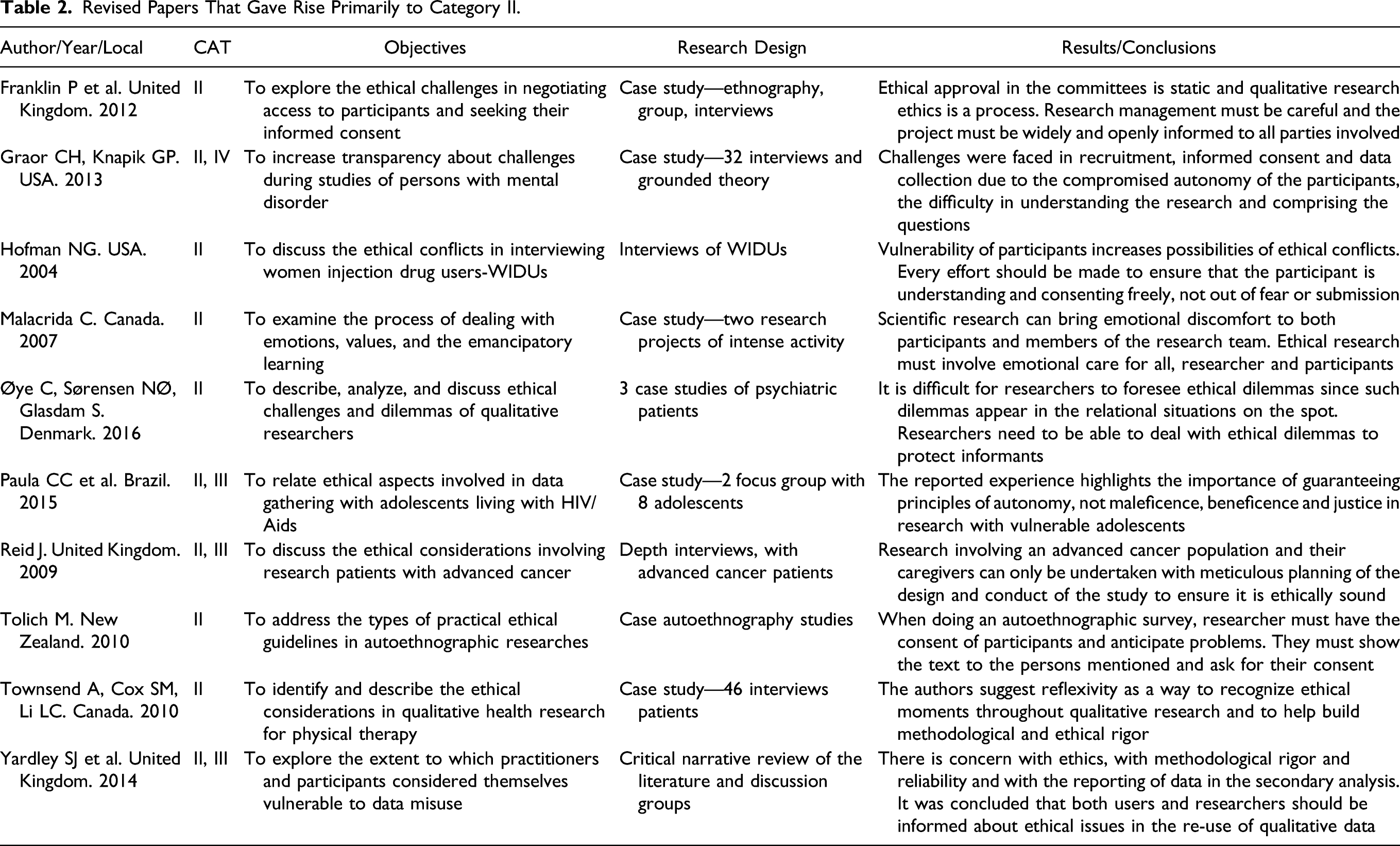
The participant’s autonomy in a research should be negotiated along the entire research process to ensure its ethicality, as stressed by Franklin et al. (2012). When obtaining the consent, the participant must be informed of what the research is about, why he/she was selected, and how it will be conducted. The consent must be given without coercion and the individual must understand what the consent is for. Often, some research volunteers, such as individuals with mental disorders, give their consent without understanding. Participant’s vulnerability broadens the possibilities of ethical conflicts. Ensuring the autonomy of these persons is crucially important to carry out this sort of research, which give voice to someone who is seldom heard (Graor & Knapik, 2013). A study conducted by Hoffman (2004) with female users of illicit drugs highlights the need of ensuring that participants consent of their own free will and not of fear or submission due to their vulnerability situation. J. Reid (2009) describes the hindrances to ensure autonomy in the participation in studies of individuals in a vulnerability situation, for example, patients with advanced cancer and their families. However, it is stressed that this sort of research is crucial to learn about their needs and improve the care. A similar situation is described by Paula et al. (2015) in a study conducted with seropositive adolescents undergoing treatment. At the same time, the adolescents’ autonomy to participate in the study must be assured, regardless of the will of the persons who are responsible for them, the vulnerability situation of the underaged must be considered when recruiting for the research, guaranteeing that they are aware of and agree to it before giving their consent.
Malacrida (2007) reports a study on the emotional demands of a research team in which there are different degrees of power and hierarchies. The team members in a lower hierarchy level sometimes jeopardize their autonomies, not feeling respected or assured during the research process, a situation that deserves ethical attention as well as that of the research participants.
Certain studies depend on gatekeepers for the recruitment of potential participants. In the relationship between gatekeeper and individual there may be interests involved, which may cause power imbalance that jeopardizes the individual’s autonomy. The recruiter may use criteria that prevent the participation of certain persons. Øye et al. (2016) mention three studies that exemplify these conflicts. In the first study, the recruiter used personal criteria and prevented potential individuals from participating; in the second study, there was the invitation to individuals who did not fulfill the research criteria; and in the third case, one of the recruited participants was excluded due to demonstrating difficulty in understanding the research. Another problem to be stressed in the recruitment of a participant is when it is made by the same professional who delivers the professional care, which makes the person feel obliged to participate; an example is a research described by Townsend et al. (2010), with patients receiving treatment for rheumatoid arthritis, in which some individuals were invited by their physicians.
The involuntary participation in a study, without consent, occurs frequently in autoethnographies. In this investigative proposal, the author uses auto-reflection to explore his/her experiences connected to broader cultural, political, and social issues, which necessarily involve other persons, as reported by Tolich (2010) in a study on ethical conflicts present in autoethnographical research. The author asks himself whether this is a scientific type of research and argues that there are available resources for an anticipatory ethics in these studies. A similar situation of disregard of autonomy occurs in the re-use of qualitative research data in which it is not possible to obtain the consent of participants. Yardley et al. (2014) raise several questions about this type of research, among which the possibility of secondary use of data when these are anonymous.
III - Conflict related to the risk of causing damage to participants/researchers/research
Frequent dilemmas fit into this category, divided in three types of implicit conflicts. In the first type are included situations of discomfort caused by: discrimination of which certain groups of the population are victims, such as homophobia and racism; past traumas, such as the loss of dear ones, suffered violence, participation in armed conflicts; and the very theme of the research, such as those involving personal issues. In the latter case, there is the risk that the researcher is not able to keep the necessary impartiality, feel vulnerable and distressed, and ultimately causes interpretation biases in the study or even changes in the path of an interview. It may also occur that the interview generates new demands that must be fulfilled. In the second type are included the cases in which a research is jeopardized by the power asymmetry between the interviewer and the interviewee, or when the researcher’s ideology leads his/her interpretation to be compromised and cause damage to the study. The third type regards the damage that may be caused by the publicization of the research’s outcomes.
Revised Papers That Gave Rise Primarily to Category III.

Certain research themes potentially cause great distress to participants. Briller et al. (2007-2008) discuss about the risk of research conducted by means of focal groups of bereaved persons, on exploring experiences related to death. The authors make recommendations for the management of aroused emotions and what care to take. Strong emotions and harm may be stirred also in the researcher depending on his/her personal story and traumas. Chaitin (2003) describes the experience of a research with individuals who had gone through social traumas, in which the researcher herself was a member of the conflicting society under study. Different political viewpoints of the conflict can hamper the performance of the work and data interpretation. Another example of conflicts related to sensible themes is reported by Hess (2006) in a study about the post-abortion experience. Some participants showed discomfort in the face of the recollection of the abortion, and so did the researcher, who is a woman and nurse and had difficulty during the research, as not to step out of her role of researcher and keep her impartiality regarding the emotions that aroused. Research with seropositive patients is another example of a sensible theme, presented by Kylmä et al. (2001), that may represent a threat to those involved. The researcher’s attitude on the field impacts people’s life, requiring from him/her a constant ethical questioning. Ethical aspects are undissociated from the research and from the researcher as well, argues Silva et al. (2012) in a study on the theme of sexual abuse in childhood. The relation between violence and health is a delicate topic because it arouses in the participants a feeling they prefer to forget, for the pain they cause or even for the fear of telling a specific episode, or for rage and resentment. Pérez-Tarres et al. (2019) describe a study on violence, work and health in which are discussed the ethical limits of dealing with such a delicate issue.
The possible influence of the researcher’s ideology and emotions on research data interpretation becomes clear in sensible themes like homosexuality, in which the individuals are victims of prejudice. Perry et al. (2004) reflect about the involvement and detachment in a research process on this issue, in which the researcher was a lesbian. In a study about the reconstruction of the researcher’s narrative as a strategy for the practice of reflexivity, Bishop and Shepherd (2011) stress that the researcher’s personality and biography influence the interpretation of their research data. There is the need to have a continuous and systematic examination of subjectivity to avoid the perception only of what is wished and not of what actually happens.
An ethnographic study carried out by Pulido Fuentes (2017) questions the effects produced by the researcher on the participants and on him/herself because who conducts the research is simultaneously subject and object of the research. Making an objective observation on the field implies trying to detach from one’s own subjectivity in order to obtain knowledge that can be useful. The reflection on the researcher’s role and his/her influence on the research field was the theme of the paper by Råheim et al. (2016). During two years, a group of six experienced researchers had meetings to debate this theme based on studies with symmetric and asymmetric relationships between researchers and participants. They highlight the importance of reducing the distance between the researcher and the subject, creating an anti-authoritarian relationship. Another type of conflict that may cause damage to the research is observed by Rothwell (2010) in research with focal groups. Interactions between participants may be restricted by some who monopolize the group, hence suppressing the participation of others, therefore preventing from reaching valid scientific knowledge.
In a study that questions the validity and the ethicality of sharing research outcomes with participants (member-check), Goldblatt et al. (2011) present four examples of ethically conflicting situations. The first example is of an interviewee who felt invaded with the exposure of her privacy. The second is of an interviewee who changed her point of view when exposed to the outcomes. The third refers to compromising the doctor-patient relationship because the participants were the doctors and their patients. The fourth situation is that of an interviewee who did not wish to learn about the outcomes but accepted being told about it to please the researcher. The practice of returning outcomes has proved to be damaging to the research, researchers and participants. Diniz (2008) reports an ethical conflict resulting from an ethnographic research about the legal interruption of anencephalic fetuses pregnancy. The outcomes of the study originated a documentary that could be commercialized and generate profit, which motivated ethical conflicts with the participants.
The risk caused by returning data may also occur when sharing them for secondary analysis. Antes et al. (2018) verified in a research on data sharing that there are few available repositories for qualitative data. Moreover, the repositories that present guidelines for sharing their data are scarce; this puts participants of studies at risk and may cause them harm.
IV- Conflict caused by mistaking the roles of researcher/therapist/friend
This conflict may occur as a consequence of the trust relationship established between researcher and participant, which is necessary for the latter to be sincere in the answers to the questions posed and which may bring a desire to talk about other subjects, personal ones, not included in the research, and the researcher assumes another role, that of a therapist or friend. It is often difficult to end an interview when the participant verbalizes his/her suffering and is emotionally vulnerable. The researcher may also feel vulnerable and distressed during the interview. This conflict is also very likely to occur in cases when a health professional does research with his/her own patients, or when the individuals suffer from mental disorders and have difficulty in differentiating the research interview from a therapeutical interview. Conflicting situations are also likely to occur when the researcher socializes in small communities where all people are acquainted and the research participants have difficulty in seeing him/her with impartiality during data collection. It is noteworthy, though, that in certain situations the health professional is obliged to change his/her role from researcher to therapist, due to demands that may arise in the research setting.
Revised Papers That Gave Rise Primarily to Category IV.
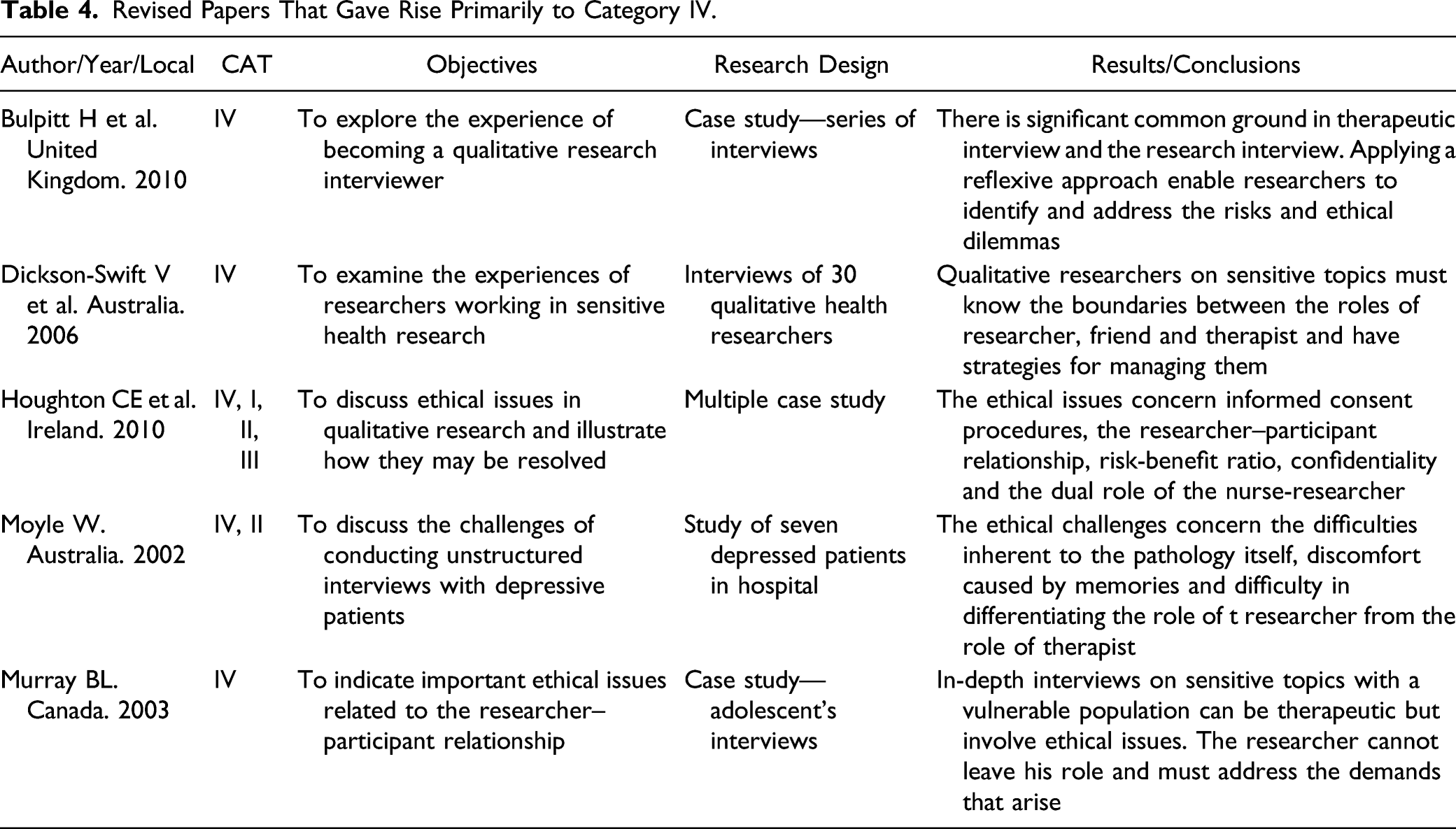
The ethical situation that is most often commented in this category is the research with individuals with mental disorders. Bulpitt and Martin (2010), in a research exploring the experience of becoming an interviewer, highlight the differences between the attributes of a therapeutical and a research interview. The objective of the first one is to provide treatment to the interviewee; the objective of the research interview is to have an intellectual understanding of a given theme in the benefit of the interviewee and the community. It is necessary to avoid the dilemma of using therapeutic techniques to relieve psychological suffering. Therefore, there is the need to know one’s own limits and not step out of the researcher’s role, as stressed by Dickson-Swift et al. (2006). These authors conducted a research by means of interviews with 30 researchers and registered that being a professional requires proper management of those limits. The therapeutic interview benefits the interviewee and the research interview benefits the interviewer, with the remark that the interview may transform both and arise the demand for therapy. Moreover, the authors also explain about the limits between friendship and research, besides the difficulty to end the relationship when the latter is over. In another study with individuals with mental disorders, Moyle (2002) points that it is a challenge to conduct research with this population due to the possibility of mistaking the roles of therapist and researcher.
In a study that examines the many ethical challenges of qualitative research, Houghton et al. (2010) stress the relationship between the researcher and the participant when the first one has double function, being a professional and a researcher. It is necessary not to mistake the roles and act with reflexivity, providing the interviewee with a clear explanation about the role of the interviewer. The confusion about functions may create conflicts; therefore, the researcher must be attentive in order to be able to manage the relationships that are developed through the research.
Murray (2003) argues in his study that a research interview can be therapeutical, but the researcher cannot deviate from his/her role and must provide the necessary referral in case the interviewee demonstrates the need of therapeutical support. The author stresses, like the previous authors, the obligation to keep clear limits between researcher and therapist.
V- Conflict caused by project evaluation by RECs
Revised Papers That Gave Rise Primarily to Category V.

According to some authors, hindrances to projects approval at RECs originate from the non-equitable treatment given by their members to qualitative research in comparison with quantitative research. To deal with these problems, Cutcliffe and Ramcharan (2002) indicate the improvement of practices by researchers to provide greater ethical assurance to participants.
Keogh and Daly (2009) present in their study the hindrances at RECs to the approval of research in the mental health area. The authors argue that members of the committees are concerned that the research may harm the participants because they believe that people with mental health disorders are not capable of understanding the contents of the study and making conscious decisions. To overcome this difficulty and guarantee the achievement of research with users of mental health services, which are essential for the knowledge of their actual needs, the studies must be designed in such a way as to ensure autonomy, confidentiality, truthfulness of data, and protection to participants all along the study.
The lack of qualitative researchers in the ethics committees is one of the problems faced by proponents of this kind of projects. In a study on the process of ethical review of qualitative research projects, conducted by means of interviews with 30 researchers, McMurphy et al. (2013) verified that the majority of the interviewees had a negative viewpoint of the process. There is an atmosphere of distrust that jeopardizes the evaluation of the research proposal. The changes on the projects suggested by RECs are at times considered ridiculous or beyond limits of the theme under study.
Inadequate requirements made by RECs members are highlighted by McCormack et al. (2012) in a study about the challenges faced by qualitative researchers in the analysis of their projects. The authors report the example of a researcher who was required to provide mathematic calculations on the size of his sample, which shows the lack of knowledge about qualitative projects. This type of problem in RECs may result in significant delays in carrying out research and consequently in new knowledge production. Another aspect emphasized by the authors is the separation of researchers from the review process, given that they are rarely called for a dialogue at RECs meetings. Changes are required without any sort of consultation with the researcher.
Discussion
Performing scientific research in human beings or with human beings implies respecting the dignity and liberty of participants, which is crucial to ensure the integrity and quality of the study. The studies reviewed make evident that for the consideration of these principles in a qualitative research it does not suffice to comply with ethical regulations and to have the approval of committees or panels that have this objective and legal competence for this purpose. Ethics in qualitative research should be understood as processual, relational, situational, and emergent. It is necessary to act preventively and take action with reflexivity all along the way, that is, constantly examine and reform research practices to find solutions to problems that arise, protecting the researched persons, fulfilling their needs, respecting their rights, and identifying the circumstances in which the researcher’s feelings may be interfering in the study’s data production. The ethical approach requires constant reflection, previous experience, and team discussion. It is necessary to foresee possible problems and find solutions to those that arise, always with the purpose of fulfilling the participants’ needs.
The interview is the technique most frequently used in the production of qualitative data and several conflicting situations are likely to occur. The researcher can reduce unexpected damage by knowing how to handle the discomfort regarding certain themes, ensuring confidentiality when the participant reveals information that may put him/her at risk, and restoring the consent to continue with the research whenever perceiving insecurity from the interlocutor (DiCicco-Bloom & Crabtree, 2006). In certain types of research, the consent must be continuous, processual, as the research progresses and new situations arise. A clear example is the publicizing of outcomes that may breach the study’s confidentiality or cause damage to participants, who must be consulted and give their consent to the disclosure (Tolich, 2010). On the other hand, it is noteworthy that cultural differences can raise questionings that escape the established research ethical norms as in the case of confidentiality and anonymity, which virtually do not exist in small communities (Minayo & Guerriero, 2014).
In cases when the research data may be used by other researchers, participants must be previously asked for their consent to future utilization (Yardley et al., 2014). In research with individuals having mental disorders or other complex issues, the ethical rigor in ensuring the participant’s autonomy cannot be an instrument of oppression or restriction of rights. The consent should be broad and careful as to be sure that the potential participant has understood and consented in an autonomous and voluntary way (Braz & Schramm, 2011; Graor & Knapik, 2013). The same attention should be valid for research with populations of different cultures, such as communities of indigenous peoples, quilombolas, religious sects, among others. In a systematic review on informed consent in indigenous communities, Fitzpatrick et al. (2016) highlighted the need to have previous knowledge about local norms, respect cultural aspects, and consult with their leaders before requiring the consent of potential participants.
Self-awareness is pointed as a researcher’s necessary attribute to be able to perceive the other, to recognize emotions involved in the research setting, to understand what is at stake, and be capable of mitigating any discomfort that arises (Hubbard, 2001). He/she must be self-aware of own values, beliefs, and theoretical affiliations that might influence the entire process of knowledge production and must therefore be remembered in order to ensure the rigor of the study, respect for the participant’s autonomy, prevention of a participant’s exploitation, confidentiality, and the recognition of interpretation biases (Damianakis & Woodford, 2012; Hewitt, 2007).
In order to work with unexpected issues that arise in the research field, with ethical conflicting situations, it is necessary to take action with reflexivity, that is, critically analyze the own research process, be constantly attentive to what occurs in the empirical context of the study, and how this affects the participant, the researcher and the research. The reflexivity action is pointed as essential by several authors. It enables the researcher to observe him/herself and the influence he/she has over the other person. This interaction can modify both of them. The researcher must know what is his/her place and from which standpoint he/she is acting and, therefore, be aware that there is no unique truth nor is he/she capable of fully identifying it (Baker et al., 2016; Minayo & Guerriero, 2014). Above all, the researcher must constantly analyze his/her actions, the ethical issues involved in the research process, and subject these to an examination as thoroughly as that provided to the collected data (Guillemin & Gillan, 2004).
Reflexive acting is improved from the debate between pears on the collective examination of the research practice. When the researcher shares reflections with the team through the practice of narrative there is a contribution to the ethical improvement of the study because at times he/she does not perceive the influence of personal, subjective issues in the construction of research data. The relationship between the researcher and the researched person involves feelings from both sides that can engender ethical conflicts. Some authors suggest the reconstruction of the researcher’s narrative as an efficient strategy to identify ethical issues and develop ethical mindfulness. The narrative enables the examination of the emotions involved and their influence on the research practice, thus contributing to understand and face them. Scientific research must be ethical in order to have quality and the narrative exercise provides the possibility to perceive and understand the emotions involved, to deal with these emotions in ethically difficult moments, to be reflective, and to know how to face one’s own limitations (Bishop & Shepherd, 2011; Guillemin & Guillan, 2015). Reflexivity and ethical mindfulness are interdependent concepts, with the first being a tool for the achievement of the second.
According to Warin (2011), ethical mindfulness is the researcher’s state of alertness and high sensibility to perceive and understand relational aspects of the research process. In order to achieve ethical mindfulness, it is necessary to be reflective, in the sense of bringing transparence to the research process and its outcomes, being aware of his/her influence on the participants’ perceptions, while being simultaneously influenced by them.
It is worthy to note the significance of the narrative practice in research with communities whose culture is different from that of the researcher, such as indigenous peoples. By using narratives, it is possible to achieve a better understanding of what is at stake in a cultural context that is different from the western structure. For example, Stevenson (2016) has reported a case study conducted in the north of Canada with an indigenous population that carried a unique genetic mutation. The analysis of the narrative practice and reports on this specific group provided a better understanding of the needs of this population. Moreover, it broadened the commitment with ethics when reflecting on the community’s experiences, values, and beliefs without being tied to generalized ethical norms and rules that do not apply to certain populations.
An ethical and reflexive approach by the research team is also a crucial path for the care and support to its members because it provides emotional security, mutual respect, and knowledge production in an open and dialogued way (Malacrida, 2007). Researchers and research institutions point out that the reflexive research involves emotional care of participants as well as the researchers themselves, and these should develop the awareness of the risks at stake and strive to reduce them (Dickson-Swift et al., 2008; Kendall & Halliday, 2014; Råheim et al., 2016).
Dilemmas referring to the change of the researcher’s role can be prevented with the clarity about the attributes to perform a good research interview, which differ from a therapeutical interview. According to Bulpitt and Martin (2010), the researcher must be able to listen, be empathetic, be curious, have a good memory and the ability to establish a good dialogue. For Dickson-Swift et al. (2008), researchers must have clarity about the differences between a therapeutical interview and a research interview and have strategies to manage the limits. A research interview can be therapeutical and also rise the need for therapy. The researcher cannot deviate from his/her role and should provide referral to therapeutical help when the need arises (Murray, 2003).
The imperative improvement by RECs of the analysis process of qualitative research projects was made clear in the reviewed studies about this issue. The RECs should be educative and not disciplinary. The authors advocate greater communication between the interested parties (Franklin et al., 2012; McMurphy et al., 2013). The relevance of ethical committees processes is emphasized; however, there is a lack of adjustment between the ethical review guidelines and the qualitative research design, causing an atmosphere of mistrust between researchers and RECs that jeopardized the progress of evaluations. These processes can be improved if RECs members act in a more amiable way and invite the researchers who can contribute to a better understanding of the project under evaluation. McMurphy et al. (2013) suggest greater transparency of the evaluation procedure, the application of guidelines according to the nature of the research, and greater communication between RECs and researchers, recognizing this action as similar to the peer review of scholarly productions. The members of RECs should have more knowledge on qualitative research to be able to evaluate the damages and also the benefits of this type of research. The lack of this knowledge hinders the approval of protocols and may also relax the practices that ensure protection to the interviewees (Peter, 2015).
A study carried out with former participants of a research, about their perspectives on the ethics in that very research, suggests that a good ethical practice is one that considers the impact of the research upon the participants, in a reflexive approach, rather than just following bureaucratic or prescriptive procedures. In this same study, which comprised participants of both quantitative and qualitative research, the differences regarding the nature of the study were discrete; the differences were more significant as the theme of the research became more sensible (Graham J et al., 2007).
Final considerations
This review was restricted to two databases and empirical studies published in journals of the health area. Therefore, it does not cover the variety of ethically conflicting situations that may occur in qualitative studies. However, it presents the diversity of the most frequent conflicts, providing a contribution to researchers to be alert about the possibility of their occurrence and offering alternatives of solutions. It is important to notice the need to reflect about the new modalities of qualitative data production by means of social medias and remotely, which can originate unprecedented ethical challenges. In sum, to ensure the integrity and quality of research and the respect for the participants’ dignity and liberty, the main factors to be achieved are self-awareness, reflexive action and sharing with peers, continuous processual consent, and ethical mindfulness.
Footnotes
Acknowledgments
We thank FAPERJ - Carlos Chagas Filho Foundation for Research Support of the State of Rio de Janeiro and UERJ – State University of Rio de Janeiro for supporting research development.
Declaration of Conflicting Interests
The author(s) declared no potential conflicts of interest with respect to the research, authorship, and/or publication of this article.
Funding
The author(s) received no financial support for the research, authorship, and/or publication of this article.
