




Abstract
This article explores how reading focus group data ‘against the grain’ offers new insights into publics’, and especially marginalised groups’, negotiation of dominant discourses. Using data from a study with members of the UN Foundation’s Girl Up campaign in the UK, US and Malawi, I demonstrate that reading against the grain both across and within groups enabled me to explore the girls’ complex negotiations of girl power discourses in international development. I argue that reading focus group data against the grain involves paying attention both to wider social power relations, as is crucial to a poststructuralist discourse analysis, and to interactions between group members, a form of analysis more commonly associated with Conversation Analysis. This methodological strategy enabled me to explore the topic of girl power discourses in international development from a new perspective, moving beyond the abundance of critiques in the literature of dominant discourses emerging from powerful institutions. By focusing on the girls’ instances of resistance to, and critical engagement with, dominant discourses, I suggest that reading focus group data against the grain opens up the possibility of a rich new area of research for scholars and practitioners alike: one which goes beyond simplistic victim/agency binaries and explores the complexities of audiences’ readings of texts.
Introduction
This article explores how reading focus group data ‘against the grain’ offers new insights into people’s negotiation of dominant discourses. Using data from a study with members of the UN Foundation’s Girl Up campaign in the UK, US and Malawi, I demonstrate that reading against the grain enabled me to explore the girls’ complex negotiations of seemingly dominant girl power discourses in international development and to highlight moments of resistance to, and critical engagement with, those dominant discourses.
Girl Up was launched by the UN Foundation in 2010 to encourage girls in the United States to fundraise for girls’ education projects in the Global South. It is part of a wider phenomenon that has been labelled the ‘girl powering of international development’ (Koffman & Gill, 2013, p. 86), critiqued by feminist scholars for its reductive depiction of gender inequalities and its perpetuation of patronising saviour discourses towards women and girls in the Global South. Girl power discourses in international development posit that when a girl in the Global South is given an education or a loan to start a business, she will work hard, provide for her family, marry later and have fewer, healthier children and in so doing, improve the economy of her whole country. In this depiction, girlhood in the Global North and South are presented as opposing subject positions, in which Northern girls are encouraged to see themselves as always already empowered, while Southern girls are seen as constrained by outdated gender norms that only Northern intervention will help to break down (Bent & Switzer, 2016, p. 123; Chant, 2016, p. 316; Marshall & Sensoy, 2010). Furthermore, girls’ and women’s rights are presented as worth pursuing primarily as a means to achieving other development outcomes (Chant & Sweetman, 2012, p. 521; Hayhurst, 2014, p. 304; Khoja-Moolji, 2015). The campaigns’ use of digital platforms and slick branding has also led to them being critiqued for reducing complex fights for girls’ rights to ‘multimedia advertising campaigns, in which we are not always sure of what is being sold or to whom’ (Calkin, 2015b, p. 662).
For Sangeet Kumar and Radhika Parameswaran, however, ‘the privileging of textual critique at the expense of ethnographic and qualitative fieldwork methods’ is a ‘continuing blind spot within postcolonial theories’ oeuvre’ (2018, p. 354, emphasis in original). While there is a wealth of literature on the girl powering of development, few studies have analysed girls’ participation in such campaigns. In this article, I describe the approach I took in a research project with Girl Up clubs in the UK, US and Malawi. I adapt Shenila Khoja-Moolji’s (2016) approach of ‘reading against the grain,’ which she used to analyse girls’ writing, instead using it to analyse focus group data. By doing so, I identify instances – no matter how small – where girls questioned the Girl Up discourse. This approach enabled me to explore how, contrary to the gloomy tone of the literature, the girls’ conversations show a negotiated reading of Girl Up. Drawing on the work of Stuart Hall and feminist audience reception studies, reading focus group data against the grain is an approach that conceptualises marginalised groups as collectively negotiating dominant discourses. While acknowledging that those discourses are both powerful and harmful, this approach leaves space to acknowledge the agency that groups show in adapting them to fit their own contexts and understandings. Given the focus in this study on exploring how girls adapt, or even reject, neoliberal, individualistic discourses of girls’ empowerment in international development, this focus on group processes of negotiation and resistance is both empirically and conceptually important.
In the following section, I summarise debates within the literature on conceptualising and analysing focus group data. I then discuss my research design for this project: namely a feminist, poststructuralist and postcolonial approach to analysing focus group data with Girl Up club members in the UK, US and Malawi. I then go on to demonstrate how reading the focus group data against the grain reveals important insights. This was done in two ways: firstly, by reading against the grain across groups, exploring how differently located groups or different groups in the same location questioned dominant meanings in similar ways; and secondly reading against the grain within groups, to explore the minor interactions between girls that show ruptures within a seemingly otherwise dominant group reading (sometimes labelled horizontal and vertical analysis, see Wibeck & Linnér, 2021). Finally, I conclude, this research suggests an important and rich area of future research, one which goes beyond simplistic agent-victim dichotomies in understanding how groups negotiate dominant discourses.
Focus Groups: Conversation or Discourse?
Historically, there has been some debate between discourse analysts and conversation analysts about how to analyse focus group data. Many of the points of contention come down to fundamental theoretical assumptions about the nature of the data, with little apparent scope for reconciliation. However, some scholars have argued that within a poststructuralist theoretical framework, it is possible to embrace the tools and insights that Conversation Analysis (CA) can offer (e.g. Baxter, 2002a, 2002b). Particularly relevant to this research is the opportunity that CA provides ‘to render concepts such as “resistance” and “complicity” less opaque than they sometimes seem in some postmodern theorising, and instead to reveal them as concrete practices visible in talk’ (Kitzinger, 2000, p. 175).
Despite the extensive literature on the benefits of using focus groups in generating lively discussions (e.g. Bagnoli & Clark, 2010; Colucci, 2007; Farnsworth & Boon, 2010; Gibson, 2007; Montell, 1999; Överlien et al., 2005; Wilkinson, 1998a) and what this can reveal about the public construction of discourse, in practice conversation analysts are among a minority of researchers who actually treat those interactions as research material. Often, the words of participants are analysed as if uttered in a one-to-one interview, or participants’ contributions are analysed one person at a time (Hydén & Bülow, 2003; Munday, 2006, p. 90; Wilkinson, 1998b, p. 112). This approach has two important implications. Firstly, and of particular concern to a reflexive, feminist researcher, quoting participants’ individual words devoid of any context erases the moderator’s role in shaping the conversation (Munday, 2006, p. 99). Secondly, it fails to analyse the degree of consensus or dissent around a given topic (Onwuegbuzie et al., 2009, p. 5). Interactions between participants might reveal how a group consensus was in fact reached through the censorship of opposing viewpoints, and can also highlight where an apparent focus for the group is in fact a topic of particular importance to one, dominant member (Kidd & Parshall, 2000, p. 300–1; Vicsek, 2007, p. 24). In this regard, poststructuralist discourse analysts can learn a great deal from CA’s careful attention to patterns of interactions.
While focus groups offer an ideal method for both poststructuralist discourse analysts and conversation analysts to gain an insight into group processes of meaning making (Hammersley, 2003, p. 752; Jowett & O’Toole, 2008, p. 464; Överlien et al., 2005, p. 334), there are also incompatibilities between the two approaches. CA’s roots in ethnomethodology mean that it is grounded in theoretical assumptions that are contradictory to PDA (Kitzinger & Frith, 1999, p. 299). For example, for conversation analysts, interactions being analysed must have occurred naturally or be ‘naturalistic’ (Wilkinson & Kitzinger, 2017, p. 75). This ranges from a view that even if the research setting itself is not natural, the conversation that takes place within it is (Onwuegbuzie et al., 2009, p. 14), to the belief that conversation analysts should only analyse talk that has occurred in a ‘natural setting’, ‘in courtrooms, at the dinner table, on the telephone, and so on’ (Speer, 2002, p. 784–5). By contrast, in poststructuralist research, the focus group is ‘a forum for generating public discourses about a topic’ rather than ‘a way of uncovering participants “real views”’ (Smithson, 2000, p. 114; see also Wilkinson, 1998b, p. 118, 1998a, p. 186). A poststructuralist discourse analyst would see any conversation as framed by, and reacting to, the setting in which it occurs. While this needs to be reflected on, it is not in itself a problem.
A further conflict comes in the assumption of conversation analysts that it is possible to conduct analysis without imposing the ideas of the researcher onto the data, which is seen as a form of ‘ascription’ (Wooffitt, 2005, p. 182). For conversation analysts, researchers must avoid imposing categories and constructs onto the data, where participants themselves have not oriented towards them (Ehrlich, 2002, p. 732–3). As Speer explains, ‘This means that gender, and a range of other sociological and demographic variables […] should be deemed relevant to the analysis only if they are procedurally consequential for, and oriented to by the participants themselves’ (2002, p. 785). Similarly, Kitzinger asks, ‘What warrant (if any) do we have for our claim that an act of oppression has taken place, if the participants do not orient to it as such?’ (2000, p. 171).
While any reflexive, feminist researcher would baulk at the idea of drawing research conclusions that were completely at odds with participants’ own understandings, a concern with the operations of power, and how a ‘particular discourse systematically constructs a version of the social world,’ means that an analysis beyond participants’ own wording is essential in PDA (Khan & MacEachen, 2021, p. 5). Furthermore, a feminist researcher’s interest in patriarchal power relations means that she looks for gendered constructions everywhere, not only in those passages where participants are explicitly talking about gender. Finally, discourse analysts have also countered that it is never possible to avoid the imposition of the analyst’s theoretical categories and concerns, particularly given conversation analysts’ tendency to zone in on a small extract of conversation of their choice, to the exclusion of what came before and after it (Wetherell, 2014, p. 110).
Nevertheless, some proponents of PDA argue that it is possible to draw insights from CA, paying attention to how groups interact – albeit in much less detail than a full CA would entail – and what that can tell us about how a group collectively makes sense of a topic, in the context of wider societal meanings and power relations (Baxter, 2002a, 2002b). In this article, therefore, I demonstrate how ‘reading against the grain’ might act as a useful strategy for doing exactly that – highlighting how group dynamics and interactions reveal seepages in, and resistance to, dominant power structures and meanings.
Research Design
In order to analyse girls’ negotiation of the Girl Up discourse, I conducted focus groups with Girl Up clubs in the UK, US and Malawi. I asked club members about their participation in the campaign and asked them to discuss a Girl Up promotional video, Connecting the Dots (United Nations Foundation, 2010) and the ‘Girlafesto,’ a poster sent out to club members when they join (Girl Up, n.d.-b).
While not an inherently feminist method, focus groups correspond in many ways to the values of feminist research, including in mitigating hierarchical research relationships by creating a situation in which the researcher is outnumbered by the participants (Walters, 2020), and the potential consciousness-raising effect in bringing groups of women together to discuss issues affecting them (Maynard, 1994, p. 17; Montell, 1999, p. 54). Given that in many settings, especially schools, these power relations might be exacerbated, focus groups are also seen as particularly well suited to research with children and young people. It is important, however, to avoid simplistic assumptions about children’s communicative abilities or the inherently ‘empowering’ nature of particular methods (McGarry, 2016; Raby, 2010, p. 13) which ‘serve to exaggerate both the differences between children and adults, and the similarities between different groups of children’ (Åkerström & Brunnberg, 2013, p. 529; Walters, 2020). I therefore approached the focus groups with the ethos that ‘when space is made for them, children’s voices express themselves clearly’ (Mauthner, 1997, p. 21).
When Girl Up was initially launched, it was only open to members in the US, and it remains part of the US-based UN Foundation. While it is now open to girls anywhere, the majority of Girl Up clubs are still in US schools and the focus remains on encouraging girls in the Global North to fundraise for their Southern counterparts (Girl Up, n.d.-a). My initial strategy was therefore to try to establish contact with teachers at Girl Up member schools in those areas of the US with the most active clubs, close to the UN Foundation headquarters in New York and Washington DC, as well as the small number of member schools in the UK, my own country. However, searches on the Girl Up community map revealed that a small number of clubs had emerged across countries in the Global South, which raised important questions for my research. I attempted to contact any of these schools where I felt my own language skills (English, French, Spanish and Italian) would be sufficient to conduct focus group research. Of a total 42 clubs contacted, ten replied to engage with the research, 23 did not reply and nine replied to say that they did not have, or no longer had, a Girl Up club. Eventually, I was able to form relationships with six schools in a range of contexts in the UK, US and Malawi. 1
Fieldwork was undertaken in late 2016 and early 2017. 87 girls aged between 11 and 21 participated in 29 focus groups across the six settings, with three schools inviting me to come back and speak to girls a second time. Each lasted between 30 and 70 minutes and, on the advice of teachers and girls themselves, were conducted in English, which in all settings was the language of education and of Girl Up club. Ethical approval was obtained from the University of Bristol research ethics committee. In a study of this kind, a particular ethical concern was the decision to contact teachers as gatekeepers. The risk was that the invitation, coming as it did from an authority figure within an educational setting, may appear to suggest an event for which attendance was either mandatory or would be viewed favourably (Taquette & da Matta Souza, 2022, p. 5). However, it was decided that this was preferable to any attempt at approaching girls directly. Great care was taken as a result to ensure that all girls and – in the case of those under the age of 18 – a parent or guardian were made aware that their participation was voluntary, and that they had a right to withdraw from the study. All names quoted below are pseudonyms. Given the availability of information on the Girl Up Web site of the names and approximate locations of clubs, some of which are the only clubs in a particular region, I have been careful to remove identifying information about the wider school communities. Girls in all locations talked about experiencing stigma for attending Girl Up club and so it was especially important that they felt able to discuss their participation confidentially.
In five of the six schools, a teacher joined the discussion. While this will have undoubtedly had an impact on what girls felt able to say, in many cases this was school safeguarding policy and non-negotiable. Furthermore, Girl Up stipulated at the time that clubs needed an adult sponsor, and so girls were used to meeting with these teachers, who were supportive of the girls’ aims. In the remaining school, two teachers were closely involved in setting up the focus group and in the classroom next door while it was taking place. The involvement of teachers ensured that girls had access to school safeguarding and support systems.
In every setting, my status as adult and as researcher positioned me as an outsider in relation to the girls (CohenMiller et al., 2022, p. 2; Khan & MacEachen, 2021, p. 1), although I was clearly most markedly an outsider in Malawi. My original intention had been to work only with girls in the Global North participating in Girl Up, precisely in order to analyse and deconstruct the ‘white gaze’ of international development, which “measures the political, socio-economic and cultural processes of Southern black, brown and other people of colour against a standard of Northern whiteness and finds them incomplete, wanting, inferior or regressive” (Pailey, 2019, p. 733). However, in creating Girl Up clubs and adapting the campaign to suit their own aims, it seemed that groups of girls across the Global South were subverting that gaze. In taking the decision to travel to Malawi to understand the girls’ participation in the campaign better, I hoped to challenge reductive discourses of girlhood in the Global South. However, I also had to confront the uncomfortable truth that as a white researcher from the UK, I was a beneficiary of, and at risk of perpetuating, the ‘white gaze’ of development, even if I did not see myself as signatory to it (Pailey, 2019, p. 735; see also Le Bourdon, 2022). In the wider project, therefore, I have tried to reflect on the many ways in which my presence may have impacted on the findings or potentially even reproduced girl power discourses in development. In choosing the focus group method, in which groups of friends outnumbered me, the outsider, I also hoped in some way to redress the clear hierarchical power relations inherent in any research encounter (Pinto da Costa, 2021, p. 2), especially one that crosses Global North-South divides.
I transcribed the conversations verbatim and took the decision not to ‘polish’ the girls’ or my own language (Standing, 1998, p. 199–200). Whilst facilitating the discussion and making notes on who was speaking when, I was unable to note physical movements and gestures, so these are not included in the analysis. I have, however, drawn on the following conventions of focus group transcription to add small details that are not revealed by words alone (Bloor et al., 2001, p. 62): [: indicates the start of overlapping speech (): indicates incomprehensible speech []: transcriber comments, such as laughter, long pauses, or a change in tone such as whispering.
I used NVivo qualitative data analysis software as a tool to help me manage a large data set and to keep records of analytical steps taken (Flick, 2014, p. 370; Mauthner & Doucet, 1998, p. 122).
The concept of ‘negotiating’ discourse is taken from the work of Stuart Hall. Hall argues that a media text has a ‘preferred meaning’ (1997, p. 228) which the creator or creators intended it to purvey. However, they have no control over how a reader or viewer might ‘decode’ that meaning. Hall identifies three positions from which decodings may take place: dominant, negotiated and oppositional (1980, p. 136–138). In a dominant reading, the viewer or reader decodes a media text within the same terms of reference in which it was encoded, interpreting it according to the preferred meaning. An oppositional reading is one in which a reader or viewer chooses to decode a message ‘in a globally contrary way’ (1980, p. 137–8, emphasis in original). A negotiated reading, however, ‘operates with exceptions to the rule,’ meaning that while a viewer or reader might accept large parts of a dominant discourse, they find exceptions to this interpretation, often based on their own ‘local conditions’ (1980, p. 137). This approach is also informed by scholars in feminist audience reception studies who argue for a ‘modified Foucauldian approach,’ which ‘views women as historical subjects who are moulded by authoritative (and persuasive) media discourses, but are not “passive recipients” of dominant messages’ (Parameswaran, 2003, p. 317; see also Craig Watkins & Emerson, 2000, p. 157; Durham, 2003, p. 24; Zaslow, 2009, p. 36).
Data Analysis
I adopted an approach to analysis based on Shenila Khoja-Moolji’s (2016) strategy of ‘reading against the grain’ (see also Walters, 2017). She argues that her own previous research in Pakistan ‘engaged with girls only to hear, and re-articulate, Eurocentric knowledges around personhood, community and citizenship’ (2016, p. 746). However, years later, she decided to ‘re-turn’ to her participants’ words, this time focusing on the ‘seepages and excesses of their voices to signal their differently-lived and differently-constituted investments and desires’ (746). She calls this endeavour ‘doing the work of hearing girls’ voices’ (746). In revisiting her data, she sought to find ‘that which escaped privileged categories’ or was ‘hidden or buried under dominant codes and themes’ (753). She goes on to conclude that this led her to draw different conclusions from the same texts. This is not a strategy that disregards the dominant discourse: indeed, it must identify it in order to identify the seepages from it. Rather, it is an attempt to listen to girls’ interpretations and understandings that do not fit neatly into preassigned categories based on campaigns’ priorities or researchers’ preconceptions.
While Khoja-Moolji used this strategy to analyse girls’ individual, written words, in the analysis that follows, I show how it can be adapted to analyse focus group data. In doing so, it can reveal how girls collectively negotiate dominant discourses. In the first pass of sorting the data, I read through each transcript and coded extracts according to the concepts identified in the relevant literature. Amanda Coffey and Paul Atkinson call this the process of “data reduction,” that is sorting through a large data set and identifying extracts of relevance to my conceptual framework (1996: 30). During this pass, the codes used are “a priori,” drawn from concepts identified in the literature. After this process was complete, I read through the data in each coding category to analyse how the extracts did or did not reproduce the Girl Up discourse. Having done this several times, I began the second pass at coding the data, “data complication” (Coffey & Atkinson, 1996: 30). This involves teasing out new “emergent” codes, that is analytical concepts emerging from the data in participants’ own words but also capturing my own analysis of what is being said (Spencer et al., 2014: 272). For example, a girl in North Wales told me, “we’re still limping a bit” in the UK in terms of achieving gender equality. “Still limping a bit” then became a code for all extracts where girls seemed to be challenging representations of Northern societies having already achieved gender equality. Reviewing these coded extracts allowed me to “read against the grain” on two levels: firstly by gathering together all of the excerpts from different groups and settings that challenge the dominant discourse in similar ways; and secondly by analysing individual extracts in detail, to see how group interactions reveal disruptions in an otherwise dominant reading (see Figure 1).
2
Diagram of the approach to analysis.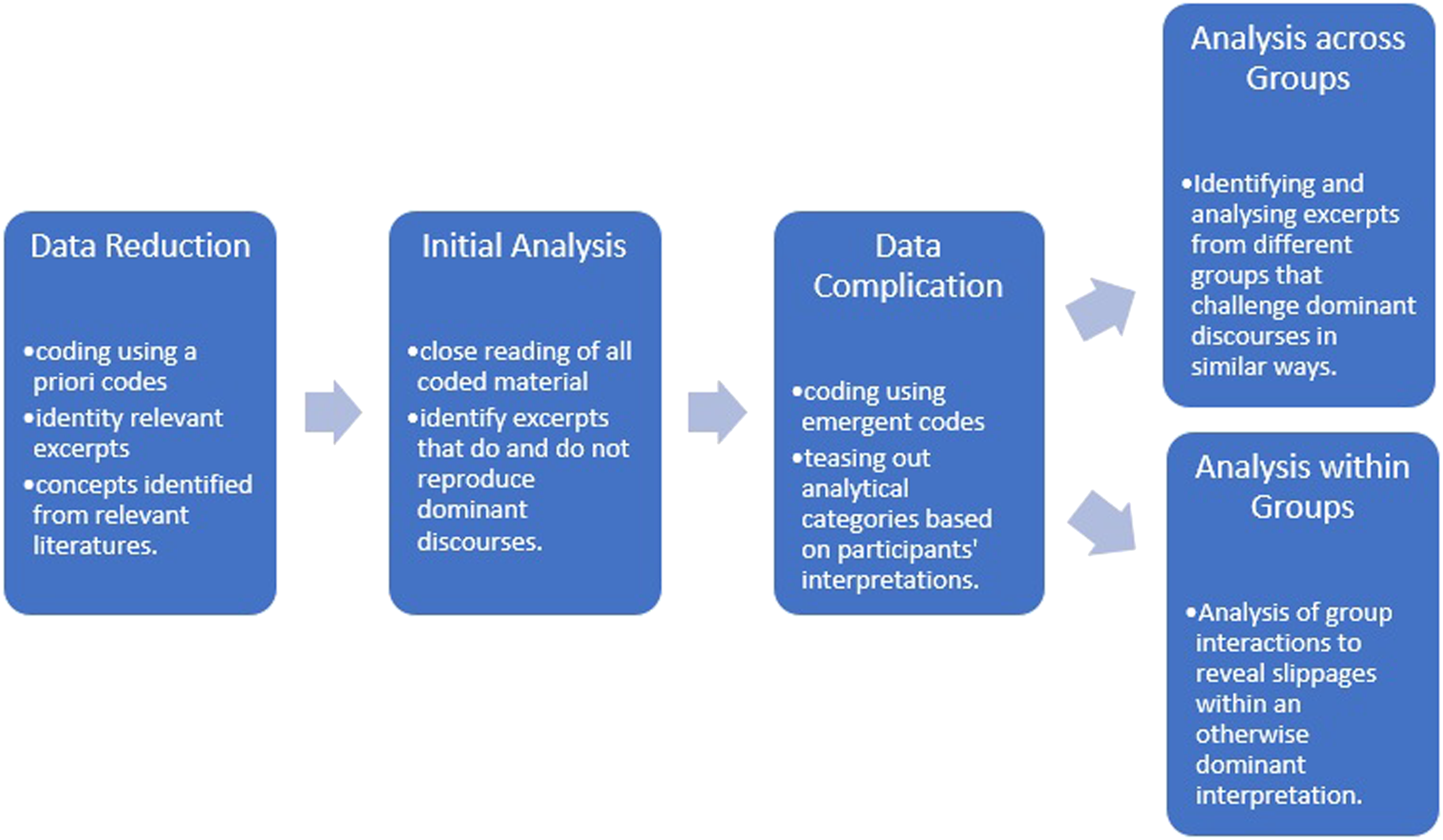
Reading Against the Grain Across Focus Groups
In this section, I give three examples of the many in which girls across different contexts questioned the Girl Up discourse in similar ways. The first example is of how all three groups in the Welsh school and one group in New York all questioned the depiction in the Connecting the Dots video of the girl in the Global North. This simple, black and white animation begins by asking the viewer to imagine that she is 12 again. The rest of her life, a female voiceover with a US accent explains, will play out as follows: getting ‘decent grades,’ finding friends, making good decisions about boys, going to college, getting a job, buying shoes, falling in love and planning for the future. We rewind. A globe spins around the girl, as we are told that she is 12 again, ‘but this time you’re one of the 85 percent of all the world’s adolescents with a lot fewer options’ (United Nations Foundation, 2010). She must work and leave school, and she is forced to marry an unfaithful husband and contracts HIV. By aged 20, she has four children and is left alone in darkness. We zoom out to find that she is just one black dot on a map in which the Global South has been covered in black dots, while the narrator explains, ‘now multiply that by the six hundred million adolescent girls in developing countries.’ A coin spins in the air as a video tells us that ‘When you connect the dots you start to improve the options for girls around the world.’ We rewind again. This time the twelve-year-old girl attends a school with a UN flag. She has healthcare and a loan to start a business (symbolised by a sewing machine). The result is ‘a better future for herself, her family, her community and her world.’ The viewer can make this happen so, the video asks, ‘What are you waiting for?’ (United Nations Foundation, 2010).
In just under 2 minutes, Connecting the Dots establishes Northern girlhoods as characterised by success, opportunity, delayed childrearing and consumption and Southern girlhoods as characterised by poverty, ill health and early marriage (Chant, 2016, p. 316); it reduces a map of the world to countries covered in black dots and those left white; it sets up the Northern girl as the saviour-in-waiting of the Southern girl, who need only embrace girl power in order to succeed (Desai, 2016, p. 257); and it proposes a solution – a sewing machine – to poverty and abuse that would never be deemed appropriate for a girl in the North because a Northern girl would not be required to sew her way out of poverty (Moeller, 2014, p. 599). Yet, there were aspects of this depiction of Northern and Southern girlhoods that Girl Up members questioned, as demonstrated in the following extracts: Lauren: It was also actually quite interesting how even [pause] for the, you know the more, the more liberal one they still grew up to find a husband. RW: Mm Lauren: That you know that’s quite interesting. [Pause] RW: Interesting in what way like Lauren: That there, there was no option for it to be a, for it to be a wife or for them to grow up and not get married or [pause] that so [pause] there was, so even in our society there’s still you know a few more barriers [it Daniela: [Like expectations Lauren: Yeah Daniella: Still.
(UK)
*** Gabriella: While it also showed like cons I think both lifestyles have cons like things that weren’t really great about them cos like, for like, girls like here we have like, our whole life seems to be planned ahead of us that like stage of go to college, get a job, get married and like it’s so hard to veer off from that.
(US)
*** Lucy: I think like just in the video then it’s about erm, settling down with boys and I don’t think there’s a fair representation of girls who like women or girls who like both, and I think that does put a lot of people off maybe, because there’s still even on the UN video one depiction of a girl and one type of girl.
(UK)
*** Chloe: I think I’m just being a bit picky when it said the shoes and I was sort of like oh, she bought shoes right cool. [Laughter] Chloe: Nice one. Leah: Well done. Chloe: Yeah. Bethan: Bit stereotypical. Chloe: [Yeah Leah: [It’s like Bethan: [But other than that I think that’s I mean Leah: [I got a job, I can buy a house no let’s buy shoes. [Laughter]
(UK)
These excerpts demonstrate instances, no matter how minor, of girls negotiating the Girl Up discourse’s construction of girlhood in the Global North. In the first extract, Lauren finds it interesting that even the ‘liberal’ girl had ‘no option’ but to marry a man, showing the ‘barriers’ (or as Daniela intercepts, ‘expectations’) that some UK girls face growing up. Similarly, Lucy comments that the video isn’t a ‘fair representation of girls who like women.’ While in the Girl Up discourse, and indeed in wider girl power discourses, decades of positive change mean that girls in the Global North have every opportunity and choice available to them (Koffman et al., 2015, p. 160), Gabriella interprets the timeline of the girl’s life to mean that her ‘whole life seems to be planned ahead’ and ‘it’s so hard to veer off from that,’ mirroring Lauren’s statement that there is ‘no option’ for a girl to follow a different path. Meanwhile, one group of girls in the UK question the choices the girl in the Global North makes with her supposed freedoms – choosing to buy shoes with the money gained from her successful career.
These are by no means oppositional readings of the video. Within the broader research project, the girls in the Global North rarely questioned the depiction of girlhood in the Global South. For example, in the first extract, Lauren finds it interesting that ‘even’ for the girl in the Global North, her life choices are limited, while she later goes on to express her frustration that in the North, girls ‘still’ face barriers, which is reiterated by Daniela’s repetition of the word. The use of a temporal word like ‘still’ would suggest an assumption that the Global North should be, or is, further along a path towards gender equality than the non-‘liberal one’ (Yeğenoğlu, 1998, p. 98). While Gabriella does not adopt a dominant reading of the positive representation of the Global North, seeing the ‘cons’ in the lack of options available to girls there, she does not question the portrayal of girlhood in the Global South as having many ‘cons.’ Lucy’s frustration that ‘even on the UN video’ there is only one depiction of desirable girlhood is critical, but also suggests a belief that the UN, generally, is leading efforts at achieving gender equality. These are not, then, wholly oppositional readings. Rather, they are negotiated readings where the girls adapt the message of the video, or reject some of that message, based on their own experiences, understandings and contexts. They do show though, that across the groups in the UK and US, girls questioned some aspects of the depiction of oppositional girlhoods in Girl Up.
While the academic literature on the girl powering of development is critical of the ‘corporatisation, branding and commodification of humanitarian communication’ in girl power campaigns in development (Koffman & Gill, 2013, p. 84; see also Calkin, 2015a, p. 301; Koffman et al., 2015; Shain, 2013), reading against the grain across the UK focus groups reveals how club members reflected critically on choices made in the campaign’s branding. One issue that came up repeatedly when the girls in the UK were reading the Girlafesto poster was its repeated lack of capitalisation of the pronoun ‘I’ in its statements such as ‘i am a girl […] i am me. i follow. i lead. i teach […]’ (Girl Up, n.d.-b). Chloe: I like it. [Pause] Bethan: I agree with the message but like, they’ve used like a load of capital letters wrong there. [Laughter] Bethan: I know that’s Leah: [Laughing] Or no capital letters. Chloe: So, you agree with the message, just not the grammar. [Laughter] Bethan: Yeah, yeah basically.
(UK)
*** RW: So yeah if you just wanna have a little read [Pause] Lauren: Oh, it’s lower case. [Laughter] Teacher: What is it with the students in this school? RW: Yeah Teacher: Everyone’s picking up on the grammar [laughs].
(UK)
Again, the girls are not disagreeing outright with the poster’s message. However, they reflect critically on how information is marketed at girls. Girl Up claims to be a campaign ‘by girls, for girls’ (Girl Up, n.d.-c), and stylistic decisions will have been made in order to appeal to girls of this age. Yet, across the groups in the UK, these decisions were seen as detracting from what girls viewed as the serious message of Girl Up. Indeed, Lauren’s comment ‘oh, it’s lower case’ came just 3 seconds after I asked the girls to read the Girlafesto, while Chloe’s assertion that she liked the resource was met with a few seconds of silence, followed by a group discussion on the lack of capitals. While it would be impossible to draw conclusions from these limited examples about girls rejecting the campaign or its discourse, they certainly do show that in the UK at least, girls are by no means passive consumers of branding aimed at girls.
A final example to illustrate reading against the grain across focus groups is in the reaction of girls in the township of Lilongwe to the Connecting the Dots video. These girls faced serious economic hardships. They used their Girl Up club to support one another, to discuss issues such as how to manage menstruation in a school with no running water, and to rehearse the plays they put on in their community to teach adults about the importance of educating girls and to raise money for their peers’ school fees (see Walters, 2018 for further analysis of the girls’ activities). Yet the Girl Up discourse is silent about girls’ activism in the Global South. The Southern girl in the Girl Up discourse is helpless and awaiting rescue (Cobbett, 2014; Marshall & Sensoy, 2010). I wondered, therefore, what the girls would make of Connecting the Dots, but once again, they adapted it to their own context: RW: What, what did you think of it? [Pause] Ellen: Er, it’s also talking about the way () the pregnancy [pause] erm [pause, clears throat] she can also [pause] back to school. RW: Mm mm. […] Linda: It’s like when the girl [pause] she’s, she’s married RW: Uh huh Linda: You can go there and encourage her so that you should, she should go back to school. RW: Mm mm Linda: Yeah.
(Malawi)
*** RW: So, what what did you think of the video? Fatsani: I thought, I think it’s good encourage us, uh to get be educated girls. Mayamiko: To work hard in school, to achieve their goals. RW: Mm mm [Pause] Fatsani: Also to have confidence for yourself, confidence.
(Malawi)
Far from reproducing discourses that see early motherhood as a missed economic opportunity from which girls in the Global South cannot recover (Switzer, 2013), Ellen and Linda see the video as stressing the importance of bringing mothers back to school. Furthermore, while the intended meaning of the video would seem to be that a girl in the Global North, by donating money to Girl Up, can ensure that a girl in the Global South never gets pregnant in the first place, these Southern girls interpret it to mean that they themselves can change the situation by bringing their pregnant friend back to school. The second extract illustrates an interpretation that was shared widely across the groups in this school: that the video was aimed at motivating girls in the Global South to work harder in school. Again, this is not an oppositional reading. It reproduces essentialist and instrumentalist discourses about girls’ education and does not question structural inequalities that shape the opportunities available to girls (Chant, 2016, p. 315–6; Switzer et al., 2016). However, these readings challenge the depiction of Southern girls in the Girl Up discourse as passively awaiting rescue. These girls feel that they have the power to bring other girls back to school, to ‘achieve their goals’ and to ‘have confidence’ in themselves. Reading against the grain across the focus groups – in different or the same contexts – has revealed how differently located groups of girls question, adapt or at times even subvert the Girl Up discourse, even in the most subtle ways. They do not question or reject it outright, but neither do they reproduce it uncritically.
Reading Against the Grain Within Focus Groups
In some cases, moments of resistance emerged within groups that otherwise had a dominant reading of the Girl Up materials. Sometimes, these prompted the entire group to rethink their interpretations, and at others the conversation swiftly returned to a positive appraisal of the video or poster in question. In the extract below from a focus group with 17- and 18-year-old girls in the UK, a few girls succeed in bringing the entire group round to a more critical reading of Connecting the Dots: Chloe: It said like the eighty-five percent and it made a percentage and it made like that was the shocking part, the percent was the shocking part and I don’t think the percent should be the shocking part I think it should be Leah: That it happens. Chloe: Like all of it should be the shocking part because it happens and it is on a big scale, but it has to combine to really make a difference. Charlotte: I think things like that are good though where they put you in the issues cos I know, like what we've been saying if it, unless it happens to white people, people don’t really care. Chloe: Yeah. Charlotte: And that’s that’s really bad. Chloe: It is yeah. [Lines omitted] Charlotte: But videos like that do help because they they make you Leah: Mm Chloe: Think about Charlotte: Kind of empathise [with it Chloe: [Yeah Leah: [Yeah. Charlotte: And pay attention to what’s going on. Leah: I think it would’ve helped a little bit more if it wasn’t a cartoon. Bethan: [Yeah. Chloe: [Yeah. Leah: Because it’s a lot less like reality then you think, oh yeah [it’s and you see yourself as it Charlotte: [It’s easier to ignore it, isn’t it. Leah: But at the same time [it’s not as Chloe: [It’s not real Leah: Serious, it’s not real, like in your mind seeing yourself doing that. RW: Mm Siobhan: Yeah the tone that was used as well, it was very like and very like ve-, they were very quickly going over it Leah: Yeah Siobhan: It wasn’t like focusing really deeply on it, it was just kind of like, oh yeah then this happens and then this happens and then this happens. Chloe: Yeah Siobhan: And it’s like, not a lot of detail so it’s kind of like, oh.
(UK)
The extract starts with Chloe questioning the use of statistics in the video to ‘shock’ the viewer. Although not an oppositional reading – she is not questioning the decision to shock viewers into action, but rather the use of statistics to do so – she is questioning the choices made by Girl Up staff in representing the issue. Leah’s interruption to finish Chloe’s sentence suggests she agrees with this critique. Charlotte immediately counters by voicing her support for the message of the video. However, she does so by arguing that videos such as these are important because ‘people’ –presumably people in the UK, Northerners or ‘white people’ more broadly – only care about issues if they happen to ‘white people.’ Although Charlotte likes the video, her reading of it is a negotiated one because her view of white Northerners as racist and apathetic complicates the subject positioning of Northern saviour, Southern victim. Chloe is quick to agree with this assessment of Northern audiences.
In the following section, Charlotte tries once again to assert that the video will ‘help’ by making Northern people empathise with the plight of Southern girls. While Leah and Chloe seem to be agreeing with their utterances of ‘yeah’ and ‘mm,’ Leah moves the conversation on, leaving no pause, to a new criticism of the video – that the animated format is not appropriate for this topic. This draws immediate and simultaneous agreement from Chloe and a fourth girl, Bethan, and the group has now returned to critiquing the video’s format. Charlotte even joins in to agree that using animation makes the issue ‘easier to ignore,’ before Siobhan voices her frustration and disappointment at the lack of detail given.
The girls reach a consensus on three points: firstly, that Northern publics are generally racist and apathetic. This does not fit with a dominant reading of Girl Up, which positions Northern girls as eager and willing to help (Koffman et al., 2015, p. 161). Secondly, they agree that the tone of the resources is too light to be taken seriously, rejecting the simplification of complex issues in the Girl Up discourse. Thirdly, the group went on to conclude that the video was ‘quite American,’ with Bethan stating that ‘if you ask what I’ve noticed about it’s probably that.’
Returning to Sydney Calkin’s assessment, campaigns such as Girl Up have been critiqued for reducing complex fights for girls’ rights to ‘multimedia advertising campaigns, in which we are not always sure of what is being sold or to whom’ (2015a, p. 662). However, these quotes from the girls in the UK show that they are conscious not only of what is being sold (Girl Up) and to whom (girls in the US), but also how (language, use of cartoon imagery, use of statistics etc.). This example shows how the analytical approach of reading against the grain, and of paying attention to interactions within a focus group, can reveal seepages in an otherwise seemingly dominant reading of the Girl Up discourse.
Conclusions
These examples illustrate a complex array of negotiations of powerful discourses, where girls never adopt an entirely oppositional stance to the Girl Up campaign, but nor do they embrace it uncritically. While girls in the UK and US questioned the campaign’s representation of girlhood in the Global North, none of the girls seemed to question the representation of girlhood in the Global South. Nevertheless, the Malawian girls’ readings subverted the Girl Up discourse by assuming a role for Southern girls themselves in overcoming the inequalities they face. Finally, in the UK, participants were very aware, and critical, of branding and stylistic choices intended to appeal to girls, even if they did not necessarily disagree with the messages being conveyed. Crucially, across all the contexts, reading these extracts against the grain has demonstrated how for these girls, a critical reading of the Girl Up campaign is a collective, group process, and not the work of one or several individuals.
The complexity of the insights offered into the girls’ negotiation of Girl Up is a result of the methodological choices explored in this article. Firstly, by drawing on Stuart Hall’s concept of negotiating discourse, I have been able to explore girls’ agency in relation to powerful discourses, an under examined topic in the literature on gender and development. Secondly, the methodological choice of reading against the grain enabled me to analyse that agency on two different levels, exploring the commonalities between differently located groups of Girl Up club members and their adaptations of the Girl Up discourse, as well as the detail of interactions within a group that show ruptures or seepages in the dominant discourse. The latter was enabled by a third important choice to draw on the lessons that poststructuralist discourse analysts can learn from Conversation Analysis about the importance of paying attention to interactions between members of the focus groups, rather than analysing only the content of what was said. Within the broader research project, these choices yielded novel insights into how girls at times embrace, at times reject and at times strategically use the Girl Up discourse to further their own feminist aims (Walters, 2018).
There is much more that could be explored within even these brief excerpts, in particular in relation to how girls across the different research contexts adapted the discourse in very different ways. Indeed, doing so would help further in countering reductive depictions of girlhoods by highlighting the rich nuance within differently located girls’ interpretations. This is an important focus for the wider research project. However, the findings presented here clearly demonstrate the potential to use the strategy of reading focus group data against the grain to explore the complexities of groups’ negotiations of powerful discourses, in a way that goes beyond simplistic dichotomies of victimhood and agency. The fact that girls critically engage with resources from a campaign that they have actively chosen to become members of counters the tendency in scholarship, the media and advocacy work to portray them as the passive victims of harmful discourses about girls. This strategy, then, could be used to explore the experiences of marginalised groups more broadly and to enrich debates amongst scholars and practitioners alike about agency and resistance.
Footnotes
Acknowledgments
I am very grateful to Jutta Weldes and Karen Tucker for their comments on earlier versions of the analysis contained in this article. I am also grateful to the editors and the two anonymous reviewers for their insightful comments.
Declaration of Conflicting Interests
The author(s) declared no potential conflicts of interest with respect to the research, authorship, and/or publication of this article.
Funding
The author(s) disclosed receipt of the following financial support for the research, authorship, and/or publication of this article: This work was supported by the Economic and Social Research Council, grant number 1488667.
