




Abstract
The purpose of this literature review-based paper is to share some insights into general methodological issues pertaining to the case study research strategy and how I applied it for purposes of my doctoral study on the design and delivery of rural enterprise business support programmes. I hope that the insights I share here will help novice researchers who have intentions of using the case study research strategy for their studies or those who just want to broaden their knowledge about the research strategy. The paper is largely an excerpt of my methodology chapter from my recently completed and unpublished doctoral thesis, derived mainly from the methodology literature. The paper starts by exploring the definition of case studies and goes on to look at case studies issues to do with the unit of analysis; research questions; types of case studies; sampling, data collection, triangulation and quality issues.
Keywords
Introduction
The purpose of this literature review-based paper is to share some insights on general methodological issues pertaining to the qualitative case study research strategy and how I applied it for the purposes of my doctoral study. It is primarily targeted at novice researchers in the social sciences who may have intentions of using the case study research strategy for their studies, hence, the level of discourse in this paper is pitched as such. The paper will help them save time from having to read the massive literature that is available on case study research and helps give guidance on the key literature to consult for such scholars to fully acquaint themselves with the research strategy. Further practical considerations are given in the paper on how I applied the qualitative case study research strategy on my doctoral research project.
Saunders, Lewis and Thornhill (2009, p. 136) define research strategy as the “general plan of how the researcher will go about answering the research question(s)”. They identify several research strategies that may be utilised in implementing exploratory, descriptive and/or explanatory pieces of research. These include experiment, survey, case study, action research, grounded theory, ethnography and archival research. The importance of the choice of the research strategy is in its ability to yield the objectives of the study, thus answering the research questions central to the investigation.
The main research strategy that I used in my doctoral study on the design and delivery of rural enterprise business support programmes was the case study strategy in line with the interpretivism research philosophy that I chose to underpin the study. The case study strategy is listed among some of the most commonly mentioned qualitative research strategies in the literature (Creswell, 2007, 2009; Ebneyamini & Moghadam, 2018; Guba & Lincoln, 1994; Glette & Wiig, 2022; Lavarda & Bellucci, 2022; Merriam, 2002; Rashid et al., 2019). The other strategies include grounded theory, ethnography, phenomenology and narrative research which can be applied based on the purpose of the research study at hand.
The paper, which is not necessarily exhaustive when it comes to case study design issues but, is limited to how I applied the research strategy to my doctoral study, starts by giving details of the doctoral research project on which the case study research strategy was applied. It then explores the definition of case studies and goes on to look at case studies' key decision areas to do with the unit of analysis, research questions, types of case studies, sampling and data collection issues.
The Doctoral Research Project
My research project, which had clearance from the ethics committee of my university, was a process study of how rural enterprise business development support programmes are designed. The motivation for this research stemmed from my many years of experience working as a rural enterprise business development consultant for non-governmental organisations (NGOs) in Zimbabwe. Specifically, I was interested in finding out the step-by-step processes of designing these programmes, the design factors that are taken into consideration, the determinants of success of such programmes and the delivery approaches that are considered effective. The key outcome of the research was the development of a design and delivery framework for rural enterprise business development support programmes. To achieve this, I needed to talk to people who are involved in the design of the programmes (programme managers/officers) and those who are directly involved in the delivery of the programme support services (field officers/support service providers). The latter were either in-house employees of the concerned organisation running the programme or their partner organisations to whom the delivery of the programme would have been delegated. This is because NGOs consider working with local partners important to enhance the sustainability of their programmes. Thus, where such a scheme of arrangement existed, I had to target those partners as the participants instead.
The above meant studying several NGO-driven rural enterprise business development support programmes (existing and/or past) pointing towards the adoption of a qualitative case study research strategy.
Definition of Case Study Research
Flyvbjerg (2011) opens his instalment on case studies by observing that the definitions of ‘case study’ abound with differences of opinions on their usefulness. Indeed there seem to be as many definitions as there are authors on case studies (Glette & Wiig, 2022; Harrison, Birks, Franklin, & Mills, 2017; Schwandt & Gates, 2018; Takahashi & Araujo, 2020) and as Flyvberg correctly notes, some are helpful while others are not so helpful, depending on the purpose and context to which they are put to use.
One of the three recognised foundational writers on case studies (Brown, 2008; Rashid et al., 2019; Yazan, 2015) i.e., Merriam (2009, p. X), defines a case study as “an intensive, holistic description and analysis of a bounded phenomenon such as a program, an institution, a person, a process or a social unit.” This latter part of Merriam’s definition agrees with Punch (2009, p. 119) where he says “… the case may be an individual, or a role, or a small group, or an organisation, or a community, or a nation.” However, the most commonly quoted definition in the methodology literature (e.g., Piekkari et al., 2009; Crowe et al., 2011; Schwandt & Gates, 2018; Lavarda & Bellucci, 2022) is the one by the other foundational writer, Yin (2018, p. 45), which says “a case study is an empirical inquiry that investigates a contemporary phenomenon in-depth and within its real-life context, especially when the boundaries between phenomenon and context are not clearly evident.” On the other hand, the third foundational writer on case studies, Stake (1995, 2005) desists from making a clear-cut definition of case studies, acknowledging the multidisciplinary nature of the case study methodology. Thus, a single definition may not suit the definitions that researchers in the different disciplines may make of the methodology (Yazan, 2015).
For purposes of my doctoral study on the design and delivery of rural enterprise business support programmes, both the Yinian and Merriamian definitions of the case study strategy were applied although with an inclination towards the latter. Both authors are agreeable on the level of depth in a case study where Merriam (2009) uses the word ‘intensive’ while Yin (2018) uses ‘in-depth’, an aspect that I considered in the design of the case approach I utilised in my study. I collected in-depth information from the selected rural enterprise business support programmes, thus allowing for a ‘holistic description’ (Merriam, 2009) of the associated design and delivery processes. It is interesting that in the Merriamian definition, there is specific mention of ‘programme’ as one of the different forms a case may take, which was the exact situation of my study that involved collecting data on multiple cases/programmes to yield the specific research questions and outcomes of the project.
Case Studies Research Questions and Outcomes
Central to the use of case studies is the types of research questions that can be explored. Consideration of the research questions is always taken as a key choice criterion of the research strategy to be used in a given study (Bowen, 2005; Saunders et al., 2016).
Yin (2018), together with almost all other writers on case studies (e.g., Stake, 2005; Merriam, 2009; Miles et al., 2014; Ebneyamini & Moghadam, 2018; Turnbull et al., 2021; Lavarda & Bellucci, 2022), says case studies are good at answering ‘how’ and ‘why’ research questions. Such research questions would need rich and deep qualitative data to effectively answer them. Thus, the qualitative case study is one of those strategies that can effectively yield that kind of data. It has also been mentioned that exploratory ‘what’ questions can also be investigated in case study research (Crowe et al., 2011; Lavarda & Bellucci, 2022). This was the case in my study as it sought to also explore questions such as ‘what’ makes a rural enterprise support programme succeed (success and failure factors), ‘what’ are the considerations that are taken cognisant of when designing rural enterprise business development support programmes and ‘what’ step-by-step processes are undertaken in designing and delivering rural enterprise business support programmes, among others. Finding answers to these exploratory ‘what’ questions became critical in answering the main ‘how’ research question of my study.
Thus, in my research, in line with the dictates of case study research, the main research question was a ‘how’ question, i.e., “How are rural enterprise business support programmes successfully designed and delivered?” Such a research question would naturally lend itself to a qualitative inquiry as there is a need to collect rich qualitative data that allows for thick descriptions (Denscombe, 2004; Denzin & Lincoln, 2000; Guba & Lincoln, 1994) of the phenomenon and its setting. This is in line with the interpretivist ontological and epistemological assumptions that I adopted for my study.
On the other hand, the outcomes of case studies would normally be linked to their purpose or objectives of the studies. Theory-building case studies abound in the literature (Baxter & Jack, 2008; Creswell, 2007; Dul & Hak, 2008; Eseinhardt, 1989; Hyett et al., 2014; Piekkari et al., 2009; Rawlands, 2005; Yazan, 2015; Yin, 2018) the outcome of which would be a new theory or a refinement/modification of an existing theory. There are, however, fewer case studies recorded in the literature for theory-testing purposes (Dul & Hak, 2008; Hyett et al., 2014; Piekkari et al., 2009; Schwandt & Gates, 2018) perhaps due to the general perception that case studies lack generalisation power, despite this having been argued to be a misconception or misunderstanding of the case study strategy (Flyvbjerg, 2006, 2011). However, other case study research may not result in an absolute theory or refining of an existing theory, but the outcome may be a model or framework (Eseinhardt, 1989; Hyett et al., 2014; Piekkari et al., 2009; Thomas, 2010) as was the case in my study. Such outcomes are what authors such as Thomas (2010) and others e.g., Flyvbjerg (2011), decide to call phronesis rather than theories, as models and frameworks do not meet all the qualities of a theory due to their lower generalisability power, which is mostly limited to the context in which they have been developed, through not a purely inductive process, but an abductive one (Flyvbjerg, 2011; Maxwell & Chmiel, 2014; Thomas, 2010). This was the case in my study. Thus, the major outcome of my study was not a theory, nor was it a refinement of an existing theory, but a framework for designing and delivering rural enterprise business development support programmes in Zimbabwe (Mtisi & Muranda, 2018).
Having looked at the definitional and research questions/outcomes aspects, case study researchers have to contend with key decision areas some of which can be problematic (as this paper shall later show). These include issues to do with bounding the case, determining the unit of analysis, the type of case (case design), sample size determination, the actual selection of the cases, methods of data collection and the analysis approaches all of which are addressed in the rest of this paper in the context of my research project.
Bounding The Case
A case is a case because of the ability to define its boundaries. Stake (2005, p. 444) refers to a case as a “bounded system”, thus emphasising Miles et al.’s (2014, p. 44) point in defining a case as “a phenomenon of some sort occurring in a bounded context”. Piekkari et al. (2009, p. 573) and other authors (Glette & Wiig, 2022; Lavarda & Bellucci, 2022; Schwandt & Gates, 2018) make reference to Ragin (1992) who emphasised the question “what is it a case of?” in trying to define the case boundary. Placing boundaries to a case helps avoid researcher pitfalls of making the study too broad (Baxter & Jack, 2008; Schwandt & Gates, 2018) or trying to study a topic that may have rather too many objectives. Thus, time, place, activity, definition and context (Creswell, 2007; Miles et al., 2014; Takahashi & Araujo, 2020), among other considerations, can be used to define the case. Boundary definition helps in case selection, thus anything outside the defined boundary will not be included as part of the study (Merriam, 2009; Miles et al., 2014; Verleye, 2019).
The stage in the research process at which the case should have been fully defined differs among the foundational authors. Yin (2018) advocates for a clear definition and a highly structured design right from the onset to help guide the rest of the case study research process. This is corroborated by Eseinhardt (1989), especially if the case study is for theory development. On the other hand Stake (2005) and Merriam (2009) seem to favour a more flexible structure, which can be allowed to evolve as the study progresses in line with the advantages of qualitative research that allow for an emerging structure (Mason, 2002; Ritchie & Lewis, 2003; Saunders et al., 2016). Thus, the case is not fully defined until the empirical part of the study is done (Piekkari et al., 2009). The observed differences are traced back to the philosophical tradition that the authors identify with, where Yin (2018) and Eisenhardt (1989) are more inclined to the positivist stance while Stake (2005) and Merriam (2009) are more inclined to the interpretivist paradigm (Baxter & Jack, 2008; Yazan, 2015).
In my study, I originally defined my case as the programme, i.e., public rural enterprise business development support programmes, thus effectively drawing the boundaries. Hence, programmes that did not have a business support component were not going to be considered as part of my study and so were those that were aimed at exclusively supporting urban enterprises. This definition was done at the onset of the study (Takahashi & Araujo, 2020) to help guide the rest of the case study processes as advocated by Yin (2018) above.
The Unit of Analysis
Closely linked to the boundaries of the case is the definition of the unit of analysis. Dolma (2010, p.169) defines the unit of analysis as “the entity that is being analyzed in a scientific research”. Yin (2018) acknowledges that this is one of the major problems in case study research for it is the definition of the unit of analysis that determines what the case is all about. Baxter and Jack (2008), as well as Verleye (2019), support this view by reiterating the same point that determining what the unit of analysis is can be a challenge for both seasoned and novice case study researchers alike, something that I experienced in my research project as shall be explained later. Yin (2018), Baxter and Jack (2008) as well as Piekkari et al. (2009) advise researchers that right at the time of developing the research question, they must link back to their main research question to define the unit of analysis, of what the ‘case’ of the case study is. This is in light of Miles et al.’s (2014, p. 44) observation that “the case is in effect your unit of analysis.” Baxter and Jack (2008) go on to advise that asking questions about whether it is the individual, programme, organisation or process to be analysed in the research can lead to a clear demarcation of the unit of analysis of the study as it can be either of these (Dolma, 2010; Merriam, 2002; Yin, 2018) depending on the research question. Merriam (2002, p. 8) opines that “the unit of analysis, and not the topic of investigation, characterises a case study”. This is indeed a very important observation by Merriam (2002) as it is easy to get swayed to focus on the topic of study (Eidlin, 2011) instead of the case.
In my study, I specifically defined my case as the rural enterprise business development support programme (as previously stated), thus the unit of analysis and not necessarily the topic of investigation, i.e., “The Design and Delivery of Rural Enterprise Business Support Programmes” as Merriam (2002) puts it, and not the organisation running the programme. Being a multiple case study, the study looked at multiple programmes (13 of them). In fact, Piekkari et al. (2009), citing the work of Ragin (1992), make a distinction between what is called the empirical unit, i.e., the organisation and the theoretical unit, i.e., the case. This was clearly distinguished in my study as discussed above. This level of clarity was necessary right from the onset (Eseinhardt, 1989; Yin, 2018) to help guide the development of my case protocols and other research procedures. However, upon collecting the data, I had to redefine my case and unit of analysis to be the organisation (NGO) as most of the organisations selected reported on multiple programmes they had run during their existence in the country (Zimbabwe). Some of the NGOs’ work spans many years in some instances, which made it difficult to pin the analysis on a particular programme but on this particular organisation’s experiences in running rural enterprise business development support programmes in the country. This had to be a field decision I had to pragmatically make, which indeed underscored the observation earlier made from the literature (Baxter & Jack, 2008; Yin, 2018) that the definition of the unit of analysis and the case, can be problematic.
Types of Case Studies/Case Study Designs
Having chosen the qualitative case study as the research strategy, as well as bounding the case and defining the unit of analysis, the next consideration had to do with the type of case study I had to use (Baxter & Jack, 2008; Glette & Wiig, 2022), what is otherwise known as the case study design (Yin, 2018). The choice of the design is very much guided by the purpose of the study (Baxter & Jack, 2008; Crowe, et al., 2011; Yin, 2018). Two of the foundational case study writers’ designs, i.e., Yin (2018) and Stake (2005), are popular in the literature. Yin (2018) gives what appears to be a more complete typology of case study design, as depicted in Figure 1.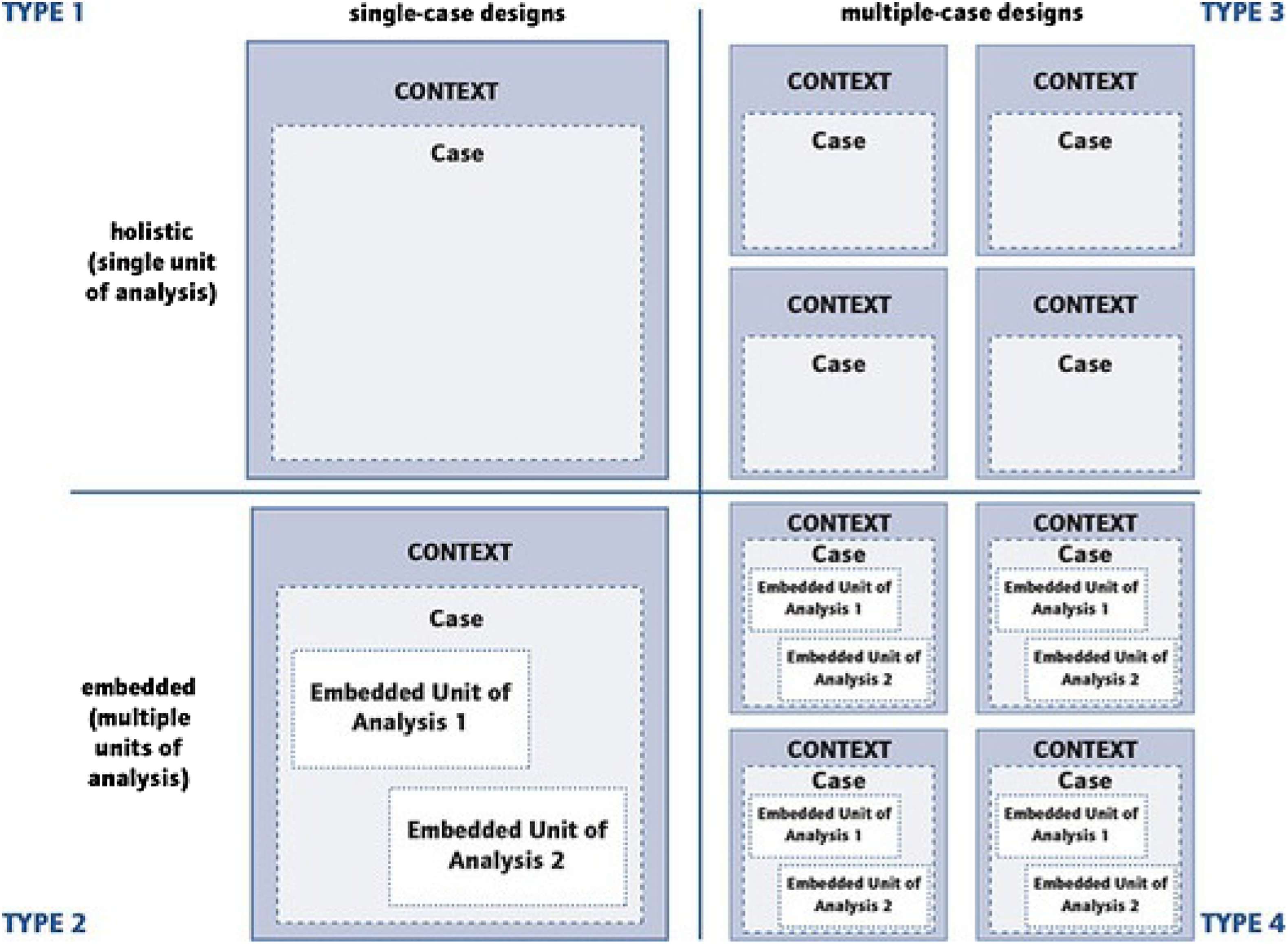
According to Yin, four designs/types are possible, as shown in Figure 1. Single holistic case studies are where one case is studied with the unit of analysis being the whole case as a single unit. Type 2 designs refer to single-embedded case studies, where the focus is on a single case with more than one unit of analysis. Type 3 designs (multiple holistic designs) are where more than one case is being studied with each case being taken as a single unit of analysis.
On the other hand, Type 4 designs (multiple embedded case studies) make use of more than one case while within each of the several cases chosen, there would be more than one unit of analysis. The Yinian design is commonly cited in the literature (e.g., Eseinhardt, 1989; Eisenhardt & Graebner, 2007; Baxter & Jack, 2008; Piekkari et al., 2009; Yazan, 2015; Glette & Wiig, 2022) given its clarity, simplicity and all-encompassing nature.
On the other hand, Stake (1995) looks at three types of case study designs, i.e., intrinsic, instrumental and collective (multiple) cases. This classification is apparently and also widely used in the literature (e.g., Creswell, 2007; Baxter & Jack, 2008; Thomas, 2010; Crowe, et al., 2011; Hyett et al., 2014). According to Stake, the intrinsic case is one where the researcher has interests in learning about a unique phenomenon (Crowe, et al., 2011) exhibited by this one particular case and not to generalise beyond it. By contrast, the instrumental case is one which can be studied to draw insights into a certain phenomenon beyond just the case studied, thus allowing for a broader appreciation of an issue or helping to refine a theory. On the other hand, collective case studies look at more than one case, which equates to Yin’s multiple case studies while the other two are single case studies.
For my study, I took Yin’s Type 3 design above, i.e., multiple holistic case studies or Stake’s collective (multiple) case studies. Organisations running rural enterprise business support programmes totalling 13 were chosen for study with each case being taken as a single unit of analysis (holistic). It is the nature of the study that dictated the choice of the multiple holistic case study design. There was a need to hear of the lived experiences of different designers and implementers of rural enterprise business support programmes in these organisations given the somewhat different programming contexts under which the different programmes are developed and delivered. Although it is noted in the literature that qualitative case studies, or case studies in general, lack generalisation (Brown, 2008; Creswell, 2007; Denscombe, 2004; Stake, 2005), studying a phenomenon based on multiple cases results in better applicability (‘generalisation’) of results than would be studying a single case (Glette & Wiig, 2022; Piekkari et al., 2009; Rashid et al., 2019; Schwandt & Gates, 2018; Stake, 2005; Turnbull et al., 2021; Yin, 2018), thus, the decision against the single case study I made in my study. Also, evidence from multiple cases is often considered more reliable and robust (Baxter & Jack, 2008; Yin, 2018) than would studying a single case. Besides, studying multiple cases has the advantage of capturing the different perspectives that may be prevalent in a phenomenon (Creswell, 2007), an aspect that was of interest in my study. Although studying single cases benefits from depth (Hyett et al., 2014; Piekkari et al., 2009; Stake, 2005), they suffer from lower across-case applicability of results, hence, the need to look at multiple cases to overcome this in my study as there was a need to extend the findings beyond the cases studied. It is, however, noted that multiple case designs would inevitably suffer from a lack of depth for each case studied as compared to single case studies (Creswell, 2007; Piekkari et al., 2009).
In my study, there was a need to look at each case holistically (Creswell, 2009; Denscombe, 2004; Yin, 2018) and again the nature of the topic of study was such that it needed to be looked at as such (Baxter & Jack, 2008). There was, therefore, no need to try and develop multiple units of analysis per programme studied even though I studied each programme at two levels, i.e., the design stage and the delivery (implementation) stage. These levels were, however, taken as a single process that has two phases to it for purposes of the study, hence, a single unit of analysis.
Case Selection/Sampling
In case study research, the issue of how to select the case(s) becomes an important point of reflection (Hyett et al., 2014) as it has a bearing on the results. Sampling, in case study research, is said to be at two levels, i.e., selection of the case(s) to be studied and selection of the participants to be interviewed in each case (Brown, 2008). At each of the two levels of sampling, purposive sampling is the most commonly used sampling technique (Guetterman, 2015; Onwuegbuzie & Leech, 2007a, 2007b; Verleye, 2019; Yazan, 2015), as opposed to random sampling. Purposive sampling is where the researcher selects the case participants based on some criteria (Creswell, 2007; Patton, 2015). In qualitative case study research, random sampling is really of not much meaning as the idea is to focus on quality and reaching data saturation (Bowen, 2005; Eseinhardt, 1989) or selecting information-rich cases (Ebneyamini & Moghadam, 2018; Eisenhardt & Graebner, 2007; Guetterman, 2015; Patton, 2015; Perry, 1998; Yin, 2018) as opposed to quantity. Thus, cases are often chosen based on their validity to the issues under investigation (Flyvbjerg, 2006) and hence, as Eseinhardt (1989, p. 537) notes, “random selection of cases is neither necessary nor even preferable”. Stake (2005) supports this position by saying usually in case research, the samples are so small as not to warrant random sampling.
Thus, in my study, like the majority of case study research, I employed purposive sampling and specifically, criterion sampling (Onwuegbuzie & Leech, 2007a; Patton, 2015), as the selection of the organisations and the programmes included was based on the programme having a component of rural enterprise development as a set criterion for inclusion in the study. Guetterman (2015) notes that it is not sufficient to simply say purposive sampling was used for a particular qualitative case study research, as there is a need to specifically mention the particular purposive sampling scheme/technique used from the over 20 that have been identified in the literature (Onwuegbuzie & Leech, 2007a, 2007b; Patton, 2015). This is so because purposive sampling is a general sampling strategy for almost all qualitative studies, hence, the need for being specific as to the actual technique used in a particular study. As for the respondents/participants of my study, they had to be people involved in the design and delivery of the rural enterprise business development support programmes, and most specifically, programme managers and field officers, as previously explained.
Sample Sizes
This is one decision area that case study researchers grapple with if my experience in my research project is anything to go by. In qualitative research, there are no strictly predetermined sample sizes, unlike in quantitative research where formulae can be used to calculate appropriate sample sizes. The question as to how many cases (for multiple case designs) and more precisely, how many interviews to conduct, is best answered by saying ‘it depends’ as aired by numerous authors (Baker & Edwards, 2012; Charmaz, 2012; Doucet, 2012; Flick, 2012; Goldsmiths, 2012; Mason, 2012; Patton, 2015; Saunders & Townsend, 2016; Small, 2009). Thus, the sample size will depend on several considerations such as the purpose of the research or research question, time, resources available, the philosophical stance of the study, precedence, peer reviewers' expectations, heterogeneity of the population, availability of potential respondents, university thesis committee requirements and advice from experts (authors) in the field, among other considerations (Adler & Adler, 2012; Baker & Edwards, 2012; Bryman, 2012; Flick, 2012; Mason, 2012; Patton, 2015; Saunders & Townsend, 2016).
One very important consideration, which is often mentioned in the literature and that perhaps deserves a rather closer examination is that of ‘saturation’ in qualitative research sample size determination (Bryman, 2012; Bonde, 2013; Guetterman, 2015; Mason, 2010; Miller, 2012; Onwuegbuzie & Leech, 2007a; Patton, 2015; Saunders & Townsend, 2016). The concept of saturation is borrowed from the work of Glaser and Strauss (1967) on Grounded Theory (cited in Mason, 2010). Guetterman (2015, p. 3) refers to theoretical saturation as “the point at which the qualitative analyst does not see new information in the data related to the codes, themes, or theory”, while Mason (2010, p. 2) refers to saturation as “when the collection of new data does not shed any further light on the issue under investigation.” Whilst the concept of theoretical saturation mostly refers to the building of theories, it is most widely operationalised as data saturation (Guest et al., 2006; Maxwell & Chmiel, 2014), thus, resonating more with Mason’s definition as given above. This concept is the same as what Lincoln and Guba (1985) (cited in Patton, 2015), Perry (1998) and Onwuegbuzie and Leech (2007a) call information redundancy. This is the point at which continued sampling does not yield any significant new information.
Recommended Sample Size to Achieve Data Saturation in Qualitative Interviews.

Source: Adapted from Bonde (2013, p. 4).
The table shows varying figures of sample sizes required to reach saturation with outlyers of one (1) and 260. The size of one is normally associated with narrative and/or case history research and the 260 quoted by Brannen (2012) refers to a longitudinal study of mothers and their children over several years, thus being a special case that cannot really be considered as a standard guideline in qualitative sample size determination.
Of particular interest, for purposes of my doctoral study, was the recommendation by Mason (2010) wherein he came up with a sample size of 30 as appropriate from analysing 560 PhD Theses in the UK (England and Wales). A similar study by Saunders and Townsend (2016), but this time for qualitative journal articles in organisation and workplace research utilising semi-structured interviews as a data collection method, came up with a mean sample size of 32, which resonates very well with the Mason study referred to above. Thus, these studies became key guidelines for sample design in my study where at the planning stage, a total of 39 interviews were envisaged, i.e., three interviews per case programme of 13 programmes where one programme manager and two field officers were to be interviewed. This was done to overcome one key criticism of basing sample size on data saturation only, as it would not be possible to determine the number of interviews to be conducted for the project before inception. This is an aspect that is critical in estimating the cost of the research, as is usually required in funded projects for purposes of estimating a project budget (Bryman, 2012; Mason, 2010). Again, basing sample size determination on saturation only would have also meant that I was going to be forced to concurrently sample, collect the data and analyse it in the field to be able to determine data saturation, at which stage sampling would stop (Baker & Edwards, 2012; Bonde, 2013; Bryman, 2012). This is opposed to having these stages being conducted linearly and as distinct stages of the research process, as I preferred doing for purposes of my study given the potential difficulties of concurrently collecting and analysing data while still in the field. Besides, some university research ethics committees would like to know who the subjects of the research are and how many they are before permission is granted (Mason, 2010). Therefore, depending entirely on saturation would not have exactly worked for me, as other authors (Baker & Edwards, 2012; Bryman, 2012; Guest et al., 2006; Mason, 2010) caution that in many studies, saturation is only claimed rather than being clearly demonstrated as a criterion for sample size determination.
Thus, in my study, there was a need to use precedence to come up with an estimated sample size at the planning stage of the study to guide its execution. I had a hard time coming up with a scientifically justifiable sample size (like many novice researchers do) until a prolonged reading on the subject matter unearthed the appropriate literature (as reviewed above) for guidance on which I could confidently base my sample design.
When it came to the number of cases as opposed to the number of interviews, I was again, in my study, guided by seasoned authors or precedence, where influential authors such as Eseinhardt (1989) recommend between four and 10 cases for theory-building studies. Eseinhardt, being such an influential author, several case study research were found to be within this range after the publication of her classical paper (Piekkari et al., 2009). On the other hand, Perry (1998) recommends 15 cases for PhD studies with three interviews per case, thus averaging 45 interviews in total before he suggested a range of 35–50 interviews for the PhD project in marketing as sufficient. Hedges (1985) cited in Perry (1998) recommends a minimum of four to six groups (cases) with an upper limit of 12 due to cost considerations and volumes of data involved. Miles et al. (2014) believe that anything more than 15 cases becomes unwieldly. Thus, again in my study, guided by the various quoted literature sources above, 12 cases were originally planned for with three interviews per case, initially making a total of 36 interviews. However, in the actual execution of the fieldwork, I eventually managed to do 13 cases after getting some key referrals in the field and substituting a few that could not participate. The total number of interviews came to 32, comprising 13 programme managers and 19 field officers/service providers, retaining an average of 2.5 interviews per case. These numbers which were achieved without many sampling constraints or limitations experienced are well within the sample size ranges discussed above from the literature.
To end this section on sample size, it is important to take note of the observations that Patton (1994, p. 185) makes about qualitative sample sizes that “the validity, meaningfulness and insights generated from qualitative inquiry have more to do with the information-richness of the cases selected and the observational analytical capabilities of the researcher than with sample size.” Also, as Onwuegbuzie and Leech (2007b) noted, qualitative sample sizes should not be too large to make the extraction of thick rich data difficult nor should they be too small as to make it rather difficult for data saturation to be achieved. Thus, what is important is transparency in fully describing methods that were employed in executing the study so that readers can judge the adequacy of the sample size achieved (Saunders & Townsend, 2016; Shakir, 2002) as I have tried to do for purposes of my study. Of interest to note is the fact that with the increased use of digital tools in qualitative research (Moylan et al., 2015), sample sizes are bound to get larger due to the general ease of reach of participants by researchers.
Data Collection
Qualitative case study research employs multiple data sources (Creswell, 2007; Ebneyamini & Moghadam, 2018; Eseinhardt, 1989; Harrison, et al., 2017; Merriam, 2009; Rashid, et al., 2019; Stake, 1995; Turner, 2010; Yin, 2018; Yohannan, 2010) for the collection of comprehensive data for the study, hence, utilising a triangulation of data collection methods for increased internal validity. The main methods, as mentioned by the above-cited authors, are interviews, observation and document analysis. I used two of these methods in my study, i.e., interviews and document analysis with the former being the main method of data collection.
Semi-Structured Interviews
The Interview method is the most widely used method of data collection in qualitative case study research and qualitative research in general (Alvesson & Ashcraft, 2012; Eisenhardt & Graebner, 2007; Harrison, et al., 2017; Rashid, et al., 2019; Saunders & Townsend, 2016; Schultze & Avital, 2011; Stake, 2005). In some case study research, the interview method was the sole method of data collection as reported by Piekkari et al. (2009) where about 72% of the 135 qualitative case study articles analysed had the interview as the sole method of data collection. This demonstrates the prominence of the interview method of data collection in qualitative case study research and qualitative research in general. Thus, my study was no exception, as I employed the interview method as the main method of data collection, which I complemented with document analysis.
As for the data collection procedures, after selecting the organisations that I was going to include in my study, I made calls to get the contact details of the programme managers/officers. I then sent an introduction email explaining my study and why their organisations were selected for study. The email had my two data collection instruments attached for them to familiarise themselves with the study questions ahead of the interviews. These were semi-structured interview guides, one for the programme manager/officer and the other for the field officer/service provider, i.e., the people who actually worked with the enterprises in delivering the programmes. After fixing appointments, I conducted the interviews and had them tape-recorded using a voice recorder to facilitate transcription. The programme manager/officer interviews lasted for plus or minus 1 hour with the field officer/service provider ones lasting between 30 minutes to just over 50 minutes.
Document Analysis
Document analysis, as a research method, has largely been marginalised and has only been considered as a supplementary method of research in qualitative research (Bowen, 2009; Mogalakwe, 2006). In fact, it is said to be often misunderstood (Wesley, 2010) and even underutilised (Mogalakwe, 2006). Thus, the method is often used to supplement or complement other methods such as interviews and observation, especially in qualitative case study research (Bowen, 2009). This is how it was applied in my research as it helped supplement the interview data that I collected from the field.
Bowen (2009), making a strong case for document analysis in research, argues that documents can easily provide information on the context of the research subjects, and in my case, the context of the various rural enterprise business development support programmes that I studied. He goes on to say that they give leads in terms of questions to be asked during the interviews. This was indeed the case in my research, as some of the questions originated from the documents that I reviewed before and during the research. Some of the documents were handed to me during the interviews and some got forwarded to my email after the interviews. These often contained useful information for purposes of the research such as statistical information pertaining to the programmes, thus reemphasising another of Bowen’s arguments that documents often yield supplementary research data. Finally, Bowen says documents can be used to corroborate information from other consulted sources in some form of triangulation (Bowen, 2009; Creswell & Miller, 2000; Golafshani, 2003; Mogalakwe, 2006; Wesley, 2010; Yohannan, 2010), which again was the case in my study.
Observation
This is considered to be one of the key and oldest methods of collecting qualitative data (Balcom et al., 2021; Creswell & Poth, 2018). McKechnie (2008) cited in Smit and Onwuegbuzie (2018, p. 1), defines observation as an approach that “involves collecting data using one’s senses, especially looking and listening in a systematic and meaningful way”. Two main classifications (among others) are common in the literature, i.e., participant or non-participant observation (Creswell & Poth, 2018; Saunders et al., 2016). In the former, the researcher is actively involved as a participant in the situation or group being studied whilst in the latter, the researcher is not involved. As alluded to earlier, observation is one of the most commonly mentioned methods of data collection in case study research. I, however, did not use this method in my study due to the nature of the study which confined itself to the collection of in-depth data on the lived experiences of the participants with no specific observations to be made as such.
Triangulation and Quality in Qualitative Case Study Research
In defining triangulation, Carter et al. (2014, p. 545), citing Paton (1999) say, “Triangulation refers to the use of multiple methods or data sources in qualitative research to develop a comprehensive understanding of phenomena.” Whilst this definition seems to limit triangulation to the traditional two main forms, i.e., data and method triangulation, Denzin (1978) has been credited in the literature (Farquhar & Michels, 2014; Model, 2005) for extending them to four by adding investigator and theoretical triangulation.
Data triangulation looks at the use of multiple sources of data while method triangulation (which can be within or between method) looks at the use of different methods for the collection of data in the same study (Farquhar & Michels, 2014; Model, 2005; Turner, 2016; Verleye, 2019). On the other hand, investigator triangulation looks at the use of more than one investigator/researcher in collecting and/or interpreting the data, whilst theoretical triangulation looks at the interpretation of the data through the lenses of different theories (Model, 2005; Turner, 2016).
In my study, I used two basic forms of triangulation, i.e., data triangulation and method (within method) triangulation. The former was achieved by using two different data sources for my semi-structured interviews, the programme managers/officers and the field officers/service providers. The latter was achieved through the use of semi-structured interviews and document analysis. Other studies can extend the within-method (qualitative) triangulation by further utilising other qualitative methods such as focus group discussions (FGDs), observation and the use of diaries, depending on the research questions under investigation (Turner, 2016).
Generally, in case study research, triangulation is considered very important as a form of confirmation of the validity of the processes (Ebneyamini & Moghadam, 2018; Farquhar & Michels, 2014; Takahashi & Araujo, 2020; Turnbull et al., 2021) or trustworthiness (Lincoln & Guba, 1985), a key quality consideration in qualitative case study research. Triangulation is critical in all aspects of trustworthiness, i.e., credibility (how far the findings reflect reality), transferability (the extent to which the findings can be applied to other contexts) and dependability (the ability of the research methods used to produce the same findings if replicated with similar subjects under similar contexts). Whilst in-depth discussion of these quality considerations in qualitative case study research is beyond the scope of this paper, it is critical to note that triangulation is important to the realisation of all of them. In fact, Shandana & Mujtaba (2016, p. 91) say “the soul of case study research is triangulation.” Farquhar and Michels (2014, p. 3) concur by saying “given this support for triangulation [from the literature], there is an expectation that case study researchers will engage in one form of triangulation or another as a means of strengthening their research findings.” The authors go on to argue that with this level of support for triangulation, its omission in any case study research will invoke questions of its rigour.
Conclusion
From the foregoing discussion of the application of the qualitative case study research strategy on a doctoral research project of rural enterprise business development support programmes in Zimbabwe, a few insights have emerged that novice qualitative case study researchers may benefit from noting. As noted in the literature, defining the unit of analysis (and thus the case) can be problematic. This is clearly illustrated in this paper as I had to make a pragmatic decision from the field to change my originally determined unit of analysis to suit the emerging definition on the ground. Qualitative case study researchers need to take advantage of the characteristic flexibility of qualitative research to their full credit faced with such circumstances. The design of the case study research should not be taken at face value, but ought to be guided by the need to yield the research questions and intended outcomes of the research. I had to settle for a multiple-case design given the purpose of my research, which could not be easily satisfied by going for a single case study. Novice qualitative case study researchers should watch out for sample size determination challenges, as it is not easy to come up with a scientifically appropriate sample size as one would expect in quantitative studies. I had to consult the literature widely and thus use precedence to justify my sample sizes of both the cases selected (organisations) and the actual participants. There is also, once again, the need for building-in flexibility in case selection as some information-rich referrals may emerge from the field which may make a difference to the quality of data obtained for the research. It is also important to note that the design of the case study is also influenced by the intended outcome of the study besides the research questions. The processes and approaches involved in theory-building case studies would be different from those intended for theory testing, with different philosophical stances. In my case, the main outcome was a framework for designing and delivering rural enterprise business development support programmes.
There are other important aspects of case study research that this paper did not deal with, which should therefore be considered as further reading, such as the different philosophical stances that dictate case study designs, quality issues that have just been touched on in passing, data analysis, as well as ethical considerations, all of which can be considered paper streams of their own and thus, beyond the scope of the current paper. It is my hope though, that this paper will be of help to novice researchers, especially doctoral candidates who are new to the qualitative case study research strategy and contemplating using it in their studies. I have learnt to appreciate the case study research strategy as a powerful approach to research given its wide applicability in different settings and contexts of research and even cutting across disciplines. As was opined in the literature that “to some extent, all research is case study” (Piekkari et al., 2009, p. 584), I have learnt to appreciate this in my budding research endeavours as an interpretivist researcher.
Footnotes
Acknowledgments
The author would like to acknowledge colleagues and two IJQM reviewers who looked at and passed comments for revision on earlier drafts of the paper.
Declaration of Conflicting Interests
The author declared no potential conflicts of interest with respect to the research, authorship, and/or publication of this article.
Funding
The author(s) disclosed receipt of the following financial support for the research, authorship, and/or publication of this article: The National University of Science and Technology Research and Development Board funded the doctoral research project.
