




Abstract
Faced with a series of COVID-19 related lockdowns in Australia across 2020 and 2021, and anxious about the safety of our research participants, we developed a novel approach to body mapping, an arts-based research method typically undertaken in-person. We produced a facilitated body mapping workshop hosted via an online videoconferencing platform. Workshops brought together 29 participants with disability, mental distress and/or refugee background who used body mapping to represent their embodied experiences of stigma and discrimination. These workshops generated rich data, and participants reported a high level of satisfaction with the process. In this paper we describe our novel approach to body mapping, and share practical tips for others who wish to undertake body mapping remotely. We outline strengths associated with this method: increased accessibility, enhanced connection between participants, the formation of a space to explore challenging subject matter, the production of rich data, and the creation of diverse body maps. We also discuss shortcomings and challenges which those considering the method should be aware of: increased logistical burden, demands related to space, IT difficulties, the danger of over-sharing, and diminished cohort sizes. To our knowledge, this is the first paper to report on body mapping facilitated via web-based workshops. Here, we seek to provide practical advice and useful insights for others hoping to utilise body mapping online.
Background: COVID-19 and the Move to Body Mapping Online
At the beginning of 2020, we commenced a research project investigating women’s 1 experiences of marginalisation, stigma, and discrimination resulting from their lived experience of disability, mental distress, and/or refugee background (Boydell et al., 2020). We felt an embodied approach to this research was imperative as it would help us understand the lived, and felt, experiences of participants. In view of this, and given the potentially distressing subject matter, we sought a research method that would allow an embodied focus and give participants latitude to respond to research questions in ways that felt comfortable to them. We decided to use body mapping, an arts-based research method. Typically, body mapping involves tracing a participant’s body outline on to a large sheet of paper. This outline is then decorated with images, text, and collage. These maps are made during face-to-face workshops in which a facilitator guides the participants through a series of reflective exercises to assist them in the creation of their map (de Jager et al., 2016). Body mapping emerged from a community development and social justice context and is oriented towards participant empowerment (see for example, Solomon, 2007), as it gives participants freedom to represent their experiences as they see fit. Body mapping – like other art activities (Fancourt & Finn, 2019) – can also be associated with positive therapeutic outcomes that can mitigate distress or discomfort resulting from discussing difficult or traumatic events (Boydell et al., 2018).
Body mapping has been utilised in diverse research settings and is increasingly deployed in the context of health research (Boydell, 2021). Our research team have experience using body mapping with diverse cohorts (see for example, Dew et al., 2018; Malecki et al., 2022; Vaughan et al., 2021) We originally planned to invite participants to undertake three x two-hour in-person workshop sessions during which they would create a body map that visually represented their experiences of stigma, discrimination, and marginalisation. Workshops were to be followed by a one-on-one interview in which participants discussed their maps and the experiences that informed their creation (Boydell et al., 2020).
As we prepared our ethics protocol and our newly formed research team got to know each other, Australia went into an extended lockdown in response to the COVID-19 pandemic (Storen & Corrigan, 2020) meaning face-to-face data collection was off the table. In early 2021, pandemic restrictions began lifting and COVID-19 cases decreased. We felt hopeful that our body mapping workshops could finally commence. We started to recruit participants, purchase art-making supplies, and ready ourselves. Prior to our first round of workshops the Delta variant triggered further lockdowns, again preventing in-person data collection. We felt stuck – participants were recruited, our prep work was done, and there was no immediate end to lockdown in sight. We began to consider the possibility of body mapping online using videoconferencing software such as Zoom. We envisioned mailing art materials to participants and then meeting online for group workshops. 2 While we were aware of several innovative digital body mapping approaches – e.g., a web-based application for body mapping (Ludlow, 2021), and virtual reality and wearable body mapping technologies (Edwards, 2021; Ticho, 2021) – we felt that, given the technical requirements and know-how associated with these approaches, the creation of physical maps via online workshops would be most accessible for a greater number of participants.
Initially, our team was trepidatious about the prospect of mapping online; would our participants feel supported working online, would they be bored during our extended workshops, and would we be able to collect rich data? After receiving constructive guidance and support from our lived experience Advisory Group and newly recruited lived experience workshop facilitators/researchers, we took an inclusive, trauma-informed approach to produce an online body mapping workshop. Over the course of late 2021 and early 2022 we conducted six workshops online (each made up of two x three-hour sessions) with 29 participants (≈five participants per workshop group). This research project was approved by the University of New South Wales Human Research Ethics Committee (HREC) on 22 January 2021 (Ethics Protocol Number: HC200667). Participants provided written informed consent prior to participation in this research. They also re-affirmed their understanding of the research process, and their consent, during the first workshop by completing a brief web-survey.
Drawing on feedback collected from research participants during workshops, post-workshop interviews, and on our own reflections as workshop facilitators/researchers, this paper reports on the novel online body mapping facilitation method we developed and delivered. We share an overview of this method, discuss the process of its development, and outline methodological strengths and weaknesses for the consideration of others who might wish to undertake body mapping online. As far as we are aware, this is the first report to outline a methodology for body mapping online via videoconferencing technology. Our goal is to share our approach and key learnings with others who wish to undertake body mapping in this way. Further, we seek to contribute to an emerging body of literature that explores the process of conducting research during the pandemic (see for example, Hill et al., 2021; Leese et al., 2022; Self, 2021; Vaughan et al., 2022).
Preparing to Body Map Online
Central to our preparation for online mapping was the composition of a body mapping facilitation guide, which outlines the workshop process. To produce this guide, we set about modifying our original, in-person workshop protocol which was based on the work of Gastaldo et al. (2012). This face-to-face protocol outlined the content of three x two-hour workshops: workshop one introduced research aims to participants and supported them to produce a body-outline, workshop two supported participants to decorate this outline, and workshop three facilitated the completion of participants’ body maps.
In authoring the online body mapping guide, we sought to strike a balance between maintaining fidelity to the in-person body mapping approach (which we have previously validated), while making strategic changes to mitigate against the challenging aspects of web-based videoconferencing. We anticipated four core challenges: (1) fighting boredom and nurturing engagement, (2) fostering a sense of connection online, (3) ensuring participant safety and support, (4) logistics emerging from body mapping solo. These challenges and our response to them are outlined below.
Fighting Boredom and Nurturing Engagement
We were concerned that body mapping online might be tedious and could leave participants feeling disengaged. To mitigate against boredom and in an attempt to address participant attrition due to what’s been called ‘Zoom fatigue’ (Nesher Shoshan & Wehrt, 2022), we decided to condense the workshop process, providing two workshop sessions (each with a duration of 3 hours), rather than three workshops (with a two-hour duration) as originally planned. We did not want to include extended didactic speech from facilitators (e.g., delivering long swathes of instructional information to participants) and also wanted to make sure we were not prescribing extended stretches of solo map-making. Our solution was to create a far more structured, interactive workshop than had been planned for in-person mapping. In session one, we utilised a reflective mindfulness exercise to introduce the research aims in an interactive manner. We also introduced a series of preparatory drawing activities intended to help participants engage with research questions, explore approaches to visually representing their experiences, and overcome any anxiety about working creatively. 3 Several participants commented that these activities helped them gain confidence and overcome anxiety about visually representing aspects of their lives. As participant P9 noted, ‘I really loved all those little exercises, I was looking [back] at my note-drawings…I actually came up with much more creative things… [in] just this short exercise’.
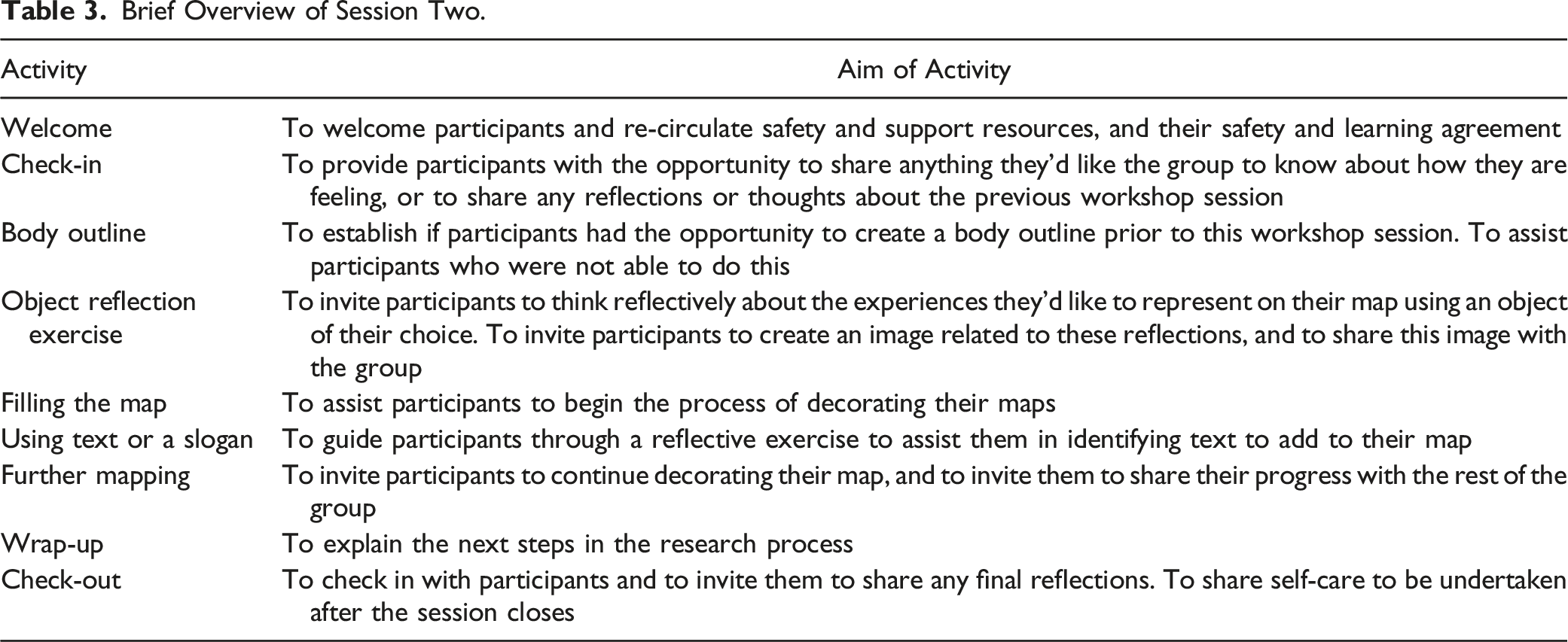
The second workshop session was intended to support participants to decorate their body map. During in-person mapping, this session is typically much less information-heavy, and less structured than session one. We felt it was important to bring structure into this session, in order to maintain a sense of connection between attendees. To this end we included a handful of creative activities across the session (e.g., working with objects to explore symbolic representation on maps, and a writing exercise to help participants determine if they’d like to include text on their maps). When it came time for participants to work solo on their own maps for an extended period of time, we used music to help maintain the sense of working in a shared space. With the permission of participants, we played gentle, unobtrusive classical music. 4 We used the cessation of this music to signal to participants that we would be coming back together to chat, do a group activity, or bring something to their attention. Participants reported that they enjoyed creating to music and found working in a group setting enjoyable and productive. As participant P28 stated, when asked what self-care activity they would undertake after the close of session two, ‘I think I’m going to listen to some more music…It’s been like I’ve been in a relaxed state [working on my map]’. In this way the online workshops offered participants access to ‘body doubling’; a motivational way to work collectively and collaboratively, yet independently (Valentine, 2022).
Fostering a Sense of Connection
As we prepared to map online, we were concerned that it might be difficult to foster a sense of trust and connection in an online environment. In previous projects involving in-person mapping, we built-in time to chat, mingle and share food to facilitate rapport building, and to help foster a sense of psychological safety. Group videoconferencing is decidedly not conducive to organic mingling. So, to mitigate against participants feeling disconnected, or awkward about sharing their experiences or artworks, we included regular time for participants to share their thoughts, experiences, emotions, and artworks. We paired each creative exercise with a period of reflective group discussion to support respectful sharing and also regularly invited participants to hold up their artworks to the screen so others could see what they’d worked on (Figure 1). As outlined below, this reflective discussion largely had a positive impact. Many participants reported feeling a sense of connection with others taking part and noted that sharing their experiences of stigma and discrimination with people in the ‘same boat’ made them feel seen, supported, and understood. As participant P4 noted, ‘pretty much every other person in the workshop had also experienced something, so it made you feel a lot less alone’. Further, working alongside one another creatively enhanced this feeling of connection. As participant P8 reflected: Participant sharing a drawing created during a preparatory exercise exploring abstract mark making.
… being in a group of people that you don’t even know and having that time to do the activities that we did, and then share them, and connect with other people’s experiences and how they represented it in drawing and words and things like that, was just – it’s been an amazing experience…coming together with those people and having that ability to be open and to be prompted by questions that you guys had for us, it was just incredible. It was a really good experience.
Participant Support and Safety
Example of Safety and Learning Agreement Authored by Participants and Facilitators.

Mapping Solo
For some, body mapping can be inaccessible, including for some people with disability or chronic pain. This is because to make a body map a person must lie down and/or work on the floor (to have their body traced to form the basis of the map, or to decorate their map). With the guidance of our advisory group, when writing both our face-to-face and online facilitation guide, we made a number of provisions to try and make the mapping process more accessible. For example, we devised some alternative mapping approaches that did not require working on the floor. These included taping a map to a wall or table, or inviting participants to work on an A4 piece of paper using a pre-drawn, or their own hand-drawn, body outline and then reproducing these on a large-scale for knowledge translation activities (see below). Those who felt uncomfortable tracing their body, or dissatisfied with working on a small-scale, would be invited to represent their bodies symbolically (e.g., a participant might draw a house to represent their body as the ‘home’ for their emotions and this house would be used as the basis for the map). During the online workshops, a number of participants produced A4-sized maps, drew their body outlines (rather than tracing them), or represented their bodies symbolically.
Taking this flexible approach to conceptualising what counts as a body map also helped us to address a central logistical hurdle of mapping online: how to trace someone’s body when they are mapping solo. When mapping in-person, participants pair up and trace each other’s bodies. When mapping online participants were often working alone in their homes without immediate (or indeed any) access to someone who could trace their bodies. To get around this, we made the act of creating a bodily outline an activity that participants undertook as ‘homework’ in between session one and session two (see Supplement Appendix 1 for details). If participants were not able to have someone trace their bodies, or felt uncomfortable with this approach, we suggested workarounds based on the alternative mapping approaches described above. Participants also devised their own ingenious alternatives to body tracing; for example, a participant who felt uncomfortable having their body traced, laid out clothes on their piece of fabric (shirt, pants, shoes) and traced these to create a bodily form (Figure 2). Body map created by tracing clothing to produce a body-outline.
Workshop Structure
Brief overview of Session One.

Brief Overview of Session Two.
After the workshops
At the close of the second workshop, we invited participants to continue to work on their maps if they needed more time to complete them. Some participants worked for a few more hours, others took several weeks. Once a map was complete (or as it was being finished, as per participant preference), we organised one-on-one interviews with participants via videoconference or phone. Prior to interviews, participants shared photographs of their maps so researchers could prepare appropriate interview questions. Participants mailed completed maps to the research team for analysis and knowledge translation activities.
Logistical and Other Considerations
Beyond the adaptations to the workshop process outlined above, body mapping online requires various logistical and other actions to ensure its smooth operation.
Materials and Postage
Prior to workshops mapping materials need to be delivered to participants. In the weeks prior to their workshop commencing, we posted our participants a ‘starter-pack’ of art materials: a large sheet of calico fabric (see below), some squares of coloured fabric (fat-quarters used by quilters), coloured ribbon, a needle and thread, a selection of coloured markers (approx. six), glue, some sheets of paper, and a pencil. We also mailed participants pre-paid self-addressed mail satchels so they could post their maps back to us for analysis. In addition to these materials participants often utilised other art supplies they had in their homes (such as paints, cut outs from magazines, charcoal and oil pastels). If budget allows, it is worth equipping participants with a larger selection of materials than we were able to provide (such as a set of acrylic paints, paint brushes, or a 36 pack of markers) so that those without art materials at home can experiment freely with colours and textures when mapping.
We chose to use calico fabric as the base for body maps, rather than the oft used paper. Calico is hard-wearing, can be drawn and painted on with a variety of materials without colour-bleeding, and can be easily manipulated by participants (e.g., cut, reshaped, sewn-on). Further, calico is cheaper than the heavy art paper (160 gsm) we have typically utilised in body mapping, and is significantly easier to cut, transport, store, and mail to participants. We sent each participant a segment of calico that was approximately 180 cm wide and 200 cm long to accommodate a full-length body outline. 5
Accessibility
For some participants, online workshops were more accessible than face-to-face sessions (e.g., they were COVID-safe, could be accessed at home, didn’t require travel etc.). However, as Liz Bowen has observed, it is a mistake to suppose ‘that “online” automatically means “more accessible”’ (2021). Researchers considering mapping online should budget for accessibility costs to support participation online if required (e.g., the provision of sign language interpreters, or live-captioning to ensure accessibility during workshops). Once a participant had joined our study, we asked them to let us know if they had any access or support requirements which we could accommodate to make the workshop accessible. Our participants advised us of a number of simple actions we could take such as using the videoconferencing software’s chat function to share a written version of facilitators’ oral instructions, enabling the videoconferencing’s real-time auto-transcription function (which should be noted, is not always accurate), accommodating the attendance of support workers, building-in regular breaks, and accommodating alternative modes of body mapping (as described above).
Facilitators
While it might appear self-evident (at least in the context of mental health research (see for example, Black Dog Institute, 2020)), we believe it is important to acknowledge that a key element of the success of our online workshops was the participation of facilitators with personal, lived experience of disability, mental distress, and/or a refugee background. Several participants reflected that knowledge and insights provided by lived experience facilitators helped them feel safe and understood. For example, participant P25 recounted that after sharing an experience of discrimination with the group, lived experience facilitator AB was ‘very affirming and she actually said, I’m sorry you experienced that’. The participant felt this response helped her recognise that she should not have had to experience this discrimination, challenging self-stigma that she held.
When possible, we suggest sharing facilitation duties between several people. We found that having three facilitators for a moderately sized group (five to seven participants) worked well. Allowing different facilitators to take charge of specific sections of the workshops has the effect of varying the rhythm and breaking-up the session. Further, facilitators who are not presenting can then be on hand to provide ad-hoc, one-on-one support to participants (e.g., by meeting them in a break-out room, or phoning them at their request). This also allows any facilitator to rest as needed (e.g., for a toilet break, if they feel upset due to workshop discussion, as a result of IT troubles, or if they require some time-out for other reasons such as chronic pain or fatigue).
Other Considerations for Participants
To combat videoconference-fatigue we aimed to take at least a short break (e.g., three to 5 minutes) every 20 minutes. We also tried to be responsive to participant needs by taking unscheduled breaks if required.
To help maintain participant momentum and engagement, we recommend facilitating the workshop sessions across two consecutive weeks. Further, if multiple workshops are planned, as in our case, we advise having the same cohort of participants working together across both sessions (rather than participants randomly attending two sessions). This is important as it maintains rapport and a sense of safety within those corresponding groups.
If possible, we recommend taking an adaptive approach to workshops and inviting feedback from participants during each session. We found this useful as participants shared lots of helpful insights about what they felt worked and what didn’t. For example, the first workshop session begins with a mindful body-scan to relax participants and introduce the research aims and questions. During one of the early workshops, a participant told us they found the body-scan stressful because they live with chronic pain and the process made them hyper-aware of their discomfort. So, we developed an alternative reflective exercise not focused on the body which could also be offered to participants. This exercise continued to evolve, with one of our team-members, Bronwen Ifred, re-writing it substantially (see Supplement Appendix 1 for the script articulating this exercise).
Finally, to acknowledge the contribution participants make to a body mapping research project (by sharing their expertise, giving their time etc.) we strongly recommend renumerating workshop participation in some way (e.g., gift cards for participants after each session).
Conclusion: Methodological Strengths and Shortcomings
We consider the online workshops to have been successful because they enabled us to collect rich data, and participants reported a high level of satisfaction with the process. By way of conclusion, we share strengths and weaknesses associated with this body mapping approach, that we feel others seeking to use this method should be aware of.
Strengths
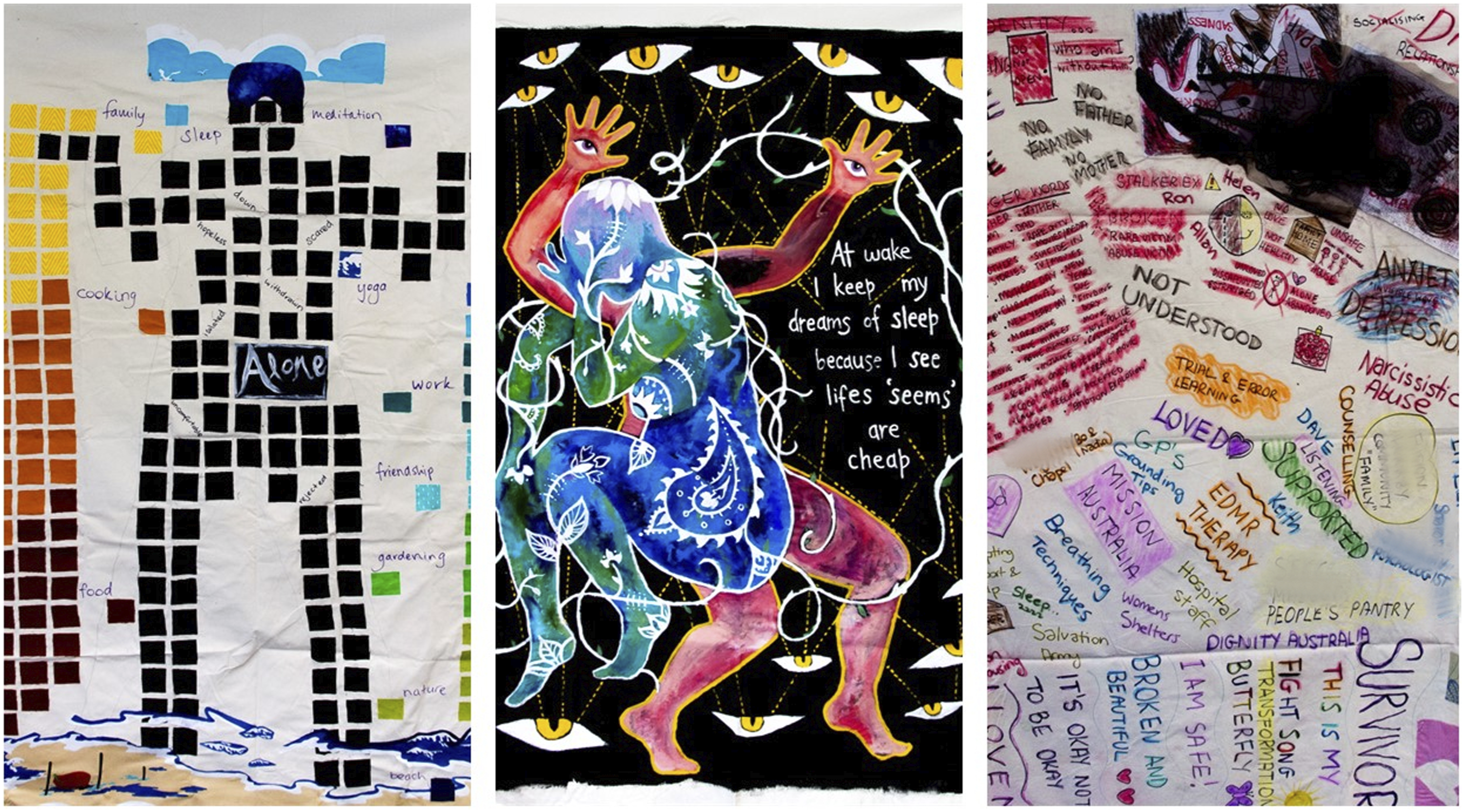
1. Accessibility: Body mapping online allows participants to work from their homes. For many, this helped them to feel safe and comfortable during the process. As participant P16 observed, ‘I really liked it because we were together but separate…it was kind of a bit safer in some ways’. Further, a number of participants with disability, or who lived in rural or remote geographic locations, explained that it would have been difficult, or impossible, for them to take part in the research, had it been facilitated in-person. 2. Connection: As a result of incorporating regular group discussions into the workshop process, participants reported a sense of connection and solidarity with others attending the sessions. As outlined above, many participants commented on the value of sharing creative and reflective time with others who have lived experience of mental distress/disability/refugee background. Others wished our workshop sessions could have continued regularly, as they afforded them a safe, creative space to visit weekly. 3. Space to explore difficult terrain: Reflecting on experiences of stigma and discrimination sometimes meant that workshop attendees were canvassing difficult emotional terrain during group discussions. Co-creating the Safety and Learning Agreement helped to foster an environment of compassionate, non-judgemental sharing and listening which supported these kinds of discussions. Across the workshops participants and facilitators discussed a wide gamut of experiences – sharing tears, laughter, and many emotions in-between. Some team members felt concerned when participants cried while sharing or listening, as they had not encountered this in previous research. These fears were allayed when participants reported that they felt safe, supported, or a sense of catharsis resulting from sharing in a supportive environment. As participant P15 stated, ‘having the opportunity to speak your truth a little bit …it’s a fantastic opportunity to do that. I have put so much of myself on your map that I never thought I would. I didn’t start the process thinking that I would do that…It’s been healing.’ However, as described above, it is important to make sure that comprehensive safety and support mechanisms are in place before, during and after workshops, and that these are clearly and repeatedly communicated and accessible to participants. Depending on the research aims and questions, it may also be advisable to make clear that workshop sessions are not therapy sessions, and that when sharing, participants need to be mindful of the potential impact their disclosures may have on others (see shortcomings below for more on this). 4. Capturing rich data: During in-person body mapping workshops, researchers often document the process via audio or video recording, photography or note taking. However, because in-person workshops tend to be quite diffuse; characterised by organic, ad-hoc discussions between small groups of participants, it can be hard to capture the process fully. With participant permission, we recorded our online workshops. This meant that the discussion emerging from workshops formed a rich corpus of data which has shaped the findings of our research. Further, researchers undertaking post-workshop interviews could revisit workshop recordings to prepare for interviews. 5. More mapping time and visual diversity: In the final session of in-person workshops participants are typically expected to complete their maps and leave them with the research team for analysis. However, participants of online workshops were invited to complete maps in their own time and then mail these to the research team. Participants were able to work on their maps iteratively, refining their approach until happy with the outcome. Participants often utilised materials they had in their home (instead of, or in addition to the materials we posted them), as a result the maps are amongst the most visually diverse and detailed we have ever collected (Figure 3). This serves to emphasize the unique biographical stories captured by each map. Details from three body maps created by participants – showcasing map diversity.
Shortcomings
1. Logistical burden: Online mapping is more resource intensive than in-person workshops. For example, rather than simply arriving at the body mapping venue with art materials, these must be posted to participants in advance. Further, there are higher costs associated with the purchase of individual art kits, as opposed to the provision of a single set of art materials participants can share. Mailing materials and financing the postage of completed body maps also adds an additional cost. Finally, pre-posting resources means that participant attrition results in resource loss. 2. Access and space: As mentioned above, while facilitating the workshops online extended opportunities for access for some participants, the internet (and IT required for videoconferencing) are not always accessible, comfortable or appealing for everyone (Saad et al., 2022; Sheldon et al., 2007; Wherton et al., 2020). Participants with a refugee background were the least represented in our online workshops, and we have speculated that this was due to their virtual delivery (we later held in-person sessions to address this). Another key barrier to joining the online workshops is related to physical space. Body maps are large, and participants require physical space and privacy to undertake the body mapping activities and to share their stories during the workshops. Some potential participants were concerned they wouldn’t have the physical or emotional room to complete maps comfortably at home, and as a result, did not join the study. Some participants purposefully joined workshops that were scheduled at times when their housemates, or family members were not at home, as they didn’t want them to hear about the personal experiences and stories they were exploring and sharing via map making. 3. Glitches, fatigue, and other web foibles: Although we did our best to mitigate against videoconferencing fatigue, it is important to acknowledge that for some, working online is draining and feels unnatural. Discomfort produced by working online can be greatly exacerbated by tech issues with which, due to COVID-19, many of us a wearingly familiar: freezing, glitching, dropping out, or microphone or video malfunctions. The prospect of these tech challenges caused ongoing anxiety amongst the researcher-facilitators, leading AB to coin the term PIA (Persistent Internet Anxiety). While participants told us they enjoyed the online workshops, some still bemoaned that they couldn’t move around and check out other people’s maps, or chat one-on-one informally with facilitators or participants. 4. Too much sharing: We noted above that the increased opportunity for group discussion and sharing was a positive characteristic of body mapping online. However, it is important to note that for some participants this sharing had a negative impact. For example, one participant withdrew from the research as they felt overwhelmed and upset by what had come up for them in the aftermath of the first workshop session. Another participant felt triggered by an experience recounted by another attendee during group discussion and did not join the second workshop session, instead preferring to complete their map by working offline in consultation with the research team. Another participant (P22), who completed the workshops and created a body map, noted that sometimes engaging with other participants could be exhausting: ‘…hearing a lot of new stories…it’s just been a little bit emotionally exhausting for me’. While safe disclosure and purposeful storytelling techniques were often raised during the authoring of the Safety and Learning Agreement, some participants were not familiar with these concepts, or were unaware of their own storytelling boundaries. We believe that the project’s safety and support protocol, and the Safety and Learning Agreement creation process largely mitigated distress during workshops. Despite this, we strongly believe everyone has a right to participate in research and to feel safe while doing so. Researchers undertaking body mapping online (especially those exploring potentially difficult issues or experiences) need to be aware of the double-edged quality of group sharing. While it can be associated with positive outcomes, there is always the potential that individuals will experience distress as a result. Therefore, it is vitally important to have robust safety and support mechanisms in place, and to support participants to be aware of their emotional wellbeing and psychological safety, even if it means they need to withdraw from the project or find an alternative way of participating. 5. Small cohorts: While it is not necessarily a methodological weakness, we think it important to note that, in our experience, online body mapping is ideally suited to small cohorts. Workshops involving more than six participants can get unwieldy (e.g., they can run far longer than scheduled). Smaller groups allow facilitators to give all participants an opportunity to regularly share their reflections, thoughts, or artworks.
Although digital conferencing platforms can feel disembodied and disorienting, we were excited to discover that with careful planning, and a flexible and responsive approach to the needs of research participants, we were able to create a safe, reflective online space for engagement with embodied, lived experiences. Although there are shortcomings and challenges associated with body mapping online with which facilitators/researchers should be aware, the novel method outlined here offers a productive means of collecting rich data, in a manner that can be fun, engaging and psychologically safe for participants.
Supplemental Material
Supplemental Material - Exploring Embodied Experience via Videoconferencing: A Method for Body Mapping Online
Supplemental Material for Exploring Embodied Experience via Videoconferencing: A Method for Body Mapping Online by Priya Vaughan, Angela Dew, Akii Ngo and Katherine Boydell in International Journal of Qualitative Methods
Footnotes
Acknowledgments
Thank you to the “Women marginalised by mental health, disability, or refugee background” project team: Yamamah Agha, Jill Bennett, Ainslee Hooper, Bronwen Iferd, Julia Lappin, Caroline Lenette, Cindy Lui, Apuk Maror, Jacqui McKim, Jane Ussher, Ruth Wells, and Yassmen Yahya. Our thanks and gratitude to the participants who took part in the online workshops described in this paper, your feedback about, and engagement with, the process greatly enriched it. We acknowledge that this research took place on unceded Aboriginal land. We pay our respects to Aboriginal and Torres Strait Islander peoples as the first custodians of the lands and waters where we live and work.
Declaration of Conflicting Interests
The author(s) declared no potential conflicts of interest with respect to the research, authorship, and/or publication of this article.
Funding
The author(s) disclosed receipt of the following financial support for the research, authorship, and/or publication of this article: This work was supported by the This research was funded by an Australian Research Council Discovery Project Grant. Grant number: DP200100597.

Supplemental Material
Supplemental material for this article is available online.
Notes
References
Supplementary Material
Please find the following supplemental material available below.
For Open Access articles published under a Creative Commons License, all supplemental material carries the same license as the article it is associated with.
For non-Open Access articles published, all supplemental material carries a non-exclusive license, and permission requests for re-use of supplemental material or any part of supplemental material shall be sent directly to the copyright owner as specified in the copyright notice associated with the article.
