




Abstract
Qualitative researchers differ in their beliefs about the role of theory in data analysis. Some begin with theoretical constructs employed as codes in a deductive process while others hold theory at bay until late in an inductive process (Gibbs, 2007). Still others toggle back and forth from theory to data to theory and so on. Researchers have offered comprehensive accounts of inductive coding (e.g., grounded theory; Charmaz, 2006) or general descriptions of the application of theory within data analysis (Anfara & Mertz, 2006; Dressman, 2008). Absent from the literature, however, is a detailed description of a back-and-forth analysis practice. The current article fills this gap in the literature by presenting a specific procedure in which the researcher begins with an initial theoretical position and then examines the data to establish a key question raised by that data. The process continues as the researcher considers a variety of theories which address the question, selects the “best fit” theory, carefully applies that theory to the data and supporting literature, and finally reflects on ways in which study findings may enhance the theory. I exemplify this activity with data from a study of members of a writing group for adults with major mental illness.
Qualitative researchers differ in their beliefs about the role of theory in data analysis. Premature theoretical framing may skew research findings or undermine the discovery process that is fundamental to inductive exploration (Corbin & Strauss, 2015). On the other hand, as Garvey and Jones (2021) note, “a framework may provide a sense of the story as it emerges out of the analysis, leading down paths of inquiry that may otherwise be missed” (p. 1).
Within particular forms of qualitative research, theory plays a lesser role. For example, phenomenological research emphasizes the need for bracketing: a suspension of (theoretical) judgment (Husserl, 1913/2017). And rapid qualitative research (RQR) is well-suited to fluid, quickly changing contexts such as hospitals during the COVID-19 pandemic (Luciani, et al., 2021) and corporate institutions (Isaacs, 2013). Research in these venues privileges the perspectives of insiders and accelerated data analysis, and generates information that is highly contextualized (Smith, et al., 2022).
Nevertheless, theoretical framing is, generally speaking, a useful aspect of data analysis and in the presentation of qualitative research (Anfara & Mertz, 2006; Cresswell & Cresswell, 2018; Dressman, 2008; Jackson & Mazzei, 2012). Many who claim to approach data from an atheoretical position, Garrison (1988) has argued, fall into one of three categories: they hold tacit theoretical positions that demand reflection, they hold theoretical perspectives explicitly but decline to state them, or they “hide” theoretical stances (from themselves as well as others) within the description of methods. Of those who believe in the importance of explicit theorizing, some view the role of theory as limited, employed only as a general foundation for thinking and planning; others see it playing a broader and more pervasive role: influencing the development of research questions, driving data collection and analysis, developing a justifiable interpretation, and structuring the writing up of findings (Anfara & Mertz, 2006; Henstrand, 2006). I, too, adopt this stronger view of theory, although I heed Garvey and Jones’s (2021) warning to constantly explore a given theory’s fit to the data, question how and when to employ it, and adapt or abandon a theory as appropriate.
Considering the relationship between theory and research methodology is an ongoing endeavor for me because I regularly teach my department’s seminar for newly enrolled doctoral students. This course serves several functions: to introduce students to faculty with whom they will interact, to familiarize them with departmental milestones, to guide them through writing a paper they will use for their qualifying exam, and—most relevant for this article—to expose them to key theories in the field. At the top of the syllabus, I include a quote from Kurt Lewin: “There is nothing more practical than a good theory,” and I re-iterate and support this claim throughout the semester by encouraging students to imagine ways in which each theory we study might connect to their own research interests.
On the very first night of class, we discuss the uses of theory in planning for, carrying out, analyzing data from, and writing up research. I tell them that theory helps the researcher in a variety of ways. For example, mediation theory (Vygotsky, 1978) allows the researcher to understand what they see (“Oh, so the poetry she wrote served as a tool to mediate communication with her friends”), notice what they did not originally see (“I didn’t recognize at first that phone conversations with friends were as much mediating poems as those she wrote down”), communicate with colleagues (“I look at the role of poetry through a mediation lens”), and inform practice (“We might encourage high school students to think about the ways in which poetry—however they define it—could serve as a mediational tool in their daily lives”).
I suggest that students set a long-term goal to have one or two theories they know like the back of their hand, defined as being able to give a brief talk without notes. Generally speaking, this request makes sense to them: they learn early on from visits to the class by department faculty that many draw on a particular theoretical lens in the work they do. But students seem less certain about my follow-up recommendation: that they should eventually have a working familiarity with other theories which will prove useful to them down the line. Often, I explain, I embark on a research study with a sense of the theoretical frame I will use, only to discover that this frame is less helpful for explaining, noticing, communicating, and informing than I had expected. My awareness of a range of other theories—and the ability to reflect on and critique each as I select the one which seems most profitable for a given research project—allows me to move forward in a more productive way.
I describe for them a practice which entails adopting a tentative theoretical lens for a given research study. After collecting data, the researcher reads through it, seeking a key question raised by that review. Then they consider several theories that connect to the question, select the “best fit” theory, carefully apply that theory to the data and supporting literature, and finally reflect on ways in which study findings may add to the theory; this process—which I have come to refer to as theory-responsive analysis—integrates theory and data in a productive way. It is the intent of this article to explain how such a practice might be used for data analysis and as an instructional tool for students in qualitative research methods courses. For purpose of explanation, I will describe how I employed this approach in a study of a writing group for adults with major mental illness.
A Place for Us: Volitional Writers in a Psych-Service Center Context
The site for this study was A Place for Us (APFU) 1 , a nonclinical psych-service center located in a southwestern U.S city. This center provides opportunities for adults with major mental illness to engage in a variety of activities, ranging from classes and recreational pursuits to running a small business. Sharon, a local writer and editor, organized a writing group for members several years prior to my arrival. I termed those who participated volitional writers—those who write voluntarily for personal fulfillment—and I was drawn to this site because I was interested in the ways members of marginalized groups employ writing to meet their needs. The following research questions initially drove the work: What do members of a voluntary weekly writing group for adults with major mental illness say about why they choose to write? What functions does writing serve for them? I imagined that study findings would inform our understanding of the role of writing in the lives of those whose gifts often remain unappreciated by the broader society.
Before data collection began, I discussed the study with group members. I explained that I, too, had a mental health diagnosis and hoped this shared positionality might sensitize me to their experiences, even as I understood that each of us was unique. I noted that I would audio-record writing sessions whenever all of those in attendance agreed to this; collect, photocopy, and return writing; and conduct semi-structured, audio-recorded interviews. Eleven members chose to participate in the study. Of these participants, ten were white, and one was African American; five were male and six female.
The group met on Thursday afternoons from 2-3 pm. Occasionally, Sharon or I offered writing prompts, but most came from members. After the prompt was read, members wrote for about ten minutes or so and then, if they wished—and nearly all did—read their work aloud to the group. Clapping followed, as did compliments about what listeners appreciated in the writing (e.g., “I saw a picture in my mind of what you wrote about”; “That was so funny!“). To ensure that members felt fully supported—and valuing self-confidence and interpersonal relationships over writing improvement—critique was absent from the interaction. We repeated this routine one to three times more.
Framing the Data
Described below is the process I employed in approaching study data and preparing a manuscript for publication (Jaeger, under review). This process began by assessing the appropriateness of the theory with which I initially framed the study, systematically exploring alternative theories, selecting a core theory and considering its problematic aspects, applying the chosen frame to the study data and research literature, and reflecting on that theory in light of the collected data. Several authors have examined the application of multiple theories within qualitative research (Dressman, 2008; Jackson & Mazzei, 2012). Other researchers have explained how they selected from among alternative theories, but these authors referenced only non-specific reasons for accepting or rejecting these theories. For example, Kearney and Hyle (2006) found that a theory “could not be easily operationalized in our research” (p. 125); Mills and Bettis (2006), argued that rejected frameworks were “not rich enough to explain some aspects of our findings” (p. 76). The current article is, to my knowledge, the first to track the details of evaluating a range of theories and selecting one to employ in data analysis.
Step 1: Drawing on a Preliminary Theoretical Frame
Jackson & Mazzei (2012) noted the downside of committing early on to a well-known and oft-used theoretical perspective, saying: “(I)n our zeal as qualitative researchers to gather data and make meaning . . . we often see that voice which we can easily name, categorize and respond to” (p. 4). Premature commitment to a theoretical frame has the potential to cut off other, and potentially more fertile, avenues of analysis. Nevertheless, adopting a tentative theoretical lens—what Malinowski (1922) referred to as “foreshadowed problems” (p. 9) and Mills and Bettis (2006) described as starting a study with a “notion” (p. 74)—can provide focus for the research design phase.
Although I could find no writing group research presented from this perspective, I initially believed Cultural-Historical Activity Theory (CHAT)—a framework I had employed in past work—would shed light on the data I collected, helping me to understand that data, see aspects of the data of which I might otherwise be unaware, communicate what I found to other scholars, and even apply what I learned by establishing a similar group with different kinds of members (see Figure 1):
The aims of CHAT are to explore the ways in which people employ tools to achieve their goals and the ways in which these efforts are influenced by the communities to which they belong. In my mind, individual writing group members were the subjects who employed the tools of pen and paper in service of their object (improving their writing). The rules (norms) of the group (prompts, writing, and reading aloud) brought the members together—their labor divided between readers and listeners—as a community, leading to written products as the outcome. At this point, however, I heeded Dressman’s (2008) advice to “turn relations between one’s theoretical framework and one’s data inside-out” (116) and ask questions such as: In what ways does CHAT fail to explain the data I am collecting? What holes in the framework does my data reveal? CHAT’s emphasis on community building in service of a positive outcome remained relevant. But once I began data collection and ongoing analysis, my commitment to CHAT wavered. As Sandelowski (1993) has suggested, a researcher may jettison a theory—no matter how promising—"if it fails to earn its way into a project” (217). CHAT model (Engestrom, 2019).
Step 2: Immersion in Data
When I finished data collection, I compared the theoretical frame I had initially chosen to the data I had collected, surfacing the limitations as well as the strengths of that theory. It soon became clear that CHAT was likely not the most productive lens I could employ. Tools such as pen and paper, and even the signs (language) which accompanied them (prompts, brief comments) seemed largely superficial. Norms demonstrated none of the complexity of those found in other CHAT-based studies (e.g., Cliff, et al., 2020). Members exhibited only minimal concern about improving their writing; in fact, I could find no object or outcome shared by all. And membership varied enough that no true community developed.
Step 3: Surfacing the Key Question
This realization led me to the question: what is this situation actually about? The APFU experience was about group interaction; that explained why I had been drawn to CHAT in the first place. But in the time I spent with the writing group, I came to understand that the setting facilitated not just interaction but nourishing interaction. Generally speaking, members lived challenging lives and faced any number of barriers to attendance: there were family crises, doctors’ appointments, and an assortment of other unexpected events, and members were often absent for weeks at a time. And yet they returned. They spoke in interviews about the sustenance they took from (and provided to) each other, as writers and as human beings. This data set demanded a theoretical frame which attended carefully to the sustaining quality of the group’s interaction.
Step 4: Considering Several Theories/Selecting the Most Generative
Researchers often draw on multiple theories throughout the course of their research. Like Henstrand (2006), many use different theories for different aspects of the research (e.g., determining the unit of analysis or justifying the chosen researcher role) or for different subsets of data (Mutch, 2006). In what follows, I describe a process designed for a researcher who—although likely informed by a variety of theories—wishes to home in on a single theory to drive a particular project.
Ideally, a researcher has a working knowledge of a number of social theories that consider the phenomenon in question—in this case the workings of supportive groups, systems, and contexts—allowing them to consider a range of options for coding their data. Those whose theoretical knowledge is less extensive, might pursue other theories by reading, conversing with mentors and peers, and eventually evaluating and discarding those which are less effective. This is likely to be a somewhat intuitive process; as Smith (1978) noted, “As events occur which several theories omit, neglect, or speak to only minimally, the generation of one’s own position comes to the forefront” (p. 333).
My criteria for theory selection included the extent to which the theory helped me understand what I witnessed in the data (that is, the role writing played for each member as they described it during interviews and in collaborative conversations about the benefits of the writing group), the extent to which it allowed me to see what had previously been invisible to me, whether it might help me communicate with readers, and how it might influence practice. Ideally, other researchers would have employed the theory in research on writing groups and/or of individuals navigating the world of mental illness. I review below each theory I considered, my reasons for rejecting four of them, and for selecting the fifth.
Ecological Systems Theory
Bronfenbrenner’s ecological systems theory (Bronfenbrenner & Morris, 2006) considers individual growth within the context of a system. This theory has served as the frame for studies of adults within the mental health system (e.g., Cohen, 2020; Low et al., 2019) and the APFU setting is such a system. Participants in my research study were members of the writing group microsystem. Some were also members of another microsystem: the group that crafted the monthly newsletter. A mesosystem overlap occurred when drafts from the writing group appeared in the newsletter. There were exosystems as well (microsystems that influenced APFU members but of which they were not a part), such as the center’s Board of Directors. Finally, the macrosystem consisted of overarching cultural attitudes that influenced the working of the total system.
The richness of ecological systems theory lies in its emphasis on the complex interactions of all system components and refusal to oversimplify those connections. In the end, however, my greatest interest lay in the writing group microsystem itself. It was, no doubt, influenced by other microsystems and by the APFU system as a whole, but largely functioned apart from other aspects of the system. I feared that the virtue I most appreciated in Bronfenbrenner’s theory—its broad and elaborate scope—would overwhelm the microsystem-focused data of this study. In addition, the few studies that linked writing data to this theory dealt with children only (e.g., Axelsson et al., 2020) and would offer few recommendations for evaluating and improving practice.
Culture Circles
Paulo Freire (1990) initially developed the concept of culture circles as he worked with adult literacy learners in Brazil. He came to understand that these learners struggled not only with literacy but with other aspects of daily life. More than anything, they were the victims of class oppression and were viewed not only as illiterate but as inadequate in all ways. Freire formed groups of villagers which he termed culture circles. These groups began by investigating the issues and problems which defined members’ lives and noting the themes that united them. Next, they created artifacts (e.g., drawings, photographs) representative of these themes of struggle. This process was followed by critical dialogue and collective problem-solving leading to action. Learning occurred via dialogic inquiry and the ultimate goal was action in service of a better future. In this sense, culture circles are “polyphonic spaces honoring multiple voices and perspectives” (Souto-Manning, 2011, p. 105) and emphasize that education is always political in nature (de los Rios & Souto-Manning, 2017)
Given pejorative attitudes toward the mentally ill, we might consider them to be members of an oppressed group. And Freire’s work has served as the theoretical foundation for studies of adults with mental illness, emphasizing mutual support via study circles (Whitney et al., 2008), as well as critical reflection on storytelling accompanied by visual images (Mizock et al., 2014; Potash et al., 2018). Within the APFU group, interactions were most certainly dialogic in nature with no single person serving as “teacher.” The group never emphasized common political difficulties or taking action in the world in ways that promoted change. It seemed likely that culture circle theory would push me toward an interpretation not fully supported by the data.
Communities of Practice
A community of practice is, as Wenger (1978) put it, a group that creates itself through an ongoing pursuit of a shared endeavor. Members are practitioners and interact around that practice through the sharing of tools, stories, and experiences. Three dimensions define communities of practice: • Mutual engagement: members work together to accomplish goals and build relationships • Joint enterprise: members negotiate ideas of what is important and why; they hold each other accountable • Shared repertoire: members interact via shared routines and discourses
Mental health research employing the frame of communities of practice emphasizes the importance of a shared domain of knowledge, concrete activity within that domain, and a supportive social learning environment (Cassidy, 2011; Piat, et al., 2016). Among research studies that viewed writing groups through this lens, two examined academic writers. Ciampa & Wolfe (2020) studied graduate students working on dissertation proposals; members provided emotional support as well as writing feedback with a goal of generating improved texts. Like these students, professors in Gardner et al.’ 2020 study attempted to increase their rate of publication via goal setting. Creative writers in Nelson & Cole, 2012 study also focused on giving and receiving feedback in support of improved writing.
Members of the APFU writing group were certainly passionate about the writing practice they shared, and they learned from each other along the way. But that learning was less about becoming better writers and more about how to flourish in a group of like-minded souls, embedded in a broader world where their individual challenges were often misunderstood and rarely supported. Emphasizing knowledge-building would not, it seemed, lead to more expansive writing group interactions for APFU members or those attending other similar groups.
Third Space
Homi Bhabha (1994) first described the idea of Third Space in his text The Location of Culture. He referred to these spaces as both “inbetween” (56) and “contradictory and ambivalent” (55). Within literacy scholarship, Moje et al. (2004) have viewed Third Spaces as physical, social, and discursive locations in which members draw on multiple resources to make sense of their world, including oral and written texts. Within this hybrid space, members of marginalized groups in particular experience bridges to conventional discourse, often in the service of cultural and social change. Third Spaces can be rich and productive domains in which individuals and their connections to the social environment are transformed through cycles of learning. Nevertheless, work within these spaces is also “difficult and filled with contradictions, setbacks, and struggle” (Gutierrez, 2008).
Within the therapy context, Lesser (2021) explored telemental health services during the COVID-19 pandemic through this lens, noting the presence of skilled dialogue characterized by “respect, reciprocity, and responsiveness” (259) but also the tension among a variety of participant identities. In the one writing group study I could find in which the authors employed Third Space as a theoretical framework (Carr, et al., 2020), members of the group were academics; they focused on goal-driven work to publish and develop their professional identities but, like the group members in my study, they also focused on sharing perspectives and building relationships.
APFU writing group members brought with them an assortment of life experiences and discourses. One was a baker, several were artists, one was a former teacher; others had been absent from the workforce for extended periods. The writing group was not, however, a place to forge links between the experiential and the conventional. Identities expanded here, but not specifically in service of writing improvement. In addition, a sense of relaxation, rather than struggle, typified the space. Practices which emphasized the contradictions and setbacks members may, at times, have felt would be unlikely to serve this group or others like it.
Holding Environment
As Anfara and Mertz (2006) suggested, when the researcher stumbles upon the theory most relevant to a set of data, there occurs a kind of “aha” moment. That moment occurred when I considered D.W. Winnicott’s theory of the holding environment, and the related concepts of mirroring and transitional object. Winnicott’s predominant and lifelong interest was in the relationship between babies and their mothers. He wondered what it was about this relationship that facilitated the child’s movement within the family system and out into the bigger world, and what undermined that movement. Despite, his focus on mother-infant bonds, Winnicott’s theory seemed the best fit for the data I had collected because it emphasized the value of supportive relationships and the way they were enacted. 2
Winnicott referred to the site of a mother’s interactions with the infant as the holding (or facilitating) environment. He defined this environment as one in which “the infant’s natural growth processes and interactions . . . can evolve,” and added that, when provided with such an environment, “the individual has a chance as time goes on to reach out to the world creatively and to enjoy and use what the world has to offer” (Winnicott, 1987, pp. 24–25). In such a dependable environment, the child feels able to safely express a range of emotion, to tolerate the mother’s short-term absence, and to venture out from that environment on occasion, assured that they can always return for care and nourishment. A fundamental aspect of the mother-infant relationship occurring within the holding environment is what Winnicott referred to as mirroring which takes place when the mother sees and truly recognizes the infant as a fellow human creature and reflects this recognition back to them. The child continues to develop and can no longer depend on the mother’s constant attention. At this point, Winnicott (1971) noted, most children develop an intense attachment to some item—a stuffed animal, a blanket, even a scrap of cloth—which they “love” nearly to death. The child fights any separation from what Winnicott termed the transitional object, so named because it facilitates the transition from their expectation that the mother will be constantly present to spending short periods of time apart.
I came to view the APFU writing group setting as a holding environment, members’ response to each other’s writings as a form of mirroring, and the prompts and written texts themselves as objects facilitating the transition from inner feelings to outward expression. The theory allowed me to: (a) understand the supportive tone of the group; (b) view responses of members as ways of reflecting back what they saw in their peers’ writing and the prompts and writings as transitions toward improved mental health; (c) convey key aspects of group experiences within a framework that has already been employed in literature on writing and mental health (Hunt, 2000); and (d) imagine this writing group’s interactions as a model for other such groups.
Step 5: Addressing Problematic Aspects of the Chosen Theory
Rarely does a theory match new data neatly and unproblematically. Winnicott’s theory presented two major challenges for this study: that of gender and of the potential for infantilizing study participants. Contemporary psychologists and pediatricians have shifted the discourse from mother to parent (Leigh, 2016) so, in describing the adult-infant bond, I considered using the gender-neutral term caregiver: defined by the Cambridge English Dictionary as “someone who takes care of a person who is old, young, or sick.” However, this term encourages infantilization, a practice common in describing adults dealing with mental illness (e.g., Ripples, 2020) and one I wished to avoid. In contrast, the term guide is defined as “a person or thing that influences what you think.” I chose to use this term because it is appropriate for both infants and adults and does not fundamentally alter Winnicott’s theory. It is important to note that, within the APFU setting, I did not play the role of guide, nor did any single individual. Guidance emerged from two sources: the writing process allowed members to generate expressive and creative texts and the group as a whole encouraged their peers’ efforts.
Further reading also eased my mind somewhat. As Phillips (2007) noted, “It is important that we . . . don’t assume that when [Winnicott] is talking about mothers and infants, as he almost always is, that that is all he is talking about” (p. x). On occasion, Winnicott suggested that his theory also applies to adults. As he stated, “The potential space between baby and mother, between child and family, between individual and society and the world, depends on experiences which lead to trust” (Winnicott, 1971, p. 103). Adults, too, need a holding environment to support their ongoing maturation and creative expression. As Dethiville (2014) argued, we can reactivate growth, given a nourishing environment.
Step 6: Developing and Applying the Coding Scheme
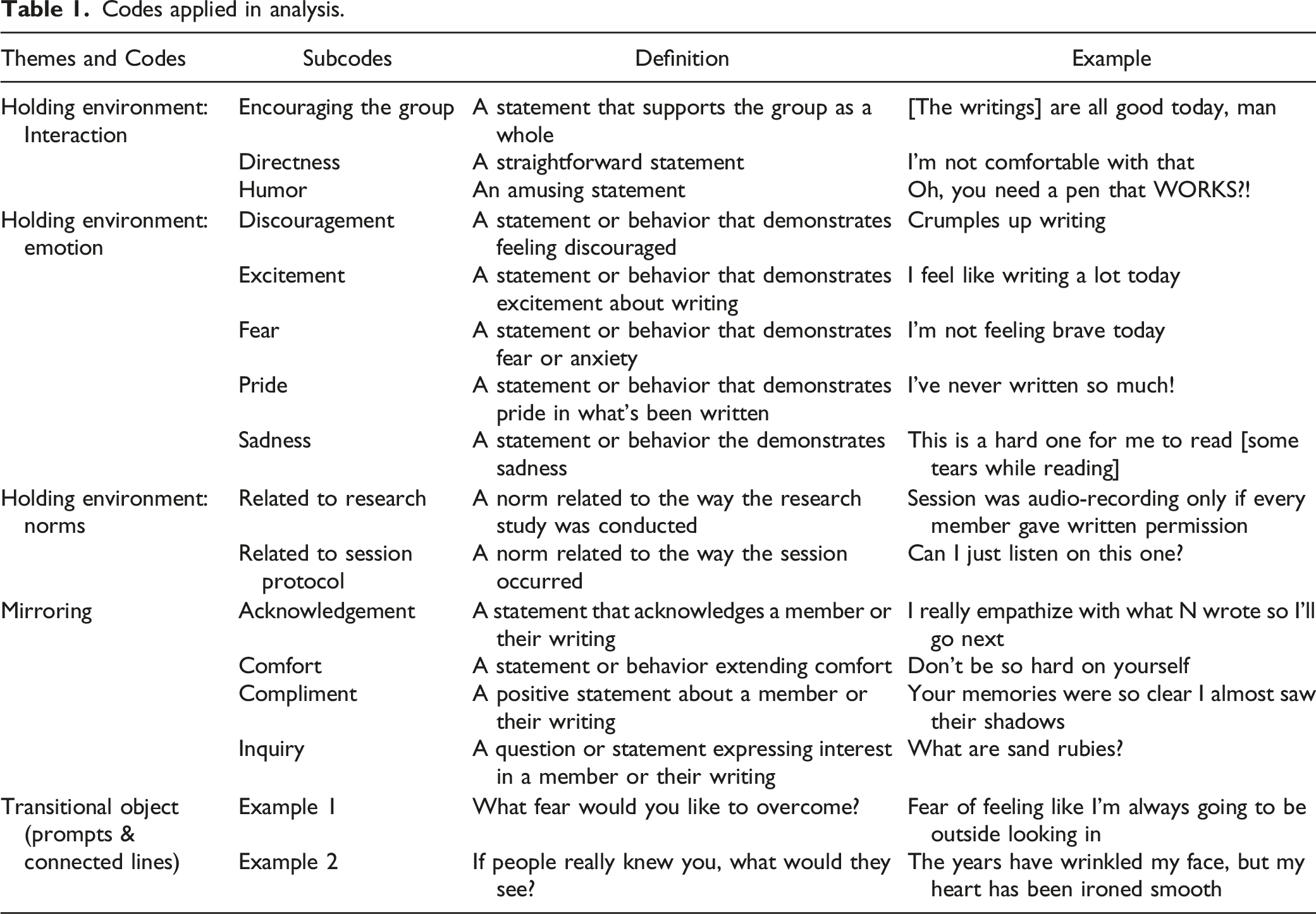
The themes I employed reflected the three primary concepts of Winnicott’s theory: holding environment, mirroring, and transitional object. I conducted what Gibbs (2007) has termed concept-driven coding: that is, beginning with a template of themes drawn from theory. In response to the data, I also constructed relevant codes and sub-codes during this process in what Gibbs referred to as data-driven coding. As Gibbs (2007) stated, “Most researchers move backwards and forwards between both sources of inspiration during their analysis” (p. 46); I generated analytic memos to document that process (Garvey & Jones, 2021). Once I had constructed all relevant sub-codes, I developed a code book (Table 1) and used this document to re-code all data.
Codes applied in analysis.
Step 7: Major Findings
I next wrote up the findings from the study, structured using this coding scheme. Winnicott (1971) asserted that a holding environment experience could benefit adults in the same way it supports young children, and the APFU writing group space seemed to do so for the adults with major mental illness who attended. Time to write in response to prompts, to read aloud, to listen and applaud: these norms provided a structure of safety and predictability. Members communicated in a straightforward manner, expressing encouragement and gratitude in both serious and playful ways. They demonstrated emotion ranging from excitement and pride to anxiety and heartache. All these aspects contributed to the holding environment. Members witnessed each other’s interests in ways that mirrored those interests for their friends with compliments, concern, and comfort. Writings served as transitional objects for APFU participants—mediating “between the writer’s inner self and the world the self inhabits” (Allen, 2004)—and prompts offered a path to that transition.
Step 8: Applying the Coding Scheme to Research Literature
The review of literature should link to the findings as presented. For this study, the research literature I reviewed addressed what is known about the workings of writing groups, particularly those whose members deal with mental health challenges. These groups operated in holding environments; among researchers who studied groups whose members dealt with mental illness, at least one (Hunt, 2000) has employed that term specifically. Others described the ways in which these groups met member needs by facilitating self-awareness (Bolton, 1999) and building interpersonal connections among members (Hartill, 1998). Facilitators “held” the space (Hartill, 1998) and norms such as quiet time to write (Lengelle & Ashby, 2017) and reading work aloud followed by supportive responses from others characterized this space (Bundesen, et al., 2020). Determining that Winnicott’s theory applied to the reviewed literature assured coherence among all aspects of the paper.
Step 9: Reflecting on the Theory Employed to Conduct Analysis
As Dressman (2008) has suggested, “in relating observed experience to theory, the process is not unidirectional; social theory is not simply used to make sense of observed experience, one’s experiences also give sense and understanding to social theory as well” (84). Winnicott’s theory served as a lens to better understand the writing group context. In addition, evidence from this study expands and enriches our understanding of Winnicott’s theory by fleshing out its application in an adult environment with participants coping with a mental health diagnosis. Within the guide-child relationship, “holding” has a clear physical component that was less evident in the APFU writing group, but the psychological aspect is equally strong. For the baby, the holding environment establishes and enhances a feeling of safety; for writing group members, writings demonstrated self-awareness and read alouds built bonds with other members. For the infant and guide, mirroring is also an intensely physical act of gazing into each other’s eyes in a way that allows both involved to be “seen;” for writers, acknowledgement by peers is a less physical but equally powerful reflection of who they are. A blanket or stuffed animal, serving as transitional object, assists the small child in dealing with the sense of abandonment they may feel in the guide’s absence; for writing group members, prompts eased the activity of transferring ideas to paper and the writings themselves connected members to aspects of their lives that demanded attention. Evidence from this study allows us to see the importance of holding environments like this for adults as well as children.
Conclusion
Qualitative researchers often emphasize data-driven methods such as grounded theory (Charmaz, 2006). There is an understandable fear that bringing a predetermined theoretical frame to the analysis process may constrain that process in ways which limit what the researcher sees in the data and, as a result, what a reader learns from the study. As Eisner (1993) has warned us, “Theory . . . not only reveals, it conceals” (viii).
The method I have described here goes a long way, I believe, toward offsetting the limitations of theory-driven analysis. The researcher enters the field holding a tentative theoretical perspective but realizes that this perspective may, in fact, impede a deep analysis of data. After a deep immersion in the data, the attentive researcher asks, “What is this situation truly about?” The answer to this question, combined with a working knowledge of multiple related theories, assists the researcher in selecting the most productive theory. Particularly when research participants are members of disempowered groups—such as those in this study—the decision-making process described here could be improved if a researcher presented those theories under consideration to participants, allowing them to explore, challenge, and interrogate the relevance of each theory for interpretating their experience. In this way, the selection of theory would occur “in an ongoing conversation with participants who take on the role of co-theorists” (Asenbaum, 2022, p. 6). Developing a coding scheme based on that theory—a scheme that is further refined during application to data and research literature—leads to coherent findings and, ultimately, to reflecting on the role of the theory in a new context. It allows the theoretical framework to “guide and inform rather than determine and force” (Harris, 2006, p. 145).
What implications does this process have for the learning of research methods? First, it demands that researchers attain a solid mastery of two or three theories that serve as the foundation for anticipated research projects. These theories serve as the baseline from which the researcher operates. Second, it requires a working knowledge of several related theories. As Diesing (1971) noted decades ago, “The prospective field worker will acquaint himself with a variety of theories (the more the better)” (p. 142). Initially, this may involve reaching out to colleagues and asking, “I am studying X. My baseline theory is Y. The situation appears to be about Z, and Y doesn’t seem to get at the root of it. What other theories might I consider?” Wide reading is also important (Fowler, 2006). Finally, the process depends on intellectual flexibility: the willingness to question, to compare theories and data, to adjust.
Footnotes
Declaration of Conflicting Interests
The author(s) declared no potential conflicts of interest with respect to the research, authorship, and/or publication of this article.
Funding
The author(s) received no financial support for the research, authorship, and/or publication of this article.
