




Abstract
A researcher’s worldview shapes the research methodology, design, and ensuing relationship with participants and the local environment. Western research has traditionally been carried out on, rather than in collaboration with Indigenous Peoples and has largely been conducted through eurocentric and ethnocentric knowledge systems, methods, values, and beliefs which have perpetuated extractions, racisms, and harm. To counteract harmful research, Indigenous scholarship stresses the necessity of articulating and clarifying researcher positionality and self-location prior to embarking on research with or by Indigenous communities. A fundamental component of positionality and self-location is clarifying one’s own relationships with colonialism and embarking on a process of self-decolonization. With this focus in mind, this paper shares methodological insights from an Anishinaabe community-led pilot project for Indigenous language revitalization in the Great Lakes Region of Turtle Island (also known as North and Central America) with participants to whom the researcher is related by marriage or known. This paper adds to existing qualitative methodological knowledge by introducing and operationalizing Dùthchas—a millennia-old Scottish Gaelic concept, worldview, and way of life—as kincentric methodology. The researcher begins the methodological inquiry with his own positionality and self-location as a Gàidheal (Scottish Gael) who is not Indigenous to Turtle Island. Following Dùthchas, the researcher identifies five key methodological principles that informed a kincentric and relational approach to community-led research. The paper demonstrates how Dùthchas has served as a guide for the researcher’s ongoing self-decolonization processes and for emplaced ethical relations. The paper illustrates how Dùthchas enabled the researcher to be in-relation to the lands and Peoples where the research project took place and to conceptualize and conduct research as part of a greater Indigenous Anishinaabe research paradigm, Mino-Bimaadiziwin (The Good Life). Dùthchas has implications for Indigenous—non-Indigenous reconciliatory relations and for the conceptualization and implementation of future (qualitative) research in-relation methodologies.
Introduction
The researcher’s epistemological stance on any research inherently shapes its methodology and design. That is, a researcher’s knowledge and belief system, attitude towards, and ensuing relationship with the research and its participants. This stance influences which knowledge system is being extended, which stories are told, which questions are asked, and how the “data” are analyzed and interpreted (Chiblow, 2021; Smith, 2021).
Many methodological approaches to research with (or on) Indigenous communities have emanated from a positivist paradigm which assumes the researcher and the research can and should be “objective” and “neutral” (Colorado, 1988; Ermine et al., 2004; Leonard, 2017; Denzin & Lincoln, 2018; Meyer, 2001; Smith, 2021; Tuck & Yang, 2012). Research has largely been conducted through Eurocentric and ethnocentric knowledge systems, methods, values, and beliefs (e.g., Creswell, 2013; Dutton, 2005; Liu, 2011; Martin, 2003). The academy has viewed Indigenous peoples as “subjects” or “objects of study” with little regard to the social realities they face or the impact of the research on their wellbeing (e.g., Assembly of First Nations, 2009; Cajete, 2000; Deloria, 1991; Gilchrist, 1997). Research has traditionally been carried out on, rather than in collaboration with, Indigenous peoples (McGregor et al., 2018).
To counteract extractive and harmful research approaches and methods, Indigenous scholarship stresses the necessity of articulating and clarifying researcher positionality, or “self-location” prior to embarking on research with or by Indigenous communities (Absolon, 2011; Kovach, 2009; McGregor et al., 2018; Riddell et al., 2017). Knowing how to authentically locate oneself is not a straightforward process since every researcher has their own unique worldviews, assumptions, beliefs, and interpretations of reality and knowledge which affect the totality and the impact of the research. Novice researchers may find the process of articulating and clarifying their positionality to be particularly challenging. Postgraduates commencing their research journeys for the first time may not have been required to position themselves previously or may have received very limited guidance on how to do so (Darwin Holmes, 2020). Darwin Holmes elaborates, “for new researchers doing this can be a complex, difficult, and sometimes extremely time-consuming process. Yet, it is essential to do so” (p. 20).
Researcher positionality, an ongoing critical and self-reflective examination of the researcher’s relationship with the research and its participants, is crucial across all disciplines, Indigenous or -non. It is a pre-requisite for equitable, trustworthy, and transformative work and a good methodological approach (Absolon & Willett, 2005; Held, 2019; Lavallée, 2009; Marom & Rattray, 2019; Lin, 2015; Tollefson, 2006). Absolon (2011) underscores, “location does matter. People want to know who you are, what you are doing, and why” (p. 73). When engaging with Indigenous research and given the harmful impacts of research on Indigenous communities, a fundamental element of positionality and self-location is clarifying one’s own relationships and intersections with colonialism and embarking on a process of self-decolonization (Geniusz, 2009). As Smith (2021) underscores, “‘research’ is inextricably linked to European imperialism and colonialism… [It] is probably one of the dirtiest words in the Indigenous world’s vocabulary…it stirs up silence, it conjures up bad memories, it raises a smile that is knowing and distrustful” (p. 1). Positionality and self-location are crucial to be transparent about intentions, avoid perpetuating colonialism, and build trust with Indigenous peoples and communities so they can decide whether to consent, or refuse to participate in any research collaboration (McGregor, Restoule, & Johnston, 2018).
This paper will focus on methodological insights from a community-led pilot research project for Indigenous language reclamation and revitalization (see Meighan, 2022 for further discussion on the project) with participants from my Anishinaabe family’s community in Ketegaunseebee (Garden River First Nation) in the Great Lakes Region of Turtle Island (also known as North and Central America). I will begin this methodological inquiry with my own positionality and self-location as a Gàidheal (Scottish Gael) in relation to this research. I will then introduce Dùthchas (which I translate as Ancestral Bonds) as a Scottish Gaelic methodological approach and guide to my self-decolonization journey. Smith (2021) explains that decolonizing methodologies are “about centring our concerns and world views and then coming to know and understand theory and research from our own perspectives and for our own purposes” (p. 43). I seek to add to existing qualitative methodological knowledge by introducing and operationalizing Dùthchas—a millennia-old Scottish Gaelic concept, worldview, and way of life—as a kincentric research methodology. I describe what Dùthchas is by drawing on the literature and my own lived experiences as a Gàidheal before identifying five key principles and four stages of Dùthchas as kincentric methodology. I will illustrate how Dùthchas has enabled me to conduct and conceptualize research as part of a greater Indigenous Anishinaabe research paradigm, Mino-Bimaadiziwin (The Good Life), and to be in-relation to the lands and peoples where the research project took place.
Positionality and Methodological Context
Is mise Pòl Miadhachàin-Chiblow. Pòl Mac Angusina Doileig Aonghais ’ill Easbaig. ’S e Gàidheal a th’ annam. Rugadh agus thogadh mi ann an Glaschu, Alba. My name is Paul Meighan-Chiblow. Paul son of Angusina, daughter of Dolina, daughter of Angus, son of Archiebald. I’m a Scottish Gael. I was born and raised in Glasgow, Scotland.
My research focuses on Indigenous language revitalization, decolonizing language education, and language education policy. My experiences as a Gàidheal growing up in Glaschu (Glasgow) inform my work. I was raised by my mother who is from the Gàidhealtachd,
1
more specifically, Dalabrog (Daliburgh), in the north-western island of Uibhist a Deas
2
(South Uist) in na h-Eileanean Siar (Western Isles) (see Figure 1). I remember hearing Gàidhlig (Scottish Gaelic) all the time around my fluent speaking grandmother, who was a core of our family. However, Gàidhlig, an endangered Indigenous language in Alba (Scotland) with approximately 57,000 speakers, was not available to me in the educational system. Gàidhlig and Gaelic culture were almost eradicated due to many factors, such as the forced eviction of the Gàidheil (Gaels) from their traditional homes and lands during the Highland Clearances in the mid-18th to -19th centuries and the destruction of centuries-old Gaelic clan-based society after the Battle of Culloden in 1746 by British government and imperial forces (e.g., Hunter, 2014; MacKinnon, 2011; 2017; 2018). In more recent times, members of my family and older generations recall being beaten for speaking the language in classrooms. An example is the maide crochaidh (the “hanging” or “punishment” stick) that children passed along to those who were caught speaking Gàidhlig (MacKinnon, 2019). Moreover, Gàidhlig, spoken for more than 1500 years in Alba, is still not recognized as an official language in the United Kingdom. The multi-generational and psychological impacts of the trauma associated with the repression of Gàidhlig and Gaelic culture linger to this day and have been driving factors for language shift, “loss”, socioeconomic and sociopolitical inequities, and the near destruction of family and community intergenerational language transmission in Alba (e.g., Crichton Smith, 1982; McIntosh, 2020; Ó Broin & Chakour, 2022; Ó Giollagáin, 2020; Whittet, 1963). McFadyen and Sandilands (2021) elaborate, The ongoing legacy of this coloniality of power is destructive in a myriad of ways. In the Gàidhealtachd the effects of clearance are still felt, with a fragile economy, rural housing crisis and the decline of the Gaelic language. In his essay, Real People in a Real Place, Iain Crichton Smith spoke of historical ‘interior colonisation’ alongside a growing materialism which, he believed, had left Gaels in a cultural milieu increasingly ‘empty and without substance’…such a view resonates with...perspectives made by writers and scholars of indigenous peoples across the globe. This is not to suggest or promote an equivalence here between the experience of the descendants of enslaved people and others who experienced colonisation by modern, imperial states; rather, such perspectives describe symptoms of human-ecological disconnect, alienation and loss of meaning – an indicator of just how far our human psyche and culture has become divorced from our natural environments. (p. 163) Map of Alba (Scotland), na h-Eileanean Siar (the Outer Hebrides), and Uibhist a Deas (South Uist) (Google, n.d.).
As a direct result of deliberate processes of covert and overt linguistic eradication, family land dispossession, the role of the educational system, and internalized deficit ideologies about the “value” of Gàidhlig, I do not speak my language fluently yet. I am currently on a language reclamation journey as an adult learner since I refuse to be, as the Scottish Gaelic writer Iain Crichton Smith (1982) writes in Towards the Human, “colonised completely at the centre of the spirit” (p. 70). I introduce myself in Gàidhlig with my sloinneadh and four generations of family in Dalabrog, Uibhist a Deas. A sloinneadh is a Gaelic way of naming from whom you are descended so people in the local speaker community know who you are and to whom you are related. A sloinneadh can be patronymic or matronymic, depending on the context and circumstances. I use my matronymic line for two generations to honour my mother, Angusina MacGillivray, who raised me, and to acknowledge my grandmother, Dolina Walker. These Uibhistich (Uist women) are and were instrumental figures in my life, and without the strength, trust, and support of my mother I would not be who I am today.
My motivation for equitable education and language reclamation and revitalization has continued to grow since meeting my Anishinaabe Ojibwe husband in Glaschu in 2015. After we married there, I immigrated to Turtle Island with him in 2016. Since then, I have learned more about the devastating impacts of colonialism on the Indigenous Peoples of Turtle Island from him and from discussions with my Anishinaabe family. We talk frequently about the importance of reclaiming and speaking our languages, languages which—in different contexts, lands, and to varying extremes—have been oppressed and pushed to the verge of extinction by centuries of colonial governments and educational policy 3 (MacKinnon, 2017, 2019; Truth & Reconciliation Commission of Canada, 2015; United Nations Permanent Forum on Indigenous Issues, 2018). We want to speak our languages in our home and beyond and with our future children and kin.
These experiences have led to my current research on the role of technology for endangered and Indigenous languages. I explored the TEK-nology (Traditional Ecological Knowledge [TEK] and technology) Indigenous language acquisition approach in a pilot project (Meighan, 2022) with participants from my Anishinaabe family’s community in Ketegaunseebee (Garden River First Nation) in the Great Lakes Region of Turtle Island (see Figure 2). As a (re)searcher who is not Indigenous to Turtle Island nor from Ketegaunseebee, I respectfully followed Anishinaabe protocols and methodologies on this project. Map of Nayaano-nibiimaang Gichigamiin (Great Lakes Region) (Engel & Lippert, 2014 ; U.S. Army Corps of Engineers, Detroit District, n.d.) and Ketegaunseebee (Garden River First Nation) (Google, n. d).
The pilot project was rooted in an Indigenous Anishinaabe paradigm, Mino-bimaadiziwin (The Good Life) to be responsive and in-relation to the Anishinaabeg community where the research was taking place. I followed an Anishinaabe community-led, decolonizing, participatory methodological framework, Biskaabiiyang, or “Return to Ourselves” (Geniusz, 2009). Biskaabiiyang begins with the researcher decolonizing themselves to conduct meaningful research with the Indigenous community (Geniusz, 2009). As a methodology for my ongoing self-decolonization process, I follow Dùthchas, to which I will now turn. I will then discuss how Dùthchas informed the conceptualization of a kincentric and relational approach to the research participant recruitment, co-creation, interpretation/coding, and analysis.
What is Dùthchas?
Dùthchas is an intrinsic part of the sealladh a’ Ghàidheil (Gaelic worldview) and is derived from the Gaelic word “dú/dùth”, meaning “earth” or “land” (MacKinnon & Brennan, 2012). Dùthchas can have several meanings, both internal and external dimensions, such as: hereditary right or claim, birthright, heritage, native or ancestral home, kindred affection, or innate quality (McQuillan, 2004). The word exists both as Dùthchas in Gàidhlig (Scottish Gaelic) and as Dúchas in Gaeilge (Irish). Dùthchas, as a Gaelic ontology and methodology, stresses the interconnectedness of people, land, culture, and an ecological balance among all entities, human and more than human (Meighan, 2022). Riach (2020) explains, “the importance of this concept of the connectedness and inter-relationships between land, people and culture, held in the word “Dùthchas”, cannot be overestimated” (para. 4).
Dùthchas can be considered an example of culture specific words, or “conceptual tools that reflect a society’s past experience of doing and thinking about things in certain ways; and they help perpetuate these ways” (Wierzbicka, 1997, p. 2). McFadyen and Sandilands (2021) elaborate that the “Gaelic concept of Dùthchas… [can be] understood as a cultural, ethical and reciprocal relationship with place” (p. 173). NíMhathúna (2021) underscores, Dùthchas is an “Indigenous cultural concept…representing an expanded place-based way of knowing” (p. 251). MacKinnon (2011) writes, “The idea that the land we live in and belong to is not just a landscape, but a deeply peopled, storied place, is integral to Gaelic and Indigenous understandings of the world” (p. 78). Newton (2019) explains how Gaelic words such as Dùthchas, encode, transmit, and reinforce particular ways of thinking about the relationship between people and nature. These elements in Gaelic culture – oral tradition most specifically – encourage particular ways of ‘reading the landscape’ and perpetuate Gaelic ecological ideals and a sense of place and belonging for the individual and the community. These factors have shaped Scottish Gaelic culture and made it indigenous to its habitat in the Highlands and Islands. (p. 453)
Dùthchas predates the formation of the United Kingdom. Dùthchas is an extension of Gaelic law and land governance since it “was evidently a system of customary law or native title associated with traditional clan society and collective rights” (MacKinnon, 2018, p. 284) prior to the internal colonization of the Gàidhealtachd (see also MacKinnon, 2011; 2017; 2018). The inheritance of land and “heritable trusteeship” (Macinnes, 1996), encoded and transmitted through Dùthchas, affirms dynamic and complex kin- and land- based relationships that bond people, extended kin, and community together beyond biological ties alone (Charles-Edwards, 1993; Newton, 2019). Newton (2019) explains, “Gaelic society has been structured in kin-groups for as far back as our sources go…the term clann literally means ‘children’ in Gaelic…Biological relationships did not by any means determine or exclude the range of bonds and arrangements that drew people together” (p. 208, 228). Ó Tuama (1985) elaborates on Gaelic kinship in relation to place, It seems then that it is the sacred wedding of territory to chief – and by extension of territory to kin – which is at the heart of the passion for place in Irish [Gaelic] life and literature. Parallel with this bonding, of course, was the bonding of each free family group with its own particular inherited land. Down to our own day each field, hill and hillock was named with affection [. . .] There is a sense in which place finally becomes co-extensive in the mind, not only with personal and ancestral memories, but with the whole living community culture. If one’s day to day pattern of living is found good, the feeling of identification with its place of origin is accordingly enhanced. Community becomes place, place community. (p. 23, 28)
Dùthchas, as a dynamic, fluid ontology and praxis, goes beyond a mere “feeling” of identification with place and community to tangible conduct and action motivated by a sense of ethics, respect, and responsibility for said place and community to maintain ecological balance. MacIlleathain (2019) underscores that Dùthchas is, “an fhaireachdainn a thaobh a bhith a’ buntainn ri àite, agus an t-uallach a th’ ort airson an àite sin (the sense of belonging to a place, and your responsibility for that place)” (emphasis added, para. 4). Oliver (2021) adds, Dùthchas is that ontological dynamic of embodied experience and emplacement (‘on the ground’), and complex entanglement (‘in the mind’) with relationships of belonging and dwelling, heritage and inheritance, a human ecology with ‘place’ (including, where relevant, land) …This sense of belonging and responsibility, when conceived of as praxis, as emplaced ethical relations, ‘is political, social and cultural imagination in action.’ (n. p.)
Dùthchas, therefore, is not monolithic, static, parochial, nor inward-looking. It is inclusive, fluid, with an eye to the future, sustainable communities, and generations to come (Cox, 2009; Dziadowic, 2022; Gillespie et al., 2000).
Conceptualizing Dùthchas in Action
I identify several key characteristics of Dùthchas as a methodological approach for my own self-decolonization process and to conceptualize emplaced ethical research relations with my married family’s Anishinaabeg community. I am informed by my personal lived experiences and worldview as a Gàidheal, by conversations with my Anishinaabe family, and by interdisciplinary literature relating to culture and language reclamation and decolonizing methodologies (e.g., Kovach, 2009; McGregor et al., 2018; MacKinnon, 2017; Smith, 2021).
When I was younger, I used to always doodle and draw in my notebooks. One symbol that I drew and continue to draw frequently is a Gaelic knot (see Figure 3), taught to me by a peer when I was in primary school in Glaschu, Alba. Gaelic knots symbolize interconnectedness and the infinite and cyclical nature of all things, represented by no start nor end point. The key principles, which are non-exhaustive and non-hierarchical, I have identified for my articulation and conceptualization of a Dùthchas methodology are: interconnectedness; responsibility; respect; ecological balance; and kinship. Gaelic knot representing Dùthchas methodological principles.
Interconnectedness
The first principle of a core interconnectedness stresses a dynamism and holism in the research process and beyond. All things are connected in the process, including the researcher. The acknowledgement of researcher subjectivity enables research participants to assess researcher credibility and thus influences the validity of the research and the interpretation of the whole (Johnston et al., 2018; Smith, 2021). Interconnectedness underscores that no research can be unbiased nor wholly objective and therefore researcher positionality and self-location needs to be explicit, transparent, and clear to all involved (Absolon, 2011; Johnston et al., 2018; Kovach, 2009; Riach, 2020; Riddell et al., 2017).
Responsibility
The second principle of responsibility underscores the need for the researcher to take responsibility for the impact of research processes and be accountable to the land, place, relationships, and more than humans encountered at all points during the research (MacIlleathain, 2019; McGregor et al., 2018; Oliver, 2021). This means research is not extractive nor part of a “helicopter approach” (Hall et al., 2015) where researchers arrive in marginalized and Indigenous communities, collect “data”, and rarely ever return. Researchers must be prepared to foster and maintain long-term relationships that build reliability, trust, and confidence with participants and the community (McGregor, 2018).
Respect
The third principle of respect mirrors calls for research to be answerable to the communities where the research takes place (McFadyen & Sandilands, 2021; McGregor et al., 2018; Ó Giollagáin & Caimbeul, 2021). This means culturally specific protocols—such as the offering of Asemaa (Tobacco) when seeking knowledge in Anishinaabeg contexts (Wilson & Restoule, 2010)—and local, community, and/or territorial treaties and agreements should be followed, beyond institutional ethics boards, where and whenever applicable (Chiblow, 2021; Lavallée, 2009). Respectful research is led by the community and by the participants who share their knowledge and expertise to ensure all research is mutually beneficial.
Ecological Balance
The fourth principle of ecological balance highlights the need for all entities—humans and more than humans—to be considered in any research endeavour or project (McFadyen & Sandilands, 2021; Ní Mhathúna, 2021). Land is not a resource, but rather a living entity wherein plants, waters, animals, humans, spirits, and more are interconnected (Bateman, 2009; Kimmerer, 2013; McGregor, 2018). This means more than humans, for example, the land and waters, should not be disregarded in ethics and be acknowledged and respected in the research (McGregor et al., 2018; Chiblow, 2021). Research conducted should not have a harmful environmental impact on the community (McGregor et al., 2020).
Kinship | Càirdeas
The fifth principle exemplifies the need for kinship that radiates beyond the researcher and human-to-human interactions to the wider community and more than humans (MacKinnon, 2011; Newton, 2019; Van Horn et al., 2021; Whyte, 2021). Kinship guides ethical research conduct by strengthening bonds among and responsibilities towards all entities in a given environment and setting (Charles-Edwards, 1993; Cox, 2009; Ó Tuama, 1985; Whyte, 2021). Kinship fosters a deeper understanding of and loyalty towards a common goal to which all participants and researchers on the research journey can feel attached and accountable. In Gàidhlig, kinship (and friendship) can be translated as Càirdeas. Càirdeas stimulates a dynamic lùth-mothachaidh (sensory energy) which is embodied and encoded in Dùthchas (MacInnes, 2006).
Dùthchas as Research In-Relation: The TEK-nology Pilot Project
Dùthchas, as a Gaelic methodology and ontology, is rooted in emplaced ethical relations (Oliver, 2021) and upholds respectful and reciprocal responsibilities to the local community, the land, and kin. As such, Dùthchas as kincentric praxis and research-in-relation means that when you are collaborating with a community that is not your own, you must follow culturally- and community- specific protocols and procedures that are known best by community members themselves. The goal is not to tell the community’s stories or enforce a research framework, but rather to empower the community’s voice, their knowledge, and their expertise (Lambert, 2014).
As a (re)searcher who is not Indigenous to Turtle Island nor from Ketegaunseebee, I respectfully followed overarching Anishinaabe protocols and methodologies on the TEK-nology pilot research project. The pilot project was rooted in an Indigenous Anishinaabe paradigm, Mino-bimaadiziwin (The Good Life) to be responsive and in-relation to the Anishinaabeg community where the research took place. I followed an Anishinaabe community-led, decolonizing, participatory methodological framework, Biskaabiiyang, or “Return to Ourselves” (Geniusz, 2009). The Anishinaabe paradigm helped ensure that the research followed ethical parameters, such as the 6 Rs of Indigenous research: respect, responsibility, relevance, reciprocity, relationship, and refusal (McGregor et al., 2018) and Ownership, Control, Access, and Possession (OCAP) standards (FNIGC, 2014). Ownership, control, access, and possession standards assert that Indigenous communities maintain control over research and are recognized as knowledge holders.
Research Co-creation Timeline.

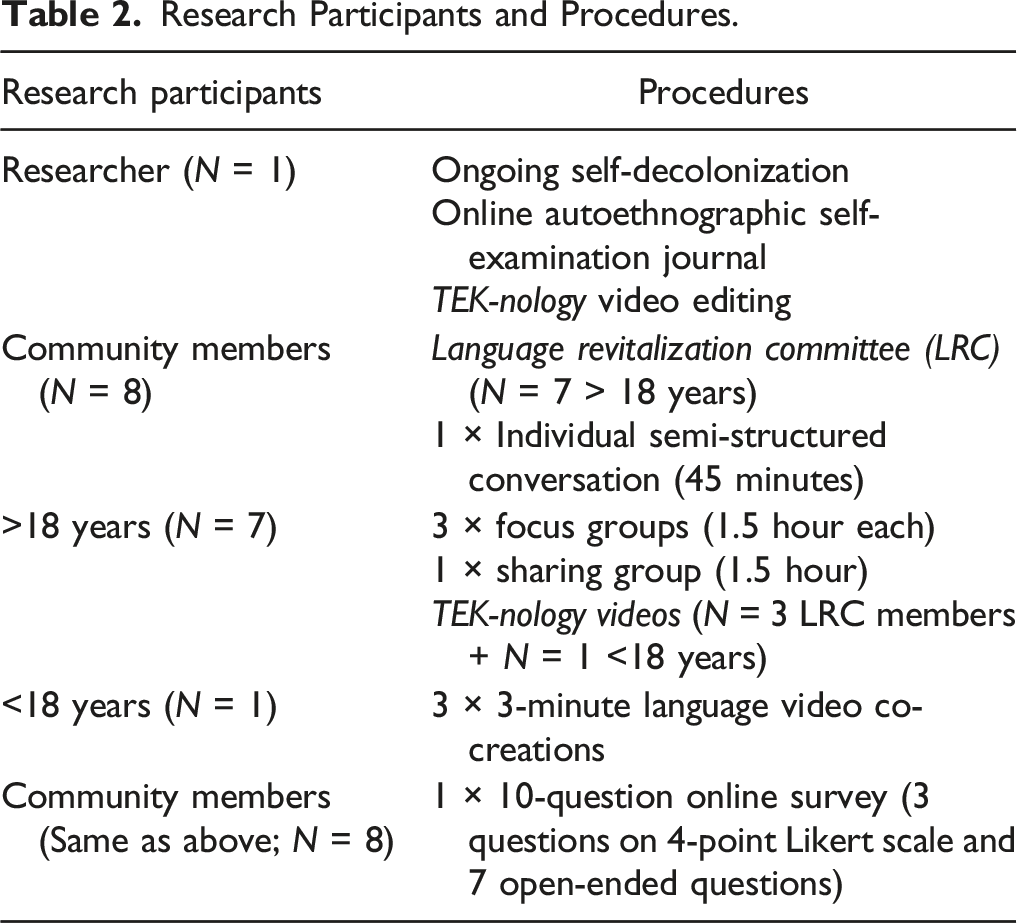
Research Participants and Procedures.
Ongoing Self-Decolonization Process
Geniusz (2009), in articulating Biskaabiiyang methodology, highlights the need for the researcher to decolonize themselves to conduct meaningful research with the Anishinaabe community. Dùthchas guides and informs my ongoing self-decolonizing processes. Dùthchas fosters a more personal, holistic, and respectful foundation for my researcher “self-in-relation” (Graveline, 1998, p. 52) and enables me to be transparently self-located and positioned prior to embarking on the research process. As Johnston et al. (2018) remark, positionality enables the researcher to become “‘knowable’ to research participants, thus disrupting the power dynamics inherent in conventional Western research relationships” (p. 11). Biskaabiiyang grounds me in community-led, Anishinaabe protocols, values, and ethical practice while Dùthchas guides me for a respectful, interconnected, non-appropriative (self)-decolonizing research journey informed by my own lived experiences. These decolonizing methodologies respond to Wilson’s (2001) call to be “answerable to all your relations when you are doing research” (p. 177).
Following Dùthchas, and prior to starting the TEK-nology project, I began to learn and reclaim my endangered Indigenous language, Gàidhlig, to connect more with my mother culture and resist colonialism, language oppression, and “ideologies of contempt” (Dorian, 1998; Grillo, 2009) towards Indigenous languages. Prior to COVID-19, I participated in Anishinaabe ceremony in my family’s community, and during COVID-19, I took an Anishinaabemowin for Absolute Beginners online course with Elder and Anishinaabek Nation Language Commissioner Barbara Nolan, who later joined the project.
Kincentric and Relational Approach to Reflexive Research
Guided by Dùthchas as praxis-oriented, emplaced ethical relations and Biskaabiiyang as decolonizing, participatory methodological framework, I implemented a kincentric and relational approach (see Figure 4) for participant selection. I selected participants (N = 8 in total: one Elder; six adults over the age of 18; and 1 youth under the age of 18) through purposive and snowball sampling (Patton, 2015) from family and family friends from my Anishinaabe family’s community in Ketegaunseebee. Kincentric and relational research approach.
This kincentric and relational approach enables me to: (1) acknowledge my own location and subjectivities as a Gàidheal (re)searcher “self-in-relation” (Graveline, 1998); (2) continue deepening and respecting existing relationships with family and friends I know; (3) better understand nuanced factors within those relationships that may have influenced intergenerational language transmission; and (4) consider and respect the dynamic role of the land and community in the research co-creation process as a whole. Wilson and Hughes (2019) explain, “As researchers, we are not separate from the process, but rather participate in relationship with what we are learning” (p. 9). Johnston et al. (2018) elaborate, The researcher is nested in concentric circles of relationships. The researcher must consider their relationship with self, with family, with those that provide guidance in carrying out the research, with the research participants, with the broader community, with the ancestors and future generations, with the environment and land, and with the Creator (p. 11)
I kept a reflexive self-decolonizing/examination journal (Moeke-Pickering et al., 2006) to document my (re)search learning journey. Stegra and Brown (2015) state, “reflexivity–a recognition that the researcher is not separate from but exists in relationship with what s/he is trying to understand–is a core component of ethical research practice” (p. 8). I wrote about things such as what decolonization and decolonizing research means to me; challenges and tensions; and my language learning journey in Anishinaabemowin and reclamation journey in Gàidhlig. This journal helps me activate inward knowledge as much as possible (Kovach, 2009). Below is an excerpt from my first online entry about the research project and participant selection: Today, I’m at the point where I'm about to send out invitations to potential Language Revitalization Committee (LRC) and TEK-nology video participants. I’m very mindful that I would like to embark on this project in my married family's community in the most relational way possible, and I think a good way of doing that is by starting with myself and radiating outwards. Me. Close immediate family. Extended family. Relational human kin (close family friends that I know or who have been recommended to me). Relational more than human kin (the land). I’m imagining this working like a concentric circle (insert image when I get to drafting it) … It is my sincere hope that I can embark on this project in a good way…I'm not from the community where I will be working myself, so I would like to start with people I know, to include people who are close to my immediate relations in the project. I want to centre the people who know the land and their community and the process of reclaiming their language at the heart. They will guide the process…I think the thing I would like most is to be transparent to myself and also to anyone else going forward. And this journal will be helpful (I hope) in tracking that journey and the experiences I have. (August 16, 2021)
Strengthening Anishinaabe Bwaajwewin and Càirdeas during knowledge co-creation
I practiced Miigwetchiwin (prayer and gratitude; Reo, 2019) before, during, and after the research process and sought to foster Anishinaabe Bwaajwewin (nurturing relationship) interactions (Reo, 2019) and Càirdeas (kinship and friendship) when consulting participants and Elders. Together, we, the community participants and I, formed the LRC. I conducted individual semi-structured conversations with LRC members, using the Conversational Method (Kovach, 2010) which gathers knowledge in relational dialogue with the “deep purpose of sharing story” (p. 40). I sought to Bizindam (Listen) to participants to learn and “hear, not react” (Chiblow, 2021). We had three LRC focus groups to generate ideas, themes, and content for videos. We discussed relationships between Anishinaabemowin, the land, and technology. In our sharing group, we shared what language education means and is for the community. After this, we co-created three 3-minute conversational TEK-nology Indigenous language acquisition videos (see Figure 5). The videos were filmed by LRC members themselves in Ketegaunseebee and are now hosted on a public LRC YouTube channel (https://www.youtube.com/playlist?list=PL-uUUEW1KLsu-1SKs-Ixd8MQGnLGa88wP) in accordance with participant wishes. At the end of the project, the videos were shown to participants at a TEK-nology video screening on Zoom. I invited participants to respond to an online survey for feedback on the pilot project and the co-creation process. Screenshots of TEK-nology videos.
Bizindam and Dùthchas to Inform Meaning-Making During Analysis
To interpret and analyze the knowledge—both “internal” as part of my own reflections and “external” (Kovach, 2009)—generated during the project, I employed qualitative Anishinaabek data analysis (Chiblow, 2021) alongside reflexive thematic analysis (RTA) (Braun & Clarke, 2021). Qualitative Anishinaabek analysis involves several phases for coding: Bizindaage (I listen to someone); Ozhibii’igi (I wrote things down); Naanaagadawendam (I consider, notice, reflect); Nisidotaagwad (it is understood) (Chiblow, 2021). Reflexive thematic analysis is a flexible method that “emphasises the importance of the researcher’s subjectivity as analytic resource, and their reflexive engagement with theory, data and interpretation” (Braun & Clarke, 2021, p. 330). Reflexive thematic analysis also acknowledges diverse guiding theories and paradigms (Braun & Clarke, 2021), such as the Indigenous Anishinaabe paradigm and Dùthchas principles. Reflexive thematic analysis involves data familiarization; systematic data coding; generating initial themes from coded and collated data; developing and reviewing themes; refining, defining, and naming themes; and writing the report (Braun & Clarke, 2021).
Codes and themes were not decided in advance or deductively, and I reflected upon and understood the knowledge shared with me in a process of “meaning-making” (Archibald et al., 2019). This meaning-making process, for me as a Gàidheal, was informed by the five principles I identified in Dùthchas: interconnectedness; responsibility; respect; ecological balance; and kinship. I sought to respectfully and responsibly Bizindam (Listen) to the interconnectedness in the participants’ stories and maintain balance by heeding our Càirdeas (kinship and friendship). First, I transcribed 11 hours of conversations and sharing/focus groups manually (Bizindaage alongside data familiarization). Then, I coded transcripts line-by-line highlighting words/phrases (Ozhibii’igi alongside theme generation). Next, I reflected on relationships among preliminary codes to identify salient and recurrent initial themes I felt could shed light on the research questions (Naanaagadawendam alongside developing themes). I then reviewed the codes and themes for consistency and named them using participants’ words as much as possible (Nisidotaagwad). Inductive RTA worked alongside Anishinaabek analysis as part of the greater Indigenous theoretical framework and paradigm to ensure validity and accountability to both Indigenous and non-Indigenous (academic) communities. Dùthchas informed my interpretation and meaning-making process as a Gàidheal researcher. This approach to the coding and analysis “is not calling for an integration of … knowledge systems but rather recognizes there are multiple ways of gathering knowledge” (Chiblow, 2021, p. 7).
Conclusion: Implications and Future Directions
In this paper, I introduced Dùthchas as a qualitative and kincentric methodology for a personal self-decolonization process and to conceptualize and conduct emplaced ethical research relations with my family’s Indigenous Anishinaabe community. Dùthchas has implications for future research.
Dùthchas seeks to maintain interconnected and dynamic kin- and place- based ethical relations(hips) that safeguard the well-being and future vitality of the local community and the land. Guided by Dùthchas as praxis-oriented, emplaced ethical relations and Biskaabiiyang as decolonizing, participatory methodological framework, I implemented a kincentric and relational approach to community-led research. This kincentric and relational approach consolidated an ethical relationship and responsibility to the qualitative research co-creation process, the participants, the interpretation, and the analysis. I identified key non-exhaustive and context-dependent principles in Dùthchas: interconnectedness; responsibility; respect; ecological balance; and kinship. Giving the example of the TEK-nology pilot research project, I further illustrated four stages of Dùthchas as kincentric praxis and research in-relation: (1) an ongoing self-decolonization process; (2) a kincentric and relational approach to reflexive research; (3) strengthening Anishinaabe Bwaajwewin (nurturing relationships) and Càirdeas (kinship) during knowledge co-creation; and (4) Bizindam (listening) and Dùthchas to guide meaning-making during analysis.
Dùthchas as kincentric methodology and praxis can inform more methodological approaches that seek to embody emplaced ethical relations and conduct future qualitative community-led research. Dùthchas illustrates how researchers—either new or already indoctrinated in extractive, Eurocentric research methods—and those who work with Indigenous peoples can begin a process of self-decolonization to collaborate with an Indigenous community. Dùthchas is a Gaelic ontological and methodological approach to co-existing dynamically and conducting research in-relation to the lands on which you are located. As a Gàidheal, my personal self-decolonizing journey is guided by the Dùthchas principles I identified. Dùthchas informed and informs my conduct. An important and significant limitation is that the Dùthchas principles and stages are culturally- and context- specific to me as a Gàidheal with my own lived experiences, and it is not intended that these principles are to be simply “copy-pasted” into future methodological approaches without researcher critical reflection, self-location, and ongoing self-decolonization. However, researchers might draw inspiration from Dùthchas as kincentric methodology to ask oneself: (1) What do my own self-decolonizing processes entail? (2) What does kinship and responsibility towards participants and the land in my research mean for me? (3) How do I build my own responsibilities, kinship, and loyalty with the communities and lands where I work? (4) What is my methodology for emplaced ethical relations in action?
Dùthchas seeks to inform ways in which we can foster, improve, and uphold emplaced ethical Indigenous—non-Indigenous to Turtle Island (research) relations (Truth & Reconciliation Commission, 2015). Dùthchas exemplifies how researchers can locate and articulate their own assumptions, beliefs, and intersections with colonialism to be respectfully in-relation with the Indigenous communities and peoples involved with the research. If researchers self-locate and are transparent about their own positionalities, intentions, knowledge and belief systems, they are less likely to appropriate, extract, and to be trusted by community members (McGregor, Restoule, & Johnston, 2018). As the Truth and Reconciliation Commission of Canada (2015) states, “reconciliation is about establishing and maintaining mutually respectful relationships between Aboriginal and non-Aboriginal peoples in this country” (p. 6). Informed by Dùthchas, I demonstrate how I followed culturally specific protocols and an overarching Anishinaabe research methodology, Biskaabiiyang, to ensure I am in respectful relation to the land and accountable to the community with whom I work (relational accountability; Wilson, 2001).
An important closing note for researchers who take inspiration from Dùthchas as kincentric methodology is that these relational processes must always be context- and culturally- specific. For example, if I were working with a different Indigenous community or Nation, one of the many hundreds across Turtle Island (Government of Canada, 2021) or across the globe, I would follow their own protocols and methodologies to foster emplaced ethical relations and heed Càirdeas. Respecting and being accountable to relationships with my ancestors, family, kin, more than kin, future generations, and the land is core to Dùthchas and the TEK-nology approach.
Footnotes
Acknowledgments
Gchi Miigwetch (Thank you so much) to Elder Barbara Nolan, Dr. Susan Bell Chiblow, Karen Bell, Joseph Belleau, Jayce Chiblow, Debra Nolan, Sydney Nolan, and Phoenix Bell for participating in the TEK-nology project and for sharing your expertise and knowledge with me. This project would not have been possible without you. Thank you to my husband, family, mentors, supervisors Dr. Blane Harvey and Dr. Mela Sarkar, doctoral committee members Dr. Wesley Leonard and Dr. Deborah McGregor, DISE-McGill, TIRF and SHHRC for all your support. I am deeply grateful and thankful to you all. Tapadh leibh.
Declaration of Conflicting Interests
The author(s) declared no potential conflicts of interest with respect to the research, authorship, and/or publication of this article.
Funding
The author(s) disclosed receipt of the following financial support for the research, authorship, and/or publication of this article: This work was supported by the International Research Foundation for English Language Education (TIRF); Social Sciences and Humanities Research Council of Canada: (Grant Number 767-2020-2826).
