




Abstract
Multiple factors contribute to community practice’s ongoing challenge of developing effective, evidence-informed, and socially just practice interventions. Currently, rationally driven systematic reviews dominate intervention design and development in various interprofessional applied health and human service fields, including community practice. As a result, community interventions often undergo significant development outside complex community contexts in which social problems manifest. Drawing from a case example of one author’s participation in a community engaged intervention development study based on mobilizing across differences, this piece advances an inclusive approach to community-based participatory intervention development driven by critical grounded theory. Undergirded by critical research perspectives, the article offers an early-stage intervention development methodology derived from the field in collaboration with community practitioners and resident leaders. Built upon existing interdisciplinary scholarship, it blends prominent intervention development frameworks, participatory research approaches, and critical grounded theory methods. Authors aim to aid scholars, practitioners, and community leaders in developing socially just, inclusive, and contextually relevant intervention approaches that originate from within communities directly impacted by social problems.
Keywords
Applying Critical Grounded Theory to Community Intervention Development
Community practice incorporates interdisciplinary perspectives to social change at the intersection of communities, organizations, and policy (Weil et al., 2013). Despite the richness and diversity of community practice interventions, practitioners encounter barriers in communities impacted by inequities and misuse of power (Dominelli, 2004; Fook, 2002; Sawyer & Brady, 2020). Complicating these dynamics, community practice interventions grounded in top-down community development, social planning, and program development, dominate the field. These interventions privilege academic, and professional led expertise (Fraser, 2020; Lavoie, 2012).
Intervention development involves the systematic, ongoing design and improvement of practice models and approaches, most often in collaboration among diverse groups of stakeholders (Fraser & Galinsky, 2010; Gilgun & Sands, 2012). Recent decades bring immense methodological progress enhancing the efficacy of collaborative community intervention development among communities, scholars, and practitioners (Quimbo et al., 2018; Wallerstein et al., 2018). Among these, community-based participatory research (CBPR) incorporates aspects of community wisdom, experiences, histories, and strengths in problem solving (Branom, 2012; Jagosh et al., 2015; Wallerstein et al., 2018).
Qualitative research methods historically play a key role in intervention development research (Gilgun & Sands, 2012). Their primary functions comprise needs assessment, adapting initial designs, expanding understanding of outcomes, and refinement in early pilot testing (Cote, 2009). Few community intervention development studies published recently use qualitative methods as a guiding approach (Duggleby & Williams, 2016). Even fewer utilize critical, indigenous, and decolonizing methodologies (Reid et al., 2018).
This piece demonstrates the utility of intervention development driven by critical grounded theory (CGT) targeted at transformative change at institutional levels. It emphasizes building power coequally with those directly impacted by unjust social structures. We highlight a case example of one author’s experience working as a community practitioner-scholar alongside community members and detail the collaborative design of an intervention development methodology driven by CGT. Authors introduce a methodological approach to community practice intervention development using CGT as a foundational component that integrates prominent intervention development and CBPR scholarship in equal partnership with community leaders (see Figures 1 and 2). Essential elements of critical grounded theory (CRT) driven intervention design and development. Critical grounded theory driven intervention development: Activities and phases.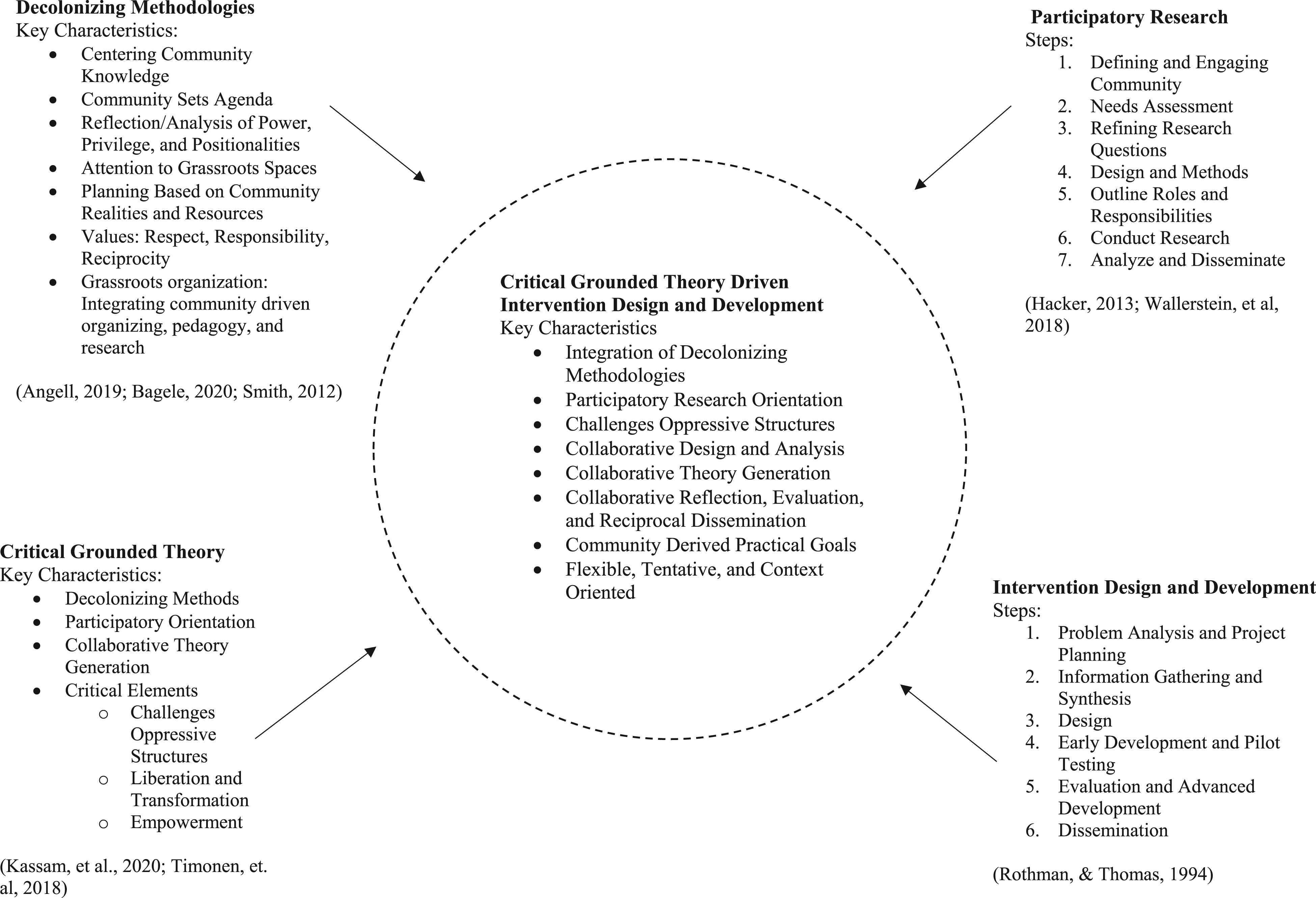

The aim: to develop an early-stage intervention development methodology that aids practitioners and scholars in developing evidence informed, inclusive, contextually relevant, and socially just intervention approaches in partnership with communities. Authors begin with a thorough literature review that explores traditionally dominant approaches to intervention development and CBPR approaches followed by a summary of the unique role of qualitative methods in intervention design and development. The literature review concludes with a detailed overview of grounded theory methods and the types of CGT. The article subsequently explores the development of the intervention methodology using the case example and highlights its key components. It primarily centers on the specific components of the intervention methodology, and briefly introduces the intervention developed by the community still undergoing formal evaluation and advanced development (see appendices). To conclude, authors present the intervention development approach (methodology), explore lessons learned, and examine implications for CGT as a core element in critical community practice intervention development.
Literature Review: Grounded Theory, Critical Grounded Theory, and Community Intervention Development
Values undergirding dominant community practice approaches rooted in rational bureaucracy, business, and profitmaking fall short in fundamentally challenging injustice (Fursova, 2018). These mainstream approaches reinforce incremental change within already existing social arrangements (Dominelli, 2004; Emejulu & Scanlon, 2016; Quimbo, et al., 2018) To align theory with practice, values, assumptions, and goals must align with methods (Kassam et al., 2020; Thomas et al., 2011). Often, vast divisions persist among professional, community, and academic knowledge which impacts community change goals as well as how interventions guide implementation (Angell, 2019; Bagele, 2020; Smith, 2012). Lack of intentional clarity and inclusive collaborative practices only exacerbate the breadth of these divisions (Kivunja & Kuyini, 2017; Sawyer & Brady, 2020). Critical community practice challenges policies, practices, and change goals grounded in institutional power (Pyles, 2020). It seeks to eliminate policies and practices that perpetuate oppression (Evans et al., 2014).
Interventions guide practice in communities, and are driven by prevailing knowledge, theory, and expertise (Fraser & Galinsky, 2010; Gilgun & Sands, 2012). In communities, they often reinforce contentious knowledge claims and histories (Quimbo et al., 2018). The case example is no exception in which community members sought practical ways to address long laid historic institutional oppression within an initiative led primarily by professional experts and city bureaucrats.
One of the original gold standards for creating evidence-informed interventions in community practice involved the use of systematic reviews and developing intervention models based on their findings. For a time, systematic reviews dominated intervention design and development, and in many disciplines continue to hold prominence (Issacs et al., 2018; Lewin et al., 2017). The prevalence of systematic reviews over time also elicited sharp responses from community intervention scholars and practitioners over the last 20 years leading to the rise in CBPR in multiple fields (Hacker, 2013). Rothman and Thomas’ (1994) seminal intervention development framework shared wide use among community and organizational practitioners along with the work of Fraser and Galinsky (2010) in the field of social program development. Also shown in Figure 1, Rothman and Thomas’ (1994) integrated model of design and development illustrated six phases of intervention: (1) problem analysis and project planning, (2) information gathering and synthesis, (3) design, (4) early development and pilot testing, (5) evaluation and advance development, and (6) dissemination (Rothman & Thomas, 1994, p. 9).
Qualitative Research and Intervention Development
Qualitative research methodologies also play a key role in the history of intervention research development (Gilgun & Sands, 2012). Nevertheless, historically they are primarily used as a component of needs assessment, to extend understanding of outcomes, evaluate and explore intervention revisions, and refine initial mixed methods designs (Cote, 2009). According to Duggleby and Williams (2016), few examples of recently published studies exist to demonstrate the foundational use of qualitative approaches to developing community interventions; however, systematic reviews show qualitative research methods aid in evaluating, shifting, and revising interventions based on contextual circumstances (Jansen et al., 2018). Of late, studies utilizing decolonizing critical qualitative methodologies with first nations and indigenous peoples also show benefits in building trust, community engagement, and informing interventions across stages (Reid, et al., 2018).
Grounded Theory
Grounded theory routinely informs intervention development through emphasizing the voices of those most impacted by one or more societal issues (Sawyer, 2021; Emlet et al., 2017; Nunn, 2018). Originating within sociology, grounded theory research develops theory based on views of study participants’ emic (insider) perspectives (Creswell & Poth, 2018; Guba & Lincoln, 1994; Urquhart, 2013). Scholars, such as Glaser (1978), and Glaser & Strauss (1967) fall within the early, rational worldview of grounded theory research. Procedures within this world view tend to be prescriptive and oriented toward inductive-deductive generalizability and objectivity (Duggleby & Williams, 2016). Conversely, Charmaz (2014) and Clarke (2005) advocate for interpretive versions of grounded theory utilizing various constructivist procedures that differ from their more prescriptively structured counterparts (Charmaz, 2014). In their more subjective approaches to grounded theory, results are tentatively held, and context bound, and although they may result in transferable findings, generalizability is not the goal of the research enterprise (Creswell & Poth, 2018; Timonen et al., 2018). Widespread acceptance of Charmaz (2014) and Clarke’s (2005) approaches within applied social science literature has influenced many scholars, such as Corbin and Strauss (2008) to adapt some of the assumptions in their earlier work to align with more subjective, interpretive, and constructivist forms of grounded theory. These pathed the way for innovation for grounded theory methodologies guided by critical perspectives.
Critical Grounded Theory’s Guiding Perspectives
Critical perspectives also influence development of ground theory methods, and underly CGT’s foundation of critiquing society to change it (Hense & McFerran, 2016). They reference a specific body of knowledge that interrogates the oppressive effects of institutional power, knowledge, and social problems (Mullaly & Dupre, 2018). Theories within this lexicon encompass feminism, critical theory, intersectionality, critical race theory, and others (Pyles, 2020). They examine the effects of racism, oppression, power, domination, and capitalism, and reveal social problems within institutions and society (Constance-Huggins, 2019). Critical perspectives seek human emancipation and institutional transformation “to liberate human beings from circumstances that enslave them,” and promote a practical, action-oriented form of knowledge building (Horkheimer, 1982, p. 244).
In a critical world view, researchers conceptualize grounded theory in many ways. Critical realist grounded theory (Bunt, 2018; Oliver, 2012), critical constructivist grounded theory (Charmaz, 2020; Hense & McFerran, 2016), and transformational grounded theory (Redman-MacLaren & Mills, 2015) represent the main strains of CGT. Critical realist grounded theory develops hypotheses linked to underlying structures, and center participants’ relationship to social systems (Lee, 2016). Critical constructivist grounded theory expands constructivist grounded theory by integrating participatory methods and incorporating transformative social change goals (Hense & McFerran, 2016). Unique among CGT methodologies, transformational grounded theory prioritizes indigenous decolonizing methodologies (Redman-MacLaren & Mills, 2015).
Each version varies slightly with little structured methodological guidance or broad uniformity. For this reason, we utilize specific components of each combined with existing grounded theory methods. As shown in Figure 1, our rendition blends assumptions from critical theory, PAR approaches, indigenous methodologies, and numerous grounded theory methodologies. It utilizes certain key components which include challenging oppressive structures, a participatory orientation, collaborative theory generation, liberation, transformation, and empowerment. Further, each is fundamentally grounded in community participation (Charmaz, 2020; Hense & McFerran, 2016; Redman-MacLaren & Mills, 2015; Timonen et al., 2018).
An Integrated Approach to Intervention Development
Figure 1 synthesizes the core components of prominent decolonizing methodologies, participatory research approaches, CGT, and intervention design and development. When integrated, these comprise a tentative set of key characteristics for CGT driven intervention design and development. The key characteristics outlined in Figure 1 and summarized below guide the intervention development process in the case example, further detailed in the case example and in Figure 2.
Intentional use of collaborative participatory research approaches remains a key aspect of CGT driven intervention development (Oliver, 2012; Redman-MacLaren & Mills, 2015; Timonen et al., 2018). CBPR emphasizes researcher attitudes and values, coequal partnership, and institutional power considerations (Hacker, 2013; Wallerstein et al., 2018). Stoecker (2012), and Wallerstein et al. (2018) aid in clarifying essential guiding principles, key components, and aspects of CBPR approaches and their contributions to community intervention development. Furthermore, prevailing intervention development frameworks, such as those covered below aid in further clarifying the “how” of developing quality contextualized interventions (See Figure 2). Rothman and Thomas (1994) also provide clear guidance on the stages used in intervention development without prescribing a particular research methodology.
Key steps in CBPR encompass: (1) developing a research question, (2) designing methods, (3) collecting data/data generation, (4) data analysis, and (5) reporting and disseminating research (Wallerstein et al., 2018). Influenced by community organizing and popular education, CBPR within a critical perspective must be embedded within an effective social change strategy (Stoecker, 2012). Aligned with Alinsky (1971), specific criteria for selecting CBPR projects involve those that are precise, organizable, and winnable. Specific guiding principles for CBPR: (1) participation, (2) collective praxis, learning, and teaching, (3) social change, and (4) a joint research strategy that advances mutual understanding and unforced consensus (Habermas, 1989; Stoecker, 2012). Many indigenous scholars outline practical considerations for decolonizing research which involve: (1) setting a shared agenda, (2) increasing co-researcher participation, (3) explicitly outlining mutual benefit, (4) collaborative analysis and theory development in the case of CGT, and (5) concurrent collaborative data collection and analysis (Bagele, 2020; Redman-MacLaren & Mills, 2015; Smith, 2012).
Figure 1 shows how these aspects of CGT, CBPR, and Rothman and Thomas’ (1994) intervention development approach integrate to lay out the key characteristics of CGT driven intervention development. These include: (1) intentional integration of decolonizing methods, (2) participatory/collaborative research orientation, (3) open challenging of oppressive structures and systems, (4) collaborative design and analysis, (5) collaborative reflection, evaluation, and reciprocal dissemination, (6) community derived project goals, and (7) flexible, tentative, and context-oriented activities. Broadly, CGT must push collective theorizing toward developing interventive problem-solving approaches aimed at challenging oppressive social arrangements (Angell, 2019; Kassam et al., 2020; Rothman & Thomas, 1994; Wallerstein et al., 2018).
A Case Example in Critical Grounded Theory Driven Intervention Development
The case example draws from a community engaged intervention development study conducted within a neighborhood initiative in a mid-sized urban city and covers parts of the project in direct relation to the development of the intervention methodology. Throughout this section and subsequent ones, authors utilize specific terms, such as community leaders, professionals, civic leaders, and volunteers. Community leaders are residents that hold formal and informal positions of social power within the community and have access to social networks, such as civic association leaders, and leaders of other community groups. Professionals mostly include non-profit workers from within or outside the community getting paid to provide a service to the initiative based on expertise and specialized knowledge. They may also use the power of their professional position to benefit the initiative. Civic leaders refer to the local elected officials and city bureaucrats.
The project took place within a formerly segregated neighborhood challenged by histories of oppression, institutional racism, urban removal, redlining, and gentrification. Community residents celebrated long traditions of closely knit ties of mutual aid, empowerment, professionalized non-profit services, and community organizing. The goal of the intervention development project was to build a contextually adaptable, critical community intervention methodology aimed at addressing institutional problems. Participants hoped it might allow community residents, leaders, and professional practitioners to collaborate more effectively within the existing initiative. It also provided inspiration that their past and current experience in navigating differences in power and historic oppressions might benefit other communities and practitioners (Sawyer, 2021).
The local office of a large national community development corporation (CDC), spurred by converging economic and social interests, targeted this community made up of three intersecting neighborhoods, for comprehensive community development (Sawyer & Brady, 2022). It was funded from 2010 to 2020 due to its susceptibility, potential, and predicted success based on predetermined criteria established by the funder, outside the community. Funds were allocated to hire a community organizer for a period of 3 years to convene the initiative as an employee of a local non-profit community center in the community. Representatives from the funding agency attended nearly every meeting. The development of the intervention methodology detailed in the following sections took place concurrently within the funded initiative and emerged out of challenges that originating from unaddressed harms in the early stages of the initiative.
Figure 2 aligns each intervention development phase with specific components of CBPR approaches, and CGT activities within each phase. This integration comprises the core components of the intervention development approach. The sections below highlight individual elements of Rothman and Thomas’ (1994) adapted intervention development phases and covers only aspects of the project related to developing the intervention (See Figure 2). Each begins by the key aspects of the phase and highlights specific activities taking by the community team. Participants use this framework as a methodology to build what would become the Critical Difference Engagement approach briefly discussed in appendix A and shown in appendix B (Sawyer & Brady, 2022).
Collaborative Problem Analysis and Project Planning
The first phase of CGT intervention development prioritizes problem analysis and project planning. It differentiates itself from traditional intervention development phases by incorporating collaboration, and a focus on institutional and structural issues, and their role in perpetuating community problems. This phase is where the community research team gets assembled. Community conditions and issues are collectively analyzed, problems articulated, and knowledge is generated about the nature of the problem or set of interconnected problems. Finally, overarching questions are created to guide the intervention development, and project goals are collectively established among the team members. This takes place over a series of gatherings and involves people from multiple stakeholder groups within the community, such as residents and a mix of volunteers and professionals working in the community.
Early in the community engagement phase of the funded community development initiative, a group of volunteer community leaders and community practice professionals noticed pivotal conflicts emerging based on historic oppressions, institutional issues, mistrust among community members and professionals, and structural impediments within the economic and community development initiative. Many of these conflicts connected to long standing conditions within the community, identity-based issues, privilege and power-based dynamics, and the core assumptions underlying the initiative. Through continuous formal and informal dialogue over a series of meetings, the group of community members, residents, and volunteers discovered that deep unresolved divisions connected to race, socioeconomics, identity, privilege, history, and misuse of power were stifling work within the initiative. As a result, led by a German born, African American volunteer resident community leader deeply embedded in the civic association leadership and me, a professional community practitioner/scholar; we decided to work together to address these complex issues with the goal of developing an intervention approach based on forging alliances across these differences, even if it meant working subversively within the already existing initiative with its own set of goals, objectives, and intended outcomes.
The team assembled over multiple meetings, formulated a problem statement, and reviewed information about how history, race, identities, socioeconomics, differences, and power impact comprehensive community development initiatives like the one in which we were working. During this stage, the group repeatedly assembled, analyzed community conditions and issues, learned about the problem (i.e., its historic origins, its institutional and structural components, and how they are uniquely experienced within the community context), created questions, and developed project goals. We also explored what additional information needed to be learned about community practice approaches, and problems navigating differences grounded in identity, history, mistrust, and historic misuse of power. Three research questions were formulated to guide the intervention development: (1) What elements do existing practice constructs, models, and approaches provide relative to issues arising from identity, privilege, and power in community practice? (2) What are the key components of effective community practice across difference? (3) How can issues of difference be practically addressed effectively through the community engagement and practice process within the existing initiative? This led us to the second phase.
Collaborative Information Gathering and Synthesis
Collaborative information gathering and synthesis purposely uses power analysis of institutional practices and their effects to inform how information is gathered, synthesized, and informs ensuing phases and activities. In this phase, the research methodology is chosen, steps are made to align the guiding methodology (CGT in this case), the research question(s), and the targeted problem. Key components of knowledge built from the problem analysis phase guide the development of research protocols (ex. Interview questions and data generation procedures). Collective data collection and generation take place, and data analysis begins.
After the group refined the overarching questions guiding the development of the intervention, we selected the methodology based on the underlying desire to develop a practice theory based on unique community context and conditions. It also meant collaboratively developing protocols, sampling strategies, and plans for data generation and analysis. Interview protocols were developed based on key components from the information gathering and synthesis. The team based these on a review of literature, a thorough examination of effective community practice approaches, experiences of community team members, analysis of institutional legacy, and community history. The key components generated by the group were: dialogue, collaboration, power and oppression, learning, and group decision making.
The sampling strategy was based on maximum variation of identity and difference based on power and privilege grounded in a neighborhood community context rather than a larger geographical area. This strategy begins data generation with those most marginalized voices and gradually moves on to the most privileged based on power analysis (Rodwell, 1998). In this design, it meant interviewing those directly affected, volunteer participants, residents from minoritized groups to those from more privileged groups and professional positions of power in the community initiative. The team utilized existing relationships and both informal and formal social networks associated with the work in the community. Recruitment began with volunteer community leaders and moved to professionals using a combination of maximum variation, snowball sampling, and purposive sampling.
Corbin and Strauss’ (2008) grounded theory methodology was chosen as a starting point for developing this intervention, based on not only the structured, yet flexible design and analysis structure of their version of grounded theory, but the assumption that aspects of theory may be adapted, transferrable, and/or applied across certain contexts (Charmaz, 2014, 2016). Corbin and Strauss (2008) also lend themselves to critical theory generation when the key characteristics of CGT are intentionally infused into their methods and activities.
The data generation methods were based on semi-structured interviews where participants were encouraged to tell their stories of working on community practice initiatives where differences in identity, privilege dimensions, and misuse of power were present. Prompts were based on key components that emerged from the information gathering and synthesis: dialogue, collaboration, power and oppression, learning, and group decision making. In telling their stories, participants were encouraged to discuss what approaches worked and what did not based on their experience. Interviews were collaboratively analyzed in word data units using constant comparison, categorization, and coding over three stages: open, axial, and selective. Each stage comprised collaborative data analysis among the team members made up of a volunteer community leader, one of the community practitioner/scholars sharing this piece, and volunteer community and civic leaders who identified the initial problem and came together to formulate a strategy for developing an effective intervention approach. The first stage of open coding established a host of categories, practical skills, and barriers to effectively navigating differences in identity, privilege, and power in the community practice process. The axial coding stage dealt with subsuming subcategories within each category, and open coding set relationships among established categories and subcategories and developed an initial theory to guide the further intervention development (See Appendixes A and B).
Collaborative Intervention Design, Development, and Early Pilot Testing
The core aspect of this phase of the CGT driven intervention development targets underlying oppressive practices and systems at play within the community setting. In this phase the practice theory is built, and from it, the initial intervention is collaboratively designed. The team considers key questions to further hone the early-stage intervention design, and pilot implementation and testing begins.
The team authenticated findings through member checking of interview participants. Subsequently, we built both the initial theoretical model and tentative beginning level intervention design directly from findings using the integrated process outlined in Figure 2 and discussed in the section above. To begin early pilot testing, select members of the research team assembled a group of six practitioners working in various other community practice settings and arenas, such as youth organizing, public housing and neighborhood organizing, economic justice and labor organizing, and racial justice.
The goal of gathering a set of experienced practitioners outside the context of the existing initiative ensured a deeper level of data analysis and development and assessed transferability of the intervention approach. Practitioners outside the initiative offered ideas for further shaping of the intervention and discussed ways to adapt it to their practice settings. The group collectively considered the following questions to further hone the strength of the early-stage intervention design: (1) How does the intervention challenge both oppressive structures and practice interactions among participants in the initiative? (2) How well does it address the social conditions underlying the problem? (3) Has the team included multiple stakeholders, if not who else needs to be at the table? (4) What adaptations does the group recommend aligned with the goals of the intervention? Data generated in the form of extensive, detailed field notes from the gathering of practitioners informed further development of the intervention, and guided pilot implementation from within the initiative itself. Specifically, it adapted the Critical Difference Engagement approach developed by participants into a stage-based, cyclical intervention approach (See Appendixes A and B).
Collaborative Evaluation and Advanced Development
Collaborative evaluation and advanced development utilize community, collective, and contextual knowledge, and experience to reflect and adapt the intervention. Participants ideally go through collective reflection and collaborative evaluation based on community goals and criteria as implementation begins. Ideally new data generation and analysis takes place to refine the practice theory and the intervention approach. In the case of the Critical Difference Engagement approach, more work needs to be done to further hone, evaluate, and formally develop the intervention for application across community settings (Sawyer & Brady, 2022). The group of community leaders that took part in the project began implementing lessons learned from the intervention development project; however, due to feasibility issues, the intervention approach could not formally undergo all steps for deep level collaborative evaluation and advanced development. Deep level collective reflection, evaluation, and development remains a vital component of the intervention approach, and when feasible, needs to be prioritized.
Lessons Learned: Implications for Critical Community Practice Intervention Development
In comparison to mainstream, traditional community practice intervention development, critical community practice intervention development continues to be significantly understudied by academics and depends heavily on knowledge and expertise outside of elite academic institutions (Graeber, 2009; Pyles, 2020; Tilly et al., 2020). This offers community practitioners and scholars oriented toward transformative community change opportunities to forge partnerships and collectively formulate practical solutions to community problems (Sawyer, 2021; Fook, 2002; Mullaly & Dupre’, 2018). Widespread growth and acceptance of CBPR approaches has increased across academic institutions in recent years (Wallerstein et al., 2018). This mainstreaming brings resistance from institutions, opportunities for change, and threats of co-optation. The neoliberal drift in the community practice field continues, perpetuated by professional experts, and private interests (Brady et al., 2014; Stoecker, 2012). For example, academic institutions depend heavily on external grant funding which sets priorities for research agendas, and CBPR often takes much more time and resources than other forms of academic research (Hacker, 2013). Academic institutions often do not take these considerations into account when establishing tenure standards for community researchers, in building community partnerships, or prioritizing research agendas (Dominelli, 2010; Fenton, 2014; Su, 2007). Research endeavors that generate revenue for institutions gain priority and celebrate notoriety, so if research problems do not provide added benefit, they receive little to no attention (Wallerstein et al., 2018). Thus, to do critically oriented work in partnership with community efforts, community scholars frequently put themselves at personal and professional risk, particularly when the research is critical of actions taken by the academy or other prevalent societal institutions (Stoecker, 2012). We argue, along with others, that increased resources need to go toward community engagement, and be matched to every stage of the research process in CBPR projects. Institutional incentives for community-based research need to be updated to reflect these realities (Wallerstein & Duran, 2010).
Even still, studies support these participatory intervention development practices and their effectiveness. They repeatedly find that prescriptive community intervention models developed outside their target communities rarely work or transfer across settings (Boehm & Cnaan, 2012; Kenny, 2019; Sawyer & Brady, 2020). Increasingly community practitioners and scholars call for community engaged approaches, that can be adapted to local circumstances” (Bollier, 2019, p. 95). This methodology can promote further extension of inclusive, evidence informed, knowledge building in collaboration with community (Lavoie, 2012; Sawyer & Brady, 2022).
Tentative Criteria for CGT Intervention Development Methodology
Ideally CGT driven intervention development represents one way among many in which multiple stakeholders may build transformative and collaborative critical community practice interventions (Sawyer, & Brady, 2022). Its use needs to be dictated by sets of ground level community conditions (Branom, 2012; Redman-MacLaren & Mills, 2015). All community-based intervention development projects are not suited for CGT driven community intervention development (Sawyer, 2021). The following criteria offer a starting point: (1) community driven problem solving regarding a pervasive community problem or set of problems, (2) the need to develop a theory to explain and guide change activities (if a theory or set of theories exist, then CGT may not be appropriate), (3) address underlying social structures, oppressive systems, and/or transformative changes to institutional and organizational practices, (4) guide the development of a set of activities toward intervention, (5) implement activities without exposing community leaders to great personal risk, and (6) the community must be open and available to the process, or willing to collaborate. Adequate levels of trust must be built and reinforced.
Future Directions: Methods, Decolonization, and Key Questions
This project demonstrates strides in developing inclusive, critical intervention development methodology. Key questions remain regarding which CGT methods might be appropriate. Depending upon community context, changes to grounded theory methodologies may need to be made to align methods with critical/transformative aims. For example, in the case example, the sampling strategy incorporated maximum variation of power and identity to make attempts to further equalize power among researchers and community members, and the phases of research design, collection, and analysis intentionally incorporated collaboration among key community members and leaders (Sawyer, 2021). In certain stages of the data analysis process, due to feasibility issues, many community members and participants were not able to fully participate. This brings up key questions related to collaboration and decolonizing methods. Where is the line between full participation and meeting the demands of community life? Do methods make CGT critical in its orientation? Is it a matter of values, or a complex interplay of both? Given the current early methodological development of CGT, more dialogue, study, and experience are needed to create consensus and reconcile aligning research methods, values, and collaboration toward critical theory building (Redman-MacLaren & Mills, 2015).
The use of indigenous methodologies and decolonization remain a core aspect of CGT. These approaches remain contested, and practitioners need guidance in applying them. Tuck & Yang (2012) posit that decolonization cannot be actualized without intentional focus on how settler colonialism, violence, and land occupation impact community life. Many indigenous scholars also argue that if institutions are not giving back land, then they are not embarking on decolonizing work. This begs the following questions. How can academic institutions, so deeply rooted in colonizing history and institutional activities lead these initiatives? Can scholars and professionals ever fully decolonize their research? Is it possible to utilize indigenous methodologies in all CGT driven intervention development studies? Is it socially just to include community members in all aspects and stages of the research project when they are often experiencing the impacts of systemic oppression as they participate? Is it fair to ask community members most impacted by injustice to assume time intensive roles in academic research and trust scholars, given their problematic history?
These pivotal questions demand further consideration as community practitioners and scholars hone skills and continue to push the field forward. Furthermore, their answers need to be forged in direct partnership alongside the expertise of those most directly impacted by social problems. Scholars must also be willing to act subversively within their academic institutions to intentionally work towards decolonization, and use their power responsibly (Stoecker, 2012). This intervention methodology provides another tool to practitioners and scholars engaged in that purpose. We hope this critical work will continue to expand, broaden, and guide further development of evidence informed critical community practice interventions.
Footnotes
Declaration of Conflicting Interests
The author(s) declared no potential conflicts of interest with respect to the research, authorship, and/or publication of this article.
Funding
The author(s) disclosed receipt of the following financial support for the research, authorship, and/or publication of this article: Financial support was provided by the University of Oklahoma Libraries’ Open Access fund the Office of the Vice President for Research & Partnerships, and the Office of the Provost, University of Oklahoma.

Critical Different Engagement Approach- Summary Findings
Appendix B

Key Components and Stage Based Categories
Definition
Practical Skills
Barriers
Key Quotes
Knowledge building
The ongoing collaborative, co-creative process of community level teaching and learning
•Curiosity
•Lifelong Learning
•Humility•Unwillingness
•Esoteric Knowledge
•Formal education
systems“It’s a great place to start community work. It should be at the beginning. If everybody is learning at the very onset of the process, then you’re sort of beginning a new experience which is what it needs to be.”
Quality communication
Creating a culture of open and accurate sharing through listening, communicative actions, and communicative versatility
•Listening
•Speaking truth
•Facilitating conflict
resolution
•Using language•Taking space
•Remaining silent
•Avoidance
•Acronyms“We can talk about the city, state, and the community, but at the end of the day, it’s about people relating, communicating with people.”
Relationship care
Using time, centering people, and building power to establish, maintain, and nurture partnerships
•Trust building
•Awareness
•Reflection•Group think
•Impatience
•Artificial unity“It has to be much more relationally oriented, particularly when there is a conflict or tension. Sometimes when there’s not, you really have to be relating to them personally.”
Coming together (Stage 1)
Specific actions that build capacity for people to collectively gather
•Preparation
•Focus
•Creating the
environment
•Breaking bread•Inconsistency
•Misinformation
•Traditional hierarchy“Opening up the space for people to come in...to create that space where everyone feels comfortable.”
Common ground (Stage 2)
Process of connecting community members to one another equally in their experience, connection, and often invisible commonalities
•Outreach
•Common space
•Common issue
•Common experience
•Common purpose•Fragmentation
•Problem focus
•Resources and time
•Resentment
•Confusion“Because we all live in this community together, we need to be doing things together.”
Common cause (Stage 3)
When cohesion is built along with its fruits and challenges
•Stoking Motivation
•Asking connecting
questions•Sustaining motivation
•Numbers/Resources“I think that a great way for difference to be overcome is to be working side by side with someone for a greater purpose.”
Moving forward (Stage 4)
Practitioners practice healthy boundaries conducive to sustainable relationships and implement lessons learned
•Letting go
•Making amends
•Facing adversity
•Staying power•Moving too fast
•Unresolved pain
•Disparate direction
•Exclusion“Leadership gets built that can take on the mantle, that can really take on the role of being the community conscience that take accountability for holding the community together. That’s when organizing works.”