




Abstract
This article describes a methodology and method that can be adopted by informal education leaders who are interested in establishing or developing a community-responsive focus for out-of-school club programming. Based on an adaptation of Dewey’s Laboratory School model, a university research team partnered with a community-based science club provider (the STEM Academy) to establish a model club space where ways of enhancing community-responsiveness could be explored. The overall aim was to scale up an iterative practice of research-informed adaptations into a program of over 20 clubs. The partnership was focused on a two-phase process, equipping the STEM Academy to continue an ongoing research practice in the absence of university influence. The first phase of the study involved gathering information regarding science needs, wants and preferences of a new community context. The second phase established a model club space and sought community feedback on the efficacy of the club in meeting community desires. The research approach used to establish the club and gather ongoing data is described in this article which ends by proposing a schema that can be adapted to suit other out-of-school clubs and programs.
Keywords
Introduction
Informal science education has long been described as a means of complementing and enlivening the school-based science education of the learner (Bell et al., 2009). This impact is even more important when the financial circumstances of the learners limit their access to high quality informal science education programs. The study described in this article was situated within a program of over 20 out-of-school science clubs provided by the STEM Academy, a charitable organization serving youth living in low-income neighborhoods across a major city in East-Central Canada. The STEM Academy clubs typically operate throughout the academic year on Saturday mornings for 2 hours and are run by staff and volunteers that have familiarity with, and experience in, the communities in which they work. Each club is attended by approximately 20 children aged 8 to 14 and combines science experiments and inquiries with team-based social activities. The following elements, described by Noam (2008) as being key components of effective out-of-school time programming, were existing objectives of the club program prior to our research: (i) learning that is engaging and includes fun and depth; (ii) adult leaders that are welcoming, organized, and knowledgeable; and (iii) club procedures that are clear with supportive organizational leadership. These components were retained as we examined ways to be more responsive to the learners’ community contexts. In addition, there were two other features of effective programming mentioned by Noam that we aimed to explore through the club space: intentionality (as it relates to community connectedness) and providing learners with choice.
Gonsalves et al. (2013) illustrated the reciprocal nature of knowledge building that is facilitated when science education is introduced into informal education settings that focus on the everyday experiences and life contexts of youth. In these informal spaces, perceptions of science and of everyday learning both shift and influence each other, to create greater impact in the lives of youth and generate stronger connections with youth identities as science participants (Rahm et al., 2005). Rahm (2014) cited the research of Birmingham and Calabrese Barton (2014) to assert that the development of a learner’s science literacy (a quality that endures beyond the confines of school-based and school-assessed knowledge systems) rests in the learner’s ability to identify the relevance of scientific knowledge in their given community context. As summarized by Rahm (2014), “learning is understood as embedded in rich social relationships, as driven by personal interests or community concerns grounded in students’ lives and communities” (p. 397). As part of a partnership between a university-based research team and an informal science education provider, we focused on exploring ways of becoming more community-responsive in a community-based science club program. The purpose of this article is to describe and reflect on the methods we employed to investigate and promote community connections for club attendees.
The Community-Responsive Approach
We drew from the principles of community-based research when designing our model club. We focused on supporting the STEM Academy to implement a science club initiative that had an inbuilt emphasis on developing an in-house research practice that would keep the club relevant and engaging in its particular context. Although community-based research has been defined in many ways , particularly in health and social care studies, Bischoff and Jany (2018) referred to the work of the Centre for Community Based Research in Waterloo, Canada, when asserting that the central feature of all community-based research is the involvement of community members in every stage of the study. This key characteristic is generally reinforced in research literature (e.g., Israel et al., 1998; Minkler, 2005). However, in our case, ‘the study’ refers to deriving mechanisms to make and keep a club responsive to community needs without placing the burden of establishing and implementing a club onto community members in each neighbourhood. As university-based researchers, we received and distributed funding for the study, and worked very closely with the STEM Academy to share research approaches and methodologies. The STEM Academy were collaborators in the study as they were providing the club and they had extensive experience in a range of low-income community contexts in the provincial region.
Minkler (2005) described how the back-and-forth of collaboration supports both formal and informal processes of knowledge dissemination as the research progresses; this ongoing exchange supports shared building and verification of knowledge, rather than waiting for a final official publication to pronounce the outcomes of the study. In the context of a partnership between a university research team and a community-based organization, university researchers are bound within the constraints of the study as described to the university’s research review board. Once the review board has approved a study, formal processes must be completed each time an amendment to the approved approach needs to be made. As described by Wood (2017), this process can present challenges for university researchers participating in community-based studies, where adaptability is an important feature of the work. To address this issue in our study, we conducted our research in two distinct phases: one that sought to understand the needs, desires and perspectives of the community prior to establishing a science club; and the other where those data were acted upon and community members were invited to provide feedback on the ways in which community perspectives were mobilized, providing suggestions for future iterations of club development. We determined that the 2-year university-mediated phase of research would serve as a model or pattern that the informal science club organization could adopt and adapt for themselves moving forward. The STEM Academy science club leaders needed to be both learners and learning facilitators at the same time; recognising that, while they were bringing a lot of expertise to the model club setting, they were also there to learn from and with the children attending the club and whomever the children viewed as members of their community. The STEM Academy staffers worked at the forefront of all activities and interactions concerning the daily operations of the science club, i.e., once the club was in operation, all communications with the community that concerned the club were made by club personnel, not university researchers. The university research team’s role was to collect data and present the analysis to the STEM Academy, supporting them as they decided how to act on the input from community members. This approach reinforced their ownership of activities and reflected their responsibility towards the community.
Flicker et al.’s (2008) meta-analysis of community-based research studies in Canada outlined the challenges of balancing the power differential between university researchers and community workers (such as the STEM Academy in our case). This concern was reinforced in Taylor and Ochocka’s (2017) more recent review of community-based research in Canada where they emphasized the importance of equitable participation by embracing a fundamental philosophy in community-based research: knowledge democracy (Hall, 2016). Hall (2016) identified three key components to knowledge democracy: i) recognition of multiple epistemologies beyond the Eurocentric western canon; ii) recognizing multiple ways of representing or expressing knowledge; iii) a strategy to use the knowledge gained for practical social change. The research team focused on being explicit about how we were honoring these three objectives and, alongside the STEM Academy, we explored how these objectives could be extended into the everyday working of the science club program.
This emphasis on knowledge democracy resonated well in our study. Moll (2019) described communities as having funds of knowledge where the researcher is called to recognize, value, and respond to knowledges and practices existing and utilized within the community. In this way, the researcher and community build a project collectively and collaboratively from the community’s vantage point, utilizing the expertise and existing skills of community members that will support the growth and development of the project. An approach that relies on community members as the generative hub promotes the processes of co-learning and co-building (Israel et al., 1998) that work towards equitable working relations. Moll (2019) indicated that such an approach also challenges the deficit perspectives that dominate the discourse associated with minoritized groups, such as children living in low-income communities.
Methodological Framework for Adapting Club Activities
The notion of creating a model club from which we could examine the mobilization of various community-responsiveness principles was based on the philosophy that led Dewey to establish the University of Chicago Laboratory School at the end of the 19th Century. As described by Tanner (1991), Dewey explained his philosophy in the following statement: “We have attempted to find out by trying, by doing—not alone by discussion and theorizing—whether these [curriculum] problems may be worked out, and how they may be worked out” (p. 101 [brackets present in Tanner's original text], quoting from Dewey, 1900, p. 120). Dewey aimed to explore the newest theories in educational research, testing them to promote a more democratic classroom experience for the student, avoiding what he saw as the drudgery and boredom of traditional schooling practice (Durst, 2010). The Deweyan experimental approach is important because, although there may be a lot of very persuasive research progressing models of out-of-school club programming, we were keen to know what actually works in the low-income contexts in the geographical, social, cultural, and political locale within which the family of STEM Academy science clubs was established. 1
Although the model club was very much situated within the learner-centred model of education for which Dewey is heavily attributed, we did not explicitly seek to model Dewey’s philosophies of education. Rather, in Dewey’s work, we saw a kindred spirit of inquiry, centred on the educational context of children’s life experiences. According to Hickman’s (2005) accounts of Dewey’s private correspondence, the school was “primarily a school of methods, only secondarily a school of practice—That is, its primary intention is to attempt a systematic organization of the school curriculum, testing & developing methods” (Fallace & Fantozzi, 2017, p. 5, citing from Hickman, 2005). Of course, that is not to say that Dewey did not prioritize the learning experiences of students who attended his Laboratory School; rather, he saw the school as a site for ongoing, iterative development of the learning context based on connecting the educational experience as effectively as possible with children’s natural selves. Similarly, we were keen to use our model club as a space where club leaders could be more attentive to the ways in which children responded to various initiatives when compared with the regular club operations.
Based on their framework of Community-Responsive Pedagogy (a term which aptly describes our objectives for the club sessions), Tintiangco-Cubales and Duncan-Andrade (2021) indicated that all pedagogical activities (i.e., those activities that concern teaching and learning) should have an articulated philosophical basis that rests on personal and collective understandings of the overall purpose, context, content, and methods of the teaching and learning situation. They emphasized the importance of utilizing a critical lens in all aspects of educational program analysis so that structures, positionings, and powers are exposed and challenged. We sought to bring this level of awareness to our programming and planning while keeping “the theoretical work in touch with the demands of practice … [making] an experimental station for the testing and developing of methods of which, when elaborated, may be safely and strongly recommend [sic] to other schools [or rather clubs, in our case]” (Fallace & Fantozzi, 2017, p. 5 citing from Dewey, 1896).
Methods
Year 1 of the study: Gathering background understandings
Year 1 Data Sources.

Survey content was read out audibly by a club leader as children followed along and completed their surveys individually.
Based on analysis of the various surveys and interviews with club attendees and leaders, we identified key elements that club leaders and attendees agreed were signature features of the success of the STEM Academy’s science club program in low-income neighbourhoods: i) the program’s ethos was built on teambuilding, leadership development, and social-emotional learning so that attendees could develop a sense of belonging in the club space; ii) the weekly scheduling of the program, for at least 7 months of the year, supported relationship building so that club attendees and club leaders felt comfortable with one another, supporting club leaders’ abilities to conduct engaging club sessions; iii) two hours of hands-on activity allowed attendees to engage with experiments without getting bored or overly distracted; iv) capping club attendance at 20 children per group allowed for small group activities where attendees could receive personalized attention from club leaders; v) the higher education science backgrounds of the program leaders, combined with their first-hand experiences with low-income living contexts, supported their abilities to connect the learners with the activities; and vi) the curriculum modules developed by the STEM Academy staff helped club leaders to feel more confident and prepared with regard to their roles as educational facilitators. It was our aim to retain these features in the new club context and monitor their contribution to the community responsiveness of the new club.
Prior to our study, existing STEM Academy science clubs were most commonly located in recreation rooms of community housing buildings on Saturday mornings. Based on our research, we sought an afterschool space and time for the model club as parents at a local children’s club and a teacher in a local school had told us that afterschool clubs help families in the area with their childcare needs; we observed the validity of this assertion first-hand, based on the popularity of after-school programming in the area and the often harried appearance of family members and guardians who rushed to pick up children at the end of a club session. We selected a junior school (Grades JK to 5) that had responded well to our queries about the community’s interest in science education, hoping also to combat a concern seen in the Saturday clubs where children were often initially unfamiliar with each other (so, shy to attend the club) or they wanted to spend more time with their school friends, socially. We reasoned that the school-based location was open to a broader cross-section of children in the local community than a specific space in a residential building. In addition, the school was familiar to children attending the club and considered safe by their parents/guardians. Another benefit of this school location was that the age range of club attendees was narrower than that of the usual STEM Academy clubs, where some younger children and club staffers had stated concern about older children dominating the activities; attendees in the model club were a mixture of children from Grades 3 to 5 (ages 8 to 11 at the start of the school year) who attended the Prairie Lane school.
Based on the findings from Year 1 of the study and the elements of community-based research literature that resonated with the goals of the STEM Academy science clubs, the partnership team identified a set of community-responsiveness goals for the model club that are summarized as: 1. Connecting and collaborating with community members and organizations 2. Exploring and utilizing community ‘funds of knowledge’ and other community-based frameworks for science education 3. Planning inquiry-based activities according to the diversity of children’s interests 4. Supporting activities with, in and for the local community
These goals were discussed in the partnership team and each goal was described in a more expansive form that included examples of the kinds of activities and interactions that might promote movement towards the goals.
Year 2 of the study: Context and format of the model science club
The premise of Dewey’s school was to experiment for, rather than on, children (Knoll, 2014); we took this principle into our approach of exploring strategies for greater responsiveness to the community context of children in the model science club. Like the Laboratory School style described by Mayhew and Edwards (1966) that sought to experiment with the contextualization of existing educational theories, we aimed to combine philosophies of community-embedded education with findings from the existing STEM Academy clubs and community member input.
The partnership team defined the community as those with whom the children attending the club would interact on a regular basis within the geographic context of the club setting. Thus, the community included club attendees and their peers at the school, schoolteachers and administrators, family members, school support workers, local community leaders and workers, and the model club staffers. An awareness of who constituted the child’s community was central to the notion of being community-responsive in a club designed for child participants. We hoped that, given the children’s familiarity with the club surroundings, club leaders would gain confidence in planning short outdoor activities and/or trips of local relevance to support the community connectedness of the club. Other objectives included receiving regular feedback from children and other community members about the efficacy of the learning experience and providing children with opportunities to pursue investigation of some of their own scientific interests, allowing them to demonstrate their learning to community members; hence, a community showcase event was planned for the final club session.
The model club was staffed by two STEM Academy science club leaders, each of whom had extensive experience with the Saturday science club program. A member of the university research team attended the STEM Academy volunteer training program and served as a support staffer in the club. After each club session, the researcher-volunteer recorded an extensive written chronology of each session’s events and activities. Members of the university research team reflected on these notes each week, providing feedback to the STEM Academy and the club leaders (via the researcher-volunteer); this feedback was directly related to the identified community-responsiveness goals.
The STEM Academy established an additional club following the usual club model in a community hall in the same neighbourhood, running on Saturday mornings, to provide children with an alternative to the club where research was being conducted and to allow the STEM Academy a point of comparison from which to conduct evaluation of the various initiatives being undertaken in the model club. Details of this alternative club were not included within the scope of the university-based research review.
Year 2 Data Sources.

Data analysis was conducted by coding the data sources described in Table 2 according to the community-responsive goals that defined the objectives of the model club phase of the research. In brief, the model club provided fruitful insight with regard to the club leaders’ abilities to balance their organizational framework of nurturing children’s leadership, teambuilding and social-emotional skills with the promotion of science learning. We saw how club leaders, schoolteachers, and club and school administrators recognized the potential of informal education for increasing a child’s motivation towards, interest in, and understanding of science within their community context. The model club illustrated the capacity for schoolteachers to capitalize on the children’s interest in science, welcoming their previously unrecognized science expertise and enthusiasm into the classroom space. The informal nature of the club further supported children in pursuing some of their own lines of science inquiry but, as a research partnership team, we recognized the organizational challenges and resourcing issues that totally free inquiry might present. After the showcase event, where children demonstrated the results of sustained group inquiries to invited community members, we considered how, with more time and continued communication with community members, community funds of knowledge, including professional and academic science knowledges that family members of some club members possessed, could be accessed and incorporated into the club structure; this would support the incorporation of complementary science epistemologies and ways of practicing science that community members may have and which can support the knowledge democracy objectives that we set out to reinforce. We also saw how the afterschool location of the club presented a conducive space into which community members could be invited to share their funds of knowledge as well as learn science alongside the children and club leaders. These findings supported future iterations of both the model afterschool club and the STEM Academy’s pre-existing Saturday club programs. More fundamentally, for the purposes of this article, we developed a workable methodology that could be used as a pattern for in-house research of other community-based informal education programs (see Figure 1). Proposed organizational research schema.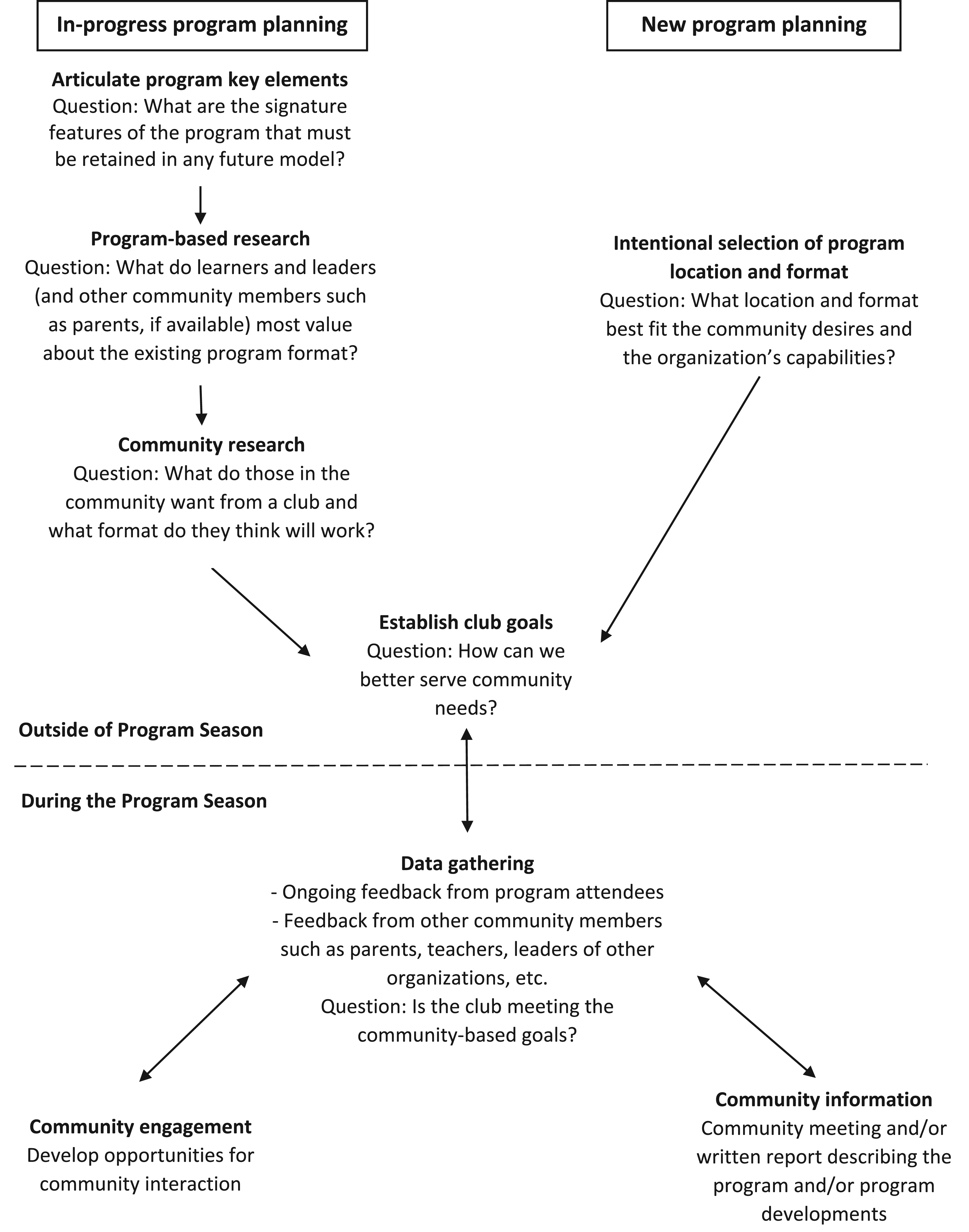
Discussion
Community-based initiatives, such as the STEM Academy’s science club program, are defined by their capacity to address pertinent issues within a given context and not just by their location in a community setting. In this study, we recognized how children from low-income communities regularly face structural inequities and deficit narratives when it comes to learning science. In this article, we have illustrated the approach taken during a university-informal science education partnership aimed at exploring ways of enhancing community-responsiveness in a science club program serving low-income communities. Rather than describe the outcomes of this information-gathering process (explored in Burke & Navas Iannini, 2021 [study phase 1] and Burke et al., 2022 [study phase 2]), this article documents the mechanisms that supported the STEM Academy in developing an ongoing community-responsive research practice that would inform program development across their family of science clubs. We took inspiration from Dewey’s model of a Laboratory school to design a model club within which to explore various aspects of community-responsive science education as reported in the research literature, as requested by local community members, and as desired by the STEM Academy in their commitment to community service.
This community-based research initiative provided manageable constraints within which to try out new approaches outside of regular programming. For example, rather than shifting their entire pre-existing club structure based on theories generated in settings that may be quite different from the sociocultural context within which the STEM Academy operates, the STEM Academy was able to establish an experimental space for conducting a research-informed exploration of contemporary practice when applied to their working environment. Such an approach presents fewer risks than wholescale action, and provides a more efficient, scalable means of evolving programs to better meet the needs of community members. While the STEM Academy serves numerous low-income communities across a given region of Canada, we understand the importance of addressing the needs and desires of individual neighborhoods. Being community-based means responding to the needs of a specific locale as well as addressing the broader concept of community; therefore, the STEM Academy found it useful to contrast findings of the model club with their experiences in the regular Saturday morning club established in the same neighbourhood.
In this study, the STEM Academy took on the role of leading in design of the club structure and curriculum (based on the study’s Phase 1 community-based data), while the research team collected data to report on the affordances and challenges of the science club provider’s strategies for responding to a specific community. While we recognize the value of joining university and non-profit organization resources and expertise for such an initiative, we believe that this study has demonstrated how a community-based organization could carry out their own research projects, collaborating with community members to address local needs; as planned, this will be the pattern employed by the STEM Academy moving forward.
Conclusion
At the end of this study, we recommended that the STEM Academy maintain a model club (not always at the same location) within their family of clubs in order to maintain a mechanism for engaging in constant inquiry, the outcomes of which can be scaled, as desired, throughout the club program. The program coordinator could readily assign someone with a role similar to the researcher-volunteer in our study to one or more of the clubs; that person would have the responsibility of documenting club experiences, both challenges and triumphs, after each club session. These records could be used by educator teams (including the volunteers and staffers who are recruited from the community) to determine lines of inquiry the organization would like to pursue in their model club spaces or throughout the program. Decisions about which approaches to try and what ultimately gets included in or excluded from a program will help program leaders to articulate more clearly the fundamental philosophies upon which their programs are focused.
Finally, Figure 1 summarizes the approach used in this study and outlines a schema that could be adopted and/or adapted by organizations seeking to be intentional about embedding club activities within the learner’s community context to support the learner in appreciating relevance and agency with regard to the activities conducted within an out-of-school club setting.
Footnotes
Acknowledgments
The research contributing to this paper was conducted with the financial support of a research grant from the Council of Ontario Directors of Education (CODE). The author extends warm thanks to the STEM Academy organization (a pseudonym), the children, teachers, and other Prairie Lane community members (Prairie Lane is also a pseudonym) who participated in the study. Finally, thanks go to our enthusiastic team of researchers including Ana Maria Navas Iannini, Kristen Schaffer, and Novella Ricotti.
Declaration of Conflicting Interests
The author(s) declared no potential conflicts of interest with respect to the research, authorship, and/or publication of this article.
Funding
The author(s) disclosed receipt of the following financial support for the research, authorship, and/or publication of this article: Council of Ontario Directors of Education (CODE)
