




Abstract
This paper discusses multidisciplinary international research collaboration team formation during the COVID-19 pandemic, challenges faced, strategies adopted, achievements and dynamics in the implementation of research on Coronavirus disease-2019 (COVID-19), by the African Translational Research Group (ATReG). The paper also discusses the lessons learnt and future opportunities for global collaborative research. In-depth virtual interviews were conducted with consenting members of ATReG. Questions were designed to provide rich, deep, and insightful opinions, lived experiences and perspectives of ATReG group members on group formation, challenges, strategies and achievements. Interview data was transcribed and analysed thematically, and the results were presented with important quotations presented. The ATReG consisted of English (n = 13) and French (n = 1) speaking sub-Saharan African (SSA) researchers who specialise in public health, epidemiology, optometry, information technology, supply chain management, psychiatry, community health, general medical practice, nutrition and biostatistics. Most members of the group reported an informal but well-coordinated structure of the group. Formed during the pandemic, all group meetings were held online, and many members are yet to meet each other in person. The group collected data from Africans and published 10 peer reviewed journal articles on COVID-19 within two years. It presented in international conferences, engaged with the media and the public and was awarded a national competitive funding in Nigeria all of which which contributed to career progression and academic promotion of some members. There have been challenges in sustaining the research collaboration and maintaining productivity. Challenges include difficulties meeting deadlines and obtaining funding for research activities. However, these challenges have been addressed through a collaborative problem-solving approach. The study found the need for operational and methodological flexibility, centralised coordination, and established funding sources as being essential for long term sustainability and performance of the group. The ATReG’s objective of providing useful data on COVID-19 and generating useful knowledge about COVID-19 in SSA has been achieved. In such a multi-disciplinary international collaborative team relaiant on the online medium to operate, the experiences and challenges can be a model for learning for researchers intending to form international multidisciplinary collaborative groups. Nonetheless, there are still many important areas of research which ATReG will continue to pursue.
Keywords
Introduction
In April of 2020 as the COVID-19 pandemic raged, five public health researchers of African heritage agreed to recruit other researchers of African heritage to collaboratively undertake timely translational public health research concerning COVID-19 in African countries. Two members of the group have affiliation to an Australian University public health department, while three members were affiliated to various public health and medical departments at South African and Nigerian universities. Within a period of 8 months, the international research collaboration grew by invitation to a membership of 14 African researchers working in various universities and research institutions spanning Australia, Cameroun, Ghana, Kenya, Nigeria, Saudi Arabia, South Africa, Tanzania, and the United Kingdom. The group adopted the name ‘African Translational Research Group (ATReG)’.
The consensus goals of this international, multicultural, multi-lingual and multidisciplinary collaborative research team were to: (1) work as a collaborative group of African researchers and researchers of African heritage (2) bring in expertise from a range of disciplines, and (3) bring resources and knowledge of their country’s culture and language with respect to data collection and research to mitigate the effects of the pandemic particularly in African countries. The team sought to provide evidence-based information that could be used to drive public health-related decision-making and policy thereby reducing the impact of the pandemic and its control measures on the African public. ATReG also sought to undertake knowledge exchange activities between African researchers in the diaspora and those based on the continent based on the peculiarities found in the different settings. The pandemic presented a good opportunity for such cross-sector multidisciplinary international partnership. Such partnerships have been shown to help create and deliver value in response to health emergencies such as the COVID-19 pandemic and in turn, help with adaptive learning (Arslan et al., 2020; Vervoort et al., 2021). A review of the emergency response in the United States demonstrated that involvement of stakeholders, where partnerships for resources, expertise and knowledge are built between state and non-state actors from different sectors functioning in a non-hierarchical manner produced better outcomes. (Yu et al., 2022).
Furthermore, the collaborative research team would drive empirical research from a uniquely African perspective and report on the outcomes of such research in a range of academic and non-academic outlets such as international journals, conferences, health policy outlets, and the general media. ATReG also aimed to engage with public health and COVID-19 policymakers. In doing so, the team sought to achieve its aim of translating research findings and making it of use to policymakers and laypersons in making decisions for control of the pandemic. This aligns with the goal of translation research to “translate (move) basic science discoveries more quickly and efficiently into practice”. Translation research does this by promoting multidisciplinary collaboration, incorporating the desires of the public and identifying and supporting adoption of best medical and health practices and their management (Rubio et al., 2010) . The formation of the team, the challenges it overcame and the achievements recorded by the team were significant and timely giving the ongoing global challenges of the pandemic particularly in sub-Saharan African (SSA) countries. Jit et al. (2021) explored multilateral collaboration between countries during infectious disease outbreaks and they suggested that responding to future global infectious disease threats and other health emergencies will require the creation of stronger mechanisms for multilateral collaboration before they arise (Jit et al., 2021). This should be undertaken through cooperation agreements driven by major research funders and researchers while harmonising research findings to avoid duplication.
Overview Synthesis of the Literature on International Research Collaboration
Research collaboration between individuals, groups, departments, institutions, regions, and countries is a growing activity that has attracted the attention of researchers from several fields including those in natural sciences, management, medicine, communication technology, and software engineering (Fry et al., 2020; Kwiek, 2021). With a diverse expansion of the literature on research collaboration, there have been several studies in this domain (Bozeman & Boardman, 2014; Kwiek, 2021). Previous publications have identified several clusters of research collaborations, ranging from inter-individual research collaboration (Nyström et al., 2018) to inter-departmental and inter-institutional collaborations as well as inter-governmental collaboration (Hedges et al., 2021).
Driven by increasing global economic competition and rapid technological changes, more countries consider inter-governmental and cross-country collaboration in science and technology a critical way to foster and maintain global innovation and economic competitiveness (Glänzel, 2001). A country with more inter-governmental and cross-country collaborative linkages is able to leverage the domestic capabilities and exploit foreign investments in research and development (R&D) and commercialisation opportunities (Wagner, 2009). Thus, international research collaboration is perceived as a dominant driving force for promoting scientific and technological advancement (Wang et al., 2014), industrial innovation, and economic growth (Sharma & Thomas, 2008). Furthermore, in scientific and technological research domains, the growing scale of research projects and complexity, particularly in projects that are set up to address important global challenges (e.g., COVID-19, energy crisis and climate action), are often beyond the capabilities of individual countries, hence significant interest in international research collaboration activities is necessary (D’ippolito & Rüling, 2019).
The literature on international research collaboration is on a steady increase (Bozeman & Boardman, 2014). While some studies have examined the factors that trigger cross-country research collaboration (Plotnikova & Rake, 2014), others have explored international research collaboration in higher education (Milman, 2021; Taras et al., 2013), and its structures and team dynamics (Bagshaw et al., 2007; Garg & Padhi, 2001). Researchers have also sought to understand who researchers choose to collaborate with (Iglič et al., 2017) including industry or university research collaborations (Mascarenhas et al., 2018) as well as the effects of such international research collaborations (Ernberg, 2019).
The dramatic growth of international research collaboration studies in recent times, makes this paper necessary and conducive to a nuanced understanding of our particular research domain, the difficult context of the pandemic in which this collaboration was hastily formed, and how trust was developed very quickly resulting in several successful research outcomes (Berger et al., 2021; Yu et al., 2021; Zakaria & Yusof, 2020). The unique characteristics of the inter-individual international research collaboration makes this study different from that of other domestic research collaborations.
A robust understanding of the field of international research collaboration in any discipline is necessary. The geographic, linguistic, political and cultural distance is more significant than those in other kinds of research collaboration (Chen et al., 2019; Cheng et al., 2016; Fu & Li, 2016). Moreover, the capabilities and motivations for international research collaboration may affect the patterns, effects, and outcomes of international research collaboration. Such differences are more pronounced when research collaboration expands to individual researchers in several countries across Africa, UK, and Australia. Therefore, the patterns, team dynamics, processes and effects of such inter-individual international research collaboration mostly undertaken online demonstrates unique features that are yet to be analysed in other international research collaboration studies.
To fill this research gap, a case study was conducted based on collaborative team processes and dynamics in the implementation of COVID-19 related empirical research in sub-Saharan African (SSA) countries during the lockdowns that were enforced in many African countries, as well as lessons learnt that could be adopted by researchers seeking to collaborate anywhere in the world.
Methodology and Interview Analysis Strategies
Interview Guide and Consent
The interview guide was developed by an independent researcher – an expert in qualitative research who was not a member of the group at the time. The guide was based on the information provided on the activities of the group. The interview guide was reviewed and pre-tested before the actual interview was conducted. A written or verbal informed consent was obtained from participating members of ATReG before commencement of the interviews, basic biographical data of the members were collected followed by questions focused on the composition, strategies, success stories and achievements of the groups, as well as the challenges and recommendations. Approval for this study was obtained from the Humanities and Social Sciences Research Ethics Committee (approval#: HSSREC 00002504/2021) of the University of KwaZulu-Natal, Durban, South Africa. The study adhered to the principles of the 1967 Helsinki declaration (as modified in Fortaleza 2013) for research involving human subjects. The confidentiality of participant responses was assured, and anonymity maintained.
Samples and Interview
The narration of the team formation, working strategies, achievements and lessons from this international research collaboration was obtained through an in-depth interview conducted among members of ATReG. The members were in nine different countries namely, Australia, Cameroon, Ghana, Kenya, Nigeria, Saudi Arabia, South Africa, United Kingdom and Tanzania. All members of the group except for one who declined interview were purposively sampled in this research.
The interviews were conducted virtually either via Zoom video conferencing applications or scheduled telephone calls, depending on member’s preference, and at a convenient time for the respective respondents. With the consent of the respondent, the interviews were audio-digitally recorded, and notes taken by a note taker. In total, 13 interviews were conducted; each interview lasted about an hour 30 minutes to 2 hours.
Data Analysis
A thematic analysis of the data was conducted in six phases as suggested by Braun and Clarke. Phase 1 was about familiarization with the data where each recording was listened to by two independent researchers, and thereafter each interview was transcribed verbatim using the Otter.ai transcription software application and complemented manually with the recordings and the notes taken during the interview. The transcripts were read thoroughly and comprehensively to generate initial codes (Phase 2) and subsequently, themes and sub-themes were generated using the inductive and deductive approaches (Phase 3) (Elo & Kyngäs, 2008). The sub-themes were reviewed for accurate representation and checked to ensure they fit the main themes and the objectives of the study. Those that did not fit, were eventually discarded before the final analysis (Phase 4). The final themes and sub-themes were labelled, and the data analysed using Excel Spreadsheet application(Phase 5). Finally, the results were produced, and the reports presented using the various themes and important interview quotes (Phase 6).
Findings
Characteristics of the Research Team
In total, 13 interviews were conducted, one member declined to participate for lack of time, resulting in a response rate of 92.9%. Each interview lasted about an hour 30 minutes to 2 hours. The respondents were aged between 39 and 62 years, mostly men (10, 76.9%), majority were from English speaking countries in SSA (11, 84.6%), had postgraduate qualifications in various fields (Figure 1) and two were full Professors, one in health-related specialty (Optometry) and the other in computer science. Areas of specializations of the research group members. The categories included computer science, human nutrition, supply chain management, psychiatry.
Analysis of Responses of Group Members by the Themes and Sub-Themes that Emerged from the Interview.

Thematic Responses
Table 1 shows the different themes and sub-themes that emerged from the interview. At the time of this study, the group had published 10 peer reviewed jounal articles in respected public health outlets. The group also published two policy articles in the Australian and African editions of the Conversation. Also, ATReG made presentations at two separate international conferences. The group also published translated research in three newspaper articles, one in Ghana and two in Nigeria and successfully obtained a highly competitive research grant award from the Nigerian Tertiary Education Trust Fund (TETFUND). According to the respondents, the social factors responsible for the research successes of ATReG included strong social relationships and ties between members, mutual tolerance and mutual respect, having a team ethos, a strong central coordinator, and strong trust in each other’s ability.
Discussion
The working principles and the achievements of the group were identified and reported under three important themes. The themes are: group composition and working strategies; successes and achievements of the group; the group’s challenges and recommendations moving forward. Each of the three themes are discussed as follows.
Group Composition and Working Strategies
Group members are from various SSA countries. Each member was invited to join the group either by someone known to them who was already in the group, or through being referred because of their research background by a member of their institution/University who was not part of the group. Members included researchers, clinicians and programme officers. Members mainly spoke English and French which connotes the concept of collaboration that describes involvement of people from different contexts and experiences or perspectives coming together for a purpose (Nyström et al., 2018).
Inter-individual collaborative research is becoming popular amongst scholars with advancement in information and communication technology and globalisation in research agenda (Carayol & Roux, 2007). Inter-individual collaborative research is also growing in order to increase research productivity and attract higher numbers of scholarly citations (Katz & Martin, 1997). Coordination is often needed in collaborative research to ensure smooth running, commitment, and performance by the diverse partners (Bansal et al., 2019). Various collaborating groups adopt diverse approaches such as having a formal structure or an informal structure like the type presented in this study. ATReG was set up without a formal organisational structure but has effectively functioned with many success stories through an informal coordination by one of the conveners of the group. The coordination mechanisms deployed include (1) frequent online meetings (2) WhatsApp messaging (3) emails, and (4) phone calls. Incidentally, Nyström et al. (2018) found that projects were more successful if they use more coordination mechanisms compared to those that use fewer coordinating mechanisms.
Depending on the approach chosen in research collaboration, partners can be involved from the stage of researchdesign, data collection, data analysis, report or manuscript writing right through to the final dissemination to various audiences. Roles were mostly assigned to members based on their areas of strength and whatever they volunteer to do. There are no permanent roles in the collaborating team except for a couple of scholars with aptitude for and skills in statistical analysis. There was however active and collective participation by members of the group in the full range of tasks. From conceptualization of topics, research design, to the design of data collection instruments, actual data collection, analysis and reporting through a rigorous collaborative peer review process during their regular online meetings. This approach has also been successful in other international collaborations involving researchers from diverse cultures who were at different career stages in North American, European, Middle Eastern, and East Asian universities (Dusdal & Powell, 2021). Numerous factors influence collaborative research, and they are usually driven by funding organizations. The group was established on the premise of wanting to promote collaborative research in Africa by Africans and this was captured in a respondent’s statement; “But the initial idea was to try and drive research from an African perspective”, “It is a Research, for Africa, in Africa and by Africans”.
Success Stories/Achievements
Although the initial objective of the group was to conduct research with a focus on COVID-19, the research programme later expanded to other research areas. The group achieved successes by the numerous peer reviewed publications, including an article on COVID-19 myths in Sub Saharan Africa (Osuagwu et al., 2021; Ovenseri-Ogbomo et al., 2020) which was part of a World Health Organization sponsored series, Risk perception of COVID-19 within SSA countries (Abu et al., 2021), and compliance with mandated public health practices during the pandemic (Nwaeze et al., 2021). Within the first 18 month period of operation, the group experienced the successful award of a competitive national grant from the Federal Government of Nigeria. This grant achievement was considered as the greatest achievement by many in the group because both the grant and the publications have accelerated the career progression and academic promotion of some members of the group. The grant and publications have also elevated their research, academic and professional career profiles above those of their peers. Some members reported that they got promoted to Associate Professorship and others mentioned that they were assigned higher responsibilities, and became more visible in their institutions and within other professional groups as a result of the publications and conference presentations. The social relationships formed, and networking opportunities were also viewed as more valuable achievements of the collaborative team than the publications and grants by some members, considering that the group was formed during the COVID-19 lockdown, a period of disruption to research activities, increased isolation and loneliness (Wu, 2020).
As documented by other research collaboration teams, successful international research collaboration is the result of synergy and commitment among diverse partners, where every partner is willing to work and contribute positively to the group, in addition to the effective coordination of the group’s activities (Cummings & Kiesler, 2005). The most reported motivation in this collaborative research were the groups’ diverse competencies, level of commitment, simplicity, respect for one another and hard work. Good communication is an important concern raised in inter-cultural/inter-country and inter-disciplinary collaborative research, and in this study, participants appreciated the good communication and high level of mutual respect. They considered these to be motivating factors for their active involvement and high performance.
Challenges and Recommendations
Figure 2 presents a summary of the challenges of ATreG. Although the research collaboration was among Africans in Africa and Africans in the diaspora for African health and COVID-19 policymakers, there were some challenges posed by the differences in time zones. Some members of ATReG were residing outside of Africa at the time of the collaboration, which made virtual meetings the most convenient option. Even though, time zones and Saturday meeting times were not convenient for some members, they made regular sacrifices to attend the meetings due to the high level of commitment. With diverse membership and multiple activities, it was expected that bottlenecks and challenges would be encountered. Respondents felt research activities were tasking and meeting deadlines were overwhelming given day to day work and family obligations. The process of designing and writing manuscripts and grant proposals were perceived as time consuming and challenging as was also noted in another study (Martin, 2010). Challenges to team formation and research activities.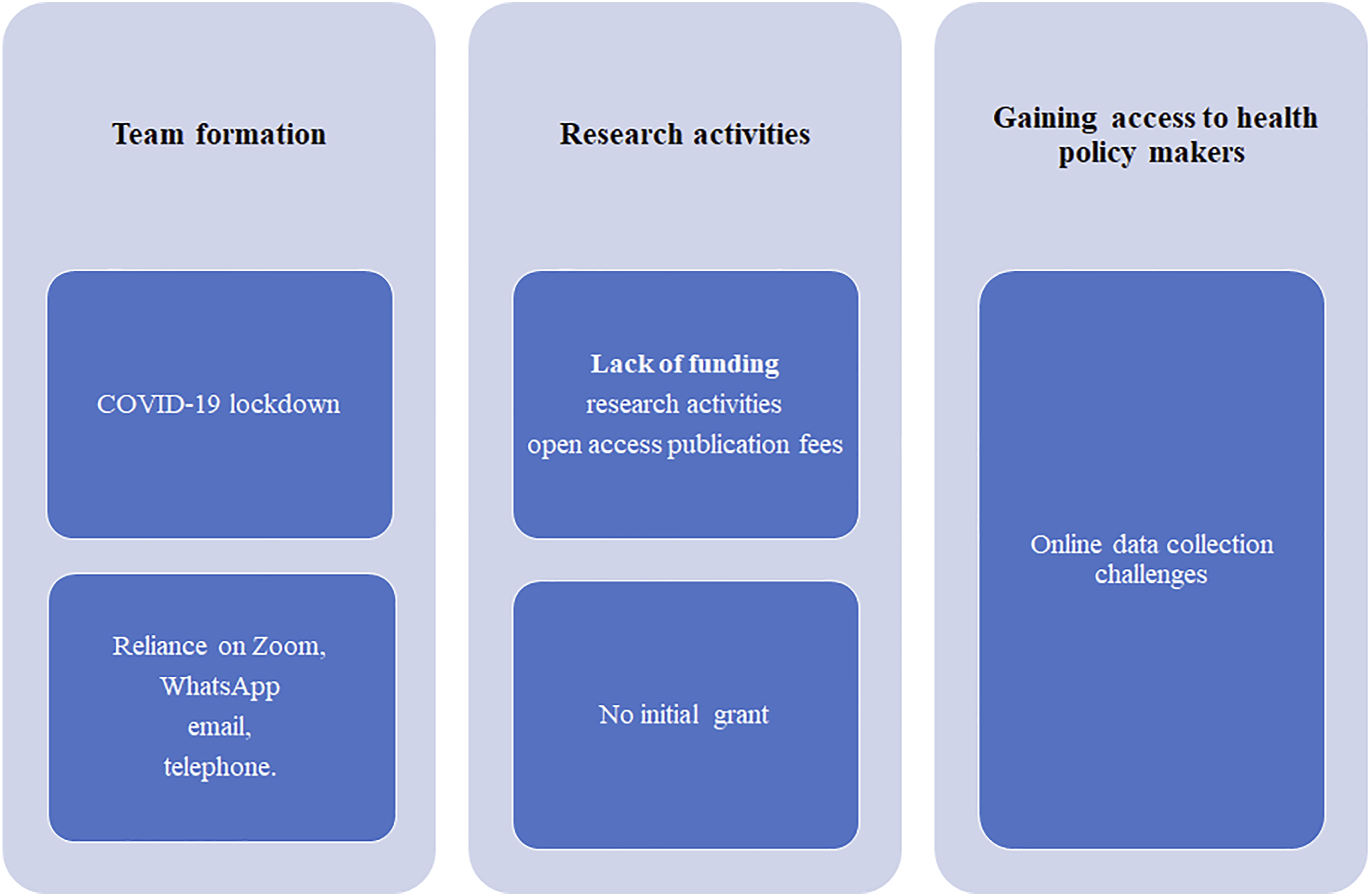
Some other challenges that were reported by members of ATReg and which are not uncommon to many collaborating research groups include financial constraints in funding research activities, and a lack of formal structure. There were also challenges with raising funds for payment of open access publication fees. The respondents however thought the funding challenge could be overcome by identifying a funding source for future research activities and long term sustainability of the group and its research programme. Although the group has managed well without a formal structure or source of funding, respondents felt there is a need for a more formal coordinating structure, believing that this would help to achieve better productivity and reduce the coordinating workload on a few individuals particularly as the scope and mandate of the group is expanding.
Conclusions
This study revealed that international multi-disciplinary online research collaboration between African researchers in Africa and researchers of African heritage in the diaspora during the COVID-19 pandemic could result in significant achievements in publications and contribute to career progression and academic promotion for collaborating members, inspite of most members having never met in person. There were challenges with data collection which was mostly undertaken online. There were also financial challenges in funding research activities, programmes and publications. International multidisciplinary collaborative research is a model for researchers and a critical way to foster and maintain global innovation and research successes, particularly around public health issues and the management of the processes and systems that support public health decision-making and infrastructure. The study also demonstrates the need to have centralised coordination to drive research programmes and projects, and to frequently pull team members together to ensure that members are working collectively and cohesively as a team through effective communications and coordination online.
Furthermore, there were lessons that emerged from the complexity of the context of the collaboration. These include the transnational, trans-cultural and bilingual nature, and subsequent reliance on online tools such as Zoom and WhatsApp for communications over the most difficult period of the pandemic. Furthermore, lessons could be learnt from the collaboration of researchers at various career stages. ATReG membership includes a top university administrator, senior scholars/researchers, mid-career researchers (MCR) and early career researchers (ECRs). Also, members of the group working in various universities and institutions around the world in close collaboration with researchers based in African institutions who speak French and/or English language in African institutions and universities without conflict, grievance or group breakdown, may be worthy of note and emulation.
The collaboration also involved knowledge exchange between researchers that are resident in Africa and those resident in the diaspora. These took place before, during and after research conference presentations and through discussions during regular meetings. ECRs were also able to learn and be mentored by more experienced researchers. Learning from the successes and challenges in such a large international cross-cultural, multi-disciplinary collaborative research team can be replicated by any researcher in any discipline at any level of their research career and experience. We reported on the need to develop swift trust of team members even when one hardly knows the other and the fact that all team members need to take on a mature, tolerant, and respectful stance towards others, their opinions and perspectives.
Footnotes
Declaration of conflicting interests
The author(s) declared no potential conflicts of interest with respect to the research, authorship, and/or publication of this article.
Funding
The author(s) received no financial support for the research, authorship, and/or publication of this article.
