




Abstract
The qualitative action-project method (A-PM) was developed in counseling psychology and is useful for studying human actions in various contexts. With this article we provide a guide to A-PM data analysis with a focus on the method’s coding technique. We briefly outline the theory underpinning the method as well as the different phases of data collection. The A-PM data analysis happens in parallel from a bottom-up and top-down approach, where researchers consider the data closely for what participants are doing, how they are doing it and the ways in which their actions are directed by their overall goals. We add to the existing literature by detailing the coding technique, providing examples at each stage of analysis, as well as reflect on the possibilities for adapting the protocol for different types of research. Our aim is to support researchers in their efforts to undertake the method.
Introduction
In this paper we aim to offer an in-depth explanation of the Action-Project Method (A-PM) coding and analysis processes based on our experience using the method (Gruneir et al., 2021). Ample work has been done using the A-PM to study the experiences of people during major transitions and life events (Khalifa et al., 2018; Marshall et al., 2014; Young et al., 2008), but less has been published on how to conduct the qualitative coding and analysis of the data. This paper is instructional in nature and is meant to serve as a guide for researchers new to the A-PM and support their efforts to undertake the method.
The A-PM is a consensus-based method for conducting qualitative research. Researchers approach the data through a lens of observing what people are doing instead of asking what they are talking about (Young et al., 2021). The A-PM is a relatively new method and was developed in counselling psychology. As such, most literature to date is either (1) conceptual and theoretical and aimed at further developing the method (Marshall et al., 2012; Wall et al., 2016; Young et al., 2001, 2011, 2021) or (2) empirical studies using the method (Marshall et al., 2011, 2012, 2014, 2018, 2020; Wall et al., 2020; Young et al., 1999, 2001, 2011, 2018; Zaidman-Zait et al., 2014).
A significant number of empirical studies using the A-PM have outlined in detail how to collect data and how the various stages of data collection add different perspectives on action (Marshall et al., 2008, 2014, 2020; Young et al., 2001, 2008). The literature describing the coding is mostly brief and without specific instructions on how to code the data. In some methodological work, the coding is outlined more in-depth with examples of codes and more concrete descriptions of how to conduct the coding (Marshall et al., 2012), but the number of these articles is limited. Even when the coding stage of the analysis is described, it is rarely in the same papers that outline the other stages of the analysis in-depth, leaving researchers to search the literature for sources of instructions. There is, to the best of our knowledge, no literature that comprehensively details the analytical process with the aim of instructing researchers of the practical steps of data analysis using the A-PM.
A-PM Theoretical Background and Methods of Data Collection
Contextual Action Theory
Contextual Action Theory (CAT) is the theoretical foundation for the A-PM. CAT addresses behaviors, or actions, that are goal-directed and intentional within their social and cultural context. In CAT, actions are considered from different perspectives: manifest behaviors, internal processes (cognitions and affect), and social meanings as constructed by individuals and groups in the relevant social or cultural context (Young et al., 2021). Actions are also considered on different levels, specifically verbal and nonverbal behaviors or elements, the functional steps taken to reach a desired end state and the goals that represent the meaning of the functional steps and action processes leading to these goals. Finally, CAT also includes consideration of actions in systems. This refers to short-term action happening in the moment, middle-term projects where linked series of actions are constructed to achieve a goal, and long-term careers where multiple projects throughout people’s lives are constructed around a common goal (Young et al., 2021).
A-PM Overview
Data Collection
Most A-PM research has used one of two approaches. In approach one, data is collected in two rounds. In the first round or meeting, the sequence is as follows: (1) an introductory conversation with the researchers, (2) the participant conversation, and (3) video-recall interview for participants separately. In the second round of data collection participants have an opportunity to provide feedback on the initial analysis through a review of their narrative. In approach two, data collection occurs over a longer period, typically 3-6 months (Marshall et al., 2008; Marshall et al., 2014; Young et al., 2001). The process starts with the same two rounds of data collection described above followed by a monitoring period. At the end of the monitoring period, researchers repeat the two rounds of data collection to gather a longitudinal perspective on the participants’ experiences.
In both approaches, researchers collect data from (1) the participant conversation, (2) the video-recall and (3) the narrative review. The participant conversation can be between two or more participants or a single participant and a researcher. During the conversation, which is video-recorded and transcribed, participants are prompted to discuss a specific issue without the presence of a researcher. In the video-recall, each participant engages separately with the researcher as they watch the recording of the conversation played back in approximately one-minute segments. The researcher asks the participants about their internal processes and intentions. Following transcription and analysis of the conversation and video-recall, the researchers write three narrative summaries, one for each participant and one for the dyad, or group depending on the number of participants, of the joint actions that the participants have engaged in as well as a tentative joint project. These narratives are reviewed by the participants to provide feedback regarding the accuracy of the preliminary analysis. Together, the individual participants and the joint participant engagements are referred to as a single case.
Ample resources are available on the A-PM data collection procedure and we direct readers to the following for more details: Marshall et al., 2008, Marshall et al., 2020, Wall et al., 2020, Young et al., 2018.
Framework for Data Analysis
The primary goal of the A-PM data analysis is to describe the participants’ joint action in its complexity (Young et al., 2021). Data analysis occurs after each round of data collection, regardless of whether there is one round or multiple rounds. Most current A-PM literature focuses on the top-down and bottom-up approach to the data analysis (Young, Valach & Colin, 2002). The top-down perspective is used to ask “how” participants achieve their joint goals, which reveals the functional steps, and asking how participants accomplish these functional steps reveals action elements. The bottom-up perspective focuses on the “why”. Specifically, asking why participants use certain action elements reveals the functional steps of the action and asking why they enact those functional steps reveals their goals. In this circular way, researchers go back and forth during data analysis until they arrive at an understanding of the participants’ joint actions Figure 1. Steps for reaching consensus about joint projects.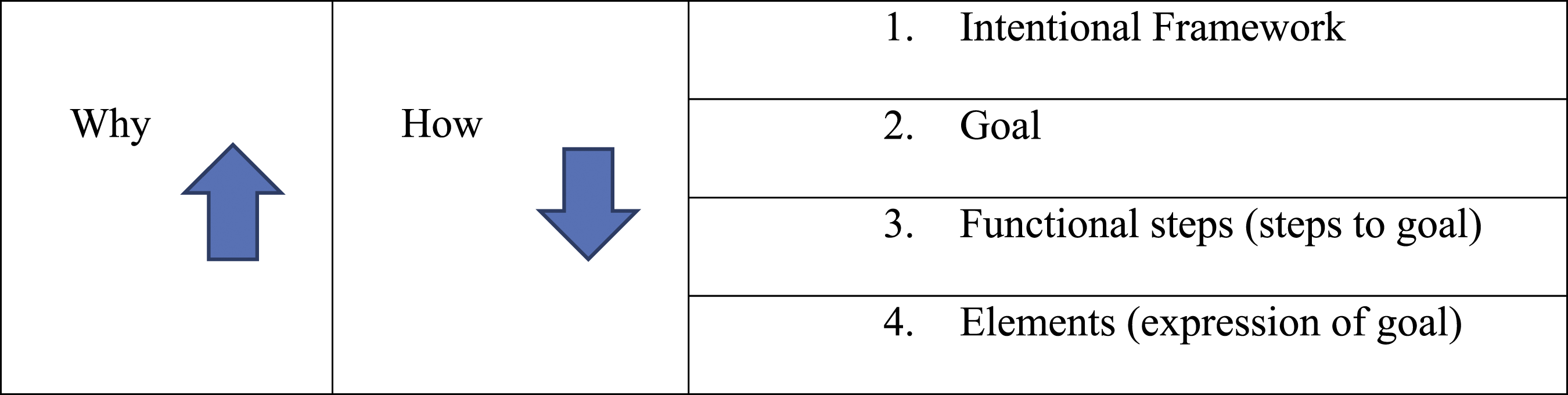
The first step towards achieving a shared understanding of the participants’ joint project is to determine a preliminary intentional framework, or overall goal, for the dyad and the individual participants. From there, researchers use the bottom-up approach to code the specific behavioural elements (verbal and non-verbal depending on the study) to identify the functional steps, which are sets of linked elements or actions leading participants towards their goals. The researchers then use the conversational elements and the functional steps to identify the individual and joint goals (desired outcomes) of participants and revise the preliminary intentional framework.
A-PM Qualitative Analysis
The A-PM Approach to Data Analysis
Researchers work in pairs to code cases, followed by discussion on interpretation of the data and to compare and refine the analysis. The principle behind this team approach is that two researchers become deeply familiar with a dyad’s data, and then share their analysis and insights with the rest of the team to get feedback and broaden the analysis. This allows multiple perspectives on the same data to construct the analysis in a movement back and forth between analysis and team discussion.
Analysis of A-PM data involves three steps. First, researchers transcribe and prepare the data from the joint conversation for coding. In the second step, researchers code the conversation, using the video-recall data to inform the coding. This coding is the basis for the third step of the analysis, writing a narrative summary in goal-directed language for presentation to, and feedback from, the participants.
Preparing Transcripts for Coding.
In this first phase of coding, the researchers review the transcription for accuracy while watching the video-recorded data. They do this to identify transcription errors and to get a sense of tone of voice, body language and the general atmosphere surrounding the conversation. While reading the transcripts, the researchers also note what they think participants are doing in the conversation. This initial estimation is a tentative understanding of the intentional framework.
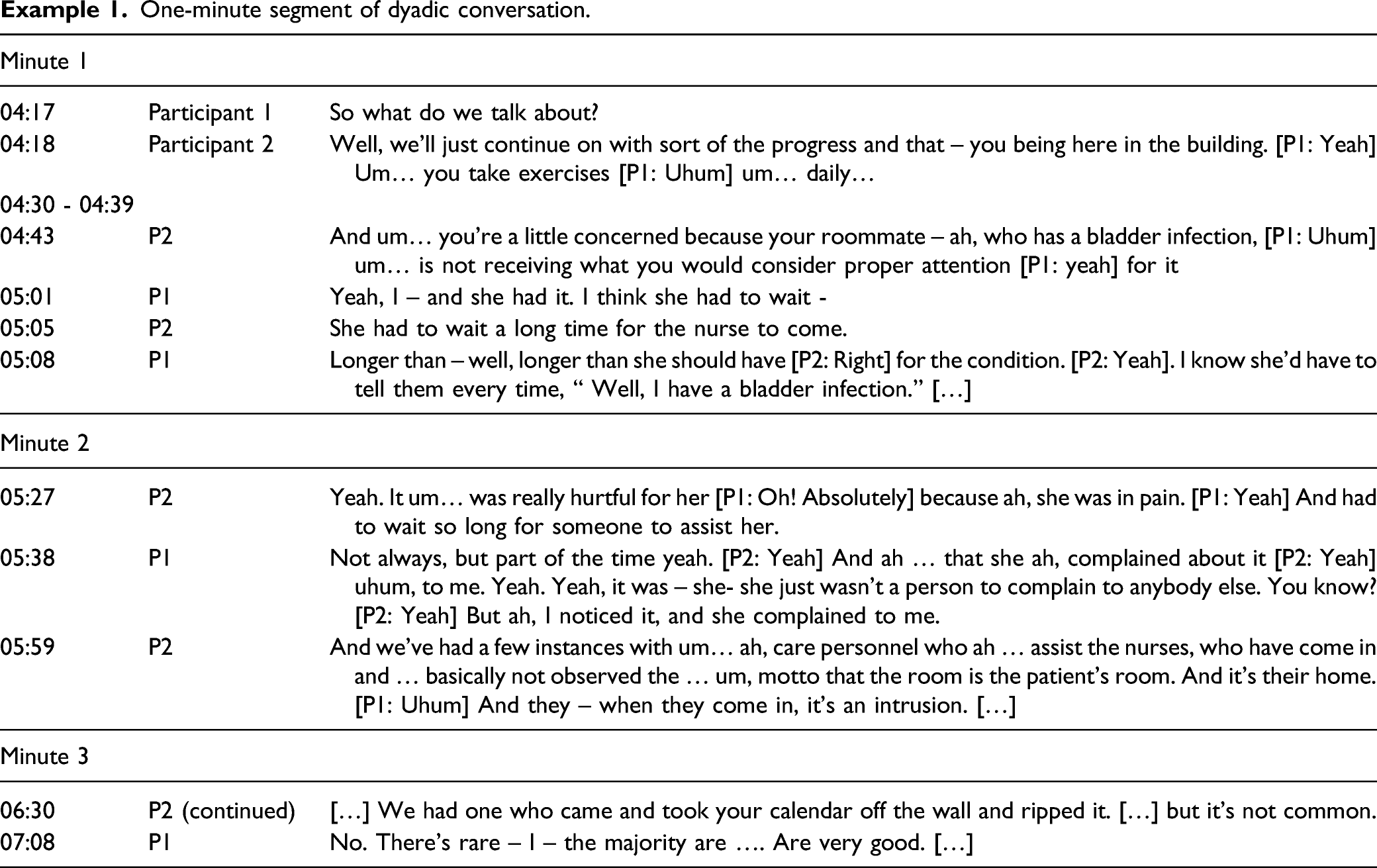
One-minute segment of dyadic conversation.
Coding
Code List
Researchers typically develop or adopt a master code list at the start of the coding process. We provide an example in Supplemental Appendix A. Most code lists characterize verbal behavior; however, if the researchers are interested in non-verbal action, for example, interpretative dance or musical expression, then the code list would include non-verbal behaviors. Code lists can also be modified as the coding process proceeds by adding new codes or deleting redundant or unused codes. Based on this master code list, individual coders identify the most appropriate code for an action within a single turn-of-phrase at a time. Since action is the unit of analysis, a code targets an action taken by a participant, such as “expressing [type of] emotion”, “describing past event”, or “acknowledging dyad partner”.
Coding Elements
Coding of One-Minute Segment Of Dyadic Conversation.

Individual codes address different types of action within a turn of speech, which is particularly illustrated at 5:08. Often part of a turn of speech is a reaction to the other participant in addition to further action. The best way to code all the relevant types of action is to move back and forth between each turn of speech to capture the joint nature of action. This allows researchers to not just focus on one participant at a time but on what is co-constructed between the participants.
Functional Steps
Once the conversation has been coded, researchers read the turns of speech within each one-minute segment and cross-check them against the corresponding sections of the video-recall. This allows researchers to better understand the way in which participants’ actions are informed by their intentions. In the A-PM this is referred to as functional steps, meaning the linked sets of actions that participants take towards these yet undefined goals. In each one-minute segment, each participant’s functional steps are identified based on the coded elements as well as their intentions stated in the corresponding parts of the video-recall. We provide an example of this below.
Functional Steps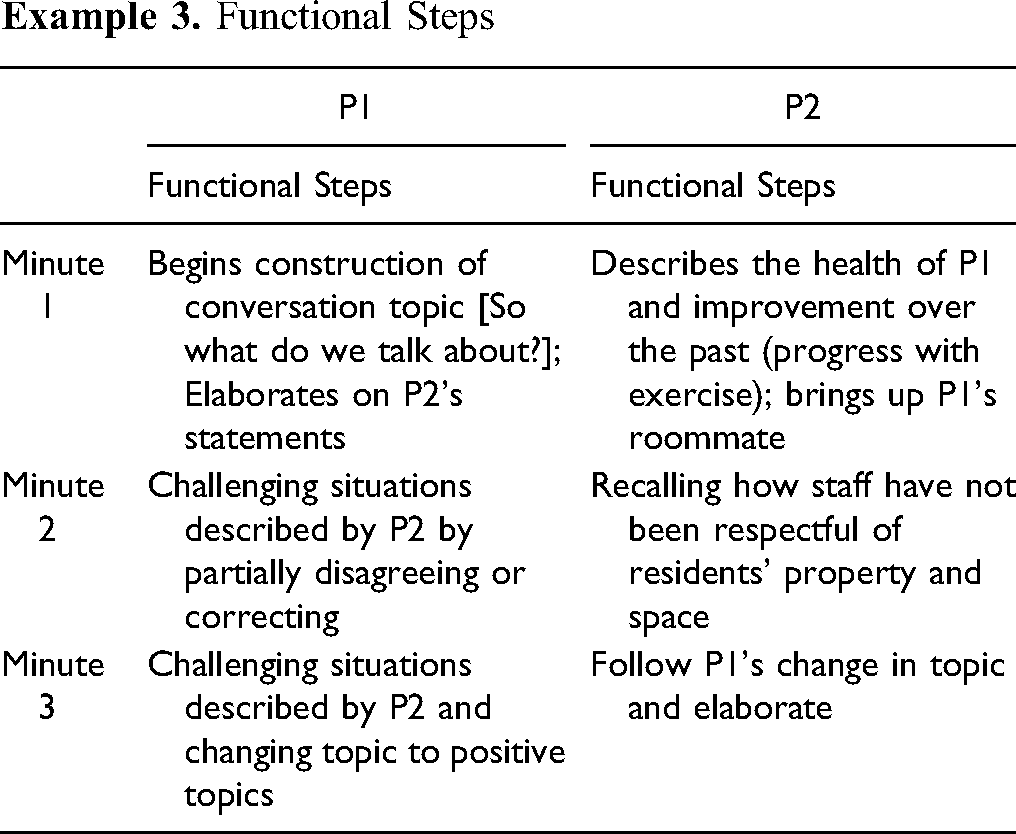
Identifying Joint Goals and Projects
At this point in the analysis, researchers will have an idea of the functional steps but not the actual goals. In Example 4, we show each participant’s goals for the first one-minute segment. Goals are the desired outcomes that guide actions. While individual goals are unique to each participant, they are not necessarily independent of one another. This leads to the concept of joint goals, where individual participant’s goals are interlinked with their partner’s goals. Even divergent individual goals can still be linked. In Example 4, the two individual goals are not the same, however they are clearly linked. Both goals put P2 in charge of the construction of the conversation and both involve advocacy for care. Together, these goals can be described as the joint goal “To review the routine of P1 as it relates to well-being; illustrate the importance of quality and responsiveness of care (roommate’s story)”.
Goals.

While goals are the immediate perspective on action, projects are made up of series of goal-directed actions over time. Like actions, projects can be individually, jointly, or culturally constructed. The researchers’ aim is to determine whether there is a joint project between the participants and, if so, what that joint project is, by looking at how the actions of the participants link together over time and what their actions move them towards.
Narrative Summary
After the initial coding has been completed, an individual narrative summary is prepared for each participant and the joint narrative and tentative joint project are written for the dyad. A narrative summary contains a description of the participants’ actions and joint actions, using their language drawn from the transcripts. The summary of actions and joint actions ends with a tentative description of the inferred project(s).
Each participant is given the opportunity to review their own individual narrative and the joint narrative to provide feedback. The feedback of the participants is important as it provides a check of the accuracy of analysis and researchers’ interpretation. Any changes requested by participants or other feedback are added to the narrative review and integrated into the data.
Within Case Analysis - Case Summary
The next step of the A-PM analysis is the within-case analysis. In this part of the analytic process, researchers move away from the minute-by-minute analysis to view the full set of interactions and accompanying video-recall and narrative reviews as a case. They include any context and general observations made during the data collection, such as background information about age, gender, living circumstances, relationship, and other pertinent contextual issues. To summarize the case, researchers use the information from each step in the coding to finalize the overall intentional framework. A case summary template can be found in Supplemental Appendix B.
The case summary also includes accounts of the verbal and non-verbal behavioural patterns between the dyad members, the apparent goals of the participants as well as the issues raised in the conversation. Finally, the case summaries include information gathered in the narrative presentation, specifically surrounding agreement, and suggested changes. Notes can also be made in the case summary about any meanings or concerns that might have come up around the participants engagement with the research project. The researchers who coded, analysed, and created the case summary present it to the full research team for in-depth discussion.
Cross-Case Analysis
This part of the analysis allows research teams to explore cases that are similar or divergent in themes, patterns, or projects. Typically, cross-case analysis is conducted in iterations. The cases are organized into groups of three or four to facilitate comparison, either through random selection and/or relevant participant characteristics. This is typically done at least twice to ensure that cases are compared against as many other cases as possible. The team works towards consensus, comparing projects and goals across cases to ensure findings accurately represent the research participants’ actions.
Discussion
The aim of this paper is to provide an overview of the coding and analysis process for qualitative studies using the A-PM. While other authors have written about the approach and conducted A-PM studies (Marshall et al., 2012; Wall et al., 2016), our paper builds on their work by adding an in-depth description of each step from the theoretical underpinnings to the team-based nature of the coding process, to the practical steps for coding, to analysing the data.
Throughout this paper we aimed to keep our overview of the coding and analytical process as general as possible. However, our instructions are influenced by our own experience using the method, which for majority of our team was isolated to the nursing home setting in Edmonton Alberta, Canada. In other settings and with other populations, actions can manifest differently, which might require different tools for coding and analysis. In research studies involving non-verbal methods of expression, say art or dance, the coding would have to be based on code list of non-verbal behaviours appropriate to that type of expression. This could also be true for studies conducted with young children or other participants relying on observable behaviours as methods of communication rather than speech. To the best of our knowledge, only two studies using A-PM, both involving young children, have included non-verbal communication (Zaidman-Zait & Young, 2008; Zaidman-Zait et al., 2014). The opportunities to use the A-PM to understand non-verbal actions have therefore not fully been explored yet, and there is potential for further methodological development in this area.
Different academic disciplines may be interested in different methods of expression or action, in which case various aspects of the A-PM process can be modified while still staying true to the theoretical framework and the overall focus on goal-directed actions. These modifications could be 1) inclusion of non-dyad participants (either single individuals or larger groups), 2) number of rounds of data collection depending on the capacity of the research team as well as the participants, 3) the coding list and the types of actions and expressions of actions that are of interests, 4) timing of the narrative review depending on its utility for the research team and the participants. Adaptation of the method may be necessary to enable the applicability for different research settings, which is important for research teams to keep in mind as they design their A-PM studies.
The use of the A-PM to study joint actions between people allows researchers to approach the data in a way that is simultaneously driven by the participants while not depending on the participants' individual narratives. The method is particularly useful when researchers start with an understanding of the phenomenon as involving goal-directed action between two or more people. For example, understanding the need to take a prescribed medication as an action between doctor and patient. Once we think that it involves a joint goal-directed conversation, we can then formulate a research question. A-PM research questions target actions and identify the people involved with the action. An example could be a research question identifying young adults and their parents as the participants and the transition to adulthood as the actions that are being analyzed.
The A-PM is beneficial to all research questions concerned with the multifaceted complexities surrounding actions occurring between people. The method simultaneously works well for exploring day-to-day life and major life transitions, as it is uniquely concerned with the supra individual level of analysis. Qualitative methods tend to interview individuals or work with focus groups. Rarely if ever is it the actions between people that are the center of attention, and the A-PM thereby offer researchers a method specifically targeting a different level of analysis. Areas of research that would benefit from the unique approach to data collection and analysis offered by the A-PM could be; transgender transitioning between transgender persons and people close to them, healthcare workers and healthcare managers navigating their day-to-day environment, people with terminal long-term illness receiving home care from family members turned caregivers, new parents navigating the transition into parenthood, soldiers transitioning with their partners at home from warzone to home environment, people leaving closed religions or communities and navigating the transition with people close to them.
We have illustrated the steps to conducting an A-PM research study based on our empirical experiences. By doing so we hope to provide other researchers with some of the tools and the knowledge necessary to tackle an A-PM approach to conducting qualitative research. While it is important for researchers to consider their research topic carefully to ensure the proper adaptations are made from the beginning, the A-PM should be considered a useful addition to other qualitative methods.
Supplemental Material
sj-pdf-1-ijq-10.1177_16094069221108035 – Supplemental Material for Data Analyses using the Action Project Method Coding Technique: A Guide
Supplemental Material sj-pdf-1-ijq-10.1177_16094069221108035 for Data Analyses using the Action Project Method Coding Technique: A Guide by Charlotte Jensen, Matthias Hoben, Stephanie A. Chamberlain, Sheila Marshall, Richard A. Young and Andrea Gruneir in International Journal of Qualitative Methods
Footnotes
Acknowledgments
We would like to thank Kirstie McDermott, Monica Buenamino, Jaclyn Tompalski, Sadaf Ekhlas and Gillian Bever for their work to the data collection.
Declaration of Conflicting Interests
The author(s) declared no potential conflicts of interest with respect to the research, authorship, and/or publication of this article.
Funding
The author(s) disclosed receipt of the following financial support for the research, authorship, and/or publication of this article: This work was supported by the Canadian Institutes for Health Research (145401, 156426, 162236)

Supplemental Material
Supplemental material for this article is available online.
References
Supplementary Material
Please find the following supplemental material available below.
For Open Access articles published under a Creative Commons License, all supplemental material carries the same license as the article it is associated with.
For non-Open Access articles published, all supplemental material carries a non-exclusive license, and permission requests for re-use of supplemental material or any part of supplemental material shall be sent directly to the copyright owner as specified in the copyright notice associated with the article.
