




Abstract
Gaining access to formal institutions can be problematic for ethnographers. This is especially so when it comes to prisons where people are incarcerated by the state against their will for various crimes committed by them. Here, in such highly controlled environments, some authors have pointed out the lack of openness of correctional facilities to inquiry and the limited cooperation forthcoming from the various authorities that oversee them. Accordingly, this article examines the difficult processes undertaken to negotiate access to a high-security prison in Spain, and then maintain his role there for a 2-year period as a volunteer sports educator in order to explore the multiple meanings given to sport and physical activity in the prison setting by the prisoners, educational staff and the guards. The emotional costs and ethical dilemmas of sustaining working relationships with these different groups over time in order to achieve specific research goals are highlighted and reflections for future studies of prison life are offered.
Introduction
I have to pass five checkpoints to get into the prison; in the first I show my Identity Card and in the second the officers give me the ‘entry’. I show it twice more and at the last checkpoint they finally give me access to the sports center. On the way out, I count 384 steps from the sports center to my car and pass through eight doors, most of them closed and waiting to be opened by the guards. (Fieldnotes, 15–10–2001)
Walls, doors, keys, corridors, and checkpoints are part of the physical environment that separates the prison from the rest of the world. Many relationships and symbolic and emotional issues emerge between both environments and affect any research carried out behind bars, especially in ethnographic studies. The time and cohabitation requirements of field work are accompanied by problems associated with ethics, feelings, needs, and value judgments that coexist with the original purpose of obtaining data and understanding the events under study. Following Gibson-Light and Seim (2020) and Ugelvik (2012), the continuous negotiation process inside and outside the prison walls makes ethnographic work a difficult undertaking.
In their research, ethnographers play insider and outsider roles to the field (Phillips & Earle, 2010), but in prison they never gets rid of the outsider label if s/he is not an inmate. This was the case of a volunteer and researcher, the lead author of this paper (Daniel), who carried out the ethnographic field work in a maximum-security Spanish prison as part of his PhD project. The field notes made during the study are the main data sources for the present confessional paper. Although a data analysis was performed after the field work, allowing some time to pass facilitates the process of self-reflection according to Crewe (2014).
The rest of this paper is focused on the human relationships Daniel maintained as a researcher with people from inside and outside the prison for 5 years. It also takes into consideration the role changes, formal and informal negotiations, ethical dilemmas, and research needs. Obviously, it should be kept in mind that Daniel needed the participants’ acceptance since the quality of the data depended especially on it (Fetterman, 1998). The negotiation processes and human relationships thus become very important, so much so that a non-intrusive entry is strongly recommended if you want to go unnoticed (Taylor & Bogdan, 1986). We must not forget that ultimately access to information in a certain field is an “absolutely practical” matter (Hammersley & Atkinson, 1994; p.71). Researchers face an unknown world that involves making multiple on-the-spot decisions that cannot be found in ethnographic manuals, as described in the following field note: …emphasize the huge responsibility of having to make decisions, many of them important. Many times, I did not know what direction to take (…) What does the literature say about this topic? (Fieldnotes, 5-10-2001)
The contingency variable in any social scenario means that each investigation requires ad hoc strategies to obtain entry and correctly establish certain roles. The ethnographer acts as a bricoleur during the negotiations for access and the establishment of rapport in such a way that if s/he “needs to invent, or piece together, new tools or techniques, he or she will do so” (Denzin & Lincoln, 2005; p.4). The various ways of proceeding in a certain social setting depend not only on the research objectives but also on the researchers’ resources, their ethical principles and the special requirements of the context, in this case, a prison. In this paper, we therefore offer an ethnographic portrayal based on the main researcher’s reflections on the difficulties in negotiating access, emotional costs, and ethical dilemmas encountered during the research of a particular inquiry carried out in a prison several years before.
The Ethnography of Reference
The reflections that follow this section arose from a 2-year ethnographic study by the first author carried out in a Spanish high-security prison, at that time a doctoral student supervised by the other two authors. Our main purpose was to understand the meanings that inmates, workers, and volunteers gave to sports and physical activity in prison. Because this paper focuses solely on reflections on the methodological process followed, this section only gives information to provide a context to readers to understand this paper. For further details, see Martos-García et al. (2009a, 2009b) or the PhD thesis itself (Martos-García, 2005).
The field work consisted of a total of 500 hours, which enabled Daniel to visit different areas of the prison to which he was granted access. However, coexistence was more intense with the prisoners in the sports hall. During the process, data were gathered through participant observations, in-depth interviews and some prison documents.
Far from being unalterable, the observations could vary according to the inquiry’s needs and the special nature of the setting. Events that we considered relevant were written in a field diary. Initially, we decided to hide the diary and wrote up the notes outside the prison, but once the research had become an overt process, Daniel wrote his notes publicly. The only criterion for writing the field notes was that they should be chronologically organized from the beginning. However, with the passage of time and after the analysis they were sorted into the emerging themes.
In the covert ethnography, Alex the sports educator was the only person interviewed. After a few months we began to interview inmates, especially those known as destinos who assist with the equipment in the sports hall and keep it clean. Finally, we gathered 46 interviews from a total of 39 participants who presented different positions within the prison context. Only two people were interviewed more than once, a temp assistant, and Alex the gatekeeper, who was interviewed 6 times.
Although the semi-structured nature of the interviews allowed us to introduce unanticipated questions as the conversations progressed, some issues were constant, such as life in prison, sports inside, drugs, and reintegration of prisoners. However, with some interviewee profiles there was more emphasis on certain topics or new ones were included. In this way, the prisoners were asked for more information about life in the modules, their social relationships with each other, and the details of their physical activities, among other issues. When interviewing female inmates some questions focused on their special life in prison, whereas the interviews with workers focused more on their work and less, for example, on drugs.
All of the interviewees were encouraged to speak at length about the prison’s role in reintegration and the part sports played in it. Relationships among the different groups of workers, fundamentally between those in security (guards) and the educators, gradually gained greater interest. We should also bear in mind that the various ways of proceeding in a certain social setting depend not only on the research objectives but also on the researchers’ resources, their ethical principles and the special requirements of the prison context.
Prison as the Research Setting
Life in prison is conditioned by certain elements that are worth explaining. In the first place, overcrowding is common in most prisons (Alexander, 1988; Wacquant, 2002). Many more prisoners than the number for which the prisons were designed are forced to live together. They belong to different ethnic backgrounds, social classes, and genders. In this scenario, rumors, suspicion, opposing factions, and conflicts abound (Jacobs, 1974). This atmosphere does not make it easy to live together and is marked by the traditional rivalry between people who must obey and those who have the power to punish them.
Officers and prisoners are two different opposing groups; a situation that affects the neutrality the researcher tries to achieve to avoid favoring either group. In fact, even today inmates regulate their coexistence according to their own tacit rules (Marquart, 1986; Schlosser, 2008; Schmid & Jones, 1993), which reaffirms them as a collective.
We must also mention the fact that research carried out in prison is not highly regarded, especially by the warders and this makes prison contexts opaque to inquiry (Wacquant, 2002; Waldram, 2009). Research is considered a threat to the control of information: the prison always tries to prevent what happens there from spreading and it is also a problem for the inmates who do not dare to report their situation for fear of reprisals. It can also be a dangerous activity since it takes place in a violent environment (Rhodes, 2009). The researcher therefore feels forced to permanently negotiate his/her legitimacy and limits his/her role in a decidedly hostile atmosphere (Earle, 2014; Jacobs, 1974) in which every movement is monitored by the different members of the environment (Waldram, 1998). These circumstances do not exactly make ethnographic research welcome and, as Simon (2000; p. 290) points out, lead to “the disappearance of inmates’ social life as an object of knowledge outside the prison precincts.” This is especially daunting due to the increased prison population in the USA (Wacquant, 2002) and most European countries (OECD 2007). Crewe (2005) even observed an inverse relationship between the increased population and the reduction in research. In this situation, prisons become black boxes that are in urgent need of ethnographic studies to shed light on prison life (Rhodes, 2001, 2009). Since access is the first step in achieving this goal, the following lines describe the different strategies used in the present study to gain entry to the prison.
Access and Prison Life
The formal and informal negotiations for access are the key to successful ethnographies. Obtaining official permission is only the first step in attaining access, which is usually complicated. From then on, the researcher must be willing to knock on all the necessary doors to gain entrance into the field (Waldram, 2009). In this regard, it is relevant to wonder “How do researchers connect with someone who has been shut out from the world for years or someone who knows he or she will not be released any time soon?” (Bosworth et al., 2005; p. 225)
Formal Negotiation: “a favor is paid with a favor”
As entry through an NGO (non-governmental organization) was an express request of the prison authorities, the first step was to contact an NGO that carried out educational programs in the prison. Through this organization we applied for permits from the central authority, the Ministry of the Interior in Madrid. A long negotiation process then began in which the three different parts offered a service and asked for something in exchange (Figure 1). Multiple Interests Come Into Play in the Formal Negotiation for Access.
Given the need to obtain access to the prison sports center we made ourselves available for the needs of the facility. The fact that the lead researcher had a bachelor’s degree in physical education could help in the sports activities. In fact, the prison warden obtained a new volunteer for the sports center using an NGO for legal coverage and we obtained permission for the ethnographic study. The NGO not only gained a new sports collaborator but also for other activities outside the prison.
After each part involved in the formal negotiation process had explained their needs and requests, we established two contact levels, as suggested in previous ethnographic studies (Goetz & LeCompte, 1988): first, with the prison authorities and then with Alex, the prison sports instructor, who acted as the gatekeeper for the sports facility, a common key position in qualitative research (Hammersley & Atkinson, 1994) and especially useful for studies carried out in prisons (Hicks, 2012).
During the 2 years the formal negotiation lasted, Daniel therefore collaborated with the NGO in out-of-prison activities, especially in a supervised apartment where prisoners lived under an open-prison regime.
As a result of our requirements, and taking advantage of the frequent contact with Alex, Daniel carried out several in-depth interviews on his life story. As a key informant, his life story allowed us to understand in-depth his role as a sports instructor who mainly did his job in the sports center. Although this inquiry resulted in a paper (Devís-Devís et al., 2010), it played an important role in exploring places, people and activities that would later be part of the ethnography. Fortunately, at the end of 2000 the definitive official permission arrived, after a long desperate wait, as in the case of Norman (2018). Daniel started the field work when they opened the prison doors to research and collaboration, finally, on the fifth of February 2001. It was a moment of great uncertainty, but also of hope, as mentioned in the following field note: First day of the stay in prison. I was there for three hours, from 9 to 12 a.m. What can I say? Anything (…) I have my notebook but it seems that my senses are on my side and everything seems new and significant. I may be suffering from an overload of initial information (Fieldnotes, 05-02-2001)
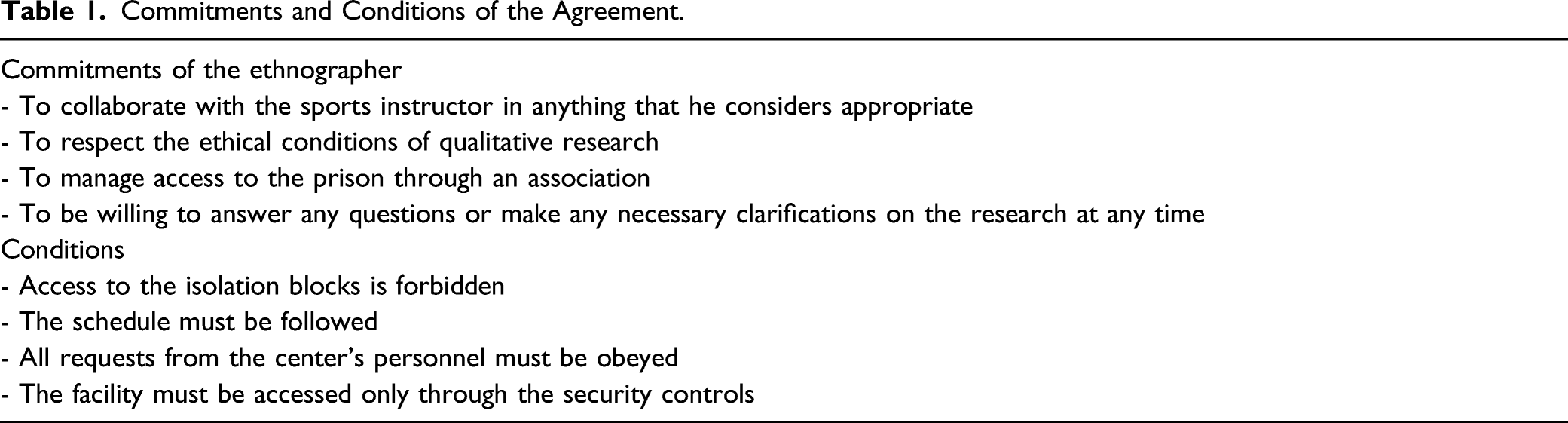
Commitments and Conditions of the Agreement.
Non-Formal Negotiations: Searching for Rapport
Once we obtained the entry permit, it was evident that this access did not guarantee the cooperation of either inmates or personnel (Waldram, 1998). At this point, the second phase of role negotiation began with the various officials involved that were just as delicate as the formal negotiations or more so, with the purpose of achieving the necessary rapport to obtain good data (Castellano, 2007). If the first days of any ethnography are problematic (Hammersley & Atkinson, 1994), we must also admit that the first hours and days in a prison are certainly distressing. They are filled with uncertainty and ambiguity, given that the ethnographer is anxious not to make mistakes and to go unnoticed, while s/he feels the need to engage in constant negotiations (Ugelvik, 2012). Caution thus became an axiom and discretion became an obsession: Perhaps the most difficult moments are on the first days, when you know no-one and have to be there for hours and hours. You make the first contacts with caution with your eyes open (…) tact should be a part of the catalogue of needs of an ethnographer in prison. (Fieldnotes, 14-02-2001)
Equidistance
As part of the non-formal negotiations, Daniel tried to play a neutral role by maintaining equal relationships with the different groups in the prison. It was important to communicate with them but without identifying with or becoming part of any group. However, this ability to cross frontiers (Goetz & LeCompte, 1988) is not always easy. According to López-Aguado (2012; p. 186), who carried out an ethnography on gang life, “it is easy to find yourself caught between the two sides”, occupying “a contentious middle ground.” In other words, you “sometimes felt like trying to walk two moving tightropes at the same time” (Damsa & Ugelvik, 2017; p. 6). This means that equidistance is not only difficult but most of the time inadvisable.
Readers should know that a prison is not like anywhere else and social relationships are not like those in other contexts. The prison creates mistrust; inmates distrust both one another and the staff, who in turn keep their distance from the inmates and even educators and volunteers. All of this greatly affects the stay and attitude of the ethnographer in the field of study: After greeting the instructors, I am preparing to lift weights. No one says anything to me, but only stares at me occasionally. Aware that I am an outsider but not what my real intentions are keeps me apart from everybody else. I do not want to force things, given that mistrust is the first sensation to appear. Little by little, I will let them know that I am not spying on them, that I will not tell about anything, that they can act normally in front of me. (Fieldnotes, 13-02-2001)
Establishing rapport is a complex mission in a prison (Schmid & Jones, 1993), and just being around and sharing spaces and activities with different groups allowed us to achieve the necessary rapport to obtain good data. The problem is that personal involvement in an ethnography makes the goal of being neutral and equidistant a chimera (Marquart, 1986). The closer you get to one group, the further you move away from the other. Calculated impartiality is closer to a laboratory experiment than to ethnographic field work. The biases stemming from this must be considered in the results but rejecting the results outright would question the viability of the ethnography. Therefore, prudence and patience, at this point, became essential skills for Daniel in achieving an optimal position inside the prison environment.
However, at the opposite extreme, being too close to one of the groups, for example, the inmates, could restrict mobility inside the context (Hammersley & Atkinson, 1994), or can even lead to the suspension of the permission to investigate, as explained in Gibson-Light and Seim (2020). In the present study the field worker was much closer to the inmates than the prison staff, which caused a lot of distrust, especially among the guards. Once, when a guard identified me as an inmate he felt annoyed as in Rowe’s (2014) experience: Prison officer: Where are you going? Daniel: For a coffee. Prison officer: Which module are you from? Daniel: Uh, no, no, I’m a volunteer at the sports facility. Prison officer: Volunteer? Where is your ID card? Daniel: Mmmm… I have it right here. Prison officer: The card must be clearly visible on your chest; in your pocket it serves no purpose. Daniel: Ok, can I go then? Prison officer: Ok, go on, but this is not clear at all. And put on your ID card! (Fieldnotes, 10-10-2001)
Needless to say, the inmates attracted Daniel’s attention more intensely than the rest of the people in the prison for several reasons, some more obvious, such as the day-to-day coexistence and others more implicit such as his ideological convictions: Many male and an occasional female inmate have become my friends. Although this could entail a certain risk, for example when it comes to interpreting, for me it was unavoidable. It is inevitable that when you spend many hours with people, with whom you laugh, get bored, make jokes, become close, carry out interviews, and ask questions, they end up becoming more than mere informants. (Fieldnotes, 22-03-2002) The libertarian atmosphere in which I grew up ideologically viewed the prison as a repressive institution worthy of the most intense hatred. The role of prisons, always serving elitist policies, is none other than eliminating dissidence, hiding poverty, preserving the system. People who end up in the penitential networks were predestined to do so. (Fieldnotes, 14-10-2002)
Either by the simple empathy caused by coexistence or by ideological issues, feeling identified with one of the groups, in this case the prisoners, positioned Daniel closer to them and as we have seen before further away from the guards.
Alex, the Gatekeeper
If the best way to access a scenario is through one of its members (Fetterman, 1998), in our case, this person was the gatekeeper Alex, as mentioned above. The sports instructor was responsible for the sports facility and therefore a key element in the research. Without his consent, we could never have achieved our goal. At first, Alex was reluctant to open the doors for this study, given that he thought Daniel was going to take up his time in order to carry out different activities. However, in time his concerns disappeared. In the informal negotiations with him prior to attaining access, Daniel made an effort to sell him our proposal, as Woods (1998) recommends, based on two key arguments: (a) the study’s ability to find out what happens in the sports’ facility and to improve his professional activity; and (b) the assistance that a university graduate could provide, as Castellano (2007) described in his study of the criminal justice system. In any case and as commonly occurs in prison the negotiations with Alex did not end there and were extended to the day-to-day field work, as we will see further on.
A Volunteer Position/Condition
The literature on the different ways of getting permission to enter prisons describes a number of strategies, most of which try to avoid the well-known reluctance of these establishments to open their doors to research. We thus find studies carried out by workers (Alexander, 1988; Marquart, 1986), by a priest-researcher (Hicks, 2012), or in collaboration with inmates (Schmid & Jones, 1993). There are so many difficulties that studies have even been carried out by mail to collect data (Bosworth et al., 2005), interviewing females once they had been released from prison (Martínez-Merino et al., 2019), or through real hands-on exercises to substitute the participant-observation denied by the authorities (Norman, 2018).
In our case, we had to offer to become a volunteer to gain access, the same thing that happened to Gibson-Light & Seim (2020), which had its advantages and disadvantages. On the negative side, as mentioned above, was the collaboration with the NGO’s external activities which involved extra work and being available to help Alex as the only way to do research in the prison. On the other hand, being a volunteer justified Daniel’s presence in the first months of field work. In addition, many volunteers enter the prison daily and their presence is undoubtedly welcomed by the inmates.
The field worker situation as a volunteer entailed a significant advantage related to the status of this position. A prison is a strictly disciplined environment in which all activities are closely scrutinized (Waldram, 2009). In this context, where sanctions are given daily, the fact that a volunteer cannot sanction an inmate considerably reduces the distance between them, so that once the inmates realized that Daniel could participate in many activities without sanctioning them, their attitude towards him improved significantly.
During the field work, we avoided telling the authorities on inmates involved in illegal behavior such as fighting or drug use. The ethnographer cannot and should not use his/her research to tell on inmates; she/he merely points out that such rules are being broken but without personalizing. Not telling on anyone is an important part of the inmates’ code, which, according to Trammell (2012) they obey and make others obey.
The guarantee of anonymity is not only a commitment in the interviews. The protection of sources is imperative and continuous and is obviously necessary if one wants to continue investigating, guarantee new studies and even ensure one’s personal well-being. Williams et al. (1992) refer to the possibility of an ethnography becoming a dangerous experience in certain places. It goes without saying that in prison all the elements are present, as we pointed out in another paper (Martos-García & Devís-Devís, 2015). If Daniel had told on the inmates he would have endangered not only the investigation and any future studies and more than likely his physical safety as well.
One of the most beneficial aspects of a field worker distancing himself from the authorities was the decision not to wear the distinctive orange ID that identified Daniel as a volunteer. Inside the sports facility he kept his identification in his pocket as if he were another prisoner. The literature contains many cases in which this same decision was made (Waldram, 1998) as well as other cases in which the norm was followed (Castellano, 2007; Rowe, 2014; Ugelvik, 2012).
Remuneration
Compensation is a common practice in ethnographic studies (Fetterman, 1998; Hammersley & Atkinson, 1994) to the extent that Wolcott (2005) talks about the art of giving and receiving presents. In the specific context of a prison, the payments are not only varied and indispensable but may even be risky and put the researcher’s ethical principles to test. For example, Jacobs (1974) was asked to send letters, bring in joints or leak news to the press, while Marquart (1986) made arrangements for new cells, uniforms, or medical appointments. The prisoners always have many needs and so it is not surprising that the demands are continuous (Waldram, 1998). In our case the initial stage of mistrust was followed by another stage of close relationship, especially with the prisoners known as destinos, “those who assist in the sports hall with the equipment and keep it clean” (Martos-García et al., 2009a; p. 80). The demands for compensation were increasing to unsuspected limits: I take in Rafa’s order, a box of vitamins… This morning I look more like Santa Claus than a volunteer. (Fieldnotes, 11-04-2001). I deliver the Scotch tape to the person who asked for it and he thanks me. Someone else asks for gum. In a short amount of time, I can become their mail service with the street. (Fieldnotes, 19-11-2001).
The decision to endanger the study’s continuity by bringing products into prison seems risky, especially considering the nature of some of the orders. For example, it was forbidden to bring in chewing gum although it was commonly delivered. On another occasion, as explained in the following note, the risk was extreme: Today I did one of those things that lead to deep reflection. I brought in a jar of sugar, only half full… The contradiction comes from entering with a cocaine-like substance and if I get caught a prison worker could be extremely annoyed. But these orders further strengthen my friendship with those who I want to research… (Fieldnotes, 19-04-2001).
The ethnographer often finds him/herself facing this type of dilemma. For instance, Daniel often wondered what would happen if he did not agree to the demands. It could mean never earning the inmates’ trust, whereas by satisfying their demands he took the risk of being caught and possibly being denied permission to return. Satisfying the inmates’ demands undoubtedly strengthens the relationship with them and breaking the rules in this way gives the idea of being external to the prison and so increases their trust (Waldram, 1998). However, it is advisable to establish some limits and find a balance between risk and the search for good rapport, a balance that is difficult to maintain (López-Aguado, 2012). Throughout our ethnography, for example, Daniel agreed to bring in an endless number of products, but never drugs or other elements such as weapons or syringes. In any case, again field work moves between the ambiguity of the method and the difficultly of decision-making in complex situations.
On the one hand, we adapt to the environment in some decisions, as Hammersley & Atkinson (1994) point out but on the other we coincide with Vanderstaay (2005) when he mentions the need to previously establish some ethical guidelines that should be obeyed regardless of the situation.
Participation
Despite entering the prison as an NGO volunteer and assisting the sports instructor, Daniel did not have any specific role assigned. As described in other investigations (Jacobs, 1974; Marquart, 1986), this circumstance produced some uncertainty but at the same time it gave him great mobility in the field. In this way the specific definition of the roles to adopt mainly depended on his decisions at any given moment.
In order to understand this mobility, Wolcott (1973) alluded to a continuum in which the extremes were occupied by the roles of “complete observer” and “complete participant.” In this ethnography, Daniel never adopted extreme roles in the continuum, but intermediate positions, that is, a participant as observer and an observer as a participant. The following quotes exemplify this: I spent the next period simultaneously observing Rita’s class and Vicente’s Full-Contact class. My butt is freezing and I do not talk to anyone. Just like to go home. (Fieldnotes, 05-02-01) I avoid playing the final game with the excuse that I am no good at it but with the idea of saving my legs and avoiding confrontation due to possible violent play. In any case I will keep training with them in order to get to be one of them. (Fieldnotes, 06-10-2001)
The first days of the field work were limited to the distant observation of the inmates, trying to understand the dynamics of the scenario, their social relationships and Daniel’s own mobility possibilities. This situation could be understood as “distancing” (Castellano, 2007), given that it consisted of refraining from any activity. If this strategy aims to reduce subjectivity, in my case it was due to a great extent to the need to proceed with caution in a hostile and unknown environment. However, contrary to what Hammersley & Atkinson (1994) point out, abusing this role, known as the “fly on the wall” method, made Daniel run the risk of appearing to be a vigilante in the sports facility. Sitting on the bleachers by the central field alone and taking notes, Daniel could only seem to be a clear threat and provoke a logical rejection. As Wolcott (2005; p. 81) explains, it is a mistake to expect that “simply being there will enable them to observe or experience what they are interested in observing and experiencing.”
Daniel took on a more active role due to the need to relate to the inmates and combat the boredom, as also occurs with inmates. In fact, this is one of the main concerns inside the prison (Schmid & Jones, 1993) and often ends up justifying the inmates’ participation in activities (Goifman, 2002; Martos-García et al., 2009a). Thus, the “anchoring” phase started, “defined as deepening involvement in participant activities to gain acceptance into member culture” (Castellano, 2007; p. 707). In this regard, prison researchers admit to having played soccer and watched television with the inmates (Goifman, 2002), or playing pool and having coffee (Ugelvik, 2012), lifting weights and boxing (Marquart, 1986) or eating with them in the prison dining room (Waldram, 1998). All of these strategies respond to a relationship of increasing trust, which is logical in any social setting but in a prison makes it possible to reduce the strong initial suspicion. In our study, Daniel not only participated in the sports activities that he organized and the ones the sports instructor asked him to participate in as compensation but also shared numerous moments and experiences with the inmates, especially with the destinos. This allowed him to break the ice and speed up his integration into the group, as others have also pointed out (Buchanan, 2001). Daniel lifted weights, played basketball, indoor soccer, fronton, squash and even Parcheesi: When Rafa arrives, he challenges me to a squash match. Rapport compels me to accept the challenge and, after changing, we played three or four matches. (Fieldnotes, 16-02-2001). After playing squash, more boredom, so when Laura asks me to play basketball, I accept even though I’m tired. (Fieldnotes, 23-10-2001).
Apart from the sports practice, one of Daniel’s favorite activities in prison was conversation, as Jacobs (1974) explains. He talked about anything, the weather, the sentences, about drugs and escaping, adventures and fights, or about the future, soccer, or sex. Any topic is useful to pass the time: Prison is terribly boring. This boredom even affects the instructors and volunteers. I get bored with just talking and talking. (Fieldnotes, 23-10-2001). The alternative is to talk, and so we do this, the ‘prisoners’ and me in the office. The conversation touches on many topics. I feel integrated and they already treat me like one of them, without hiding a lot of things. (Fieldnotes, 20-02-2001).
To sum up, participation helps to further strengthen a field worker’s relationships with the inmates, as revealed in the last quote. This closeness, especially with the destinos, is interesting in prison because feelings and emotions are hidden or limited. However, the longer they are together, the more ethical dilemmas appear (Vanderstaay, 2005).
The good relationship stemming from this coexistence meant that Daniel witnessed some situations that were clearly illegal. In these cases he avoided participating, as Castellano (2007; p. 714) also did, “as a strategy for declining to participate in certain tasks when the researcher has little or no forewarning to preempt the offer.” As we have already said, although showing mutual trust (Jacobs, 1974) this challenged the investigation’s ethical principles.
Being a witness to sexual relationships in the locker room or between the theater seats, drug or alcohol use, or various acts of violence presents the researcher with a dilemma. Should he report it to the guards? In all these cases, the decision was always the same: he never revealed anything. This is not the researcher’s function but that of the guards. Nor did he censure the repeated sexist or racist statements that emerged in the conversations: During the conversation, Alex makes three or four clearly derogatory comments about Muslims, without showing any signs of joking. Simply, I believe he says what he thinks, exhibiting a racist attitude. This can be a serious problem due to my need to write it down [in my diary] and keep quiet although my blood was boiling. This is the task of an ethnographer, taking notes but not judging. But how can I remain silent when faced with so much stupidity? (Fieldnotes, 08-04-01)
Likewise, Daniel did not judge the beliefs and erroneous practices related to the physical activities, mainly in body building or planning the training schedule. In this case, he almost always behaved like a novice, playing the role of an incompetent or ignorant “interested person,” despite being a graduate in physical education, as other authors have pointed out in similar contexts (Hammersley & Atkinson, 1994; Lofland, 1971). The literature makes continuous recommendations to avoid revealing or judging (Fetterman, 1998; Hammersley & Atkinson, 1994), even in research carried out in prison (Marquart, 1986; Ugelvik, 2012). Although the ethnographer can feel indecisive, revealing behaviors observed and judging comments heard thanks to the trust gained would ruin this relationship (López-Aguado, 2012).
Researcher-Officials Negotiation
The Relationship With the Sports Instructor
We have already mentioned that Alex initially resented a researcher being there but finally accepted our presence. This initial ambivalence was present all through the field study in such a way that Alex oscillated between being close to and distant from Daniel. The distance contributed to differentiating between the educator and Daniel, whereas a certain closeness provided him with some benefits. We should not forget that many of the contacts, especially those with prison workers, were made through him: Around 10 o’clock when Alex appears, he asks me for help with the June outdoor pursuit. I say yes and note a significant change of attitude towards me as if I had passed a trust test. (Fieldnotes, 09-04-2001).
Following Fetterman’s (1998) recommendations, Daniel was honest with Alex about the research aims, although we established many aspects as the study went on, in what we could call a “consent process” (Sparkes & Smith, 2014; p. 214). We must admit that Daniel did not explain everything at any one moment and there were certain aspects that he never mentioned. On the one hand, there is information that we do not have at a certain time (Murphy & Dingwall, 2011), but there are also data that must be kept confidential (Marquart, 1986; Sivakumar, 2018). Thus, for example, close to the end of the study Alex asked Daniel about the inmates’ opinions of him, given that in his words he had been able to connect with them (Martos-García, 2005). Although with the minimum information to satisfy his request, Daniel omitted some details and above all identities.
In Alex’s favor, we must point out that he provided Daniel with various prison documents and consented to being interviewed on six occasions and information from several conversations being written down throughout the ethnography. We thus obtained valuable information about his experiences, contextual resources, and the micropolitical strategies that Alex used in his workplace (for more information, see Devís-Devís et al., 2010). However, the ethnography was also useful to him, as he recognized when he agreed to participate in this investigation: Why did I accept? First, because I could benefit from it. I think I can draw important and interesting conclusions from the investigation. Second, because it involves another person working, also for his own benefit, but at least working for the center. And finally, for the conclusions to vary my orientation a little in the way I do this job. (Interview, 01-04-2003).
The Prison Workers
Most of the workers in Spanish prisons are guards, who, as their name implies, are mainly in charge of opening and closing the doors, counting the inmates and ensuring safety. However, the smallest group is composed of educators, whose function is to monitor the inmates and organize educational activities. Although both groups are traditionally reluctant to collaborate with any investigations carried out in prison, the guards’ attitude to the study activities was much less cooperative than the educators. However, it should be said that the relationship between these two groups is not good. Without being too simplistic, and as we reported earlier (Martos-Garcia et al., 2009a; 2009b), the guards’ predominant interest is security, whereas the educators are more interested in the prisoners’ resocialization and this often causes conflicts between the two groups.
During the field work Daniel’s relationship was more intense with the inmates, trying to give more attention to “the ones below” (Murphy & Dingwall, 2011). However, for the sake of completing the study he also interviewed people from the group of workers, in each case choosing personnel representing all the subgroups: vigilance, educators, and psychologists. At times, the people who worked in the sports facility were prioritized, with whom in time Daniel came to have a closer relationship. As Sivakumar (2018) explains, he naturally established a cordial relationship with some of the people who work in the jail every day. Despite the fact that many people enter the prison every day, the different shifts, and the fact that I do not go there every day, there are people who recognize me immediately. Both at the entrance and in the sports’ facility there are people that I can already say that I know. (Fieldnotes, 25-02-2001).
Daniel kept his distance from and at times not very cordial relationship with some of those in this group, and so encountered overzealous officiousness at the gate, as Gibson-Light and Seim (2020) pointed out. Sometimes he had problems with the distinctive orange ID and the lack of definition of his role. For most of the guards, he was simply a volunteer and therefore they were not aware of his role as an ethnographer, as Castellano (2007) also reported. This somewhat limited the benefits of overt research, as described among others by Sparkes and Smith (2014) as better access to spaces and people. However, these problems did not interfere much with the investigation.
Interviews and Field Notes: Change of Role
The negotiations for gaining access to people last throughout the investigation and are again fundamental in starting the interview phase. One of the main activities of an ethnographer is to interview people, although in prison we must consider several specific determining factors (Schlosser, 2008).
In the first months at the sports facility, Daniel was covered by his label as a volunteer. In fact, in the beginning, he avoided taking notes in front of the inmates, just as Ugelvik (2012) did. He took notes discreetly or memorized and reconstructed them later, as Marquart (1986) said he did. Everything was based on a covert research strategy, so that only some people knew that he was a researcher. The intention was to reduce the reactivity that a declared investigation can produce (Sparkes & Smith, 2014), especially in the inmates. But this argument started to crumble as the days went by:
After the disastrous class, I tell Donald that if I were paid for this job, it would be the job of the century. He does not believe that I do not get paid, that I do it for free. (Fieldnotes, 18-02-2001)
Therefore, after participating in several activities to “create a level of collective trust and experiential camaraderie essential to intensive interviewing…” (Ferrell, 1998; p. 32), Daniel started to reveal his research intentions. Having waited some months before disclosing this information allowed him to calmly decide what he wanted to ask and how to do so, as Wolcott (2005) recommends. This aspect was essential, given the prison’s opaque nature and the strong inductive orientation of the research. The covert role thus gradually gave way to an almost completely overt role, with its resulting advantages such as “being able to move about, observe, and ask questions” without restrictions (Lofland, 1971; p. 95). In this regard, during the months of coexistence his relationship with the inmates was such that the so-called reactivity had disappeared: I observe that now no one is surprised that I am there researching, although they do not understand how I can go there without being paid. (Fieldnotes, 18-03-2002)
The interview process started with the inmates, with whom relations were best. An appointment was arranged with each and every inmate, but not without first explaining the aim of the research and the interview itself. In all cases the ethical commitments were clear. In no case was written informed consent requested, due to the negative reaction it produced (Sivakumar, 2018), and so they gave their consent verbally. Daniel carried out the semi-structured interviews in the prison facilities by himself. Additionally, as Marquart (1986) points out, he could not use a tape recorder, due to their being strictly prohibited in the prison. He immediately transcribed the interviews, as Wolcott (2005) recommends, and he gave them to the interviewees for their correction or approval, as did Waldram (1998). This feedback made a lot of sense in our case because data were collected manually. Without exception, Daniel’s perception was that the inmates felt free and comfortable with all the topics addressed and they answered openly. However, in prison, sincerity is complicated, as he reflected on at the time: When we were walking towards the module, he [Alex] tells me that I should consider that in the interviews I held the inmates could have taken me for a ride and told me stories. I explained to him that I already knew this but that detecting lies and interpreting why they are being told is my job (Fieldnotes, 17-12-2001).
On many occasions, the interviews lasted a considerable time, which suggests that the inmates felt comfortable (Wolcott, 2005) and the conversations became a sort of therapy (Sparkes & Smith, 2014).
The inmates’ interviews took place without any serious problems. Regarding the workers, Daniel accessed them either with Alex’s help or due to his personal relationship with them during the field work. In these cases, informed consent was not signed nor was a tape recorder used, except in the interviews with Alex, in which we used a recording device because they took place outside the prison (Devís-Devís et al., 2010).
Final Comments
This paper examines and reflects on the difficulties in negotiating access and the emotional costs and ethical dilemmas the main researcher encountered during an ethnographic process in a prison several years before. For some authors the reflection on the research process is a key strategy for avoiding methodological problems or biases in the use of personal documents and qualitative data sources (see Galdas, 2017). However, it is also an ethical resource for transparency, a form of self-criticism or reflexivity and helps readers to judge and strengthen qualitative research (Lincoln, 1990; Ortlipp, 2008). Reflections of this kind give authors and readers better awareness on different aspects of the ethnographic process that enhance qualitative inquiry and future research (Ravindran et al., 2020).
In the context of prison studies, these reflections are even more important due to the opacity of these institutions and the unclear rules available in the specialized literature. Although reading previous literature on a topic seems to be an interesting way to approach any study, its usefulness is often limited (Wolcott, 2005). From our point of view the information found in various qualitative research manuals and especially in ethnographic studies, is a good start, at least in our case. A second and indispensable step in these preparations is the search for and detailed reading of specific studies more closely related to our investigation, as Sivakumar (2018) recommends. As the ethical dilemmas that any ethnographer must face are many and challenging this is a good way to begin with guarantees (Vanderstaay, 2005). Faced with the impossibility of creating “universal procedural guidelines” (Abbott et al., 2018; p. 8) previous studies on prison research can help in anticipating the feelings that a context such as prison produces (Jewkes, 2012).
However, the manuals and some articles are of limited use since many ethnographic skills are not picked up from books and learned in seminars. Ethnography involves non-mechanical or technical procedures on the engagement of the researcher in the field under study, but also a commitment for providing meaning, a suspension of preconceptions, and a focus for discovery (Ball, 1989; Lüders, 2004). In addition to these issues, research in prison involves many challenges and often endangers our decision-making ability and ethics during the investigation process. The prison and its conditions make us continuously confront our own values, so that even though it is worthwhile to be loyal to some basic principles (Vanderstaay, 2005) there is a need to make on-the-spot decisions, sometimes based on pure intuition. Paraphrasing Ball (1989), Lüders (2004; p. 227) points out: Not only do researchers have to go into unknown territory, they must go unarmed. No questionnaires, interview schedules, or observation protocols must stand between them and the cold winds of the raw real. They stand alone with their individual selves. They are the primary research tool; they must find, identify and collect the data.
Following Damsa & Ugelvik (2017), beyond reporting substantial findings it is necessary to explain the uncertainties, dilemmas, decisions, and processes in studies of this type to pave the way for new ethnographic studies in special contexts such as prisons. As in this paper, a confessional tale makes it possible for these issues to emerge since it helps the researcher bring personal and emotional issues to the forefront that would remain hidden in a realistic way of writing (Van Maanen, 1988). Drawing on the tensions in fieldwork in prison, we offer future researchers a way to manage these issues.
In a delayed analysis of the ethnography several years after the field work it is possible to discover new information, as Rowe (2014) has suggested. We made a new in-depth analysis of issues; we briefly advanced in a previous paper (Martos-García & Devís-Devís, 2017), including: (i) the field worker’s ideological commitment and how it affects his relationships with the different participants; (ii) the emotional implications of equidistance; or (iii) the problems of becoming an insider with the guards’ consent. Following Macbeth (2010), it represents a new process of reflexivity to assess this type of on-the-spot “small decisions” that shed new light on the fieldwork. In other words, looking back some years later, we were able to better evaluate the consequences of our decisions and the difficulties we overcame during the study. As Crewe (2014) suggests, looking back at our work allows us to engage in a new deferred process of reflexivity beyond the assessment of an ethnographic project (Richardson, 2000). This process establishes an authentic interrelationship with our own research (Tracy, 2010) since we find a large number of details, decisions, contradictions, and feelings hidden in the traditional way of writing. We try to be transparent by sharing our personal data and after reflection produce some conclusions to improve future research and help other researchers. A confessional tale shows our inquiry and we ourselves undressed in front of the audience to be scrutinized as part of our ethical requirements as researchers.
At this point, it seems relevant to highlight that we did not try to fool anyone, not only to seem credible and non-threatening but also to guarantee future research and even show ourselves as we really are. During all the field work, we tried to avoid harming any of the people involved and respected their privacy. In this regard, the rapport established created friendships with continuous mutual benefits.
Due to all the above we were able to coexist with prisoners and prison workers for more than 2 years. As in previous studies (Gibson-Light & Seim, 2020; Rhodes, 2001; Sivakumar, 2018), the penitentiary laws that limit access to prisons did not prevent us from carrying out the research. Although prisons are secure enclosures designed to confine people, ethnographic sincerity and commitment to the investigation are important keys that open many doors.
This study provides evidence of how far one can go with tenacity and sincere intentions. For us, it was a pleasure to discover that there are real people behind each case who are hidden by their sentences, most of whom are in some degree of distress. To some extent, they are victims of our lack of understanding and neglect, aspects that are not reflected in any penal code. Their controversial existence has weak points through which we can penetrate into a subculture just as closed and unknown as the penitentiary.
Due to its flexibility and ethics, ethnographic research is called upon to shed light on our prisons, their inhabitants and coexistence inside their thick walls. The slow process of opening their doors should not make us give up our aim of investigating and interpreting all and every social space.
Footnotes
Declaration of conflicting interests
The author(s) declared no potential conflicts of interest with respect to the research, authorship, and/or publication of this article.
Funding
The author(s) received no financial support for the research, authorship, and/or publication of this article.
