




Abstract
Interpretative phenomenological analysis (IPA) first appeared in publication in 1996 but was introduced as a comprehensive methodology in a first published book in 2009 by Smith, Flowers and Larkin. Since its publication, IPA has seen tremendous application in psychology and cognate social science disciplines. Most IPA studies have used interviews as their primary data collection tool. This is not surprising as semi-structured interviews fit the theoretical foundations of IPA and the authors of the IPA book themselves dedicated a chapter to interviewing. However, the authors have also lamented the lack of the use of diaries in the methodology. Yet, there are scarce IPA studies (or even phenomenological studies in general) using diaries as data collection tool. This is surprising as diaries are amenable with some core elements of phenomenology which IPA ascribes to. The inadequate use of diaries within IPA may be due to the lack of practical insights into what diaries could look like, how they can be obtained or whether they can fit with phenomenology. In this article, I reflect on how diaries can be administered and what kind of information can be accessed as part of a study involving children whose parents have mental illness. The article shows that diaries have strong connections with the theoretical foundations of IPA. Also, because diaries offer adequate time and space for participants to reflect on their lifeworld, it enables participants to talk in-depth about experiences of significance to them. The article can provide lessons for researchers hoping to employ diaries in their IPA studies or other phenomenological approaches.
Keywords
Introduction
Interpretative Phenomenological Analysis (IPA) was developed in the UK by Jonathan Smith in the 1990s, first appearing in publication in Psychology & Health (Smith, 1996). The original intent of IPA was for use in qualitative health psychology. However, there has been a proliferation in the use of IPA in many disciplines besides psychology. For example, it has been used to study volunteering among university students (MacNeela & Gannon, 2014), social support among athletes (Brown et al., 2018) and older adults’ functional limitations (Awuviry-Newton et al., 2020). Thus, IPA seems to have gained traction among qualitative researchers, particularly those interested in phenomenology. Within the available research employing IPA, it is common to find that most of such studies use semi-structured one-to-one interviews to collect data (Smith, 2011). This is not surprising as the first book with comprehensive guide to IPA titled Interpretative Phenomenological Analysis: Theory, Method and Research (Smith et al., 2009) has a chapter dedicated to interviewing. Undoubtedly, interviews can be easily managed, allowing to build suitable rapport with participants and give them space to think and be heard. This is key to the personal nature underlying IPA. Like interviews, diaries can offer potential to have access to in-depth information about a phenomenon. Unfortunately, while Smith et al. (2009) have lamented the limited use of diaries in IPA studies, its use remains scarce.
As part of a study where I used IPA with children whose parents have mental illness, I show how diaries can provide important data. Before showing how I administered the diaries and what data can be attained through its use, I provide some descriptions on the use of diaries as a qualitative method. Further, theoretical foundations are key to the use of IPA due to its connection to phenomenological philosophy. Therefore, I discuss how diaries align with the theories of IPA which is essential to state as justifications when adopting it as a data collection method. There are limitations, though, from a philosophical point of view when considering how phenomenological philosophy aligns with qualitative methods like diaries. This is briefly considered. Ultimately, the goal of this paper is to enable readers appreciate what diaries have to offer within a phenomenological framework.
Diaries as Qualitative Method
According to Alaszewski (2006; p. 1), a diary is ‘a document created by an individual who has maintained a regular, personal and contemporaneous record’. It follows then that a diary contains regular and dated sequence of events with fixed times used for entries. They are kept by an identified individual who controls what information are put in the document. Diaries can either be solicited or unsolicited (Alaszewski, 2006; Morrison, 2012). Unsolicited diaries are readily available with the relevant information that the researcher requires for their study. With these, the researcher has no control over how the diaries are created. Such diaries may already be in the possession of the diarists or their family and friends. For example, there are people who keep records of daily activities or major events. Unsolicited diaries can also be historical documents stored in the form of archives. These are already existing data that the researcher needs to find.
On the other hand, with solicited diaries, the researcher has control over what information is kept in the diary. Often, the researcher designs the diaries based on the purpose of their study and expects participants to complete the diary within the remit of the research aims. Solicited diaries are more common within qualitative research (Jones, 2000; Morrison, 2012). The focus of this paper is on solicited diaries. Thus, while I do use the term diaries throughout the paper, I am describing solicited diaries. The fundamentals of diaries such as their openness, depth of information collected, ability to recall experience of significance as well as the accuracy of information provided (Alaszewski, 2006) are not to be compromised. Researchers are encouraged to offer some guidance for the completion of diaries with a focus on the issue that is being researched. Guidance can be given on, for example, when diaries should be completed, what the researcher would like participants to write about, explaining in simple terms what the diary is about and providing an outline page (Morrell-Scott, 2018). For instance, the researcher can ask participants to focus on their interactions with others, daily experiences, past events or emotions. Undoubtedly, this may suggest some form of intrusion in the design of solicited diaries (Filep et al., 2018; Plummer, 2001). Yet, they can facilitate the provision of intimate descriptions of people’s everyday life (Polit & Beck, 2009). It is more so when a particular study, as often in phenomenology, wants to get at the essence of a phenomenon.
When dealing with sensitive topics, some participants may not be forthcoming during personal interviews. This may impact the quality of data that is collected. Diaries can be helpful in such situations as it gives participants enough space to think about what to write without feeling pressured to provide on-the-spot responses. Further, participants have sufficient time to recall past events as closely as possible (Alaszewski, 2006; Morrell-Scott, 2018). With diaries, researchers can ask participants to document continuous and evolving experiences that shape their views about a particular phenomenon. However, it is not a given that diaries provide richer insights into participant’s perspectives. There are many practical considerations that can impact the quality of information provided in a diary. Younger children, people with cognitive limitations, time constraints on the part of researcher and participant and inability to follow-up on the diary are only few of those circumstances that can impede the depth of information collected through diaries. However, with adequate thought to its design and planning, diaries can stand alone as a main data collection method or as supplement to interviews. Generally, the use of other methods like interviews and observations demand a considerable amount of time, energy and other resources from the researcher. In addition, because of their intrusive nature, participants can change the behaviour that is being observed and potentially compromise the research process (Alaszewski, 2006). While no data collection method is essentially powerful than the other, diaries are relatively under-utilised. This is surprising as diaries are less likely to involve significant labour as interviews and equally possible of providing useful insights into a particular phenomenon. Just like in interviews, it is important to inform participants that their diary will be anonymous and no identifying information will be presented.
To acquire detailed data from participants, diaries are better left unthemed with blank pages for participants to write freely. Untheming a diary essentially means leaving each page blank for the participant to write. This enables participants to provide real and personal accounts. The researcher can provide guidance for completing the diary so that participants are clear about what to tell. In the study involving children whose parents have mental illness, I asked participants to describe their daily life activities or experiences. Some further guidelines were given such that the children can focus on events at home, school setting and interactions with professionals. While these may serve as a frame of reference guiding the children, they have to choose the particular experience or perspective for their diary. Essentially, daily writing activities are not themed but left to the participant’s imagination. When left without themes, participants can focus on their own personal accounts without being constantly guided by the researcher.
Entries into the diary are made at a time close enough to the events being recorded to ensure that problems related to recall are minimal. The entries contain what the diarist considers significant and can include a range of events related to a particular topic of importance. Much qualitative research emphasise giving opportunity for participants to present their own experiences or perceptions about a topic without much control from the researcher. A key feature that characterises diaries is that the data is collected in a less intrusive manner (Bedwell et al., 2012). This allows participants the time and space to adequately reflect on their experiences, something that may be difficult to do in traditional interviews. It is not surprising that the ability to reflect on experiences and events have been commonly reported among participants who completed diaries as one of its important features (Bedwell et al., 2012; Nielsen & Angel, 2016). In connection with this, diaries can help deal with memory problems as there is enough time and room for participants to engage in recalling their experiences (Alaszewski, 2006).
Aligning Diaries with the Theoretical Foundations of IPA
The theoretical basis of IPA is founded in phenomenological philosophy, relying on the works of Edmund Husserl, Martin Heidegger, Maurice Merleau-Ponty and Jean-Paul Sartre. Phenomenology centres on first-person accounts of phenomena. First-person accounts are readily accessible through diaries although these are analysed from a second-person’s (researcher) point of view. Husserl (2000) said that we should go back to the things themselves. Diaries are a way to let experience show itself without the predilections that may be introduced by the researcher. Especially for diaries that are completed immediately after the observed phenomenon, it offers important insights into the basic structures of such phenomenon. Smith et al. (2009) argue, ‘our predilection for order can mean that we can too quickly look to fit “things” within our pre-existing categorisation system’. With diaries, participants have the opportunity to create their own stories or lived experiences based on their daily life events (Cao & Henderson, 2020), but they are not free from predilections. The participant is already a living being who is part of and being influenced by the world (see paragraph on Dasein). So, diaries ultimately reflect the assumptions of participants who further make choices about what to write or not write. Practically, in interviews, we see the researcher (with their own assumptions) constantly asking questions of participants (with their own assumptions of the world too). In this scenario, there is a potential for a ‘double bias’ from the researcher and participant’s point of view. With diaries, this ‘double bias’ can be reduced because the researcher is not constantly asking questions of the participants. Essentially, predilections or biases can never be avoided in either interviews or diaries but they can be managed.
Another concept of phenomenology that works well with diaries is intentionality. Husserl (2000) states that intentionality is consciousness of something. If we remember, see, hear, our remembering, seeing and hearing is always of something. Intentionality is perspectival in that we always think of something in a particular way (Zahavi, 2018). For instance, one might think of a pen as a tool used in writing, as a present from their parent or as a means of passing an exam. Zahavi (2018) goes on to add that apart from perceiving an object in a particular way, one may also judge it, remember it, imagine it. For example, one may consider the pen as causing them to fail their exams. Essentially, we are presented with the same kind of object but it shows itself to us differently. In research involving diaries, participants have considerable amount of time to present the different aspects of the phenomenon based on the particular circumstances they find themselves. Participants are not expected to provide on-the-spot responses to research questions, but have the time and space to allow the phenomenon to show itself in different ways. In my research with children with parents who have mental illness, I found that some of the children did not provide detailed responses to interview questions. However, when asked to complete the diaries, the same children told rich and detailed stories that might not have been accessible in the interviews. As diaries provide participants with enough time and space to reflect on their stories (Morrell-Scott, 2018), it may have given the children the opportunity to have better control of their own world. As a result of this, they are able to tell, in different ways, what they think about their parent’s mental illness. This is integral to Husserl’s intentionality as it clarifies the connection between experiential subjectivity and objects in the world (Zahavi, 2018).
IPA also draws on Heidegger’s theory about being in the world, what is referred to as Dasein. Dasein emphasises our throwness into a pre-existing world of culture, langue, relationships and people which we cannot detach from (Smith et al., 2009). The concept of relationships is key here because being is not just being with thyself but being with others (Heidegger, 1927/1962, 1927/2011). This is captured in the following elaboration: Dasein is essentially being-with…Even Dasein’s being alone is being with in the world. The other can be missing only in and for a being with. Being alone is a deficient mode of being with; its very possibility is the proof of this (Heidegger, 1927/1962, pp. 156-157).
The phenomenological concept of intersubjectivity is one that is central here as it shows the overlapping, shared and relational nature of our engagement with the world (Mulhall, 2013). Our throwness into the world influences the way we think about and perceive objects or events around us. Because diaries are open, often left at the will of participants, it gives a better clarity and insight into the lifeworld of participants characterising their being in the world with others. Essentially, diaries portray the world of participants as beings related to and influenced by a set of relationships, culture and language. In my work with children whose parents have mental illness, I found that the children used common language, expressions and understandings to describe what it is like to live with a parent with mental illness. The shared understanding reflects the common world that the children experience. This connectedness is not only reflected in how or what they think but their connections with people in the family, at home, school, play settings, church and psychiatric units. The relationships at these different settings and with different people shaped the way they viewed and/or talked about parental mental illness. Thus, being-in-the-world also implies being-with-others which characterises engagement with the social world as a totality of being (Reuther, 2014).
Another major influence on IPA is idiography. Idiography is concerned with the particular against a nomothetic approach that seeks to make claims at group or population level (Larsen & Adu, 2021; Smith et al., 2009). Here, the focus is on detailed and in-depth analysis of a particular case. This explains why data analysis in IPA is done individually on each case. IPA seeks to find out how an experiential phenomenon is being understood from the perspective of particular people, in a specific context. This single case approach makes it possible to provide detailed accounts and analysis about how a phenomenon is being experienced by a particular person (Smith, 1996). Diaries typify an idiographic approach as it centres on the lived experience of a particular individual over a period of time. IPA’s focus on the particular makes it amenable with diaries as they offer deep insights into the participants’ view of their lifeworld. This is because as individuals reflect on past events, they are able to provide rich descriptions or insights into said events (Alaszewski, 2006). More so, because they are less intrusive, diaries offer unique insights to participants’ world from their own point of view. Smith et al. (2009) caution not to conflate focus on the particular with a focus on the individual. On one hand, experience is uniquely situated, perspectival, from the individual’s point of view. On the other hand, as learnt from Heidegger, there is a relational component implying that experience is shared.
The Study
The illustrative diary presented in this paper is part of my PhD research which is a phenomenological study investigating what it is like for children to have a parent with mental illness. Phenomenological questions posited as ‘what is it like to experience something?’ is a psychological research question influenced by Husserl’s transcendental phenomenology (Larsen & Adu, 2021). This also follows through an assessment made by van Manen (2017) which suggests that phenomenological research questions has a recurring theme of finding out what it is like to experience something. I used interviews and diaries as data collection strategies with children. For the purpose of this article, I reflect on how I collected data through diaries as part of my study. Children (10–17 years) in Ghana whose parents have mental illness participated in the study. The parents were receiving services from outpatient psychiatric units. Parental diagnosis included schizophrenia, depression, anxiety disorders and psychosis. After interviews with the children, they were asked if they were willing to complete a diary. Out of 30 children that were interviewed, 19 agreed to complete the diary. This article is based on work with the diary. The focus is not to analyse data from the diaries and report as findings as often seen in empirical research papers. However, the aim of this article is to show how the process of a diary method could be and what kind of information can be collected when using it as part of a phenomenological study. Ethical clearance for the study was received from the College Human Subjects Ethics Sub-Committee of City University of Hong Kong prior to the data collection. All children were financially compensated for spending time to complete the diary.
Structuring the Diary
Diary completion guideline.

The children were allowed to either write or draw in the diary based on what they felt comfortable with. Some children may be more comfortable drawing instead of writing. Whether they choose to draw or write may also depend on the story they want to tell. Drawing can provide a better or easier way to express thoughts, especially for younger children. Pages of the diary were dated to ensure that the children were recording recent information about their daily activities as well as impact of parental mental illness on their views about life. The children were advised not to enter the diary for a day that was different from the entry date. Therefore, for those whose entry dates were overdue, they were encouraged to leave the page blank. The diary was left unthemed, that is, except the front page, each page was left blank for the children to tell the stories in their own way. This is important to IPA as it allows participants enough room to reflect on their most significant life experiences (Smith et al., 2009). The diaries provided the children with sufficient time and space to reflect on their thoughts during the interviews, provide new or different perspectives, provide further clarifications on ideas presented in the interviews and elicit continuous or evolving information. I left the diary open for participants to take charge of the contents they entered. The diary was informed by the guiding question, what is it like to have a parent with mental illness? I also informed the children to enter into the diary additional information that they remember during the interviews. Within the 3-week period, I called the children once a week to hear their feedback about how the diary completion was going. It was also a way to remind them to complete the diary in case they had forgotten. At the end of the 3-week span, I went to the children’s homes to collect the diary and thanked them for their participation in the study.
The Children’s Diary
In this section, I report on some of the data that was gained from diaries completed by two participants; Rosemary, a 10 year old girl whose mother has schizophrenia and Christabel, a 17 year old girl whose mother has been diagnosed with psychosis. The names of the participants are not their real names but I asked them to choose a pseudonym that they would like to be identified with. Rosemary is a primary school student. She lives together with her mother, grandmother and a 3-year old sibling. Rosemary’s mother is separated with her partner and the two do not often interact. Her mother is engaged in a petty trading business with her grandmother; they both make pillows and sell to people in surrounding areas of their community. Her grandmother has been supportive of her mother and the children, especially as her mother becomes unable to provide care during symptomatic phases of her mental illness. Rosemary also supports the family by helping to cook, bathing her younger sister and going on errands for both her mother and grandmother.
Christabel is a high school senior. She is the youngest of four children in her family and lives in a single-parent family as her father passed away. As Christabel’s siblings are adults, they are often not at home because they are living independent lives. Because of this, the burden to care for their mother with psychosis usually falls on her. Consequently, she often finds herself in a position to balance her schoolwork and having to be there for her parent with mental illness.
A Snapshot Into Rosemary’s School Life: Not Impacted by Parental Mental Illness
Rosemary’s school activities do not seem to be impacted by her parent’s mental illness. This is because, often in her diary (see Figures 1 and 2), she does not reflect on how her parent’s mental illness interact with school. Rosemary has a consistent routine with school which she describes often in her diary. This generally covers her taking the bus to school and having some classes in history, ICT, English, Mathematics and History. This is followed by break times where she takes lunch at the school canteen and thereafter school closes and takes the bus back home. IPA allows participants to focus on significant moments in their life. For Rosemary, such moments involve her presence at school without necessarily thinking about the impact of parental mental illness or how her mother’s illness interferes with what she does at school. Daily school activities (Rosemary, 10 years). Daily school activities (Rosemary, 10 years).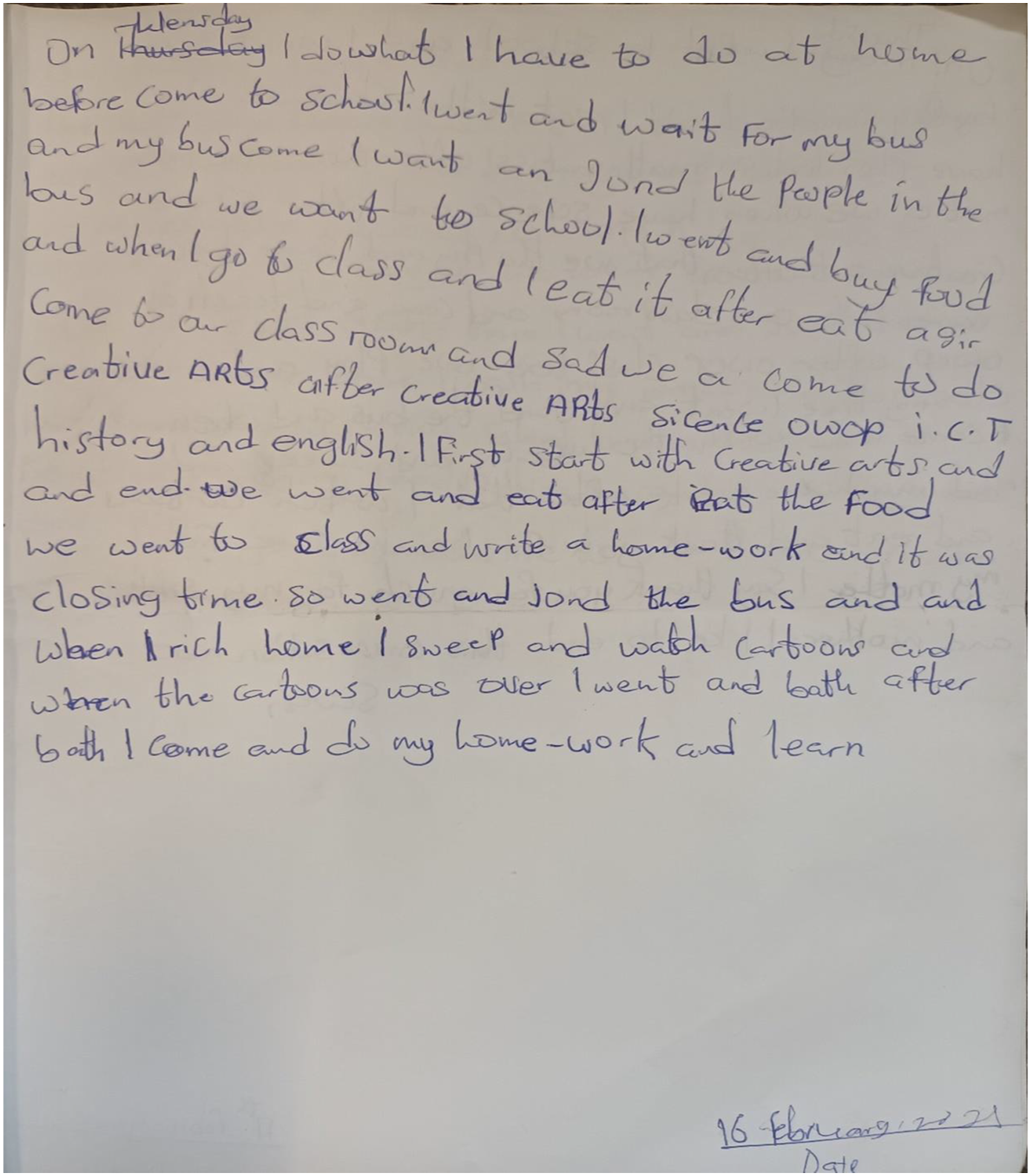

In Figure 3, it shows that Rosemary is generally happy about school as she writes ‘Mary is happy’ while waiting for the school bus. This underscores her positive view about life at school. In her diary, she talks less about her mother’s mental illness as her own focus has been about what happens at school and what she does back at home. View on school life (Rosemary, 10 years).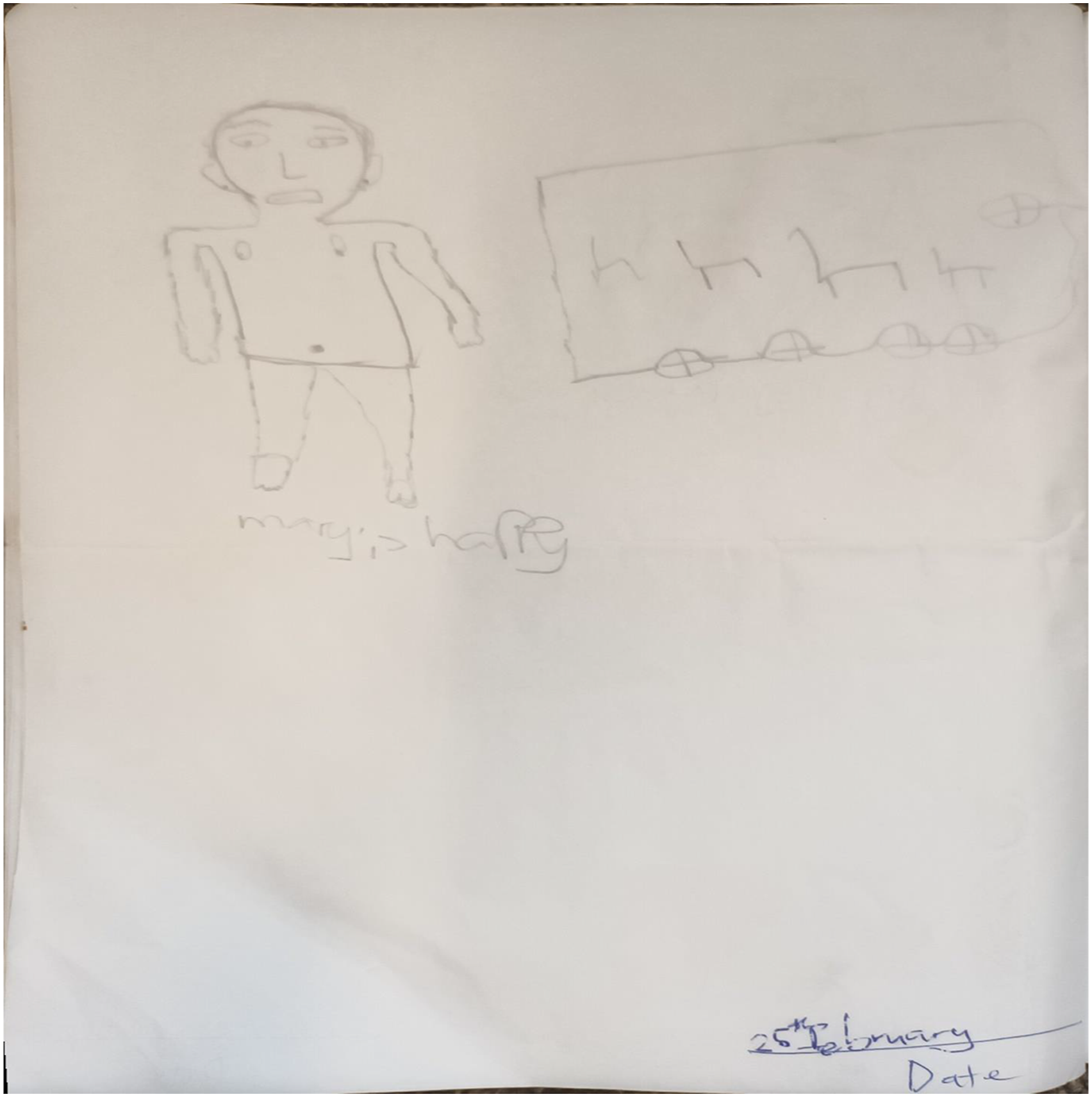
Christabel: Parental Mental Illness Impact on School Activities
A consistent theme that runs through Christabel’s diary is that she has to navigate between focussing on her studies at school and caring for her mother with psychosis. Among her siblings, Christabel is the one who regularly interacts with her mother because all her older siblings have left home to live independent lives. Because of this, she is often caught up in her mother’s dealings with mental illness. A significant part of living with parental mental illness for Christabel is how this interferes with schoolwork. Her reflections in the diary suggest that her mother’s mental illness has negative impact on her academic work. She often has to leave school early to return home and check on her mother. Other times all what she does at school is to think about her mother’s condition and how she might be feeling, not concentrating on what is being taught in class. Christabel’s writing in Figure 4 shows that she feels uncomfortable when she goes to school knowing very well that her mother might be symptomatic. She highlights that it is not always that her mother is in a symptomatic phase, indicating that she feels good during those times where her mother is well. Yet, she has to be there for her mother when her symptoms show because her mother is a ‘treasure’. The purpose of phenomenology is to get to the essence of a particular phenomenon (Dahlberg & Dahlberg, 2020; Dahlberg, 2006). For Christabel, what characterises this essence is how she treasures her mother. Hence, she will do her best to be there for her mother no matter the circumstance, even if it means missing school. Parental mental illness impact on schoolwork (Christabel, 17 years).
Christabel: Strain on Family Financial Resources
In the interviews I conducted with Christabel, she mentioned that her older siblings provide her with support by paying her school fees. This is important for Christabel as she lives in a single-parent family with the only parent living with mental illness who could not hold a regular job to gain stable income. However, the interview did not make it clear that their family experienced financial challenges due to their mother’s mental illness. It is possible that the time and space that the diary provided Christabel enabled her to better reflect on their family’s financial situation. In the diary, she mentions how her mother’s medical expenses caused financial strain on the family. This means that the money her older siblings provide for her school needs to be shared with their mother’s medical expenses. Figure 5 illustrates Christabel’s description of the financial crisis their family experience due to their mother’s mental illness. Strain on family finance (Christabel, 17 years).
Diaries provide insights into taking-for-granted activities (Alaszewski, 2006). A key task of phenomenology is to bring to light taken-for-grantedness (Smith et al., 2009; Zahavi, 2018). In so doing, we get closer to the thing itself. Relatedly, as Heidegger’s being-in-the-world suggests that Dasein has the tendency to cover things up (Larsen & Adu, 2021), a way to uncover things is to use diaries. It helps to unravel the true essence of a particular phenomenon. To clarify this, during the interview, Christabel did not talk about the financial strain on the family but only mentioned that her older siblings have been supporting with paying her school fees and her mother’s medical expenses. However, the use of the diaries further shows that there are financial difficulties within the family.
Some Limitations to Ponder
In this paper, I have shown how diaries connect with some phenomenological concepts from Husserl and Heidegger. This is important as phenomenological qualitative research needs to show some familiarity with phenomenological philosophy (Zahavi, 2019). However, there have been some arguments about the utility of phenomenological philosophy to applied research, most notably coming from Paley (2016). He argues that phenomenology as qualitative research should be conducted without engaging in its philosophy. Indeed phenomenological philosophy can be esoteric and unappealing to applied research. However, agreeing with Zahavi and Martiny (2019), Paley’s (2016) analysis seems to be limited to three qualitative approaches to phenomenology; Amedeo Giorgi’s Descriptive Phenomenological Method, Johnathan Smith’s Interpretative Phenomenological Analysis and Max van Manen’s Hermeneutical Phenomenology. These approaches do not represent the total movements in phenomenology. Engaging with these criticisms is beyond the scope of this paper, but phenomenological concepts like Dasein and intentionality are clearly relevant here and could serve as an important analytical framework. Whatever phenomenological approach researchers intend to adapt, it is important that they familiarise themselves with some basic philosophy and consider their applicability to their research method. Researchers should bear in mind that the aims of phenomenological philosophy and qualitative research are different (Giorgi, 2008), so there are bound to be challenges ahead of the road.
Also, features like openness, depth of information and flexibility have been used to characterise diaries (Alaszewski, 2006; Day & Thatcher, 2009). The reasoning here is that, when undertaking diaries, researchers give participants enough time and space to talk about their experience. There is enough space because the researcher gives participants the opportunity to choose what they want to talk about without being required to respond to direct questions from the researcher, as is common in interviews. But these are only assumptions that should be interpreted with caution. There are some participants who just might not have much to write. Researchers are expected to regularly remind participants to complete their diary. When the researcher forgets to remind or encourage participants throughout the diary period, it is possible that several pages in the diary will be left empty. Also, some participants may just feel that the task of completing the diary is daunting and might stop midway. These are some practical limitations that researchers should think about in designing diaries for their study.
Conclusion
Regardless of the limitations, diaries can offer important insights into a phenomenon. When working with participants who are not forthcoming in personal interviews, diaries can be an appropriate alternative. For instance, younger children may not be able to express themselves clearly in regular interviews. In my interview with Rosemary, the 10 year old girl, I realised she did not provide in-depth responses to her experience of what goes on at the school. But with the diary, she was able to provide a much detailed description of her daily activities at school. Rosemary was given 3 weeks to complete the diary and always entered something in the diary after she returned from school. She seems to have a lot to talk about with what goes on at school without focussing too much on her parent’s mental illness. It suggests that the school may be a significant space for her as she focuses most of her diary in that setting. The diary appears to be an important tool for participants to critically reflect on and talk about events, places, experiences or interactions of significance to them. Considering that IPA centres on collecting data around experiences of significance to participants (Smith et al., 2009), diaries are an important tool to achieve this.
In the example provided, the diary writing was undertaken after the interviews. This had to do with the study’s time limitation. Waiting on the diary before conducting the interviews would have taken some amount of time as each child had 3 weeks to complete the diary and the diary was not given on the same day to each participant. But diaries can also come before interviews to further inform questions to be asked. There may even be a stronger argument for collecting data being led by participants if diaries are to come before interviews. Whatever method comes first, researchers should make such considerations within the scope of their own study.
To conclude, data collected through diaries offer a useful approach to giving priority to participant’s voices. This is more so in the case where pages in the diary are left open without specific questions to guide the participant on what to write. It becomes an opportunity for the participant to focus on what matters to them most. It can be a good way to begin data collection before going onto interviews. The diaries can be used to guide interview questions knowing that they reflect the worldview of the participant, not necessarily that of the researcher. Diaries can also be used as a standalone method to adequately capture the worldview of participants.
Footnotes
Acknowledgments
I declare that this is my original work, I have the rights to it and it is not being considered for publication elsewhere. While the material for this article is based on my doctoral thesis at the City University of Hong Kong, the text is not a copy of the thesis. I thank my PhD supervisor, Dr. Marcus Chiu, for encouraging my ideas for methodological innovation. Thanks also goes to the children who made time to go through the arduous task of completing the diaries, even so for a child living with a parent with mental illness.
Declaration of Conflicting Interests
The author(s) declared no potential conflicts of interest with respect to the research, authorship, and/or publication of this article.
Funding
The author received no financial support for the research, authorship and/or publication of this article.
