




Abstract
Hermeneutic phenomenology (HP) as research method is increasingly used in health and social science studies to collect and analyze lived experiential descriptions (LEDs) of a phenomenon. However, currently there is little guidance in how to apply philosophical notions to interpret LEDs in HP studies and this approach has faced critique in how meaning is attributed. In this paper, we offer clarity about what “we do” in HP studies. It does not present a comparative analysis of qualitative approaches or claim to present an inflexible “how to” menu. The purpose is to provide guidance to those new to this methodology or/and for less experienced supervisors of postgraduate research students using this approach for the first time. The focus is specifically on conducting HP research and how philosophical notions are used to inform methodological decisions. Drawing upon data from our empirical projects we illuminate how meaning is surfaced, demonstrating a key feature of HP studies in the use of philosophical notions to uncover ontological significance. Consideration is also offered on how trustworthiness in HP studies can be achieved. The key contention is how the philosophical underpinnings of HP thinking, and the constant call to be reflexive, draws forth hitherto unspoken meaning that can inform new thinking and practice.
Introduction
Over the last 2 decades, there has been a rise in Heideggerian hermeneutic phenomenology (HP) being used as a research method in health and social care studies (Hunter, 2003; Miles et al., 2013; Smythe, 2010). Although the majority of qualitative research involves some form of synthesis to elucidate meaning from lived-experience descriptions (LEDs), HP offers a more reflexive and critical underpinning philosophy to inform methodological and interpretive decisions and moves beyond descriptions of experiences to uncover meaning through an ontological inquiry.
Heidegger’s quest was to answer the “meaning of being,” the fundamental ontological basis of how one comes to understand and interpret our lifeworld. According to Heidegger, the purpose of ontological inquiry, is to go beyond systems of categorization (such as those used within, e.g., psychology, sociology, biomedical sciences) and to uncover what “being” is within the everyday life world encounters (Heidegger, 1995). However, the challenge that Heidegger presents to us is that the fundamental basis through which human beings come to know and understand the world is essentially withdrawn, hidden, forgotten, covered up and even disguised—taken for granted in our everyday familiar pre-reflective background (Heidegger, 1927/1962). Heidegger viewed phenomenology as a “destruction” which means looking past the everyday superficial understandings to elicit the meaning of the experience (Cohen & Omery, 1994, p. 141).
In HP studies, researchers draw on Heidegger’s notions to offer more than mere descriptions of their empirical data and to uncover essential insights as to what lived experiences mean. This requires an interpretive process involving an interpretive leap. This involves the use of philosophical notions that help surface meaning from the empirical experiential data collected. Taking an interpretive leap requires a depth of appreciation of philosophical understanding and an attitude of openness. Unfortunately, there are some HP researchers who do not appear to adequately incorporate the philosophical underpinnings in their projects (Horrigan-Kelly et al., 2016). Horrigan et al., highlight how Heidegger’s orientation to inquiry opposes a presuppositionless approach to phenomenology and how the role of reflexivity throughout a HP study must be foregrounded because of our unavoidable embeddedness in the world as Dasein, a key notion in Heideggerian phenomenology. To avoid addressing this key notion in any HP study covers over how world and being are co-constituted. This can lead to inadequate philosophical appreciation, which, when coupled with a paucity of well-considered guidance on how and when to take an interpretive leap can lead to hasty, and even superficial interpretive findings. This has led to HP as research method coming under scrutiny and facing critique about how meaning is attributed to empirical data (e.g., interview transcripts) questioning the trustworthiness and rigor of this work (Paley, 2016; Paley, 2005). In this article, we have used this critical questioning as a starting point for further reflection.
This article does not address how data should be collected and prepared for analysis or how findings should be presented, because there is a plethora of literature in this area (e.g., Caelli, 2001; Crotty, 1996; Crowther et al., 2017; Ironside, 2005; Smythe et al., 2008; Thomson et al., 2011; van Manen, 2014). Neither do we defend the trustworthiness of participants’ testimonies and whether such data provides direct access to their experiences—this has been addressed elsewhere (Crowther et al., 2017). We acknowledge that there are different phenomenological research approaches such as the descriptive or lifeworld approach (see Dowling, 2011, in Thomson et al., 2011, for distinctions) or interpretive phenomenological analysis (Smith et al., 2009). The differences and similarities between these approaches have been addressed by others (e.g., Lindsay, 2006; Starks & Brown Trinidad, 2007). Instead the focus is on conducting HP research, particularly how to interpret the data, informed by the writings of Heidegger and his student Gadamer, who extended the project of hermeneutic phenomenology into philosophical hermeneutics.
Although some articles, for example, Ho et al. (2017) provide detailed vicarious insights into how they undertook HP analysis on their empirical data, our purpose is to provide more broader methodological guidance to those new to this methodological approach; to make the interpretive process as explicit as possible, while maintaining the unbounded nature of the endeavor. In the following sections insights into Heidegger’s philosophical treatise and application of these to HP research studies are provided, including formulating the research question, the constant call for reflexivity, and how to undertake the interpretive “leap.” Finally, this article highlights some of the challenges in addressing trustworthiness in HP studies, and how these can be addressed. An engaged reflexive stance which explicates preunderstandings and foregrounds our own horizons of understanding is important in HP research, therefore, to begin it is crucial to position who we are in relation to this article.
Positioning the Authors
Susan’s background is in healthcare practice, education and research for 40 years, 28 of them specifically related to maternity care and midwifery. Gill has a psychology background and has been engaged in perinatal research for the past 17 years. Neither author claims to be a philosopher, rather we use HP when the research questions being posed require this approach. We both used HP within our own PhDs and subsequent postdoctoral work and supervise and guide students who use this approach. We both attended the Institute of Hermeneutic Phenomenology in USA to inform our work over several years—and now run an annual UK based HP methodology course. We are often called upon to speak about HP and at times defend this methodology and the use of philosophical notions and the surfacing of meaning from empirical data. Susan and Gill have both published previously on methodological issues related to HP as research method (Crowther et al., 2017; Thomson & Crowther, 2019; Thomson et al., 2011).
Hermeneutic Phenomenology as Research Method
There are three distinctive differences in Heidegger’s project and how his writings can apply to research methods. First, Heidegger’s work was concerned with fundamental ontology (how one can make sense and find meaning of our life-world), whereas in HP studies, one undertakes an ontological account of a phenomenon (Dowling & Cooney, 2012; Smythe, 2011). This is a regional ontology in which a partition of the world is created to facilitate focused phenomenological examination (Elder-Vass, 2007). Second, Heidegger did not develop a methodological framework for ontological investigations, rather his insights encourage researchers to constantly ask questions to appreciate and understand the meaning of being within the context of their lives. Hermeneutic phenomenological research projects generally use unstructured interviews, often with few indicative questions like “tell me about…,” to gather LEDs of phenomena. The researchers transcribe these interviews and continue to be in dialogue with the transcriptions that result. All understanding, as Gadamer (2008/1967), contends, occurs through dialogue with each other, the texts that are read, the participants that are interviewed, and the personal and professional contexts in which the researchers live. Any understanding is thus always an understanding surfacing in myriad conversations.
Third, Heidegger’s work was essentially conceptual in nature whereas in HP studies, the LEDs are used for interpretive analysis to come to deeper understanding about the human condition (Vagle, 2014). LEDs are subjected to descriptive and then a deeper interpretive analysis to surface the qualities and commonalities of those experiences revealing what is beneath and behind the taken-for-granted and obvious subjective accounts (Thomson et al., 2011; van Manen, 2014; Vagle, 2014). HP does not aim to create a robust theory, solve problems or to determine fixed conclusions, rather it aims to reveal, enhance and extend understandings of a human experience as it is lived; to explore the structures of various types of experiences ranging from perception, emotions, actions and behaviors (Smythe, 2011).
This genre of research is an ontological inquiry underpinned by a philosophical attitude to wonder, openness and unboundedness that seeks no ultimate fixed truth (Heidegger, 1927/1962; Heidegger, 1959/1969; Saevi, 2013; Spence, 2017). Instead truth in HP is addressed as something always covered over and hidden (Gadamer, 1960/1975) and through a process of interpretive analysis a further revealing of phenomenon is made possible without any claim to that interpretation being final. The notion that any conclusions in HP can be final and fixed is an anathema to the purpose of this way of working. This is because the hermeneut always appreciates the dialogical sense of data and how any interpreted meaning surfaced by a researcher (interpreter), and then subsequent readers of the work, are always provisional; any interpretation will always give way to the possibility of new interpretations over time in an ongoing dialogue (Gadamer, 1967/2008).
This requires HP researchers to embrace an unboundedness that can at times feel uncomfortable and uncertain, especially when measurable final “truths” are often priced in the politics of the wider research community (Thomson & Crowther, 2019). Adopting the Heideggerian (1927/1962) pluralist thesis of truth is a reminder that there is no finite interpretation because there is always more perspectives to uncover and horizons of understanding to further reveal, as Gadamer describes: “The horizon is the range of vision that includes everything that can be seen from a particular vantage point. Applying this to the thinking mind, we speak of narrowness of horizon, of the possible expansion of horizon, of the opening up of new horizons, and so forth.” (Gadamer, 1960/1975, p. 302)
Reflexivity and Reflectivity
When using HP as research method it is imperative to remain aware that researchers always stand inside and describe their experiences as an involved participant and encounter the life-world of their projects and themselves as one and the same, vis-a-vis, they consider their research area from a particular vantage point. This is a call to be continually reflexive. Researchers come with their pre-understandings of the topic, which, in some way influence the study. As Gadamer contends the very research questions arise from one’s prejudices, without such prejudices the inquiry would not begin (Gadamer, 1967/2008). According to Heidegger, human beings are all meaning making beings (Heidegger, 1927/1962) in a relational totality of meaningfulness that permeates human life. Any “meaning” that emerges from HP work is not an object that lies in the text or in the interpreter, but rather an interaction of the two (Smythe et al., 2008). While everybody is prejudiced, it does not mean individuals are trapped by their pre-understandings; rather they provide the gateway into how they question, understand and respond (Gadamer, 1976; Spence, 2004).
Reflectivity and reflexivity are thus integral facets of HP projects. However, to do HP requires researchers to adopt a more reflexive approach than reflection alone. Reflection relates to exploring and examining ourselves, our perspectives, attributes, experiences and actions to gain insight and understanding of the way we are. Whereas reflexivity is our capacity to reflect on how the influences e.g. political, social, cultural, gender, sexuality, class, ethnicity, influence our research (Sandelowski & Barroso, 2002, p. 222). This is a dynamic process that continues throughout a HP project. One of the ways HP researchers engage in reflexivity is through Heidegger’s notion of the hermeneutic circle.
The hermeneutic circle describes three fore-structures through which individuals come to understand and interpret their life-world. i) Fore-having is the background context of pre-understandings, ii) fore-sight relates to how an individual always enters an experience with a specific viewpoint and iii) fore-conception is an anticipated sense of the interpretations that will be made (Heidegger, 1927/1962). Heidegger believed that while human beings never understand phenomenon in a pre-suppositionless vacuum, it is essential that these fore-structures are worked out so that rigorous interpretation can be possible. As Heidegger (1927/1962) states, [It] “is not to get out of the circle [of understanding] but to come into it in the right way” which is essential (p. 195). The aim is to prevent interpretations being generated only in what is already known, rather than uncovering what is hidden and lies beneath. In HP one does not attempt to bracket or adopt a Husserlian phenomenological reduction where preconceptions and pre-understandings are put aside to pursue the interpretive work in an unmediated way (Dowling, 2007). For Heidegger it is the individual’s situated being-the-world with their own fore-structures of understanding that allows them to understand and question the world from a certain vantage point (Heidegger, 1927/1962). Attempts to bracket out their understandings and pre-suppositions are impossible.
HP studies inevitably draw people to the study area for a reason, i.e. due to personal or vicarious experiences. For Gill it was her own personal experience of a traumatic/difficult birth, and for Susan it was being a midwife who had witnessed and experienced the joy of childbirth many times over 2 decades. There are different ways that HP researchers can reflexively engage with their “biases,” such as a pre-understanding interview undertaken at the start of the HP study to explore underpinning influences and justification for undertaking the research, and maintaining a reflexive diary throughout (Barry et al., 1999; Koch & Harrington, 1998; Spence, 2017). HP studies are not an isolationist activity, rather they need to be a collective endeavor where insights, thoughts, interpretations are shared with others (i.e., supervisors, colleagues, participants, wider academic and practice-based community). For example, Spence (2017) describes how a reflexive stance adopted throughout postgraduate research supervision helps to foreground the biases of the supervisees and herself. Adopting a reflexive stance acknowledges that interpretations will never be bias free, however, it is important that any interpretations are not merely disclosing answers based on what is already known (Heidegger, 2000). While any final interpretation offered is still our own, as has been shown in the previous section, it is always one drawn from many conversations, for example, with participants’ data, peer feedback, published literature, project supervisors and use of philosophical notions.
Gathering the Lived Experiential Descriptions (LEDs)
In response to the question of the phenomenon of interest, participants are chosen for interview. Participates are those who have had the experience and able to articulate them. The aim is to gather LEDs that capture lived moments of “being there.” These LEDs gathered often through interviews use open questions (e.g., “tell me about your birth experience”) and associated probes to elicit rich in-depth insights of an experience. The HP interview often uses one key question (i.e., tell me about the experience of X) to encourage individuals to share their story(ies), rather than asking individuals to theorize or rationalize what happened. Following the interview, and when researchers listen to the recordings and transcribe, they note down what “jumps out,” what surprises them, moves them and to ask themselves “what is the overall sense in the data?” This process is captured in a reflexive diary that can be used to help demonstrate their unfolding journey of reflective thinking.
Moving From Description to Initial Interpretation
From the beginning of a HP project there is continuous interpretive engagement from formulating the initial questions, through gathering data and how to work with the data (e.g., verbatim transcripts of individual or group interviews). Through reading and re-reading, the LEDs can be crafted into stories that foreground the qualities of the phenomenon of interest (refer to Crowther et al., 2017, for further details on this crafting process). Crowther et al. (2017) describes how crafted stories help to draw attention “to the multiple meanings within phenomena and draw the reader/listener into new understandings” (3). Crafting stories is integral to the interpretive process which continues as meanings inherent within them are uncovered through an ongoing three-level journey of description to interpretation. This process is offered as a means of analysis that can help orientate the new HP researcher.
Although Figure 1 suggests a lineal journey, it is important to emphasize that strict adherence to any fixed formulaic structure is the anathema of HP research. Instead Figure 1 indicates a direction of travel through analysis. In practice, these levels weave in and out, back and forth throughout a HP study. When one becomes conversant with the philosophical underpinnings and becomes immersed in the interpretive process level two and three often merge as the philosophy draws us deeper into analysis. To help clarify this process some worked examples to illustrate these stages of analysis are provided, but first, it is important to address the challenging question of “Where does meaning come from?” in HP as research method.

Three levels of data analysis. Note. This figure provides a pictorial representation of the three levels involved in the interpretive process which is explored in the text.
Surfacing Meaning
Attribution Theory
There are several approaches to understanding and explaining where meaning comes from (there may be others not included here) none of which, we contend, are congruent with HP (Paley, 2016). One is “attribution theory” which concerns how psychological processes influencing perceptions of meaning. This theory implies causation. As stated, HP is not concerned with causative inferences but a method that describes, illuminates and interprets human experiences. HP may suggest plausible associations, yet its purpose is not to seek these out. In HP it is important to guard against language that infers causation in the pursuit of teleological explanations to justify the purpose of HP projects.
Frequency Counting
HP studies do not focus on the frequency of themes in a form of hierarchical thinking where recurring issues are super-valued. Any notion of frequency may misdirect the focus onto the dominant discourses at play, or as Heidegger suggests the voices of the dictatorial “They.” The They (das Man), according to Heidegger (1927/1962), is the faceless voices of the individual’s life world. It is through the They that human beings learn the traditional and cultural norms that govern conduct in society (Gadamer, 1976) and constrain public and private behaviors (Heidegger, 1927/1962). According to Heidegger, if the standards, beliefs and prejudices of The They are embraced, individuals come to exist not on their own terms, but only in reference to others. Heidegger regarded this as living an inauthentic existence. An inauthentic Dasein (i.e., human being) does not live as itself but as “they live”; they become absorbed and lost in an anonymous public self (Polt, 2003). The They dictates the rules of the world in which individuals live and mostly obey without questioning. For example, the notion of childbirth safety being assured in a well-equipped hospital, or that “normal birth” leads to women experiencing satisfaction with childbirth. In Susan’s study, participants frequently referred to the term “normal birth” yet this label did little to reveal the phenomenon of joy at birth. On first examination it would have been easy to say that normal birth was the same as a joyful birth as they seemed to “match up” in the LEDs, yet on closer examination the use of the term “normal birth” appeared to be mirroring prevalent discourses and provided no further meaningful insights into joy at birth. The danger in assigning frequencies in HP studies, is that the They can lead to false dichotomizing and superimposing meaning that only reinforces a current influential position. In other words, just because a certain turn of phrase or expression is frequently used is not proof of its “truth” or its ability to claim generalizability.
HP studies are concerned with all the variants of human experience even when shared by one participant among many. Moreover, one participant’s LED may provide the glimpse to the phenomenon not spoken by others, yet resonates throughout, giving the researcher and those that read the LEDs an “aha moment” or “phenomenological nod.” For example, one of Gill’s participants who had had a positive birth, following a traumatic childbirth event expressed “I always knew that having another baby would change the future, but I didn’t know it would change the past.” This insight thereby highlighted the notion of redemption, which echoed across other women’s accounts.
Meaning Attribution
Another method of assigning meaning—“meaning attribution”—belongs to psychological methodology (e.g., Gordon & Graham, 2006; Heider, 1958; Kelley, 1967). This approach concerns the use of theory to attribute feelings and beliefs or intentions in attempt to understand an individual’s behavior. In HP studies the intention is not to apply pre-formed theoretical frameworks to the data, e.g. sociological notions of shame or the social-politic construct of neoliberalism; indeed, these can be further whispers of the They and an individual’s own biases. Instead the aim is to illuminate meaning already there yet hidden. This requires appreciation of a dialectic interpretive play between the LEDs and the researcher’s own practical understanding. It is vital to remain mindful that any interpretations are coming from the “thing itself,” that is, what is the data plausibly “saying” while acknowledging what one brings to the interpretive process.
Reflexive Engagement
In HP research, meaning is surfaced through a process of reflexive engagement with the hermeneutic circle to seek out qualities about what it means to be human in a context. The task in doing HP work is to uncover and illuminate what meaning is unspoken by explicitly bringing the text into a dialogue so that new horizons of understanding can emerge. As one engages with the data, they ask “what meaning is in this lived experience expressed through the crafted story I’m working with now?” This requires reflexive attention to when a pattern is perceived and how one can begin to seek it everywhere to support provisional and hasty findings. The need to explain everything by assigning labels, explanations, associations and causes to all phenomenon can lead to premature declaration of absolute immutable truths. The textual data (transcribed interviews) hold meaning for each participant, but also meanings that are shared and re-interpreted by each reader of the crafted stories, including the researchers.
Gadamer (1997) speaks of a multiplicity of meanings within stories of human experience. Therefore, there is never a single meaning, only a meaning that is uncovered within a specific context of time, place, persons and events within experiences. What is highlighted in HP analysis are the relationships and distinctions, the juxtaposition of apparent opposing meanings that often gesture to more depth within interpretive analysis. The final written report is often deceptively simple and without doubt not an easy endeavor. As Saevi (2013) reminds us, “The gentle encounter with the otherness of world, text, other and self, addresses the fundamental hesitation needed for the beginning phenomenological writer to be sufficiently attentive to the ruptures, contradictions and twists of language, seeing and writing.” (p. 8)
An Interpretive Journey
Two examples from our PhD studies are provided to illustrate how the interpretive journey looks in practice (refer to Figure 1). Each example begins with a crafted story. This represents level one analysis where we use the participant’s words to illuminate an aspect of the phenomenon. This level may not offer phenomenological insights but enables the researcher to reveal their basic understanding of the data. The crafting process has been explored and described more fully in a previous publication (Crowther et al., 2017).
Level 1: Crafting, Description and Initial Interpretation
The first example is taken from Susan’s work. The following crafted story from Amy’s verbatim transcript speaks about her experience of labor and birth after a transfer from a planned homebirth with complications resulting in a forceps delivery. We were in our own hospital room and we had music on which was incredibly soothing. I guess more than anything else Tom [partner] was there and my friends Sal, Dina and Louise were there who brought flowers. I remember the laughter and jokes outside and within contractions. There was also serenity; on one side we’ve got laughing and on the other side a kind of stillness and silent anticipation. I was feeling very connected, to source, and close to what really matters in life. It was being alive, being present, being and feeling love. The doctor arrived and did his job well, it was painful. [Amy has an emergency forceps delivery]. Seconds after Ellie was born and seeing Tom’s face; the emotion on his face was just pouring out—his face reflected exactly what I was feeling. It was amazing to have that mirror. The three of us [Amy, baby, Tom] huddled together in an intense sense of togetherness. I was led on a bed being monitored, even though I knew I should be active. I was in pain, they told me I could be in labour for 72 hours and wouldn’t give me any pain relief until I was over 1.5cms dilated. When I got to 3cms I had an epidural, but it didn’t take away all the pain. At the pushing stage she wouldn’t come out—I was watching the monitors and could see problems with her [baby] heart rate. There was no reassurance from anyone. I tried everything to get her out in all this pain, panic, complete lack of control and real fear that she was at risk. They used forceps, the most painful thing possible—you’re cut open, these horrible things are inserted and there’s blood everywhere—it’s like something out of medieval times. There are all these women, professionals there who didn’t do anything—about the pain or my obvious distress—they didn’t care. I found that really hard to accept.
Level 2: Deeper Interpretations
Amy (story 1) describes the journey of her birth as one made whole and complete through those who were with her and how they were with her. Although birth unfolded differently to her own expectations, she was able to come to a place of peace and contentment through the intensity of the relationships around her in the birthing room. Birth and others being there were a crucial part of the experience. The joyous moment of meeting her baby was increased through the intimacy shared with her partner as she goes into a relational bubble of felt love and affection that opens a space that seems set apart from the activities around her in the birthing room.
Jackie’s birth (story 2) is not one that she anticipated. Jackie describes a deep sense of vulnerability, separated from any human connection, in a fearful and torturous birth environment. Her story speaks of disconnection and isolation created and maintained by the professionals (and notably women) in attendance. The professionals appeared to be aligned with clinical procedures, rather than a laboring woman, arguably to achieve what they perceived as a positive outcome. Others were part of Jackie’s birth experience yet how they were there, and what they said and did, shaped her experience and memory of the birth.
In HP we seek to surface hitherto unspoken meaning in our data. This requires us to continue our dialogue with the data and take an interpretative leap using phenomenological notions (level three).
Level 3: Interpretive Leap Using Phenomenological Notions
This level involves engaging with seminal and secondary texts of Heidegger’s works and other related phenomenological writings. This level is crucial in HP work and distinguishes it from other approaches such as descriptive phenomenology and qualitative descriptive studies. As mentioned previously levels 2 and 3 can merge as analysis unfolds. The purpose here is to seek out philosophical notions that help illuminate the underlying meanings inherent in the crafted stories. This process is not to try and “force a fit” but rather an iterative process of reading, thinking and re-thinking, re-reading and cycles of writing and re-writing. Rewriting is not simply editing, rather it is concerned with surfacing meaning and with each rewriting our interpretative work comes into clearer view (Smythe, 2011). The time-consuming iterative process of a good phenomenological journey enables meaning to leap off the page. At the same time, it is important to not change the meaning in the data but make meaning “reveal itself” more clearly using philosophical notions. Figure 2 illustrates the iterative nature of this interpretive leap.
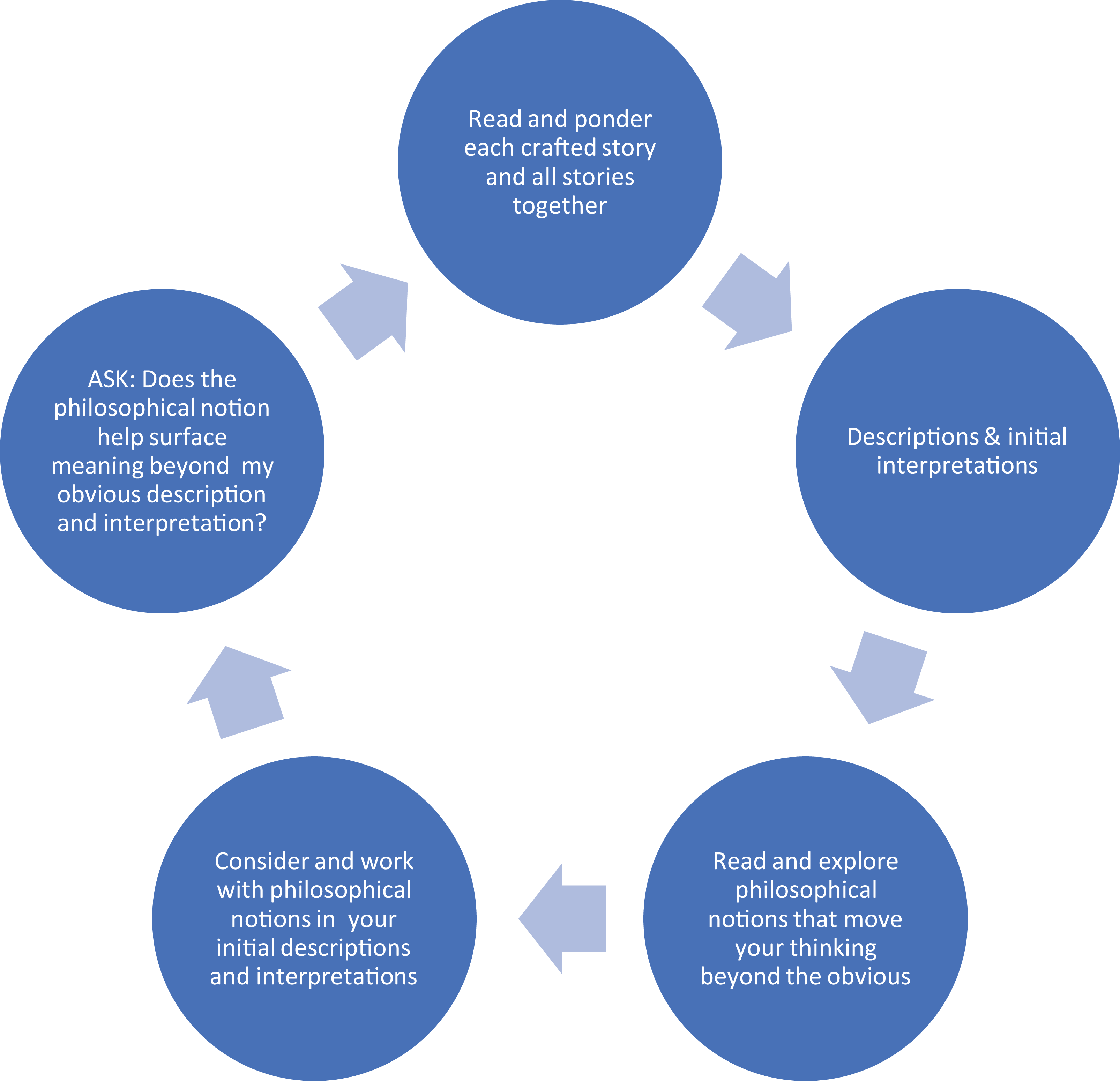
Taking an interpretive leap. Note. This figure builds on Figure 2 providing further pictorial representation of the interpretive process as discussed in the text.
Returning to the two crafted stories our focus turns to Heidegger’s notion of “being-with” and shows how it was applied in level three analysis. Being-with (Mitsein) is central to Heidegger’s understanding of Dasein as an entity that is always with others—to exist is to exist-with. Human beings are by nature social beings who share a world and exist alongside others, either with those physically near and far to us but also others unseen and voiceless, the “They.” Heidegger (1927/1962, p. 121) also describes different forms of being-with-one-another (Miteinandersein) to capture how human beings express concern for each other; with this innate concern referred to as “care” or “solicitude” (1927/1982, p. 121). The first is—“leaping ahead” where concern and actions aim to enhance the possibilities for the “other”:” “Leaping ahead in contrast, goes ahead of the other, not to take away their care but to give it back to them. It helps the other see themselves in their care, and become free for it.” (Heidegger, 1927/1962, p. 159)
Being-With Shows Itself as Joy
In Susan’s study Amy describes “being-with” at birth as a mood of joy. The crafted story reveals a quality of connectedness and how “others” in and around the birth contribute to the mood of joy in around labor and birth. Infused in this story is the sense of trust in those she had chosen to be there. This sense of trust appeared to overcome feelings of anxiety reported in other parts of Amy’s story. Even the doctor who arrived to do the painful forceps delivery played his role well but did not interfere with the experiences of being-with at this birth. Amy articulates an experience of being-with that seemed to transcend physical presence and gestures to a connectedness in and around birth that illuminates “otherness,” as an experience of numinosity. A shared experience of “being-with” as joy magnified the intensity of that collective encounter bringing a sense of celebration to the occasion. “Leaping ahead” was evident in how being-with through joy brought concerned actions, which invoked a sense of increased responsibility, tenderness, positivity and drive toward tactful practices. Heidegger’s (1927/1962) leaping ahead is concerned with opening a space for others to carry out their own projects so they become more transparent to themselves in their coping. According to Heidegger “…that which leaps in…dominates, and that which leaps forth…liberates” (Heidegger, 1927/1962, p. 159). Leaping-ahead practices at birth uncovers a way of being-with that liberates and attunes to joy.
Being-With Shows Itself as Fear
In Gill’s study “being-with” depicts a mood of fear revealed through descriptions of disconnection, isolation and vulnerability. While Jackie was surrounded by professionals, she felt alone. Health professionals operated as distant, disengaged observers, who demonstrated “leaping in” by applying clinical procedures, surveillance and active management, irrespective of Jackie’s physiological or psychological needs. They displayed an inauthentic form of solicitude whereby the “care” they provided was one of seeming indifference. In line with Heidegger’s depiction, this induced passivity and dependence, with Jackie feeling “done to” rather than “done for.” For health professionals, “being-with” in fear aligned them to risk and clinical guidelines, with perceived threats managed by technological means to ensure a safe outcome. Whereas for Jackie, her attunement was fundamentally felt through a lack of connection in a vulnerable birth space; an unseen, denied, uncontrollable self that spiraled into an ever-increasing sense of panic and impending doom, acquiescence to unwanted (and at times ineffective) procedures and scenes of torture.
What became clear, through using Heidegger’s notion of “being-with,” was how birth was a unified phenomenon in which being-with others was always already a being-in-the-world of birth—a being together in different ways, attuning to different moods. This is more than a social occasion of “getting together,” but rather an existential quality around birth. For Amy this togetherness of the occasion was the experience of joy in which alienating and separating thoughts, feelings and experiences seemingly evaporated in the strength of the joy being expressed collectively. For Jackie, it was an experience attuned to fear as she lived through an escalating experience of disconnection, disembodiment and concerns for safety with long lasting painful memories.
The naming of joy and fear are not merely platitudinous and cliché terms but gesture to phenomena that require further illumination. Before any “thing” is named it is already existing in a kind of pre-interpretive existence and called forth through the act of naming (Heidegger 1980). Heidegger refers to this as “primordial interpretation” (Heidegger, 1927/1962, p. 5). To name phenomenon is therefore a way of beginning an interpretive inquiry: “The acts of naming and saying things about the phenomenon, even while consciously “bracketing out” culturally generated abstracting interpretations, are still forms of interpretative action. There is still some kind of hermeneutic or interpretative template at work.” (Willis, 2001, p. 5)
An Endless Hermeneutic Journey
Of course, there is more than can be analyzed and more LEDs in the transcriptions waiting to be crafted and worked on in this way. Further qualities are revealed as one moves deeper into interpretive analysis—there is not a singular interpretive leap but a series of deepening insights as one becomes further acquainted with the phenomenon and remain open to whatever surfaces. In practice it is a dynamic cyclic movement. Other notions could have been used because multiple notions can surface the overflowing meaning that dwells within each crafted story. One may “try on” different philosophical notions to see if they illuminate meaning from the LEDs. For example, Heidegger’s notion of care, mood, temporality and authenticity as well as Merleau Ponty’s phenomenological notion of embodiment (Merleau-Ponty, 1962/2002), could have been used to surface further meaning in the examples. Within the literature other HP researchers have employed an array of philosophical notions to illuminate meaning in their research (e.g., Crowther et al., 2014; Goldberg et al., 2011; Horrigan-Kelly et al., 2016; Taylor & De Vocht, 2011; Thomson, 2011).
Making the interpretive leap is not a lineal process and occurs idiosyncratically. Smythe and Spence (2020) in their paper “working with the data” discuss how post graduate research students find their own way within the lived-experience of doing their HP studies as an ontological revealing. This entails finding different ways of thinking, for example, bringing Heidegger’s philosophical notions to thinking, being with art, taking a walk, journal musings, discussing with others and writing and re-writing. Starting to write with an attitude of free abandonment leaving concerns about structure and grammar aside often helps. For both authors this involved rituals such as meditating and giving gratitude for the time to do this work, for example, lighting a candle at the start of writing and sometimes involved writing poetry sitting outside in nature which provoked new insights. Such rituals help attune to a dwelling thoughtfully with the data and trusting the journey. What is evident is that allowing time and space for thinking to draw forth interpretation beyond the constraints of formal structured writing times alone is necessary. Thinking time in HP studies is part of the study, As Smythe and Spence contend, interpreting is like weaving as words, phrases and structures emerge that culminate in the completed project report. Moreover, word selection is critical in HP writing (Spence, 2017); sometimes sentences and phrases more adequately distil meanings than use of single words with several possible interpretations—this requires thinking and dwelling with the writing.
The examples provided may describe experiences unfamiliar to the reader, yet interpreting the findings using fundamental ontological notions can help elucidate childbirth in the 21st century beyond the everyday discourses of “normal” or “medicalized birth.” For this one needs to dwell with LEDs of childbirth, craft stories and read extensively to reveal the qualities of the phenomenon to arrive at a different vantage point and become rewarded, through allowing time and idiosyncratic creativity, renewed horizons of understandings. The examples help bring to light and articulate something taken for-granted in the everydayness of busy maternity services. They provide an opportunity to contemplate what is going on in moments of practice and how they are meaningful. That is what HP as research methodology gifts when done well.
Trustworthiness in Interpretive Analysis
The trustworthiness of HP work can be challenging for two principal reasons. First, because no two HP projects are the same, and therefore no standardized “measure” of rigor or repeatable interpretive process is possible or even desired. HP work is always a fusion of horizons (Gadamer, 1967/2008) of the times, places, people involved and ourselves; it never claims to be complete, final or generalizable. Second, conveying rigor in HP projects can be challenging due to wordage constraints in published peer reviewed journals. Word length restrictions, as highlighted by Paley (2016), often renders it impossible to convey the iterative, in-depth, often pain-staking and rewarding analytical processes involved in HP work. That said it is important to address the trustworthiness of HP projects, and to draw on seminal literature that addresses the rigor in interpretive studies (e.g., de Witt & Ploeg, 2006; Lincoln & Guba, 1986; Morse, 2015; Rolfe, 2006). Achieving trustworthiness and rigor requires a variety of activities such as: careful attention to reflexivity (as we have highlighted); sharing interpretations with participants and peers to facilitate confirmability of study findings; use of rich and varied participant’s quotes to produce credible interpretations; reporting sociodemographic details of the participants and study context to facilitate transferability; and providing clear insights into how the analytical process was undertaken for dependability purposes. There also needs to be a seamless philosophical congruence between study purpose, methodological processes and reporting of interpretive findings while honoring that many health and social scientists (including us) are not philosophers, neither do we claim to be.
The power of HP as research method is its ontological uncovering of what lies within and beyond everyday knowing and its capacity to resonate with others that shows the true measure of trustworthiness and rigor. The beauty of HP work, when done well, is that one does not have to experience the phenomenon itself, yet we can “come to feel” the phenomenon of “fear, love, vulnerability, joy” (Crowther et al., 2014). HP study participant stories act as a way into phenomenological inquiry—they come full of meaning which joins with the researcher’s own fore-structures of understanding in new and novel ways (Gadamer, 1960/1975; van Manen, 1997). If you watch a movie narrating an emotive real-life story do you remember the specific words used or the felt-meaning over the following days that the movie surfaced within you? Did you need to directly experience what was portrayed in the movie or did you come to feel the meaningfulness of the story as your own? A crafted story from a LED is alive and moves out from its origins. For Derrida (2004/1972) this is “dissemination,” in which a story is always larger than the sum of its differing vantage points harboring multiple meanings. Doing HP research is about acknowledging the uniqueness of each researcher’s approach on this journey. As Smythe and Spence (2020) contend “The way is to go forward not knowing the way in advance. Each case, each researcher, each subject matter will lead to a way of its own. One must learn to “trust the process” (p. 7).
Conclusion
The primary aim of this article was to support and provide guidance to novice HP researchers, particularly postgraduate research students, and less experienced supervisors encountering this approach for the first time by illustrating what “we do” through hermeneutic interpretive analysis. This article highlights how the underpinning philosophy (namely the work of Martin Heidegger) was not originally offered and intended as a guide for applied research but can be used as a foundation that informs methodological and interpretive decisions in HP projects.
A key criticism levied against HP studies is how meaning is attributed to gathered LEDs. Moreover, many using this research approach do not adequately incorporate the philosophical underpinnings which lessens the integrity and congruence of HP studies. Through worked examples we have illustrated how meaning is developed through a series of interconnected levels and highlights the key distinctive phase of taking the “interpretive leap.” This occurs through an iterative process of in-depth hermeneutic work on empirical data using philosophical notions and continuous reflexive engagement. Foregrounding the existential philosophical underpinnings and being scrupulous in reflexive work can surface plausible and believable existential meanings from the LEDs collected. While attention to address rigor and trustworthiness is important, the final litmus test is work that resonates with those that hear and read the work, whether they have had direct experience of the phenomenon or not. HP as research method uncovers insights that speak to us all, insights that reach beyond the descriptive and obvious, that extend beyond the specifics of one contextualized individual story.
Footnotes
Authors’ Note
Ethics not required. Studies referred to in this discussion article have been published previously in peer reviewed publications and have had full ethical approval.
Acknowledgment
The authors would like to acknowledge Professor Liz Smythe (AUT University) who kindly acted as a critical friend in a pre-submission draft of the article.
Declaration of Conflicting Interests
The author(s) declared no potential conflicts of interest with respect to the research, authorship, and/or publication of this article.
Funding
The author(s) received no financial support for the research, authorship, and/or publication of this article.
