




Abstract
This paper discusses the methodological challenges in studying health risks that could arise from consuming terrestrial snails infested with pathogenic microorganisms. In Cameroon, snails remain an inexpensive protein source and are collected from free-living environments termed “farms.” Our focus has been on understanding health risks due to the handling and consumption of snails collected from locations that include decaying vegetation and untreated human and household wastes. To complement preliminary field observations and get more in-depth understanding of the existing situation, we adopted a qualitative approach using lived experiences, participant observation, in-depth interviews, and a focus group. We made use of informal settings where snail vendors and consumers narrated their routines and experiences from snail harvesting to consumption and the strategies they use to keep their families safe from foodborne illnesses. The study adopted two frameworks: Soft Systems Methodology to explore and model the “messy” nature of the social system and Social Practice Theory to explore the local practices identified through systemic model. The challenges discussed are set in the context of conducting social research in a developing world situation in a time of social and political tension and a global pandemic (COVID-19). With this in mind, the methodological decisions discussed include the type of enquiry and selection of frameworks, selection of field sites, recruitment and engagement with participants, design of interview instruments, interpretation, and trustworthiness of the study findings. We also discuss the strengths and limitations of using our approach.
Keywords
Introduction
One in ten people around the world fall sick due to the consumption of food contaminated with microorganisms (Pires et al., 2021). These pathogenic microorganisms may cause illnesses ranging from simple intestinal discomforts to serious cases of neurological disorders and death (Ganguly et al., 2012). An improved understanding of food safety principles by food handlers will greatly reduce the incidence of food-originated diseases (Ganguly et al., 2012).
Locally called “nyamangoro,” “Congo meat,” or “slow boys,” terrestrial snails are considered a desirable source of food and livelihood in Cameroon (Ngenwi et al., 2010). Typical in sub-Saharan countries, snail farming is uncommon, and snails are collected from their natural habitats for human consumption (Ngenwi et al., 2010; Ndah et al., 2017). Several authors have enumerated significant pathogenic microorganisms in snails harvested from farms and sold in markets (Adagbada et al., 2011; Ebenso et al., 2012; Nyoagbe et al., 2016; Okafor-Elenwo & Imade, 2019). However, local practices in snail handling and consumption leading to possible contamination are under-researched.
The purpose of this paper was to discuss the methodological challenges in exploring the local practices that could lead to food related illnesses among snail meat vendors and consumers in Buea. It is part of research on the microbiological prevalence and health risks of consuming contaminated terrestrial edible snails. This study considers the snail meat consumption process as a system of activities (harvesting, preparation, and consumption) with interacting actors (snail meat handlers) performing distinct set of practices. Given this research aimed at improving the health outcomes of a targeted population in Cameroon, six methodological choices had to be resolved: • Type of enquiry and selection of conceptual frameworks. • Selection of sites for the study. • Selection and recruitment of, and engagement with participants. • Design and use of interview instruments. • Interpretation of qualitative information. • Trustworthiness of the study findings.
Furthermore, this paper provides background on the methodological challenges in the context of Cameroon and COVID-19 pandemic, and a rationale for the choices made to address the challenges.
Research Context
The study was carried out between June 10th, 2019 and August 24th, 2021 in the capital of the southwest region of Cameroon called Buea. Buea is located on the eastern slope of mount Cameroon at latitudes 4°12’N and longitudes 9°12’E. It is made up of a tropical rainforest with annual rainfalls between 3000 mm to 5000 mm throughout the year (Buea Communual Development Plan [BCDP], 2012). This research context is best described by socio-political, cultural, economic, and sanitary characteristics.
Social and Sanitation Conditions
The people of Buea live in houses separated at approximately zero to one hundred meters from each other, with arable land in-between. This is thought to maintain easy communication, harmony, social proximity and security from robbery (Manyi, 2007). With changes in consumption habits, poor community participation and the role of HYSACAM, 1 this system of housing has led to unsafe sanitary waste disposal such as open defecation 2 and flying toilet 3 (Assob et al., 2012; BCDP, 2012; Bate, 2020). Household waste along with human feces are commonly found between habitats (Field notes, September 20, 2019). Bate (2020), describes the current waste disposal and management situation in Buea as “poor,” “pathetic,” and “rudimentary orchestrated,” which may increase disease prevalence.
Pandemic and Political Conflicts
Buea has a surface area of 870 km2 spreading between four urban spaces (Buea station, Great Soppo, Molyko/Mile 17 axis, and Muea). Due to politics and pandemics, its population is blended with people from neighboring villages seeking refuge, given it is considered to be more secure and accessible than nearby villages in the southwest region of Cameroon (Nicholas et al., 2020a). In October 2016, for example, a marginalization crisis started with lawyers and teachers demanding professional reforms. This later lead to armed conflicts termed the Anglophone crisis, with separatist fighters calling for secession of English Cameroon (i.e., 20 percent of the total Cameroonian population), to a formation of an “independent Ambazonia” state (Ngange et al., 2019; Bertelsmann Stiftung’s Transformation Index [BTI], 2020). In the southwest region, this resulted in over 3000 deaths, with about 200 000 internally displaced and over 100 000 as refugees in Nigeria (Ngange et al., 2019; BTI, 2020). Consequently, Buea’s population reduced from 300 000 inhabitants in 2005 to 169 745 inhabitants in 2017 (BCDP, 2012; Nicholas et al., 2020a).
In addition, Cameroon registered its first COVID-19 case on March 6th, 2020, and more than 1000 people became infected in a month (Nicholas et al., 2020b). Travel restrictions were implemented to prevent a rapid spread, due to an existing Cameroonian culture of tight family relationships with people making several contacts per day and its poor health systems (Nicholas et al., 2020b). This situation proved challenging in obtaining key informants for this research and further fieldwork later in 2020 and 2021.
Economic, Cultural, and Hygienic Contexts
Buea is best described as a complex community of urban, semi-urban, rural and traditional settings. In this rural setting typical in Africa, only a minority of women are educated. It is assumed that a woman will eventually get married thus transferring money that would have been spent in her education into her marital household (Adelakun-Odewale, 2018). In contrast, male education is strongly encouraged because it is believed to be a productive financial investment which secures the family lineage (Adelakun-Odewale, 2018). This limitation in female education has contributed to early polygamous marriages (i.e., before 18 years), and to varying household day-to-day living arrangements, aspirations, and expectations (Wetheridge & Antonowicz, 2014; Cislaghi et al., 2020). According to Adelakun-Odewale (2018), early marriages are believed to be another chance into a better life. Wetheridge and Antonowicz (2014) relate that women experiences through these pathways are of living in rural areas, poverty, traditional practices, illiteracy, and early sexual debuts. With increasing costs of living, many Cameroonians live below the monetary poverty line that is, at less than 931 FCFA 4 (less than 2USD) per day, with about 16% of households being undernourished (World Food Programme [WFP], 2017; Kaldjob et al., 2019). Although the government had aimed at reducing the poverty rate to 28.7% through an average sustained economic growth of 5.5% between 2010 and 2020, the International Monetary Fund (IMF) foresee a growth decrease due to weak business environment among others (WFP, 2017).
With this present situation and confronted with all sorts of hardships as a mother and sometimes as main provider of her household, a woman is forced into diverse profitable ventures, such as, arable farming and street food vending (Assob et al., 2012; WFP, 2017). Arable farming is typically practiced at zero to four km from homes and involves the cultivation grains, nuts, tubers, and vegetables (BCDP, 2012; WFP, 2017). Street foods are ready-to-eat foods sold in streets, roadsides, and markets. These activities are not legally recognized or regulated. Due to minimal or no knowledge of hygienic food handling practices, food preparations occur in microbiologically unsafe conditions (Assob et al., 2012; Yongsi, 2014). Assessing the personal hygiene and health status of vendors involved in informal sales of food in Buea, Assob et al. (2012) isolated one or more faeco-orally transmissible parasites from their faeces. Also, the presence of enteric microorganisms in chili pepper sauces served with street food (including snail meat), around the University of Buea campus, Mile 17 Motor Park, Malingo and Muea markets have been attributed to poor handling procedures (Nicholas et al., 2020a). The above conditions constitute key elements in the context of this study, and consequently the status of our research participants.
Methodological Choices
The methodological decisions in this study were to build a conceptual model of actors and activities, and then develop an in-depth understanding of the local practices in the model. In this section, we described the choices made and its associated challenges in six headings: (1) type of enquiry and selection of frameworks, (2) selection of field sites, (3) selection and recruitment of, and engagement with participants, (4) design and use of interview instruments, (5) interpretation of qualitative information, and (6) trustworthiness of the findings.
Type of Enquiry and Selection of Frameworks
A qualitative approach was used in this study. As oppose to quantitative research, which seeks to confirm hypotheses about phenomena, qualitative research provides insights on the “human” side of an issue such as behaviors, beliefs, opinions, and relationships among individuals (Mack et al., 2005). We were guided in our choice of approach by our purpose: to understand health risks that could arise from handling and consuming snails infested with pathogenic microorganisms in Buea. To do this, we needed to explore and capture rich and interpretative information from participants (i.e., snail vendors, consumers, an epidemiologist, and a veterinary doctor) about human practices. We were seeking to know how our informants themselves understood their practices. We used lived experiences (Creswell, 2014), participant observation (Mack et al., 2005), and face-to-face in-depth interviews (Mack et al., 2005; Creswell, 2014), to reveal participants’ naturally occurring behaviors vis-à-vis snail meat consumption and relate their narrations or experiences to their actual home routines. Mack et al. (2005) and Creswell (2014) encourage these combinations of qualitative methods as it produces a thick or detailed description of participants’ feelings, opinions, experiences, and interprets the meanings of their actions. This resulted in audio recordings of exploratory interviews, field notes, and photos as potential information that could be regarded as “unstructured” stories and experiences.
Our approach presented particular challenges in the context of this study. For example, it was not always possible to find participants homes for observations and interviews. Presently in Cameroon, locations are verbally indicated as streets and home addresses are still to be recognized. Basic utilities such as electricity and internet to ease communication are unavailable in certain locations and/or in some days/weeks. While in the search of participants’ homes, and due to urban construction and misunderstandings, we walked through a wrong path into an uninvited house in three occasions. This led to a postponement of two interviews, and we ended up missing on one of the key informants. In addition, to the greater population in Buea, snail meat is viewed as a source of nutrition, an inherited dish and a delicacy. Getting key informants to participate on the basis that it might lead to illnesses was regarded as “bizarre” and not part of their beliefs. For example, in some of the interviews, statements as below were recorded. Do you eat snails around the toilet? “Yes, why not, is it not meat” (home consumer) “If snails eat excreta and you eat snails, [...], you have eaten snails and not excreta” (snail collector)
We needed to be clear in the explanation of our enquiry to participants that it was based on the fact that “maybe” their practices could get them sick and not that they were actually or already sick because they eat snails.
A further methodological choice was the decision to use two theoretical frameworks which focused on a system thinking approach, that is, Soft Systems Methodology (Checkland & Poulter, 2006; Proches & Bodhanya, 2015), and practices as social systems, that is, Social Practice Theory (Shove et al., 2012), as shown in Figure 1. Theoretical frameworks of our enquiry.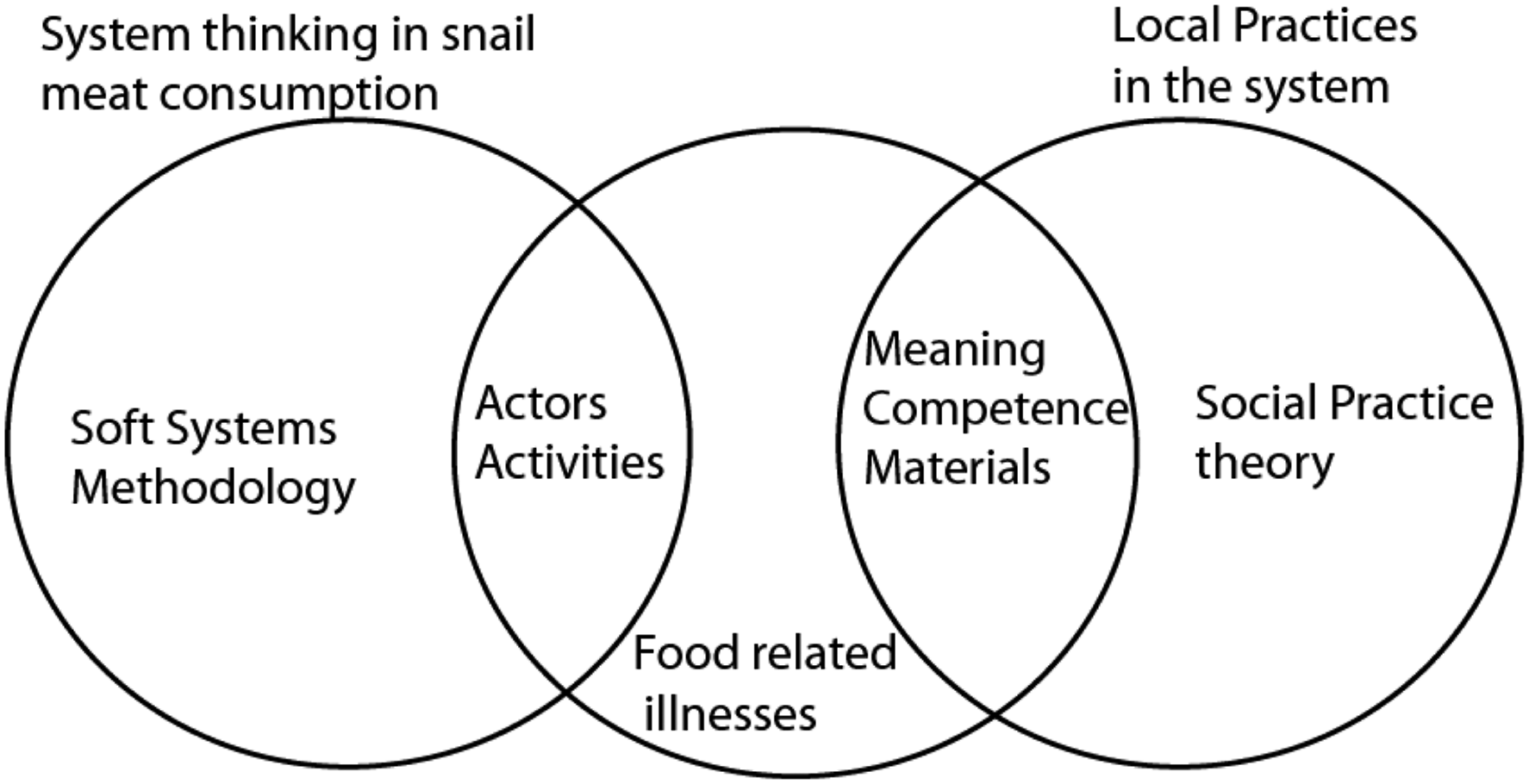
Particular aspects of the research drove our choice and specific use of these frameworks: to identify local practices in participants’ shared experiences in an undefined food-disease causing problem situation. “Soft” system thinking permitted an exploration of the erratic and unstructured nature of our obtained information, by moving from the real-world situation to a model system, then back to the real world. Inspired by the problem-solving approaches of Maqsood et al. (2003), Yadin (2013) among others, Soft Systems Methodology (SSM) was chosen for its capacity to structure and conceptualize complex human situations (Checkland & Poulter, 2006; Proches & Bodhanya, 2015). Maqsood et al. (2003) presents five case studies dealing with confused situations involving humans and organizations, Yadin (2013) analyzed real life examples of students' perceived learning systems by revealing their specific difficulties. In contrast to hard systems where the problems can be well-defined with optimal solutions, SSM attempts to explore and appreciate problems using models of human activities in real-world situations where people act purposefully (Checkland & Poulter, 2006; Proches & Bodhanya, 2015). It analyses the problem situation and permit purposeful actions by accommodating the perceptions, judgments, and values of different actors in the system (Checkland & Poulter, 2006; Proches & Bodhanya, 2015). We used rich pictures, 5 root definitions, 6 CATWOE, 7 and conceptual models 8 developed by Checkland & Poulter (2006), Proches & Bodhanya (2015). With this, we were able to develop and describe snail meat consumption as a complex human system involving different actors (rural women) with interrelated activities (snail picking, cracking, cooking, and vending). This approach helped us gain insights on the problem situation (i.e., possible human pathogenic exposures) in participants’ routines.
Our research context led to distinctive ways of applying SSM such as the building of a rich picture using an Ishikawa diagram. Also known as the cause-and-effect (CED) diagram or the Fishbone diagram, the Ishikawa diagram is a quality control tool that graphically illustrates the relationship between a given outcome and all the factors that influence such outcomes (Suárez Barraza & Rodríguez González [SBRG], 2018). It has been used in different contexts from manufacturing companies to service organizations such as medical services, supermarkets, banks, and restaurants to identify, sort, and display possible root causes of a specific effect, problem, or condition (SBRG, 2018). We decided against a conventional SSM rich picture for two main reasons: limited opportunities for a prolong fieldwork in Buea due to COVID-19 and its effects on travel restrictions, and the fact that our participants did not see their practices as a problem situation. To do this, we modified SSM’s convectional action-oriented approach which sought to improve already existing problematical situations (Checkland & Poulter, 2006; Proches & Bodhanya, 2015). Based on our “rich picture” development and in-depth interviews, we articulated five root definitions to adequately capture the perspectives of key actors: snail collectors, markets sellers, street vendors, home consumers, and street eaters. We then chose three transformations (i.e., snail meat is a source of income, a source of nutrition, and a food choice), to describe using CATWOE. Our choices for developing a conceptual model were to illustrate an ideal systematic set of activities needed by participants (our key actors) to realize these transformations.
Components of Social Practice Theory (SPT) (Shove et al., 2012).

We focused on these three elements in order to discover possible exposure routes in participants’ experiences. It should be noted that practices are social as they are similar for different individuals at different locations and different point in time, for example, in picking snails, selling at the market, cooking, and hawking. Individuals are seen as the “carriers of practices” who do not freely choose between practices based on utility or similar individualistic concepts but are “recruited” to practices according to their background and history (Reckwitz, 2002). The use of SPT was appropriate for our study as we were dealing with human practices, which are bound to change over time. For example, in the description of snail meat preparation, one of our participants acknowledged modifying her method of snail cracking to boiling a few days prior to the interviews on the basis that the previous method was “nasty.” She admitted adopting this new method from her neighbour. According to Shove et al. (2012), “practices emerge, persist, shift and disappear when connections between these three types [materials, competences, meaning] are made, sustained or broken.”
SSM and SPT were selected suitable frameworks for understanding the local practices of our participants, as the consumption of snail meat is a day-to-day feeding habit and/or occupation of the people of Buea.
Selection of Field Sites for the Study
Four main motivations guided our choice of Buea: (1) snail meat consumption is ancestral and culturally embedded; (2) Buea’s agro-climatic characteristics favors a productive survival of snails (Miegoue et al., 2019; Ndah et al., 2017); (3) the availability of snail collectors, mobile and stationed snail meat vendors and consumers (Kaldjob et al., 2019; Ndah et al., 2017); and (4) the researcher has a deep knowledge of the locality under study through lived experience. After brainstorming with the researcher’s family members, friends, and neighbors, we selected specific fieldwork locations (Mile 17 Motor Park, streets and markets in Molyko, Buea town, Muea, Bomaka, Mile 16, Sandpit, Small and Great Soppo, participants’ homes and farms). We were interested in those locations where live snails and snail meat are routinely and readily available in order to observe and meet key informants. Designing the enquiry was particularly challenging in this context as approaching someone on the footpath or road to ask for directions to snail vending sites or clues regarding key informants could easily lead to suspicions that we were Ambazonians.
9
In the early days of the Anglophone crisis earlier mentioned, separatists created the Ambazonian Freedom Fighters on Facebook and WhatsApp to rally supporters against the Cameroonian government. Through these pages, activists gained momentum to initiate strike actions, impose ghost towns,
10
and created fear among the population (Ngange et al., 2019). Inquiring from people we met in public places (streets and bus stops) lead to questions such as “where do you live,” “what quarter do you come from,” “who are your parents,” “how did you know I sell or eat snails,” which we believed was their strategy to maintain privacy and confidentiality. On the other hand, our honest responses to the above questions were vital as it facilitated the recruitment of participants, and positively contributed to the quantity and quality of information obtained in this research. Another challenge in carrying out research at the selected sites was that the study could only be carried out in the rainy season, that is, from March to October each year. It is a period of snail reproduction and abundant availability compared to the dry season, that is, November to February (Kaldjob et al., 2019; Ndah et al., 2017). During this period, snail collectors could be heard and seen at night actively picking snails, and roadsides are filled with snail hawkers (Kaldjob et al., 2019; Ndah et al., 2017). We needed to walk with collectors to these sites, which are slippery and muddy due to heavy downpours, and in most cases, sites are only accessible with torches. “We use very good and shining torches to pick snails; places are very dark, if you do not use a torch that the light is good, you will not see snails” (snail collector)
In addition, access to markets on rainy days was difficult due to its nature being muddy mixed with domestic wastes, and mostly overcrowded with vendors, buyers, and pickpockets (Field notes, August 15th, 2019). This led to a longer observation phase than expected as a) the picking process was at random and entailed more intense walks given many households are involved in the search of snails; b) markets are not open daily, for example, the opening days of the Muea market is only on Thursdays and Sundays; and c) travel restrictions imposed by the abovementioned Anglophone crisis. One of the ways we managed these contextual challenges, was to use key informants with lived and memorable childhood experiences as recorded below. “Like if I am out of Buea [...] if I see a pit toilet that is locally open [...], it can be certain, and I will just know that snails will be present there” (home consumer)
Selection and Recruitment of, and Engagement with Participants
To develop a system understanding of snail meat consumption in Buea, we sought to understand the perceptions of those who possessed childhood experiences and still incorporate snails in their routines. The recruitment criteria required participants must have live in Buea for at least five years with active participation in snail consumption stages, that is, as snail collectors/pickers, snail local market sellers or snail vendors, snail home-based consumers, snail meat cleaners, snail street hawkers, and street consumers. These stages were aimed at capturing experiences from snail harvesting to consumption. The number of participants in this study (seventeen) was based on the logic of small samples outlined by Crouch and McKenzie (2006) for interview-based qualitative research. These authors argued that a sample size of say less than twenty will facilitate the researcher’s close association with each participant, and thus, enhance the validity of fine-grained, in-depth inquiry in naturalistic settings (Crouch & McKenzie, 2006).
The first step in recruiting participants was the integration of a note taker. A note taker according to Mack et al. (2005) should know the research material and the method in use and possess the ability to quickly identify and take down individual quotes that capture the spirit of a given point. We recruited a female geographer who had recently use semi-structured questionnaires to carry out a survey in the southwest region of Cameroon. She had a full knowledge of the qualitative approach in this study, as well as the landscape of the Buea municipality. The researcher and note taker started by visiting markets, road junctions, and streets for observations, identification of key informants, 11 and recruitment of participants.
A key to recruiting and engaging participants required sufficient trust and relationship with our participants. To gain trust according to Gehlert and Mozersky (2018), a researcher needs to be honest about her intentions and expectations, consider the cultural settings, highlight the benefits of the study to participants, and ensure confidentiality. As previously noted, our enquiry was carried out in a context that included suspicion. Prior to engaging key informants to participate in the study, we made observations and inquiries at approximately fifty metres from potential participants. When we came across a seller or buyer of snails, we needed to approach them in a polite, honest, and informal manner. In some instances, we started by supporting their businesses, such as, buying snails from them, and while packaging the purchased snails, the researcher got into an informal conversation with her key informants, leading to an explanation of our research interests. This was a strategy of gaining our participant’s attention as approaching a hawker with no purchasing intentions could raise instant reluctance and rejection for participation. Key informants asked questions such as “how is that important to me,” “how can I make more profits from that,” “are you saying eating snails is bad.” Drawing inspirations from the Italian proverb “he who enjoys good health is rich, though he knows it not,” the researcher successfully drew their attention to the fact that it was for their family wellbeing and participation was voluntary. Potential participants were also given a written information sheet and consent form.
Consistent with our field observations, similar studies by Miegoue et al. (2019) and Ngenwi et al. (2010), respectively, recorded 57.69% and 60% of women in snail businesses; thus, we chose to focus only on women who are also housewives and therefore in charge of family food preparations. The involvement of women who are termed “vulnerable,” initiated another challenge in this study. “Vulnerable” describes those who are disadvantaged or marginalized and have experience homelessness, poverty, and unemployment situations (Bashir, 2018; Gehlert & Mozersky, 2018). As highlighted earlier, the socio-economic and cultural status of our participants can render them vulnerable. With this, two participants in this research refused an audio recording of their voices emphasizing that rumors and misinterpretations were common in Buea. With our enquiry, it was obvious the participants were afraid of gossips, which could arise from family members and friends listening to what they say about snails; their source of income was at stake. At an incident, using facial gestures, one of the participants’ daughters contradicted the mother in her presence, regarding her detailed method as outdated and unpleasant, and told her mother to be careful with what she was sharing. There was this fear of losing customers due to the hygiene they practice in their homes and businesses. Nonetheless, prior to and during the interview sessions, participants invited trusted relatives with formal education or curious friends to explain deeply the purpose of the interviews. According to Mack et al. (2005), the willingness of participants to participate in an interview will depend on how well the participants understand the study, what will be expected from them, and how their privacy will be respected. Knowing the peoples’ customs, we regarded it as unethical to tell her family members and friends to leave, as we were strangers at their homes. However, their presence was helpful to us especially as most of our participants have never heard or participated in research-based studies or face-to-face interviews and could neither read nor write as elaborated by a recruited epidemiologist: “You will see that a majority of the population is still uneducated, so they don’t have knowledge on disease prevention, they don’t have knowledge on how to manage particular diseases when they are infected or affected by that disease”
Although cultural background determines what is eaten as well as when and how (Oniang’o et al., 2003), this was challenging as the presence of others could affect the participants’ ability to share potential information (Bashir, 2018; Gehlert & Mozersky, 2018). To avoid these setbacks, we chose interview settings and time at each participant’s conveniences and privacy. Bashir (2018) confirms that the more comfortable participants are in their own personal space, the more they are to disclose information that reveals the nature of their lived experiences. In addition, the researcher created useful discussions among family members, friends present during our visits, and their opinions were stated in the field notes. Shenton (2004) encourages this discussion technique, which allows for individual viewpoints and experiences to be verified against others. Consequently, their attitudes or behaviors can contribute to a rich picture based on the contributions of different participants.
Finally, acknowledging that the researcher’s educational background could affect participants’ responses, or the information obtained, we adopted, as a strategy, to speak the Cameroon Pidgin English (CPE) 12 throughout the fieldwork. This strategy portrayed a sense of belonging to the same community as participants, thus contributing to an atmosphere of self-confidence and trust within participants.
Design and Use of Interview Instruments
This research used interview instruments: ethical guidelines, a written consent form, information sheet,
13
and an interview protocol
14
which was designed according to Mack et al. (2005), Creswell (2014) and human ethics at Lincoln University, New Zealand. An approval (approved number: HEC 2019-25) was obtained from Lincoln University ethics committee. These instruments addressed issues outlined in this research context, our methodological choices, the expected impact of the study, and how confidentiality was to be ensured. The interview protocol was mainly composed of statements that focused on the three components of SPT (Figure 2). We decided on these components as it logically organized and interpreted these research findings. Summary of interview protocol.
Due to the socio-cultural, economic, and political differences between Buea and New Zealand, these interview instruments presented certain challenges during its approval and in obtaining consents from participants. For example, the ethics committee required details on participants’ low level of education, how participants’ consents were to be obtained due to a lack of a CPE translated version and how participants will withdraw from the study if they possess no telephones or email addresses. This was practically true as although individuals are competent with the capacity to make rational decisions, lack of formal education, and/or language barriers presents an inordinate challenge in the comprehension and understanding of informed consent (Punjwani, 2015; Gehlert & Mozersky, 2018). To resolve these contextual challenges, the researcher ensured each participant recruited had a mobile phone to reach us on the contact numbers provided on the information sheet and had sufficient time (up to a year) to withdraw from the study. We held brief conversations with individual participants during our first contacts, and following their voluntary acceptance to participate in the interview sessions, they were immediately handed copies of an information sheet and consent form. Our reasoning being they could seek further explanations at their discretion from trusted friends and families prior to the interview dates. This was challenging in that it created some degree of reluctance to participate as participants needed to put in valuable time to understand the rationale of the study particularly written in the English language. However, on the interview day, the researcher gained participants’ interest by conversing in CPE, engaging participants’ relatives and friends to clarify questions or doubts, and highlighting the importance of the study findings.
Interpretation of Qualitative Information
Six steps in interpretation adapted from Braun and Clarke (2006).
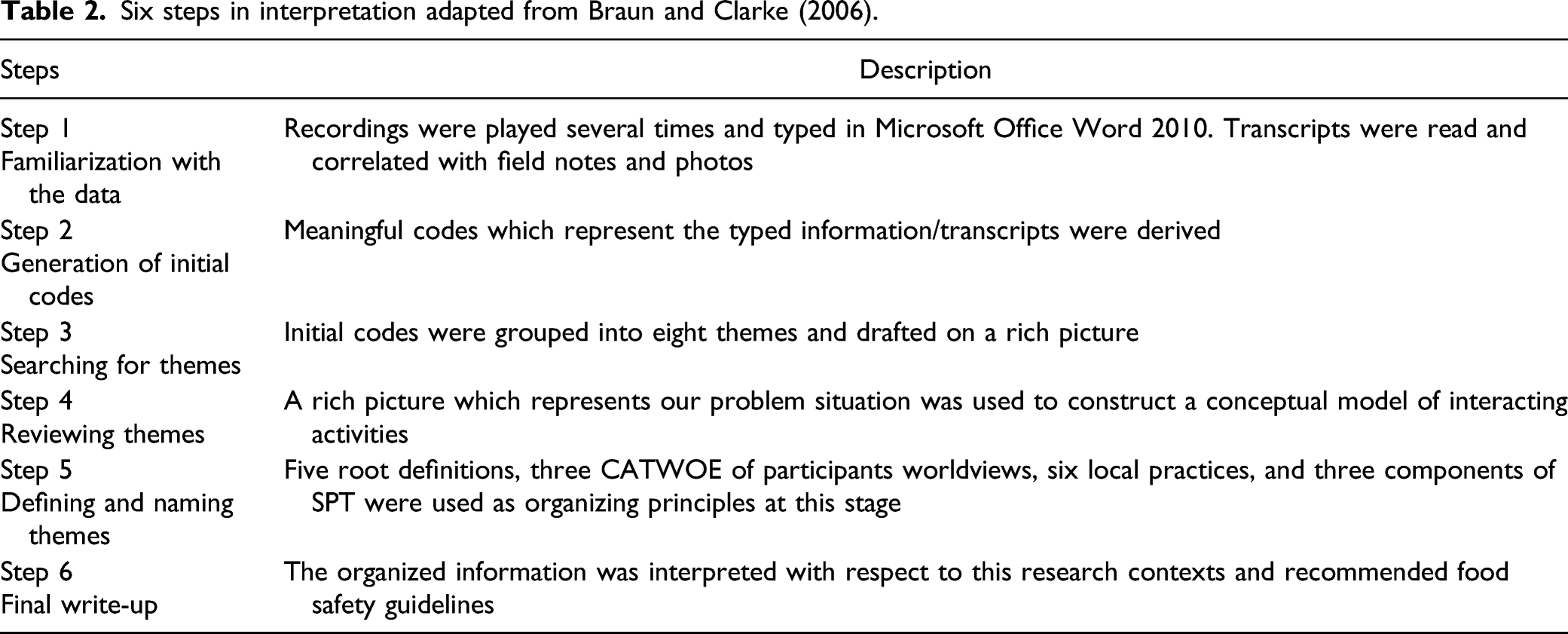
Firstly, we manually transcribed 15 and hand coded all texts and images. This process was found adequate since audio recordings were in CPE and contained inaudible speeches and pronunciations, thus rendering automated transcription unsuitable. Next, we used inductive and deductive reasoning including SSM and SPT, to organize derived themes. Creswell (2014) noted that “inductive process illustrates working back and forth between the themes and the database until the researchers have established a comprehensive set of themes. Then, deductively, the researchers look back at their data from the themes to determine if more evidence can support each theme or whether they need to gather more information.”
As stated in step 5, we derived five root definitions (snail collectors, market sellers, street vendors, home consumers, and street eaters); three CATWOE (snail is a source of income, a source of nutrition, and a food choice); and six local practices (picking, cracking, washing, cooking, selling, and eating). Following the SPT categories, we deduced participants’ competences, materials used, and symbolic meaning. These different organizing themes gave an interpretation of our study findings that could be readily discussed, understood, and critiqued.
Particular challenges in linking this organized information to public health risks were as follows: (1) snail meat food safety regulations are still to be implemented in Cameroon; (2) we focused on participants who have little or no knowledge on the principles of food safety; and (3) the “local” practices identified in this research have never been questioned or studied or assessed. To resolve these challenges, we sought to interrogate our findings using: “does each performed practice respect proper food safety procedures” (Figure 3). Interpreting our study findings.
The interpretation of the study findings was informed by two public health officials (an epidemiologist and a veterinary doctor). In Cameroon, epidemiologists assess the root causes of disease prevalence while veterinary doctors/nurses perform regular inspections on meat (beef and pork) in abattoirs and markets. These public health officials revealed current food safety implementation procedures, disease prevalence in Buea, and their stances on the current snail consumption practices as a contributor to foodborne illnesses. Their opinions were correlated with recommended guidelines, such as WHO (2006), for the interpretation of this study findings.
Trustworthiness of the Study Findings
Qualitative researchers have adopted criteria to “judge” their findings as those of internal validity and reliability used in quantitative research have been shown to be unsuitable (Korstjens & Moser, 2018; Shenton, 2004). The principal criterion applied is trustworthiness which simply addresses the question: Can the findings be trusted? Among the several definitions and criteria of trustworthiness, we principally applied the best-known criteria of Lincoln and Guba (1985). These criteria are credibility (prolonged engagement, persistent observation, triangulation, and member check), transferability, dependability, and confirmability. We encountered certain contextual challenges in ensuring this research was trustworthy.
As earlier mentioned, Buea persistently observed “complete lockdown” days colloquially referred to by residents as “ghost town” (BTI, 2020; Ngange et al., 2019). On such a day and thereafter, fear was common, and inhabitants were forced to engage mostly in indoor activities. We needed to re-schedule field observations and face-to-face interviews. This greatly affected our initial strategies to ensure prolong engagement and persistent observation. However, triangulation, member checking, and clarifying the researchers’ bias were instrumental in this research.
Firstly, we used multiple sources of information (variant field sites, grey literature) and information collection techniques (interviews, observations) as a triangulation strategy. Interview sessions were between 25 and 60 minutes per participant with field observations repeated multiple times on the same day and/or on different days. The use of an interview protocol and the inclusion of a note taker permitted us to observe while recording, and at the same time, take down notes and images. Also, with limited published documents from online searches, we sought information from YouTube and closed groups on Facebook. We were interested in uploaded videos, statements, and comments on people experiences as snail consumers and vendors. We watched two snail meat preparation videos from Buea (BTI, 2020; Ngange et al., 2019), and several others from Nigeria and Ghana (BTI, 2020; Ngange et al., 2019). According to Creswell (2014), “If themes are established based on converging several sources of data or perspectives from participants, then this process can be claimed as adding to the validity of the study.” As such, our findings are to be trusted.
Secondly, member check is feedback data, interpretations, and conclusions by participants from whom the data were originally obtained (Creswell, 2014; Korstjens & Moser, 2018). Travel restrictions enforced by COVID-19 came at a time when the principal researcher of this study was in Christchurch, New Zealand. To get to our participants in Buea, Cameroon, we modified our member check strategy of a focus group. Here, the note taker conducted discussion sessions with participants using a video pre-recorded by the principal researcher describing our major findings. Prior to watching the video, participants were briefed on its content, and the video was paused at regular intervals to clarify participants’ doubts and take down comments and opinions of the study findings. These comments were used to enrich and confirm our findings
Finally, a clarification of the researchers’ bias further strengthens our findings. Referred to as reflexivity, the researchers reflect on how their role and personal background, culture, and experiences can shape the interpretation of the findings (Creswell, 2014). As a native from Buea, the principal researcher early childhood was in Bomaka and Muea. She still recounts memories of snail picking with her siblings in the early hours of 4.00a.m. “We will crack the shells with stones, separate the foot from the internal organs with our hands, and our mother will wash and prepare later in the day. Knowing that the quantity of snail meat prepared was dependent on the quantity of snails picked, there was this zeal to search for snails in the dark”
Certain challenges witnessed at this stage were to convince participants to narrate their own experiences. To some participants, the information we sought to understand was simple and direct, not requiring all the explanations and procedures recommended for qualitative research. To others, it was “a waste of their time” given they knew the researcher was a native from Buea who should obviously be aware on how snails are picked until consumed. According to (Creswell, 2014), a researcher needs to have a continual internal dialogue and critical self-evaluation with explicit recognition that their presence may affect the research process and outcomes. With this in mind, we recognized participants in Buea as experts and the principal researcher as a learner.
These abovementioned methodological decisions embed trust in our study findings as it revealed participants’ routines and lived experiences in snail meat consumption.
Discussion
This paper presents the methodological choices and contextual challenges in exploring food related illnesses associated with snail meat consumption in Buea. With limited studies on the health risks of snail meat, this research is the first to focus on pathogenic exposures among snail vendors and consumers. We used in-depth interviews, participant observation, lived experiences, and a focus group, to get holistic views of participants’ routines. In particular, we focused on challenges encountered in building trust and/or engaging participants, the use of participants’ lived experiences and theoretical frameworks.
To our knowledge, existing research has been limited at questioning the food safety of live snails through microbiological analyses (Adagbada et al., 2011; Ebenso et al., 2012; Okafor-Elenwo & Imade, 2019). Our purpose of seeing-through the eyes of snail handlers and consumers served as a start-up point for future research. We used the researcher-specific lived experience to engage tentative and vulnerable participants and a practice-based approach to understand exposures to food safety hazards rather than alternatives that might abstract theoretical risks from embedded practices or may focus on modifying isolated behaviors.
In our approach, recruiting participants required the building of trust and confidences between the researchers and key informants. We used strategies such as observing key informants at approximately 50 m at snail sale points, buying snails from key informants to get their attention, communicating in CPE, and scheduling interview sessions at participants’ conveniences and in the presence of trusted relatives. These relatives were instrumental in clarifying doubts to participants and in some cases provided vital information through discussion sessions. We were motivated to use these strategies because of our participants’ culture, level of education, and their expression of fear following the Anglophone crisis.
Some researchers have criticized the use of in-depth one-to-one interviews, on the grounds that it can reveal painful memories, feelings of shame/failure, and trauma (Bashir, 2018). We were conscious of this, especially as we involved women with educational barriers, and who are currently facing economic hardships, collectively termed vulnerable. However, Bashir (2018) goes further to highlight that there is little discussion of whether participation in in-depth interviews is a catalyst for further distress in social research. That notwithstanding, this research included two natives (i.e., the principal researcher and note taker) from Buea, which successfully eliminated vulnerability issues that might had occur. Their presence in this research built confidence within these women who felt “safer” due to comparable childhood and everyday experiences.
We summarized participants’ experiences and stories using inductive and deductive reasoning implying moving back and forth within pre-determined themes. According to Creswell (2014. p. 199), a “traditional approach in the social sciences is to allow the codes to emerge during data analysis”; however, “text and images data are so dense and rich, not all of the information can be used in a qualitative study” (p. 195). These statements enhanced the suitability of using deductive reasoning, shaped by SSM and SPT to organize our findings. SSM and SPT, respectively, correlated participants’ different worldviews, competences, symbolic meaning, and materials in each identified local practice. Using SSM, we decided to use an Ishikawa diagram to develop our “rich picture” which directly linked the cause (identified themes) and effect (possible pathogenic exposures) in snail meat consumption. This proved a useful framework to “dump” and link multiple complex dynamics. Although this approach in developing a rich picture is not conventional for SSM, we believe this approach is appropriate as there is no syntax or defined rules of representing rich pictures (Checkland & Poulter, 2006; Proches & Bodhanya, 2015). As outlined in this paper, the methodological decisions made with respect to these research contexts revealed participants’ unique snail consumption habits.
Conclusion
Terrestrial edible snails are a source of nutrition and/or an income generating activity to the people of Buea. However, snails are collected from free-living habitats for consumption. With Buea’s poor hygienic and waste disposal systems, plus the devastating cholera outbreaks in 2010, we sought to discover the foodborne pathogenic exposures in snail vendors and consumers routines. To attain our exploratory objectives, we made methodological decisions that presented contextual challenges such as in building trust and/or engaging participants, the use of participants’ and researcher’s lived experiences, and application of generic theoretical frameworks. With challenges particular to this study, including participants’ educational level, participants’ vulnerability, and travel restrictions imposed locally by the Anglophone crisis and internationally by the COVID-19 pandemic, our adaptation of qualitative approaches of lived experiences, participant observation, and in-depth face-to-face interviews were effective in elucidating the potential public health risks from snail meat consumption. Further studies to quantify the risks from established bacterial pathogens have been conducted and will be described in due course.
Footnotes
Acknowledgments
MKT is grateful to the New Zealand Ministry of Foreign Affairs and Trade for a NZ Aid Scholarship. We thank the Lincoln University Open Access fund for payment of the open access charge. Thank you to Dr Barbara Nicholas for providing helpful comments during the realization of this research and to the women of Buea who generously shared their stories with us.
Declaration of Conflicting Interests
The author(s) declared no potential conflicts of interest with respect to the research, authorship, and/or publication of this article.
Funding
The author(s) disclosed receipt of the following financial support for the research, authorship, and/or publication of this article: This work was supported by the Lincoln University Open Access Publication Fund and New Zealand Aid Programme.
