




Abstract
Critical inquiries with children have been increasingly conducted in various educational settings. However, valuing children’s way of knowing while keeping inquiries critical remains an ongoing issue. This study aims to understand what can be learned about the design, conduct, and interpretation of critical inquiry from children’s engagement. I present a case of critical inquiries that I conducted with five fifth-grade migrant Joseonjok children in an after-school class in South Korea. By documenting the moments when the children’s engagement in critical inquiries raised methodological dilemmas, as well as the moments that allowed me to learn, this study provides concrete examples of how children instilled unexpected complexity into the critical inquiries and how the inquiries continued to change over time. The findings suggest critical inquiry with children can be a process of unlearning in which teachers and researchers acknowledge that what they believed they knew could be wrong and reconstruct their knowledge about children and children’s way of knowing by learning from them.
Keywords
Introduction
Informed by critical pedagogy (Freire, 1970) and inquiry approaches in critical literacy (Fecho, 2001; Shor, 1999), critical inquiries have been conducted in various educational settings, providing fascinating stories of how children critically read inequity in society and call for changes to make a more just and fair society (e.g., Campano, 2007; Cueto & Corapi, 2019; Ghiso, 2016; Jones, 2006; Vasquez, 2014). Despite these captivating results, inherent power issues are embedded in critical inquiries with children. Conducted by educators who have a strong desire to reduce inequity and social injustice, critical inquiries are likely to be teacher-directed projects (Shor, 1999) that are pushed in certain ways the educators believe are important for equity and social justice. One of the biggest problems with this practice may be the unintentional marginalization of children that occurs when ignorance is projected onto them, thus negating the very equity that critical inquiry pursues (Freire, 1970).
The current methodological discussion on participatory approaches to research involving children offers fruitful insights into this inherent tension in critical inquiry with children. Repositioning children as the subjects rather than objects of research, participatory approaches have highlighted research with children rather than on them (Fraser et al., 2014). Drawing on a participatory approach, many studies in the field of education (e.g., Pahl & Allan, 2011), healthcare (e.g., Boles & Winsor, 2019; Lomax, 2018; Staphorst et al., 2017), and geography (e.g., Gordon et al., 2016; Marshall, 2013) have been conducted based on children’s unique perspectives, providing fertile implications that benefit both children and their communities. However, on the other side of these remarkable results, scholars have warned not to romanticize children’s participation (Chesworth, 2018; Gallacher & Gallagher, 2008; Holland et al., 2010; Palaiologou, 2014; Spyrou, 2011; Thomson, 2008). A salient caveat from the field is that children’s participation cannot be reduced to a method (Chesworth, 2018; Gallacher & Gallagher, 2008; Palaiologou, 2014). That is, although there has been a proliferation in the development of child-friendly methods, drawing on certain methods does not guarantee more ethical or productive research. Even when researchers mobilize a participatory approach, power issues between adult researchers and children remain, leading to unintended results, such as children’s duplicating the researcher’s voice (Holland et al., 2010) or researchers’ overlooking participation that does not conform to their assumptions (Gallacher & Gallagher, 2008). Thus, in research involving children, there have been requests for researcher reflexivity beyond a participatory approach (Chesworth, 2018; Holland et al., 2010; Spyrou, 2011).
Informed by the body of international literature highlighting researcher reflexivity in research with children, this study presents the lessons I learned about the design, conduct, and interpretation of critical inquiry from my engagement with children, specifically, from a series of critical inquiries that I conducted with five migrant Joseonjok children in South Korea. By documenting the events during which their engagement complicated the research and raised methodological dilemmas, this study provides concrete examples of how children instilled unexpected complexity into the critical inquiries and how the inquiries continued to change over time. The findings suggest that critical inquiry with children can be a process of unlearning in which researchers acknowledge that what they believed they knew could be wrong and reconstruct their knowledge about children and children’s way of knowing by learning from them.
Learning From Children
Over the past two decades, research with children has come into focus, relocating children from the object to the subject of research. Despite its advantages, researchers have warned that just taking a participatory approach in methodology, per se, is not a panacea that guarantees better research or ethical integrity (Chesworth, 2018; Gallacher & Gallagher, 2008; Holland et al., 2010; Palaiologou, 2014). Instead, they emphasize that work with children should be an ongoing process that occurs throughout the course of a study and that the researcher’s attitude is at the core of that process. For instance, Gallacher and Gallagher (2008) discussed the extent to which adults are ignorant of children’s environments, contrary to the dominant image of researchers as experts. Arguing that researchers’ immaturity is why research must be conducted, Gallacher and Gallagher stressed that immaturity implies potential and that a position of ignorance allows researchers to learn from children.
Previous literature has also stressed the concept of power relations in research involving children. Waller and Bitou (2011) warned that research with children in an educational setting is likely to be didactic, replicating a teacher–pupil dynamic of power. In addition, there is the inherent danger of framing children’s work within the democratic ideals of adults, thus overlooking actions that do not conform to researcher assumptions, such as nonparticipation (Gallacher & Gallagher, 2008). Based on these critiques, Waller and Bitou (2011) argued researchers must keep in mind that children’s agency often goes beyond the research agenda. They argued that attention should be paid to how children let researchers be involved in their worlds, how they develop research methods with the researcher, and even how they expand the researchers’ agendas. That is, children need to be understood not only as experts in their own lives but as individuals who have unique expertise in the research project (Palaiologou, 2014).
Last, scholars have emphasized the need for researchers to be reflexive and transparent about the uncertainty interlaced in their research (Chesworth, 2018; Spyrou, 2011). Chesworth (2018), who discussed research as an ethical practice, delineated the possibility of losing control over the final result in research with children. Going further, she wrote that acknowledging, acting on, and making visible uncertain factors throughout the research process is the key to fulfilling the ethical promise of research with children. Without the willingness to be reflexive and transparent, research risks replicating certain interpretations that are taken for granted (Spyrou, 2011).
Building on the literature, I understand learning from children in the context of critical inquiry as the following: Critical inquiry is not only a space where children’s critical knowledges are collectively produced but also where researchers’ preconceptions are refined and expanded. Thomson (2008) argued research with children is not a checklist of what they are doing but an exploration of the extent to which researchers are embedded in cultural prejudices about children and their identities. This implies that participatory research affords researchers a space where they can open their eyes to a universe of glorious differences beyond the world as it is currently ordered. To that end, this study focuses on the moments in which dissonance with young participants arose that refined and expanded my understanding of the inquiry topics (Corsaro, 2005).
In addition, centering learning from children in critical inquiries means any research design that is planned ahead is tentative and constantly shifting. Gallacher and Gallagher (2008) argued that research with children is inherently unpredictable as “the best laid plans are liable to go awry” in accordance with children’s desires, interests, concerns, and pursuant agentic actions (p. 523). Since I initiated the critical inquiries, I could not avoid designing a critical inquiry space that reified my assumptions about migrant children’s worlds and what would be “critical.” Given that children’s agency often goes beyond the researcher’s agenda (Waller & Bitou, 2011), it was natural that my plans and expectations were negotiated by the participants and changed. Therefore, in this study, I zoom in on the shifts in research design as well as my own understanding about migrant children.
Consequently, this study foregrounds researcher reflexivity and transparency, particularly taking heed of the emotional work required of the researcher. Learning from children involves emotional vulnerability that comes from the realization that what one believes to be true may be wrong (Chesworth, 2018). Centering learning from children, I keep track of my emotional work rather than trying to escape and erase it. This includes developing an analytical understanding of my emotional turmoil by paying attention to my resistance to acknowledging my ignorance and unpacking the conflicting assumptions behind the tensions.
Methodology
The Study
The present paper comes from a set of reflections on my dissertation study, which illuminated migrant Joseonjok children’s critical inquiry project about the politics of belonging in South Korea. As Korean Chinese people whose ancestors migrated to northeastern China in the early 1900s for political and economic reasons and who have currently come back to South Korea for economic reasons, Joseonjok are a main target of xenophobia and racism in Korean society. Through my dissertation, I aimed to better understand migrant Joseonjok children’s epistemic privilege (Campano, 2007; Mohanty, 2003, 2018; Moya, 2002), which refers to the advantageous position of socially marginalized groups in possessing or acquiring knowledge about social inequity and thus in generating counternarratives. Drawing on transnational feminist theory and critical inquiry from critical literacy, I invited migrant Joseonjok fifth graders to inquiry sessions and facilitated their critical inquiries into migrant belonging.
Grounded in the intersection of practitioner research (Cochran-Smith & Lytle, 2009) and participatory action research with children (Caraballo et al., 2017; Fine, 2008; 2016; Fine & Torre, 2019), I conducted fieldwork over the course of 7 months from 2019 to 2020 in an after-school class in a public elementary school located next to a large-scale industrial area in Gyeonggi Province, where many migrant workers resided. At first, drawing on a purposeful sampling method, I recruited eight Joseonjok fifth-graders through teachers at the school. After the pilot study, a few children dropped out, and I recruited one more child through the children who had decided to keep participating in the research, using a snowball sampling method, to overcome the limitation of the teacher as a gatekeeper in participant selection (Horgan, 2017; Spyrou, 2011). As a result, the data were mainly collected with five girls—Euna, Haelin, Jay, Sunny, and Xia (pseudonyms). Gender was not considered in participant selection, but since the final participants were inadvertently all girls, this gendered composition might have influenced the findings of this study.
Critical inquiry group sessions served as the main sources of data. In addition to the migrant children and myself, a collaborating teacher, Mr. Sun, joined us in meetings. He was also Korean and one of the teachers who had interests in teaching for equity in the school. The meeting was held once per week, each lasting 1 to 1.5 hours. There were 33 sessions in total, including the pilot study. I audio-recorded the meetings and translated them from Korean to English. The sections in which the children used Mandarin was translated in Korean and then in English. Though the meetings were in person in 2019, because of the COVID-19 pandemic, the inquiry group moved to a virtual space, and we used Zoom for the remaining sessions. Since supplies, including iPads and recording equipment, were available at the school, the children were able to generate various multimodal projects using those technologies, including TikTok videos, music collages, maps, mosaic poems, and vlogs that demonstrated their understanding of migrant belonging.
In addition to the inquiry sessions, I conducted two paired interviews with each of the children. This decision was made not only to cover the middle ground between focus group and individual interviews but also in consideration of the children’s request to be interviewed together with their friends. The first interview was conducted at the beginning of the study and focused on the children’s migration history and their expectations for the critical inquiries. The second interview was conducted after completing the sessions and focused on their reflections on their experience participating in the critical inquiries and what they came to know.
Reflective conversation and journaling was another important data source. After each critical inquiry session, Mr. Sun and I shared our feelings and thoughts about the day’s session over tea, which lasted 30 to 60 minutes. Since the sessions rarely progressed as we anticipated, we spent substantial time talking about the unexpected moments. The tea times were important for me to reflect on the discordances and to think about the gaps between the children and myself rather than quickly forget them. After these tea times, I took notes on our conversations and wrote down my thoughts and questions, which became the main resources for this study.
The collected data were initially analyzed through participatory data analysis. Based on the assumption that the findings are impacted by who analyzes the data and through what lens (Mertens, 2014), I decided to encourage data analysis by the children to “better ensure that findings more accurately reflect the realities of [children’s] lives” (Liebenberg et al., 2020, p. 2). I held two data workshops, where the first was a thematic data analysis (Liebenberg et al., 2020) and the second, an analysis to generate counterstories (Cahill, 2007). I also analyzed the data individually. By reviewing multiple sources of data, I was able to find themes that emerged across them (Corbin & Strauss, 2014). I inferred the themes by finding repeated and common codes across the data, but I also paid attention to the dissonances I found among the children as well as between the children and me. I made an effort to read the web of power relations (Kincheloe, 2011) by connecting the larger context to my understanding of each participant and myself, unpacking different assumptions, and being reflexive about how the differences were likely to be neglected.
Researcher’s Positionality
In this study, I took on the role of teacher–researcher. This was partly due to my research design based on practitioner research, but also because I had worked in the research context as a teacher. My dual and layered positions made me wary of how my positionality would impact the study. First, my role as a teacher was likely to position me as the “adult-in-charge” (Johansson, 2012). In addition, my position as a female adult researcher, born and raised in a middle-class Korean family, might have made my understanding of the migrant-child experience in Korea less impartial (Jipson & Jipson, 2005). I made efforts to be reflexive and transparent about how my position impacted the research by documenting the unsettling moments and dilemmas I faced rather than erasing them. Further, by sharing with the children my experiences living and studying outside my home country, I tried to make information-sharing go both ways and not just from the children to me to mitigate my privileged position as a researcher. Even though this effort could not erase my adulthood and the asymmetric power dynamic, it was helpful for the children to recognize me as an unusual adult figure in school rather than just another teacher (Christensen, 2004). Moreover, sharing my experience living and studying outside my home country helped shape feelings of empathy between us about the overt and covert social disregard of migrants, making it possible to deterritorialize usually stable and restricted adult subjectivities (Johansson, 2012).
Research Ethics
Regarding ethical consideration, this research mainly paid attention to two issues: the children’s consent and the benefits they would receive from the study. Even though the children consented to participation at the beginning, their consent had to be an ongoing, flexible, and provisional process (Flewitt, 2005), one that could be renegotiated throughout the research (Dockett et al., 2009). Informed by Chesworth (2018), who enabled children’s temporary withdrawals from the research process to compensate for the limitations of the formal consent process, I took a more flexible approach to the group’s consent. I notified the children that if they wanted, they could stop participation at any time, and that they could also decide not to come to the sessions whenever they wanted and still maintain their eligibility to participate. With those provisions, Euna, who sometimes did not get along with the other children, and Haelin, who seemed to gradually lose interest in the critical inquiries, both attended the sessions irregularly and eventually dropped out before the end of the project. Given they had to spend substantial time after school participating in the research, the sessions could have been burdensome, and Euna and Haelin’s dropping out was understandable. For the other children who continued to attend until the end, participation in the critical inquiries seemed to mean not only producing knowledge but also having the opportunity to spend time with their friends.
The benefits to the children were another important ethical consideration. As the IRB process places more importance on reducing risk, the ethical focus of researchers tends to be on mitigating risks rather than providing participant benefits (Mangual Figueroa, 2016). However, as Mangual Figueroa (2016) has argued, the ethical challenge of providing benefits should be considered as thoughtfully as that of risk management, and to that end, taking participants’ requests seriously is important. In this study, the migrant Joseonjok children requested two things, which I took seriously. First, when I asked what benefits the students would like, some of them mentioned snacks. Even though children's requests for snacks in exchange for work are not unusual, I noticed their request meant more than just something to eat, because for the children, going to the convenience stores with their friends to buy and eat quick meals meant having a fun time with friends in their daily routine. Therefore, I provided snacks after every session so that they could enjoy free time with friends, and this became one of the major joys they took from the critical inquiries.
Another benefit the group requested was that I help them stand up to classmates who were hurtful toward Chinese students. The children in our group said they tried to defend themselves against those classmates who misunderstood or teased them, but their efforts often did not work well. By joining the critical inquiry sessions, they wanted to take advantage of my power as an adult researcher. Therefore, throughout the research, an important part of our agenda was how to address others’ misunderstandings and create respect for Chinese students.
Facing Unexpectedness, Holding Onto Dilemmas, and Embracing Complexities
In this section, I present moments that illuminate how the children’s engagement in critical inquiries allowed me to learn. I analytically describe these moments with a focus on what dissonances existed, how different assumptions conflicted, what I learned, how the critical inquiries changed through those moments, and what questions remain.
Children’s TikTok Videos and Nationalism: Whose Concerns Should Drive Critical Inquiries?
Nationalism was a topic that gave rise to an unexpected complexity regarding what should be handled in the critical inquiries. Specifically, there was a salient gap between the children and myself with regard to our stances on nationalism. As strong nationalism is intertwined with racism, nationalism works as a major mechanism that reproduces discrimination and exclusion against migrants, as is the case in South Korea (Ghim & Ryu, 2020). In China, nationalism has flourished as well. Particularly after the PRC was established, nationalism was promoted by the state, changing modes depending on politics (Modongal, 2016). Based on a review of the literature, I had a strong sense that an important topic in our critical inquiries about migrant belonging would be nationalism.
Contrary to my belief, it was obvious that for the migrant children, nationalism was neither a striking nor a resonant issue. When they made TikTok videos to explain their sense of belonging, the videos were full of nationalistic images. For example, Jay placed pictures of military marches and a cartoon of children saluting the national flag of the People’s Republic of China (PRC) alongside images of politicians and samples of their political rhetoric. Similarly, Euna included images of Mao Zedong in various contexts and an image of a child holding the national flag, as shown in Figure 1. The children's works, full of nationalistic symbols, were obviously objects I need to unpack from my perspective. TikTok videos by Jay and Euna.
However, that nationalism was not read by the children in the same way the teacher and I understood it was more obvious in the follow-up conversation. When Mr. Sun, who was curious about the children’s rationale for including such symbols, asked them about it, the children asked him a rather different question in response:
Mr. Sun’s question about why Euna included a politician in her belonging video did not seem to make sense to her, leading her to ask him whether the issue was with which politician she had picked. Moreover, Euna’s answer that she included Mao because he made modern China demonstrates that, for her, nationalistic discourse was part of the repertoire that explained her identity as Chinese. Mobilizing nationalistic discourse to explain one’s identity appeared in the other children’s videos as well, including Xia’s, who said, “They are symbols to let people know where we come from.” The children’s videos and the subsequent conversations not only showed that the migrant children identified as Chinese but also that they embodied and performed nationalistic discourse as national subjects (Woronov, 2007). For these Joseonjok children, nationalism was natural rather than problematic.
The stark difference in our stances brought up a dilemma for me, as a researcher, regarding whose concerns should drive critical inquiry if the children and researcher have different views on a topic. Even though nationalism has been characterized as an ideology that excludes migrants from a society, for these migrant children, nationalistic discourse seemed to be instead a means to identify themselves, particularly in circumstances in which they experienced threats as part of a minority ethnic group (Anthias & Yuval-Davis, 1992).
This dissonance also brought up several questions that needed to be addressed before inquiring about how nationalism hindered migrant belonging: How much could I push the children to think against nationalism? How much could I push them to think about the oppressiveness of the ideology and practice if they did not perceive it already themselves? If I pushed them to mobilize a critical view of nationalism in framing migrant belonging, how much of the “children’s voice” would be theirs? Conversely, was it okay to never push them to think critically in the critical inquiries? In that case, how could the critical inquiries be critical? How could I keep the inquiry critical but at the same time let it be driven by the children?
The questions had no right answer or an easy means of addressing them. However, it became obvious that without ongoing reflexivities about whose concerns should drive the critical inquiry, the children would be likely to replicate my concerns rather than foreground their own. Given my position as an adult researcher, someone often regarded as having expertise and legitimate knowledges, a push from me could make the children reproduce my ways of understanding and leave their own perspectives behind. Accordingly, the question this study addressed changed from how nationalism impacts migrant belonging to whether nationalism is an appropriate idea for children to use to explain their experiences regarding migrant belonging.
“I’ve Always Seen Korea Attack China First”: What Should Be Represented as “Critical” Inquiries?
A particularly important power issue in participatory research with children is which of their voices are being heard and why (Horgan, 2017; Sime, 2008; Spyrou, 2011). Similarly, an unexpected complexity I faced was related to the criticism or lack thereof in the children’s voices and the concomitant methodological dilemma of what represents a “critical” inquiry.
Since my dissertation aimed to illuminate the migrant children’s epistemic privilege, I paid special attention to their critical insights about migrant belonging. Indeed, I witnessed the children’s critical knowledge in reading xenophobic racism and critiquing othering practices against Chinese people, which assured me of their unique knowledge about the inequity surrounding migrants. However, they were not always critical in the ways I expected. Sometimes their ideas were rather “uncritical” from my perspective, which confused me in terms of how I should understand their capacity as critical thinkers and how I should represent this capacity in the study.
The children’s conversation around the relationship between Korea and China was one example. The conversation arose after watching a newscast that depicted a case of bad public behavior in China to highlight the civic virtue of Koreans. The children strongly criticized the news as unfair reporting that created a negative image of Chinese people through a simplistic comparison, thus potentially leading to repercussions for migrant Chinese like themselves. However, my excitement over their critical insights abated as the conversation went on.
In the conversation, Jay and Xia diagnosed the problem as people’s insularity and caring only about themselves and suggested an attitude of “put[ting] themselves in other people’s shoes” to address the problems. While children's sharp insights about inequity were, at first, exciting to me, what unsettled me was that Sunny seemed to be reproducing an essentialized binary between us and them, China and Korea. From my perspective, she did not only assume a fixed relationship between the two countries but also distorted the problem by victimizing China as the one that endures and resists its neighbor’s agressions. I could not straightforwardly characterize the children’s conversation as either critical or uncritical of the status quo.
I faced a dilemma here that involved two issues: what scenes would be represented and not represented in an asset-based approach to research and who had the power to choose those representations. By taking an asset-based approach that aimed to illuminate the migrant children’s critical insights about social injustice and inequity, their critical perspective was to be focused on in this study. However, in actual research process, I needed to reconcile my critical orientation with the ambivalence of its results. Further, if the children were not always “critical” from my perspective, I should not romanticize them but still demonstrate the value of their criticisms, such that they were. Given that children may internalize dominant narratives (Ghiso & Campano, 2013), how to approach and represent them was an important issue.
The imbalance of power surrounding representation also bewildered me. Even though I took a participatory approach and positioned myself to listen to the children, it was not easy to refrain from evaluating them with my own criteria, estimating what would or would not be desirable as representation. The children’s conversations made me realize I was still the person who would ultimately decide what would be represented in the study despite a methodological approach to disrupt power asymmetry between researcher and child.
The questions surrounding what should be represented as critical inquiry reminded me of the necessity of researcher reflexivity in asset-based research. I had my own understanding of what the children’s assets were, which made me quickly judge their words as either valuable or not. There is always the temptation to make a triumphant story by praising children’s assets instead of understanding the complexities surrounding them. Even in participatory research, this can happen based on the power asymmetry between researchers and children. Even more so than in typical qualitative research, reflexivity is called for in asset-based research to generate trustworthy findings.
Children’s Playlists About Belonging: How Should Belonging Be Conceptualized?
The group brought up complexities within different inquiry topics, and the concept of belonging was one example. In my research, based on transnational feminist theories and critical literacy, I framed migrant belonging as being intertwined with othering, exclusion, and structural discrimination due to migrant status and a transnational family background. Indeed, the children shared many of their own experiences of how their belonging was limited in Korea. However, what they shared with me was not confined to their transnational practices or their exclusion as migrants. They also wanted to share how their belonging was multifaceted and more than their migrant status, and this complicated my research.
The children’s playlists about belonging were one example. I explored several ways of incorporating the children’s ways of knowing, and music playlists were one of them. Witnessing how music was such a significant part of the girls’ daily lives, I suggested they create playlists about migrant belonging. They made belonging playlists, listened to the music they had picked, and made multimodal collages by putting songs, images, and words together. The sessions were vibrant, and the conversations included new stories I had not heard before.
However, it did not take long before I realized their conversations were far afield from the expected discussion about belonging. For instance, Haelin presented her collage, which was decorated with K-pop boy band BTS’s lyrics, pictures, and her own fan message for them, as shown in Figure 2. Haelin's collage based on her song playlists
Haelin explained her collage, saying, They are the songs that comfort me. After I finish the day, feeling tired and stressed, I listen to comforting music and I comfort myself and hang in there day after day. That’s why I listen to this “comforting music.” And [I also listened to] some “happy songs” because I don’t want to be gloomy today. I listen to them to try to hang in there. To smile. To be strong.
As popular culture has been regarded as an important site for “healing, belonging, and self-care” (Yoon & Vasudevan, 2021, p. 2), for Haelin, BTS’s music was an important tool for her to create her own sense of belonging in Korea. Haelin connected her belonging to BTS songs, saying they relieved her emotional burden and helped free her from exhaustion. Responding to her comment about exhaustion and conjecturing that racism or xenophobia may have been impacting her daily life, I cautiously asked why she felt emotional exhaustion and how it related to her belonging. To my surprise, her answer was simple and ordinary: She felt distressed when she had to do things she did not want to, such as attending cram school. Since I had focused on her migrant status, her answer, perhaps predictable for children at her age, was hardly what I expected, and I felt embarrassed. I soon noticed this pattern was repeated throughout the children’s conversations. When Sunny shared her music collage, which featured another K-pop song, Every Day, Every Moment by Paul Kim, the children had the following discussion:
In conversation, the children paid particular attention to the feeling of comfort. For them, the feeling of comfort amid their busy daily routine, particularly related to cram school attendance, seemed to be important to building their sense of belonging. In Korea, attending a cram school and spending most after-school hours there is a very common practice starting in elementary school. Even though the children in our group had had much more of an academic burden in China, attending cram school in Korea was not easy. They clearly expressed their exhaustion and the importance of having their own time away from their stressful routines for their well-being. As Jay said, family, friends, and songs might have comforted Sunny, and for all the children, those were one way to find relief from the unwanted academic burden and to create belonging in Korea.
The children’s explanation brought up new and interesting stories about migrant children’s belonging but simultaneously shaped an embarrassing discordance with my assumptions, which had focused on exclusion that limited their belonging. This became a stark issue because I could not easily give up the belief that focusing on migrant exclusion was the most important agenda in my study.
However, the children further complicated my understanding of belonging with a group of TikTok videos they made on the topic. As Figure 3 shows, Euna’s video consisted of the children playing with the camera on a phone. They were on the school grounds, and some played by posing against the autumn sky, while Euna, who was holding the phone, created optical illusions, another form of play. Euna’s TikTok video
Since many of our discussions and work in the pilot study were about nations—how the children still had a strong sense of belonging to China and how they felt discriminated against in Korea—I had anticipated some national markers or symbols of exclusion in their TikTok videos. So, when I first saw Euna’s video, I thought she might have misunderstood the video project and created something different from what we had planned. Embarrassingly, I soon found that several videos from the other girls also showed a similar pattern, being composed of numerous selfies with their friends. The children’s videos bewildered me, but soon reminded me of a simple but important aspect of belonging: friendship.
In fact, the children’s own analysis of their videos made a clear argument that friendship was a key to their belonging, as demonstrated in Figure 4. Sunny and Haelin's analysis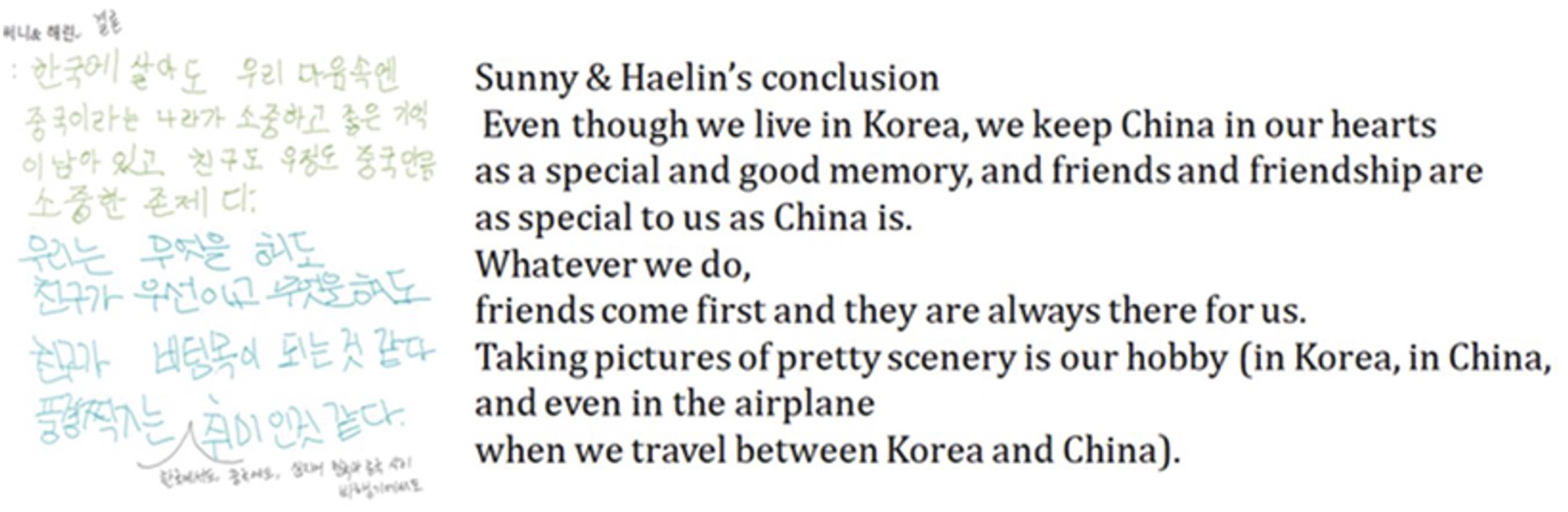
While I assumed migrant belonging entailed being against exclusion, the children continually pushed me to complicate my understanding of belonging. One salient way was their reminding me their lives were more than just being migrants. As with many children their age, friends were the most precious and important people in their lives. In addition, like other children in Korea, the children in the inquiry group went to cram school, struggled with it, and tried to maintain their well-being under the academic stress. Their argument that managing stressful situations was a way they negotiated their belonging made me realize that I had somewhat internalized the dominant view of migrant children as different from other children. Despite my good intentions, I might have unintentionally reproduced the dominant views that constructed these children as “others” in society. Their presentation of their belonging taught me that to support them, I had to disrupt my own preconceptions of them as only migrants and be willing to accept the complexity of their belonging.
Children’s Objection to a Bilingual Teacher’s Joining: Who Are the Cultural Insiders?
Another event that caused discordance between the children and me was a bilingual teacher’s joining the critical inquiries. Inviting a bilingual teacher was an ambitious decision I had made in designing the critical inquiries, since I thought that my subjectivities as a non-Chinese-speaking Korean who had spent most of her life in Korea might limit the asset-based approach.
The bilingual teacher I invited to the class was a female Joseonjok who had worked at the school for 5 years. In a school with many Chinese students, including Joseonjok, this teacher played a vital role, teaching classes in Mandarin and enabling communication between Korean teachers and Chinese parents and students. I thought her teaching experiences in the school and her ethnic, linguistic, and migrant background would help compensate for my limitations as a cultural outsider. Given that some of the children preferred communicating in Mandarin, her joining the inquiry sessions also seemed like a valuable means of providing the children with a unique space where their language was legitimized in school. When I asked children if they agreed the bilingual teacher could join the critical inquiries, they welcomed her and were especially enthusiastic that they could use Mandarin as the main language in the sessions.
However, once the bilingual teacher joined our meetings, the children began to express objections to her presence. In particular, Jay and Euna, whom the teacher helped the most due to their preference for Mandarin, strongly objected to her joining. In their first interview, Jay brought up the issue:
Jay and Euna said they felt timid around the bilingual teacher because they thought she was monitoring them as an authority figure, and they expressed this through emotional words such as “nervous,” “scary,” and “uncomfortable.” Their objection to the bilingual teacher’s joining the inquiry group proved unwavering, as they said they would use Korean in the inquiry communities despite their preference for Mandarin. This strong objection not only led us to cancel the plan to work with the bilingual teacher but also made me think about who cultural insiders would be in critical inquiries with children.
Having cultural insiders present in research has been regarded as a strength in that cultural commonality, particularly the same language and ethnicity (Liamputtong, 2010), allows researchers to be more sensitive to participants and have a deeper understanding of sociocultural contexts (Banks, 1998; Ramji, 2008; Suwankhong & Liamputtong, 2015). My invitation to the bilingual teacher was based on the ethnic, linguistic, and migrant background she shared with the children. However, their strong objection shows that cultural insiders must have more in common than ethnicity and language, especially in critical inquiries with children. By pointing out the bilingual teacher was an authoritative adult, the children made clear there was hierarchy and power even within the same ethnic and linguistic culture. The children’s objection overthrew my simple assumptions about cultural insiders in critical inquiries with children.
“We Already Did a Lot”: How Can Practitioner Research and Participatory Research Be Connected?
The children’s engagement with the critical inquiries impacted the research design as well. Their resistance to the separation of child-led sessions from researcher-led sessions was one example. Based on the blending of practitioner research and participatory research, my dissertation study originally began with five researcher-led sessions to practice critical inquiry, followed by twelve child-led sessions that were to remain open-ended so the children could fill them with actual inquiries.
However, the line between practitioner research and participatory research—or between practice and actual inquiry—did not seem to exist for the young participants. Even before they made their inquiries, the children brought up concerns regarding migrant belonging. After we had completed the first session, Euna texted me, asking, “Does living in Korea mean I have to cheer for Korea [in sports]?” Her text message continued, expressing her frustration with conflicts she was experiencing with her grandmother, who told her she should support Korean teams as long as she was living in Korea. On another night, Jay also sent me a text message regarding her friend who had recently been cursed at when he used a Japanese username in a Chinese online space; she urged me to incorporate and develop this issue in the critical inquiries as soon as possible. Concerns and interests would arise suddenly in the children’s daily lives, and it seemed natural for them to share these issues when the situations became distressing.
The crossing of lines between practitioner research and participatory research happened in reverse as well. As we spent more time than expected in the so-called practice sessions addressing the issues and concerns brought up by the children, Mr. Sun and I worried we would not have sufficient time for the “real” inquiries, so we pushed the group to move forward quickly to the next step. However, their response was clear:
Sunny did not hide her reluctance and refusal in her response to Mr. Sun’s announcement of the so-called real research. Her comment that they had already done a lot of work clearly showed her refusal of the arbitrary distinction between “real” and “not real” research. Mr. Sun and I felt embarrassed by the children’s objection since in our assumption, the distinction was obvious. At the same time, the children’s rejection of our original plans offered a suitable solution to the lack of time as well as a way to connect the children’s voluminous amount of work from the practice sessions to the “real inquiries.”
According to the group’s decision, the topography of the research changed, as shown in Figure 5. In my dissertation proposal, my research study had a linear design juxtaposing practitioner research and participatory research in sequence, but the children’s concerns, desires, and refusals blurred the boundaries between the two and collapsed them into a fluid process. The critical inquiries were not as linear as I, the adult researcher, would have liked. The change in research design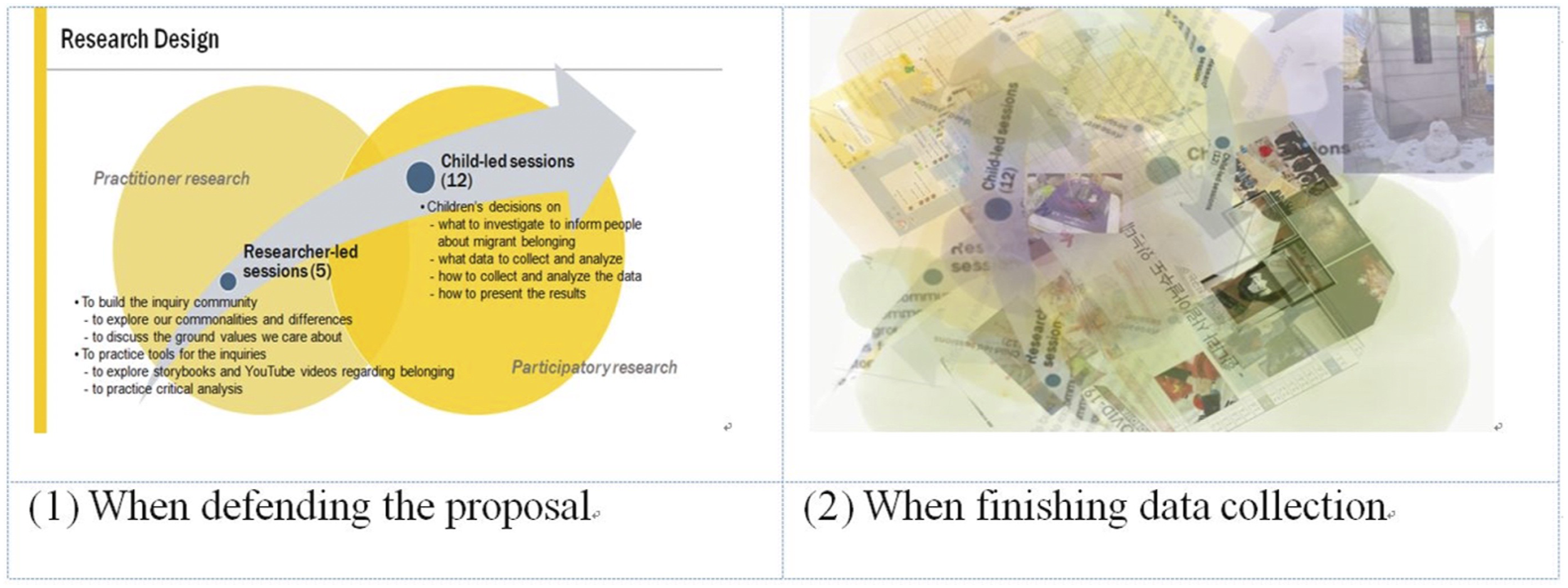
Critical Inquiry With Children as an Unlearning Process
In order to learn from children’s engagement with critical inquiries, this study examines events during which the child participants created complexities in my understanding of migrant belonging and the conducting of critical inquiries. For example, the children brought to the fore the manifoldness of their own belonging, beyond my simple conceptualization, as well as the issue of how power works in groups composed of members of the same ethnicity. They also changed the research design by arguing for abolishing the arbitrary distinction between practice and actual inquiries. In addition, the discordance between the children and me, as the researcher, created obvious methodological dilemmas, such as whose concerns should drive critical inquiries and what should be represented in critical inquiries, continuously reminding me of the necessity of reflexivity in critical inquiries with children, particularly in an asset-based approach.
In this study, conducting critical inquiries with children constantly forced me to deal with the unexpected. These dilemmas were often accompanied by embarrassment and frustration rather than clear resolutions. As MacLure (2013) argued, “suspend[ing ourselves] in a threshold between knowing and unknowing” prevents us from fully knowing but, simultaneously, “affords an opening onto the new” (p. 228). Rather than making a sleek project, I was able to embrace the complexities that child engagement raised by centering learning from children.
The results also illuminate the nature of critical inquiry as an unlearning process, expanding the literature on how to conduct critical inquiries in educational settings (e.g., Comber et al., 2001; Vasquez, 2014). Unlearning what we know involves the possibility of learning what we did not know and, more importantly, of tinkering with the inherent relations of power in critical inquiries with children.
Critical inquiry in educational settings has been highlighted as an emancipatory practice. However, as feminist scholars have pointed out (Ellsworth, 1992; Gore, 2003; Hooks, 1994; Luke & Gore, 1992), critical pedagogies have involved the challenge of how to decenter the authority of teachers (Fobes & Kaufman, 2008; Stanger, 2018), and critical inquiries with children are no exception. The findings of this study suggest reconceptualizing critical inquiry as an unlearning process in which teachers’ and researchers’ preconceptions and knowledges are deconstructed and reconstructed. By struggling with discordances rather than erasing them, I was able open new pathways in the critical inquiries.
Valuing children’s experiences and knowledges should go beyond just proclaiming their existence; rather, we should be ready to learn from those knowledges, and we should acknowledge our ignorance of the things children know and their ways of knowing. Even though we cannot completely eliminate the imbalance of power between teacher and student, between adult researcher and child, acknowledging our ignorance and being ready to unlearn what we believe could be wrong helps us be attentive to our inevitable assumptions and be on the lookout for wrongness.
The findings of this study provide some suggestions for researchers, particularly teacher–researchers who conduct critical inquiries with children. First, researchers need to think of critical inquiry as an ongoing construction rather than an implementation of a predesigned curriculum. Koro-Ljungberg et al. (2020), who advocated “leaky architecture in methodology,” claimed that qualitative methodology should be thought of as an “unexpected, surprising, and continuously shifting design” (p. 292). This implies that research methods need to be understood as a working process rather than a foreseen and predictable order. Similarly, this study highlights that even though critical inquiries are built on the researcher’s assumptions and plans, children’s engagement causes the critical inquiries to shift throughout the project.
As a way to support these shifts, the teacher–researcher should apply sensitivity and patience to the discordances that arise in critical inquiries. These discordances can appear in very brief moments, such as in a few seconds of children’s conversation or in short video clips they share. These fleeting moments may cause intense emotions in the teacher–researcher, such as embarrassment or confusion, so researchers are tempted to dismiss them. However, the findings of this research demonstrate that the moments of discordance could be “ethically important moments,” which refers to “the difficult, often subtle, and usually unpredictable situations that arise in the practice of doing research.” (Guillemin & Gillam, 2004, p. 262). If researchers acknowledge their possible wrongness and are willing to develop their understanding and research design throughout the research, they need to take these moments into account seriously. The tea times I had with the co-teacher after the critical inquiries were helpful in revisiting discordances and probing the conflicting assumptions beneath the tensions. Finding ways to sit with discomfort rather than erasing it quickly is key to allowing critical inquiries to shift according to children’s engagement.
Last, this study shows that alternative inquiry tools have potential to help children engage in critical inquiry. Employing digital practices the children already enjoyed in their daily lives, such as TikTok videos and music playlists, played a major role in producing new and unexpected stories from the group, supporting the idea that researchers need to pay more attention to creative inquiry tools that incorporate children’s ways of knowing. The tools do not guarantee engagement in critical inquiries, as many researchers warn that a participatory approach cannot be reduced to child-friendly methods (Chesworth, 2018; Gallacher & Gallagher, 2008; Palaiologou, 2014). However, they could be useful in inviting elementary schoolers to engage with critical inquiries and creating a basis for researchers to learn from. Making an effort to understand and incorporate these ways of knowing, together with an attitude open to complexities, would be a practical strategy for teacher-researchers to realize critical inquiry as an unlearning process.
Footnotes
Declaration of Conflicting Interests
The author(s) declared no potential conflicts of interest with respect to the research, authorship, and/or publication of this article.
Funding
The author(s) disclosed receipt of the following financial support for the research, authorship, and/or publication of this article: This work was supported by the KAERA (Graduate Student Research Paper Award), Teachers College (Dean’s Grant for Student Research), Teachers College (Research Dissertation Fellowships), and Teachers College (Vice President’s Grant for Student Research).
