




Abstract
This study demonstrates that vignette, when added to the in-depth interview, is a useful data collection method to uncover the hidden truths in the socio-political sensitive business environment. The vignette method’s “less personal” nature motivates the participants, who initially declined to be interviewed, to accept the interview invitation. This study showcases how the vignette is designed, constructed, and applied in empirical research. It also demonstrates the types of cognitive questions that can be incorporated in the vignette to uncover the social norms in practice that are silently known as the rules of the game. This study provides methodological considerations in constructing the vignette that may impact its success. Using the empirical data from the Malaysian housing sector, the thematic analysis shows that the vignette method: (i) stimulates participants to provide in-depth interpretation, (ii) uncovers the hidden information, and can (iii) fill in the missing details that participants initially reluctant to disclose. The findings are discussed, along with the limitations of using the qualitative-vignette method. Some critical suggestions for future research are also included.
Keywords
The interview in qualitative studies enables researchers to have an in-depth understanding of a research context (Legard et al., 2003). The researchers, however, face challenges in recruiting participants to participate, especially on socio-politically sensitive research topics. This is because potential participants are concerned about confidentiality, fearing their identities can be easily revealed, especially when asked about some specific confidential details that are not available to the public. Tolich (2004) divided confidentiality into external and internal confidentiality. External confidentiality refers to the researcher’s promise of not disclosing the participants’ identities in the final report. This is usually done through a consent statement signed between the researcher and participant at the beginning of each interview. Tolich (2004) also emphasizes the importance of internal confidentiality, that is, if the participants in the study can identify each other in the final report. In this study context, confidentiality is extended to consider whether the internal industry players could recognize the participants’ identity in the final report, given the limited number of players in the socio-political sensitive market. Because of the confidentiality concern, participants may hesitate to disclose their insights during the interview. In some cases, they may also decline to participate in the interview. This occurs when examining socio-political sensitive topics such as corruption culture. Campbell and Göritz’s (2014) study revealed that the less corrupt firms or those firms that intend to fight corruption are likely to participate in the interview compared to highly corrupt firms. This may result in the underrepresentation of highly corrupt firms, affecting the research findings (Campbell & Göritz, 2014). Moreover, participating firms may assign atypically loyal employees to participate in the interview, resulting in researchers being misled or receiving limited or embellished information about the company’s actual operations.
To access these sensitive and confidential data, scholars suggest adopting an ethnographic approach by observing participants. For instance, De Rond and Lok (2016) investigated the psychological injury of the army at war via on-site observation at the army camp in Afghanistan for 16 months. However, it could be challenging for the non-citizen researchers to collect data on sites at political-sensitive venues, such as army camps, parliament buildings, or foreign consulates and embassies. Although participants observation is a popular tool to access hidden information, it often requires well-trained and experienced researchers to collect data on-site for a considerable period (Blundo, 2015). As indicated by De Rond and Lok’s (2016) study, on-site observation research could be time-consuming, and thus, it is not practical for researchers with multiple job commitments. Furthermore, it is also challenging for non-citizen researchers to collect data on sites at political-sensitive venues.
On the other hand, LeBaron et al., (2018) suggest video recording as an alternative way of accessing sensitive data without the researcher’s on-site presence. The authors reveal that the method is common in uncovering medical treatment procedures, problem-solving processes, and the participants’ emotional display. However, the neglected inconveniences of using video recordings are: the researcher still needs to obtain prior approvals from the relevant authorities and the written consents from the respondents who are being observed. Moreover, the equipment preparation, logistic arrangement, data collection, and interpretation process may be costly and time-consuming. In addition, the participants who are under-observed may purposely hide their actual behavior or keep sensitive information (Blundo et al., 2013).
Gould (1996) and Richman and Mercer (2002) suggest incorporating vignettes into the interview. It is a straightforward, easy to adopt, inexpensive, and time-saving data collection method compared to participants' observation. Gloud (1996) argued that vignette offers a feasible alternative to observations, allowing the exploration of the sensitive topic without requiring questions involving attitudes. It allows respondents to explain their experience in their own words and disclose unprompted practical reasoning, which is more “aesthetically satisfactory” than a list of comments produced by the “trait method” of the structured questionnaire (Richman & Mercer, 2002). Vignette can also potentially minimize the observers’ bias and avoid ethical dilemmas during the observation (Gould, 1996). Besides, a vignette can also be added to focus group discussions (FGD). Nygren and Oltedal (2015) highlight the benefits of integrating vignettes with FGD in the comparative study. By showing multiple vignettes to the participants from various countries in the EU, Nygren and Oltedal (2015) motivated the multi-national participants to compare the children’s needs of their respective countries. In the same vein, Jakobsen (2012) argued that vignettes motivate the FGD’s participants to debate with one another. The participants may defend their points by quoting evidence from their own experiences. As such, the researcher can uncover the unspoken yet silently known rules of the game in the respective settings rather than the politically correct answers gathered in conventional interviews.
Following this, the author draws his own experiences of handling data collection in the socio-political sensitive context; and how and why he included the real-life vignettes in the semi-structured interview after experiencing declines in interview invitations due to confidentiality concerns. This study showcases how the vignette is designed, constructed, and applied in management research. It also demonstrates the types of cognitive questions that can be incorporated in the vignette to uncover the social norms in practice that are silently known as the rules of the game.
The Characteristics of Vignette
Vignette was first adopted by Alexander and Becker (1978) to solicit participants’ spontaneous responses to a scenario. It could be a photograph (Lanza & Carifio, 1992) or a short story describing a hypothetical scenario (Finch, 1987). It is often used to prob medical case histories and deviant behavior in nursing studies or investigate social problems and prejudicial decision-making in the social science field (Richman & Mercer, 2002). It is often used to explore participants’ perceptions of a complicated situation (Barter & Renold, 2000; Finch, 1987; Lee & Goh, 2020; Reedy & King, 2019). In management studies, the vignette method is widely adopted in quantitative-experiment design studies by applying the constant-variable-value-vignette (CVVV) method or factorial-scenario type of experiments. These quantitative-vignette studies focused on participants’ moral judgments, such as service failure (Wang et al., 2021), leadership in crisis (Klebe et al., 2021), unconscious bias on racial issues (Hughey et al., 2017), risk management in the insurance industry (Bednarek et al., 2021), and organizations’ whistleblowing culture (Valentine & Godkin, 2019). Wason et al. (2002) pointed out some limitations of the CVVV method studies. Firstly, participants may choose the same forced-choice option (or scale) for various reasons (Hunt & Vitell, 2006). Secondly, although the close-ended scale can summarize participants’ judgments, it fails to demonstrate the sequence of the judgment process. Lastly, given the closed-ended questionnaire design, participants may be forced to complete the questionnaire by responding to the behavior they do not commit or the possibility of social desirability bias, even if their anonymity is assured (Fernandes & Randall, 1992; Hunt & Vitell, 2006).
Jenkins et al. (2010) highlight the benefits of adopting the qualitative-vignette method, widely recognized in nursing and sociology studies. For instance, Bradbury-Jones et al. (2014) discovered that patients who were initially hesitant to share their own experiences are more open in sharing their thoughts when the researcher adopts the vignette technique. The vignette method protects the patients’ identity by allowing space between their live experience and the given vignette. As such, researchers can elicit insights from the participants. Aujla (2020) and Lee and Goh (2020) reveal that the vignette method helps examine situational-sensitive topics. For example, Aujla (2020) uncovers the polices’ perspective of honor-based crimes and forced marriages in Canada by including the vignette method in the interview. Similarly, Lee and Goh (2020) use the vignette method to discover underprivileged children’s viewpoints, the tension and dilemma they face. Thus, it shows that qualitative researchers often add vignettes in interviews or focus group discussion when collecting data, it is rarely used as a standalone data collection method which is commonly used in the quantitative study: see, for example, the studies of Atzmüller and Steiner (2010) and Wörtler et al. (2021).
Despite the exploratory and explanatory power of the qualitative-vignette method, the method is rarely applied in management studies. This study addresses the gap by applying the method in Malaysia’s highly regulated housing market. It aims to uncover the insights of the socio-political sensitive housing market, which is unlikely to obtain by the interview method alone. Specifically, this study demonstrates the circumstances under which the qualitative-vignette method is superior, complementary and the reasons that make it as such. It also aims to convince and stimulate future organizational research to employ the proposed qualitative-vignette method.
Qualitative-Vignette as a Data Collection Strategy in Management Studies
The vignette method can capture meanings, professional opinions, social judgments, and situationally positioned behaviors (Barter & Renold, 2000; Keddell & Hyslop, 2018). Hazel (1995) reveals that the vignette offers a solid scenario that allows participants to express comments and opinions. The researcher can then initiate a discussion around the comments articulated. Hughes (1998) added that participants are requested to react to the scenario; in essence, what would they do in that specific scenario from a third-party’s perspective. Therefore, the interviews are less personal, and they potentially motivate the participants to provide insights into the study context (Kandemir & Budd, 2018). When added to interviews, the vignette method can potentially offer high-quality and detailed data that allow thick descriptions that are important in qualitative research. Thus, possibly improving the rigor of the research.
Past studies suggest a few criteria of a good vignette. Firstly, it should be written to reflect the actual situation or be believable in the participants' eyes (Bryman, 2016). Secondly, the participants must be able to associate themselves with the given scenario so that the researcher can draw out the participants’ normative evaluations on the given scenario (Bryman, 2016). Thirdly, a third-party form of attitude and behavioral questions should be incorporated in the vignette to encourage reflective replies. This is essential, especially when it comes to sensitive topics. The participants may feel threatened and, therefore, reluctant to respond when they are directly and openly asked (Finch, 1987; Groot et al., 2020). The above is in line with Hughes’s (1998) assertion, where the author suggests that the questions attached to the vignette should reflect the questions of the other entities, which allows a distance between the questions and the participants. As such, it causes a less threatening ambiance during the interview. Barter and Renold (2000) summarize the advantages of employing the qualitative-vignette method: it allows behavior in context to be investigated, clarifies one’s judgments, and provides a less personal and less threatening way of probing sensitive issues.
Qualitative-Vignette Design, Construction, and Application
Past scholars (e.g., Barter & Renold, 2000; Bradbury-Jones et al., 2014; Rizvi, 2019) suggest that the vignette can be constructed from the research findings of previous research, pilot interviews, real-life perspectives, and literature reviews. This study aims to examine industry actors’ responses to the policy intervention. The secondary data from online and offline media suggested that the housing developers may conform, lobby, avoid, or manipulate the mandatory housing policy. Some of these strategies are considered bending or against the rules. For this reason, the majority of housing developers were shy away from the interview invitation. When approached, some declined by stating that it is against their company policy to disclose outsiders’ internal operations and business strategy. Some invited housing developers insisted on pre-screening the interview questions before being interviewed. After screening the interview questions, most of them declined the interview invitations, while others refused to respond at all.
The above issue is addressed by designing two vignettes. Vignette A was drafted based on a specific company’s annual reports (documents – secondary data). Vignette B was based on the pilot interview data and the author’s observation of an actual scenario. The actual development plan/map was presented to the prospective participants. When re-inviting some housing developers for interviews, they had been verbally informed that the face-to-face interview was based on a “case study” (Note that the less-technical term of “case study” was used instead of “vignette,” so that the participants could relate the “case study” term to their prior understanding). Accordingly, the housing developers were asked to respond to the given vignette. They were assured that they did not need to relate the scenario to themself or their own company’s experience unless they were willing to do so. Three companies initially declined to be interviewed accepted the author’s second invitation. This occurred after the author reiterated that the interviews were based on the given “case study.” The other four newly invited housing developers accepted the author’s invitation after knowing that the interview was vignette-based.
Study Context and the Details of Vignettes
Inadequate affordable housing has become a critical social problem worldwide. Currently, approximately one billion of the world population live in informal housing, as UN-Habitat (2016) reported. Most Asian governments have struggled to provide adequate housing for the low-income group (Shuid, 2016). In Malaysia, an ethnic-based housing policy was introduced in 1971 to offer low-cost flats for the Malays and other Natives in East Malaysia. At that point in time, most of these ethnicities were under the low-income group. After 30 years, the government implemented the need-based low-cost housing policy where the low-cost flats are offered to all the B40 group (the bottom 40% low-income group), irrespective of their ethnicity. Under both ethnic-based and need-based housing policies, the housing developers must allocate 30% of their development for low-cost flats. Given the ceiling selling price of RM25,000 (USD12,500), the housing developers need to subsidize a net RM100,000 (USD25,000) per unit built. To cover the loss, housing developers build high-end housing with a higher margin. They then use the surplus to cover the shortfall in low-cost flats construction (Cheah, 2019; Cheah et al., 2020). This has resulted in an oversupply of low-cost flats and high-end housing and an inadequate supply of middle-end housing for the M40 group (the middle 40% income group). The government responded to this by enacting the affordable home policy in 2012. Housing developers were also required to build middle-end housing. The evolution of housing policies (from ethnic-based, need-based low-cost housing to affordable housing policy) indicates that housing developers need to manage their resources better and have cost competitiveness due to increased compliance costs.
Additionally, over the last 10 years, the rapid growth of inter-state township development and the growing number of integrated developments consisting of commercial and residential development on the same parcel of land meant that property developers had to comply with public amenities and infrastructure requirements. Following the government’s austerity measure, the government has increasingly relied on township developers who operate more than 150–300 acres of land size (depending on the state) to sponsor and build public amenities (schools, park, and place of worship) and infrastructure (road, public transport hubs, and drainage). To meet the mandatory requirement, the housing developers need to coevolve with the new requirements and ensure continuous project approval from the authority (Cheah, 2021).
Vignette A and Vignette B (see Figure 1) illustrate the industry actors’ responses to the Malaysian housing policies. Both vignettes were presented to the participants during the face-to-face interviews for their input and evaluation. The information on Vignette A was derived from the secondary data (the company annual reports), whereas the details in Vignette B were derived from the authors’ observations and data from the pilot interview. Hence, the information on the company in Vignette B is not publicly available. Although the participant’s anonymity is assured, a few participants demanded that the company’s name (of Vignette B) must not be mentioned when reporting, considering that there are only a few key players in the housing market. They are worried that the insider information that they have shared could be easily traced and linked to their actual identity. Based on this concern, the development plan in Vignette B has been modified for reporting. (Note: the actual map is submitted as an attachment to the editors and reviewers for verification purposes. It also serves as a piece of evidence). Vignette A and B.
Both vignettes adopt the following open-ended interview guides: 1. Are you familiar with the description of the situation? 2. In your opinion, what makes the company implement this strategy? 3. Is that common in the housing industry? Have you heard of other similar situations? 4. Do you think the policymakers knew about it? And what are the responses from the policymakers? 5. Moving forward, what do you expect to see in the industry in 5–10 years?
Other probing questions were also included depending on the participants’ feedbacks.
Both vignettes are written in short paragraphs of 160 words and 220 words, respectively, with graphic illustrations. The short and colorful vignettes accelerate the participants’ understanding of the scenarios and generate interest of the participants to offer enough time for both researchers and participants to interact (Barter & Renold, 2000). The storyline is drafted based on the official annual reports and pilot interviews which entices the participants to relate their live experiences, observations, and evaluation of the scenarios.
Research Methodology
Research Paradigm
The strategy to incorporate vignette into the interview as a data collection method aligns with the ontology (relativism) and epistemology (social constructivism) adopted in this research. The relativist approach believes reality is subjective, and social actors produce social reality through social interactions. The adopted social constructivism epistemology also reveals that meaning and interpretation of the business strategy (context of the study) are made via social interactions as no activity is performed in isolation (Harré, 2001; Ivanova-Gongne & Torkkeli, 2018). The social constructivist approach enables the exploration of housing developers’ adaptation strategies. Additionally, this study recognizes the importance of the hermeneutic process, which underpins the interpretive approach (Lopez & Willis, 2004). The hermeneutic process involves exploring the unspoken yet silently known as the rules of the game, which the members of a community share for making sense of the social environment. An interpretive approach tracks the process of sensemaking from the various actors involved, who are heterogeneous. The interpretive approach can potentially uncover the different voices and possibly, the conflicting meanings made by the interpretive-discourse-practice communities (Thompson, 1997). Thompson (1997) particularly highlights the advantage of using an interpretive approach in the research that involved public policy. The approach helps to uncover the black box and hidden hands in the highly regulated environment “the interpretive approach engages various aspects of political, including silence in the discourse, whether silenced by choice or silenced by the force of some sort.” (Yanow & Ybema, 2009, p. 40). As suggested by Aujla (2020) and Barter and Renold (2000), the vignette that integrated with the interview, has the potential to elicit the silence voices, or forced silence voices, from the participants.
Participants Selection Criteria
This study adopts the theoretical sampling, using Scott’s (2013) typology involving five agents who co-influence the affordable housing market. They are as follows: (1) nation-state (policymakers), (2) business firms, (3) professions (including property valuer, consultation company, and auctioneer), (4) associations (Real Estate and Housing Developers Association-REHDA), and (5) marginal players (housing investors and homebuyers). These actors provide their opinions on the given vignettes; the varied voices and opinions offer in-depth and all-rounded insights into the study context.
Respondents’ Profiles.
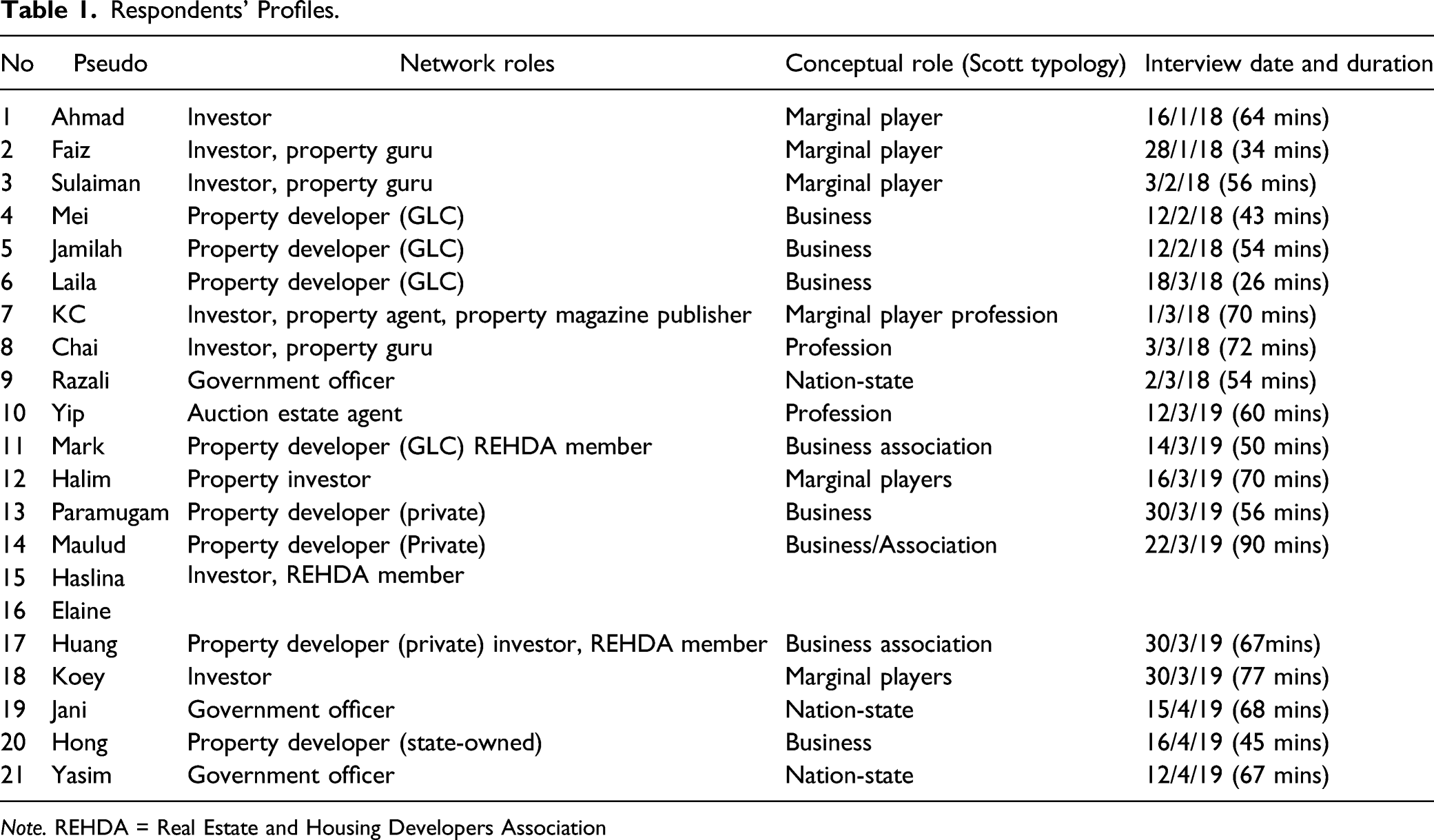
Note. REHDA = Real Estate and Housing Developers Association
Data Collection and Analysis
The interview questions were submitted to the university’s ethics committee for consideration. The approval was granted, and the research is classified as low-risk. Before the interview, all participants were informed about the nature of the research. They are also requested to sign the consent form, covering the collection, analysis, and presentation of the interview data. Participants are ensured about the confidentiality of their identities and all the parties mentioned in the interview. All audio files, field notes, transcripts are held electronically, filed securely, and identifiable only through the relevant pseudonym.
The respondents’ background is limited to their ethnicity (that could be judged from the pseudonym) and professions, as further data analysis according to their ethnicity and professional background is needed. Additional individual background information emerges during the interview. Where there is any potential to identify people, details have been disguised at the researcher’s discretion.
At the beginning of the interviews, a few simple questions about the housing developers’ strategies were raised for their feedback. This is the pre-screening step to identify if the participants were willing to share their opinions with minimal reservations. The interviews were conducted without the vignettes for the active and outspoken participants. As for the participants who hesitated in answering, the vignettes were presented to them first to create spaces between the given scenarios and their own experience. It is also served as an ice-breaking tool (Kandemir & Budd, 2018). The vignette is used sparingly and carefully throughout the research to ensure that the entire interview was not guided by the vignette method; some open-ended probing questions were included. Among the questions were “Apart from the vignette, have you come across a similar situation?” “From your observation, is that possible that the other reason causes this incident?” and “Is this the company’s only strategy can practice?”
The author presented the data in three international academic conferences from 2017 to 2018. The findings were also discussed in the closed-door focus group interviews that involved 27 industry players from all five categories of actors by Scott’s social network typology. The focus groups were organized by the independent Think-Tank and took place from Oct 2018 to Feb 2019. As such, the findings were verified, and members checked. The data collection and analysis happened simultaneously in a non-linear way. The coding and analysis were done manually. It allowed the author to compare similarities and differences of the insights provided by participants. Three themes emerged, as presented in the next section.
Research Findings
Three themes that emerged from the research data are as follows: (i) Illustrating reality – denotes participants’ acknowledgment of the presented scenario and expands by providing more in-depth interpretations. (ii) Uncover the hidden information – exposes the story behind the adoption (or non-adoption) of such a strategy. (iii) Filling the missing details – highlights how the participants relate the vignette to their similar self-experience, which they were reluctant to articulate initially.
Theme 1: Illustrating Reality
Past literature stressed that the vignettes should reflect the realities. Thus, it must be believable (Aujla, 2020; Finch, 1987) in the participants’ eyes. To verify that, participants were requested to review and further illustrate the vignettes. A property investment guru participant, Chai, commented that it makes sense for the company in vignette A to collaborate with multiple government agencies: Researcher: Does the company’s strategy in Vignette A make sense to you? Chai: Yes, it is. I have invested in one of their housing projects. I was surprised that they do not comply with the ethnic-based quota, whereas other housing developers must comply with the mandatory requirement…..Later (after a year), I found out that they used the government agency to negotiate with the government to remove the mandatory ethnic quota.
The housing developer, Laila, affirmed that such a strategy was commonly adopted in the housing industry until 2018. She quoted: Laila: I know another private developer is collaborating with PKNS (a state-owned property planning agency). It is considered a strategic partnership as the private developer can concentrate on the housing development and leverage their strategic partner to deal with policy compliance.
Another property investor participant, Halim, explained the reason why government agencies, as partners, can lobby for flexibility in policy: Researcher: What do you think about the company’s strategy? Halim: The ethnic quota ensures the Malay ethnic shares the property (economic) development pie. The policymaker wants to ensure the Malays are involved as purchasers or developers.
Two government officer participants, Jani and Yasim, were asked to evaluate the ethnic-based quota and the low-cost housing quota currently implemented since the country attained independence in 1957. This question was raised before showing them the vignettes. Both government officers mentioned that ethnic-based and low-cost housing policies are still relevant and fully enforced to date. Their departments are the gatekeepers to ensure that the private housing developers comply with the policy. To gather more insights, the author then presented the Vignette A to both government officers. After deliberating, both officers validated and admitted that housing developers might avoid the mandatory requirements if they collaborate with the right government agencies: Jani: ‘No surprise that the government agencies involved would negotiate with the state (us) for more flexibility on both policies’ Yasim: “Developers who collaborate with the state agencies are likely to be offered leeway and received preferential treatments from the state authority.”
The above reflects the advantage of incorporating a vignette into the interview. When reality in the form of the vignette is presented in the interview, it can elicit more insights from the participants. The input from both government officers reflects possible circumstances of non-compliance with the mandatory policy. It also shows the policymakers’ tolerance when the housing development projects involved government agencies. Both officers acknowledged that the incidents in vignette A have been in practice for the last 20 years, and at the same time, the other participant, Laila, has reaffirmed that the private sector-government agencies' collaborations are the social norm in practice by quoting a similar example. Such insights would not be possible to be captured or recorded without the aid of vignette A (Note that the government officers had denied the possibility of manipulation in the first place before the Vignette A was presented to them).
Theme 2: Uncovering the Hidden Information
This section highlights the story behind the adoption (or non-adoption) of the business strategy, as stipulated in vignettes A and B. A newly set-up housing developer participant, Parumugam, shared his company’s experience by referring to the company in vignette A: “I know it is common for the established companies to work with the government agencies to avoid the policy compliances. I do not think my company can do that because we are still new and must comply with all the policies imposed on us”.
As a new player in the industry, it is likely for Parumugam’s company to take the form of strict compliance with regulations by aligning various resource combinations in continuous interactions with critical stakeholders. Hence, it shows the vignette’s ability to draw out the insider story, which is why the adoption or non-adoption of the business strategy in vignette A.
A few other participants shared their thoughts of the company’s strategy in Vignette B. The housing developer participants, Maulud, Mark, Huang, and Koay, emphatically rationalized the company’s strategy in breaking up the big piece of lands into smaller pieces for housing developments since the year the 2010s: ‘When the lands are subdivided into a smaller size, the developers can avoid the low-cost flats quota, and they no longer need to subsidize the shortfall in low-cost flats construction. After all, all housing developers are profit-driven; they can always find ways to go around the policy to maximize profits’ (Koay). ‘It makes sense for the company to sub-divide the land because the policy compliance is way too expensive. In a critical situation like now, the developers would prioritize survival over policy compliance’ (Mark). ‘It is a brilliant idea for the company to sell the big piece of land. No. 2 to a government-linked company. It reduces their total land size and avoids the mandatory requirement to build public amenities. They also sell land No.3a and 3b to private individuals. So now, these private individuals are separate business entities’ (Huang). ‘Our hands are tied; we are so different from other industries. As a seller and producer (of housing), we could not decide what price to sell and whom we can sell? So, I can see the rationale of manipulation.’ (Maulud)
The above verbatims show that the housing developers rationalized the company’s act in Vignette B by providing their social judgment and professional opinions (Barter & Renold, 2000; Keddell & Hyslop, 2018). This study showcases that the participants are more willing to share if a gap is created between them and the vignette case, especially regarding a sensitive topic such as the business strategy of breaking the state rules and regulations. Barter and Renold (2000) indicated that a vignette allows behaviors in context to be investigated, clarifies one’s judgments, and provides a less personal and less threatening way of probing sensitive issues. In this case, the manipulating strategy is a sensitive issue. In essence, the vignette can provide thick descriptions of the subject matter.
Theme 3: Filling the Missing Details
This section uncovers how participants relate their similar self-experience that they are reluctant to articulate if asked directly.
Huang, a property developer, disclosed the rationale of building relationships with government agencies in Vignette A because Malaysian housing developers must offer political contributions to the political parties, especially developers who have projects pending approval from the state authority. As Huang mentioned, this phenomenon is not exclusive to emerging economies like Malaysia but also developed nations. The other property agents, KC, and Yip added their thoughts on the mentioned political contributions. KC: ‘The political contribution is often channeled through the middle man or the government agencies. Perhaps this is why the company (Vignette A) builds relationships with the government agencies. …… Housing developers need to set aside a budget for political contribution, especially during the public election campaign’. Yip: ‘As far as I know, the political contribution is common. Some giant firms are fully and officially involved in the presidential election campaign in the USA. In Canada, housing developers’ political contributions could shape the election outcome’.
The above indicates the vignette’s capability in filling up the missing details on the companies’ strategies in vignette A. It entices the essential details from the participant Huang on the political relationship building and election campaign funding that took place in 2013 and 2018. It also enables the researcher to use Huang’s input and elicit further details from other participants. The vignette stimulates the participants to insert the vignette’s missing details when they respond to the authors’ questions (Finch, 1987; Kandemir & Budd, 2018). As such, it offers a detailed and thick description of the subject matter.
When responding to the given vignette, another participant, Mark, endorsed the companies' strategy in vignettes A and B by relating his recent experience. Also, note that the below insider and detailed statistical information was shared after the presentation of vignette B to the participant. The statistics rationalized the act of the company’s strategy in breaking up their lands. Researcher: Is the company’s strategy described in vignette A & B common in the housing industry? Mark: ‘Well…I have been in the housing industry for more than 30 years, and I would say such manipulation is becoming rampant. 20 years ago, most of us complied with regulations. Back then, there was less competition in the industry; that is why……Recently A property developer who was considering buying a big piece of land for township development had appointed me to do a feasibility study. I was tasked to work out the cost of including the public amenities and infrastructure in their development plan. Our finding was: after land allocation for public transport hubs, schools, playgrounds, sewerage treatment plants, mosques, and green lung reserve, only 60% of the land could be used for housing project development. The land cost is now Ringgit Malaysia 50 per sq feet instead of the initial Ringgit Malaysia 24 per sq. feet.’
Another property developer, Malud, related his recent experience in 2016 after reviewing Vignette B: Maulud: I can understand the reason that had made the company divide the land. I have one housing project of 150 acres in the X area. Before I completed the project, I received a notice from the state government that I needed to provide drainage infrastructure, not only within my housing project but also in the surrounding area. Researcher: So, how did you respond to the sudden requirement? Maulud: I tried to appeal to the state government because such a requirement is not part of the initial township approval plan. ….but there is no room to argue with the authority as they control all approvals.
The above statements demonstrate another instance where a vignette can elicit the company’s adaptation strategy’s missing details in the highly regulated network.
Conclusion and Discussion
Selected Verbatims Motivated by Vignette Presented.
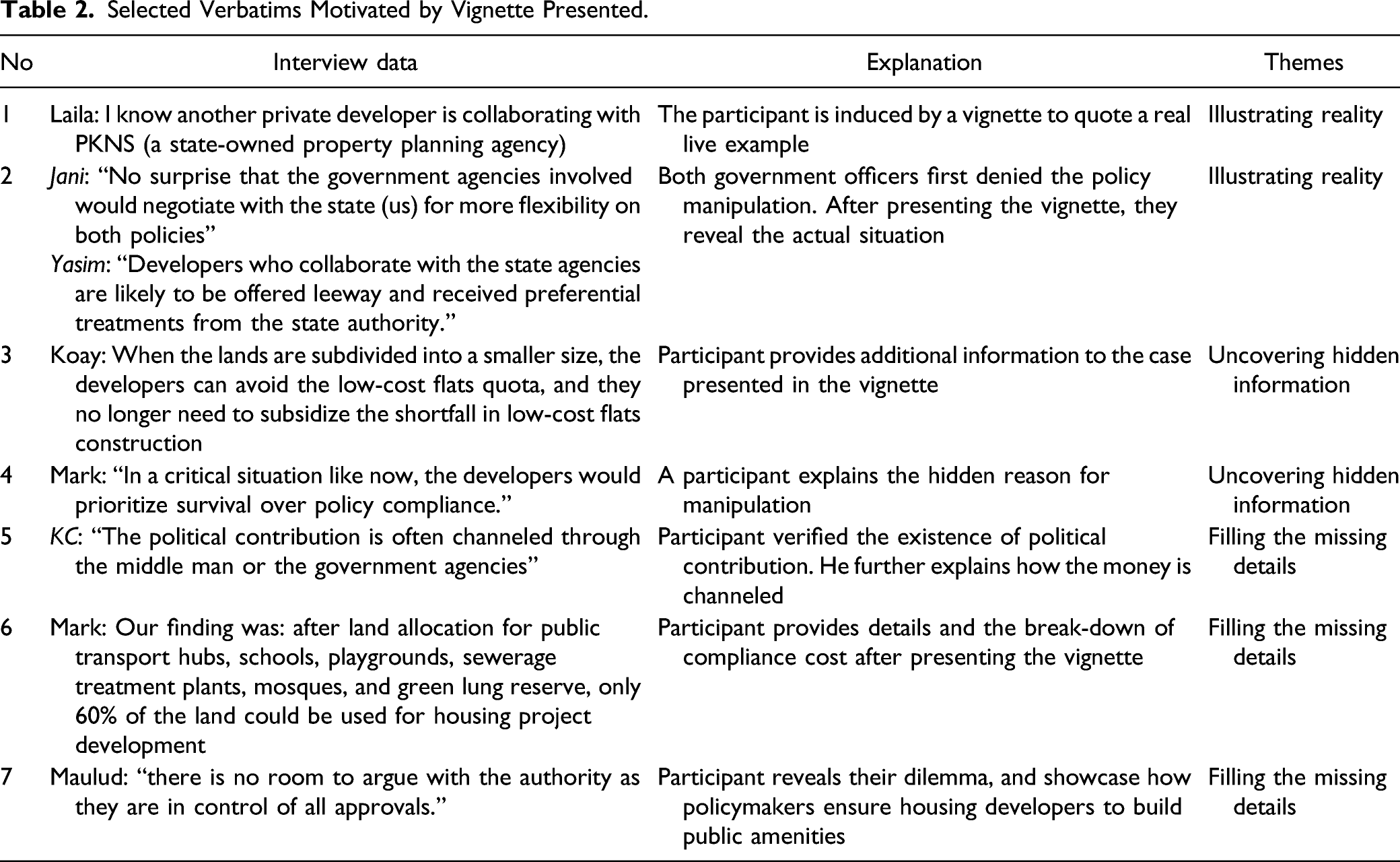
This study systematically demonstrates the process of vignette design, construction, and its application in the social network. It demonstrates several ways of designing vignettes from the primary data (from the author’s observation and pilot interviews – Vignette B) and secondary data (from the publicly available annual financial reports – Vignette A). It also demonstrates the circumstances under which the vignette method is superior, complementary, and why? Precisely, the vignette is only presented to the participant when the participants articulate their views with reservations and hesitations (for the case of some housing developers) and when the participants openly deny the manipulation strategies that are already widely practiced in the social network (for the case of government officer participants – Jani and Yasim). Moreover, this study also suggests that the vignette could entice participants to participate in the interview. Notably, it showcases that participants who declined the interview invitation eventually accepted it after the vignette was adopted.
Using theoretical sampling, this study allows varied voices and interpretations from the five categories of industry actors, but the vignette technique further empowered these participants to control how their experiences are shared. The non-directive nature of the vignette guided participants to articulate industry problems and policy obstacles. It inspired the participants (who are also the practitioners) to interpret the vignette in their terms (Barter & Renold, 2000) and tap into their stock of knowledge (Jenkins et al., 2010) on business strategy. Specifically, the vignette technique elicits participants’ different meanings and interpretations of the same scenario. For instance, the participants have conceptualized collaborations with the government agencies as (a) to go around the mandatory policy, (b) to leverage on their partner to negotiate with the policymakers for policy compliance, so that the developer can have more focus on their core business, (c) to channel political funding, (d) to stay relevant as they have multiple projects that are pending approval from the authority. The input added details into the vignette and has enriched the research findings, which may not be captured if the vignette is not adopted.
Methodological Contributions
Holmlund et al. (2020) highlighted five critical characteristics of excellent qualitative research; relevance, rigor, integrity, narration, and impact. The subsequent section justifies the vignette method’s potential to enhance some of these qualitative research qualities.
This study depicts the vignette construction involving the industry practitioners’ pilot interview data and the researcher’s self-observations. Participants were provided with “space” to interpret the situation as a third-party observer during the interviews. They are also allowed to relate their personal experience to the vignette. Applying the social constructivism-interpretive approach and maximum variation-purposeful sampling, the study invites all the stakeholders to follow Scott’s social network typology. This allows social judgments and professional opinions to be recorded and thus enhances the research topic’s social value and managerial relevance (Holmlund et al., 2020; Tracy, 2010). It also permits varied and balanced voices from multiple perspectives. Doing so enhances the data quality and enriches the subsequent data analysis. This makes the study more solid and rigorous. Combining the vignette method and interview, this study uncovers the hidden truths on actors’ coping strategies in the regulated market, which is unlikely to be obtained by the interview method alone or any other data collection method such as a questionnaires survey. As such, it potentially addresses the few possible shortcomings of the qualitative research highlighted by prior scholars, that is, not enough data, lack of detailed data that could be used to analyze the context under study and thus limits its theoretical and managerial contributions (Holmlund et al., 2020; Witell et al., 2020). Furthermore, a vignette is used as a tool to cross-examine the participants’ opinions.
When approaching the participants, the researcher emphasized and assured them of confidentiality. The vignette was highlighted during the interview invitation. Those situational-sensitive participants were assured that they only needed to respond to the vignette. When reporting the research findings, the participants were each given a pseudonym. Sensitive issues highlighted by the participants would be sensibly and appropriately reported. For instance, Vignette B’s map is modified to protect the participants’ actual identities, given that only a handful of industry players have insider knowledge of the context. The impartially designed, non-directive nature of vignettes coupled with open-ended questions permits the participants to interpret the vignette on their terms. Doing so allows the researcher to set aside his/her own opinion, and the participants are more focused and only need to provide feedback on the issues under study. As such, it minimizes and refrains the researcher’s likelihood to impose his/her own opinion, which may influence the participants. In some cases, the participants’ interpretations are cross-examined with other participants to allow more in-depth explanations. As such, the research findings are more transparent and trustworthy, contributing to the value of research integrity.
Limitations
Despite the vignette’s usefulness and practicality, some scholars highlight their concern about the vignette’s capability to capture reality fully. The vignette is often presented in a short story form; hence, the concern on the validity of the research findings might be questionable (Finch, 1987; Hughes, 1998). Additionally, some scholars believe that even though the vignette is a useful tool, it comes with a risk when the researcher and participants are too narrowly focused on the vignette case. This may neglect the other circumstances and limit its exploratory power in a qualitative design. To address the concern, some open-ended behavioral questions can be incorporated in the vignette to encourage reflective replies from the participants to address this possible limitation.
Although the vignette method allows a distance between the questions and the participants, where the participants were asked what they would do if they experienced a similar scenario (Hughes, 1998), this possibly creates uncertainty on the actions that they think they could do and also the actions that they would do in the actual scenario. Therefore, the results or decisions might be inconsistent. Additionally, the possibility of social desirability bias, as found in the quantitative-vignette method (Fernandes & Randall, 1992), may still exist. The participants are inclined to provide a “right answer” in a manner that the interviewer/researcher would favorably view.
Implications for Future Research
Despite the limitations highlighted above, the study suggests that the vignette method is a useful data collection tool. Future researchers investigating political or socially sensitive topics, such as political stance survey, corruption topic, whistleblowing culture, ethnicity, and LGBT issues, may explore the vignette method as it creates a platform that allows proactive and interactive responses to the business, social, and political participants. Future empirical studies that adopt the vignette method may also consider methodological concerns and participants’ receptions to the vignette.
Footnotes
Declaration of Conflicting Interests
The author(s) declared no potential conflicts of interest with respect to the research, authorship, and/or publication of this article.
Funding
The author(s) received no financial support for the research, authorship, and/or publication of this article.
