




Abstract
The LIFE-DCY research project has two aims. First, to evaluate disabled children’s quality of life (QoL) as reported by themselves and their parents, and second, to locate commonalities, differences, and conflicting issues in the processes that may influence disabled children’s life quality and participation. This paper describes the study design, methodology, and methods along with lessons learned. In addition various methodological and ethical concerns are raised. A sequential mixed-methods design was applied. In Phase one (mapping) we used KIDSCREEN-27 to study how disabled children evaluate their QoL compared with the perspectives of their parents and those of non-disabled children and their parents. Using the Participation and environment measure we also studied parents’ perspectives of their children’s participation in different social contexts. Altogether 209 disabled children and their parents, and 335 children in a control group and their parents (paired reports) participated in phase one. Phase two (unpacking) consisted of 14 case studies with disabled children aged 8–18 years and focus groups with 21 disabled people aged 19–35 years. The initial analysis was inductive and data-oriented. We then used critical and transformative lenses to shed light on how meaning was made of life quality and participation in relation to the context in which study participants found themselves. The LIFE-DCY research promotes an understanding of how important aspects of life quality and participation may intersect within different contexts and at different times. The theoretical understandings from this study may also help unpack various aspects of childhood disability in terms of knowledge and power and enhance understandings of how ideas about normality and childhood disability are constructed.
Keywords
Introduction
Research into the life quality and participation of disabled children and young people 1 has been fragmented and spread over different disciplines and has mainly consisted of small-scale qualitative studies (Stalker, 2012) and a limited number of large survey studies (Silva et al., 2019). Many of these studies provide partial and/or descriptive perspectives, which limit the possibility of scrutinizing the complex dynamics involved in participation of disabled children and young people along with their life quality 2 (Tisdall, 2012; Watson, 2012). Furthermore, due to the lack of necessary adaptations, disability is often poorly presented in research that aims to provide important insights into children’s and young people’s well-being and social contexts. This was the inspiration for a study on life quality and participation (LIFE-DCY) that sought to evaluate disabled children’s life quality as reported by themselves and their parents. This paper describes the study design, methodology, and methods along with lessons learned. In addition, we discuss various methodological and ethical concerns and how they were addressed in relation to our use of a critical disability studies perspective (Goodley et al., 2019) in combination with a transformative mixed-methods design (Mertens, 2007; Mertens et al., 2013).
The intersecting dynamics of disabled children’s life quality and participation, which are the hallmarks of our project, are arguably best studied through a mixed-methods design that allows extensive quantitative and rich qualitative data to be produced and compared. Our point of departure was that, although life quality and participation measures are important in enabling the comparison between the ratings of disabled and non-disabled children and their parents, they nevertheless have shortcomings since they do not take into account each child’s unique perspective on the relevant significance of a measure’s set options in relation to their life (Gibson, 2016). Thus, in order to scrutinize the commonalities and differences between disabled and non-disabled children’s and young peoples’ experiences, we integrated quantitative measures with stakeholder perspectives through creative, participatory methods. By comparing and contrasting different types of datasets, we aimed to provide a broad spectrum of insights into aspects that facilitate or restrict the life quality and participation of disabled children and young people. We also aimed to identify recommendations for increasing their opportunities for participation and living a “good life.”
Theoretical Perspective
The complexities of evaluating life quality and participation pose challenges to research design and methodology, particularly when research aims to generate both generalizable knowledge and in-depth understanding of the ways in which an individual’s experiences take shape within certain contexts.
Our theoretical perspective played an important role in our study design aimed at addressing these challenges. We framed the study within a critical approach to disability (Goodley, 2014; Goodley et al., 2019; Meekosha & Shuttleworth, 2009) that promotes an understanding of and challenges exclusionary and oppressive practices associated with ableism, and aims to unpack the ways in which these may intersect with other forms of marginalization, such as class, gender, and ability. What unites critical disability study theorists is an agreement that disabled people are undervalued and discriminated against and that this cannot be changed simply through changing legislation and policy (Goodley et al., 2019). Instead, new forms of knowledge are needed that value disabled people’s experiences as experts in helping to address marginalization and exclusion. In line with this approach, this study focuses on the multiple disadvantages and mutual processes of exclusion which may affect disabled children and young people’s life quality and participation. Moreover, we sought to explore the possibilities for living well in non-normative bodies and to push back against the imperative that bodies should conform to normative ideas. Through this critical lens, the body, emotions, and affect are surfaced while cultural and structural systems that get in the way of living well with disability are critiqued (Goodley et al., 2019; Meekosha & Shuttleworth, 2009; Meekosha et al., 2013).
A second pillar of our theoretical perspective is a transformative framework that focuses on generating knowledge that pertains to societal contexts and emphasizes social justice, the role of power differentials in the definition of reality, and specific issues of importance to marginalized groups (Mertens, 2007; Mertens et al., 2013; i.e., disabled children and young people). This is consistent with our critical approach and foregrounds the importance of designing studies around building trust with participants and transparency of goals and strategies through partnerships and dialogues between researchers and disability communities. Our study was inspired by the fact that, although Article 7 in the Convention on the Rights of Persons with Disabilities (United Nations, 2007) states that disabled children’s perspectives are to be given due weight, on an equal basis, with those of other children, there are indications that, they may not be heard or their concerns may not be acted upon in research and practice (Andersen & Dolva, 2014, Bekken, 2017; Einarsdóttir & Egilson, 2016; Wickenden, 2019). In our study, we specifically aimed to include children and young people who are typically excluded from research and to learn from their experiences as a basis for societal change. A transformative framework requires that dissemination of findings is conducted in ways that encourage them being used to enhance social justice and human rights (Mertens, 2007; Mertens et al., 2013; Sweetman et al., 2010), something we have implemented throughout the research process.
By focusing on uncovering processes of knowledge, power and exclusion, the two frameworks contributed to a holistic understanding of disabled children’s and young people’s experiences that helped us interrogate the key constructs of our study and generate new types of knowledge with transformative potential.
Life Quality and Participation
The two constructs, life quality and participation, are often ill-defined or inadequately defined with different researchers and disciplines having different understandings of what is desirable and important and what constitutes a “good life” (Coster et al., 2012; Dahan-Oliel et al., 2012; Dijkers, 2007; Fayers & Machin, 2016; Gibson, 2016; Haraldstad et al., 2019). However, most scholars agree that life quality is a multidimensional construct that reflects on the individual’s perception of his or her life and well-being (Whoqol Group, 1995). Use of quality of life (QoL) measures is important in enabling comparison between groups, such as between the views of disabled and non-disabled children and their parents (Ravens-Sieberer et al., 2005).
Such measures, nevertheless, presuppose that life quality is a pre-existing stable object, altogether discoverable and amenable to measurement. Standardization unavoidably imposes particular normative ideas about what constitutes a good life by offering set options that do not take into account individuals’ perspectives on the relevant significance of each of these options in relation to their lives (Gibson, 2016). Ideas of what constitutes a good or poor life are part of a larger repertoire of socially embedded beliefs that mediate how persons come to understand themselves and others (Bourdieu, 1977). Although subjective satisfaction with life has been promoted as the most important conceptualization of life quality, it should be acknowledged that individual determinations of satisfaction do not occur in a social vacuum but rather are shaped by prevailing normative discourses of normality and disability. Thus, personal judgments of the goodness of life are always formed within sociocultural environments across time and place, as well as by immediate circumstances, opportunities, emotions and state of mind (Gibson, 2016).
Participation is also a multi-dimensional phenomenon and is commonly described a person’s involvement in a life situation (World Health Organization, 2001), highlighting everyday functioning and social roles. Lack of conceptual clarity and operationalization of the meaning of participation has been pointed out (Maxwell et al., 2012; McConachie et al., 2006; Piskur et al., 2014), but two main dimensions are typically described, an objective dimension reflecting whether someone is included in the routine social activities of a particular setting, how and with whom and a subjective dimension reflecting engagement, sense of belonging and satisfaction with the extent of one’s involvement within that setting (Anaby et al., 2014; Coster et al., 2012), acknowledging the informal and social aspects of the construct (Horgan et al., 2017). In line with our theoretical perspective, this study specifically considered the social and material features of the children’s and young people´s typical environments at home, school and in their communities (e.g., social relations, attitudes, practices and traditions, physical layout, sensory qualities and aspects of nature), to determine to what extent they were able to participate within different settings. Also, how these environmental features affected the development of accommodations and acceptances that could promote the children’s and young people’s participation (Egilson & Hemmingsson, 2009; Egilson, Jakobsdottir, et al., 2017; Egilson et al., 2018; Imms & Granlund, 2014; Krieger et al., 2020).
Study Aims
Drawing from this combination of critical disability studies and transformative approaches, we designed a study that aimed to develop understanding and knowledge about Icelandic disabled children’s and young people’s life quality and participation. While foregrounding the views and perspectives of disabled children and young people, we also included the perceptions and expectations of their parents and other key stakeholders to develop insights into the role of the social contexts in which the children’s experiences were formed. This included decisions regarding participation made by different stakeholders and structures and processes that facilitated or restricted disabled children’s and young people’s participation, inclusion and overall life quality and well-being.
Our focus on the interplay between social and material features and processes that impact disabled children’s and young people’s experiences of life quality and participation was operationalized through specific emphasis on (1) the role of agency and resistance, (2) the role of language in interactions between children/young people and other stakeholders, (3) the interplay between the children’s experiences of being disabled and the environments in which they participated, and (4) the intersection of disability with other dimensions of the children’s and young people’s lives. In order to meet our aims, we developed eight research questions, four quantitative and four qualitative/mixed-methods questions. How do disabled children rate their QoL as compared with non-disabled children? How do disabled children rate their QoL as compared with their parents? How do parents of disabled children rate their children’s QoL as compared with parents of non-disabled children? How do parents of disabled children rate their children’s participation and environment supports as compared with parents of non-disabled children? How do the perceptions of disabled children and young people about their life quality differ from that of family, friends and teachers and how can this be understood/explained? How do the socio-cultural-material environments interrelate with disabled children and young people’s life quality and participation? How are disabled children and young people actively involved in important (personally defined) aspects of their lives? How do the constructs of life quality and participation interrelate in the lives of these disabled children and young people?
Study Design and Methodology
Scholars have pointed out that mixed-methods designs are uniquely suited to providing a multifaceted picture of life quality and participation (Carroll et al., 2018; Gibson et al., 2014). Applied to our study, this resulted in a sequential transformative explanatory design (Creswell, 2014; Mertens, 2007) in which quantitative measurement of children’s life quality and participation was followed by a range of qualitative methods in an effort to extend the breadth and range of inquiry, and complement and bridge objective and subjective ways of knowing.
We initially used surveys in our “mapping phase” to compare QoL ratings between disabled and non-disabled children, between disabled children and their parents, and between parents of disabled and non-disabled children. We then followed with an “unpacking phase,” consisting of qualitative case studies and focus group interviews in order to yield rich information about the situations and perspectives of disabled children and young people. The survey data in the mapping phase were gathered in 2015–2018, although preparations started as early as 2013 by translating, culturally adapting and piloting the two measures and setting up an electronic platform (Egilson et al., 2013; Egilson, Jakobsdottir, et al., 2017; Egilson, Ólafsdóttir, et al., 2017; Egilson et al., 2018; Jakobsdóttir et al., 2015; Ólafsdóttir et al., 2014). The qualitative data in the unpacking phase were generated in 2017–2019. Analyses are ongoing, particularly those building upon the entire dataset. Figure 1 presents the components of the study design.

Theoretical stance: Critical and transformative.
The study was approved by the Icelandic Bioethics Committee (VSN-13-081/16-187-V2).
Phase I—Mapping
This phase was designed to provide statistical information about the QoL, participation and environments of disabled children aged 8–18 as compared with children of the same age from the Icelandic national registry—in order to answer the first four research questions. Thus, we examined how disabled children evaluated different aspects of their QoL and compared this with the perspectives of their parents and of non-disabled children and their parents to convey existing similarities and differences. We also gathered data on parents’ perspectives of their children’s participation in different environmental settings.
Measures
Two measures, KIDSCREEN-27 (KIDSCREEN Group Europe, 2006) and the Participation and Environment Measure [PEM-CY] (parent report; Coster et al., 2011, 2012), were used.
KIDSCREEN-27 is a generic QoL measure designed for children aged 8 to 18 that can be self-completed or used as a parent-proxy report. This measure was chosen as it provides a broad perspective on the understanding of QoL and focuses more on how the child feels than on what he or she can do. Furthermore, the measure is child-friendly and easy to complete (Ravens-Sieberer et al., 2006). KIDSCREEN-27 includes five dimensions: physical well-being (five items), psychological well-being (seven items), autonomy and parent relations (seven items), social support and peers (four items), and school environment (four items). Either the frequency of feelings or behaviors or the intensity of an attitude is assessed. Each item is scored on a 5-point scale and the recall period is one week (KIDSCREEN Group Europe, 2006). The measure has been translated and validated for more than 40 countries (Silva et al., 2019). It has good psychometric properties and excellent cross-cultural comparative validity (Ravens-Sieberer et al., 2014).
The PEM-CY is designed for parents of children aged 5–17 and examines children’s participation and the effect of the environment on participation at home, in school and in the community (e.g., community events, organized or unstructured physical activities and getting together with other children). In the PEM-CY, parents are not only asked to identify how frequently their child participates but also how involved the child typically is while participating and whether the parent would like to see the child’s participation in this type of activity change and how. In the environment section, parents report on whether and how environmental characteristics such as physical layout, sensory qualities, attitudes, and cognitive and social demands of activities have an impact on their child’s participation at home, in school and in the community. Furthermore, parents’ views on structural and social aspects are included through questions about the availability and adequacy of resources in these three settings, such as, services, information, time and money. The PEM-CY fits well with our theoretical perspective as it links the impact of the environment to participation within a particular setting, focusing simultaneously on participation and environmental factors (Coster et al., 2011, 2012). The PEM-CY has been translated and culturally adapted into a number of languages (Krieger et al., 2020).
Participants and Procedures
Disabled children aged 8–18 were recruited from the registry of the State Diagnostic and Counselling Centre (SDCC), which keeps diagnostic records of the great majority of children and young people diagnosed with neurodevelopmental disabilities in Iceland. Initially, data were gathered on children with ASD with an IQ ≥ 80. In order to get a more varied sample, we then included children with physical impairments and children with an IQ < 80. Many children were diagnosed with more than one type of impairment. In order to reach out to children with sensory impairments, we also collaborated with institutions providing services for children with vision and hearing impairments. Consequently, the KIDSCREEN-27 platform was adapted in order to accommodate children with vision impairment and translated to sign language in order to reach deaf or hard-of-hearing children. Survey data from a control sample from the Registers Iceland allowed for comparison between disabled and non-disabled children and their parents. Although the survey data were not gathered simultaneously but in three phases and then amalgamated, the exact same procedures around data gathering and analyses were implemented all three times. The KIDSCREEN was first sent out electronically to children and their parents, and 8 weeks later, parents had the option of answering the PEM-CY.
Information on altogether 209 disabled children and their parents and 335 non-disabled children and their parents (paired reports) were gathered. Overall, the sample was varied and considered representative by our partnering institutions.
Most of the information about data gathering, analysis and accessibility procedures within the mapping phase has been thoroughly described in our earlier publications (Egilson, Jakobsdottir, et al., 2017; Egilson, Ólafsdóttir, et al., 2017; Egilson et al., 2018; Ólafsdóttir et al., 2019). Key findings reflect that disabled children rated their QoL lower than the children in the control group but nevertheless mostly within the average range. Parents of disabled children evaluated their children’s QoL lower on all dimensions than did parents of children in the control group, and the difference was substantially larger than for the children´s self-reported scores. Finally parents of disabled children rated their children’s QoL considerably lower than the children did themselves, even if they were asked to answer “just as their child would.”
According to their parents, disabled children participated in fewer activities and were less involved than their peers at home, within school and the community. Parents of disabled children desired more change in their child’s participation than did other parents. Also, parents of disabled children much more often reported that characteristics of the environment made participation harder (Egilson, Jakobsdottir, et al., 2017; Egilson, Ólafsdóttir, et al., 2017; Egilson et al., 2018; Ólafsdóttir et al, 2019).
Comparing the answers from parents on KIDSCREEN-27 and PEM-CY is ongoing and will allow for a better understanding of their reasoning at the time and place of assessment, that is, whether or how their understanding of their disabled child’s participation and environmental supports may possibly explain how they answered questions about their child’s QoL. Forthcoming papers present the correlation between parent’s ratings of the two instruments along with the psychometric properties of the Icelandic version of KIDSCREEN-27.
The survey results provided important pointers for targeting recruitment of participants and refining the focus of the next phase, unpacking.
Phase II—Unpacking
This phase was designed to explore in-depth the diversity, complexity and richness of disabled children’s lives. It took place after most of the survey data had been collected and consisted of (a) case studies with disabled children age 8–18 years and (b) focus groups with young disabled people age 19–35. In this phase we aimed to follow-up on and better understand some of the key-findings of phase I, such as the different views of parents and their children about the children’s life quality, and the effect of different environments on the children´s possibilities for participation.
Case studies (Creswell, 2014; Yin, 2009) can promote an understanding of the context in which disabled children´s lived experiences take shape, such as the daily structure of the children’s lives, their aspirations and agency, and the role of important actors in their lives. Moreover, this methodology made it possible to build a relation of trust with the children, and to apply a step-wise approach in addressing sensitive issues. The components of the two surveys proved helpful in broadening the scope for the children’s reflections on their life quality and participation.
In addition, focus groups were conducted in order to further reflect on the survey findings and on the meaning of the two key-constructs in the lives of disabled children and young people. This method departs from a retrospective approach that allows for considering aspects of life quality and participation within the context of participants’ life stories and experiences. Also, group dynamics support participants in exploring and clarifying their views in ways that would be difficult in an individual interview (Krueger & Casey, 2009). Participants were recruited through invitation letters from our collaborating institutions, ads on their websites and other social media, and through key informants within the disability sector, such as disability activists and service providers. In order to obtain a varied sample in terms of gender, age, residence and impairment types, snowballing recruitment followed through existing study participants.
Altogether four children in the case studies and 10 participants in the focus groups were recruited through snowballing and key informants within the disability sector. We emphasized reaching out to youth who are often excluded from research on the grounds that they cannot speak for themselves (Teachman, 2014), such as children and young people diagnosed with ASD, communication and sensory impairments and/or mild intellectual disabilities. Table 1 summarizes the main characteristics of the participants in this phase.
Characteristics of the Disabled Children and Young People Who Participated in the Unpacking Phase of the Study.
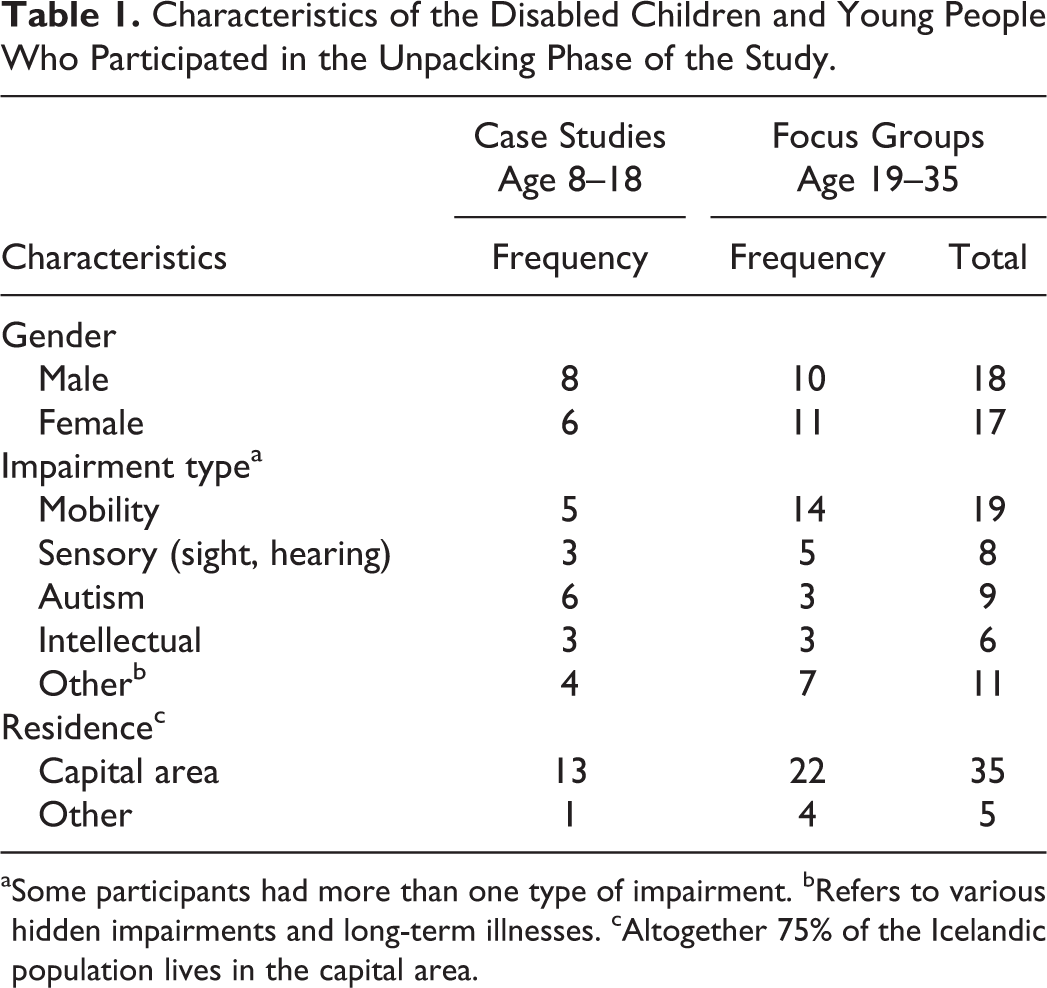
aSome participants had more than one type of impairment. bRefers to various hidden impairments and long-term illnesses. cAltogether 75% of the Icelandic population lives in the capital area.
Participants and Procedures
Case-studies
Each case centered on a disabled child and included interviews with the child and at least one parent and one teacher, along with observations and document analysis. In line with the case-study approach, we drew on multiple sources of information (Creswell, 2014; Yin, 2009). Interview guides for children, parents and key actors such as teachers and therapists were developed by the research team. The interview guides were informed by the main components of and our analysis of the two surveys in order to connect the two phases of our data collection. Thus the interview topics covered various aspects of the child’s participation in different settings, their involvement and sense of belonging, friendships, and what they identified as key aspects of a good life. In addition, the children were encouraged to choose conversation themes that they found important.
Typically, we started by interviewing parents to gather background information that would better enable us to build trust and establish rapport with their child, and ensure that we focused on topics and issues that were relevant to their child (Teachman & Gibson, 2013). Then we met with the child on several occasions. For children with difficulties expressing their views and feelings, we opened the dialogue by talking about something that she or he enjoyed (Skovbo Rasmussen & Pagsberg, 2019) and then used the questions in the KIDSCREEN-27 to initiate conversations about life quality and experiences of participation in different settings. We told the children ahead of time what we would ask about in the interview and how long it would last. In order to avoid jumping to conclusions, we emphasized probing and asked the children directly about certain events and experiences through questions such as “Why did you do it that way?” “What were you thinking when…?” “How did you feel when…?” Stakeholders such as teachers and therapists were typically interviewed last.
Observations took place in the children’s usual environments, such as, within their homes, their schools and in recreational settings, and focused on the children’s possibilities for participation and their engagement and interactions with peers and adults. Participants also shared with us documents such as the child’s individual education plan, school assignments, photos and drawings. Approximately 6 months after the last interview, participants received accessible summaries to review and discuss, which also gave them an opportunity to provide additional comments to the researcher either in person or on-line.
Altogether, 14 case studies were carried out, each including four to seven interviews with a child, his or her parents and teachers, and two to four observations. The interviews typically lasted about 1 hr each and the observations lasted from two to six hours. More data were generated with the participants aged 8–13 than with those aged 14–18. Although these older participants shared their views openly, they were not as keen on having us researchers observe them in schools and leisure settings, which we respected.
Focus groups
Four focus groups with a total of 10 disabled men and 11 disabled women, aged 18–35, were conducted to (a) place participants’ childhood experiences in larger context of experiences later in life, and (b) to jointly reflect on the results of Phase I and the two key constructs of the study. Two of the groups were mixed gender, the third group consisted of disabled women and the fourth of disabled men. Participants’ gender was self-identified. Two research group members, who both identify as disabled, moderated the focus groups, which lasted between 1.5 and 2 hr each. The participants were asked to reflect on their childhoods and adolescence, how they viewed their life in terms of its quality, and on their possibilities for participation and sense of belonging in different environments. Based on their experiences, participants were asked what they considered to be the most important aspects of enabling disabled children and young people to participate in society, and which aspects they considered to be barriers to their participation and well-being.
Data Analysis
Interviews from case studies and focus groups were recorded with the participants’ permission and then transcribed verbatim. Each transcribed interview and observation note was reviewed and reread iteratively by the researchers to determine its accuracy (Brinkmann & Kvale, 2015). Then, the data were grouped and organized by characteristics in ATLAS.ti in line with the noticing, collecting, thinking (NCT) model of qualitative data analysis (Friese, 2014; Seidel, 1998) using a flexible coding system consistent with the research objectives and conceptual framework. Thus, the initial analysis was inductive and data-oriented (Alvesson & Skjöldberg, 2018), highlighting processes and transitions within and across cases. By comparing and contrasting participants’ experiences, we strived to locate commonalities, differences and conflicting issues in the mechanisms that facilitate or restrict life quality and participation.
Initially, the team reviewed observation notes and interview transcripts together and established a joint coding list to identify patterns in the entire dataset. This coding list was applied to the data, allowing for identification of areas for further inquiry. Subsequently the researchers jointly reviewed the list by comparing interpretations and code definitions, resulting in merging of similar codes and creation of new ones. To ensure consistency, at least two researchers applied the joint coding list to all qualitative data and performed comparisons. This approach ensured that the data was scrutinized and interpreted on a thematic level in a collaborative way, thus supporting trustworthiness of our analyses. This work provided the foundation for subsequent inductive and descriptive analyses that are the subject of presentations and publications (e.g., Egilson, 2021).
To answer the last four research questions, we then used the critical and transformative lenses described above to shed light on how meaning was made of life quality in relation to the contexts in which our study participants found themselves. Critical analytical questions guided the analysis, for example: How do participants understand and talk about life quality? What discourses, ideas, values and subject positions do they reproduce in their talk? How do they reproduce or resist common ways of understanding disability? How do characteristics of the children’s environments, e.g., age, class, residence, gender, sexuality, impairment type, social and material arrangements, expectations, and practices, intersect to enable or constrain the children’s daily pursuits? Common in our analysis was the aim of uncovering processes by examining everyday practices and asking why they persist and to scrutinize current conceptualizations of the constructs of life quality and participation
To further develop our critical disability studies lens in line with study aims and analysis of data (Goodley, 2014; Meekosha & Shuttleworth, 2009; Meekosha et al., 2013), we drew on specific critical concepts such as Bourdieu’s (1986) central concepts of habitus, capital and field. These concepts were used to unpack how children come to see themselves as disabled or included/excluded and the complex social forces that appear to produce participation, life quality and differential access for disabled children and youth. Through this analytical frame, we strived to develop a nuanced and detailed picture of the complex web of individual and social structural barriers faced by disabled children and how they accommodate or resist these in their talk and actions. The scrutiny of the complex dynamics and interplay of different elements that together construct disability within a specific social field were particularly useful. Although the disabled young people might possess sufficient symbolic and cultural capital to succeed in a field such as elementary school, they could be ill-prepared, ill-equipped and out of place in a field (Bourdieu, 1986; Cregan & Cuthbert, 2014) such as attending university and in obtaining employment.
Different analyses from Phase II are presented in published and forthcoming papers. One paper explored the negative effect of shame on young disabled people psychological wellbeing, life quality and participation (Jóhannsdóttir et al., 2021), using Wetherell’s (2012) notion of affective practices. Another paper focused on how microaggressions appear in the day to day life of young disabled people using the definitions of Keller and Galgay (2010) on manifestations of microaggressions towards disabled people as well as Goffman’s (1959) theories on social interaction and stability (Ágústsdóttir et al., 2020). Forthcoming papers explore for example disabled siblings’ possibilities for participation, their interactions with peers and adults and the essence of the therapy services they received (Egilson, 2021); young disabled peoples’ reflections on transitioning to adulthood, extracting how they negotiate and make-meaning out of entering adulthood; their experiences of internalisation of ableism (Campbell, 2009) and how it affects their health and well-being; the way in which young deaf people with cochlear implants experience their life quality, with particular emphasis on the relation between their identities and their perceptions of what constitutes life quality; and the social participation of children on the autism spectrum in school, using some of Bourdieu’s (1977) key-concepts to analyse the children’s situation.
Accessibility, Voice and Ethics
A core value of the research project was to ensure that anyone who was interested in participating was able to participate. Ethical issues around and accessibility of the surveys in the mapping phase have been described in our earlier publications (Egilson, Jakobsdottir, et al., 2017; Egilson, Ólafsdóttir, et al., 2017; Egilson et al., 2018; Ólafsdóttir et al., 2019). Particular measures were taken to ensure the access of children and youth with sensory impairments. In the unpacking phase, multiple measures were put in place to adapt methods to individual participant’s needs. These included preparing thoroughly and taking into consideration participants’ different ages, abilities and preferences by giving enough time, simplifying language and the use of sign-language interpreters, drawings, and photography (Carroll et al., 2018; Einarsdóttir & Egilson, 2016; Gibson et al., 2013). In line with the transformative research approach (Mertens et al., 2013; Sweetman et al., 2010), attention was paid to power relationships and a strong emphasis was placed on participants’ involvement in the decision making about their participation, trust and security in interactions with the researchers and the transparency of research goals and methods. This included seeking informed consent from the children as well as from their parents about decisions on whom to interview and whether, when and where observations should take place.
Throughout the research process, we were aware of the complexities of the much debated notion of “giving voice to children” (Facca et al., 2020; Spencer et al., 2020; Spyrou, 2011; Tisdall, 2012) Within the research processes, we acknowledged disabled children’s and young people’s voices and experiences as complex constructions “where meanings are always situated and open to multiple interpretations” (Facca et al., 2020, p. 9). Also, we acknowledged that our research, like most if not all research, is an interpretive process that necessarily involves carving out and/or foregrounding pieces of data that we ourselves selected, edited and drew on for our theoretical arguments. Therefore we placed emphasis on encouraging participants to reflect on ideas and notions related to goodness of life and participation that often have taken-for-granted meanings in professional and academic circles.
A challenge was how to respect the children’s and young people’s agency while simultaneously acknowledging their fluid and shifting positions within different environments and at different times. As in previous research (Gibson, 2018, p. 1), we noted how participants “actively worked to construct preferred identities and resist others.” Similarly, many of the disabled children who participated in our research strived to present themselves as capable and in control although they faced various challenges, discrimination and injustices, as was evident in our findings.
Participants in the focus groups described how they, as teenagers, had downplayed most challenges in an effort to present as strong and/or competent. When entering adulthood, they increasingly acknowledged the various hardships they had faced, including the oppression of stereotypes and disabling material and social environments, leaving them often with feelings of being inadequate and/or flawed (Jóhannsdóttir et al., 2021). While they had become increasingly critical, they also did not want to be seen as victims of any sort. It was challenging at times to respect participants’ agency in conveying their stories while simultaneously underlining the disabling structures they encountered in their daily lives. Our transformative focus helped better understand participants’ complex realities, such as the discussions in the focus groups which allowed for sharing and scrutinizing complex childhood experiences. In line with our critical approach, our study did not set out to expose life quality and participation in terms of a singular reality, rather we aimed to uncover the contradictions and fluid interpretations that characterise disabled children’s lived experiences. This contribution to scholarship and practice, opens opportunities for reflections about life quality and participation when considered on the children’s terms.
Discussion
In this section, we discuss methodological lessons learned by highlighting some key findings. Our study addresses an important challenge in childhood disability research, i.e. implementing a comprehensive theoretical and methodological approach aimed at uncovering the perspectives and experiences of disabled children and young people on their life quality and participation. As aforementioned, we also paid attention to the perspectives of parents and other key actors, as well as to the structures disabled children and young people encounter within different social and material environments.
It is well known that the views of disabled children and their parents tend to differ (Davis et al., 2007; Egilson, Ólafsdóttir, et al., 2017; Hemmingsson., 2017; Ólafsdóttir et al., 2019; Silva et al., 2019; Upton et al., 2008). Nevertheless, including the perspectives of parents and other key stakeholders enabled us to better understand how key actors in the children’s lives make meaning of the child’s life quality and participation and how this was interrelated with the way in which the children perceived their own situations.
Our explanatory mixed-methods approach allowed for important comparisons within and between datasets to interrogate similarities and differences based on a clearly developed theoretical framework. Large scale surveys such as the ones undertaken in our mapping phase provide important overviews and make it possible to compare findings on structural variables relevant for policy and practice, e.g., in relation to allocating resources. For example, the lack of availability and adequacy of environmental resources reported by parents of children with autism (Egilson, Jakobsdottir, et al., 2017; Egilson et al., 2018) poses a serious concern and highlights the need for considering policies and processes that create inequity and exclude families of disabled children.
The comparison with non-disabled children was also an effective part of our study design, especially regarding the child self-reported data which placed the experiences of disabled children in a wider context (Dickinson et al., 2007; Ytterhus et al., 2015) and served to counteract normative ideas of what a good life should entail. For example, on KIDSCREEN-27, the disabled children and young people as a group had relatively high scores on the psychological well-being dimensions that focused on positive emotions, satisfaction with life and absence of feelings of loneliness and sadness. This is an important message to parents who rated their children’s psychological well-being much lower, even when they were asked to answer as their child might (Egilson, Ólafsdóttir, et al., 2017; Ólafsdóttir et al., 2019). Comparing the answers of parents on KIDSCREEN-27 and PEM-CY also allowed for a better understanding of their reasoning at the time of assessment, that is, whether or how their understanding of their disabled child’s participation and environmental supports might explain how they answered questions about their child’s QoL. This will be described in a forthcoming paper.
The pairing of the answers from the children and their parents along with comparisons with a group of non-disabled children helped inform the focus and questions in the unpacking phase (Egilson, Jakobsdottir, et al., 2017; Egilson, Ólafsdóttir, et al., 2017; Egilson et al., 2018; Jakobsdóttir et al., 2015). The use of creative participatory methods within that phase (e.g., the thorough discussions in the focus groups and creating opportunities for children to express themselves in relation to the two Phase 1 surveys of life quality and participation) allowed for scrutinizing the commonalities and differences between disabled children’s and young people’s experiences, making meaning of life quality in context. The mixed-methods approach thus enabled participants to engage with our findings, which they co-interpreted and expressed through contextualization, deeper insight and critical reflection.
Having facilitators with lived experience of disability in the focus groups was a foundation for building shared comfort and trust with the participants, and the emphasis on creating a safe-space promoted rich discussions where young disabled people openly shared, compared and contrasted their childhood experiences, which often led to new insights. As an example, in one of the focus groups, participants shared that having attended a summer camp for disabled children had been a devastating experience for some, while others had thrived and made important and lasting friendships in the same camp. These different experiences enabled reflection and discussion among focus group members, encouraging them to make sense of their experiences in relation to other aspects of their lives and the environments in which they grew up.
The generation of rich and varied qualitative data was important as, at times, we aquired certain information in one interview with a young child and then got a different viewpoint in the next. This reflects a central challenge for life quality research, recognizing that life quality is not experienced as a stable reality that can be consistently conveyed by either children or adults. The same applies to participation as individual wishes regarding inclusion, involvement and interactions may be formed by environmental features such as available opportunities to participate and make meaningful choices, in addition to preferences and state of mind, which may vary across time and place. Moreover, the research and interview contexts inevitably shape participant narratives. Thus, the multiple points of contact provided a depth and richness to the data that would be difficult to achieve otherwise. Being flexible and using a range of methods and adjustments to accommodate different accessibility needs enabled us to work effectively and respectfully in both phases. Thorough adaptations of the KIDSCREEN-27 enabled us to reach out to disabled children who are typically not included in large scale survey research, and, consequently to make comparisons with non-disabled children and their parents. Extensive preparations before and during the qualitative phase, e.g., in relation to building trust, creating a mutual dialogue, customizing communication, and drawing on knowledge about autism and working with interpreters, helped ensure a relatively smooth implementation.
The use of critical and transformative lenses helped us conduct a nuanced in-depth analysis of the intersecting sociocultural mediators of young people’s self-understandings of their life quality and participation (Ágústsdóttir et al., 2020; Curran & Runswick-Cole, 2013; Goodley et al., 2019; Jóhannsdóttir et al., 2021; Meekosha & Shuttleworth, 2009). Combining quantitative and qualitative perspectives provided a broad spectrum of insights (Mertens, 2007), including different contextual viewpoints by which to interpret the findings (King et al., 2013) and propose recommendations. In line with our transformative focus, an effort has been made to target political decision makers at various levels, such as by disseminating the findings to policy makers in Iceland and other Nordic countries (Nordic Welfare Centre, 2021), organizations for disabled children and families, practitioners, and other stakeholders. We have in particular emphasized ways to promote participation and remove barriers for disabled children and young people, based on our findings. In addition, many of our participants have shared their views and experiences at national seminars and dissemination events. Publications in Icelandic are also part of our transformative focus, a way to make the outcomes of our research more accessible within the local community and to further a social justice agenda (Ágústsdóttir et al., 2020; Egilson, 2016; Jakobsdóttir et al., 2015, 2017; Ólafsdóttir et al., 2014).
Finally, scrutiny of our data reflects the dynamics of the different elements that intersect and constitute goodness of life and a feeling of involvement within different environmental settings. Typically, a sense of belonging and acceptance were highlighted and defined as the most important markers. As stated by one of the focus group members:
The best moments in my life are when I am allowed just to be myself, not only the disabled me. These are the moments when people are open to accepting me for who I am, not only seeing my disability.
The theoretical understandings and implications from our study will be further explored and presented in future publications focusing on specific aspects of participation and life quality of disabled children and young people, as well as the interplay of the two constructs.
Conclusion
By contributing insights from our study, this article responds to a call by scholars to pay close attention to methodological and conceptual issues when planning studies on life quality (Haraldstad et al., 2019) and participation (Dahan-Oliel et al., 2012). Our methodological approach allowed for comparisons within and between datasets to convey similarities and differences about how key issues of life quality are understood by disabled children and young people and relate to one another. It also allowed for a conceptual elaboration of the complex construct of participation. The LIFE-DCY research promotes an understanding of how important aspects of life quality and participation may intersect within different contexts and at different times. In addition, exploration of the similarities that exist between disabled and non-disabled children may serve to demystify important aspects of disability, normality and the goodness of life. The theoretical understandings from this mixed-methods transformative study may help unpack various aspects of childhood disability in terms of knowledge and power and enhance understandings of how ideas about normality and childhood disability are constructed (Curran & Runswick-Cole, 2014; Gibson, 2016; Runswick-Cole et al., 2018). In addition to contributing to developments in scholarly work, our study has the potential to inform the reflexivity of policy makers and professionals who organize and provide support to disabled children and their families.
Footnotes
Acknowledgment
The authors acknowledge and thank the children, young people, parents and other informants who contributed so generously to this study. We also acknowledge the support of the State Diagnostic and Counselling Centre, our collaborating institution.
Declaration of Conflicting Interests
The author(s) declared no potential conflicts of interest with respect to the research, authorship, and/or publication of this article.
Funding
The author(s) disclosed receipt of the following financial support for the research, authorship, and/or publication of this article: The study was funded by the Icelandic Research Fund (grant number: 174299-051) and the University of Iceland Research Fund (2018–2019).
