




Abstract
This article explores the relations between teachers’ visual cartographies and oral narratives to better understand the spatial and temporal relations on teacher learning. It builds on a research project whose main questions were: 1) How and where do secondary school teachers learn to teach? 2) What are the consequences of this learning in their pedagogical relations and their students’ learning processes and results? Since narrative research has been a common way of approaching the subject and have led to an emphasis on learning as a journey across contexts and over time, some of its contributions to explore teachers’ learning paths are theoretically discussed, and visual methods, particularly cartographies, are also examined. Furthermore, the article presents the analysis of cartographies and video recordings of 29 secondary school teachers focusing on the interactions in different spaces and moments in time described by them. Findings suggest that learning to be a teacher may happen in interactions with objects, people and spaces beyond the boundaries of school, university and formal places of training and learning. They also show that the rhizomatic character of the cartographies may not prevent teleological thinking or the idea that any kind of learning is purposeful. Finally, this paper concludes that teachers’ learning does not fit the representational frame that distinguishes between formal contents and leisure activities, classrooms and private spaces, lessons and bodies, emotions and knowledge.
Introduction
Teacher learning has been the subject of several studies (e.g., Armstrong et al., 2005; Darling-Hammond & Richardson, 2009; McKenzie, 2001; Opfer & Pedder, 2011) since it is commonly assumed that, to change education, teachers must learn new ways of teaching, regardless of the subject they teach or the population they work with. Some of these studies focused on teachers’ pre-service or in-service learning (e.g., Davis & Krajcik, 2005; Korthagen, 2010; Putnam & Borko, 1998; Vaillant & Marcelo, 2015). In the past years, some scholars turned their attention to the teachers’ learning lives (e.g., Biesta et al., 2011; Sancho-Gil & Hernández-Hernández, 2014). These biographical studies searched for the relations between the itineraries of teachers’ life experiences and their professional identity. Since narrative research methodological perspectives have been used to approach the subject, there is an emphasis on learning as a journey across contexts and over time (Sefton-Green, 2017).
This paper builds on a research project whose main questions were: 1) How and where do secondary school teachers learn to teach? 2) What are the consequences of this learning in their pedagogical relations and their students’ learning processes and results? Having experience studying teachers’ learning through narrative research (e.g., Hernández & Rifà, 2011; Sancho-Gil & Hernández-Hernández, 2014), our group decided to use cartographies to explore teachers’ representations of their learning in different formal and informal contexts. Besides paying more attention to the contexts of learning, we also wanted to avoid structured educational discourses in which the theory has the authority over the story that is told (Conle, 1999). The cartographies built by the participants and the narratives surrounding them had many references to the spaces and places of learning and established temporal relations between moments of learning and situations.
This article discusses both narrative and cartographical perspectives through our research and the results related to time and space in learning. We begin by discussing some of the contributions of narrative research and visual methods to understand teachers’ learning paths. We then reflect on how time and space may be present in narratives and cartographies about teacher learning and explain the contexts and methods of our research. Finally, we present and discuss our findings and offer conclusions.
Narrative Research on Teacher Learning
For decades, teachers have been the subject of countless studies due to their understandably important role in education. The so-called narrative turn of the 1980s affected most disciplines in the social sciences (De Fina & Georgakopoulou, 2012) and was justified by the storied form of teacher’s knowledge (Elbaz-Luwisch, 2007), the fact that we live in story-shaped worlds and are storytelling animals (Sparkes & Smith, 2008), the need to narrow the gap between teacher education and life and the “importance of temporality in life and in research” (Conle, 1999, p. 7). In the narrative mode logic can be used, but it is also often violated, as many narratives bring about ruptures in expected patterns. Human intention and emotion predominate over reason and objectivity, and the worlds of action and consciousness are presented as parallel but separate universes. At the center of the narrative mode are human vicissitudes and drama, and the particularities of human existence rather than its general patterns receive the greatest attention. (De Fina & Georgakopoulou, 2012, p. 16)
Taking narrative as epistemology or method (De Fina & Georgakopoulou, 2012) narrative inquiry is concerned with lived experience, it looks for personal understandings, but like all qualitative research, it is sensitive to context (Elbaz-Luwisch, 2007). Its value lies in the “capacity to give meaning to human experience” (De Fina & Georgakopoulou, 2012, p. 16). Sparkes and Smith (2008) highlighted the difference between a constructivist and a constructionist perspective: the first views narratives as a way of accessing the “inner workings of the person’s mind” (p. 297) and the second as “forms of social action through which human life and our sense of self are constructed, performed, and enacted” (p. 299).
Narrative research is heavily linked to temporal issues which are bound by the telling itself. There is not a clear distinction between what is told and what happened because telling itself establishes what is being told (Brockmeier, 2000; Conle, 1999). Brockmeier (2000) stated that “autobiographical remembering is a paradigmatic case of relating temporally distinct events and places” (p. 54). In autobiographical time, there is a constant back-and-forth movement between various times and time orders that relates events and places (Brockmeier, 2000). Besides, a narrative is also about making sense of it for the teller (Conle, 1999; Padilla-Petry et al., 2014).
Different authors (Brockmeier, 2000; Mishler, 2009; Sparkes & Smith, 2008) stress that narratives are bound by the narrative resources and linguistic devices of the teller and the context in which they are produced. For instance, telling a story about how one became a teacher on a job interview is very different from telling it to a novice teacher or a researcher. Research on conversational storytelling has shown that narratives may not be seen as self-contained texts or free-standing detached narratives. The “telling of a story, and the ways in which it is told, are shaped by previous talk and action” (De Fina & Georgakopoulou, 2008, p. 381).
In our previous experience with narrative research on how teachers tell their learning experiences and construct their professional identity (e.g., Hernández et al., 2010; Sancho & Hernández-Hernández, 2013), we listened to and helped write many teachers’ professional life histories bound by multiple temporal perspectives (Ricoeur, 1996). We did that from a constructionist perspective, assuming that the stories told by the teachers were necessarily constructed in and bound by the research context. We became familiar with teleological explanations (Brockmeier, 2000) and the need to make sense of one’s professional life history (Padilla-Petry et al., 2014). The teachers’ narratives of our past research projects kept repeating two features: The dominance of time over space. Teachers organized their narratives along different moments in time and established teleological relations in which their learning experiences of the past explained the present. The presence of learning and educational theories. Although their narratives were always about their experiences, educational concepts were often used to explain and justify their choices.
Although we combined narrative research with ethnographic methods, interviewed teachers in their workplaces and discussed real teaching situations, we wondered about what they would tell us with other methods. Using visual methods seemed like an interesting opportunity to explore other possibilities and go beyond oral and written narratives.
Visual Methods and Cartographies as Spaces of Entanglement
The spatial turn of the last 30 years comprises a reworking of the notion and significance of spatiality (Warf & Arias, 2008). From this new framework, we arrive at visual cartographies both as an epistemological tool and as a rhizomatic research strategy, with a long trajectory in social sciences and education research (McKinnon, 2011; Paulston & Liebman, 1994; Ruitenberg, 2007; Ulmer & Koro-Ljungberg, 2015). As an epistemological tool, in our case, it would allow new ways of thinking about and reflecting on learning. As a rhizomatic strategy it would allow for and emphasize connections that do not follow hierarchies and are never finished or contained.
We considered cartographies as an inventive method “oriented towards making a difference” (Lury & Wakeford, 2012, p. 11) and linking abstract concepts (Mason, 2002; Sclater, 2003). Cartographies may help to depict physical, mental, and emotional territories, as well as to explore social and political issues. The entanglement of notions and meanings around cartographies is synthesized by Donna Haraway (1997) as follows: Geographical maps are embodiments of multifaceted, historical practices among specific humans and nonhumans. Those practices constitute spatiotemporal worlds; that is, maps are both instruments and signifiers of spatialization (…) maps are models of worlds crafted through and for specific practices of intervening and particular ways of life (p. 135).
From the review above, we came to define cartography as an “apparatus of capture” that territorializes the new and the singular and can show assemblages. We brought cartographies to our research project as a powerful and versatile strategy that would give us a new approach to the teachers’ learning trajectories. In this process, the cartographies functioned as connectors of experiences and knowledge through design, abstraction and translation. Thus, cartographies were supposed to be not just a visual method of elicitation, but a space of entanglement in which all these substances—bodies and things, texts and situations, affects and intensities, movements and crossroads, ideas and manners of doing—remained assembled.
Within the postmodern framework, cartographies are also used by researchers to promote interactions and interrelations while generating shifting spaces where writing and reading are visually articulated in continuous change, questioning the educational discourses of over-structured practices. For instance, Ulmer and Koro-Ljungberg (2015) place cartographies beyond “a systematic and semi-objective reflection of a textual analysis” (p. 138). For them, they allow a fluid, dynamic process of exploration and experimentation in research and writing. Others like Mitchell (2008) see cartographies as “a reversal of the metaphor of the classical map where experiential, subjective space and the cognitive nature of mapping and reading are emphasized” (p. 3). Mcconaghy (2004) used cartographies to analyze homophobia and resistances to anti-homophobia programs in teacher education, but the cartographies were built by the researcher based on the discourse of student teachers. Likewise, Lapum et al. (2015) used pictorial narrative mapping as a qualitative non textual artistic-analytic technique. In our project, the cartographies that would be built by the teachers were chosen to question whether mapping would allow us to go beyond objectivity, modern thinking, and representational logic in research because they act as
Nevertheless, our previous understanding of cartographies had to be considered in relation to the contributions on the role of visual methods and maps in various fields of social research. Pain (2012) reviewed the use of visual methods finding that, among many other goals, they could be used to enhance data collection because they would help build rapport, facilitate communication, help expressing abstract ideas or tacit knowledge and encourage reflection on experience. Liebenberg (2009) also mentions that images facilitate understanding experiences and meanings and that the visual may transcend pre-conceived notions and allow for an opportunity to reconsider complex problems from a new angle. All these issues were, in one way or another, part of our research process, when we asked the participants to build cartographies of their learning and talk about their cartographic process revealing other aspects that were not present in teachers’ oral narratives.
When we decided to bring cartographies into our research, we thought they would allow the participants to tell their learning experience in ways that we could not anticipate. Pain (2012) also states that visual methods may enable richer data, but at the price of additional challenges in presenting them. In our case, it was not about richer data, but rather another epistemology with its diverse data, and the challenges were welcome because we considered research not as a fixed, linear and predeterminate procedure but as an unpredictable displacement that might put us on becoming (Atkinson, 2012). Since we maintained our constructionist stance, we never considered cartographies as something that would simply yield results that would be independent from us, our goals and relationships with the teachers.
Time and Space in Narratives and Cartographies About Teacher Learning
Narrative time is central to how a story is structured and understood, and temporal ordering is simply one strategy for organizing the events into a plot (Mishler, 2009, p. 38).
Narratives may be understood as necessarily matching chronological order or following an interactional focus (De Fina & Georgakopoulou, 2008; Mishler, 2009). The first approach sees the clauses that do not follow the sequence of episodes as non-narrative clauses. The others take into consideration the experiential dimension and see narrative as much more than a chronological sequence of events. Since people have memory, consciousness and other capacities, the linear temporal-order causal model may be a quite limited approach. Instead, a model that considers how people act toward a desirable state and allows for the reinterpretation of the meaning of past events, and the revision of the plots of their life stories is needed (Mishler, 2009).
Sefton-Green (2017) asks whether we can think of learning not as a trajectory or a journey, which are traditional ways of understanding learning influenced by narrative research and narrativization. For him, the idea of learning over time and across place is “trapped by the metaphor of a pathway or journey” (p. 117), which always bias interpretation of learning toward a teleological way of thinking. But he also criticizes the use of maps as they “may only appear to illuminate the complexity of understanding learning across contexts” (p. 112). He claims that maps: a) were used to claim power and knowledge of a place, b) are contemporary of colonial and positivist imagination, c) isolate the individual and thus cannot show learning over time and across contexts, d) do not make sense if read intuitively. Also, mapping itself is linear and two-dimensional and could lead to an idea that any kind of learning is purposeful, thus forcing us to see the route instead of the redundancies and the journeys that were not taken. Finally, the author argues that mapping turns the attention to the moment of change instead of how learning unfolds (Sefton-Green, 2017).
We share with Sefton-Green (2017) the concern for a bias toward a teleological way of thinking when it comes to talking about learning. We also agree with Sefton-Green (2017) when he implies that maps may be used to claim power and knowledge over something. However, since we make a distinction between conceptual maps and rhizomatic cartographies, we cannot equate the latter to the former. Cartographies are not meant to dominate or explain a subject through a structured map, but to visually represent experiences through rhizomatic connections that are never finished or contained. Thus, a cartography may represent a single moment in time or many of them. It may refer to and connect different places or simply establish multiple connections surrounding a particular space. Finally, a cartography may be two or three-dimensional, but never linear.
Research Questions and Methods
This article presents partial results of a narrative cartography-based research on how and where secondary school teachers learn and tries to answer the following research questions: How are time and space presented in the context of the research? Do these narratives still privilege time over space (Jones et al., 2016)? Do these narratives rely on theoretical assumptions about learning or do they escape “overly structured educational discourses” (Ulmer & Koro-Ljungberg, 2015, p. 139)? Does the construction of the cartographies help produce textual narratives that show different worlds and kinds of webs (Ruitenberg, 2007)?
The research was carried out with a total of 29 teachers. The first three participants came from three different schools to participate in what they knew was a pilot study. This first session of the research occurred at a civic center in Barcelona. The other 26 teachers from three secondary schools of Barcelona were invited to a session at their schools in which they would reflect on their learning through building cartographies. Though the researchers presented it as an informal session with no certification whatsoever, almost all teachers told us that they saw it as a training opportunity. They signed a participation form and received a document that presented our research group experience and explained the goals and methods of the research. In this document we also provided examples of cartographies of our own learning experiences. Though the participants were not explicitly told about the rhizomatic nature of the cartographies, they were presented as visual ways of thinking about and expressing one’s thoughts about and experiences of learning without any need of structure, hierarchy or logical spatial organization. We suggested preparing an initial sketch using their desired format and selecting materials and references that they wished to include in their cartography, such as photos, drawings, texts etc. Participants were advised to request in advance any other materials needed to build their cartographies.
The field work was completed in two phases. During the first phase, we met with groups of eight to 12 teachers in each of the participant schools. The research group began by introducing themselves not only to build rapport, but to establish a horizontal relationship. After that, the teachers introduced themselves and were asked why they had chosen to participate in this workshop. They were asked to think about and relate three issues: a) where they learned b) their displacements between the inside and the outside of the institution, and c) the sense they made of the very act of learning. Some participants brought their own materials whereas others did not. A researcher accompanied each teacher during the construction of the cartography and the process of tracing the trajectories and places of learning was articulated as a conversation. During this conversation, the teachers mentioned their difficulties and doubts, and little by little started to carry out displacements that led them to give meaning to their routes. Our role as researchers was limited to accompanying one or two teachers and asking questions about the process of building the cartography while maintaining the participants as authorities on their learning (Liebenberg, 2009). Everyone completed their cartography in between 30 minutes and 1 hour. Upon finishing, the teachers gave us their general feedback on having participated in this activity. They told us how the activity had been an experience that allowed them to think and give visual form to their learning journeys, and this was a new experience for many of them. We talked about their learning displacements, their concerns and expectations. In these conversations, the teachers explained their doubts, intentions, background and much more through visual and textual elements. The whole process, including the self-introductions, was documented through pictures and field notes. Upon finishing their cartographies, each teacher was video recorded explaining his/her cartography. After that, they returned to the shared space and talked about the most relevant aspects of the experience.
From a constructionist perspective, the whole process of collecting the data was intrinsic to the process of building the cartographies. Not only the dialogues with the researchers, but all forms of data registering (photos, written notes and video recordings) were part of the cartographies. The research design tried to resolve the tensions between individual and collective work and visual and textual narrative. The first was related to the authorship of the cartography. Though all cartographies were about a teacher’s learning experience and were individually built, the teachers were not alone in this process: they were accompanied by the research team and everybody shared the same space. Instead of promoting individual narratives or trying to isolate the teachers, the research design fostered individual narratives in a collective space since the interaction among them was thought to help them reflecting upon their individual trajectories. The second point of tension was about the visual and textual aspects of their narratives. The cartographies had texts and the teachers talked about their cartographies while they were building them and later in a video recording. The interaction between visual and textual elements was thought to improve our understanding of the process and help teachers think about their experience.
And from the same perspective, it does not make sense to ask how the cartographies would have been if the teachers were building them on their own without any kind of data collection. Likewise, we were not looking for ways of maximizing the use of cartographies as a research tool; instead our main concerns were to establish a horizontal research relationship with the teachers through dialogue and accompaniment and record a process that was far more complex than an interview.
When we devised the research protocol, we thought that teachers should not be confronted with direct questions such as “How do you learn?” or “What are your learning trajectories?” We felt that these questions could contribute to a hierarchical relationship that would be incoherent with the ethical and methodological approach of the research. The cartographies proved to be more than just a method of triggering visual representations and reflections, since they created a shared space of relationships. Moreover, unlike other narrative methods, cartographies allowed for the visualization of spatial axis (places of learning) and temporal axis (chronology).
Six months later, we returned to the schools to share with them what the cartographies and their narratives had made us think about learning and our encounter. This feedback given by the researchers to the teachers was, first of all, part of the ethics of the research: doing research with teachers and not about them implied an ethical commitment to discuss our findings with them. Secondly, it had a formative function for the teachers as it allowed them to think and reflect on their learning. Finally, it worked as a form of triangulation since it gave the researchers an opportunity to give and receive feedback on our findings. This session was divided into three phases: a) first we showed a video clip of the first session, b) then we had individual meetings with each teacher to give personal feedback and c) finally we had a general discussion with the whole group about the research and its resonances on their learning experiences.
For the current paper, we analyzed the transcriptions of the video recordings of each teacher after they finished their cartographies. These videos lasted between 3 and 8 minutes. In all of them, the cartography was hanging on a wall and the teacher was standing next to it. After talking about their cartography and the process of building it, they were asked what they thought about the cartography building process itself. Since Catalans are bilingual, all data collection was done and analyzed in Catalan and Spanish, the examples presented in this article were translated by the authors.
Since this article presents partial results of our research, the analytical units applied here were previously identified during the first global analysis of the results. The transcriptions were deductively analyzed on three levels. Since the teachers’ narratives intertwined time and space, the first level of analysis separated the narrative fragments that referred to the past from the ones that were timeless or about the present. The second level of analysis classified the learning interactions described in all of them (e.g., with people, objects and spaces). The third level of analysis focused on narrative fragments that were not necessarily about learning or elements of the cartography (e.g., personal beliefs about teaching, ideas that were left out of the cartography). These three levels of analysis were used to minimize the overlapping of the analytical units since each fragment could be related to different analytical units. For instance, the same narrative fragment about how a past learning was related to the teacher’s present situation could also explain interactions with people.
Findings and Discussion
During the cartography building sessions, we talked about teachers’ learning displacements, their tensions and expectations. In these conversations, the teachers explained their doubts, intentions, background and much more. Compared to our previous narrative researches, there were three main differences: 1) the teachers’ reflections and explanations were more spontaneous in the sense that we were not asking questions about them, they emerged as part of the cartography building process; 2) since they were not answering questions about their lives, their reflections and explanations were mainly aimed at how to express something (e.g., feelings) through the cartography; 3) since the teachers were not telling us how to write their stories, but discussing with us how they would tell their stories through their cartographies, these conversations were perhaps more self-reflective than elucidatory. Moreover, the filmed narratives were determined by the cartographies since they were mainly trying to explain the cartographies and the process that led to them.
Both the cartographies and the filmed narratives referred to teacher learning through relations with people, objects and physical spaces. It seems that the cartographies building process helped the teachers to take into consideration interactions with objects and physical spaces outside the school. Internet is now my most important learning environment and finally, at the end of it all, I have decided to put the books as a base because really all my life I have learned from books, I love to read (Tania
1
). I put here my library card because I would not be me without these books (….) the books and going to the library to live other lives as an escape, an evasion. Another world is possible, this is what saved me in that moment (Paula). Swimming, I did not realize, but it gave me awareness. The first contact I had with swimming encompasses it all. The body asked me to stop and I started swimming because I needed it (….) it helped me cleaning. Ideas or something else would come to my mind in the water (Paula). And then I wanted to draw a small circle that is when I go to the gym. I did it with all the colors, because I try to make this space that I have daily, or almost daily (….) it is a space where I try to leave my mind in a blank state, to catch some air and try to solve the four subjects (problems, friends, family and educational community) when they get together (Rose).

An example of cartography.
The Spaces of Learning
The main goal of our project was to study what, how and where secondary school teachers learn, but the change from a narrative perspective to a cartographic one generated expectation regarding the spatial aspects of learning. As it could be anticipated, the cartographies had plenty of references to physical spaces of learning such as schools, universities, libraries, foster homes, gyms, theaters or movie theaters. They are all some sort of paths that take you. So, one starts with the richness of the town, which for me is the square and then it is all a circle that grows, since your childhood, everything you do and how it influences you. My town is X, a cold town, with many hours of reflection in the library, in the interior (Belén). Actually, they made me capable on my way through school and the university. And not only as places, but as zones where you learn all kinds of knowledge: curious facts, personal experiences, curricular experiences. We learn from all (Clara). Life, which is travelling, the mountain, the sports, which also give me satisfaction, feedback, hope and challenges. They also make me feel like myself; and the friendship that is very related to family and life (Diana).
The second consequence is related to the rhizomatic character of the cartographies. The great majority of the cartographies established non-hierarchical open relations among their elements (e.g., places, people, experiences, metaphors). Since cartographies are not conceptual maps, the participants were not trying to define or classify their learning. Instead, the connections made by them helped to extend teacher learning beyond formal training spaces, but most of all, to understand it as something that is not compartmentalized.
Besides mentioning many physical spaces of learning, the participants emphasized the relational spaces that helped them learning to be teachers. Relatives, friends, teachers, colleagues, and students were often mentioned (see Figure 2). These relationships were often linked to the spaces in a way that could re-signify the spaces themselves. Their schools and homes were two of these spaces that could have different meanings according to the positions they occupied. The participants referred to the schools of their childhood, but also to the schools where they currently work. Likewise, home could be where they lived when they were children or where they live nowadays with their current family. The most important is the family. I was the eldest, the big sister, and also the second eldest of 6 cousins. We were always playing together, and I was always the teacher and they were the students (….) Love is also very important. My husband has been a teacher for 11 years, so we live our profession with the same passion (Paula). Tree metaphor cartography. When I was in school, I thought my teachers were all idiots, except for three who did different stuff. The others did not know what was in front of them, just what was in the book (…) And what about my students? The ones that want to come to school and the ones that do not (Nair). From some teachers I have got good things, from others, bad things. They were all useful to me and made me who I am right now. I keep the good things instead of the bad things, to improve and be a teacher who has things to bring to the students (Xavier).
While the interactions with objects and non-human situations were always mentioned as positive to learning, the relationships could be depicted in different ways (e.g., as a source of problems) and associated to different feelings (e.g., love). Nevertheless, no relationship was presented as an obstacle to learning. This may be due to a teleological thinking that explains everything from the past, even the problematic relationships, as contributing to the present moment.
Learning in Time
The cartographies were organized around physical and relational spaces (e.g., school, library, family, friends), but almost all recorded narratives mentioned different moments in time (e.g., childhood, youth) that were implicitly represented in the cartographies’ elements. Although the cartographies were explicitly much more about spaces than moments in time, they did represent the latter, but that was not evident prior to the teachers’ recorded narratives. The physical and relational spaces in the cartographies often represented moments in time (e.g., the school of my childhood).
This would be my childhood. In my childhood, I learned to explain (subjects) to other people, and to look at them and think about how they thought, since I spent many breaks explaining math. This would be what I learned in my adolescence. I learned the mental structure and to say no! I will not explain anything anymore because I do not want to be the one that explains everything and does it all (Tania).
The cartography building process helped to generate a narrative that was spatially organized but did not inhibit a teleological thinking or a temporal order behind the teachers’ reflections about their learning. Not only did many cartographies use metaphors that had some kind of flow direction (e.g., a tree, a river), but the textual narratives expressed teleological thinking in which the past determined the present (see Figure 3).
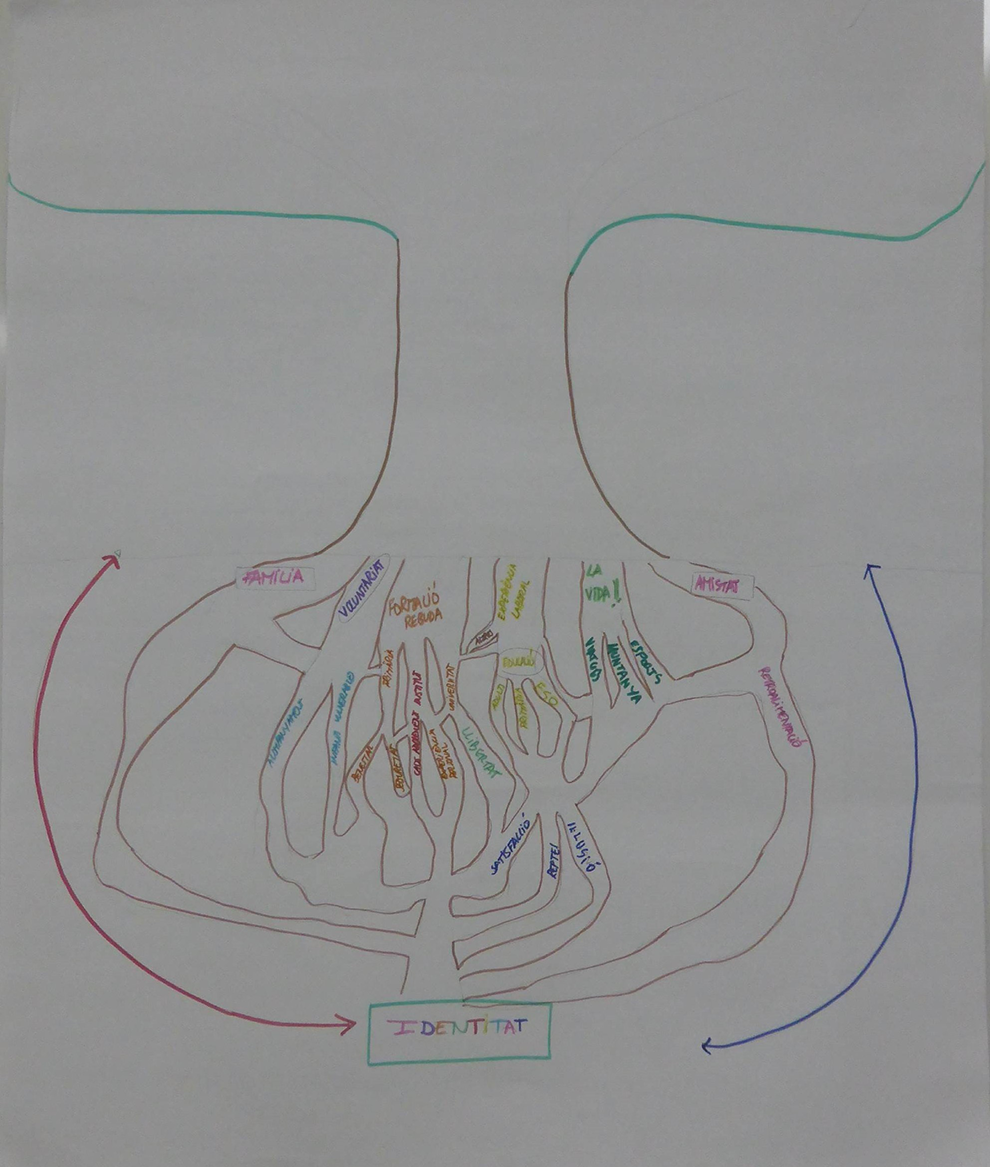
Root metaphor cartography.
The secondary school was a time of adolescent chaos. I put it in red because of that. But even so it gave me a very important personal experience. It was when I started to be conscious of the concept of identity. Even though I shaped this concept with my family and voluntary work, I became aware of that (Diana).
I had the process on my mind. I have always had that on my mind, my teaching career as a path that takes me to a finishing line, like a marathon (Clara).
I knew it clearly since here—since when I was little—that I wanted to be a teacher. But here I had many role models, the most important in high school, they made me decide I wanted to be like this person, I wanted to be a teacher (Paula).
However, the cartographies were not only about the past and the teachers mentioned current events and backward movements. They mentioned what they learned with their colleagues, friends, families and students nowadays and how these experiences contributed to their teaching. But they also referred to how current experiences made them remember and re-signify their past experiences. This job made me love my university degree and that is why I wanted so much to return to the university (….) all that takes me to a double path (Belén). Being an adult, I went back to being a student. But not a Masters student, a typical student: doing tests, taking notes and memorizing stuff. This makes me connect with my past and also see other ways of teaching and learning. Also, I was lucky to have professionals that used other methods (Violeta).
Since the cartographies were not free from teleological thinking, one may wonder whether they favored teleological representations of experiences and relationships as Sefton-Green (2017) argues about purposeful learning in maps. Since cartographies are rhizomatic, they would not necessarily lead to a teleological thinking, like a timeline would, for instance. Even so, it would be interesting to further explore whether or not cartographies would favor or not teleological representations.
Theoretical or Experiential
One of our concerns was the potential repetition of structured educational discourses such as learning theories since it happened in other narrative researches (Sancho-Gil & Hernández-Hernández, 2014), though we never asked about them in the past or in this research. All cartographies were about their learning experience and there was not any explicit reference to theories or academic educational discourses. The recorded narratives tried to explain the elements and relations of the cartographies, so they were mainly about the experiences that lay behind them.
Only five of the 29 participants mentioned how they learn through brief statements such as: Learning is filling a backpack with knowledge (…) I learn from my mistakes, I solve, improve and change them (Clara). Learning is a process that never ends and each time we must encompass more (Josep). I always need things to make sense, because if they do not (make sense) I forget and do not learn them (…) if you are conscious of your learning processes you may train them (Ariadna). You learn from living; it is the fundamental way of learning because it is something that becomes you and comes from you. It is richer because it is something that does not come from the outside (Carmen).
Thinking through these spaces we were able to locate moments, relations and experiences of learning, but not how learning takes place. The teachers’ cartographies told stories about where, with whom and with what they learned, but it was unclear—unknown—what they told us about how they learn. However, we do not consider this “unknown” as a limitation but, as a possibility for “constantly being challenged by doubts about what we don’t know. This is what effective research does, it helps us to see that uncertainty and curiosity not only motivate new enquiries, but also inspires artistic impulses” (Sullivan & Gu, 2017, p. 50).
Conclusions
The teachers’ cartographies were assemblages where knowledge was produced by thinking which elements were involved and how they were interwoven. As a fluid and dynamic process, the cartographies allowed teachers to explore and experiment, extending “beyond normative forms of theorizing and representing” (Ulmer & Koro-Ljungberg, 2015, p. 139). This approach is quite different from the use of mapping as a way of describing and interpreting any kind of learning (Sefton-Green, 2017, paraphrased). Firstly, because the teachers were the ones who represented their trajectories, being able to escape the colonial discourse of the maps by using appropriation and transformation strategies. Secondly, because their cartographies told stories about where, with whom and with what they learned, but not how they learned.
In our research, the teachers’ cartographies were not only visual and textual forms of expression, but also: a process of collaboration and generation of concepts that went beyond the visual representation. a space of thinking and making connections between educators’ nomadic learning experiences and their visual design. an awareness of the cartography potentiality to think about educators’ learning transits and scenarios in an ongoing way by creating-thinking-understanding-sharing-dialoguing. a flat terrain of reconnections and continuities beyond a traditional frame about learning and its boundaries.
For teachers and researchers, this meant “in a sense putting [ourselves] at risk, becoming unrecognized within the normalizing frameworks that govern [our] practice” (Atkinson, 2011, p. 5). As researchers, we assumed forms of dialogue that we had not previously experienced. This process also put the teachers in a position that, as one of them said, led them to think about the unthinkable, to realize the contrast between the cognitive sense of learning with which they relate to students, and the embodied and biographical meanings present in the cartographies.
To conclude, this research showed us that cartographies involve a process that collects contingent features and enacts them as a provisional whole. In other words, “a map is a verb rather than a noun” (Dewsbury et al., 2002, p. 439). Learning does not fit the representational frame that distinguishes between formal contents and leisure activities, a classroom and private spaces, lessons and bodies, emotions and knowledge, and so on. On the contrary, one of the main characteristics of the participants’ visual and verbal assemblages consisted of creating continuity among heterogenous issues and spatio temporalities. Finally, the visual metaphors usually took the shape of a becoming and made sense of teachers’ learnings as affective, entangled journeys.
Footnotes
Declaration of Conflicting Interests
The author(s) declared no potential conflicts of interest with respect to the research, authorship, and/or publication of this article.
Funding
The author(s) disclosed receipt of the following financial support for the research, authorship, and/or publication of this article: This paper builds on the project “How teachers learn: Educational implications and challenges to address social change” (EDU2015-70912-C2-1-R), partially funded by the Spanish Ministry of Economy and Competitiveness.
