




Abstract
Cultural-Historical Activity Theory (CHAT) was conceived and has been developed as an interventionist proposal and mostly as an analytical tool. The aim of this paper is to explore the connections between ontological and epistemological considerations underpinning CHAT and concrete research methodological decisions. We discuss how considerations of the philosophical basis of CHAT and more recent developments in philosophy can offer specific guidance to methodological decisions by exploring an example of research about using technology to teach in secondary science education. The explicit definition of the ontological character of activity, the status of the concept of transformation, or considering points of entry as an epistemological device suggest a possible logic to define data-gathering methods which could be generalised to other areas of CHAT research. We also discuss complementary frameworks, in particular the concept of identity, to develop a more comprehensive understanding of the complex and dynamic nature of the activity.
Introduction
Cultural-Historical Activity Theory (CHAT) has been extensively used in different areas of research to understand contextualised, mediated human activity, with an emphasis on transformation. CHAT has been developed as an interventionist proposal and an analytical tool, as its purpose is to promote changes in activity systems emerging from the self-reflection of their participants (Engeström et al., 1999). When applied to qualitative research, CHAT is often used as a paradigm to design transformative interventions (Lopes et al., 2021) or a post-facto interpretative framework (Mama & Hennessy, 2013). The application of CHAT often involves just some elements of the theory rather than considering it as a complete research paradigm, which might leave the impression that considerations on the onto-epistemological basis of CHAT are not relevant in the design of research methods for CHAT-based research.
Albeit this is not the norm, there are examples in the literature where CHAT is explicitly considered to inform methodological decisions. Sometimes, they present general methodological frameworks, as in Hansson (2014) and Postholm (2015), or analytical frameworks, as in the interventionist studies of Engeström & Pyörälä (2021) and Sannino et al. (2016). These proposals, however, do not discuss methodology in relation to an explicit definition of what is studied, what questions about the studied phenomena are asked, and why (Toomela, 2008). Other authors have related their discussion to concrete research contexts, as in Mwanza-Simwami (2001) and her analysis of work practices in organisations, or in Yamagata-Lynch (2010) and her studies in educational contexts. However, these proposals use CHAT to inform the selection of methods and/or instruments for data gathering, but do not draw explicit attention to the ontology and epistemology of CHAT in its design. Hence, the wide scope of CHAT and this lack of concrete methodological references have resulted in the application of a broad range of research methods. Our contention is not that only some of them are appropriate, but that more discussion on the methodological implications of the onto-epistemic elements of CHAT might be useful to researchers using this theory to develop more coherent and grounded methodological choices.
The aim of this paper is to explore how ontological and epistemological reflections can inform the definition of a complete and concrete methodological design within the CHAT paradigm in educational research. To address our aim, we structure this paper into three sections. First, we offer a revision of philosophical (ontological and epistemological) considerations underpinning CHAT we deem relevant on connection to methodology. Second, based on these considerations, we explore several concrete research methodological decisions informing the design of methods for data gathering to study activity systems; to illustrate how the dialogue between onto-epistemic and methodological issues can crystallise, we present an example of research in science education where we used CHAT as the theoretical and practical research framework, described in Grimalt-Álvaro (2016) and Grimalt-Álvaro et al. (2019). Third, the paper ends with a discussion of the key aspects emerging from the application of CHAT to inform the design of methods for data gathering and their implications.
Ontological and Epistemological Considerations
It is beyond the scope of this paper to discuss in depth the ontology and epistemology underpinning CHAT. Our aim for this section is to make explicit the basis of our methodological arguments, which we will develop in the next section. We will start by summarising the key ideas of CHAT. Afterwards, we will focus on the ontological and epistemological aspects of the theory we consider more relevant to our discussion on methodology. More comprehensive introductions to CHAT can be found in Engeström et al. (1999), Nardi (1996), and Roth & Lee (2007).
The Roots of CHAT
CHAT is based on the Vygotskian theory of cultural mediation, which states that the human (subject) action on a part of the world (object) is always mediated by culturally developed artifacts. These three elements affect each other, and together they determine the activity which will produce a particular outcome, a transformation of an aspect of the world. This theory is based on Marxist theory and asserts that individual’s development results from the interaction with the cultural-historically determined tools through which subjects mediate their actions on the world. Social processes cannot be understood without the participation of individuals who use and develop, these mediation tools (see Figure 1). Marxist epistemology, dialectics, is used to study the relationships between the elements of activity. Representation of the first generation of CHAT, based on the Vygotskian theory of cultural mediation. The arrows represent the interaction between the subject, artifacts and object of the activity.
Leont’ev developed later on the activity theory by explicitly articulating the role of social groups in the activity, including the concepts of social rules, community and division of labour. Together with the central elements proposed by Vygotsky, all these elements define an activity system which considers the complex, dialectical relations between individuals, and the cultural, material and historical dimensions of the social structures. Leont’ev proposes three levels making up each activity: activity, action and operation. Activity, which is guided towards a global motive, is brought about through more specific actions, which have different goals (see Figure 2). Actions are based on operations that depend on the contextual conditions. Representation of the second generation of CHAT, based on the work of Leont’ev and elaborated by Engeström (1987).
Michael Cole and Yrjö Engeström, among others, brought together and further developed these two sources. These researchers took the activity system as the unit of analysis where the activity and its context cannot be separated. Engeström and colleagues introduced the study of the relationships between different activity systems. New concepts were introduced to include multiple personal perspectives and the dialogues that arise. The concept of contradiction, already present in Vygotskian theory as the source of developmental transformations in individuals, is reframed in Engeström’s CHAT to refer to a source of change in activity systems. Without leaving its Marxist roots, CHAT has introduced ideas that challenge some previous interpretations, such as the focus on dialectics, to study different points of view and dialogues among participants within an activity system and across activity systems (see Figure 3). These developments have brought about a Cultural-Historical Activity Theory, which is the perspective we adopt in this paper. Engeström (1987) considered these three proposals as different stages of activity theory referring to them, respectively, as first, second and third generation activity theory. Representation of the third generation of CHAT, based on the work of Cole, Engeström and others, where different activity systems with a shared outcome can interact with each other, as published in Engeström (2001).
Re-Thinking the Methodology From the Ontology and Epistemology of CHAT
Ontology and epistemology apply to methodology because they identify the entities in the phenomena we study and how they relate to each other, and what and how, can we know about them. We want to look into this relation for specific elements within the CHAT framework.
Studying the Activity From a Relational Ontology
The first element we will consider is the concept of activity. Despite being the central concept of CHAT, this concept is not unequivocally defined in the literature (Slobodchikov, 2001) being related by different authors to both ontology and epistemology (Miettinen, 2006). In our view, a CHAT perspective is better adopted by stressing its ontological character. We take activity to be more than a relation among moments or elements of the activity system. We see activity as an ontological unity of significance rather than as an extrinsic relation between individual subjects and their context. To us, activity must be seen, in line with Marxist and Vygotskian tradition, as a key category to transcend dualism by intrinsically relating consciousness and the physical world, the individual and society. However, some authors have argued that CHAT often includes a dualistic perspective which would not agree with is Vygotskian roots (Veresov, 2016). In our view, the root of this issue lies in the conceptualisation of consciousness. Despite their materialist roots, neither Vygotsky nor Leont’ev presented thought or consciousness as pertaining to the field of neurology or the natural sciences. We do not see this because of the knowledge at their time, but rooted in the importance of the social in their thinking. Therefore, without having to resort to a monist view, as the one espoused by Vygotsky, we can escape dualism by understanding consciousness to be connected but neither reducible to, nor an emergent of, physical systems. Therefore, we take a (new) realist ontological perspective to underpin our use of activity theory (DeLanda, 2006; Gabriel, 2015; Harman, 2018). These considerations justify our approach to the study of the subject of the activity.
Since activity always involves physical objects and consciousness, this implies, according to our ontological stance, that activity is neither something that can be fully determined by the theories of natural sciences nor explained by post-modern relativism. Therefore, while we see the physical world as best described by natural sciences, we argue that consciousness is outside the ontology of natural sciences. Hence, what we can say about phenomena involving human consciousness has to consider this ontological characteristic, and this will entail the use of particular methodologies which must consider the actual existence and effect of the out-of-mind objects and, therefore, cannot only focus on cognitive phenomena.
Because of the description of activity systems in CHAT, the ontology we propose is relational. We consider relations among different parts of the activity system as extrinsic to the definition of these parts while being connected to their changes. The importance of relations is seen both in the relations established within the activity system and in the cultural-historical relations that connect the activity and its participants with a wider social context. This relational character is also in keeping with the transformative character of CHAT. Activity itself implies the irreducible interrelation of consciousness and physical characteristics of external reality in changing one another. This relational character connects with methodological choices.
The Need for a Point of Entry
Our ontological choices commit us to take into consideration the complexity of actors involved in the activity. This poses the methodological question of how to justify the study of particular elements of an activity system that the theory considers a unit of analysis. To do so, following Marxist theory, we must define a point of entry. No point of entry can be considered a priori as being more important than any other, but the existing literature can suggest suitable points of entry on connection to the research questions. We must present our point of entry as contingent on our research interests and consider our results critically to not disregard the other processes included in the activity system, which might also be suitable points of entry.
Transformations and the Role of Time
Activities imply changes, and changes imply time. It is essential, hence, to consider the role of time in researching the subjects, the objects, their mutually defining relations, the activities within which those relations are contextualised, and the world(s) transformed by these elements and relations. It is also essential to understand how all these components are intrinsically, though not essentially, defined as well by a historical social network, that is, existing in a time frame that goes beyond the time frame of the activity being studied. We must consider both time frames in CHAT research methodology.
The foundation role of activity and the stress on transformation requires a mechanism for explaining how transformations, changes in the activity systems, come about. CHAT uses the concept of contradiction referring to conflicts within and between elements of the activity system, between systems of activity (Engeström, 1987). These contradictions manifest as tensions within and between activity systems. The importance of transformation in the Marxist tradition underpinning CHAT has led a considerable amount of CHAT research to adopt the view that it cannot dissociate studying a system of activity from bringing about change to that system.
While we agree CHAT research is oriented towards change, we consider that the historical and cultural timeframes involved in activity systems make it relevant to study different temporal points and constituent aspects of the system of activity. Hence, we pose that transformation can be seen as an axiological characteristic rather than an epistemological one. This means that transformation is more fundamentally bonding to the goals of the researchers and less necessarily connected to the praxis of immediate research. By taking this position, we are not assuming an absolute value connected to change, but change as a value related to social practice (Fleischer, 1968); change is a value because transformations of the system of activity are positively significant for human beings. Our axiological perspective allows us to consider change a fundamental characteristic of the dialectical nature of society while recognising the individuals’ subjective autonomy (Fleischer, 1968). Therefore, our proposal allows CHAT research to study distinct moments related to a particular transformation instead of focussing only on the study interventions aimed at bringing about a transformation, and provides a space to discuss transformation in relation to individuals’ subjective perspectives.
CHAT and the Design of Methods for Data Gathering for Classroom Activity
Data gathering should allow researchers to study the ontologies defined by the CHAT paradigm and to do so in a way that is coherent with its epistemology. Although the CHAT ontology points out which types of elements need to be considered and which can be seen as data sources (Seaman, 2008) in the activity’s study, it does not pre-define its attributes, which are situated and need to be inferred from the data in each context. This apparent ambiguity would help to explain why there are no privileged methods for data gathering within the CHAT paradigm. However, the selection and the design of the methods should be based on to what extent the selected methods can provide information to reconstruct the entire activity system for each activity and context.
Our research wanted to evaluate a program introducing digital technologies into secondary schools. The design of data gathering followed three successive steps elaborating on the heuristics suggested by Mwanza-Simwami (2001); Yamagata-Lynch (2010). First, since the program we studied could be connected to several changes in the educational system, we started by identifying the outcome that we wanted to study. This allowed us to identify the scope and constitutive elements of the activity system we were to study; second, we had to select a point of entry to study the activity system. In particular, we chose to study changes in the professional development of science teachers because of the program as the outcome and, consequently, we chose science teachers as the subject of our activity system(s). We consider that the smaller point of entry that could empirically be studied with a science teacher as the subject of the activity was its relationship with an object and the mediating artifacts at the level of actions. Third, we expanded data gathering methods to reconstruct the entire activity system in which the study of division of labour, community and rules (context-mediators).
Collecting Data About the Outcome
To study a system of activity, we must determine its constituent elements. In our view, this implies acknowledging the multiple planes of focus in which we could define each element of the activity system. Rogoff (1995) defined these planes as different grains of focus within the whole activity. For example, a teacher can be the subject of the system, but also part of different collectives – teachers from the same school, the local community of teachers... Within the same activity, each element can be studied at different planes. Although Rogoff (1995) only acknowledged three planes (community/institutional, interpersonal and personal), we see the structural organisation of society as a continuum ranging from the individual to the largest collective plane at which each element can be conceptualised for each activity. Hence, we will refer to this continuum as the individual – collective axis in which different planes for the elements of the system lead to the definition of different planes of focus of the same, or closely connected, activities.
Selecting the plane of focus serves the function of clarifying which processes are for discussion in the whole activity (Rogoff, 1995). Other planes of focus need to be held in the background but not separated, as it is necessary to acknowledge that development occurs in the whole activity. Hence, to understand each plane requires the involvement of the others (Rogoff, 1995). We argue that considering multiple planes of focus can also help researchers to better study the interaction between activity systems working on a negotiated object within the third generation of CHAT as described in Engeström & Sannino (2021), as it refines the heuristic to better identify the implications of this interaction at all planes. For example, it would allow us to identify tensions between different activity systems (e.g. between one teacher as the subject of the teaching activity, and one student as the subject of the learning activity), but also between elements of the same activity system in different planes (e.g. between the teachers and students from the same course teaching and learning, respectively, or between the local community of teachers and the youth of the same neighbourhood). Using the iconic and triangular representation of the activity system, we can visualise this configuration of the system of activity as a pyramid (Figure 4), which helped us to visualise the influence of the cultural context in the most individual plane. Multiple planes of focus of the teaching activity system can be defined.
The focus of our study was to understand how teaching was mediated by recently introduced technology – IWB and laptops – in secondary science classrooms described in Grimalt-Álvaro (2016) and Grimalt-Álvaro et al. (2019). By taking this focus, we are determining the plane at which we will study the activity on the individual-collective axis. Once this has been established, we should determine the outcome that will guide the selection of the elements of the activity system that we will use as a point of entry for the study of this activity. In our research, we set the focus of the outcome at the most individual plane of activity: the classroom in which participant teachers carried out their science lessons with 12–16-year-old students.
Collecting Data to Study the Immediate Outcome
Within CHAT, the outcome is understood as the transformed reality, the results and products (Leont’ev, 1974), which can be of an ideal nature, material or both (Postholm, 2015). Activity emerges as a process that effects a reciprocal transformation between the subject-object poles (Leont’ev, 1974). From these considerations and the plane of the activity selected for our study, we understood that the transformed reality would be twofold: the teachers’ professional development in terms of the improved competences in using IWB and laptops for teaching (participant teachers were novices in its use at the beginning of the study) as well as the students learning of science contents and competences. These outcomes, which we would relate with the motive and the object of the activity, result from a series of actions and operations which make possible the process of internalisation that is needed in attaining their respective learning for both teachers and students. Thus, as described by Engeström et al. (1999), internalisation of these practices becomes the dominant form of learning and development from the CHAT paradigm. We placed the focus of our study on the teachers as the subject of the activity system, and their professional development as the outcome. Even though we could analyse, to some extent, students’ learning through our inferences of their social interactions in the classroom, we did not study it explicitly. The teachers’ mediated actions on the students made up a central element of their professional development process. Hence, we studied that professional development as the outcome of the activity system inferring teachers’ developed competences related to the use of IWB and laptops from the study of classroom teaching-learning processes, as well as through teachers’ interviews.
To study the outcome, we considered intermediate transformations related to the organised tasks students carried out in the science lessons led by the teacher, which correspond to the actions that together make up the teaching-learning sequences. These actions, which we selected as our point of entry, are mainly developed in the social plane, which is the plane encompassing the interactions between teacher and students and between students (Vygotsky, 1978). Actions in the social plane can be observed in a reasonable amount of time. Consequently, we considered direct observation the most appropriate method to gather data about the outcome at this level. This method has been also frequently used in CHAT research for the study of the outcome in classroom contexts, as in Barab et al. (2002) or Demiraslan & Koçak Usluel (2008).
We videotaped different lessons for each participant teacher to study the development of the outcome within a sequence of a significant time period. We chose video recordings as the primary source of data since they would allow to reproduce actions and operations with IWB and laptops after the observation both regarding the verbal classroom dialogue and the non-verbal communication in the lesson. This information would also allow us to infer the situated meanings of the elements of the activity and their relationship with each other, as it is described below.
We placed two cameras in the classroom, following Luff & Heath (2012) recommendations. One camera was placed at the front of the classroom, recording a fixed and wide perspective in which all participants appeared (students and teacher). The wide approach provided information about the classroom setting and the outcome in relation to the mediation of the division of labour, community and rules, for example, providing context to explaining why the teacher interrupted one-to-one dialogues with students to draw the attention of the less concentrated students while students were working in groups with their laptops (picture on the left, Figure 5). A second camera was at the back of the classroom and the researcher moved it to follow the movements of the teacher. This follow-up camera provided a detailed perspective of the teachers’ practices with IWB and laptops, and the created artifacts with the tools (e.g. productions with the IWB or laptops), as it is exemplified in the right picture in Figure 5, where the teacher is discussing with two students about the work they have been doing in their group. Therefore, the follow-up camera provided detailed information about the outcome related to the subject–tool–object relationship. This method appeared to be easily adaptable to the different classroom settings studied, where students’ tables and IWB had been arranged differently. Examples of the use of the two cameras in the study of the outcome of the activity recording simultaneously a wide perspective (left) and follow-up perspective (right).
Collecting Data to Study the Outcome From a Historical Perspective
History is another relevant aspect to consider when studying the outcome in CHAT-based research, as explained above. Historical analyses need to focus on units of manageable size (Engeström et al., 1999). However, if the unit of analysis is the individual, or the individually constructed situation, history is reduced to ontogeny or biography; if the unit is the culture of the society, history becomes very general or endlessly complex. Therefore, Engeström et al. (1999) recommend taking the collective activity system as the unit which would make history become both manageable and step beyond the confines of individual biography. From this perspective, in our study, the historical analysis drew from the study of previous configurations of the system of the activity at the school or administrative planes. These planes acted as the ‘legacy’ leading and explaining the present activity system in which the classroom plane would be included and be part of it, following the representation in Figure 4.
We carried out an analysis, involving a deep study of the literature, of previous large-scale introductions of digital technologies into the Catalan educational system and their reported consequences for teaching practices. Again, although we placed the focus of our study on the teaching practices mediated by IWB and laptops occurring within a science lesson, this historical analysis contributed to assign meaning to the present outcome and the entire system. Together with the results of the analysis of the studied activity system for the six participant teachers, it contributed to outline different guidelines and recommendations to better integrate IWB and laptops for science teaching purposes. As these guidelines were distributed and published at the end of the research, we understood they could subsequently lead to transformations in other teachers’ activity systems.
Collecting Data About Actions: Subject, Tool and Object
The choice of the outcome determines the plane of focus of the activity system. In our case, since the outcome is the professional development of science teachers, we choose the teacher to be the subject. Therefore, we will choose as the point of entry one of the relational processes of the activity system connected to the teacher. Considering that classroom practice is key to professional development, we have chosen ‘classroom activities’, which in CHAT can be seen as related actions that bring about the activity of teaching and learning science, as the point of entry. To study these actions, we need to collect data about the subject (teacher), mediating artifacts (IWB and laptops), the object and their relationships. Acknowledging the difficulty in the definition of the object, since our study focused on the teacher and the development of their teaching competences, we only studied the object of the activity in relation to the development of teachers’ competences to teach science, connected to the teachers’ goals of organising and leading different learning tasks in each science lesson. Learning tasks became concrete in their interactions with students and in the work they were asked to do in the classroom. Hence, students, in relation to their leaning of particular science competences, were the object of the activity system.
Gathering Data About Teachers as the Subject of the Activity
Gathering data about teachers, as the subjects of the activity, has been traditionally described as studying their attributes (Engeström et al., 1999). These attributes have been characterised in different ways as referring to the subject’s knowledge, beliefs, perspectives, attitudes and/or ideas, as well as affects, emotions and motivations (Karasavvidis, 2009; Roth et al., 2009). The traditional CHAT paradigm considers that these attributes are shaped by the outcome of the action (Stetsenko & Arievitch, 2004), but it does not elaborate on how subjects could also have agency in shaping them. To address this gap, we propose addressing teachers’ attributes from the lenses of identity as a complementary framework. We take the definition of an identity as the set of meanings that define who one is (the self) when one occupies a particular role in society, a member of a particular group, or claims particular characteristics that identify him or her as a unique person (Burke & Stets, 2009, p. 3). Although other definitions of identity can be found in the literature, from our perspective the proposal of Burke & Stets (2009) improves the study of the subject within the CHAT ontology for two reasons: First, because it shares some foundations with CHAT being a relational paradigm. Second, because it provides an ontology of the subject that better accounts for its relationships with the community in the activity system. Interactions between the subject and other elements of the activity system facilitate inferring the attributes of these identities but are not intrinsic to their definition, which is more coherent with the ontology we propose. Hence, identity theory acknowledges the agency of the subject in shaping their identities: an identity is composed of different processes dealing with meanings within the context and within the self which operate in a homeostatic way to maintain perceived self-meanings within a certain range (Stets & Serpe, 2013). This framework is also coherent with our vision of educational processes, in which the teacher has an active role in organising and orchestrating their internal resources (pedagogical content knowledge, beliefs, etc.) towards the object to produce a desired outcome as the activity is developed, in line with Stetsenko & Arievitch (2004).
In our research, we acknowledged the existence of two main identities for each teacher (as subjects of the activity): role identities and personal identities. Teachers’ role identities are defined as the internalised meanings of a social role that individuals apply to themselves (Burke & Stets, 2009). In our context, role identities accounted for teachers’ expectations tied to their social position (i.e. ‘being the ICT coordinator’) which guided their attitudes and behaviour, and were intricately linked to specific performances (e.g. teachers’ apologising for the lack of technical maintenance of the IWB or laptops) (Burke & Stets, 2009). From the CHAT perspective, understanding teachers’ role identities was relevant since these identities provided evidence of the relationships with, and between, other elements in their activity system. Teachers’ personal identities, defined as the traits which make the teachers see themselves as a unique and distinct individual different from others (Burke & Stets, 2009), were also singled out in some responses and interactions within the outcome that went beyond teachers’ role identities. For example, these personal identities included traits as being ‘ICT-reluctant’ or ‘ICT-lover’ (mainly made explicit in the interactions with the researcher).
In identity theory, the basic process of identity operation is identity-verification (Stets & Serpe, 2013), where the subjects make the meanings about themselves in the situation (inputs) correspond to the set of meanings defining the attributes of each identity of the subject (their identity standard) – For example, acting as a caring teacher in a situation. When teachers’ identities experience difficulties to achieve congruity between perceptions of the environment (inputs) and the identity standard, stress or distress arises in the teacher (Stets & Serpe, 2013). From our CHAT perspective, these interruptions, manifested in teachers’ stresses, are signals of tensions between the subject and other elements of the activity system, or internal tensions within the subject, as it has been described by authors such as Engeström et al. (1999). For example, in our research, we observed that some teachers who described themselves as constructivists refused to use the IWB in their lessons, contrary to what educational guidelines from the administration were fostering, as they felt the IWB forced them to act as if they were transmissive teachers. Hence, we interpreted that these teachers’ stress indicated a tension between meanings attributed to IWB by teachers (as the tool mediating the activity), teachers’ beliefs about themselves (as the subjects of the action), and their ideal of how teaching should be (attributes of the subject of the activity).
For these reasons, when studying the subject, one of our principal aims was to identify those moments of distress and, together with the subject, interpret them as a proxy to understand their activity system and the relationships between elements. To make this reconstruction, we used one-to-one interviews to gather data and record them in audio. Other CHAT-based researchers characterising the subject’s identity have frequently used one-to-one interviews (Nguyen & Yang, 2018; Wade-Jaimes et al., 2019). We structured our interviews in different sections aimed at providing information to (i) study the subjects’ attributes and reconstruct teachers’ different identities, and (ii) identify possible tensions in the rest of the elements of the system of the activity perceived by the subject by recognising the stress derived from interruptions in teachers’ identity-verification processes.
In the interviews, we knew that a new activity (research) was being undertaken different from teaching, in which the teacher and the researcher developed different roles than the ones developed in the lessons. Therefore, we acknowledged that interactions between the system of the research activity and the system of the educational activity could happen and, as a result, the interviews could influence the actions and operations within the teachers’ science lessons. Through the transformative lenses of Activity Theory, we considered these influences could help teachers to develop a deeper understanding of their systems of teaching activity and that changes in their lessons would be caused by a negotiation of the relationships between elements – therefore, resulting in a cycle of expansive learning.
Gathering Data About IWB and Laptops, as Tools Mediating the Activity
To study how the tool mediated the activity, we considered the three levels of the activity’s structure (activity, actions and operations) (Leont’ev, 1974). Although in our study, teachers used two instruments (IWB and laptops) and the concrete operations with each instrument were different, we observed that when the IWB or the laptops were used – often simultaneously – , the attributes of the rest of the elements of the system of the activity remained unchanged. Hence, the subject (teacher), rules, community and division of labour (context of the activity) were still the same, as well as the goal of the activity, we considered that IWB and laptops were used within the same object of the activity. Therefore, IWB and laptop were analysed as a single tool. This approach was also more coherent with the context: a simultaneous introduction of both instruments in secondary schools.
Data about the three levels of activity (activity, actions and operations) with IWB and laptops was necessary to understand its mediating role. This was challenging at the level of operations since at this level the tools become transparent for the subject as if integrated into the human body (Roth et al., 2009). For example, we observed that, most times, teachers used the IWB as traditional projectors (Figure 6). Operations with the IWB used as a projector situated teachers far from the IWB when interacting, retrieving information or creating new content, regardless of the classroom arrangement (Figure 6). When teachers were asked about the aims or the conditions of these operations, these were described vaguely in most cases, suggesting that teachers had not carried out a thorough consideration of the operations undertaken with the IWB in relation with the object of the activity (developing students’ scientific competences). Therefore, teachers were not aware that the use of the computer to change the information displayed in the IWB made them turn their backs to the students when talking, interrupting the classroom dialogue (both verbal and non-verbal communication) to move from one side to another and concentrate on the manipulation of the computer, as shown in Figure 6. As the analysis of those operations was necessary to gather an understanding of the classroom activity and the situated meaning of the tool in the activity, the analysis of the mediating role of the tool at the level of operations had to rely mostly on the researchers’ interpretations. Four different situations in which the IWB were used as traditional projectors. The use of the IWB as a traditional projector situated teachers far from the IWB regardless of the classroom arrangement.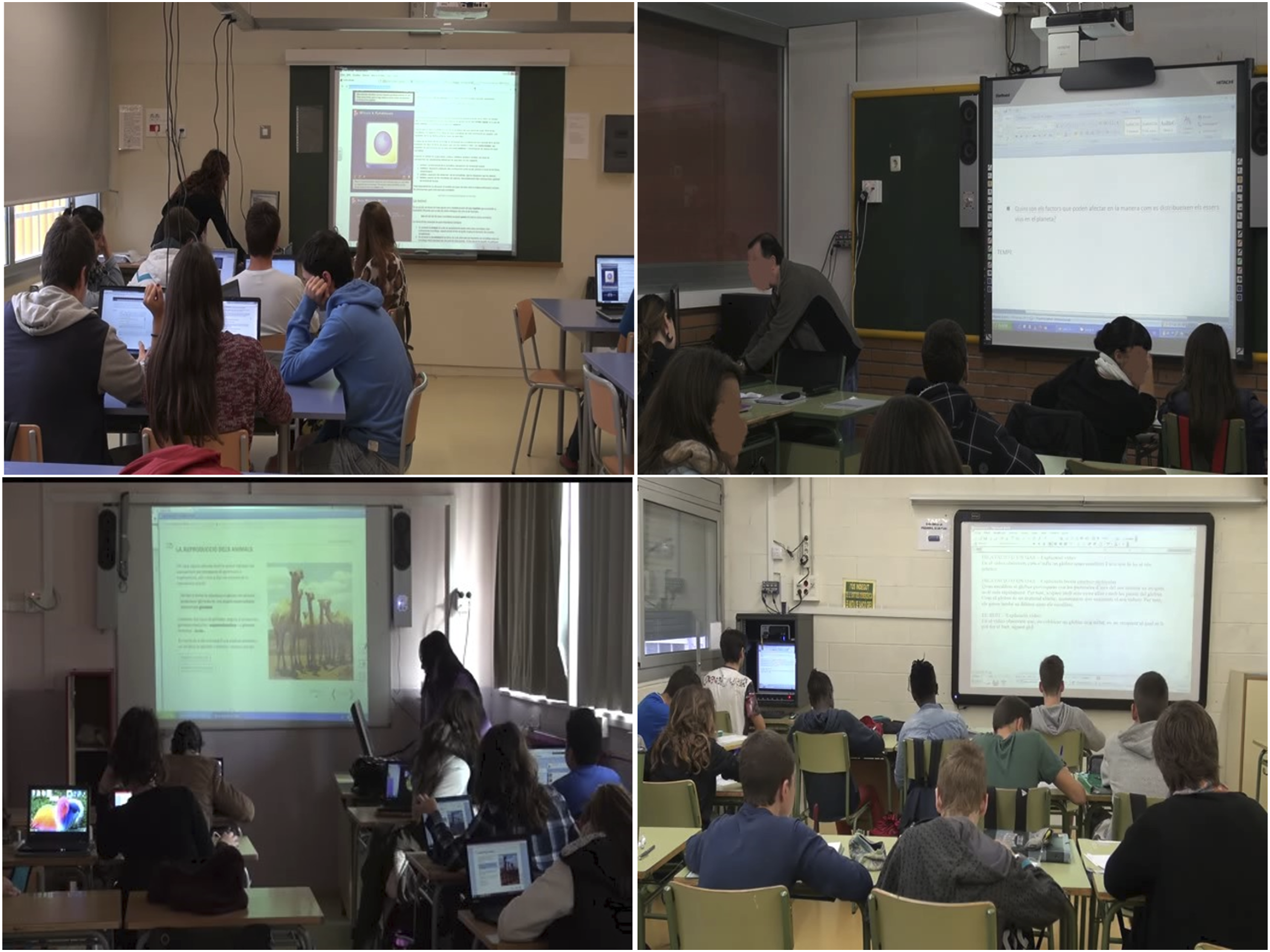
We retrieved data about the operations with each tool from the study of the classroom actions (i.e. direct observations). To this end, we changed the design of direct observations to better capture operations with each instrument within each context (e.g. how to place the camera to capture teachers’ operations with IWB/laptops).
Using the IWB as a traditional projector evidences how this tool was used and transformed in new ways within the activity (Postholm, 2015), showing that the tool cannot be understood without the activity, which provides a meaning to the tool, and vice versa. We inferred the mediating role of the tool from data about the outcome, that is, observations, but especially from one-to-one interviews with teachers. Observations of the outcome provided a preliminary insight into the actions and operations undertaken. However, a deep understanding of the mediating role of the tool was based on the subjects’ interpretation of the relationships between the different constitutive elements of the activity. These interpretations and, in particular, the subject’s views about the subject–tool–object relationships were necessary to understand if the subject had intentionally given the situated meanings to the tool or not. We considered that the tool defined the activity, and vice versa, when the situated meaning was assigned by the context, that is, not by the teacher. Conversely, we considered that the tool transformed the activity, and vice versa, when the situated meaning was given intentionally by the subject. This process of identification also required to make visible the operations with each instrument. We also explored the interactions with other activity systems when the transformation had been produced consciously as, for example, an outcome of the teachers’ training activity system.
Gathering Data About Students as the Object of the Activity
We collected students’ data through video recordings of the classrooms. We inferred information about the object from observations and one-to-one interviews with the teachers. Therefore, we redesigned interview guidelines to collect information for reconstructing the attributes of the object. We put a special emphasis on teachers’ making explicit their perceived learning regarding the use of IWB and laptops for science teaching purposes, and their motives or their expected outcomes guiding the activity. This information also facilitated identifying other beliefs related to teachers’ identities, contributing to better determining the attributes of the subject. Inferring the attributes of the subject contributed to better define the subjects’ attributes, and the relationship between the subject and the object within the activity system.
Collecting Data About the Division of Labour, Rules, and Community
Information needed to reconstruct the attributes of the community, rules and division of labour (context-mediators of the activity) was considered in the last step of the definition of the methodological strategy. In previous CHAT studies in educational contexts, division of labour has been related to the specific roles of individuals within the activity (Roth et al., 2009). In our case, these roles related to those of the teacher as the subject of the activity, and the role of students as the object of the activity. Conversely, rules and community have been more widely defined in previous research. For example, rules have been defined as the regulations set by the teacher (Gregorcic et al., 2017), as course requirements or curriculum (Schuh et al., 2018), or school rules, and/or government regulations (Mama & Hennessy, 2013); and community has been defined as the teachers and students in the classroom (Schuh et al., 2018), but also as all students, teachers or school administration (Al-Huneini et al., 2020).
To resolve this complexity, there is a consensus in the literature that the definition of the attributes of rules and community should be based on the extent these elements meaningfully mediate the subject–tool–object relationship within the activity. We inferred the manifestations of the situated meanings of these context-mediators of the activity either from the classroom observations, conversations with teachers or both, when these elements were specifically mentioned, or made up a motive of a tension, following Jonassen & Ronrer-Murphy (1999) and Postholm (2015). Direct observations provided a first familiarisation of the meanings of division of labour, rules and community to the researchers. Afterwards, these preliminary situated meanings were contrasted and complemented with the subject’s points of view in the subsequent one-to-one interviews, as in Gregorcic et al. (2017). In this process, the subjects’ perspectives acted as a reference, guiding the definition of the situated meanings of these elements on their teaching activity system. We considered that the subjects would best know their teaching activity system. As the identification of tensions between the subject and division of labour, rules and community was prioritised in our research because of the research aims, we used no other additional data gathering methods apart from observations and interviews. However, in other studies as in Yamagata-Lynch (2010), it might become useful to collect complementary documentary evidence and/or other artifacts when exploring the rules, the community and division of labour, and/or interview members of the community (students and parents), as in Sannino et al. (2016).
Final Considerations and Implications
Although the use of CHAT does not define a particular methodology, in this article, we have described an example of how we used onto-epistemic elements of CHAT to inform the design of the methodology in a study of the impact of introducing IWB and laptops in the teaching practices of six science teachers. The discussion on the onto-epistemic elements of any theoretical framework might be useful to develop more coherent and grounded methodological choices. We have proposed a three-step strategy underpinned by onto-epistemic considerations, which we believe could be used as the basis for a generalised process to make grounded methodological decisions. Drawing from Mwanza-Simwami (2001) and Yamagata-Lynch (2010), the first step of this process would imply the researcher to be familiarised with the activity to be studied and, particularly, with the outcome of study. Setting the outcome would lead to methodological decisions and contribute to guide the researcher to analyse and characterise the present state of the activity system in relation to past and possible and future states. As a result, this defines the plane of focus of the activity.
The second step involves identifying a suitable point of entry and choosing methods for data gathering which can provide the necessary information to study the elements of the point of entry and its connections with the rest of the elements of the activity system that will be studied in the third step. In our case, we have chosen classroom actions as our point of entry, hence focussing on the exploration of the attributes of the subject, object and tool and the relationships among them. We think that a similar choice is likely to be suitable for many educational research topics. We suggest the use of the identify theory (Burke & Stets, 2009) as a complementary framework to develop a more comprehensive understanding of the subject and the complex and dynamic nature of the activity.
Methods for gathering data should provide the necessary information to infer the situated meanings of the related elements subject-mediation artifacts-object while, when possible, being comprehensive enough to capture other possible meanings related to other planes, which can also influence the outcome. Research aims may sometimes direct the research, and its data gathering design, towards focussing on an element, representing an additional plane of concretion. However, even at the more individual plane of study, researchers are likely to benefit from looking at the mutual influence between different planes of the activity system when using CHAT to underpin the selection of methods (Roth et al., 2012).
In the third step, we need to consider the rest of the activity system, considering the plane of analysis. Since the entire activity system is the unit of analysis for CHAT, the data gathering has to be designed to connect with the analysis of the point of entry, as well as to consider the possibility of other points of entry. In our case, the designed method focuses on the study of the meanings attributed to the context-mediators of the activity (division of labour, community and rules), which does not always involve setting up specific methods for each of these three elements. The collaboration of the subject defining the situated meanings of the division of labour, community and rules in the outcome can be essential in this process. Although it was not the case in our example, we argue that depending on the activity, the research aims, and the plane at which the activity system is considered, it might be necessary to involve other participants, such as different members of the community, in defining the attributed meanings and relationships between elements. This might be the case of the study of several stages of transformative interventions or expansive learning processes, as the ones described in Engeström & Sannino (2021)
The process of data gathering and subsequent analysis results in the definition of the situated meanings of the ontological elements. In consequence, this process originates the construction of a particular ontology of the activity specific to the context of study, which is informed by the aims of the research as well. This ontology also points at useful and necessary data to refine the reconstruction of the activity system, evidencing the iterative cycle in the process of definition of the activity system and how the ontological commitments direct methodological decisions.
We argue that, by following historical development of the Theory of Activity and the types of considerations that led past scientists to overcome similar conceptual difficulties, a deeper understanding of the activity system could be achieved, as in Rudge & Howe (2009). This three-step process determines a time sequence which facilitates the progressive development of the understanding of the complex activity system defining a point of entry. We believe that, by using this strategy in the design of the methods for data gathering and the ontological arguments underpinning them, we collected the data to understand the elements of the activity and the outcome in the activity systems and answered our research questions. In this construction, researchers make several decisions which need to be made explicit not only from the perspective of ensuring appropriate validity of the research, but to show how CHAT has permeated the entire research process.
Based on the assumption that the adoption of CHAT as a research paradigm does not define a specific methodology, research in the literature often omits the discussion of how CHAT theoretical and philosophical foundations inform the design of methods for data gathering, even though methodology is part of the theory and connected to the onto-epistemic assumptions. Our contributions not only suggest a possible methodological strategy in the application of CHAT to research in education but, highlight how this paradigm can also constitute a powerful tool to improve the quality and the theoretical robustness of the design of methods for data gathering in qualitative research.
Footnotes
Acknowledgments
We would like to express our sincere gratitude to all teachers and students who participated and contributed to this research. As well, we would like to thank the reviewers of this article. Through their insightful advice, they helped us to refine and improve our argument.
Declaration of Conflicting Interests
The author(s) declared no potential conflicts of interest with respect to the research, authorship, and/or publication of this article.
Funding
The author(s) disclosed receipt of the following financial support for the research, authorship, and/or publication of this article: This work was supported by the Ministerio de Ciencia e Innovación (MICINN) through the project Observ@COMDID [RTI2018-096815-B-I00] and the Department of Subject Specific Education of the University of Girona, and carried out within the ARGET research group [2017SGR1682] and the GRECA research group [2017SGR0635].
