




Abstract
Researching sensitive topics poses multiple methodological and ethical challenges. To overcome these, this contribution proposes the method of cartoon elicitation, inspired by photo-elicitation and based on framing theory. The impersonality and satire of cartoons and the distance made between a sensitive topic and real life events can diminish potential feelings of threat among respondents. The cartoons offered opportunities to (a) discuss potential stigmatising aspects of a sensitive topic; (b) trigger memories while empowering participants to decide what (not) to share with the researchers; and (c) stimulate rapport between researchers and participants. The contribution elaborately examines the used method in a case study where radicalisation was debated with persons who might be perceived as suspect within the larger community. It is discussed how this method is applicable to study a broad range of sensitive topics.
Introduction
Researching sensitive topics implies that “there are potential consequences or implications, either directly for the participants in the research or for the class of individuals represented in the research” (Sieber & Stanley, 1988, p. 49). Lee and Renzetti (1990) argued that this definition includes nearly all research and thus advocate focussing on topics that seem to be threatening to the research subjects. For instance, research on sexuality with older people (Gledhill et al., 2008), child sexual abuse (Arata, 1998) or immigrant experiences (Cleaveland & Kirsch, 2020) can be considered sensitive.
Sensitive topics exist in a context of invisibility and powerlessness – the voices of the concerned groups are not regularly voiced and heard (Jansen & Davis, 1998). The researcher is deemed to be in a more powerful position than the participant, with determining control over the course of the research (Dickson-Swift et al., 2007). This feeling of vulnerability or powerlessness may feel threatening to the participants, giving them little control over the research process and the effect of the research results on their community (Elam & Fenton, 2003). Thus, when studying a sensitive topic, researchers often focus on empowering the participant (e.g. Goodman et al., 2011; Marsh et al., 2017) and look for methodologies that give the participants voice (Pincock & Jones, 2020).
In any case, researching sensitive topics poses methodological and ethical challenges. Ethically, research on sensitive topics, in sensitive places, has the potential to cause the participants and the researchers discomfort and distress (Adeloye et al., 2019). A fear of disapproval (for example, when discussing deviant or sexual behaviour) can concern the participants (Elam & Fenton, 2003). The subjectivity of the topic can evoke intense emotions. However, Elmir and colleagues (2011) state that talking about an experience in a safe and respectful environment might help gaining personal control over the event or situation. As a result, sensitivity of the research can also impact the different stages of the research process (Siegel & Baumann, 1986), as researchers can be perceived as threatening by one group, but as non-threatening by another (Goyder, 1987). Additionally, studies that investigate deviant activities can be sensitive because the participants might fear identification or stigmatisation (Lee & Renzetti, 1990). This leads to some methodological challenges, such as the recruitment of participants, as these fears and feelings can lead to powerful gatekeepers imposing restrictions on researchers (Renzetti & Lee, 1993). The combination of these factors can influence the choice of topics to be investigated, because limitations (e.g. participant recruitment) can restrain research.
This contribution suggests cartoon elicitation, inspired by photo-elicitation, as a method to overcome these diverging challenges. The developed method is discussed through methodological choices and challenges the researchers faced in a case study of discussing radicalisation with the ‘suspect community’, an imagined community that through a security perspective is treated as a probable risk to society (Breen-Smyth, 2014; Brown & Saeed, 2015).
Literature Review
Using Questionnaires
Researching sensitive topics is not limited to qualitative research. Questionnaires have been used to ask sensitive questions (Lee, 1993). A comparative study by Langhinrichsen-Rohling and colleagues (2006) showed that youth reports little distress over self-reporting surveys on sensitive events (e.g. drug use or suicidality). However, qualitative research is discussed to be best suited for obtaining techniques such as probing (Bowling, 2014). Focussing on interviews, advice is given: make sure the interview is not disturbed or overheard (Adeloye et al., 2019), build rapport and trust with participants (Dickson-Swift et al., 2007) while paying attention to the potential emotional burden for the researcher (Lee, 1993) as well as the emotional distress for the participants (Decker et al., 2011).
Elam and Fenton consider research among ethnic minority communities to pose additional challenges, where a collaborative approach is beneficial to both researcher and participant (Elam & Fenton, 2003). For example, the immigration status of the participant might have an impact on their decision to open up to a researcher (Elam & Fenton, 2003).
Photo-Elicitation as a Participatory Solution
Photo-elicitation might provide an answer to the ethical and methodological questions posed by doing research on a sensitive topic. Photo-elicitation is ‘inserting a photograph into a research interview’ (Harper, 2002, p. 13). This can happen in different ways: by inserting pictures chosen by the researcher (Buckley, 2014; Matteucci, 2013) or by letting the participants take pictures, and discussing them later in an interview (Clark-Ibáñez, 2004; Humpage et al., 2019; Kwesell, 2020) (For an overview of possibilities, see Tornabene et al., 2018). However, when inserting researcher-driven images in an interview, a researchers bias is introduced as well (Matteucci, 2013), whereas using participant-driven images might create self-representation bias (Prosser, 1992). Epstein et al. (2006) elaborately discuss the balancing of choosing participant-driven or researcher-driven pictures in research with children with cancer. Having the kids take the pictures added an extra task on the participants in a moment where they should enjoy free time, while pictures taken by the researchers might not include the perspectives of the children.
There are clear advantages to using photo-elicitation methodology in a context of urban environments, and particularly with less powerful groups in society (Rose, 2016). First, photographs can evoke new information (Allen, 2011; Clark-Ibáñez, 2004; Darbyshire et al., 2005). For example, by letting the participants take their own pictures and discussing them in interviews when studying sexual cultures in a school environment, Allen (2011) learned more about the role of locker rooms, a location she could not enter nor knew the importance off. Secondly, using participant-driven photo-elicitation focuses on day-to-day activities which are easily overlooked in standard interviews (Darbyshire et al., 2005; Rose, 2016). Thirdly, discussing pictures taken by participants give way for more in-depth, personal conversations with room for emotions while triggering memories (Bagnoli, 2009; Harper, 2002; Rose, 2016; Warner et al., 2016). For example, the picture of a street can stimulate the sense of smell in that street and trigger memories (Matteucci, 2013). Fourthly, using photos, either participant or researcher-driven, can unclench the tension and ease rapport between researcher and participant (Clark-Ibáñez, 2004; Kunimoto, 2004). Lastly, photo-elicitation can bridge worlds that are more culturally distinct (Harper, 2002). For example, photos were used to discuss the neighbourhood Schilderswijk, The Hague, with the ethnically heterogeneous inhabitants and elicited information about different perceptions on the same reality (Van Der Does et al., 1992).
A possible explanation for these advantages might be that images are polysemic (Barthes, 1977); hence, they incorporate multiple meanings. It is the insights from the different meanings attributed to images that researchers in photo-elicitation interviews are interested in (Bignante, 2010). A photographic image has no code, compared to drawings, paintings or cinema which add a supplementary message (Barthes, 1977).
Considering these benefices of photo-elicitation, the method of participant-driven photos has often been used in research on sensitive topics. For example, Allen (2011) used photo-methods to study sexuality in a school environment and Humpage et al. (2019) applied it in research with refugees. Researchers using photo-elicitation methods in such research, claim aspects of empowering the interviewee (Clark-Ibáñez, 2004; Lorenz, 2011) and giving voice to the participants (Smith & Woodward, 1998) by giving them partial control (Rose, 2016).
Method: Cartoon Elicitation
Even though there are multiple valuable aspects of using photo-elicitation in sensitive research, cartoon elicitation can bring some added value. In this study, we applied cartoon elicitation for multiple reasons, discussed hereafter. We share our experience and critical reflections of the method in the subsequent section.
Cartoons have the advantage over pictures that they are impersonal. Showing pictures of specific persons involves a choice for that one specific event of individual, and participants might have strong opinions about those individuals or events, or what they represent. For example, showing a photograph of a politician will be a specific politician and is not able to represent the sole ‘idea’ of a politician. By using drawings, the researchers can avoid this side effect, depending on the purpose of the research. By having abstract or schematic instead of concrete representations, there is more room for interpretation by the reader. When the aim is to discuss a general phenomenon (e.g. refugees, or #metoo), it can be desired to not have a particular photograph or case chosen by the researchers.
A cartoon captures most often humour and satire, is impersonal and offers the possibility to interpretation by the reader, all aspects that are advantages in researching sensitive topics. Cartoons either combine the verbal and the visual semiotic modes or only present the visual (Tsakona, 2009). The humour and metaphors resulting from these elements (Tsakona, 2009) stimulates the readers to provocation and laughter (Kyong Liong and Kyo˘ng-nyong, 1996). A part of the cartoons signification takes places in the minds of the readers (Kyong Liong and Kyo˘ng-nyong, 1996), as lines, forms and colours in a drawing are interpreted as people, furniture or whatever they represent (Jappy, 2013). The humour might stimulate participants to disclose personal beliefs (MacGillivray, 2005).
Cartoon elicitation has been used in both non-sensitive and sensitive research. It has been applied in speech-related research (Nathan, 1992) or to elicit sign language (Duncan, 2005). Cameron and Theron (2011) let their teenager participants draw their own cartoons to depict their migrating journey. Used with sensitive topics, such as stereotypical cartoons or AIDS (Harrison, 2009; Mutonyi & Kendrick, 2011), cartoons have shown to transcend taboos, be culturally sensitive and reliable (Bidaut-Russell et al., 1998). It is made possible to discuss current political issues since the focus is on the cartoons rather than on a person’s personal views (Dougherty, 2002).
Cartoons offer advantages to research sensitive topics, since by using metaphors in visuals (Warburton, 2005), issues are easier discussed by the use of satire in cartoons (Moloney et al., 2013). Using visuals in combination with words creates richer data for the researcher (Fradkin, 2019; Sligo & Tilley, 2011). The cartoon is likely to draw the attention of the participant by using humour, as well as presenting a riddle: ‘What does this mean?’. While, where a text may be authentic, and participants may evaluate that differently, a cartoon is clearly fictional (Nathan, 1992).
Finally, cartoons draw upon stereotypes and synthesis the cultural narrative (Warburton & Saunders, 1996). Therefore, how they will be read depends on the public recognisability of the metaphors and stereotypes. The use of stereotypes in cartoons facilitated conversations on prejudice about gay people, giving opportunity for participants to talk about personal intolerances via the cartoons (MacGillivray, 2005). An important requirement is that the participant understands that the used stereotypes and presumptions are not the views of the researcher, but rather that the methodology is a facilitator of making these perspectives tangible and discussable to which cartoons can contribute.
Critical Reflections on Cartoon Elicitation
Case Study: Researching Radicalisation in Conversations With The ‘Suspect Community’
The cartoon elicitation methodology is illustrated by means of a case study, conversations on radicalisation with the suspect community, which should be understood as a minority group perceived as suspect based on their race, religion, class or other factors (Pantazis & Pemberton, 2009). Countries tackled radicalisation from a securitised perspective, focussing on repression and prevention (Ragazzi, 2017) which resulted in alienation, stigmatisation and the labelling of Muslim communities (Awan, 2012; Kundnani, 2009; Pantazis & Pemberton, 2009). Radicalisation was understood in relation to terrorism (Onursal & Kirkpatrick, 2019), the process of developing extreme ideas (Borum, 2011) which can lead to acts of violence (Simi & Windisch, 2020). Based on these elements, participants were selected on neighbourhood, age and migration background. In larger society, irrespective of religious convictions, clothing or skin colour are considered indications of religious believes. Building upon the image of a suspect community, the authors did not factor in religion – which would raise a number of alternative questions: Who is considered religious? However, the majority of the participants self-identified as Muslim. The research can be seen as sensitive because of the potential consequences for the respondents in participating in a study on the stigmatising ‘radicalisation’ concept and the potential trigger of traumatic memories.
The case study consists of a combination of focus groups and in-depth interviews with young participants (18–25) with a migration background living in cities linked to radicalisation in the public debate (Brussels/Molenbeek, Antwerp and Verviers). These cities were infamous for knowing a significant departure of citizens to Syria, or as a hiding place for terrorists connected to the Paris (2015) and Brussels (2016) attacks. Participants were contacted through a complex process of go-betweens who functioned as gatekeepers (youth workers and teachers), which continued via snowballing. The tension surrounding ‘radicalisation’ both forced the researchers to rely on go-betweens and complicated that relationship. The creative approach with attention for the participants needs was essential in continuing the process. For example, the lengthy discussion of the recording of the conversations, the possibility to leave the conversation at any given moment without explanation and having the discussion in an environment familiar to the participants, were some of the key points. One focus group took place in Antwerp with 11 participants (6 male and 5 female, ages 18–24, AVG = 21) and one in Verviers with eight participants (all male, ages 18–22, AVG = 21). The sample was added with six one-on-one interviews in Brussels (all male, ages 18–22, AVG = 19).
Before the Conversations
Combining interviews and focus groups
Sensitive research has been studied from both a quantitative (e.g. Langhinrichsen-Rohling et al., 2006) and a qualitative approach (e.g. Cleaveland & Kirsch, 2020). In the context of discussing a potential stigmatising concept, the authors preferred a qualitative approach, considering qualitative research provides techniques by which sensitive and complex studies can be studied in-depth, for example, through probing (Bowling, 2014). Qualitative research provides participants considerable control over the interview process (Corbin & Morse, 2003). Participants hold the agency to put the interview on-hold, can choose whether or not to answer questions and how much personal information they provide the interviewer (Corbin & Morse, 2003). It could be considered to use cartoons in a survey-context, where an image is presented and respondents are asked a series of questions on, for example, credibility, humour or representation. A survey offers the opportunity to speak freely in anonymity without a researcher present. However, with survey methodology, the options to contextualise potential stigmatising representations are limited to an accompanying text – which the researchers can only hope the participants will fully read. The researcher cannot respond to spontaneous reactions or questions by the participants.
Both interviews and focus groups, facilitated by the first author, were used to gain experience and learn about the procedure. Furthermore, a combination of both methods can enrich the knowledge on a phenomenon and increase the trustworthiness of findings (Lambert & Loiselle, 2008). Participants that were contacted individually took part in the in-depth interviews, while pre-existing groups – through youth work – were approached together through focus groups. Within the focus groups, which lasted between 72 and 100 minutes (AVG = 86), the cartoons stirred discussion among the participants, giving them the opportunity to bounce ideas back and forth.
Focus groups bring in the rich research data of interaction between participants (Kitzinger, 1994), and working with pre-existing groups provides a social context in which ideas are formed and decisions are made (Khan & Manderson, 1992). However, group dynamics give some participants more input, where others shy away. Cartoon elicitation can facilitate these group dynamics by introducing a card sorting exercise that requires everyone’s participation rather than the oral discussion of what is represented. For example, by having to place the cards in an order (agree – neutral – not agree) and comparing them with the other participants, interaction is stimulated. Individual interviews reveal complementary information to focus groups, not substitutes (Kaplowitz, 2000). In the one-on-one interviews, which lasted between 50 and 90 minutes (AVG = 67), participants had the timeframe to elaborate broader on their thoughts and speak freely. However, they were not questioned nor stimulated in their thinking by peers, which creates a more informal dynamic than in a researcher–participant conversation. Additionally, focus groups are found to create a space for sensitive topics, which are less prevalent in one-on-one conversations (Guest et al., 2017). A conversation in which other participants share their relatable experiences might make others feel at ease to do the same, whereas in an interview, the power dynamics might be harder to pierce.
Challenges of selecting cartoons
When applying cartoon elicitation technique, there are three main possibilities. The researchers can choose what cartoons to present to the participants, the participants can be asked to bring cartoons to the conversation, or the participants can be asked to draw a cartoon. Graphic elicitation techniques (Copeland & Agosto, 2012) can be helpful to visualise personal perspectives of participants. This drawing can happen either collectively or individually. When drawing collectively, the conversation that takes place while making the drawing is a rich source of data for the researcher. Here, it would be possible to learn if the participants incorporate new perspectives, how they go about taboo topics, what role humour plays in the drawings. In a similar way, by letting participants bring their own cartoons to the conversations, or letting them select from a broad range of cartoons presented by the researcher, more can be learned about personal preferences of participants: Do they reach out to humorous perspectives? Do they include or object to stigmatising representations? What type of drawings and potential stereotypes do they include?
Combining cartoon elicitation with framing on a sensitive topic is not an easy task. To be able to base the cartoons on the dominant framing, one must have the competence to devise and draw these cartoons oneself, or one must find a (professional) cartoonist willing to take this on. In the presented case study, cartoons were created by the researchers and presented to the participants. With the researcher-based cartoons, it was aimed to discuss different frames on radicalisation based on previous research (Figoureux & Van Gorp, 2020) and used the cartoon elicitation method as a facilitation to introduce these perspectives in the conversation. Frames help grasp reality by making certain elements more salient and obscuring others (Entman, 1993). As such, each frame represents a possible perspective that gives meaning to an issue, in this case radicalisation, and through which social reality is constructed. Frame packages incorporate framing devices (e.g. visual depictions, lexical choices and metaphorical language) and reasoning devices, ranging from causes to consequences, which form a logical argument (Van Gorp, 2007). The authors have explored ways to use a number of manifest framing devices to express the underlying reasoning visually in an appealing way in a series of 12 cartoons. Four cartoons presented a problematizing view of radicalisation, and eight presented a deproblematising view of radicalisation, which in this study are referred to as counter-frames.
The verbal part of each every cartoon was translated in Dutch, French and English, to be able to use them in the mother tongue of the participants. The cartoons were printed on cards the size of postcards to be used in the conversations.
Which framing and reasoning devices to depict?
Each of the 12 frames as described by the authors (Figoureux & Van Gorp, 2020) were translated into a different cartoon (see further, and Appendix for Figures 5–13). It is possible either to dedicate one cartoon to one frame or to combine multiple frames into one cartoon. In an earlier study (see Van Gorp et al., 2021), one of the authors researched the sensitive topic of euthanasia and translated the results into cartoons. The approach differed from the method on radicalisation, considering that in the euthanasia study, the cartoons combined multiple frames. So one image portrayed different perspectives on euthanasia. For example, in Figure 1, we see both the idea presented that a doctor ‘is not God’ and at the same time, the idea that informal caregivers are presenting euthanasia as an easy solution as they consider taking care of someone who is in need a ‘heavy burden’. Cartoon in which multiple frames on euthanasia are applied: ‘I’m not God’, ‘Heavy burden’ and ‘Thou shalt not kill’.
Researchers can opt either to create a cartoon for each identified frame or to combine different frames in one cartoon. With the first option, the advantage is that there is more certainty that each different perspective will be discussed. However, many frames mean many cartoons to be presented. In this study, there were 12 frames, thus 12 cartoons to imagine, draw and test. When using the second option, there are less separate cartoons to discuss and thus more time during the interview to discuss each cartoon. In the conversations, participants were less engaged and tired by the end of the conversation when a high stack of separate cards needed to be discussed. However, as shown in Figure 1, the combination of frames leads to a multi-layered meaning. The contrast creates tension that shows the multiple, contradictory possibilities to look at, in this case, euthanasia.
The second author made sketches. The cartoons were drawn freehand, then inked and coloured by computer. This method made it possible to make adjustments (e.g. colour). Each cartoon went through an adaptation-phase. In some cases, the visualisation was evident, for example, with the Virus-frame. Mostly the counter-frames showed to be more complex and more abstract, hence being more difficult to present a simple image of the overall idea. The Resilience-counter-frame (see Appendix) was one of these more complex counter-frames. This was reflected in the conversations: simplified perspectives (e.g. Virus and Puberty) were easily comprehensible and sparked immediate debate, compared to complex representations (e.g. Resilience and A catalyst) which needed some explanation from the researcher. For example, The freedom fighter (Figure 2) mentions a question: ‘Spot the differences’. The cartoon confused the participants since they started looking at the pictures as a puzzle: What are the differences in drawing? Is it the hair? Is it the clothes? These questions initiated a side-quest and derived the participants from reflection upon the perspective presented in the image, and had to be brought back to that aspect by the researcher. It could be argued that posing a different question with the cartoons (e.g. ‘fighting for freedom or terror?’) could help avoid this detour. It is thus advised to strive for clear depictions rather than an overly complex integration of ideas. Cartoon on radicalisation representing the ‘Freedom Fighter’ counter-frame.
Dealing with stereotypical depictions and clichés
A preliminary study indicated that small details in drawings could elicit unforeseen reactions from participants. In a presented cartoon on euthanasia, a mother is wearing high heels while doing the dishes. One of the participants of the conversation reacted strongly to this detail, which was not intentionally put there by the researchers. The participant focused on how those heels were a representation of the nonchalance of the mother towards the child and a lot of anger was directed towards her.
When drawing the different (counter-)frames, the issue of how to present members of the suspect community popped up. What skin colour should be used? Male or female? It was decided to mix different skin colours throughout the various cartoons. In some cartoons, the authors deliberately chose to present a white, fancy female (see Figure 3) to play with the stereotypes in the radicalisation debate. Some typical prototypes were included, for example, young boys with hoodies in the Meaningfulness cartoon. This depiction was immediately identified as ‘the Muslim’, in addition to a woman with a carrot who was ‘the vegetarian’ and less easily recognised as such. Cartoons almost inevitably rely on stereotypes (the vegetarian wearing dungarees, the hooligan wearing a white sleeveless top drinking beer), as they help to make them readable (‘this is who we are talking about’) and can incorporate a form of humour. However, because they are sensitive, this needs to happen with caution. This was done by overemphasising the stereotype for ridicule (e.g. the Penance counter-frame) or countering the stereotypes (e.g. representing a female doctor). The humour functioned as a way to take potential tension out of the conversation. Additionally, it was emphasised to the participants that the cartoons represented all potential views in society which are neither good or bad, nor represented the views of the researchers. It was stressed that these were potentially upsetting for the participants and that at any time they had control over taking a break or stopping the conversation, without justification. Cartoon on radicalisation representing the ‘Virus’ Frame.
The participants pointed out aspects of the drawings the authors did not consider. For example, in the Freedom Fighters cartoon, the participants mentioned the Tawhid-gesture – holding up a single index finger referencing to the oneness of God – of the persons portrayed. The authors did not reflect upon this interpretation of the gesture before. Similarly, the Criminal career was critiqued for mentioning ‘Syria’ as a destination rather than ‘Daesh’ (Islamic State). Personal experiences and perspectives affect the interpretation of images. They can thus stimulate broader debate than initially intended by the researchers, at the same time; these responses indicate the importance of pretesting the material in effort to eliminate researchers’ bias.
With the Virus-frame, as with the Diversity and Puberty counter-frames (see overview in Appendix) intentionally a little child was used to depict a person seen as radicalised. This aspect took the intensity out of the made accusations. Similarly, with the Penance counter-frame (Figure 4), the cartoon referred to self-sacrifice made to receive 72 virgins. The cartoon presents only a foot remaining after the self-sacrifice. The participants appreciated these cartoons, as they play with stereotypes in a way that the cartoons ridicule these ideas: “That’s the idea: they’re going to have...72...? (laughs). […] I blow myself up to get a thousand... I don’t know. (laughs) […] Frankly, if you say that, I insult you! Without being mean or anything, but I’m telling you ... it’s a joke. […] It’s all psychology. […] I don’t know how they get it into your head.” (Participant 1, interview) Cartoon on radicalisation representing the ‘Penance’ counter-frame.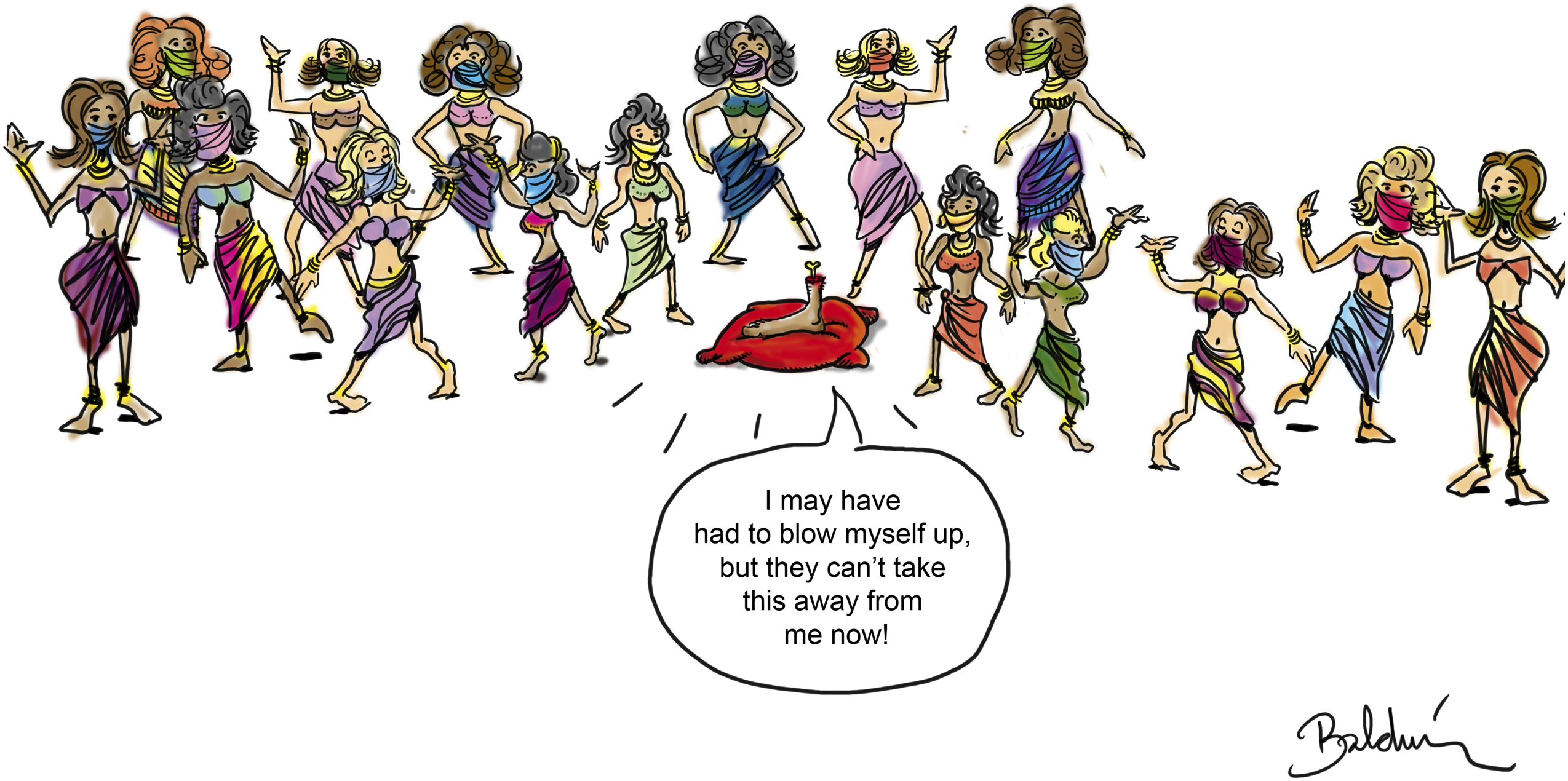
Pretesting the elicitation material
The sketches were discussed in the inner research group and presented to a guidance committee of 18 members. This guidance committee consisted of, among others, researchers with varying expertise, youth workers (i.e. trust persons from the field) and journalists. Based on these discussions, one suggested cartoon was dismissed for being too unclear. In the discussions, the Virus-frame and the Penance counter-frame cartoon were seen as potentially stigmatising, and it was suggested not to start the conversations with these cartoons. In sum, it is advised to discuss the considered cartoons in advance with representatives of the potential participants.
During the Conversations
Cartoon elicitation procedure
All essential aspects of an interview were taken into account, especially bearing in mind the relative vulnerability of the participants, thus ethical approval and a safe space to conduct the interviews. Every participant sat around a table and received a stack of 12 cards. The postcards gave the participants control. They could go back to earlier presented ideas, go as fast as they wanted to, while in the group discussion exchange with their neighbour on the different drawings, another advantage of photo-elicitation (Dickson-Swift et al., 2007).
As a preparation for the conversations, the researchers shuffled the 12 cards, and then ordered the other stacks in the same order as the first one. The stacks all have the pictures directed to the side of the table, so the participants did not see what is on the cards yet. One by one, the cards were turned. The participants discussed one card fully before they get over to the next one. When a new cartoon was introduced, the researcher let the participants first interpret it, stimulated by questions as: How do you interpret what is on the card? What associations does the cartoon make? When the cartoon was unclear, or after a discussion took place on the personal interpretation of the participants, the researcher explained the perspective the cartoon represented, which was then further discussed. In this way, the preferred reading (Hall, 2003) of the authors is brought to the table.
When all 12 cards were talked through, in both the interviews and the focus groups the exercise was made of individually ordering the perspectives. The question asked was: Which cartoon best reflected your visions on radicalisation? In the interviews, the cartoons were compared to each other, whereas in the focus groups, the order of cartoons was compared to that of the other people around the table. However, in most conversations, the attention of the young participants weakened with this exercise, since they had already seen all the cartoons, discussed each of them and felt reluctant to go over all of them again.
Elaboration of answers through cartoons
Before being presented the cartoons, the participants and the researchers had an open conversation on their lifeworld, their neighbourhood and the perception of it, aspects of their life they would like to see changed. Often, this conversation struggled; the answers were short and defensive. It was challenging the researcher to direct the conversation towards radicalisation. When asked questions about the sensitive topic radicalisation, most participants answered shortly (‘I can’t really find any answers or examples, sorry’) or in a distant, non-personal way and elaborated little on the topic, both in presence of a trust person (in this case, a youth worker) and without. The trust person was present to help facilitate the conversation, as well as help create a trusted environment. However, it is possible that this presence made the participants hesitant to open up in the beginning, as this is someone the participants will have a continuing relation with.
When the cartoons were presented, it gave the participants some grip, some reference to start talking from their own lifeworld. For example, after presenting the cartoon Meaningfulness (see Appendix), this participant reflected upon a personal experience: “He [a friend] told me that just a few years ago he saw videos, injustices by US police officers. Blacks who are killed by the police unfairly. […] Exactly after he saw this video, he was really going to join Black [Lives] Matters [sic], he was going to do that. [...] Now he tries to understand the policeman at the same time and also the sociology situation in the society. [...] If he did not want to make that decision, he just became radical. He was really at the end of becoming radical.” (Participant 2, interview)
Similarly, after being presented the Criminal career cartoon, participants opened up on discriminatory experiences with the police, while the distance towards the researchers seemed less when the cartoons were shown by shared laughter, asking questions to the researcher and having fun with comparing the cards.
Since the drawings were impersonal, it became possible to discuss topics in a non-personal way. The humour, impersonality and interpretative aspect of the drawings gave the participants the choice to either discuss the issue in a distant matter, or share personal experiences. The detour taken by the images lead to participants opening up on memories, as reflected in the shared citation.
Discussion
Cartoon elicitation is an innovative method that can be used with a broad range of sensitive topics. The method did indicate several advantages, adding to previous experiences with cartoon elicitation (Cameron & Theron, 2011; Harrison, 2009; Nathan, 1992): the elaboration of answers, the possibility to discuss stigmatising and stereotypical aspects in sensitive topics and the diminishing of power relations between researcher and participant. Reflecting on the researcher-driven method in the case of sensitive research, five aspects need to be taken into account.
Firstly, it is advised to pre-test the cartoons with a guidance committee, especially when using cartoons that play with stereotypes and stigmatising references. By presenting the cartoons to people that know the target group, the sensitivities and the possibilities, the researcher takes an important step in trying to eliminate all possible harm for the participants. Additionally, this round of feedback can diminish the researcher’s personal bias in conceptualising the cartoons.
Secondly, the method enables conversations on potentially painful topics and stereotypical representations by the use of humour and ridiculing stereotypes or countering them (Kyong Liong and Kyo˘ng-nyong, 1996; MacGillivray, 2005; Tsakona, 2009). The cartoons that are potentially stigmatising, as indicated by a pre-test, are best presented with additional explanation to the participants. If this context can be provided in a survey or experiment, for example, the anonymous environment can stimulate insights in the effect of such cartoons.
Thirdly, the use of riddles and drawings helps to keep participants’ attention and gave them control over the conversation, an aspect addressed in earlier research (Corbin & Morse, 2003). However, in the case study, 12 cartoons were on the high end; participants were counting down to the end, and some cartoons were rather complex. Having less cartoons (ideally around eight, based on our experiences) means combining ideas into one cartoon to diminish the amount of cards to present. This is possible (as with the example on Euthanasia, see Figure 1) when the drawings remain easily comprehensible.
Fourthly, the experience with both interviews and focus groups make way for some recommendations. Through the interaction between the participants, as indicated by previous research (Khan & Manderson, 1992; Kitzinger, 1994) valuable insights on the topic are gathered. As in all focus groups, attention should be paid to group dynamics: Who is speaking most? Are people silent, and why? In interviews, the power dynamics might be more persistent (see Guest et al., 2017). Due to the lack of interaction with peers, participants might more easily say ‘I don’t understand this cartoon’ or ‘I have nothing more to say on this’. Being prepared with more probing questions, can stimulate the reflection process, which in focus groups is stimulated through conversation. Examples are: What captures your attention first when you look at this cartoon? What does that mean to you? Are there other elements that you think are important?
Fifthly, the presence of trust persons has both benefits and drawbacks. As mentioned, the presence of a trust person in one of the focus groups was preferable for a trustful, amicable group atmosphere. However, the participants did not fully engage in the first part of the conversation, or answered the questions to the trust person rather than to the researcher. Research indicated trust of the researcher to be highly related to trust in institutions (Guillemin et al., 2018), which might be part of the initial hesitation. It is not possible to compare this to the other focus group (without trust person), as the group dynamics were unalike. The pondering upon answering might also be general discomfort with a research setting, as this faded during the cartoon elicitation section.
Future research can further explore this method of facilitating conversations, which creates room to discuss potential stigmatising aspects. It is the question of continuing research if every sensitive topic lends itself to the methodology. Topics in the sexual atmosphere and specifically themes as incest or rape seem challenging to visualise and discuss at first glance. However, the cartoon elicitation methodology might provide opportunities here for, for example, victims or perpetrators to discuss such events separately, since the cartoons create the space to either reflect on personal experiences, or take the conversation to a more abstract level, but leave the control in hands of the participant. The cartoon elicitation method is particularly useful for polarising issues considering the exploration of different perspectives and contradictions in the cartoons.
Furthermore, the technique can be combined with photo-elicitation by inserting photos of persons or events combined with cartoons. Participants could be asked to bring their own photos they found in the press on the topic. In such combination, participant-driven images can stir the conversation in a direction of media representation, and researcher-driven cartoons can help to examine such perspectives critically.
Footnotes
Acknowledgments
We thank our colleagues, the members of the guidance committee and the trust person, who provided insight and expertise that greatly assisted the research. We thank the reviewers for their constructive feedback which ameliorated our contribution. Above all, we thank the participants for sharing their time and stories.
Declaration of Conflicting Interests
The author(s) declared no potential conflicts of interest with respect to the research, authorship, and/or publication of this article.
Funding
The author(s) disclosed receipt of the following financial support for the research, authorship, and/or publication of this article: The research has been generously funded by Belgian Science Policy (BELSPO) under grant number BR/165/A4/CONRAD.

Appendix
fig5–fig13 Cartoon on radicalisation representing the ‘Criminal Career’ frame. Cartoon on radicalisation representing the ‘Mutiny’ frame. Cartoon on radicalisation representing the ‘Clash of Civilizations’ frame. Cartoon on radicalisation representing the ‘Puberty’ counter-frame. Cartoon on radicalisation representing the ‘Meaningfulness’ counter-frame. Cartoon on radicalisation representing the ‘Resilience’ counter-frame. Cartoon on radicalisation representing the ‘An open mind’ counter-frame. Cartoon on radicalisation representing the ‘Diversity’ counter-frame. Cartoon on radicalisation representing the ‘Catalyst’ counter-frame.


