




Abstract
Diaries are an underutilized tool in qualitative research addressing self-management. The “real time” data offered by the diaries provide an opportunity to capture details of self-management that otherwise may be missed during an interview. The purpose of this study is to describe the feasibility of using diaries for capturing self-management of post-treatment cancer survivors. The research questions are (1) how did participants engage with the diary? (2) what were participants’ evaluations of the self-management diary? and (3) how did the use of self-management diaries affect qualitative interviews and the interview data collected? We conducted a qualitative descriptive study, which comprised diary and semi-structured interview components to explore cancer survivors’ self-management activities. Participants were individuals diagnosed with head and neck or colorectal cancers at ages ≥18 years old who had completed primary treatment between 2–10 years prior. The diary instructions directed participants to document their self-management activities daily for 1 week before a scheduled interview. Data were analyzed using thematic analysis. The results showed (1) fifteen participants completed the diary and n = 9 completed all 7 days with detailed information regarding self-management. (2) A majority of the participants (n = 13) found the diary easy to use. A few participants (n = 3) shared individual-level challenges including preferring to document over several months, difficulty finding time to document, and difficulty putting thoughts into words. Suggestions to promote diary completion in future research included allowing participants to either document for only 1 day or allowing them to provide a summary of their weekly routine activities, sending reminders, and having more specific prompts. (3) For participants who completed the diary, we were able to customize the interview questions, which enhanced the richness of the interview data and captured greater complexity of self-management activities over time. Using diaries can promote the customization of interview questions and facilitate capturing rich interview data.
Introduction
Self-management is a process of engaging in managing health and well-being (Ryan & Sawin, 2009). While research on self-management is a priority area for nursing (Grady, 2017), our knowledge toward self-management of populations such as post-treatment cancer survivors is limited. Diaries offer unique data collection opportunities for self-management both for research and clinical practice. Diaries are great tools for collecting data for research (Evald et al., 2020; Furness & Garrud, 2010; Hertzog et al., 2021), providing narrative everyday life events as a reflection tool or as a primary data collection tool with the purpose of analyzing data into meaningful categories (e.g., information about daily routine). Diaries can be used in clinical decision support (Van Woensel et al., 2015) and can also improve patients’ adherence (Shim & Hwang, 2016) and enhance self-efficacy (van Kruijssen et al., 2015). In this article, we refer to diaries as data collection tools with which a study participant records daily activities and behaviors (Filep et al., 2017) that are useful for gathering information pertinent to self-management. The design of the diary itself is dependent on the research questions. While a majority of diaries have structured designs, some are designed to be open ended, encouraging participants to identify what to record and why it is important (Janssens et al., 2018).
Despite their well-established use in multiple research contexts (Fritz & Lysack, 2014; Wolf et al., 2016), diaries remain underutilized in qualitative research within the nursing discipline and self-management research (Morrell-Scott, 2018). The main use of diaries for self-management research is related to using them in self-management intervention. In symptom and behavioral change interventional studies, diaries are widely used as a tool to help participants track their symptoms and self-management (Evald et al., 2020). In cancer research, for example, diaries are often used to track symptoms such as pain (Baggott et al., 2012; Yamanaka & Suzuki, 2020). Self-management diaries are different than symptom diaries because they have a broader focus, capturing a range of behavioral activities such as exercise, diet, and symptom management in order to depict a broad overview of their day-to-day practices. Despite the benefits that diaries offer to capture rich “real-time” data, including an opportunity to collect longitudinal data that is not possible to obtain during a one-time interview, they have not been used to study self-management in post-treatment cancer survivors who received treatments with curative intent. Indeed, the current research with the cancer survivors’ population typically uses one-time interviews or surveys, which are subject to recall bias (Althubaiti, 2016).
The real-time data that diaries offer can provide a clearer picture of what individuals actually engage in every day for management of their health and well-being. Based on our previous experience conducting qualitative research on self-management, participants need prompting to articulate their self-management activities. Additionally, during interviews, participants might not immediately recall the activities that they practice. Asking participants to document their activities in the self-management diary promotes awareness (Woll, 2013), which can later help them associate their activities with self-management and discuss those self-management activities with the researcher. We developed diaries comprising close- and open-ended elements to help participants document and reflect (Bartlett & Milligan, 2015) on their self-management before the interview. Successful implementation of self-management diaries is critical for data collection because diary methods require a high level of participant engagement. In order to develop the methodological potential of diaries for enhancing qualitative data collection, the purpose of this study is to describe the feasibility of using diaries for capturing self-management of post-treatment cancer survivors. The research questions are (1) how did participants engage with the diary? (2) what were participants’ evaluations of the self-management diary? and (3) how did the use of self-management diaries affect qualitative interviews and the interview data collected? We detail our diary-based data collection methods, identify feasibility of using the self-management diary, and provide recommendations for future design of self-management diaries. This study is important to provide methodological insight and advance understanding of using self-management diaries in cancer survivorship.
Methods
Design and Sample
Self-management diaries were implemented as part of a parent cross-sectional qualitative descriptive study (N = 24) designed to investigate the self-management activities of head and neck (HNC) and colorectal cancer (CRC) survivors. Head and neck and CRC diagnoses were selected because little is known about the self-management practices of these survivor groups. The parent study aimed to identify the types of self-management activities that cancer survivors practiced and how and why participants engaged in self-management activities (Saeidzadeh, 2020). Our inclusion criteria were individuals diagnosed with HNC or CRC at ages of ≥ 18 years old and completion of primary curative intent treatment between 2 and 10 years ago. The exclusion criteria were adult survivors of childhood cancer. We developed self-management diaries for participants and asked them to document their self-management activities prior to conducting semi-structured interviews. Our goal for using the self-management diaries was to encourage participant reflection on self-management behaviors and reasons for engaging in self-management to inform subsequent qualitative interviews. Diaries were made optional after recruiting half of the participants to overcome recruitment challenges encountered during study. Data were analyzed using thematic analysis. In this article, we focus on analyzing data related to those who provided at least some diary data. We refer to those who completed all 7 days of the diary as full completers and those who completed diary less than 7 days as partial completers. We also refer to those who did not complete the diary at all as non-completers.
Description of the Self-Management Diary
The diary was developed and completed online in REDCap and comprised two sections. The first section asked participants to document their self-management activities in sections designated for the morning, afternoon, and evening using an open-ended format (Figure 1). They were instructed to document their daily routines for taking care of their health after cancer treatment was finished. Examples of routine activities were given to the participants to help them with documentation such as controlling symptoms, eating a healthy diet, physical activity and/or exercise, and protecting against sun exposure. After participants completed the first section daily for 1 week, the second section was presented (completed only once at the end of day seven) which had the list of self-management activities applicable to all cancer survivors. The second section asked participants to list self-management activities and report why they performed those activities using closed-ended, multiple-choice items with the followings response options: (1) to control consequences of cancer in their life (e.g., engaging in social activities and unable to work full-time), (2) to control symptoms and/or side effects from cancer treatment, (3) to prevent/monitor cancer, (4) to control emotion, or (5) to promote health (Figure 2). Participants could select multiple answers for each item. Reminders were sent up to two times a week for those who did not finish the diary within 3 days. Diary section one: Open-ended items documenting self-management activities. Diary section two: Close-ended multiple-choice report of reasons for performing self-management activities.

Results
Participant’s Characteristics
Characteristics of Participants Based on Completion of the Diary (N = 24).

Note. *Completers are participants who fully/partially completed the diary. **Non-completers are participants who did not complete the diary.
Feasibility
Eleven (out of 15) participants had completed diaries before they were made optional, and four participants (out of 9) completed diaries after they became optional (Figure 2 Supplementary Material). Many participants (n = 13) discussed that completing the self-management diary was easy for them. The format was “straightforward” and the space on the diaries was sufficient, which allowed them to document everything that they wished to record.
Diary Engagement
Documentation style
Participants varied in their documentation style regarding the type of information and level of detail they provided. The analysis on the pattern of diary completion shows that nine participants fully completed all 7 days of the diary and six participants partially completed the diary (less than 7 days). All participants who completed all 7 days provided detailed information regarding their self-management. The recorded information was relevant to how they took care of their health on a daily basis (e.g., managing dry mouth through using biotin products). For example, one participant (P27, 60 years, and female) recorded that her physical activity consisted of “combined sitting, standing, walking at job.” Participants outlined the details of their self-management activities. One participant (P5, 55 years, and female) recorded details of her head and neck exercises, saying, “I do 15 minutes of neck stretches to maintain range of motion and flexibility as well as to reduce neck/shoulder pain, specifically to the right side of my neck and top of shoulder. These exercises help me to be able to turn my head left and right and to tip my head towards each of my shoulders. It also reduces the number of ‘shocking,’ immobilizing pain that radiates from the right side of my jaw, down my neck and out towards my arm.” Conversely, for the participants who had documented less than 7 days, the level of detail was limited. They mainly described their overall self-management activities. For example, one participant (P50, 50 years old, and female) condensed her activities into a list without further detail, saying their morning routine consisted of “Breakfast, daily vitamins, morning medications, check blood sugar regularly.”
Diary as a reflective/self-monitoring tool
Overall, participants (regardless of being full/partial completers) described diaries as providing an opportunity to “reflect” on their behavior. Four participants discussed benefiting from diaries because they allowed participants to keep track of their self-management. For example, one participant (P27, 60 years old, and female) said, “It was good for me to keep the diary in that it, you see it right in front of you and it makes you very cognizant of how you spend your day and what, goes into your day and how you’re eating and what kind of activity you're doing or your level of activity in general and day-to-day quality of life, it seems like a meal routine. Then you had to have great benefit I think in the long run. So, if nothing else, I didn't mind doing it because it helps me keep track of what I was doing and made me very mindful of what I was doing. So, I know water, I probably can drink more water than I do. I try to drink plenty of water and that was one thing I did. I noticed more during the, when I was keeping track, I realized that I've got to keep up on my water. So, in that regard I think it's good to have something like that in front of a person. It just brought things right to the forefront of my attention not to get away from good health in general good health practices.”
Diary Feedback
Feedback for Future Improvement of Self-Management Diary.
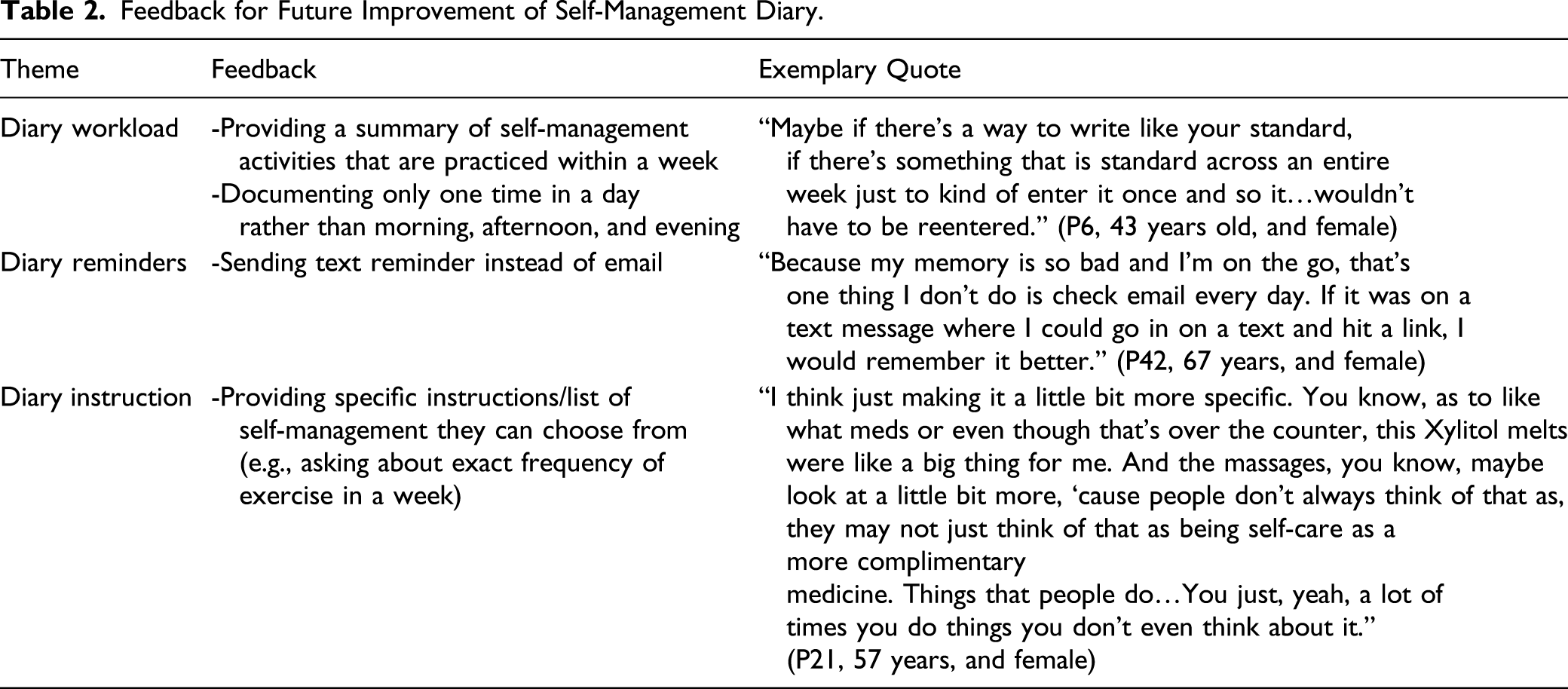
Individual-Level Challenges
A few participants (n = 3) discussed the challenges that they encountered documenting their self-management activities. The challenges were related to documentation over a short period of time (i.e., 1 week) leading to repetitive entries because they had similar daily routines throughout the week. For example, one participant (P4, 67 years old, and male) said, “It was a bit challenging. It is because I have such a boring life and it was challenging. My days are similar, my routines are similar. When I see back, I struggled with making entries on certain days and I think the survey shows repetitive entries. But when, I don’t know if over the course of several months will be more effective.” Another challenge was related to finding the time to document. For example, one participant (P6, 43 years old, and female) said, “My life is kind of busy, I work full time and I'm a full-time single parent, so it's hard to sometimes sit down and make myself do it. Obviously, my schedule is, it just can be crazy, but it wasn't too bad. It was pretty easy.” Lastly, one participant (P28, 41 years old, and male) discussed that documenting was difficult for him mainly because he found putting his thoughts into words challenging. He asked his wife to help him with diary completion. He described, “My wife helped me quite a bit with it. She actually typed it in, you know, I would get to keep track of what I did. I sometimes I'm just not able to put in words what I'm thinking. So, it was helpful for her to kind of translate for me.”
Diaries’ Enhancement of Qualitative Interview
Responding to interview questions
When participants maintained daily diaries (regardless of being full/partial completers), qualitative interviews focused on in-depth conversations about how and why participants engaged in their self-management activities, which allowed more insight into the research questions than interviews with participants who did not complete diaries. Interviews with participants who did not complete diaries focused more on remembering daily activities rather than discussions on how and why they practice these activities. For example, during the interview for one the participants (P5, 55 years old, and female) who had recorded her daily routine for her neck exercises and eating habits, the interview was able to focus on investigating how she strategized to practice these self-management activities. One of the questions that we asked was “how you strategize in terms of having the balance between getting enough healthy food and managing your dry mouth in a way that eating food is pleasant for you?” Yet, for those who did not document anything on the diary, we had limited information prior to the interview. Therefore, we were not able to customize the interview questions, and the interview time was spent on helping participants reflect on their self-management through exploring the types of self-management activities in which they engaged (Table 2).
Outcome of the interview
Diaries’ Enhancement of Qualitative Interview.

Discussion
The preliminary data obtained from completion of diaries and subsequent participants’ feedback provides methodological insight for using diaries for qualitative research on self-management in post-treatment cancer survivors. Despite the use of self-management diaries in other research designs (e.g., intervention studies), their feasibility in qualitative research is not well established. Self-management is a multifaceted concept, and using diaries helped us collect information that could not have been captured otherwise during an interview. It provided an opportunity for the participants to reflect on what they typically did during a week for self-management and allowed us to better tailor our interview questions. For those participants who followed the diary instructions and recorded information related to their health, our interviews resulted in obtaining richer data compared to those who did not complete the diary. Participants who did not complete the diary were more likely to be male, and the participants who completed the diary were more likely to be female. We did not find any differences between the quality and the outcome of the interviews for those who fully/partially completed the diary. Diary completion provided an opportunity for participants to think about their self-management routine. Our results are consistent with a phenomenological study conducted by Furness and Garrud (2010) who used diaries to collect data from facial cancer surgery participants. While the diaries were the only data collection method used in their study, the researchers found the data obtained using this method to be rich (Furness & Garrud, 2010).
Diaries enable researchers to obtain data in “real time.” It allows for capturing the change in phenomenon of interest over time (Bartlett & Milligan, 2015) and obtaining data in a “naturally occurring” setting (Xu et al., 2018). This is particularly valuable for self-management research because participants often cannot recall their day-to-day activities instantly at the time of interview. It captures fluctuations as they occur instead of relying on memory to recall events (Day & Thatcher, 2009). In our study, we benefited from employing self-management diaries which illuminated how cancer survivors typically engaged in self-management. During the interviews, participants understood what we were asking about and often referred to what they had documented in their diaries. We were able to deeply explore their self-management routine, and the results of interviews helped us to better contextualize the routine self-management based on the narrative provided by participants. Therefore, the use of diaries for self-management research can provide a supplementary source of data and also improve data collected through other methods, such as interviews. Qualitative descriptive studies on self-management overwhelmingly use one-time interviews to collect data at a single point in time, which might not provide sufficient information on the everyday routine of participants. Our experience in using self-management diaries resulted in richer data during the interviews.
While choosing a data collection method depends on the research questions, use of a variety of methods such as surveys, diaries, and photo elicitation (Fritz & Lysack, 2014) can be more informative. In addition to supporting data collection, depending on the content of the diary, it can have beneficial effects on participants too. Some of our participants indicated that using the diary made them mindful about their own self-management activities, which in turn can improve participants’ well-being and reinforce engagement in self-management. Our finding is consistent with that of Fritz and Lysack (2014) who used photo elicitation to capture self-management of diabetes. They found that participants gained awareness of their self-management when they were taking photos of their food, which resulted in them changing their self-management behavior (Fritz & Lysack, 2014).
Our study has limitations. Our sample size was small which could have limited capturing different perspectives regarding diary completion. We only offered the diary in an online format, which could have impacted some participants’ engagement with the diary. Additionally, completing diaries required more time than completing a one-time interview or a survey, which may explain why some of the participants did not complete the optional diary. Despite these limitations, there are many lessons learned from our study that can be useful for future research.
Recommendation for Future Design of Self-Management Diaries.

We recommend the following methodological research considerations in future to facilitate and promote using diaries for qualitative research. We suggest that future researchers to include the diary as a supplement/appendix file in their manuscripts. This will help future researchers have access to a variety of diary designs. Examining how the diary is used in the interview process should be investigated. It will be particularly informative to explore the feasibility of using a diary as an interview guide preparation or diary as an elicitation tool and/or analytic triangulation tool with interview data. Lastly, the methodology of using diaries in other context of self-management should be further explored.
Conclusion
Considering that diaries are useful tools in qualitative research, examining their feasibility can bring methodological insight into their further use in qualitative research. It is recommended that future researchers consider using diaries as a tool for self-management research that can facilitate data collection, enhance quality of the subsequent interviews, and provide rich data.
Supplemental Material
sj-pdf-1-ijq-10.1177_16094069211038853 – Supplemental Material for Using Online Self-Management Diaries for Qualitative Research
Supplemental Material, sj-pdf-1-ijq-10.1177_16094069211038853 for Using Online Self-Management Diaries for Qualitative Research by Seyedehtanaz Saeidzadeh, Stephanie Gilbertson-White, Kristine L. Kwekkeboom, Faezeh Babaieasl and Aaron T. Seaman in International Journal of Qualitative Methods
Footnotes
Declaration of Conflicting Interests
The author(s) declared no potential conflicts of interest with respect to the research, authorship, and/or publication of this article.
Funding
The author(s) disclosed receipt of the following financial support for the research, authorship, and/or publication of this article: This work was supported by the Graduate and Professional Student Government at the University of Iowa.

Supplementray Material
Supplementary material for this article is available online.
References
Supplementary Material
Please find the following supplemental material available below.
For Open Access articles published under a Creative Commons License, all supplemental material carries the same license as the article it is associated with.
For non-Open Access articles published, all supplemental material carries a non-exclusive license, and permission requests for re-use of supplemental material or any part of supplemental material shall be sent directly to the copyright owner as specified in the copyright notice associated with the article.
