




Abstract
Design:
A mixed-methods design will be used to collect data for the study, with each stage being of equal importance. Stage one is an online survey and stage two is a series of semi-structured interviews.
Context of study:
To explore the experiences of healthcare students who have faced allegations of breaching academic integrity, to improve the support provided to these students.
Objectives:
The main objectives of this study are to explore and describe the experiences of these students to develop an understanding of the areas they need support while going through this process.
Study population:
Healthcare students studying at a regional university in Australia.
Keywords
Contribution to Current Understanding
There is a need to carry out a study that investigates the experiences of healthcare students as they face allegations of breaching academic misconduct. It is important to understand these students’ experiences to ensure that appropriate support mechanisms are in place throughout the process. Exploring the experiences of these students will allow the development of appropriate support mechanisms from the time that students are notified of a potential breach of academic integrity through the investigation phase of the process to the decision and the post-decision phase of the process.
Background
Academic integrity is conceptualized as ethical behavior in education, acting in an honest and trustworthy way (Devine & Chin, 2018). When a breach of academic integrity occurs academic misconduct occurs, which has broadly been defined as an attempt of a student to secure an unfair advantage in their work for assessment (Tee & Curtis, 2018). Breaches of academic integrity can take the form of plagiarism, self-plagiarism, collusion, cheating, contract cheating and academic fraud. These breaches of academic integrity can either be unintentional or deliberate.
Unintentional breaches of academic integrity occur due to a lack of knowledge or skills in the conventions of academic writing and the student is unaware that they are doing something wrong (Johanson, 2010). Deliberate breaches of academic integrity are when the student deliberately undertakes academic fraud to pass work that is not their own as their own (Witmer & Johansson, 2015). Often unintentional breaches of academic integrity are dealt with informally and are opportunities for providing further education and support to the student. Deliberate breaches are dealt with more harshly, with penalties differing among institutions. In severe cases of breaches of academic integrity, students may face suspension or expulsion from their institution.
Studies to-date have explored student perspectives of breaching academic integrity from the viewpoint point of motivations to partake in academic fraud (Foltýnek & Králíková, 2018), the student’s attitude toward breaching academic integrity (Bretag et al., 2019) and whether they would participate in any form of academic fraud (Awdry, 2020). A study by Pitt et al. (2020) using semi-structured interviews looked at the experiences of seven students alleged to have breached academic integrity standards. This study highlighted that the process was a challenging experience for the student; students were reluctant to seek help from close family; students became stressed about future assignments; students faced damage to their reputation (Pitt et al., 2020). Pitt et al. (2020) also highlighted that students who had faced allegations of breaching academic integrity were keen to help other students avoid the errors they had made.
In excess of 60% of higher-education students admit to cheating on written assignments (McCabe et al., 2017). Despite the integral-focus on ethics within the healthcare professions, this trend is no different among student nurses, with 58% of undergraduate student nurses reportedly engaging in academic fraud (McCabe, 2009; Theart & Smit, 2012). A study of Australian nursing students by Birks et al. (2018) found that 45% of nursing students who participated reported as having undertaken some form of academic fraud at some point.
Objectives
The objective of this study is to explore the experiences and opinions of healthcare students who have breached academic integrity standards. Looking at how their experiences of the processes involved can be improved to better support those students in the future who may face similar allegations. To help achieve this, the following specific objective will be explored: Describe and analyze the participant’s experience receiving an allegation of a breach of academic integrity Describe and analyze the participant’s experiences of the investigation process following a breach of academic misconduct Describe and analyze the participants experience receiving the outcome of the investigative process Describe and analyze the participant’s experience post receiving the outcome, and penalty if applicable, of the investigative process Explore and analyze the opinions of participants to identify what formal and informal support mechanisms helped them through the process Describe and explore the different themes that may arise between the different professions of the healthcare students who participate in the study Explore and analyze areas where the participants felt they lack support throughout the process.
Method
This pilot study will use a mixed-methods research design to meet its objectives. The use of a mixed-methods design will allow the researches to gain a deeper understanding of the healthcare students experiences of breaching academic integrity. This deeper understanding would not, according to Lunde et al. (2013), come from using a single method.
There will be two stages of this study. The first stage will be an online survey based on studies by Birks et al. (2018) and Winrow et al. (2015). Both these studies used this survey tool to explore the views of nursing students on the topic of breaching academic integrity. Further questions were added to capture those participants who wished to be interviewed in stage two of the study and discuss their experiences of allegations of breaching academic integrity standards.
Stage two of the study will follow the semi-structured approach used by Pitt et al. (2020) and explore the student’s experiences of completing the assessment task they were alleged to breach academic integrity, the process of receiving the allegation, the process of the inquiry and outcome, and their experience after this experience had been completed.
Participant Recruitment
An email containing a link to the online survey will be sent to all students enrolled with the School of Nursing, Midwifery and Paramedicine, within a regional University in Australia. This email will invite them to participate in stage one.
Embedded within the survey is a question asking if the participant had ever faced allegations of breaching academic integrity. If the participant responds yes, they will be invited to participate in an interview to discuss their experiences. Allowing the participant to self-nominate to undergo an interview means that the research team does not single out specific students because they are aware those students have faced allegations of breaching academic integrity. The student does not feel they have been singled out. After all, they may have done something wrong, and they are free to say no to be interviewed.
As this is a pilot study, the number of interviews to be undertaken will be capped at 15 interviews. Data saturation from interviews tends to naturally occur after 12 interviews according to Guest et al. (2006). Therefore, in the pilot, three further interviews can occur to allow for data saturation to occur. Should data saturation not occur at this point, the study will report what has been found and identify that further exploration of the topic is needed.
More than 15 students may wish to be interviewed. Participants will, therefore, be chosen to participate in this pilot study on a first-come-first-served basis. Thus, the first 15 students who volunteer will be interviewed if they meet the eligibility criteria for stage two.
Should more than 15 students wish to participate, an email will be sent to the 16th volunteer onward. This email will thank them for volunteering and advise that enough participants had been recruited for stage two of the study. They will also be informed that they may be invited to participate if someone withdraws from the study or to participate in future rounds of the study.
Should the study fail to reach 15 participants, the research team will undertake data analysis with the sample they have received and report on this sample. The recruitment process will subsequently be reviewed to help better inform for future rounds of the study.
Eligibility Criteria for Stage Two
The following eligibility criteria have been established for participants of stage 2: Be over the age of 18 Have received an allegation of breaching academic integrity The inquiry into the allegation needs to have been completed and a result has been given Be enrolled in an undergraduate or postgraduate course offered by the relevant health related school. Have exhausted all avenues of appeal against the allegation of breaching academic integrity Have no concurrent allegations of breaches of academic integrity being dealt with
By ensuring that all avenues of appeal are completed and no concurrent allegations in the process will all the research team to explore the participant’s experiences and not act as a sounding board for the participant to air complaints about the process.
Data Analysis
Data analysis will occur using the qualitative content analysis developed by Elo and Kyngäs (2008). This process will allow the data to be explored to identify themes raised by participants. These themes will then be presented to stakeholders in separate interviews using Patton’s Triangulated Reflexive Approach (Patton, 2002). This approach will allow a deeper context to be developed from the identified themes.
The Trustworthiness of the Study
The trustworthiness of the study will use the six criteria established by Nowell et al. (2017), to maintain trustworthiness throughout the study. Credibility will occur using participant verification checks and peer debriefing of the research team to ensure the accuracy of the analysis and the conclusions made are pertinent to the study. Transferability, this is a pilot study and the transferability of the results will be limited. The individual reading the presented results will need to determine whether the data is transferable. Dependability, the research will follow the logical process discussed in this protocol document. Confirmability, the research team will document the decisions made throughout the process and presented for readers to determine the appropriateness of the decision. Using Patton’s Triangulated Reflexive Approach will also help confirm the reliability of the results. Audit trails, a copy of the raw data and transcripts will be kept according to the University’s policy of data storage as an audit trail of the research process Reflexivity of the research will be presented alongside the discussion of themes that emerge from data analysis.
Ethical Considerations
Consent
Participation in both stages of the study is voluntary. No gifts or incentives will be offered to encourage participation in the study. Consent for stage one will be obtained electronically via the online survey. The opening section of the survey will explain the study to the participant and ask if they consent to participate in the study. If they answer yes, they are taken to the study to complete. If they answer no, they are taken to the final screen of the survey and thanked for their interest.
Consent for stage two will be written. The participant will be presented with the Research Participant Information Sheet before the interview and a copy of the consent form. When the interview takes place, the participant will be asked to sign the consent form. If the interview is to occur electronically then before the interview the participant will be asked to email a copy of the signed consent form to the interviewer. No interviews will take place without this consent form being submitted.
All participants will be informed that they are free to withdraw from the study at any point. During stage one if the participant wishes to withdraw, all they would need to do is close their web browser and this will stop them entering any further data into the survey. As no personally identifiable data is collected in stage one, it may not be possible to remove an individual’s contribution from the study. A determination will be made by the research team as to what level of completion of the survey is need before it is excluded from the data analysis for being incomplete. Should a participant start an interview then decide to withdraw from the study. The interview data will be deleted.
Participant Protection
Dealing with the issue of breaching academic integrity is a sensitive issue. The events raised in the survey and through interview could be emotional and distressing to the participant. In stage one it is not possible for the research team to fully deal with these issues as the survey is completed anonymously away from them. The final screen will provide contact details of those who can support the participant should they become distressed by the issues raised in the survey.
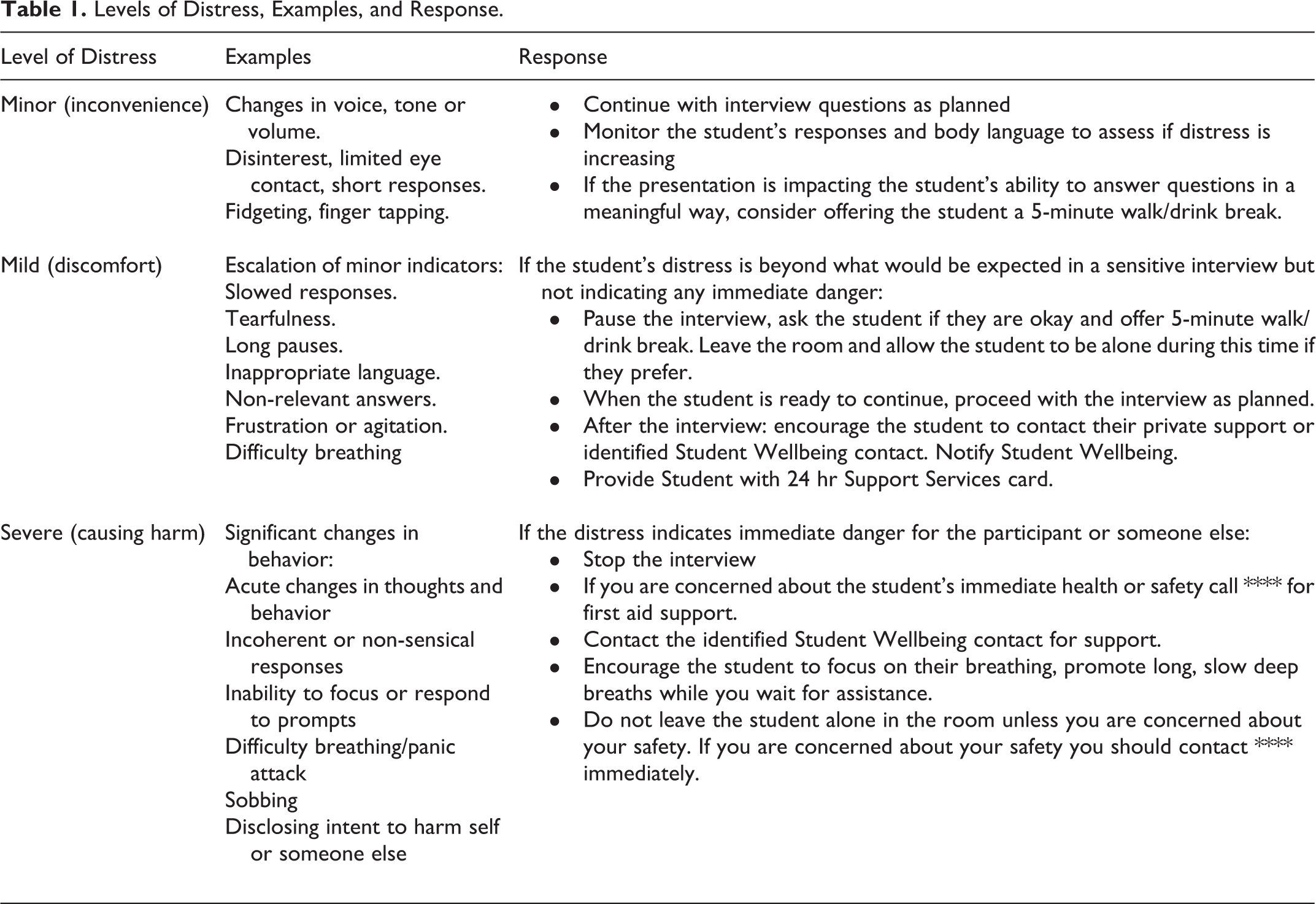
To help protect the participants during the interviews, the following processes will be done: Interviews will take place only after the entire inquiry process is completed The interviewer will have experience in interviewing people about sensitive issues and undergone Participant Wellbeing training developed by the Student Wellbeing team at the University No interview will occur at times support services within the University are not available Participants will be informed that they can decline to answer any of the questions asked It the participant becomes distressed during the interview will be stopped and the interviewer will be guided by the process developed in Table 1 as to what happens next All participants will be made aware of the support services available to them through the University
Levels of Distress, Examples, and Response.
Confidentiality of Participants
The discussion of breaching academic integrity is a sensitive issue. Participation in the study may be reduced if they feel that they are identifiable by the research team. The participant may also feel that any future relationship they may have with the research team as markers of futures assessment clouded, as the research team is aware of the allegations made against them, proven or not.
To help maintain the confidentiality of the participant a research assistant will be employed to undertake all duties related to participant involvement. The research assistant will be the person who contacts the students who self-nominate to participate in stage 2 and verify their eligibility to be interviewed. They will also be the one to obtain consent from the participant and carry out the interview. Should the participants have questions about the study they will go to the research assistant first, anonymized and sent to the research team to be answered. Responses from the research team will be fed-back to participants via the research assistant.
To further help maintain the anonymity of the participant, a study-specific email address will be used. All communication about the study from participants will be directed to this email address. The only person who will have access to this email address will be the research assistant.
The interviews are expected to last no longer than an hour and will be digitally recorded. The research assistant will arrange for the transcription of the interview and participant verification of the transcript. Once this has occurred the research assistant will allocate a pseudonym to the transcript and present the anonymized transcription to the research team for data analysis. This adds another layer toward protecting the confidentiality of the participant.
Discussion
Being accused of breaching academic integrity is a highly emotional time for many students. They often don’t know what to do or who to turn to for help. They can bottle things up and hide things away from their family and friends out of shame. This makes studying the experiences of these students a very sensitive one. But it is also an important study to undertake.
By exploring and understanding the experiences are of students who have faced allegations of breaching academic integrity, structures and process can be put into place to better support their needs. This will provide opportunity to develop resources that will better guide students through what is a highly stressful time. There is also scope to review the support provided to students following an academic misconduct process, to assist the students in understanding their options moving forward.
Given the high level of stress associated with the misconduct process, the interviewing of students should be treated with sensitivity. Students may also be concerned about coming forward to be interviewed and identified as someone who has cheated on an assignment. Especially if they haven’t told anyone about the allegation or the allegation has been proven false.
By having a specific email address and a single person of contact who is not part of the School or the research team, goes to help alleviate some of the potential fears of the participant. Knowing only one person can identify them is more reassuring than knowing that a whole team could identify them. Also, knowing that the person they are dealing with is not a member of the teaching team can reassure them that potential future markers are not going to be biased toward them because of an old allegation of breaching academic misconduct.
Finally, by only undertaking the interview when all avenues of appeal and the final verdict in place about the allegation, allows the student to fully reflect on the whole process. The student is not caught up still thinking that they can use the study as another avenue of the appeal of the allegation. The student can discuss and talk about each aspect and demonstrate what has happened to them with clarity.
Limitations of the Study
This is a pilot study exploring this topic and therefore the results are not likely to fully generalizable. The study is reliant on the participant passing on truthful information about their experiences openly. Should the participant not answer certain questions or provide less than truthful answers to some of the questions the findings of the study become limited.
Footnotes
Declaration of Conflicting Interests
The author(s) declared no potential conflicts of interest with respect to the research, authorship, and/or publication of this article.
Funding
The author(s) received no financial support for the research, authorship, and/or publication of this article.
