




Abstract
In this paper, we critically reflect on our conceptualization and operationalization of “rapid photovoice” as a close-up, emancipatory, action research methodology which has multiple, intersecting social-justice goals; and consider the methodology’s potential for helping to achieve such goals. We first consider photovoice in relation to its typical use in public health research, as well as in prior research into student experiences of higher education. We then consider our pragmatic redesign of the methodology as rapid photovoice (RPV), which we conceptualized in response to the goals, parameters, and constraints inherent in our project, which studied student movement violence and wellbeing. In the third part of the article, we describe and discuss our operationalization of RPV in this study on four university campuses in South Africa. In the fourth section, we reflect on some of the ethical considerations arising from the topic and the methodology. In the final section of the article, we critically assess the interim outcomes of our use of RPV in terms of (1) psychologically empowering students to reflect on traumatic experiences in a safe space and enhancing their self-awareness of wellbeing, wellbeing resources and coping strategies; (2) the politically emancipatory potential of photovoice to represent student experiences authentically and with immediacy to higher education policy role-players, and (3) its ability to co-create artifacts of collective memory that provide authentic empirical material for making trustworthy knowledge claims.
Keywords
Introduction
In recent years, student mental health and wellbeing have moved onto the national and institutional higher education policy agenda in South Africa, spurred by increasing numbers of student suicides and reports of student mental health problems, especially in the aftermath of student protests and related violence on university campuses (Cornell et al., 2016; Livemag, 2017; Monama, 2019; Schreiber, 2018). In order to investigate this, the Human Sciences Research Council (HSRC) and the University of Venda jointly embarked in 2019 and 2020 on a research project to explore students’ experiences of violence on university campuses and their wellbeing resources and coping mechanisms, focusing particularly on those who had been involved in student activism in recent years and had witnessed, perpetrated, or become victims of violence. Photovoice was chosen as a close-up emancipatory methodology for the study, which was conducted with small groups of former student activists at four violence-prone university campuses in South Africa; that is, University of Fort Hare; University of the Free State; University of Venda; and University of the Western Cape (UWC).
In this paper, we critically reflect on our conceptualization and operationalization of rapid photovoice (RPV) as a variant of photovoice. We first describe the typical use of photovoice in public health research and prior research into student experiences of higher education; and then reflect on our pragmatic redesign of the methodology as RPV. Unlike accounts in the literature on the methodology which recommend engagements with participants over an extended period (for example, Kessi & Cornell, 2015; Strack et al., 2004; Wang & Burris, 1997), our use of RPV compressed our core interaction with the participants into three 1-day workshops held during a single week. After describing our application of the methodology and reflecting on some of the ethical considerations arising from the topic and our method, we ask: (1) Can RPV psychologically empower students to present their case on a level playing field, creating a safe space to reflect on their student experiences, and enhancing self-awareness of their wellbeing, wellbeing resources and coping strategies? (2) Does the rapid form of the methodology retain the politically emancipatory potential of photovoice to represent student experiences authentically and with immediacy to higher education policy role-players and student affairs professionals? (3) To what extent can we support claims that the RPV methodology co-creates artifacts of collective memory which provide the empirical material for making trustworthy knowledge contributions? Should these claims to produce empowerment, emancipation and trustworthy knowledge be nuanced, or should they simply be abandoned so as not to appear disingenuous? We answer these questions with reference to: our observations of, and reflections on, the process; and the results of workshop evaluations completed by most of our student participants (20 of 26) after each engagement.
Photovoice as a Public Health Research Methodology
According to Wang and Burris (1997, p. 370), photovoice is a methodology which has been deployed by public health researchers with three main aims: (1) to enable people to record and reflect their community’s strengths and concerns, (2) to promote critical dialogue and knowledge about important community issues through large and small group discussion of photographs, and (3) to reach policymakers.
Participants then collect photographs which focus on strengths and weaknesses in their communities or individual lived experiences (Newman, 2010). The use of photographs, typically taken by community participants, is a defining characteristic of the photovoice process, which seeks to identify, represent, and enhance issues of concerns within the community (Wang et al., 2000, p. 82). Researchers report different ways in which the taking of photographs by participants is facilitated. In some cases, participants use their own phones (Irby et al., 2018); while in others, they are provided with a digital camera (Finholt et al., 2010; Gravina et al., 2020; Musoke et al., 2016); a disposable camera (Mayfield-Johnson et al., 2014; McKernan et al., 2019); or given the option to use any of the three (Wendel et al., 2019). The researchers will typically direct participants about the number of photos they should take (Cooper et al., 2017; Musoke et al., 2016), and in all but the most “low-participation studies” (Catalani & Minkler, 2010), participants will also be involved in the selection of the photos to be used for further discussion and analysis (Musoke et al., 2016).
After the photos have been taken, they are typically shared within a closed group which discusses and reflects on their meaning (Irby et al., 2018). Researchers may deploy storytelling (Carlson et al., 2006); writing exercises (Irby et al., 2018); semi-structured interviews (Lucke et al., 2019); or questionnaires (Wainwright et al., 2017) to interpret the meanings of the photos in keeping with the goals of their study. The action research component of photovoice studies typically includes creating a photo exhibition which displays issues of concern to the research participants themselves, as well as the wider community and decision-makers (Catalani & Minkler, 2010). In most photovoice studies, participants are usually not included in the final analysis and writing of the study (Hergenrather et al., 2009), with a few exceptions (for example, Irby et al., 2018; O’Donovan et al., 2020). In some studies, the researchers involve participants to member-check the research findings (Mayfield-Johnson et al., 2014; McKernan et al., 2019).
In genuinely participatory photovoice research, the participants should ideally be involved in all stages of the research process: co-determining the research aims, questions and process; taking and selecting photographs that best reflect the strengths and problems in their community; discussing the meanings of the photographs; analyzing the photographs for any emerging themes; and eventually engaging in community-based action and advocacy work (Wang & Burris, 1997). However, in their systematic review of a sample of photovoice studies, Catalani and Minkler (2010) found that the quality of community participation varied widely. They found low, medium and high levels of participation. In low-participation studies, participants were usually not included in the final analysis and writing of the study (Hergenrather et al., 2009). In addition, in some cursory projects, participants were typically only involved in collecting photographs and in individual discussions or interviews about their photographs (p. 439).
By contrast, in medium-participation projects, community members participated fully in a number of stages, including in “taking pictures, selecting photographs for discussion, contextualizing and storytelling, codifying photographs, disseminating findings through community presentations, and conducting project evaluation” (p. 440). Such medium-participation studies included more than two meetings between research facilitators and participants at which the project’s direction and the photo-taking assignment would be clarified; the photos would be discussed collectively; and engagement in some form of action, such as a photo exhibition, would be agreed (p. 440).
Finally, Catalani and Minkler defined high-participation studies as those in which community members led the photovoice process from beginning to the end; that is, from the project’s conception and conceptualization through its operationalization to the final action and advocacy components. Such studies were typically part of ongoing long-term partnerships between a community and researchers (p. 440). According to Catalani and Minkler (2010, p. 448), the classification of photovoice studies by the quality of participation was important as the more participatory projects were more likely to achieve the main aims of photovoice studies (as noted with reference to Wang & Burris, 1997, above), such as: (a) enhanced community engagement in action and advocacy, (b) improved understanding of community needs and assets, which in turn could have community or public health benefits, and (c) increased individual empowerment. These outcomes were reported consistently across varying photovoice projects. (Catalani & Minkler, 2010, p. 443)
Moreover, some public health literature suggests that photovoice may be used: as an educational tool (Cooper et al., 2017; Wainwright et al., 2017); to explore the challenges of community health workers (O’Donovan et al., 2020); to encourage healthy eating behaviors (Gravina et al., 2020); or to promote community health (Carlson et al., 2006; Musoke et al., 2016; Teti et al., 2018). As such, photovoice has a wide range of applications with the potential to develop lasting impacts in communities and on individuals’ lives.
As much as the ultimate goal of a photovoice study may be conceived as seeking to promote social change at the community or policy level (Sanon et al., 2014; Wendel et al., 2019), most such research actually only succeeds in creating change at the level of the individual (Sanon et al., 2014). This change can manifest in the form of enhanced awareness (Sanon et al., 2014); increased knowledge of a subject (Mayfield-Johnson et al., 2014); partnership development; and an increased sense of agency (Cooper et al., 2017; Irby et al., 2018; Musoke et al., 2016); inspiring critical thinking and broadening perspectives (O’Donovan et al., 2020); and reducing participants’ sense of their own helplessness (Carlson et al., 2006). However, although the ideal of larger social change often goes unrealized, the individual impacts achieved through use of the methodology can have lasting positive effects in the lives of participants. Two studies that have sought to investigate the impacts of photovoice projects on participants found that they had significant lasting effects long after the completion of the projects (Budig et al., 2018; Foster-Fishman et al., 2005). Budig et al. (2018) found that participants valued the knowledge they had acquired in the process, and had developed a new-found awareness about community issues. In addition, they experienced a positive shift in their self-perception, having been afforded access to a platform for self-expression, which prized their opinions and perspectives as central to the success of the research. Furthermore, their social networks had broadened following the establishment of relationships with influential people and research partners during the research process. This had motivated a number of the former participants to initiate or participate in other local projects for the benefit of their communities.
In the context of these findings on the impacts of photovoice as an effective methodology in public health research, a key question to be considered by this paper is: How has this methodology been adapted and used in educational contexts, particularly to study student experiences on university campuses?
Students’ Experiences of Violence and the Use of Photovoice
Since the 2008 global economic recession, there has been a world-wide resurgence of student protests, often in response to the introduction of austerity measures which have made higher education less affordable and more exclusive (Brooks, 2019; Cini & Guzmán-Concha, 2017). In South Africa, a nationwide wave of student protests started in the second half of 2015 under the banner of #FeesMustFall. The protests continued with increased violence in 2016 (Langa, 2017; Morwe et al., 2020; Naidoo, 2015). The #FeesMustFall-related campaigns primarily focused on the rising costs of higher education faced by students and their inability to access sufficient funding, along with other social justice matters such as the plight of outsourced support workers at universities; inadequate student accommodation; and the generally poor living conditions of socio-economically disadvantaged students (Lewis & Hendricks, 2017; Luescher & Klemenčič, 2017). The #FeesMustFall campaign was preceded and followed by other student campaigns on university campuses across the country which dealt with issues of institutionalized racism; gender-based violence; discrimination against lesbian, gay, bisexual and transgender (LGBT) students; language discrimination, and so forth (for example, #RhodesMustFall; #OpenStellenbosch; and #RUReferenceList) (Ahmed, 2017; Tumubweinee & Luescher, 2019). Most of these movements were intended as a negotiation between management and students but were met with resistance which instigated a process of reciprocal violence (Cornell et al., 2016).
Student protests are a common experience in the lives of students. In South Africa, they are “a recurrent, if not normalised, and frequently violent part of university life on many campuses” (Luescher et al., 2020, p. 2). A recent study by Morwe et al. (2020) found that most student protesters in South African universities are peaceful and averse to violence, but that the presence of individuals who are pro-violence can transform protest actions into violence. Typically, such violence is directed toward property, rather than toward other students; other members of the university community; security personnel; and police (Morwe et al., 2020).
The standard approaches adopted by university authorities in response to student protests tend to oscillate between conciliation and contention (Alence, 1999; Ciorciari & Weiss, 2016). If university authorities adopt a hardline approach, they may deploy private security officers and/or police officers on campus, which can lead to harsh crowd-control tactics, including the use of batons, rubber bullets, stun grenades, water guns and teargas. In this regard, studies on student activism have generally found that the presence of police officers and the violent repression of student protests have an adverse effect, escalating tensions and violence and eventually creating a culture of violent student activism (Altbach, 1991; Luescher, 2018; Nkomo, 1984). Violence and repression against students during #FeesMustFall protests in 2016 led to student leaders from several universities being incarcerated on charges of public violence, arson, and the like, while others were banned from campuses for contravening university rules (Cameron, 2016). In response, student-led mental health self-help groups emerged to help students cope with the after-effects of their exposure to various kinds of violence during the protests on several campuses, such as at the University of the Free State and Rhodes University (Livemag, 2017; Wilson et al., 2020).
It is within this context that we designed a study to explore students’ experiences of violence and aggression in the student movement from a wellbeing perspective. The project was designed to use photovoice as a methodology that would also have the potential to make the research process empowering for the student participants and create broader awareness with respect to student experiences of violence and wellbeing. Our review of relevant local literature showed that in recent years there had been an increased uptake of photovoice as a research methodology to explore the concerns of South African university students. Probably the most prolific and experienced researcher using photovoice in this field of study is Shose Kessi at the University of Cape Town (UCT), who conducted a large, photovoice-based study spanning three years (see, for example, Cornell et al., 2016; Kessi & Cornell, 2015). An advantage of Kessi’s work is that her approach to photovoice as a methodology is well documented. Thus, for example, Kessi (2018) used photovoice to explore the meanings of decolonialization for a group of black, working-class, and LGBT students at UCT. Thirteen undergraduate and graduate students across different disciplines joined a process which lasted about 6 months. After student participants had been recruited via open invitation, the photovoice process started with an initial focus group discussing the meanings of decolonization. This was followed by a photography training workshop and a discussion on the themes that had emerged from the first focus group meeting. Participants were then given cameras and spent two weeks producing three to five photos each related to their experiences on campus. They then wrote up stories to accompany the photos. A feedback session was convened and a mini-exhibition was organized, at which the participants shared their photos and narratives with each other and other selected students, as well as some staff members. Finally, a 3-week-long public exhibition was held on the university campus (Kessi, 2018, pp. 104–105).
A related, later study supervised by Kessi dealt directly with matters relating to the student movement (Jali, 2018). Jali used photovoice to uncover the motives, challenges and consequences experienced by black students who had engaged in student activism as part of the #RhodesMustFall, #FeesMustFall and #ShackvilleTRC campaigns at UCT in 2015/16. Jali held a meeting with student participants, at which he introduced the project; workshopped the research aims and questions; and provided some training in photography, ethics, and related matters. The student participants were then handed cameras and returned after two weeks with photos and write-ups of their thoughts and feelings about their experiences. Students then held a focus group discussion on their experiences; and were subsequently debriefed and asked to provide their consent for the use of their photos (Jali, 2018).
Other studies provided less detail on how they were conducted. For example, Ngabaza et al. (2015) ran a photovoice study in 2015 on the topic of student safety. The findings from the research conducted at the University of the Western Cape revealed that “the construction of safety on campus is mediated by different factors of marginality within the student body including gender, class, citizenship and race among others” (Ngabaza et al., 2015, p. 1). However, notwithstanding the insights provided by the study and their pertinence for institutional policies and practices, the study provided no detailed information on the photovoice process that was deployed—either in relation to its sequencing and duration, or in relation to the training that was provided to the student participants (Ngabaza et al., 2015).
In relation to the potential emancipatory and social justice impacts of such studies, the lead researchers at UCT and UWC argued that the student participants had been empowered by the photovoice methodology, which had offered them an opportunity to ventilate their thoughts and feelings in a safe space, without judgment. It was noted that students who felt marginalized or violated at university had become more aware of their strengths in dealing with the challenges posed by student life. Furthermore, it was noted that the findings had produced important insights for the student participants; other students with similar experiences; and university authorities (Jali, 2018; Kessi, 2018; Kessi & Cornell, 2015; Ngabaza et al., 2015).
The variability in the design of such studies also implies that there is the potential for significant flexibility in the application of photovoice without necessarily compromising its goals. With this in mind, we embarked on designing a variant of photovoice, which we called “rapid photovoice”, or RPV, with the aim of accommodating our specific research goals; the parameters set by our project; and the challenges we faced.
Rapid Photovoice Research for the Study on Student Movement Violence and Wellbeing
Our research project “Understanding violence and aggression in the context of the student movement in South Africa: A psychological wellbeing perspective” was designed with three goals in mind: To explore students’ experiences of violence and aggression in universities, whether as observer/witness, victim, or perpetrator; To investigate the resources and strengths that fostered psychological wellbeing during the experience of violence and in its aftermath; and To contribute to the transformation of higher education, to social justice and social cohesion by empowering students to become more aware, articulate and better understand their experiences of violence, as well as the wellbeing resources they have developed and drawn on to cope with those experiences; and by creating new knowledge of a theoretical and practical nature so that staff appointed to oversee student affairs and services, as well university authorities, may better understand the effects of violence on students, prevent and manage violence on campus more effectively, and improve support to students through counseling and other interventions in the aftermath of violence.
We chose photovoice as a close-up emancipatory action research methodology on the basis that: (1) it would provide multiple means for expressing emotionally complex and potentially traumatic experiences through the visual image and the written and spoken word; (2) it involved an innovative, engaging, multi-stage process that could capture the interest of students and affirm their ingenuity; and (3) it had the potential to empower the participants and generate knowledge that may lead to social action.
At the same time, we were constrained by several parameters which defined our study. First, our study needed to have a multi-campus character so as to go beyond the typical single-campus studies that have characterized so much research into student experiences. Our aim was to study experiences at a number of different universities prone to violent student protests. In terms of our recruitment criteria, we sought to involve former student activists from several of the most violence-prone university campuses in different parts of South Africa. Originally six case institutions were selected across six of the country’s nine provinces. Two of these were historically black rural universities; one was a historically black urban university; one was a historically white urban university; and two were universities of technology which had been created from the merger of historically black and white technikons (polytechnics) in the mid-2000s. Eventually, we conducted our research between September 2019 and February 2020 at the following sites: The main campus of the University of Fort Hare in the town of Alice in the Eastern Cape. This is a historically black, rural university; The University of the Free State’s Bloemfontein campus. This is a historically white (formerly Afrikaans-tuition) university situated in the metropolitan capital of the centrally located Free State province; The main campus of the University of Venda in Thohoyandou. This is a historically black university located in a rural town in the northernmost corner of Limpopo Province, close to South Africa’s border with Zimbabwe and Mozambique; and The campus of the University of the Western Cape. This is also a historically black urban university, found in a historically disadvantaged part of the Cape Town metro.
We had also originally selected the Tshwane University of Technology in Pretoria, Gauteng, and the Durban University of Technology in KwaZulu-Natal. However, given delays in obtaining research permission from these institutions, the face-to-face research on their campuses planned for April and May 2020 was made impossible due to Covid-19 related restrictions which were imposed in South Africa from March 2020 and which continued for the rest of the year. Thus, this reflection on conducting research using our RPV methodology draws on our experiences of research with students at the above four university campuses between September 2019 and February 2020. It excludes the experiences of students at universities of technology, where there has tended to be even higher levels of violence than at traditional universities.
A second parameter was the funding made available to conduct the work with the students. The original budget allowed for a full research team to spend, at most, two sessions of one week each per campus. Budget cuts meant we had to reduce travel and accommodation costs. We also wanted to ensure that more funding was available for the advocacy components of the research, including the curation and staging of a photo exhibition combining mini-exhibitions from all the four campuses at politically important venues; the production of an online photo exhibition 1 ; and the production of a book.
At the same time, we did not want to reduce the size of our research team. Given the sensitivity of the topic, our fieldwork team comprised three senior researchers, that is, a higher education policy specialist; a psychological wellbeing specialist; and a trained social worker. In addition, it included a master’s student and a photographer/graphic designer who conducted the training in photography; the ethics of photography; and editing the final photos. Collectively, the team included individuals with different disciplinary specialisms and experiences and from a range of backgrounds. The mix was considered crucial for the project. The team comprised three black female researchers, a black male researcher and a white male researcher from different cultural backgrounds. The demographic diversity of the team (in terms of gender, race, ethnicity, nationality and age) was meant to signal a rich inclusivity to our diverse participants. The team’s composition also heeded the call of Kessi et al. (2019) that steps should be taken to mitigate the power dynamics inherent in relatively privileged researchers working with relatively marginalized, black students.
A final parameter for the research was the timeframe. A fixed timeline for conducting the multi-campus study was established in line with the 3-year project funding period (from 2019 to 2021); the timing of obtaining research ethics clearance and site permissions from case institutions; the availability of the large and quite senior project team required for the on-campus workshops; and the timeframe imposed by the students’ academic calendar. Eventually a hard cut-off for on-site, face-to-face data collection was also imposed by the Covid-19 lockdown in South Africa.
These parameters therefore framed the way we could conceptualize and operationalize the photovoice methodology for the project. At the same time, we wanted to ensure that our use of photovoice would not end up merely as a fancy way of collecting data. How could we ensure that our photovoice process provided a safe space for students to reflect on their experiences of violence and wellbeing, and enhance their self-awareness of wellbeing, wellbeing resources and coping strategies? How could we retain the politically emancipatory potential of photovoice to represent student experiences authentically and with immediacy to higher education policy makers and student affairs professionals? How could we ensure that the methodology provided the empirical material for making trustworthy knowledge claims through the co-creation of new artifacts of collective memory such as photo exhibitions and related photovoice stories? The research team spent several weeks designing the RPV methodology and the research instruments (including workshop guidelines) and eventually prepared an ethics application. We finally settled on the following process, which we applied at the four case institutions.
The Process of Conducting Rapid Photovoice
Our conceptualization and operationalization of photovoice is termed rapid photovoice primarily because the timeframe for introductions, training, data gathering, discussion and reflection, and an initial presentation of the results, was compressed to 3 days. Other projects that use photovoice ordinarily take from between a week to several months to implement these steps. RPV, by contrast, compressed the core of the process into a continuous, intensive 3-day series of ten sessions of collective immersion and individual and collective reflection (including a world café session with external participants).
After receiving the research site permission from the various institutions, the weeks leading up to a campus visit involved the recruitment of a group of five to ten student participants from the campus in question. The main criterion for selecting these participants was that they must have experienced student movement-related violence in 2015/16 either as an observer, perpetrator or victim of violence. Lists of potential participants were compiled by the research team from public records and campus-based contacts, including from student leaders and student affairs officials. The potential student participants were then purposefully selected (with some regard for criteria such as race, gender and political affiliation) and approached individually via email and social media. Once a prospective participant agreed to join the project, they were emailed a concise, clear guide providing at-a-glance, comprehensive information on the study, including the goals and process of RPV; the ethics of photography; photovoice ground rules and guidelines; and a schedule of planned on-campus sessions, that is, the activities, workshops and discussions to be held during the research team’s 3-day site visit. The actual 3-day program proceeded as follows:
Day 1: Introductions, Photography Training, and Discussion of Research Questions
The first day was divided into three sessions. The first session provided an overview of the research project as presented in the take-home guide which had previously been issued. Various questions and suggestions were considered in the first session and the ground rules for the project were discussed and adopted. This session also included a round of personal introductions. The introductory sessions at the four universities typically lasted about two hours each.
The second session comprised a short 1-hour workshop which provided training on the basics of photography; the ethics of photography; and how to tell a story through pictures.
After lunch, the third session of the day returned to the study’s research questions and featured discussion on the link between the research questions and the photovoice methodology. The student participants were encouraged to talk about the core topics of the study: their personal involvement in the student movement; their experiences of violence as part of being involved in the student movement, whether as observer/witness, victim, or perpetrator; and how they had managed their experiences of violence and the memory of the violence. They were encouraged to discuss how they had learned to cope with the reality or memories of the violence.
At the end of the third session, participants were asked to take new photos and/or search their personal archives and e-records (including their Facebook and other social media accounts) for existing photos that captured their experiences of violence during student protests, as well as their experiences of resources for wellbeing that had helped them to cope psychologically with the violence and its aftermath. No cameras were issued to the students since it had already been established that all the participants were in possession of a cellphone with an appropriate camera function.
The 1st day ended with a collective de-briefing and evaluation. An important aspect of the work on day 1 was to identify students who may have suffered trauma and would benefit from counseling. In addition, an open invitation was issued to all participants to join individual, one-on-one, in-depth interviews with one of the researchers.
Between Day 1 and Day 2: Taking Photographs/Searching Personal Archives
The late afternoon and evening of day 1 and the early morning of day 2 were conceived as the fourth session in the RPV process. During this time, the participants took and/or gathered from their personal archives, including their Facebook timelines, four to six photos each. The photographs related to the research topics discussed on day 1. This session was facilitated via a WhatsApp group—a closed group on a social media platform—which had been established to enable and encourage the students to share their photos. Figure 1 shows a screen grab from the WhatsApp group established for the photovoice project at the University of the Free State in which a participant has shared his photos and received encouragement and commentary from a member of the research team. Participants also shared their photos in other ways, such as by bringing them on a memory stick or emailing them directly to one of the researchers in time for the day 2 sessions.

Between day 1 and day 2, during session 4, the student participants shared their photos on WhatsApp.
Day 2: Selecting, Categorizing, and Discussing Photos; and Telling a Story Through Them
Day 2 began with a short, ice-breaker session, typically lasting less than 1 hour, during which the participants discussed the process of taking the photos they were presenting or searching through the records for them. (This session, like all the others, was audio recorded for future transcription and analysis.)
The next session (session 6) was set aside for telling the story of the photographs. This session proved quite personal and intimate at all the four campuses selected for the study. The photographs that the student participants had brought to the group were discussed one by one. Given that the study focused on past experiences of student-movement violence and contemporaneous efforts and support to promote wellbeing, it was common for participants to select existing photos instead of taking new ones. Each student in turn presented their photos (which were usually projected on a large screen for all to see) and told their story through these. The key opening question which was posed in each case was: “Why did you select this particular photo?” or “What are we seeing here?” This session took anywhere from two to three hours at the four universities.
During lunchtime, the research team printed the photos; and workstations were set up for writing captions. With the help of the researchers and drawing on their recollections and notes from the discussion of the photographs in the morning, the participants then spent between one and two hours in the afternoon writing captions and labeling their photos. The process of labeling provided a further opportunity for reflection. It encouraged the participants to think deeply about the key message or messages they wanted to convey with each photo and how to ensure that a person would understand the message.
In the second part of this session (session 7), the printed photos and captions were stuck onto hardboard (see Figure 2, in which a participant from the University of Venda pastes one of her photos onto hardboard). The mounted photographs were then arranged on an exhibition wall inside the workshop space. Day 2 ended with all the photographs (and captions) arranged in the form of a mini-exhibition.

During session 7 on day 2, a participant at the University of Venda cuts and pastes her photos and captions onto hardboard.
Day 3: Final Discussion, Exhibition and World Café Event, and Debriefing
Session 8 on day 3, which lasted about 90 minutes, offered the participants an opportunity to look at the mini-exhibition they had prepared the day before once again. This led to a discussion about how they felt, seeing their photos of violence and wellbeing as part of a collective story. It was in general a powerful session at the four universities, with participants indicating that the exhibitions had made them more aware that their experiences—their pain—were not theirs alone. This impression was later corroborated by the participants’ responses to the evaluation survey which was subsequently distributed as part of the research project. Similarly, in considering the pictures which illustrated the wellbeing resources that had been made available to them, the participants said the images had made them more aware of their strength in the face of adversity and more appreciative of the support and resources on offer.
The workshop venue was then rearranged for the penultimate RPV encounter: a “world café” to be attended by student affairs and services staff, especially from the student counseling unit, as well as other academic and management staff from the university. These staff were invited to view the mini-exhibition and join the student participants in discussion. The aim of the world café session was to move from a problem- to a solution-orientated focus. In all four cases, the world café sessions moved through several rounds of conversations. After an initial reflective session during which the invited guests were asked to talk about their impressions of the mini-exhibitions, the student participants shared what they would like to see more of, and less of, on campus. The questions being explored included: What role can university leaders play in preventing violence and supporting post-violence processes? What is the role of student affairs and services offices in promoting the psychological wellbeing of students in the aftermath of violence and aggression on campus? How can university leaders better manage the perpetrators of violence, including students, police and private security staff? The world café sessions typically ended with lunch.
After lunch, the student participants joined a final debriefing and evaluation of the day and the 3-day RPV process up to that point. At this final session—session 10—the way forward and next steps were also discussed.
After the Photovoice Site Visit: National Exhibition, Analysis, and Evaluation
Student protesting in South Africa is campus-specific; yet, the grievances raised by students are, in many cases, similar across campuses and can often only be addressed effectively with a national policy response. In this respect, #FeesMustFall was a unique campaign, as it involved all public universities across the spectrum in South Africa. Hence, part of this project’s commitment to the student participants was that all the four campus-based mini-exhibitions would be curated into a single “national” exhibition, as well as online presentation, which would address national policy role players in the higher education sector. This will go ahead as soon as it is safe in the current context of the Covid-19 pandemic.
As part of the process after the site visits, the students were asked to complete an online evaluation survey of the workshops. They will also be involved in the process going forward in several ways. First, the students will be able to participate in the final selection of photographs for the national exhibition (via email/WhatsApp); and they will be informed about when and where the exhibition is launched and invited to attend and (if they like) speak at the openings. For this purpose, some travel funds have been set aside.
Second, all the in-camera discussions on site were audio-recorded and transcribed to become part of the record which is available for data analysis. In this regard, another commitment made to participants was to include them in the report-writing process by asking them to perform member-checks on the research outputs. This process is likely to be completed within the next 6 months. Table 1 above summarizes the RPV process.
Rapid Photovoice Process Summary.

Ethical Considerations in Rapid Photovoice Methodology
A photovoice project that seeks to explore traumatic experiences, such as students’ experiences of violence and aggression and the resources and strengths that foster psychological wellbeing during and after such experiences, raises important ethical issues (Creighton et al., 2018). Thus, in addition to the ethical considerations in typical minimum risk studies conducted in an educational setting, our RPV study had to consider ways to minimize potential risks of harm to participants arising from the topic; its discussion in a workshop setting; and the publication of project results. The additional risks included the potential for personal psychological harm, which can include distress, embarrassment, trauma reactivation; social harms, such as stigma, victimization or adverse publicity; and legal risks, such as discrimination or self-incrimination (HSRC, 2018, p. 10).
Ethics Approval, Multiple Levels of Informed and Ongoing Consent, and Confidentiality
Prior to commencing the study, ethics approval was sought and received from the nationally accredited research ethics committee of the HSRC. In addition, institutional permissions were sought and received from gatekeepers of the case universities. Creighton et al. (2018), Sutton-Brown (2014) and Wang and Redwood-Jones (2001) argue that photovoice studies require three stages of consent. First, participants have to consent to participating in the study and allow the research team to use their photos as data. Second, participants have to seek consent from the individuals depicted in photos before including them in the record. Third, participants must provide additional consent for their photos to be used in scholarly publications and other related outputs of the study.
As noted in our account of the RPV process above, participants were emailed an information guide on the project as a whole once they were recruited. This included an ethics-specific information sheet and consent form. Subsequently, the first face-to-face session included a question-and-answer discussion on the project and all the aspects of the consent required from participants. The consent form included at least ten points where the participants were required to indicate their agreement by signing their initials. Participants were also required to sign the whole form. The 10 points requiring initials were:
I confirm that I have read the information sheet and discussed the research project with the researchers, and I have had the opportunity to ask questions about the project.
I understand the potential risks of participation such as self-incrimination or stigmatization.
I hereby agree to participate in the research project. I understand that I am participating freely and without being forced in any way to do so.
I also understand that I can stop participating at any point should I not want to continue, and that this decision will not in any way affect me negatively.
I understand that the data collected from me will be used for research purposes only. I also understand that it may be made available for other research projects.
I understand that this is a research project whose purpose is not necessarily to benefit me personally in the immediate or short term.
I consent to being audio recorded and allow the photos I provide to be used (delete if not applicable) and understand how the record will be used in the research and exhibition. I understand that I can object to the use of audio recordings and photos for any purpose other than creating a transcript.
I
I understand I can withdraw at any time without having to give a reason.
I understand how to raise a concern or make a complaint.
The 10 points covered several standard aspects of consent to participate in a social research project and indicate the informed nature of the consent required. The consent form also included two points which are indicative of how issues of confidentiality and anonymity were treated in the study. Participants were not only specifically asked to consent to being audio recorded for the purpose of creating a transcript that would later be used as data. They were also specifically asked to “allow the photos I provide to be used” in this research project (see point 7 above) or other studies (see point 5), and to indicate that they “understand how the record [of photos, captions and transcripts] will be used in the research and exhibition” (see point 7). In this regard, point 7 in the consent form included the option to prevent the use of the photos beyond the workshop setting, that is, in research outputs and photo exhibitions, if the participant so desired.
In terms of confidentiality, point 8 in the consent form, as well as several sections in the accompanying information sheet illustrate an application of the principle of caveat emptor, that is, let the buyer be aware (Tolich, 2009). The default position was not to promise confidentiality or anonymity, but rather to indicate to those joining the study that they should be aware that they would likely be personally identifiable as participants. Accordingly, point 8 in the consent form required that participants who did not want to be personally identifiable to indicate this by initialing the “confidential option.” None of the participants did so. A related passage in the information sheet reads: If you are uncomfortable with being personally identified now or at a later stage, you can request now or in the future that some parts or all of the records from your participation will be made anonymous, and that your participation is made confidential. Of course, you can also withdraw completely from participation in the project if you like, and then all your records will be made confidential and won’t be used.
Finally, in relation to the issue of gaining permission to use the images of other people in their photographs, participants were advised during day 1, session 2, that none of their pictures should include images where others were identifiable. In a few cases, there were identifiable non-participants in the submitted pictures, but in general such images had been sourced from the participant’s (public) Facebook timeline and the participants had received verbal consent from the original photographer to use them (see Sutton-Brown, 2014).
Psychological Harm, Social Harm, and the Research Team
The methodology employed by our research anticipated that the participants would likely feel and express strong emotions, such as anger, pain and sadness, when discussing their experiences of violence during the student protests. Therefore, the core research team included a trained psychologist and a social worker who were prepared to intervene during workshop discussions if they felt that it was unwise to continue the conversation in a group setting. However, although sensitive and emotive matters were raised, there were no occasions when the psychologist or social worker considered it necessary to intervene beyond giving some guidance during the discussion.
Further efforts to safeguard the psychological and emotional wellbeing of the participants included collective de-briefings at the end of each day; and the provision of the contact details of student counseling services at the various campuses under study. In addition, the research team informed student counseling services at the campuses in advance of the planned visits, and asked them to be alert and available. The participants were advised about the availability of free counseling services on their campuses. However, it seems that none of the subjects of the study made use of these services as a result of participating in the research.
Given that the study was concerned with the issue of violence, including perpetrating violence, the research team was aware of the need to protect participants against the harm that may be caused by stigmatization and self-incrimination (HSRC, 2018) or unfavorable representation (Wang & Redwood-Jones, 2001). The aim was to ensure that the participants were not unduly cast in a negative light or brought harm upon themselves by participating in the project. For example, a number of the photographs that some participants brought were susceptible to being interpreted in unfavorable ways by other students or university managers. The research team provided advice accordingly on the final selection of photographs for the mini-exhibition and on the captions. In relation to the possibility of social harm, a passage in the information sheet on the project and the consent form (see point 2) explicitly referred to the need to be aware of the potential risk of self-incrimination or stigmatization. Participants were asked to indicate in writing that they understood the potential jeopardy. Furthermore, they were at times stopped in their story-telling and reminded not to divulge information that may implicate them negatively.
Reflecting on the Goals of Rapid Photovoice
RPV is a pragmatic response to time and funding constraints imposed on research processes. However, the adoption of such an approach should not compromise the participatory, emancipatory, political and epistemic goals of photovoice research. In the case of the study under investigation here, the research goals were to explore students’ experiences of violence and aggression in universities; consider the resources and strengths that fostered psychological wellbeing during the particular experiences of violence and in its aftermath; and to contribute to the transformation of higher education, promoting social justice and social cohesion. With these goals in mind, the indicators for the effectiveness of the RPV methodology included that: Students articulated their experiences of violence by means of photographs and related stories; Students identified and articulated the wellbeing resources they had developed and drawn on to cope with those experiences; Relevant university staff and higher education policy role players were exposed to the students’ photovoice stories to better understand the students’ experiences of violence and the wellbeing measures and strategies developed in response to the violence; Authentic representations of participants’ concerns were created; and Trustworthy knowledge of a theoretical and practical nature was produced.
Furthermore, it has been argued that researchers conducting close-up qualitative research, as we did in our RPV project, must guard against “faking” authentic engagement (Macfarlane, 2020, pp. 1–2).
In an effort to provide a trustworthy account of RPV and its effectiveness in achieving the intended outcomes, this analysis considers the researchers’ impressions from the workshops, as well as the results of the online evaluation survey of the workshops which 20 of the 26 participants completed after the campus visits.
A Methodology That Appeals to a Tech-Savvy Youth
RPV proved an appropriate methodological choice for university students to articulate their past experiences of violence during the student movement and of the wellbeing resources they developed and drew on to cope with those experiences; and 19 of the 20 respondents to the evaluation survey agreed or strongly agreed that it had. The RPV approach adopted for the study in question used communication platforms such as WhatsApp to keep in touch with the participants and encouraged the mining of personal (online) archives on social media platforms, such as Facebook, during the photo collection process. This approach strongly resonated with university students. The evaluation survey found that 19 out of 20 participants approved/strongly approved of this use of social media platforms. In addition, WhatsApp has continued to be a main medium for staying in touch with the participants as the advocacy and reporting stages of the project have progressed in the context of Covid-19.
The RPV process was also found to have had the advantage of providing a clear, short timeframe for working through the required face-to-face processes with the student participants. Accordingly, the 1st day of workshop sessions was dedicated to the processes of getting to know one another and the project; establishing ground rules; and providing training—which freed the remaining two days for the photovoice research process itself. In this context, the period between day 1 and day 2, as well as day 2 itself—when the research products were being constantly generated and shared among the participants—were viewed as particularly rewarding. The majority of participants (15 of 20) thought that the day 2 sessions (especially those on “discussing the photos”, “writing the captions/stories” and “making the exhibition [cutting, gluing]”) were the most enjoyable. The tight schedule then allowed day 3 to be dedicated to a major advocacy element: the world café event.
Rapidly Establishing a Trusting Environment
The RPV experience must be one of mutual respect and openness; and the workshops should be a non-judgmental space for self-expression and collective reflection. Our project in particular required a safe space to share potentially traumatic experiences and difficult memories; a space for reflecting on pain, woundedness and healing. All 20 participants who responded to the workshop evaluation survey strongly agreed or agreed with the statement, “I found the photovoice workshop warm and receptive and non-judgemental.” Furthermore, despite the “rapidity” of the RPV methodology, a sizable majority of students (14 of 20) strongly agreed or agreed with the statement that “the days we spent on doing photovoice was enough time.”
The pre-data collection activities conducted during the preparation process and on site during day 1 helped to create a trusting environment. Much of the day was spent with present and former student activists discussing political matters around their grievances and the lack of responsiveness of university authorities, as well as the actual protests and the violence experienced at these. Members of the research team became quite engaged in these discussions and there was no need to “fake solidarity” on their part (see Macfarlane, 2020). In this context, all the respondents to the workshop evaluation agreed with the statement, “I felt comfortable to open up about my experiences of violence.”
Trust was also established as a result of the research project’s focus on the notion of wellbeing. The emphasis on processing experiences of violence in order to restore wellbeing signaled that the research team was taking the students’ experiences seriously and was concerned for their mental health. All but one respondent to the evaluation survey agreed or strongly agreed with the statements that “the photovoice workshop allowed me to reflect on my psychological wellbeing and healing process” and that “participating in this research made me more aware of my personal strengths.”
Prior to the on-site sessions, the participating students had been made aware of the sensitivity of the research topic, particularly in relation to its concern with political violence, and that they should not divulge information that may lead to their stigmatization or even incrimination (as discussed above). To this end, the research team had to stop the discussions from time to time and ask the student activists who were talking to tell their stories in a more de-personalized, generalized way and avoid personalizing the role that they or identifiable others had played in violent incidents during the student protests. The aim was to safeguard the student activists from potential social harm, in the knowledge that a number of student activists had been victimized in the course of 2015/16 (Langa, 2017; Ngcaweni & Nkuna, 2018). The care shown by the research team in this regard helped to build trust. Furthermore, the researchers also routinely shared their own life experiences, insofar as these were relevant to the project, and clarified their positionality with the research participants in the process. This happened during the sessions themselves, as well as during breaks and when sharing meals. This enhanced the sense of reciprocity and trust.
The research team also made every effort to accommodate student needs during the on-site sessions and to take their rights to co-determine the conditions of their participation seriously. In the evaluation survey, all the 20 responding student activists affirmed that their voices had been heard in the workshops; and that the research team had valued their contribution. They all agreed (3) or strongly agreed (17) with the statement that “granted another chance, I will certainly participate in this kind of research again.”
Authentically Representing Participants’ Concerns
It was crucial that the students’ experiences be represented authentically if the university authorities were to be engaged effectively in addressing their concerns; and in order to create trustworthy knowledge. Visual methods for collecting and presenting data recognize and challenge the limitations of language-based communication and simultaneously situate the research and associated development process as a participatory, collaborative one (Kessi et al., 2019). They create the means for relatively marginalized groups to be able to challenge their marginalization and establish themselves as meaning-makers, knowledge-creators, and activists (Seedat et al., 2015).
Although university students may not generally be considered a disadvantaged group, in the context of a university community, they comprise the most junior members with the least authority and the least discursive power (Luescher-Mamashela, 2013). Students often feel unable to reach institutional authorities, and may be intimidated and silenced by the inherent discursive inequality in the academic community.
However, the RPV methodology employed by the study in question presented participants with multiple opportunities to express their views. Photographs were used to help direct the conversations and build a narrative which represented and included the experiences of all participants. In this way, the participants were given an opportunity to make meaning of their experiences and make meaningful contributions to the community at large (see, by comparison, Lofton et al., 2020). All 20 students who responded to the evaluation survey experienced RPV as empowering. They noted that the methodology had allowed them to reflect on and represent their experiences, and learn by critically thinking things through together.
The students said they had valued the opportunity to articulate their experiences in multiple, complementary ways; and recognized that the methodology enabled an authentic representation of their voices, which could influence university policy (see, by comparison, Goodhart et al., 2006). A majority of participants said that this type of research had the potential to: Make university managers more aware of the impacts of violence on students during the protests (17 of 20); Change university managers’ attitude toward student issues (16 of 20); Encourage university managers to improve student mental health and counseling services on campus (16 of 20); and Make university managers more aware of student wellbeing issues (18 of 20).
Creating Awareness and Trustworthy Knowledge
RPV is designed so that the participants can partake in the co-creation of knowledge through their photos and related narratives. In keeping with a social constructivist understanding of knowledge creation, the individual and collective reflections represented by the photos, captions and photo narratives constitute more than mere data. In this case, the mini-exhibitions (as well as the transcripts of the sessions) should be seen as artifacts of a collective memory—artifacts which powerfully depict students’ experiences of violence and the wellbeing resources made available in the context of the student movement. In this project, the artifacts contextualized, described, conceptualized and interpreted the meaning of these experiences for the students, as well as showing how the students had sought to produce and process meaning from these experiences. In this regard, all the students responding to the evaluation survey agreed that “the exhibition captured students’ experiences of violence and wellbeing on our campus authentically” and many hoped that, as a result, “the authorities will address the issues that affect students on campus without the need for protests” (nine respondents). Figure 3 shows the detail of a photo and its caption, as displayed at the mini-exhibition produced by students at the University of the Western Cape.
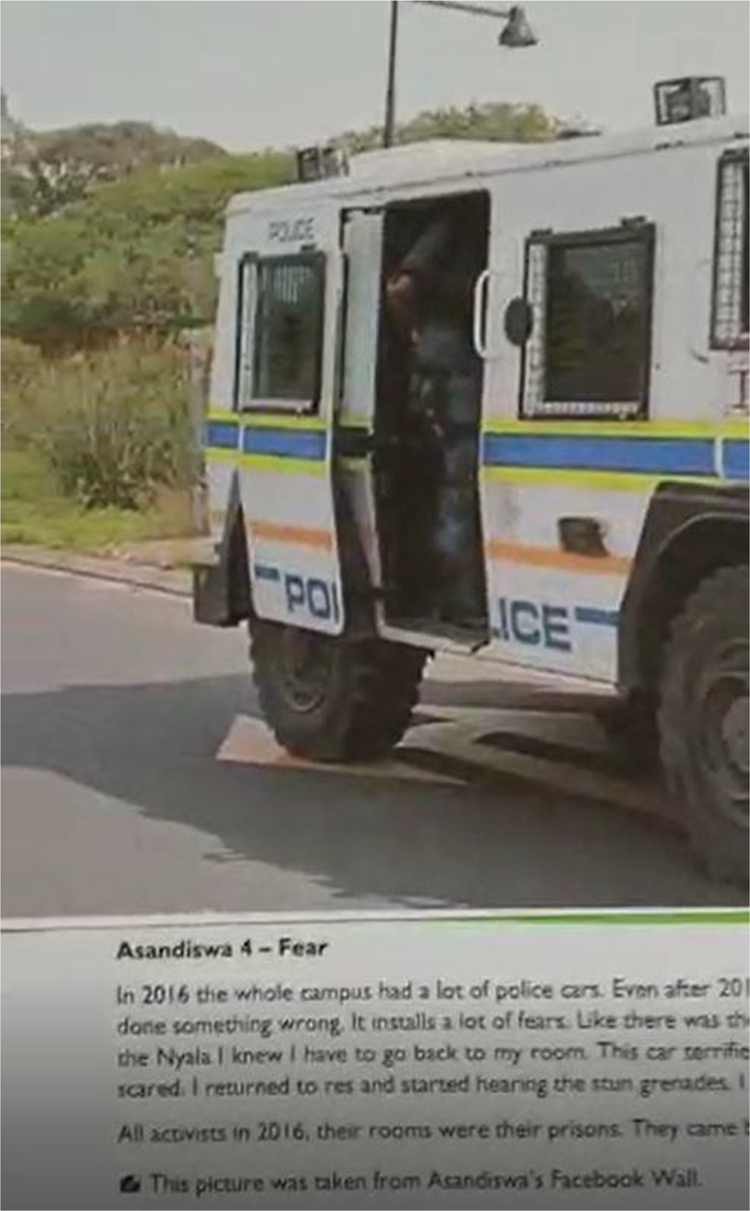
During day 3, session 1, participants at the University of the Western Cape produced a miniexhibition, which included this photo and caption.
The use of RPV for the study in question indicated that, as a research and learning process, it can foster awareness and create new knowledge at both the individual and collective levels. In terms of individual learning, 19 respondents agreed that “I earnt a lot of new things”; and 20 noted that “I realized that there are others who had the same experiences and struggles like me” and “that there are different ways in which I can create change”. Critical thinking was also widely acknowledged as a “personal take-away” from the workshops: 19 respondents agreed or strongly agreed with the statement, “it made me think critically about my actions as student activist”; and 20 respondents agreed or strongly agreed that “it made me think critically about management’s reactions to student demands and protests.”
The world café sessions which were held on every campus also produced new understanding. Student affairs and services professionals, typically from student counseling units, were invited to these sessions along with senior university leaders and academic managers. They came and viewed the mini-exhibitions on day 3 and took part in an open discussion. The purpose of the world café session was to foster a better understanding of the effects of violence on students, among key members of the university community in order to help them prevent and manage violence more effectively on campus; and offer improved support to students in the form of counseling and other interventions both during and after such violence. In every case, the discussions revealed that the participating senior members of the university community had not previously realized the extent of the trauma suffered by the students as a result of the direct and indirect violence experienced during the protests. In this regard, the majority of students noted in their responses to the evaluation survey that the research had the potential to make university managers more aware of the impacts of violence on students and their wellbeing during the protests. They further expressed the hope that the research would change the stance adopted by university managers in relation to student issues.
In considering the RPV outputs and findings from the four different sites which have been collected so far, it seems clear that the methodology can produce a trustworthy contribution to knowledge in general.
Conclusions
RPV, as presented and discussed in this article, was conceived and implemented as a pragmatic response to a set of goals, parameters, and constraints inherent in the research project in question. In this regard, it is important to note that the project remains a work in progress. So, the final impact of the methodology remains to be assessed. The campus-specific mini-exhibitions are yet to be curated into a national exhibition; a book is yet to be produced from the analysis of the full data; and both these outputs are yet to be presented to higher education policy makers. The students who took part in the site-based RPV will be invited to participate in the forthcoming work in various ways, remotely via a range of information and communication technologies (ICTs) and face-to-face at the launches of the exhibition and book.
In the meantime, the project has already achieved a number of its goals, indicating the effectiveness of the RPV methodology employed. The four campus-based RVP processes, discussions and mini-exhibitions indicate that the methodology enabled students to reflect on their traumatic experiences, as well as the wellbeing resources and coping strategies that had been developed in response, in a safe space. This had empowered them psychologically. In addition, the outcomes of the world café events indicated that the new RPV form of the methodology had not compromised the politically emancipatory potential of photovoice. Indeed, in only 3 days, the RPV methodology facilitated the co-creation of trustworthy knowledge artifacts which authentically represented and expressed the participants’ experiences and enabled the immediate communication of narratives produced from these experiences to university staff and authorities.
Accordingly, RPV, as used in the study in question, may be viewed as an innovative, variant of the photovoice methodology—and, as such, may inspire other researchers to be creative and adaptive in designing a research methodology that suits their project. RPV represents an efficient way of adapting the photovoice methodology to meet time and funding constraints through the use of social media platforms. It also holds out the possibility that photovoice could be deployed more widely in pursuit of the Freirean social justice goals (Freire, 2000) on which this methodology was originally grounded. SDG.
Footnotes
Acknowledgments
We would like to thank our research participants. We would also like to thank the members of the HSRC Research Ethics Committee for their useful comments and granting clearance No. REC 2/18/04/18c.
Declaration of Conflicting Interests
The author(s) declared no potential conflicts of interest with respect to the research, authorship, and/or publication of this article.
Funding
The author(s) disclosed receipt of the following financial support for the research, authorship, and/or publication of this article: The project “Understanding violence and aggression in the context of the 2015/16 student movement in South Africa: a psychological wellbeing perspective” is based on research supported in part by the National Research Foundation of South Africa, Grant No. 118522 (HSD180507326647). The project is part of a larger research into the new South African student movement “From #RhodesMustFall to #FeesMustFall” which is funded in part by The Andrew W. Mellon Foundation, Grant No. 1802-05403.
