




Abstract
For students and novice researchers, the choice of qualitative approach and subsequent alignment among problems, research questions, data collection, and data analysis can be particularly tricky. Therefore, the purpose of this paper is to provide a concise explanation of four common qualitative approaches, case study, ethnography, narrative, and phenomenology, demonstrating how each approach is linked to specific types of data collection and analysis. We first introduce a summary and key qualities of each approach. Then, using two common research contexts, we apply each approach to design a study, enabling comparisons among approaches and demonstrating the internal consistency within each approach. Given the nuance and complexity of qualitative research, this paper provides an accessible starting point from which novice researchers can begin their journey of learning about, designing, and conducting qualitative research.
For students conducting their first qualitative research project, the choice of approach and subsequent alignment among problem, research questions, data collection, and data analysis can be particularly difficult. As faculty who regularly teach introductory qualitative research methods course, one of the most substantial hurdles we found is for the students to comprehend there are various approaches to qualitative research, and different sets of data collection and data analysis methods (Gonzalez & Forister, 2020).
While many books and articles guide various qualitative research methods and analyses, there is currently no concise resource that explains and differentiates among the most common qualitative approaches. We believe novice qualitative researchers, students planning the design of a qualitative study or taking an introductory qualitative research course, and faculty teaching such courses can benefit from such a resource. Therefore, the purpose of this paper is to provide a concise explanation of four common qualitative approaches, demonstrating how each approach is linked to specific types of data collection and analysis. The four qualitative approaches we include are case study, ethnography, narrative inquiry, and phenomenology.
Indeed, there are other approaches for conducting qualitative research, including grounded theory, discourse analysis, feminist qualitative research, historical qualitative research, among others. Through our combined years of mentoring students on qualitative research projects and teaching qualitative research courses at several different universities, we have found the four approaches we present here are the most accessible and commonly taught to new qualitative researchers.
Qualitative research draws from interpretivist and constructivist paradigms, seeking to deeply understand a research subject rather than predict outcomes, as in the positivist paradigm (Denzin & Lincoln, 2011). Interpretivism seeks to build knowledge from understanding individuals’ unique viewpoints and the meaning attached to those viewpoints (Creswell & Poth, 2018). Constructivism views knowledge as constructed as people work to make sense of their experience (Creswell & Poth, 2018). In whole, qualitative research values people’s lived experiences and is inherently subjective and sensitive to the biases of both researchers and participants. That subjectivity, while considered a serious flaw from the positivist perspective, speaks to the core value of qualitative research and the interpretivist/constructivist paradigms. Qualitative research, conducted thoughtfully, is internally consistent, rigorous, and helps us answer important questions about people and their lives (Lincoln & Guba, 1985). These fundamental epistemological foundations are key for developing the right research mindset before designing and conducting qualitative research.
Therefore, to help scholars conduct high-quality and rigorous qualitative research, for each approach, we describe basic tenets, when to use such an approach, and what makes it distinctive from the others. We then address the different data collection techniques that can be used within the approach and the suitable types of data analysis. We also demonstrate how, when conducting qualitative research, qualitative researchers are continually making decisions and those decision-making processes are informed by the preceding steps in the research process. We follow the comparative overview with examples of the different approaches applied to familiar research contexts to highlight how one research context may be studied in a variety of ways.
Overview of the Approaches
In this section, we provide a summary of each approach, including its particular strengths or limitations. Table 1 maps each approach to appropriate data collection techniques and subsequent data analyses, providing a clear and thoughtful comparison of the four different approaches. Certainly, the comparisons presented in Table 1 do not encompass the full spectrum of possibility for each of these qualitative approaches and not every study will use all types of data. However, the comparison we present is vital for an overarching understanding of the distinctions among approaches and the clear design progression within each approach. By illuminating key qualities, it becomes easier to see each approach’s internal consistency and differentiate it from other approaches.
A Comparison of the Research Approaches on key Design Criteria.

We also note that qualitative research has its own methodological vocabulary. For readers who seek greater depth regarding terminology or associated concepts, a dictionary or encyclopedia of qualitative research (e.g. Given, 2008; Schwandt, 2015) may be useful.
Case Study
A case study is the examination of the particularity and complexity of a case, coming to understand its activities and particular circumstances (Stake, 1995). Yin (2017) outlines case studies’ critical features. First, case studies investigate “a contemporary phenomenon in depth and within its real-life context, especially when the boundaries between the phenomenon and context are not clearly evident” (Yin, 2017, p. 18). The phenomenon and its context are intertwined, but the case should represent a bounded system, in which the case is clearly defined and delimited (Merriam & Tisdell, 2015). Second, case studies address the full complexity of a research problem by incorporating multiple sources and types of evidence (Yin, 2017).
Several research topics and questions indicate a case study as an appropriate approach. The key criterion is the bounded system, so any research situation where the bounded system is central is a candidate for case study. A case study can be a complete research project in itself, such as in the study of a particular organization, community, or program. Case studies are also often used for evaluation purposes, for example, in an external review. In educational contexts, case studies can be used to illustrate, test, or extend a theory, or assist other educators to analyze or shape their own practices. For example, Nogueiras, Iborra, and Kunnen (2019) used a case study to investigate the process of transformative learning for students in a counseling master’s degree program.
The case study method is particularly useful for researching educational interventions because it provides a rich description of all the interrelated factors. Both single- and multiple-case designs are acceptable and common (Merriam & Tisdell, 2015; Stake, 1995; Yin, 2017). When choosing a single case over a multiple-case design, five rationales might apply; the single case may be (i) critical, (ii) unusual, (iii) common, (iv) revelatory, or (v) longitudinal (Yin, 2017). Multiple cases are typically used for replication of an intervention and to present different context. In a multiple case study, there is a commonality among the cases, enabling researchers to analyze and find specific differences that are replicable or transferable to similar contexts.
Ethnography
The primary purpose of ethnography is to studying the culture of groups of people, meaning their patterns of social interactions, behaviors, beliefs, language, and ideation. Ethnography is appropriate when the goal is to describe how a cultural group works or explore shared lived experiences of the group (Creswell & Poth, 2018). A group culture may fit a classic definition of such, as is historically a focus of the field of anthropology, or a smaller or more contemporary perspective of culture, such as followers of a particular music group or volunteers at a non-profit organization (Wolcott, 2008). The culture may encompass the group’s language or terminology, behavior patterns, belief systems, or other shared qualities (Creswell & Poth, 2018). For example, Haddix (2002) applied ethnography to study the language of Black female preservice teachers as they navigated various professional and personal settings.
Ethnography relies heavily on researcher observational skills, which may include participant observation (Glesne, 2016), and extended fieldwork or periods of contact with the culture being studied. As a consequence, a researcher may require a gatekeeper or key informants for access to the group (Merriam & Tisdell, 2015). The goal of the study is to identify the organizational structures and shared beliefs or ideas of the cultural group. Therefore, the result of an ethnographic study is a complex and complete description of a group’s culture, with an emphasis on understanding how the group functions with respect to the original focus of the study (Creswell & Poth, 2018).
Narrative Inquiry
The narrative approach focuses on the meaning an individual attaches to an experience through the process of storytelling (Esin et al., 2014) and exposes a relationship between the words within one or multiple texts, and a relationship between text and social reality (Herman & Vervaeck, 2019). An important consideration for narrative is that the story has some kind of event or experience that has caused a change either within the person or specific situation (Herman & Vervaeck, 2019).
Several research topics and questions indicate when using a narrative approach is appropriate. The key criterion of narrative research is storytelling (Fraser, 2004). A narrative study can be conducted with a single participant, such as with a biographical study or an autoethnography, or with several people who share common experiences, using oral history. Most often, the narrative approach is used in the process of identity construction (Creswell & Poth, 2018). For example, in health services contexts, narratives can be used to explore the way medical trainees experience concepts such as leadership and followership within the healthcare setting (Gordon et al., 2015).
Different typologies exist to characterize the emphasis of narrative study. For example, Mishler (1995) outlined three possible foci: (a) the correspondence between the temporal order of sequences and when they are presented in the text, (b) the linguistic and narrative strategies used to organize different story types, and (c) the social cultural function of the story and its purpose for the storyteller. Mishler differs from Bamberg (2012), who also outlined three concentrations: text as linguistic structures (word sentences and topical cohesion), texts as cognitive structures (plot themes and coherence), and beyond the text (why the story here and now). Regardless of how researchers frame their narrative study, the essence is the same; the focus is on how people tell their personal stories and the relationship that those stories have with people’s lived histories (Green & Thorogood, 2018).
Phenomenology
A phenomenological approach to qualitative research focuses on the essence of a lived experience, or phenomenon, that can be observed or felt by people who have different viewpoints (Flood, 2010). The main aim of phenomenology is to capture, as closely as possible, the way a phenomenon was lived by people who participated in the phenomenon (Creswell & Poth, 2018; Giorgi & Giorgi, 2003). The description of a phenomenological study consists of “what” the individuals experienced and “how” they experienced it (Moustakas, 1994).
A number of research topics and questions indicate when using phenomenology as an appropriate approach. The key criteria are the focus on the nature and the meaning of an experience (a phenomenon), described by the people experiencing the phenomenon (Annells, 1999). Most often, phenomenology is used for studies that are focused on understanding the essence of a particular group of people’s lived experiences (Creswell & Poth, 2018). Phenomenology is often used when exploring a larger concept or idea. For example, in education, the phenomenon could be conceptions of good teaching particular to a pre-defined group of people, rather than a specific event, such as a teacher training workshop. An example within a healthcare setting explored how student nurses experienced anxiety during their initial clinical practicum while pursuing their nursing degrees (Sun et al., 2016).
There are at least two different types of emphasis in phenomenological studies. The first type of emphasis is on describing the phenomenon and focuses on creating descriptive categories on the perceived real world from participants’ narratives (Converse, 2012; Flood, 2010). The second type of emphasis is on the explanation of what happened in the phenomenon and focuses on how people’s meaning-making process influenced their choices (using phenomenological reflection and writing) to understand the meaning of the experience (Converse, 2012; Flood, 2010).
Comparison of Methods
Given the high-level overview of Table 1, more attention to the specific differences among approaches is necessary. Here, we summarize the methodological components of data collection and data analysis, to highlight where the approaches are similar and where they differ.
Data Collection
When conducting a case study, researchers use a variety of data collection procedures. Merriam and Tisdell (2015) and Creswell and Poth (2018) suggest multiple information sources for reconstructing and analyzing the case. Within the bounded system, one must investigate the perceptions of diverse participants, collect multiple types of evidence, and pay careful attention to the context in which all aspects of the study were embedded, in other words, triangulate data. Data collection in a case study includes but is not limited to documents, interviews, and observations.
As previously indicated, data collection for an ethnographic study relies on extensive fieldwork and prolonged exposure to the culture being studied (Creswell & Poth, 2018), during which the researcher may be full a participant in that culture. Much like case studies, data collection may include a variety of types of sources such as participant observation, interviews, documents, artifacts, and immersion in the cultural setting as an insider. Given that a researcher is likely to be studying a culture other than their own, reflexive journals are essential for maintaining awareness of the research process.
When conducting a narrative study, and given the aim to understand the self-generated meaning through story-telling, the main form of data collection is one-on-one in-depth interviews with one or more people (Esin et al., 2014). These interviews can be open-ended and unstructured or semi-structure and guided (Bamberg, 2012). In addition to the interview(s), researchers should also take field notes (reflexive journals) about the interview situation interaction to include relevant details for the transcription (Esin et al., 2014; Reissman, 2005).
In phenomenology, because phenomenology’s aim to understand a phenomenon from the people that experienced it, interviews are the primary source of data collection but may be supported by observations and personal diaries (past and present). For interviews, researchers should conduct unstructured in-depth phenomenological one-on-one interviews with only the people who directly experienced the same phenomenon (Flood, 2010; Giorgi & Giorgi, 2003; Groenewald, 2004).
Data Analysis and Coding
For all four approaches, when conducting the data analysis, researchers need to be able to code, sort, and identify themes and relationships from the data. There are many ways to do this, but since this article is focused on providing an overview, we will only address a few.
Data collected from a case study or an ethnography can undergo the same types of analyses since the data analysis requires researchers to triangulate the diversity of data. This triangulation strengthens the research findings because “various strands of data are braided together to promote a greater understanding of the case” (Baxter & Jack, 2008, p. 554). To accomplish that reconciliation, researchers may use the constant comparative method of content analysis (Lincoln & Guba, 1985) of the entire case, or an embedded analysis of specific aspects (Yin, 2017).
Unlike case study or ethnography, when researchers use a narrative approach, they are focused on the participants’ stories. Liamputtong (2009) outlines five steps for conducting data analysis within the narrative approach (this type of analysis is referred to as narrative analysis), and it primarily deals with data collected from a narrative approach. The first step is to read and re-read the transcript closely, then write a short summary of the key elements, followed by writing a short summary of the key elements. Stories can be broken up into key elements, such as past, present, and future or time, place, and scene. The next step is to look for themes to construct the meaning of the story and for transitions between themes dealing with any interpretations or discontinuities that may contradict the themes. It is important to make notes of any mini-story or plot located in the transcript. The final step to conducting narrative analysis is to create brought things and begin to connect thematic ideas to develop about the narrative within the broader literature and theories and carry out case-by-case comparisons.
Because the goal of the phenomenological approach is to describe the meaning of the lived experiences of a phenomenon by the people who lived it, the way to analyze the data is to focus on what participants said while describing the phenomenon. There are two ways to do this. One is using the phenomenological analysis outlined by Giorgi and Giorgi (2003). Their analysis follows the inductive type of the phenomenological approach. The first step of their analysis is to read the entire description written by the participants using phenomenological reduction; this allows for bracketing. The second step is to develop meaning units (passages that highlight the participants’ experience with the phenomenon) by carefully rereading the description. Thirdly, researchers need to transform the meaning units into central themes by making what is implicit explicit and making some generalizations. Lastly, the essence of the phenomenon needs to be determined by going over the central themes.
Trustworthiness and Rigor
Some of the qualitative approaches share data collection techniques; the key is to know what kind of data to collect and how to analyze the data to ensure the research study maintains rigor and alignment with the chosen qualitative research approach. While in this paper, we mention various data collection methods (techniques), it is essential to remember that in addition to collecting data, researchers must ensure rigor from the design to the evaluation of the research, i.e. start to finish.
Debates to assure quality in qualitative research have been the point of conversations among scholars for decades (e.g. Denzin & Lincoln, 2011; Flick, 2018; Guba, 1981; Lincoln, 1995), and many strategies for trustworthiness and rigor can be applied to any qualitative study. Strategies include peer debriefing with fellow researchers and scholars or experts in the field or methodology; member checks with participants to assure accuracy and enrich data collection; audit trails to have the opinion of an external evaluator; triangulation among data sources or data collection techniques; and maintaining reflexive journals during design and development of the research project (Lincoln & Guba, 1985). In the studies where a researcher is likely to conduct field work, additional means to ensure credibility include generating field notes, an activity most often associated with ethnography and case study. In phenomenology, bracketing is an essential technique to assist researchers in focusing on the phenomenon being studied. As with any human subjects research, issues of respect for participants are always paramount.
Application Examples
In this section, we present two hypothetical research problems that can be investigated using any one of the four qualitative approaches. The first context for research is a large first-year, required mathematics course at a university. We choose this example because it is understandable to most researchers since we have all been required to take mathematics courses as part of our academic training, and it has the complexity to be investigated in numerous ways, which we present in Table 2. Indeed, the details of this example are just a few of the many ways such a context might be investigated.
Mathematics Course Example: A Comparison of Designs.

The second context for research is a small organization (20 employees) undergoing leadership change as the result of merging with a larger company. We choose this example because many researchers have worked or do work in organizations of some kind, from schools to governmental agencies to for-profit corporations. Again, this example has the complexity to be addressed in several ways and the examples presented in Table 3 are but a few of the many ways a merger might be investigated.
Organizational Leadership Change Example: A Comparison of Designs.
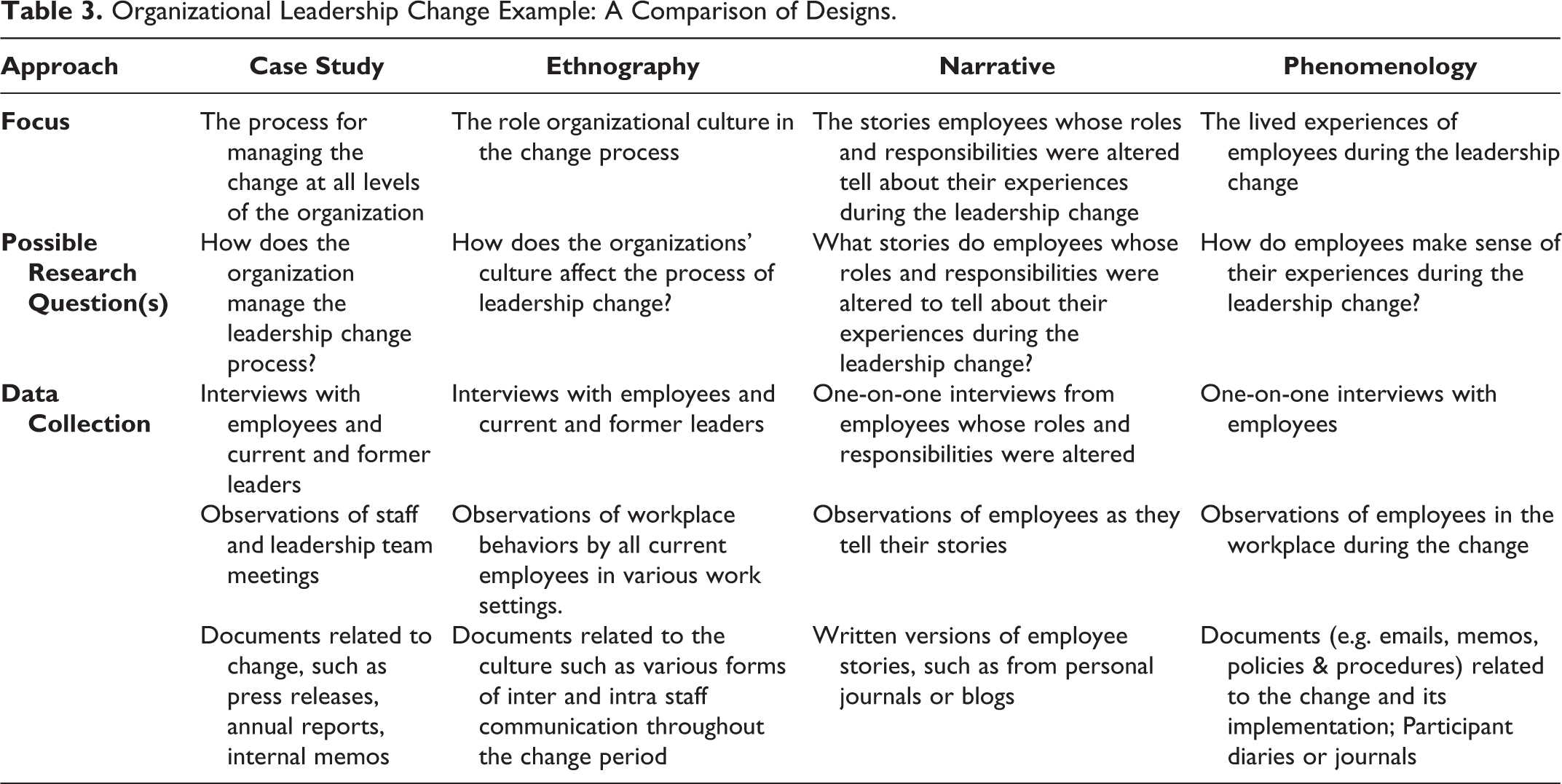
In Tables 2 and 3, we present how the two scenarios may be researched by using different qualitative approaches. Ultimately, the choice depends on the research question. The research question dictates the appropriate qualitative approach, from which point the researcher knows the possible types of data that can be collected and how to analyze the data. We intend that Tables 2 and 3 demonstrate two things. First, there are many ways to approach a qualitative study and second, for each approach, there are specific data collection and data analysis methods linked to that approach. In our own teaching contexts, we assign an exercise in which students are either assigned or asked to generate a qualitative research scenario and then complete a table similar to Tables 2 and 3. Through this task, students see how the approaches are similar but must think through the distinctive qualities of each to differentiate the designs.
Conclusions
In this article, we provide an overview of four qualitative approaches and how each approach links to specific types of data collection and analysis. Through this concise resource, we believe novice qualitative researchers will be able to scope and frame their qualitative research projects correctly and ensure increased rigor and credibility in their work. We acknowledge that this work is an incomplete representation of the breadth of qualitative research. Nevertheless, given the nuance and complexity of such research, students and educators alike need an accessible starting point from which novice researchers can begin their journey of learning about qualitative research. By describing each of the approaches and mapping the data collection and analysis techniques, we provide novice researchers an entry-level comparison of the four different approaches.
Footnotes
Declaration of Conflicting Interests
The author(s) declared no potential conflicts of interest with respect to the research, authorship, and/or publication of this article.
Funding
The author(s) disclosed receipt of the following financial support for the research, authorship, and/or publication of this article: Authors ackowledge support for publication from the Colorado State University Libraries Open Access Research and Scholarship Fund and from the Health Policy and Management Department at Texas A&M School of Public Health.
