




Abstract
This paper presents an exemplar of blending the principles of participatory action research and elements of grounded theory in a disaster risk reduction education case study. It illustrates and describes a modified methodological approach that was used during the needs’ assessment and analysis phase of a multiphase study on teaching of disaster risk reduction in science among public schools in Biliran Province, the Philippines. The approach was conceived upon considering the overarching aim of the study which is the effective, efficient, inclusive, and proactive teaching of disaster risk reduction in science, the complex nature of the disaster risk reduction education, and the multiple stakeholders involved in disaster risk reduction among public schools. Results revealed that the modified methodological approach provided a co-learning environment for both participants and researchers, created an opportunity to maximize participation toward generating knowledge, prioritizing problems, and conceptualizing solutions, strengthened the data collection and analysis process, hence ensuring quality in the entire research process, and addressed the participation issues pointed out in grounded theory studies. The modified methodological approach may be relevant and applicable to similar studies that are complex and emerging like the teaching of disaster risk reduction in science.
Keywords
Introduction
The use of participatory action research (PAR) in investigations with developmental nature is increasing. This may be because of the unique combination of research and community development (Ledwith, 2011) whose purpose is to impart social change through specific set/s of action (MacDonald, 2012). PAR lies within the interpretivist/constructivist paradigm with philosophical underpinnings that embraces a dialectic shifting of understandings, subjectivity, and coexistence of multiple realities that depend on context and circumstance (Kelly, 2005). PAR is one of the research approaches that is truly responsive and committed in providing solutions to real world problems. However, research quality is often criticized in PAR studies (Bergold & Thomas, 2012; McIntyre, 2008; Springett et al., 2016). This criticism relates to the lacking or weak methodological foundations found in published PAR studies; not that PAR lacks one, but because many PAR studies do not articulate or fail to explicitly demonstrate the methodology including data collection and analysis process. One way of addressing this specific criticism is to blend the principles of PAR approach and elements of grounded theory (GT) (Crawford Barniskis, 2013; McIntyre, 2008). This may be possible considering that both PAR and GT lies within the interpretivist/constructivist paradigm. It may be done by carefully taking into account certain characteristics of PAR and GT in the research process without diminishing or losing the value of one or the other in the entire research process. In fact, there are some studies that attempted to bring PAR and GT together, however all if not most of these studies had the PAR and GT done in succession such as PAR is done on the first phase of the study and GT on the second phase (Abdel-Fattah, 2015; Teram et al., 2005), hence lacking mergence. Moreover, like many studies anchored in GT, it is difficult to find exemplars and detailed account of the GT elements in the process as the study progresses, often inconsistent, and ambiguous (Breckenridge & Jones, 2009; Butler et al., 2018), and unclearly described (Backman & Kyngäs, 1999).
The above-mentioned attributes of PAR make it relevant and perhaps one of the best ways to explore, understand, and provide solutions to emerging, complex, inter/multidisciplinary, and contextual subjects such as disaster risk reduction (DRR). DRR is a policy objective of disaster reduction management whose strategies are aimed at preventing new and reducing existing disaster risk and managing residual risk therefore strengthening resilience and achieving sustainable development (UN-GA, 2016). One of the strategies for DRR is disaster risk reduction education (DRRE) which is defined as the call for sustained global public education and awareness along DRR, increased investments in the resilience of the education systems and educational facilities, reducing the exposure and new risk for educational facilities, the critical need to increase public education and awareness in post disaster recovery and rehabilitation (UN-GA, 2015). In the study reported in this paper, DRRE refers to the teaching and integration of DRR in science among public schools. Along this line, there are existing studies in DRR that made use of PAR (Douglas et al., 2018; Gershon et al., 2008; Mercer et al., 2008; Meyer et al., 2018; Timothy et al., 2017), however these studies share similar criticisms mentioned earlier.
The researchers conceived a modified methodological approach that blends the principles of PAR and elements of GT used during the needs’ assessment and analysis phase of a multiphase study on teaching DRR in science among public schools in Biliran Province, the Philippines. The purpose of the needs’ assessment and analysis phase is to explore the integration and teaching of DRR in science, investigate how teaching DRR fits into the existing frameworks and theories in science education, and determine the evolving gaps and emerging issues in teaching DRR. All of which are aimed toward efficient, inclusive, and proactive teaching of disaster risk reduction in science.
On one hand, PAR created a favorable condition that maximized the participation of the participants and researchers in the entire research process as they freely articulate and take responsibility in understanding the teaching of DRR in science, determining and prioritizing the gaps, issues, and concerns, as well as conceptualizing solutions related thereto. On the other hand, GT methodology provided a strong framework for data collection and analysis through theoretical sampling and constant comparative analysis. As such, the researchers and the participants develop understanding and get a holistic picture of the interconnectedness of the gaps, issues, and concerns in teaching DRR, empowered to prioritize the problem, and conceptualize solutions. This process is critical in developing and implementing tailored-fit intervention to support science teachers in successfully teaching and integrating DRR.
The succeeding sections present the following: (a) overview of PAR; (b) overview of theoretical sampling and constant comparison in GT; (c) overview of the study; (d) PAR and GT in the DRRE case study; and (e) final remarks.
Participatory Action Research
PAR Defined
PAR is a subgroup of action research that is defined as a philosophical approach to research that recognizes the need for the people being studied to participate in the design and implementation of the entire research process (Vollman et al., 2008). PAR is a combination of participatory research and action research. Action research is broadly characterized by spiral steps of planning, acting, observing, and evaluating the result of action which began with the work of Lewin (1946, 1951). Meanwhile, participatory research is defined as an integrated activity that combines social investigation, educational work, and action aimed at fundamental structural transformation and improvement of the lives of those involved (Hall, 1981). Participatory research and action research share the same values and ideologies but they differ in a few political economies as illustrated in Table 1.
Comparison of the Political Economies Between Participatory Research and Action Research (Adapted from Brown & Tandon, 1983, p. 288).

Bhatt and Tandon (2001) emphasized that PAR brings out the knowledge generation interest of the community by stimulating and assisting their issues and concerns. It is built on the premise that the community is knowledgeable about their social realities and are capable of articulating their own knowledge, thereby breaking the monopoly of knowledge. Importantly, it legitimizes the active role of the communities in knowledge generation as it leads the participants in developing their ability to analyze, reflect, and trigger collective action (Bhatt & Tandon, 2001). McIntyre (2008) defined PAR as “an approach characterized by the active participation of researchers and participants in the co-construction of knowledge; the promotion of self-and critical awareness that leads to individual, collective, and or social change; and an emphasis in a co-learning process where researcher and participants plan, implement, and establish a process for disseminating information gathered in research-a recursive process that involves a spiral adaptable system that include questioning a particular issue, reflecting upon and investigating the issue, developing an action plan, and implementing and refining the said plan” (p. 5). Similarly, MacDonald (2012) defined PAR as “a mode of systematic inquiry, as an action research methodology that focus on social change by fostering collaboration between the researcher and the participants, empowering both as it promotes capacity building in all who participates; an educational process, an approach to social investigation, and a way to take actions to address problems and issues in communities and groups of individuals” (p. 46).
Among the variants of PAR in literature include rapid rural appraisal, critical action research, community-based participatory research, and participatory community research (McIntyre, 2008, p. 3). PAR aims at improving and informing social, economic, and cultural practice through group of activities whereby participants, whose power, status, and influence differ from each other, collaborate in addressing a thematic concern (McTaggart, 1991). Moreover, PAR fosters capacity building, community development, empowerment, access, social justice, and participation (Vollman et al., 2008) among others. This is achieved through a cyclical process of exploration, knowledge construction, and action at different moments throughout the research process (McIntyre, 2008, p. 1) as illustrated in Figure 1.

PAR process braided within one another in a spiral reflection, investigation, and action-recursive process (adapted from McIntyre, 2008, p. 7).
PAR creates an opportunity to form public spaces whereby researchers and participants may reshape their knowledge on how political, social, economic, and familial contexts in communities impacts daily life (Mcintyre, 2002). Importantly, PAR allows researchers to understand participants’ feelings, views, and patterns without being controlled or manipulated (MacDonald, 2012, p. 34). Therefore, PAR is anchored on symbolic/social interactionism, that is the understanding of people’s behavior and viewpoints in an assumption that the same are based on or influenced by the meanings people attach to the environment, as well as their experiences (Dennis & Smith, 2015; Zeegers & Barron, 2015).
Among the important principles of PAR include (a) PAR enables the participation of all people, hence it is democratic; (b) PAR acknowledges the worth of people, hence it is equitable; (c) PAR provides freedom from oppressive debilitating conditions, hence it is liberating; and (d) PAR enables the expression of participants full human potential, hence it is life-enhancing (Bhatt & Tandon, 2001; Stringer, 2014). Moreover, Hall (1981) and later Selener (1997) enumerated the characteristics of PAR approach as follows: (a) acknowledge that the problem originates in the community, hence, must be defined, analyzed, and solved by the community; (b) ultimate goal is radical social transformation and improvement in the lives of the community or involved individuals; (c) involves full and active participation of the community at all levels in the entire research process; (d) encompasses a range of powerless groups of individuals (e.g. exploited, poor, oppressed, marginalized); (e) ability to foster awareness of own resources among the individuals involved that may be mobilized to develop self-reliance; (f) more than scientific method, community participation is the facilitator of the research process, hence may result to more accurate and authentic analysis of social reality; and (g) allows the researcher to be a committed participant, facilitator, and learner in the research process.
Participants in PAR
PAR demonstrates the understanding that people have the right to determine their own development, hence the need for the same to participate meaningfully in the process of analyzing their own solutions over which they have the power and control (Bhatt & Tandon, 2001; MacDonald, 2012). The most important key to PAR is the participation of the individuals in the entire research process (McIntyre, 2008). Participants should be the decision-makers responsible for how, when, and why a project proceeds, and it is the responsibility of the researcher to take the role in ways that reflects the participants desire to move the project in a particular direction/s (McIntyre, 2008, p. 26). Authentic participation in PAR considers participants’ role in setting the agenda of the inquiry, their participation in data collection and analysis, and their control over the use of outcomes and the whole process (Tandon, 1988). Common-sense participation is thought to be one of the most effective ways to encourage participation whereby participants take joint responsibility in defining the most practical and doable ways to participate, thus avoiding the pressure to conform to a way of participation (McIntyre, 2008, p. 15). As such, quality of participation is ensured.
The role of the researcher in PAR is to stimulate and facilitate the participants’ initiative, focused on valuing their knowledge, systemizing the existing knowledge, creating systematic opportunities for adult learning, and nurturing their capacities to reach their full potential (Bhatt & Tandon, 2001). However, from literature review and readings, researchers’ impression is that these studies are limited. Along research, it is limited to data collection only and along community development, it is limited to participants being recipients of an intervention. Hence one can say that it is partly or even hardly PAR.
Strengths, Challenges and Ethical Considerations in PAR
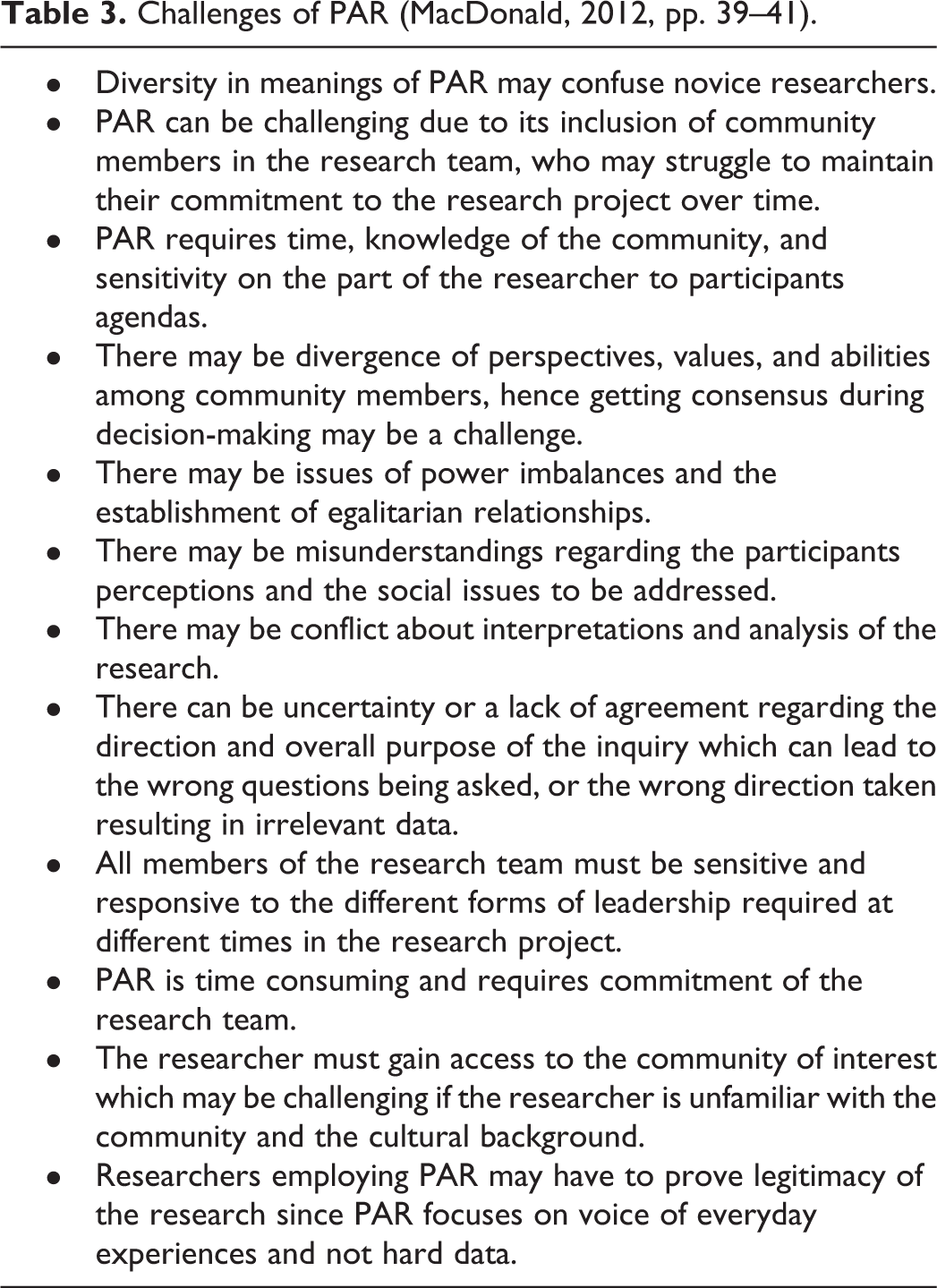
PAR is a complex process that requires a researcher to be meticulously attentive. It has several strengths and challenges that are considerably critical in developmental research as enumerated in Tables 2 and 3 respectively.
Strengths of PAR (MacDonald, 2012, pp. 39–41).

Challenges of PAR (MacDonald, 2012, pp. 39–41).
Within the research perspective, one of the important strengths of PAR perhaps is the value and role of the participants being collaborators, rather than simply subjects of the research. This may allow generation of rich contextual data made possible when participants speak-up and share their experiences and views with minimal inhibitions as they feel safe rather than threatened. Moreover, PAR ensures that the researcher understand the specific context being studied—being able to see the way participants perceive, therefore minimizing personal biases. This is important especially when the subject being investigated is emerging and much is unknown such as the teaching and integration of DRR in science. Meanwhile, within the community development perspective, the participants’ active involvement in PAR may lead to developing commitment for change as they feel sense of ownership of whatever plans or decisions that come up during the process. This is essential for project sustainability.
Moving on, like other research approaches, PAR has accompanying challenges too. Within the research perspective, perhaps one that is of utmost concern is the multiple theoretical frameworks that underpins the PAR process (McIntyre, 2008) resulting to confusion among researchers. This is compounded by lacking exemplars that demonstrate PAR in a study and if there is any, the lacking or thin description of methodology provided for in the study. Moreover, it may be challenging in involving the participants in the entire research process as it requires specific research skills such as in data collection and analysis. Meanwhile, within the community development perspective, it may be difficult to gather and sustain participation of the participants in the process especially that at times, PAR projects do not have a cut-in-the-stone structure. In addition, PAR requires good facilitation skills of the researcher to ensure order and equitable participation. This is vital for smooth exchanges of ideas and argumentations, as well as ensuring that the events or instances during the process are relevant and within the scope of the study.
The complex process of PAR approach brings with it a number of ethical considerations that researchers must consider prior to developing and conducting a PAR study as enumerated in Table 4.
Ethical Considerations in PAR (McIntyre, 2008, p. 12).

PAR and DRR
There are considerable number of studies that made use of PAR in DRR. McCall and Peters-Guari (2012) enumerated and discussed the application of PAR in DRR as follows: (a) for hazard analysis and mapping, (b) for vulnerability and capacity assessment, (c) to understand coping strategies, (d) for post disaster response and recover, and (e) for preparedness and planning for long term adaptation. Moreover, they enumerated PAR tools applicable for DRR which include (a) participation and facilitation; (b) action learning; (c) participatory research (e.g. integrated disaster risk); (d) data collection and knowledge acquisition; (e) verbal information; (f) description of current situation; (g) participatory mapping, participatory GIS, and spatial analysis; (h) analysis of change (e.g. histories); (i) eliciting local and indigenous knowledge; (j) analytical tools; and (k) planning tools. PAR in DRR recognizes the value of local knowledge, inclusivity in participatory research, and ethical considerations (McCall & Peters-Guari, 2012).
Among PAR studies in DRR available in literature include the work of Mercer and colleagues (2008) on indigenous communities as they determined the strategies for dealing with environmental hazards. There is also the work of Meyer and colleagues (2018) that made use of PAR in developing a curriculum that fosters disaster resilience. Another is the study of Gershon and colleagues (2008) related to the World Trade Center evacuation, the work of Timothy and colleagues (2017) along community based-DRR, and the work of Douglas and colleagues (2018) on gathering ecological wisdom for climate change resiliency planning among others. However, like many PAR studies, these too lack or have weak methodological foundations.
Thereto related, some studies suggest that one way of building a strong methodological foundations in PAR is to anchor the research process to GT (McIntyre, 2008, p. 55) such as the collection and analysis of data.
Grounded Theory
Glaser and Strauss (1967) defined GT as “[the] discover[y] of theory from data-systematically obtained and analyzed in social research.” It is an inductive methodology that provides systematic guidelines for gathering, synthesizing, analyzing, and conceptualizing qualitative data for the purpose of theory construction (Charmaz, 2001).
Like PAR approach, GT is underpinned by symbolic/social interactionism as it provides opportunities for analyzing the ways in which socializing experiences affect an individual’s life cycle (Dennis & Smith, 2015; Zeegers & Barron, 2015). Among the distinct features of GT include (a) simultaneous data collection and analysis, (b) reliance on comparative methods, (c) early development of categories, (d) intermediate analytic writing in between coding data and writing the first draft, (e) sampling for developing ideas, (f) delay of the literature review, and (g) thrust toward developing theory (Glaser & Strauss, 1967). Charmaz (2001) pointed out that the strengths of GT lies in the (a) logical steps in handling data collection and analysis, (b) means of correcting errors and omissions and of refining analytic ideas, (c) tools for studying basic social and psychological processes in natural settings, and (d) strategies for creating middle-range theories. As such, it requires the use of intellectual strategies such as (a) constant comparative analysis, (b) theoretical sampling and use of multiple groups comparison, and (c) theoretical coding (Glaser, 1978; Glaser & Strauss, 1967).
For more than five decades now, GT researchers have attempted to evolve the definition and understanding of GT by factoring in new ideas and bringing changes to its original form (Charmaz, 2008; Corbin, 2013; Glaser & Strauss, 1967; Goldkuhl & Cronholm, 2018; Redman-MacLaren & Mills, 2015; Schreiber & Martin, 2013; Stern, 2013; Strauss & Corbin, 1990). However, despite the few additions and modifications made to the original GT, they share uniform core principles. These include (a) taking the word grounded seriously, (b) capturing and explaining context-related processes, (c) pursuing theory through engagement with data, and (d) pursuing theory through theoretical sampling (Timonen et al., 2018).
Theoretical Sampling and Coding
Theoretical sampling is the heart and soul of GT. It is a process of data gathering and analysis whereby a researcher jointly collects, codes, and analyzes data and decides what data to collect next and where to find them in order that a theory is developed (Glaser & Strauss, 1967). Strauss and Corbin (1990) defined theoretical sampling as “data gathering process driven by the concepts derived from the evolving theory and based on the concept of
Open sampling aims for the discovery of names and categories of phenomena according to their properties and therefore keeps the data collection process open to all possibilities (pp. 206–207). Meanwhile, relational and variational sampling aims at looking for instances that demonstrate variational range or relationship among concepts (pp. 209–211) thereby validating the data gathered during open sampling and categories generated during open coding. Lastly, discriminant sampling is a highly selective sampling process whereby a researcher deliberately choses sites, people, and documents that maximize opportunities for comparative analysis (pp. 211–212). It acts to validate further the data gathered during relational and variational sampling processes and categories generated during axial coding. Theoretical sampling ceases once theoretical saturation is achieved (e.g. no new relevant data seen to emerge, categories are well developed in terms of properties and dimensions, relationships among categories are well established and validated) (p. 212) (Strauss & Corbin, 1990).
Intertwined with theoretical sampling is the different coding processes. This include open coding in open sampling, axial coding in relational and variational sampling, and selective coding in discriminate sampling (Strauss & Corbin, 1990). Open coding is an analytic process through which concepts are identified, their properties and dimensions are discovered in data. Specifically, it includes (a) discovery of concepts (concepts are labeled phenomenon); (b) classifying concepts; (c) breaking data into discrete incidents, ideas, events, and actions and given name for representation; (d) discovery of categories (categories are concepts derived from data that stand for a phenomena); (e) naming categories; and (f) developing categories (p. 101). Meanwhile, axial coding is defined as the process of relating categories to their sub-categories, coding occurs around the axis of a category (hence, axial), linking categories at the level of properties and dimensions. Specifically, it includes (a) looking how categories cross-cut and link; (b) identifying the paradigm (perspective taken toward the data), conceptual way of grouping answers to the questions why, where, how come, and when; (c) explanation of components of the paradigm; (d) labeling the conditions; (e) identifying relational statements; and (e) making mini-frameworks and diagrams (p. 123). Lastly is selective coding defined as the process of integrating and refining the theory. Specifically, it includes (a) integration whereby data becomes a theory; (b) categories are organized around a central explanatory concept; (c) discovery of the central category; and (d) refining the theory. At this point, theoretical saturation is achieved, a point in category development at which the is no new properties, dimensions, or relationships emerge during comparative analysis (p. 143) (Strauss & Corbin, 1990).
Constant Comparative Analysis and Theoretical Sensitivity
An integral part of GT is constant comparison. It is the combined analytic procedure of constant comparison and coding-joint coding and analyzing (Glaser & Strauss, 1967) that occurs during the entire theoretical sampling process. Constant comparison includes (a) comparing incidents applicable to each category; (b) integrating categories and their properties; (c) delimiting the theory; and (d) writing the theory (p. 102). These process builds with each other as one moves to the next stage, however earlier stages do remain in operation simultaneously throughout the analysis until the analysis is completely terminated (p. 105) (Glaser & Strauss, 1967).
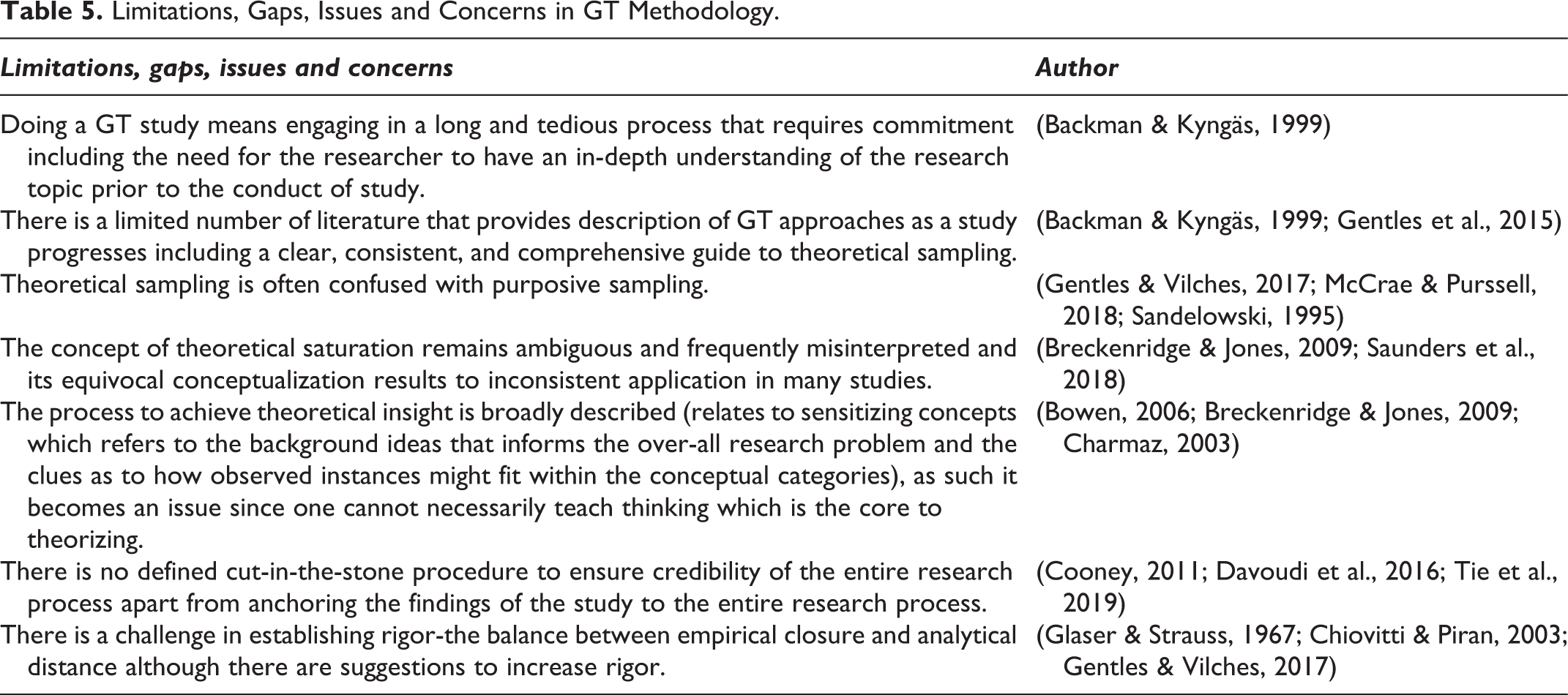
An important mechanism in constant comparison is theoretical sensitivity. It is the “ability of the researcher to generate concepts from data which requires (a) personal and temperamental bent to maintain analytic distance, tolerate confusion, and regression while remaining open, trusting to preconscious processing and to conceptual emergence; (b) the ability to develop theoretical insights into the area of research combined with the ability to make something out of these insights; and (c) the ability to conceptualize and organize, make abstract connections, visualize and think multivariately” (Glaser, 2007, pp. 56–57). However, like PAR, GT has its own limitations, gaps, issues, and concerns as enumerated in Table 5.
Limitations, Gaps, Issues and Concerns in GT Methodology.
PAR and GT
There are some studies that attempted to blend PAR and GT in methodology. In fact, the paper of Redman-MacLaren and Mills (2015) entitled Transformational grounded theory: Theory, voice, and action is an attempt to fuse GT and participatory research to promote greater participation, equity, and power for positive change as illustrated in their research work with HIV risk for women in Papua New Guinea. Similar blending also appears in the work of Wuest and colleagues with women’s health (Wuest, 2011; Wuest et al., 2002), the work of Teram and colleagues (2005) with the study on childhood sexual abuse, or the work of Crawford-Barniskis (2013) with teenagers. However, these studies carried out the PAR approach and GT methodology in succession, even with little or no evidence of theoretical sampling and constant comparison. The principles of PAR are apparent during data collection, but it ceases in the data analysis as this part of the process is left to the researcher/s. Hence, it is hardly PAR approach nor GT methodology.
The next section illustrates and discusses how the principles of PAR approach and elements of GT were merged in the needs’ assessment and analysis phase of a multiphase study on teaching DRR in science among public schools in Biliran Province, the Philippines.
Overview of the Study
DRRE is one of the strategies for DRR. It encompasses the effective, efficient, inclusive, and proactive public awareness and information dissemination of DRR. With the increasing consensus and call for the integration of DRR in existing school curricula (Selby & Kagawa, 2012), a study was conceptualized and implemented to explore the integration and teaching of DRR in science of the Philippine basic education programme. The study was aimed at developing and implementing an intervention to strengthen the integration and teaching of DRR in science.
The first phase of the study was needs’ assessment and analysis. Its purpose was to explore the integration and teaching of DRR in science, investigate how teaching DRR fits into existing frameworks and theories in science education, and determine the evolving gaps and emerging issues in teaching DRR within the Department of Education (DepEd)—Division of Biliran hierarchy (hierarchy means the levels in the organizational structure refer to Figure 2 ).

Organizational structure of DepEd at the division level (DepEd, 2015).
Participants
Considering the DepEd organizational hierarchy, participants included in the study were students, science teachers, school principals, and the DRR coordinator whose role and function with respect to DRR is described in Table 6. The same table shows the total number of participants of the study during the said first phase.
Distribution of Research Participants.

Carefully considering the DepEd organizational hierarchy, the researchers sought the help of the DRR coordinator (who himself was among the participants of the study) to provide a list of possible participants from among school principals and science teachers. One broad inclusion criterion discussed and agreed was that these school principals and science teachers should have an elevated level of interest toward DRR. This will be based on the impression of the DRR coordinator as derived from his experiences from past DRR activities. Meanwhile, the students were recommended by the science teacher participants. The broad inclusion criteria discussed and agreed is that these students should have elevated level of academic interest or of good academic standing. With these criteria for selecting the participants, being able to collect rich contextual data along teaching DRR was assured as this is one of the requirements in GT.
Although in the study, much of the focus was given to science teacher participants as they are considered the major stakeholders if we talk of teaching DRR. Nevertheless, data collected from students, school principals, and DRR coordinator were useful inputs that provided insights for science teachers and researchers in exploring the teaching of DRR as a whole.
Locale
This study was conducted in Biliran Province, the Philippines. It is one of the smallest island provinces located near the western Pacific region. The island’s topography, geographic location, and composition results to an elevated level of vulnerability to climatic-meteorological (typhoons, storms, floods, storm surges) and geo-seismic hazards (earthquakes, volcanic eruption, landslides, mudflows) (Province of Biliran, 2011).
Biliran Province is composed of eight towns and is represented by one division of the DepEd, the Division of Biliran that covers 125 elementary schools, 20 secondary schools and three integrated schools. The entire province has about 49,787 students and 1,941 teachers during the academic year 2019–2020.
Outcomes of the Study
Outcomes of the needs’ assessment and analysis phase include understanding of the (a) opportunities offered by the science curriculum to support DRR, (b) practices related to DRR-specific teaching strategies, instructional materials, and student assessment, (c) gaps in teaching DRR specifically those related to the knowledge base in teaching DRR, as well as important teacher agencies in teaching DRR, and (d) disconnect in implementation, monitoring, and assessment in teaching DRR. The outcomes of the said phase provided critical information in developing and implementing a contextualized and localized support for science teachers through a professional development programme.
PAR and GT in the Case Study
This section illustrates and discusses in detail the way the principles of PAR approach and elements of GT were blended in the study.
Assumptions Prior to the Study
The study described in this paper was anchored on pragmatic worldview. In that, it aims at researching and providing solutions to real-world problems (Creswell & Piano Clark, 2011), such as the effective, efficient, inclusive, and proactive teaching of DRR in science among public schools. Reflecting on the complex nature of DRR and DRRE per se (emerging, contextual, interdisciplinary, multidisciplinary), the deficit of systematic guidelines in integrating DRR in the curriculum, and the teaching of DRR in science, the researchers thought that one of the best ways to conduct the study is to actively involve the immediate stakeholders of DRR in schools in generating knowledge, identifying existing gaps, emerging issues and concerns, as well as finding solutions through a co-learning environment which primarily characterizes PAR (Hall, 1981; Selener, 1997). In addition, considering the equally valuable multiple stakeholders of DRR in schools that belong to different levels in the organizational structure, the researchers thought that one way of developing a holistic understanding about the teaching of DRR in science is to involve all them. This is important because despite the differences in roles and functions with regard to DRR of the different stakeholders, these roles and functions are at the same time closely interconnected. This holistic understanding may provide lens for science teachers and researchers in exploring the teaching of DRR.
Democratic and Equitable Participation
One of the most important principles of PAR is democratic and equitable participation (Bhatt & Tandon, 2001; Stringer, 2014). Although the research area was predetermined by the researchers, the specificities and structure of the study were left open to any possibilities that may occur upon the involvement of the participants in the research process. Related thereto, democratic and equitable participation was ensured in participant selection during the theoretical sampling process and data collection and analysis during the coding and constant comparative analysis process.
The study began with the DRR coordinator as one of the participants. Together with the researchers, the inclusion criteria for participation of school principals, science teachers, and students were discussed and agreed. The DRR coordinator recommended school principals and science teachers who can possibly commit to participate in the study. The school principals and science teachers themselves also recommended possible participants. The researchers and some participants contacted the recommended school principals and science teachers to find out their availability. Meetings were arranged with the participants who agreed to participate in the study. Before the study commenced, anyone who fits the broad inclusion criteria are qualified to participate in the study, hence one could generally say it is equitable. It was emphasized that participation to the study is completely voluntary and that participants have the choice to withdraw or discontinue participation at any point in time, hence democratic in nature.
Moving on, democratic and equitable participation was also ensured in the data collection process. All participants were given ample time to express their views and perspectives, experiences, thoughts, insights, concerns, and even opinions, hence equitable. Participants were not bounded to any specific structure, rather they were allowed to control the direction of the interview process as they share and express their personal thoughts and insights, as well as experiences, hence democratic. In addition, all voices of the participants were given equal consideration, hence equitable. Although, it must be noted that despite the democratic and equitable principles applied in the data collection, it is still important that the researcher is thoughtful and quick in providing prompt questions to ensure that the process does not go off track or beyond the scope of DRR in schools.
Lastly, democratic and equitable participation was also ensured in data analysis, that is during coding and constant comparative analysis process. In most studies where PAR and GT are blended, it is at this point that PAR diminishes in the process. This is because more often, data analysis is left to the researcher. However, in this study, participants were actively involved in the coding and constant comparative analysis as they provide inputs in determining and modifying codes, as well as developing and shaping categories. The detail of this process is presented in the next section. Figure 3 illustrates how the principles of PAR and elements of GT were blended in the study.

Blending the principles of PAR approach and GT elements in the study.
It may be too early to conclude that the entire study resulted to social change as a result of PAR, however the modified methodology allowed the active participation of the participants in determining the evolving gaps and emerging issues, prioritizing the same and determining solutions. In the case of this study, the participants specifically determined the specific intervention they needed immediately, that is a teacher professional development on DRR that focuses on the knowledge base in teaching DRR, as well as important teacher agencies in teaching DRR. The science teacher participants have contributed significantly in determining the scope and structure of the said teacher professional development. Moreover, by the time of writing, the science teacher participants have already presented the findings of the needs’ assessment and analysis phase to their respective school principals to sought for support and assistance.
Theoretical Sampling and Constant Comparison in PAR
Integrating GT may be one of the ways of strengthening research quality in PAR as suggested in literature (Bergold & Thomas, 2012; Crawford Barniskis, 2013; McIntyre, 2008; Springett et al., 2016). GT is thought to ensure rigor and credibility of the research process especially in the data collection and analysis. Theoretical sampling and constant comparison are among of the important processes in GT methodology specifically in data collection and analysis (Glaser & Strauss, 1967; Strauss & Corbin, 1990). In many GT studies, theoretical sampling, coding, and constant comparative analysis is left to the researcher, however as mentioned earlier, in the study described in this paper, the researchers tried to uphold and keep the principles of PAR in the data collection and analysis process. The following is the detailed account of the process.
The participants actively took part in the theoretical sampling process as they recommended school principals, science teachers, and students who may qualify to participate in the study. Although, it was important to discuss the broad inclusion criteria to ensure that a rich contextual data is gathered. It was not necessary to gather the participants as a group during the needs’ assessment and analysis phase.
The coding and constant comparative analysis process was rather complex, but straight forward. Prior to the interview, the participant is presented a synthesis of codes and categories generated so far from previous interviews. This gives the participant a lens to examine its prior knowledge, assumptions, experiences, thoughts and insights along DRR in schools. Probing questions are given thereafter to commence the interview. Toward the end of the interview, the participants were asked to generate related question/s they want to ask to the upper level in the organizational hierarchy (e.g. students generate questions to be asked to teachers; teachers to principals, and so on). After the interview, the researchers worked with the same participant in organizing further, reorganizing, or modifying the codes and categories generated so far as it is enriched with the participant’s responses. The entire process takes at least two hours.
It must be noted that there were instances that the researchers have to go back and forth to the participants for verification, affirmation, and confirmation of instances. In addition, it was ensured that the codes and categories formed and generated did not contain any of the participants’ identity to ensure anonymity. Towards the final stage of the phase, the final codes and categories generated were shared to the participants for final comments and suggestions. The above-mentioned process ensured the active participation of the participants in theoretical sampling, coding, and constant comparative analysis process; hence PAR did not diminish and research quality was maintained in the entire process.
Final Remarks
The modified methodology was deemed appropriate and relevant in the context of the study. This upon considering the existing organizational structure, bureaucracy, multiple stakeholders, and complex nature of DRR and teaching DRRE in particular. The co-learning environment allowed the participants and researchers to understand the complexity and interconnectedness of the implementation, gaps, issues, and concerns in teaching DRR in science. Although too early to say, but the researchers thought that the participants of the study in general were empowered during the process as students got awareness to learn DRR, science teachers got awareness to integrate and teach DRR, principals and DRR coordinator to actively initiate support for, as well as supervise and monitor the implementation of DRR in schools.
Ensuring the active participation of participants in theoretical sampling, coding, and constant comparative analysis has preserved the principles of PAR in the entire research process. With PAR approach, the issues related to participation in GT studies was resolved as evidenced by participants taking active role in data collection and analysis specifically during theoretical sampling, coding and constant comparative analysis. This was possible by ensuring confidentiality of the participants’ contribution (experiences, insights, thoughts, views, perspectives, issues, and concerns in teaching DRR in science) to the study. Although it took some time, efforts were made to develop partnership relationship among the participants to make them feel more comfortable and open in contributing to the study. This was possible by frequently communicating with them, listening to them attentively, suspending judgment, facilitating their thought processes and avoiding confrontation, recognizing and appreciating their contribution, and making them feel their importance and the importance of their contribution to the study among others.
Limitations
There were limitations experienced in blending the principles of PAR approach and elements of GT in the study. First, the long and tedious process of scheduling interviews with participants and going back and forth with the participants for verification, affirmation, and confirmation. Second, the very open and unpredictable nature of the interviews required the researchers to have skills of effective facilitation to ensure that the interviews did not go off track and were within the scope of the study. Third, it took some time to develop trust, confidence, and commitment in the research process. Fourth, ensuring that PAR principles are upheld in data collection and analysis process, it was necessary to present the codes and categories generated so far prior to the interview, hence the researchers have to develop a mechanism to make the presentation as simple as possible (e.g. the researchers prepare summarized matrix of codes and categories). Fifth, right after the interview, it was necessary to immediately organize further, reorganize, and modify the codes and categories generated so far together with the participant, sometimes this require longer time for some participants. Some participants lose focus and interest in the process. Sixth, at times it was necessary to go back and forth to prior interviewees for verification, affirmation, and confirmation of generated codes and categories. Seventh, deciding on data saturation was also a challenge. Although, there are existing guidelines on data saturation in GT studies, with PAR, the demarcation line for data saturation becomes thin brought by the openness of data collection and analysis. At one point, the researchers needed to take decision, based on the level of satisfaction of theoretical insights gained from interviews and literature review, to demarcate the codes and categories for consideration in the study and therefore focus the same in the facilitation process. Eight, like other GT studies, bringing reflexivity to increase credibility and objectivity of the entire research process was a challenge. It was necessary for the researchers to be consciously aware and clear of their prior knowledge and understanding, views and perspective, as well as assumptions and expectations related to DRR and teaching DRR in science as these may influence in data collection and analysis. This part of the research process depended on the researchers’ level of open-mindedness and how they communicate with the instances that are contrary to their prior knowledge and understanding, views and perspective, as well as assumptions and expectations related to DRR and teaching DRR in science, as the same may impede the process.
In the future, it may be worth looking into the possibility of bringing together in small groups the participants (horizontally and vertically) for coding and constant comparative analysis process.
Footnotes
Declaration of Conflicting Interests
The author(s) declared no potential conflicts of interest with respect to the research, authorship, and/or publication of this article.
Funding
The author(s) disclosed receipt of the following financial support for the research, authorship, and/or publication of this article: We would like to express our gratitude to Universiti Sains Malaysia for supporting us with the publication fee.
