




Abstract
Grounded theory (GT) has established itself as a rigorous process that allows in-depth analysis. The popularity of GT demands that implementation process be made easy to understand and adopt especially for novice grounded theorists. This article, therefore, introduces an analytic instrument to enable grounded theorists to organize handling of data and coding in a sophisticated manner with productive results. The Ünlü-Qureshi instrument, an analytic tool for grounded theorists, comprises four steps: code, concept, category, and theme. Each step helps in understanding, interpreting, and organizing the data in a way that leads toward theory emerging from the data. The Ünlü-Qureshi instrument was used in two studies using GT: one where students’ feedback was examined and other where mentoring patterns were studied. Both studies found the Ünlü-Qureshi instrument a useful tool. This article explains the GT steps and implementation of Ünlü-Qureshi instrument for grounded theorists, especially novice researchers.
Grounded theory (GT) is a method for generating theory through a systematic, iterative, and rigorous data collection and analysis process (Glaser, 1978). Glaser and Strauss introduced GT by publishing the book The Discovery of Grounded Theory: Strategies for Qualitative Research. Glaser and Strauss (1967) developed GT to strengthen qualitative research by offering analysis strategies to develop either a substantive or formal theory grounded in data. Also, Glaser and Strauss aimed at making qualitative research more methodical, rigorous, and structured (Charmaz, 2006).
Despite the enormous contribution GT has made to qualitative research, the fact that GT later divided into three major schools has created paradigm conflicts over GT. Glaserian GT was frequently described as positivist while Straussian being described as postpositivist (Charmaz, 2006; Kenny & Fourie, 2015; Weed, 2017). Charmaz (2006) described her version of GT as constructivist. Diversification of GT shifted the focus of GT research toward approaches to GT (i.e., positivist, postpositivist, or constructivist). Although importance of research on approaches to GT cannot be denied, novice GT researchers require assistance in benefiting from GT as an analytic tool (Urquhart, 2013), and there is need to create better understanding of the intracoding procedures of GT. Thus, this article aims to elaborate GT in three major ways: detailing what researchers actually do especially within the stages of open/initial and selective/focused coding, describing the key terms used in GT research and their usage in two studies presented in this article, and situating GT within the qualitative analysis spectrum rather than inside the paradigm debates by showing how a four-sequence analysis instrument has successfully been utilized in two different PhD studies that followed two different schools of GT.
Fundamentals of GT
Any study following GT is required to have seven basic principles (Charmaz, 2006; Glaser, 1978; Glaser & Strauss, 1967; Urquhart, 2013; Ünlü, 2015,
2018). These principles are as follows, which will be detailed later: Starting research with a broad research focus or question Delaying literature review until later stages of research Conducting simultaneous data collection and analysis Conducting constant comparison method Keeping memos Theoretical sensitivity Theoretical sampling
The first principle of starting research with a broad interest asks researcher not to have any predetermined research questions. Rather, the researcher is advised to have only broad research focus or questions (Charmaz, 2006; Glaser, 1978; Glaser & Strauss, 1967; Urquhart, 2013; Ünlü, 2015, 2018).
The topic of literature review is controversial in GT research. Glaser (1978) suggests GT researchers should delay literature review as much as possible to stay as neutral as possible toward the existing research and the theories, whereas Charmaz (2014) and Corbin and Strauss (2015) recommend literature review for sound theoretical basis.
Conducting simultaneous data collection and data analysis is the third defining principle (Glaser, 1978). This principle asks researchers to constantly compare their emerging codes within the same data item and across the same data set, which is called constant comparison method (Charmaz, 2006; Ünlü, 2015 , 2018). Through this process, the researcher aims to generate properties of each category within the theory (Charmaz, 2006; Glaser & Strauss, 1967). Furthermore, GT mandates researchers to follow memo writing principle that asks the researchers to pause while coding and reflect on the coding procedure to show the development of thinking within the coding procedures (Glaser & Strauss, 1967). Memos, or reflective notes, enable researchers to clarify what they meant or why they created certain codes in their analysis (Bryman, 2012). Through memo writing, GT aims at creating earlier versions of theoretical notions in a more concrete way (Glaser & Strauss, 1967). This also helps researchers to have an overview of the procedure with which the theory has developed (Bryman, 2012).
Theoretical sensitivity is described as being open to what emerges from the data (Glaser, 1978). This principle also underlines the need for seeing possible connections between the emerging findings and the literature (Urquhart, 2013).
The final feature of GT is theoretical sampling, highlighting sampling parallel to the theory development rather than representing the population (Charmaz, 2006). This GT principle states that the theory decides where and what to sample (Glaser, 1978; Glaser & Strauss, 1967). Any research can adopt different versions of GT. However, these principles above are accepted as mandatory features for any study following GT.
Schools of GT
Over time, three major schools of GT developed. These three schools of GT are Glaserian GT (1978), Straussian GT (Strauss & Corbin, 1990), and constructivist GT (Charmaz, 2006). Initially, Glaser and Strauss advocated that hypothesis and theory emerge from and are shaped through data coding (Kenny & Fourie, 2015). However, how to conduct coding and verify it created a split between Glaser and Strauss in the following years (Walker & Myrick, 2006). In 1990, as a result, Strauss and Corbin published Basics of Qualitative Research: Grounded Theory Procedures and Techniques. In the literature, Glaserian GT is described as the traditional approach, while Straussian version is regarded as the evolved version of GT (Mills et al., 2006). Others have also made a purist/objectivist/positivist (Glaser version) versus pragmatist/relativist (Straussian version) difference between the two approaches (Warburton, 2005). In that perspective, Glaserian approach is objectivist due to its focus on emergence of theory from the data (Åge, 2011). However, Straussian version emphasizes that the theory is historically rooted, which led it to be accepted as pragmatic and relativist (Mills et al., 2006). Charmaz (2014; 2017) also states her method is one of pragmatism and symbolic interactionism.
Despite the above-detailed paradigmatic debates on GT, others also argue that the Glaserian and Straussian GT schools are only procedurally different from each other (Walker & Myric, 2006). According to Mills et al. (2006, p. 28), these differences result from the issues of “theoretical sensitivity, treatment of the literature, coding and identifying the core categories.” In terms of theoretical sensitivity, Straussian version describes it as the active involvement of the researcher with the data and what is happening in it (Strauss & Corbin, 2008). However, Glaserian approach defines theoretical sensitivity as remaining open to what is actually happening and not having any preconceived opinions toward what may emerge from the data (Glaser, 1978). The difference of both schools regarding literature review is related with how much literature review is conducted. Glaser (1978) strongly argues that no literature review be conducted, while Strauss and Corbin (2008) state that conducting literature review from the beginning enables comparisons and theoretical sensitivity.
As for the coding procedures, both schools differ in their coding stages and purposes. According to Jones and Alony (2011), Straussian approach organizes data to generate a theory. Additionally, Straussian approach has three coding stages: open coding, axial coding, and selective coding (Bryman, 2012; Strauss & Corbin, 2008). In open coding, researchers analyze the data in all possible directions. Axial coding stage asks the researchers to contextually, consequentially, interactionally, and causally analyze the relations within the data. This stage is the major difference between Glaserian and Straussian GT. Regarding axial coding stage, Glaser (1978) implies that this stage forces the theory against the data. In the Straussian selective coding, core category is selected and related with other categories depending on the type of the relationships.
As opposed to Straussian GT, Glaserian approach prioritizes the emergence of theory from the data and avoids forcing theory on the data (Glaser, 1978; Jones & Alony, 2011). Also, Glaserian approach describes two stages of coding: substantive coding and theoretical coding. Substantive coding is conducted through open coding and selective coding; while in theoretical coding, reaching a higher level of abstraction, hypotheses, and the theory is targeted (Glaser, 1978; Urquhart, 2013; Walker & Myrick, 2006).
In 2006, Charmaz, a student of Glaser, published Constructing Grounding Theory within constructivist philosophy. Although this new approach adopts the basic principles of GT, it still differs from the classic Glaserian approach and Straussian approach since it openly addresses the role of the researcher in the analysis procedure and the creation of the theory. Constructivist approach underlines the ongoing interaction between the researcher and the researched, highlighting the co-construction of the theory. This approach, thus, rejects Glaserian notion of discovering the theory (Kenny & Fourie, 2015). Similarly, Charmaz (2006) defines the coding approach of Strauss and Corbin prescriptive.
Challenges of Working With GT
Challenges around GT can be categorized under three main headings: (a) challenges resulting from the fundamental principles of GT, (b) challenges around the philosophy of GT, and (c) practical problems. In the literature, these challenges have been extensively highlighted with the effect that very basic but practical aspects of GT, how to progress in each coding stage being one major example, remain to be further discussed in depth from novice researchers’ perspective despite efforts from GT stalwarts like Charmaz (2014) and Corbin and Strauss (2015). Therefore, in this section, the authors will first detail these challenges and then zero in on the philosophical debates and the practical problem of coding sequence in GT. In this way, the article aims at not only showing how a four-step approach to the coding can turn GT into a functional tool but also helping decrease the philosophical challenges. Before going into detail, it should be noted that challenges resulting from fundamental principles of GT will not be covered in this article as these challenges are beyond the scope of this article.
Philosophical challenges of GT result from the attempts that try to fit GT into different philosophical paradigms. Charmaz (2006), for example, clearly describes her version as a constructivist version of GT while underlining that the biggest mistake Glaser and Strauss made was to construct GT on a positivist/objectivist ground, where theory exists independent of the researcher (Bryant & Charmaz, 2007; Charmaz, 2000). Regarding the paradigm conflicts, various scholars frequently questioned GT to decide whether a paradigmatic distinction could and should be made among the different GT schools (Åge, 2011; Charmaz, 2017; Goulding, 2017; Urquhart & Fernández, 2016; Warburton, 2005). Urquhart (2013), for example, underlines the need for focusing on the powerful aspects of GT rather than paradigmatic conflicts. Therefore, she lists two major ways to use GT in any research: (a) GT as a theory-building tool and (b) GT as an analytical tool in various research designs. In terms of GT’s use of a theory-building approach, Glaser (1978) and Urquhart (2013) suggest that GT may enable a study to generate either a substantive theory or a formal theory. As for using GT as an analytical tool, GT’s systematic and clearly defined coding stages are shown as one major strength (Charmaz, 2006; Glaser, 1978; Glaser & Strauss, 1967; Hadley, 2017). Also, simultaneous data collection and data analysis stages enable researchers to smoothly proceed in the coding stages (Urquhart, 2013). Despite the very feature of being feasible to be used in two ways, GT’s practical problems, constructing the third line of challenges with GT, complicate its use to build a theory or an analytical tool. Also, since the focus in the literature has been placed on paradigm conflicts and the evaluation of GT principles, solutions to practical problems have not been sufficient and clear. One of these problems is the tension between simultaneous data collection and data analysis (Bryman, 2012). Researchers’ responsibilities (e.g., interviewing, transcribing, writing-up field notes and other deadlines) turn simultaneous data collection and analysis into a difficult task (Bryman, 2012). Various other factors also impact in-tandem data collection and analysis, for instance, gatekeepers’ concerns (Devers & Frankel, 2000); fieldwork time constraint (Corbin & Holt, 2011), team-based data collection (Conlon et al., 2015), and low and slow participation rate (Qureshi, 2019). Finally, and most importantly, since various researchers use terms without clarifying their meanings and with varying orders, there is confusion on what the words concept and category mean in GT (Bryman, 2012). For example, Glaser (1978) offers a three-stage sequence approach in each of the coding stages (codes, concepts, and categories). Charmaz (2006) offers a two-step approach, codes and categories although she later includes concepts and themes too (Charmaz, 2014). Strauss and Corbin (1998; 2008) describe a four-step approach: phenomena, concepts, categories, and properties and dimensions (Strauss & Corbin, 1998, p. 8). This confusion on the terms and the order in which these terms are constructed make it harder to understand the analytical process of GT (Bryman, 2012). Furthermore, novice researchers also find absence of sequence to follow within each coding stage confusing. Charmaz (2014) and Corbin and Strauss (2015) provide clear description of coding stages, yet there is a need to further describe how to proceed within each stage. The lack of clear descriptions within each coding stage may be flexibility for experienced researchers, but for novices, it may create ambiguity and confusion (Qureshi, 2018a). This is because the novice researchers will inevitably have difficulty in understanding how to conduct simultaneous data collection and analysis when the analysis component of the simultaneous data collection and analysis principle is unclear. For many novice researchers, trying to understand how to do the analysis and construct the terms may eventually cause a delay in the concurrent data collection and analysis, which is a big problem for GT. In this article, therefore, the authors will offer a four-step analysis instrument for GT studies. The authors believe that clearly described intracoding stage sequences will ease the analysis procedure for novice researchers. Also, this four-step instrument, which the authors call Ünlü-Qureshi instrument, is an analytic tool that will move GT away from philosophical conflicts and turn it into a useful analytical tool. This is because Ünlü-Qureshi instrument proved practical in two different PhD studies following different GT schools. Ünlü (2015) introduced this four-step approach in her adaptation of classic GT. Later, Qureshi (2018b) adopted this approach in her constructivist GT adaptation. In both studies, the coding instrument not only paved the analysis procedure in each stage of GT but also systematized the intracoding stages. In the following sections of this article, the authors will first present the background of the coding instrument through a description and the introduction to the key terms. Following this, how each study utilized the four-step coding instrument will be presented.
Describing Ünlü-Qureshi Analysis Instrument
As has been previously mentioned, this coding instrument for GT studies was used by Ünlü (2015) for her classic GT study and by Qureshi (2018b) for her constructivist GT study. This instrument clearly details how the researcher proceeds within each coding stage. That is, this instrument is an approach to analyze and identify the codes within data in the different coding stages of different GT schools.
How to conduct coding in GT has been shown and exemplified by various scholars of different GT approach (e.g., Charmaz, 2014; Urquhart, 2013); however, there hasn’t been any clear agreement on the (a) terms used in coding and (b) the order of the coding within each stage. This situation usually creates confusion for the novice researchers.
For these reasons, being clear around the process of intracoding stages is vital. In clarifying what happens in each coding stage, this article will provide a step-by-step guide on the coding instrument. After describing the key terms in the coding instrument, background on each PhD study will be presented. Then, application steps of the instrument from Study A and from Study B will be presented when necessary with examples.
Describing the Key Terms in the Coding Instrument
Before detailing how the coding instrument was utilized in two different studies, it is necessary to describe the key terms. The main terms are code, concept, category, and theme. They are linear in nature, and saturation in each stage indicates initiation of the next stage. Although saturation is required, yet following GT in essence, the researchers can go back and make changes if deemed necessary. Figure 1 illustrates the order through which these terms emerge.

Sequence of the key terms inside the coding instrument.
In this sequence, code is the first item that emerges. Codes are the labels given to the data extracts depending on what the data extract indicates. Concepts are interpretive words that group the codes sharing the similar ideas (Strauss & Corbin, 2008). Categories are “higher in level and more abstract than the concept they represent” (Strauss & Corbin, 1990, p. 7). Comparison and contrast among the concepts generate categories. Categories are the basic guide through which themes, the final step in the coding sequence, are created. Themes are the highest level of abstraction. Codes, concepts, categories, and themes can be created as concise phrases or gerunds.
Method
Setting
The first study (Study A) was conducted in an English for Academic Purposes (EAP) setting. This study was aimed at describing and theorizing feedback interactions between EAP teachers and students on academic writing. Study A followed classic GT analytical principles and the stages. The main reason for adopting classic GT was the clarity of analytical procedure of classic GT as well as compatibility with researchers’ analytic skills.
In Study A, classroom observation and interviews with students and teachers were utilized as the data collection methods. For the classroom observations, 15 EAP classes were observed. During the observations, field notes were kept. For the interviews, 7 teacher interviews and 38 student interviews were conducted. Interviews lasted 30–60 min depending on the availability of the participants. Selection of interview participants was determined through convenience sampling and the theoretical sampling principle of GT. In this article, only the analysis of the interviews will be exemplified due to practical concerns.
The second study (Study B) was conducted to study communication in mentoring in academia. To acknowledge subjectivity and researcher’s involvement in construction and interpretation of data, this study used Charmaz’s (2014) constructivist approach. Charmaz’s (2014) constructivist GT approach was complimented with Glaser’s (1978) GT approach. Sampling scaffold for theoretical sampling guided this GT research process for successful completion of the research (Qureshi, 2018c).
The data were collected through 25 semi-structured in-depth interviews with mentors (professors) and mentees (postdocs). The participants of the study included 15 mentees (14 females and 1 male) and 10 mentors (8 females and 2 male). The participants of the study were contacted via their universities’ mentoring programs in which they were enrolled. The 15 mentees and 10 mentors volunteered to be part of the mentoring programs and subsequently this research study. Invitations for participation in the study were sent to university mentoring programs via Forum Mentoring directly to university mentoring programs coordinators as well as using snowball sampling to contact participants using the nested sampling scheme (Qureshi, 2018a). The interviews were conducted over a period of 1 year. The participants were interviewed for 1-hr to 1½-hr duration depending on their time availability and topics to be discussed as per interviewees’ convenience. Of these, 22 interviews were conducted face-to-face, one was Skype interview, and two were phone interviews.
Study A: Feedback Interactions on Students’ Writing
Before detailing adaptation of classic (Glaserian) GT in Study A, it is worth illustrating the procedure in Study A using Ünlü-Qureshi instrument for better understanding (see Figure 2)
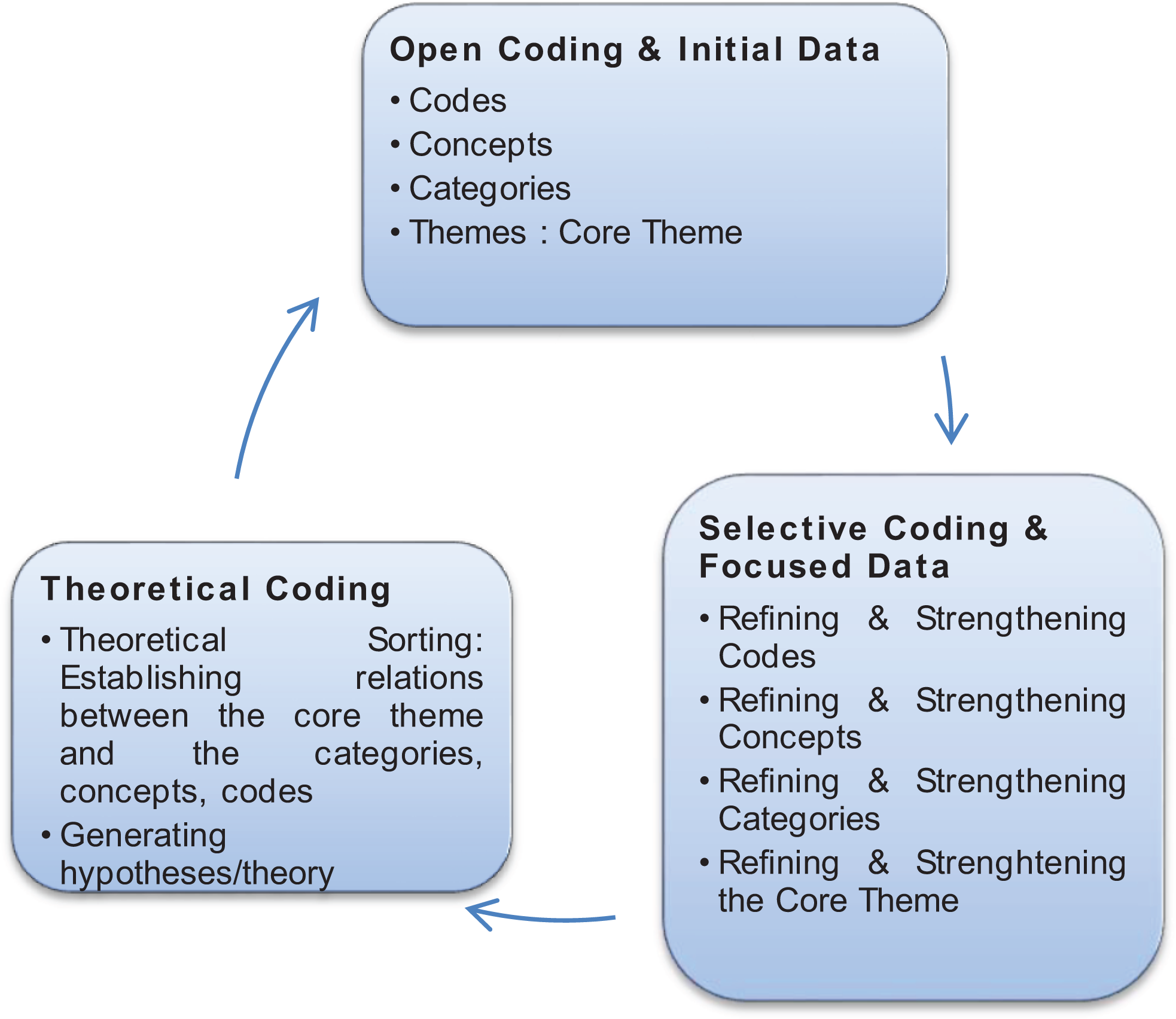
Coding procedure in Study A.
Open Coding Stage Steps
In the open coding stage, the Ünlü-Qureshi instrument was used in its entirety to analyze the initial data in all possible directions in an open way. In this stage, analysis started as soon as first data were gathered. For instance, an interview with an EAP student who was preparing for International English Language Testing exam was first piece of data collected. The interview was analyzed using Ünlü-Qureshi instruments; that is, codes, concepts, categories, and themes were generated. The description is as follows.
Generating the codes
The first element of Ünlü-Qureshi instrument is code; therefore, after the researcher becomes familiar with the data and prepares the data for coding, they can begin coding. While coding, the researcher will simply give labels to the data excerpts till saturation is achieved. During this procedure, the researcher should try to give short labels to the data extracts (i.e., noun phrases, adjective phrases, or labels in gerund form). An example in Table 1 is presented: Through this labeling, the codes, which are the first step of abstraction in GT, will emerge.
Generating Codes.

Generation of codes is detailed in Table 1. In this step, the researcher merely attached labels to the excerpt in accordance with the topic of each extract. For example, since in Excerpt 1 the participant talked about the main criteria of academic writing, the code (extract label) given to Excerpt 1 was perceived criteria for academic writing in target culture.
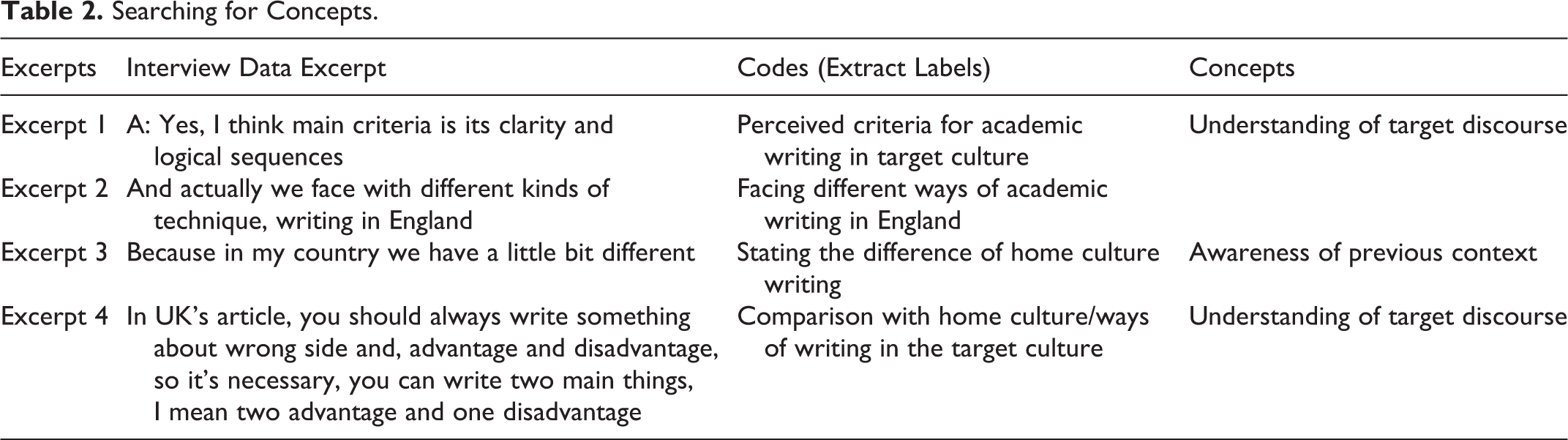
Searching for concepts
The second element of Ünlü-Qureshi instrument is concept, hence, following the generation of codes, researcher increases the level of abstraction. In doing so, the researcher reviews the codes they have generated. Comparing and contrasting the codes till saturation will reveal the similarities and differences among these codes. Through this procedure, the researcher will be able to group the similar codes together under a broader label which is called concepts.
In Study A, as shown in Table 2, since Excerpts 1, 2, and 4 all indicated the same issue, which was how the participant perceived the writing conventions in England, these excerpts were grouped under the concept titled understanding of target discourse. Since in Excerpt 3 the participant talked about their previous writing experiences in their country, this excerpt was given a different concept title.
Searching for Concepts.
Creating categories
The third element of Ünlü-Qureshi instrument is category. Once the concepts are generated, the researcher will again compare and contrast the concepts they have generated to make them even more abstract. In this stage, the concepts generated in the previous step were reviewed through GT’s constant comparison method to generate the categories that showed the relationship among the concepts (Table 3).
Creating Categories.
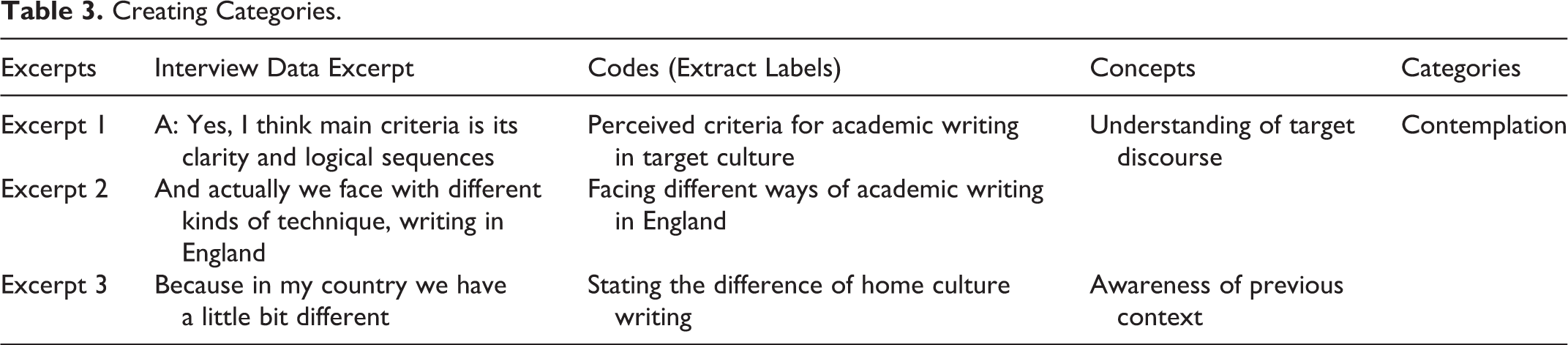
At the end of this step, a number of categories were created. In Table 4, the categories and related concepts under each category for student interviews are presented.
List of Categories and the Concepts Under Each Category.

Themes
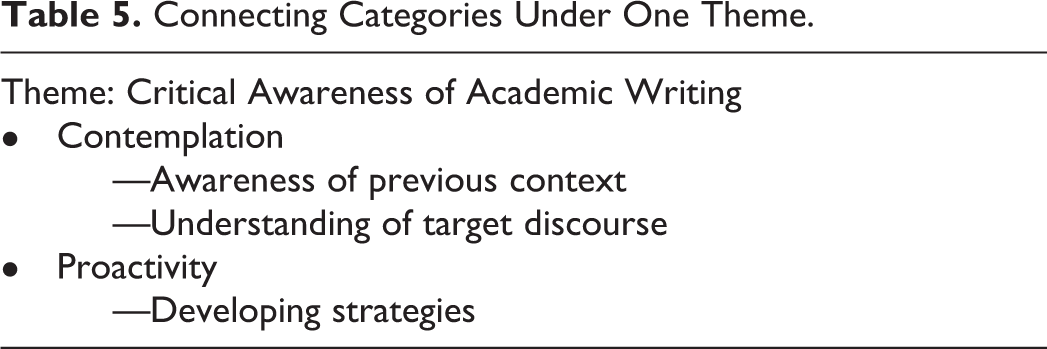
At the end of coding procedure, the fourth and last element of Ünlü-Qureshi instrument, namely theme, is established. Here, researcher will review all codes, concepts, and categories. All of these components should indicate one major issue that will be the umbrella term. This umbrella term will be the theme.
In Study A, once again the categories were compared and contrasted to reveal the relationship among these categories. It was aimed at generating a broader issue that would summarize all the categories and concepts. For the example presented here, the revision of concepts and categories revealed the theme critical awareness of academic writing as this showed how students developed their awareness on academic writing in the procedure of learning. This is shown in Table 5.
Connecting Categories Under One Theme.
Selective Coding Stage Steps
Selective stage is the second coding stage in classic GT. This stage starts once the researcher reaches a core variable at the end of open coding (Glaser, 1978). In the example presented here from Study A, the core variable, or core theme, is critical awareness of academic writing. In selective coding stage, Ünlü-Qureshi instrument was used in its entirety once again in Study A. That is, codes, concepts, and categories under this theme were refined, developed, strengthened, and expanded till saturation. The researcher was open to find completely different codes that would lead to different concepts, categories, and themes in the new data. As long as these different components were relevant to the core theme generated at the end of open coding stage, these were also kept. Therefore, the steps in this stage revolve around refining, strengthening, and solidifying codes/concepts and categories.
Theoretical Coding Stage Steps
Theoretical coding stage aims at seeking possible explanations for the connections between the themes and their properties so that hypotheses for a theory could be developed (Shannak & Aldhmour, 2009). While doing this, the researcher does not work through any new data. Rather, two tasks are completed.
Theoretical sorting
The main purpose of theoretical sorting is to “create and refine theoretical links” (Charmaz, 2006, p. 115). The researcher at this stage looks for possible links among themes. While doing this, the researcher may use theoretical coding families Glaser recommended earlier or develop their own theoretical coding families (1978; 1999). In Study A, the aim was to reach a precision and clarity while conducting theoretical sorting. Organizing the theme and its components in different ways, thus conducting theoretical sorting, completed this stage. The researcher read and grouped the memos written during the open and selective coding stages. In the end, interactive family from Glaser (1978) was utilized to establish and explain the links for it constituted “mutual effects, reciprocity, mutual trajectory, mutual dependency, interdependence, interaction of effects and covariance” (p. 76).
Generating hypotheses
Once the relationship among the themes was established, the researcher starts to write the major claims of the theory. As has been shown in the previous stage, in Study A, interactive family was utilized to establish and explain the links among the four components of the Ünlü-Qureshi instrument: themes, categories, concepts, and codes.
Study A utilized the Ünlü-Qureshi coding instrument in its classic GT adaptation. Next, how Study B implemented this coding instrument in its constructivist GT adaptation will be detailed.
Study B
The focus of Study B was mentoring communication between professors and postdocs. The data were collected by conducting semi-structured interviews with professors and postdocs enrolled in university mentoring programs. The 25 interviews were transcribed word-by-word and coded using Charmaz’s initial coding and focused coding in combination with Glaser’s theoretical coding (Glaser, 1978). The data were analyzed using Glaser’s 6Cs as analytical tool which led to emergence of four categories. Upon further analysis, all four categories were found to be part of one main theme. This multistage analytical process was organized and successfully completed by using the Unlu-Qureshi instrument (see Figure 3).

The Ünlü-Qureshi instrument.
In Study A, the Ünlü-Qureshi instrument was used in its entirety in all coding stages: open, selective, and theoretical coding culminating in successful theory development at the end of the analytic process. However, in Study B, the Ünlü-Qureshi instrument was used in stages to check reliability of the instrument as well as to conserve time without compromising on quality for successful analysis that is emergence of theory from the data (see Figure 4). The procedure for each coding stage in Study B is detailed below.
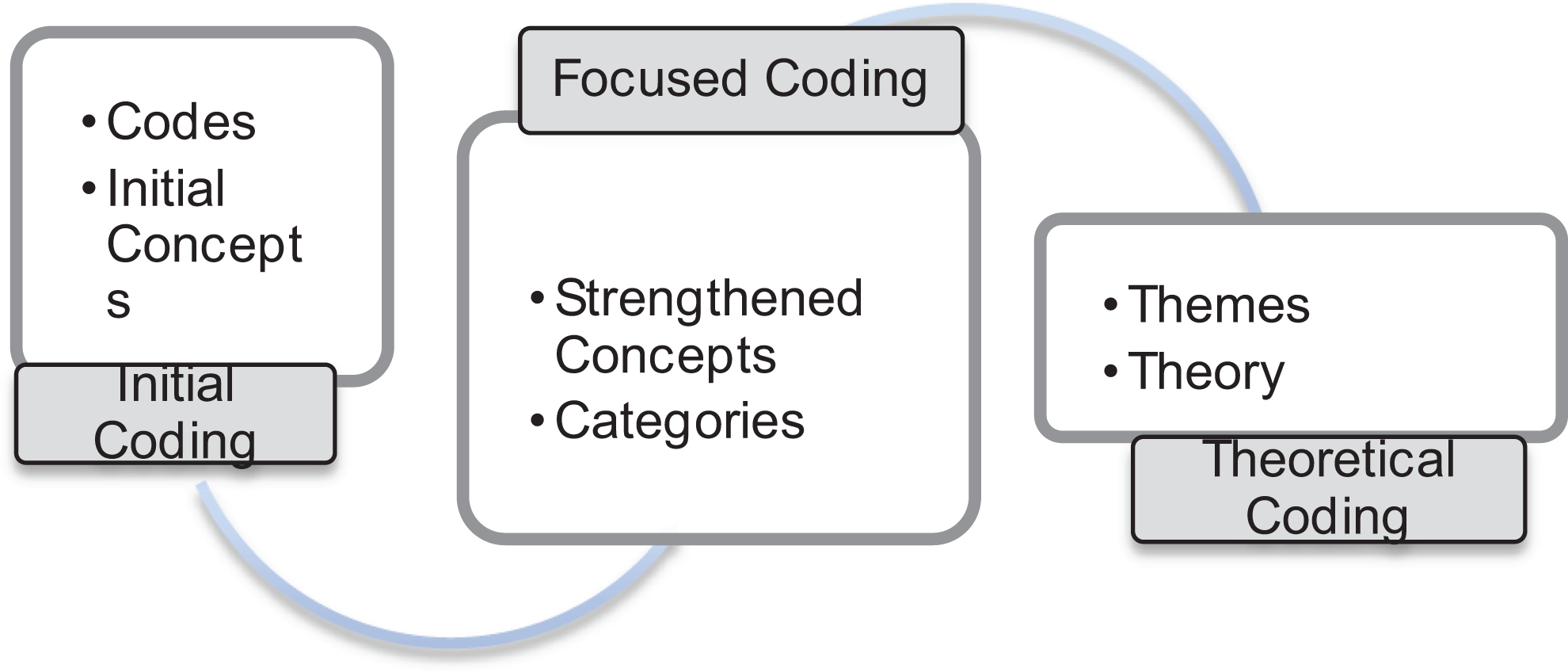
The Ünlü-Qureshi instrument in stages in Study B.
Initial Coding Stage Steps for Codes and Concepts
The first stage of analysis in Study B, initial coding stage, was guided by a section of the Ünlü-Qureshi instrument, namely, codes and concepts (as seen in Figure 5).

The Ünlü-Qureshi instrument section for initial coding in Study B.
In the initial coding stage, following lead from Ünlü-Qureshi instrument, first codes were developed till saturation was achieved with first set of interviews. In the next step, codes were analyzed and organized under relevant concepts. This was achieved with memoing and constant comparison method till all codes were saturated and organized under concepts. Initial coding stage was completed using two interview transcripts with memoing and constant comparison method and a 20-concepts framework was developed.
Focused Coding Stage Steps for Categories
In the focused coding stage, the next stage of Ünlü-Qureshi instrument, namely categories, was added to the analytic process (as seen in Figure 6).

The Ünlü-Qureshi instrument section for focused coding in Study B.
In focused coding stage, 23 interview transcripts were added to the data set and analyzed using the Ünlü-Qureshi instrument with memoing and constant comparison method. The 20-concepts framework was strengthened to 40-concepts framework in this stage by adding relevant data from 23 interviews to different codes under different concepts. During this process, codes and concepts were revised, reviewed, renamed, added, and deleted as suggested by Charmaz (2014) until saturation was reached. At the end of focused coding stage, four major categories had emerged from the data organized under different concepts.
Theoretical Coding Stage Steps for the Theme
In the theoretical coding stage, last component of Ünlü-Qureshi instrument theme was added to the analysis. Thus, guided by Ünlü-Qureshi instrument, the analytic process was completed successfully when codes led to concepts, and concepts gave way to categories which were later organized under themes (as seen in Figure 7). In Study B, the focus was given to themes and their relations with categories in the theoretical coding stage.

The Ünlü-Qureshi instrument for theoretical coding.
Glaser (1978) stated theoretical coding is conceptualizing how substantive codes were related to each other. In this case, it would be how codes, concepts, and categories were conceptually connected. Finding this conceptual link is not as obvious as developing concepts and categories. As suggested by Glaser (1978), a researcher must see over and above the obvious. Therefore, in order to proceed with this linking of codes, concepts, and categories in a single story using memoing and constant comparison method, the theoretical coding stage, in Study B, was concluded successfully with establishing the main theme based on number of categories supporting the theme. The Ünlü-Qureshi instrument was used till the major theme was selected and further explored until saturation was reached in theoretical coding stage.
Results
A comparative study of the Ünlü-Qureshi instrument used in both research studies found the Ünlü-Qureshi instrument most useful tool to organize and streamline coding process in qualitative studies using GT. Two main findings of the comparative study were as follows: The Ünlü-Qureshi instrument is a useful tool in making sense of the data by organizing it in manageable sections. It can be used in entirety or in stages depending on time and resource availability. In both approaches, rigor is not compromised. Also, the four-step instrument strengthens the verification of the findings together with the cyclic coding procedure of GT.
Discussion
GT has been established as a rigorous method to analyze data in order to facilitate theory emerging from data. Extensive literature is available on GT and how it should be conducted. Although the guidelines on conducting GT are available, those guidelines are also too generic for novices to follow. This generic nature provides flexibility to GT experts; however, for novice GT researchers, it means ambiguity (Qureshi, 2018c). Thus, the need to develop Ünlü-Qureshi instrument arose to cater to the needs of novice researchers who believe in GT yet grapple with the “How to” part of GT.
Three main schools of thought in GT present major steps to be taken while doing GT. Glaser (1978) suggests two main stages of coding: (a) substantive coding, which has the substages of open coding and selective coding, and (b) theoretical coding. In open coding, all data (interview transcripts, observations, memos, and field notes) are coded using gerunds. The codes are then compared, contrasted, modified, renamed, merged, deleted, and coded anew. At this stage as novice researchers require guidance as to how to compare and contrast hundreds of codes, the Ünlü-Qureshi instrument provides clarity to researchers by giving them the steps to follow. This will help them organize the data into manageable proportions.
Furthermore, Glaser (1978) states, once a core concept is found, then selective coding is initiated where new data are coded through the guidance of the core concept meanwhile using constant comparison. The codes established during selective coding are then analyzed in theoretical coding by incorporating them in a theoretical framework to facilitate emerging theory. For novice researchers, though it appears easy to read this procedure, however, the following questions remain: What should I do now? How to start? What next step? The Ünlü-Qureshi instrument provides answer to these questions. It was observed in both studies that the researchers after saturating one stage knew in advance which next stage to move on to within each open and selective coding stages mentioned by Glaser (1978).
Straus and Corbin (1990), on the other hand, upheld the need of theory emerging from data, yet they suggested a rigorous framework to ensure validity of the analytic process. They recommended open coding, axial coding, and selective coding. The axial coding stage was termed “coding paradigm” defined as “a set of procedures whereby data are put back together in new ways after open coding, by making connections between categories,” and studying in-depth “conditions, context, action/interactional strategies and consequences” to ensure validity of analytic process (Strauss & Corbin, 1990, p. 96). Moreover, Charmaz (2006) brought constructive approach to GT promoting co-construction of data between researcher and participants rather than theories being discovered. Charmaz (2006) recommended two analytic steps initial coding and focused coding along with theoretical coding, which were similar to Glaser’s coding stages. In Study B, Charmaz coding stages were significantly supported by Ünlü-Qureshi instrument within each coding stage.
In the three major schools of GT, Glaserian (1978), Straus and Corbin (1990), and Charmaz (2006) terms such as codes, concepts, categories, and themes are used repeatedly. They all start with developing codes, then categories with exception of Straus and Corbin (1990) who suggest developing concepts before categories and then themes. An experienced GT researcher who is familiar with the analytic process does not need reminder of what needs to be done at what stage; however, for novice researchers, ambiguity lays in the missing information (Qureshi, 2018c). Ambiguity is caused by questions such as: When should codes be consolidated under categories? Should it be done in open/initial coding stage along with developing themes? Or should it be done in selective/focused coding stage? Should all these steps be repeated after going through the extensive process of axial coding? More students around the world are interested in using GT, but lack of GT experts in their vicinity creates issues such as incorrect application of GT analytic process and discarding GT altogether.
This study is an attempt to answer these questions by presenting the Ünlü-Qureshi instrument that comprises four consecutive steps of data analysis regardless of any school of GT a researcher may follow. These steps are developing codes, concepts, categories, and themes in sequence. The Ünlü-Qureshi instrument was used in two studies in two different ways. In Study A, the data were analyzed using Ünlü-Qureshi instrument in its entirety (all four steps) in open coding stage, then again in selective coding in its entirety (all four steps). In the theoretical coding stage, relationship among these four components were sought and established. In the second study, all four steps of the Ünlü-Qureshi instrument were applied in sequence, but they were spread across different coding stages and broken down into further steps to facilitate the researcher in making sense of the data by organizing it in manageable sections and achieving analytical rigor.
Step-by-step approach of the Ünlü-Qureshi instrument over the three coding stages benefits the analytical process in multiple ways. First, the analytic process becomes organized and the researcher is aware of the required steps. Second, the initial line-by-line codes usually tend to run in hundreds, and at a glance, their huge volume may hamper researchers’ thought process as well as adding researchers’ block similar to what writers experience during writer’s block, thus affecting the research process. Using the Ünlü-Qureshi instrument may be useful in such situations as it helps in organizing data in manageable sections while ensuring saturation in each step. Third, the data are reviewed and revised multiple times to enable researchers to reflect on codes. This reflectivity later helps the researcher in theoretical coding stage when researcher is urged to look beyond the obvious while also adding to the transparency of the research. This regular interaction and familiarity with data facilitates researcher in locating the major theme. The fourth benefit of using the Ünlü-Qureshi instrument is the flexibility researcher enjoys while using this instrument, it informs them of requisite steps yet provides them the freedom to organize the analytic process according to their schedule and need of the study. However, in case of multiple researchers/flexible time frame/their personal aptitude, they can use the Ünlü-Qureshi instrument in its entirety at every coding stage as in Study A.
Conclusion
Success of GT has established it as a rigorous qualitative research methodology. The current need is to ensure GT is easy to use for novice grounded theorists. This study has suggested the Ünlü-Qureshi instrument as an analytic tool that was successfully used in two research studies. The Ünlü-Qureshi instrument was used in its entirety in Study A and in steps in Study B. The researchers in both studies found the Ünlü-Qureshi instrument useful as it helped in organizing the data, lessened researchers’ block, helped with frequent interaction and familiarity with data, and allowed freedom to researchers by informing them of requisite steps. The success of the Ünlü-Qureshi instrument in two research studies reveals its usefulness for novice grounded theorists.
Footnotes
Declaration of Conflicting Interests
The author(s) declared no potential conflicts of interest with respect to the research, authorship, and/or publication of this article.
Funding
The author(s) received no financial support for the research, authorship, and/or publication of this article.
