




Abstract
In recent years, there has been a florescence of cross-cultural research using ethnographic and qualitative data. This cutting-edge work confronts a range of significant methodological challenges, but has not yet addressed how thematic analysis can be modified for use in cross-cultural ethnography. Thematic analysis is widely used in qualitative and mixed-methods research, yet is not currently well-adapted to cross-cultural ethnographic designs. We build on existing thematic analysis techniques to discuss a method to inductively identify metathemes (defined here as themes that occur across cultures). Identifying metathemes in cross-cultural research is important because metathemes enable researchers to use systematic comparisons to identify significant patterns in cross-cultural datasets and to describe those patterns in rich, contextually-specific ways. We demonstrate this method with data from a collaborative cross-cultural ethnographic research project (exploring weight-related stigma) that used the same sampling frame, interview protocol, and analytic process in four cross-cultural research sites in Samoa, Paraguay, Japan, and the United States. Detecting metathemes that transcend data collected in different languages, cultures, and sites, we discuss the benefits and challenges of qualitative metatheme analysis.
In recent years, there has been a florescence of cross-cultural research using ethnographic data. This cutting-edge work confronts a range of significant methodological challenges in undertaking cross-cultural ethnography (Bollig et al., 2020; Falzon, 2016; Hirsch et al., 2020; Pacheco-Vega, 2020; Schnegg & Lowe, 2020). While this new methodological scholarship is rapidly and significantly advancing our understanding of how to conduct qualitative cross-cultural research, it currently provides very little guidance on how to do thematic analysis cross-culturally. In the past, cross-cultural ethnographers and mixed-methods researchers harnessed quantitative strategies, including factor analysis, to identify thematic patterning across multiple qualitative datasets (Bernard et al., 2016; Ember, 2009; Onwuegbuzie, 2003; Tashakkori & Teddlie, 2010). In this paper, we explore how the large and informative literature on thematic analysis can be leveraged to address some of the significant challenges of cross-cultural ethnography (Braun & Clarke, 2013; Charmaz, 2006; Glaser & Strauss, 1967; Lakoff & Johnson, 1980; Quinn, 2005; Ryan & Bernard, 2003). To do so, we introduce techniques for conducting metatheme analysis; these are extensions of well-documented procedures for thematic analysis that can be modified for use in cross-cultural ethnography and other cross-cultural qualitative research.
Cross-Cultural Ethnography: New Methods
Cross-cultural ethnography has been an established method since the early 1900s (Boas, 1911; Kroeber, 1909), and has a century-long tradition of methodological innovation (Bernard, 2017; Ember, 2009). Early methodological research established procedures for cross-cultural surveys, sampling, and coding (Ember, 1971; Murdock, 1940; Naroll, 1965; Tylor, 1889). In the 1970s, anthropologists began to turn away from systematic and comparative ethnography, as cross-cultural classification was increasingly associated with imperialism, racism, and exploitation (Hill, 1973). As a result, methodological innovation in cross-cultural ethnography began to lag that of other areas of qualitative research. While a handful of cross-cultural anthropologists continued to push forward methodological work, most of the breakthroughs were in quantitative and mixed-methods approaches like social networks (Bernard et al., 1988), cultural consensus analysis (Romney et al., 1986), and statistical analysis of ethnographic data (Ember & Ember, 1988). The upshot is that vital methodological advances in qualitative research, including in thematic analysis (Braun & Clarke, 2013; Ryan & Bernard, 2003), had limited uptake and little impact in cross-cultural ethnography. Path-breaking methodological work on grounded theory (Charmaz, 2006; Glaser & Strauss, 1967), for example, barely penetrated ethnographic practice. Arguably, the sole exception has been in schema analysis, where anthropologists developed a range of systematic methods for cultural analysis of texts (Quinn, 2005); but these have rarely been modified for or applied to cross-cultural ethnography.
There has been a slow and steady revival of cross-cultural ethnography in recent decades (Candea, 2019; Falzon, 2016). This work explores how meanings are shared across cultural contexts, while also deeply describing and contextualizing meanings in ethnographically-situated ways (e.g., Benton et al., 2017; Beresford, 2021; Ember, 2009; Garth & Hardin, 2019; Jordan, 1992; Mendenhall, 2019; Pacheco-Vega, 2020). Despite this burgeoning renaissance, methodological research on cross-cultural ethnography has exploded only in the last 5 years. The recent work has focused on how to: conduct local and regional case comparisons (Schnegg & Lowe, 2020), scale-up ethnographic findings (Bollig et al., 2020), develop shared questions and data collection procedures across ethnographic fieldsites (Hirsch et al., 2020), examine phenomena that are inherently multi-sited (Falzon, 2016), and apply findings to inform public policy (Pacheco-Vega, 2020). A major challenge to emerge from this work is how to bridge locally-grounded and broader-scale findings (Lowe & Schnegg, 2020, p. 16), a challenge that can be addressed using metatheme analysis.
Thirty years ago, Josephides (1991) introduced an early application of metatheme analysis in a comparative ethnography in four Melanesian cultures. Her approach relied heavily on metaphor analysis (e.g., Lakoff & Johnson, 1980) to conduct cross-cultural comparisons, but Josephides did not define “metatheme” or describe procedurally her methodological approach. A decade later, in their foundational article on theme identification, anthropologists Ryan and Bernard (2003, p. 95) defined metathemes as “overarching” themes, 1 and suggested a range of quantitative techniques for extracting metathemes from texts. Some recent research on metatheme analysis suggests that sampling guidance used for thematic analysis (e.g., Guest et al., 2006) may not be applicable to metatheme analysis conducted across cultures (Hagaman & Wutich, 2017); for example, cross-cultural metatheme analysis can require more than double the sample size needed to reach data saturation in a thematic analysis. Following Ryan and Bernard’s (2003) foundational scholarship as well as more recent uses of metatheme analysis (Bernard et al., 2016; Hagaman & Wutich, 2017), we define metathemes here as overarching themes that cut across cultures, cases, or sites in a cross-cultural research design.
While nearly all of the new cross-cultural ethnography deals with cross-cultural theme identification and description, methods for thematic and metatheme analysis are rarely (if ever) discussed or detailed. Thus, we argue that applications of metathematic analysis in cross-cultural qualitative data are an important but under-researched methodological problem. The broader literature on qualitative analysis can help provide a way forward for cross-cultural ethnography and other cross-cultural qualitative approaches to data analysis.
Challenges for Thematic Analysis in Cross-Cultural Ethnography & Qualitative Research
Techniques used to generate higher-order themes in single-sited research offer a methodological foundation for identifying cross-cultural metathemes. Processes to identify metathemes can build well-established techniques of thematic analysis used to identify higher-order or larger-scale themes. Thematic analysis is typically applied to research in single samples, sites, and/or languages, with the goal of identifying shared meanings across interviews and other kinds of qualitative data (Bernard et al., 2016; Braun & Clarke, 2013; Ryan & Bernard, 2003).
The qualitative methods literature on thematic analysis provides some guidance on identifying larger-scale or higher-order themes. For example, in Saldaña’s (2015) process of “second cycle coding,” smaller codes (or themes) are merged and synthesized. This process can then reduce a larger number of fine-grained codes into a smaller number of large-scale codes (Saldaña, 2015, p. 207). Saldaña stresses that there is no prescribed way to organize this coding process, and it should not be expected to produce neat, orderly hierarchies of codes. Rather, it should be seen as a process that is iterative, and results in successively broader and more abstract codes. This approach is similar to what Miles and Huberman (1994, p. 69) describe as “pattern coding” (Brower et al., 2019; Linneberg & Korsgaard, 2019). In grounded theory, too, the coding process is used to inductively capture themes of increasing abstraction (Charmaz, 2014; Glaser, 1998; Strauss & Corbin, 1997). Grounded theory techniques like axial coding and theoretical coding, for example, share the goal of integrating open-codes or line-by-line codes into a larger core category or storyline.
While the methodological literature on themes can inform metatheme analysis, it also presents formidable challenges when applied to cross-cultural research (e.g., Liamputtong, 2008, 2010). Qualitative metatheme analysis requires additional steps beyond theme analysis, as shown in Figure 1. For example, combining smaller-scale themes into higher-level themes requires comparing and grouping themes based on similarities and differences. These similarities and differences can be easily overlooked or misinterpreted when researchers attempt to perform comparisons across different cultural and/or linguistic contexts (Ember, 2009; Pelzang & Hutchinson, 2017; Wendt, 2020). Also, to ensure that the cross-cultural comparison of themes can take place, researchers must undertake significant upfront work at every stage of a project—from data collection through data analysis. First, researchers must select non-probability samples in ways that produce comparative data across sites (Hagaman & Wutich, 2017). Second, they must structure semi-structured protocols to yield comparable data from every site while also keeping in mind the specific linguistic, cultural, and social context of each study site (Hirsch et al., 2020, Wutich & Brewis, 2019). Third, they must make culturally-sensitive decisions around how rapport-building, positionality, and reflexivity will be navigated at each site (Mendenhall, 2019; Manohar et al., 2017; Pacheco-Vega, 2020; Suwankhong & Liamputtong, 2015). Then, to perform cross-cultural analyses, researchers must produce meaningful translations that require careful translation and back-translation (Behr, 2017; Choi et al., 2012; Hennink, 2008; Regmi et al., 2010; Tsai et al., 2004). Finally, researchers must make complex and intersecting analytic decisions about how to compare texts generated across research groups (Quintanilha et al., 2015; Wendt, 2020). Thus, rigorous metatheme analysis across sites, cultures, and languages requires that all these challenges be addressed and resolved before even beginning to identify themes in the data.
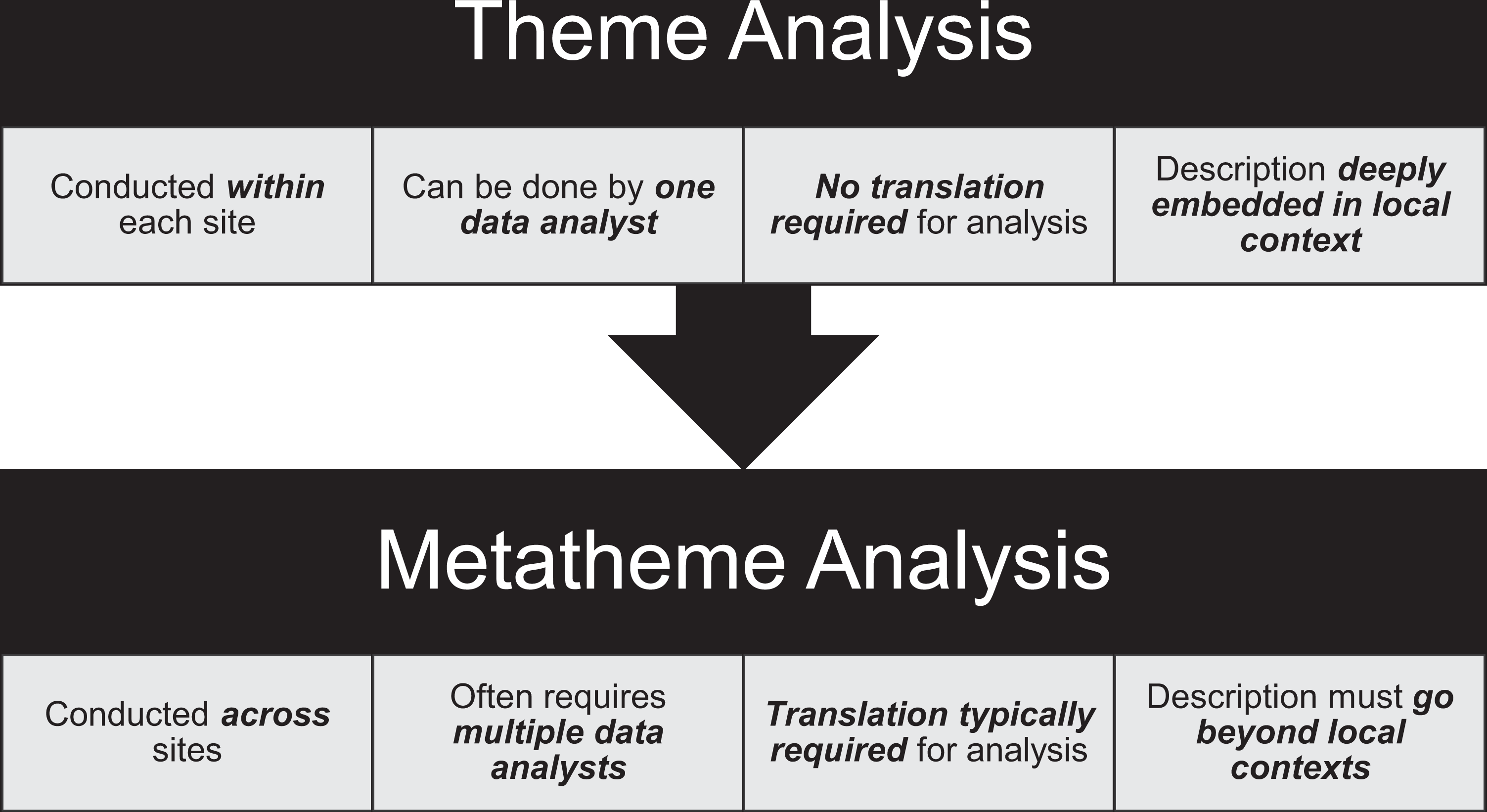
Relationship and distinctions between thematic analyses and metatheme analyses.
Mixed-Method and Quantitative Approaches to Metatheme Analysis
The mixed-methods literature has produced a quantitative approach for identifying metathemes in cross-cultural qualitative data (Bernard et al., 2016; Onwuegbuzie, 2003; Ryan & Bernard, 2003; Tashakkori & Teddlie, 2010). Such analyses typically begin with textual data, which is coded for the presence or absence of themes. Then, the data are converted into a quantitative data matrix that contains counts for the presence of the themes in each interview or observation (Bernard et al., 2016; Ryan & Bernard, 2003). This data matrix is then analyzed to identify broad trends in the patterning of themes using methods like exploratory factor analysis, multi-dimensional scaling, and correspondence analysis (e.g., Onwuegbuzie, 2003). Similar techniques have also been applied using word counts, word-based analysis and semantic network analysis (Bernard et al., 2016; Schnegg & Bernard, 1996), as well as topic modeling and latent semantic analysis (S. T. Dumais, 2004; S. Dumais et al., 1998).
Mixed-methods metatheme analyses can be useful because they yield a smaller set of overarching themes that cut across sites and information about the relationships between the themes (Onwuegbuzie, 2003). The approach has been fruitfully applied to cross-cultural analysis, as in Jang and Barrnett’s (1994) comparison of cultural differences in communication styles in Japanese and American businesses. While such techniques can be effective for identifying metathemes in cross-cultural and multi-sited research, they do not assist in producing rich textual descriptions or comparisons. For this reason, we suggest here a qualitative approach to metatheme analysis that can identify, describe, and compare themes that cut across datasets.
The Need for Qualitative Metatheme Analysis
Qualitative metatheme analysis shares goals with other well-established methodological techniques, including thematic analysis and quantitative/mixed-methods metatheme analysis. It is, however different from these approaches, as shown in Table 1. Qualitative metatheme analysis has been formally introduced in the methods literature (e.g., Hagaman & Wutich, 2017), and is applied informally to a number of cross-cultural, multi-sited, and comparative ethnographic works (e.g., Benton et al., 2017; Beresford, 2021; Ember, 2009; Garth & Hardin, 2019; Jordan, 1992; Mendenhall, 2019; Pacheco-Vega, 2020). To date, however, it has not been procedurally explained or discussed in the methodological literature. Our approach to systematic qualitative metatheme analysis (QMA) in cross-cultural, team-based, multi-sited research has emerged through trial and error and experimentation over many years (e.g., Hagaman & Wutich, 2017; Wutich & Brewis, 2019; Wutich et al., 2013). The resulting approach presented here enables us to identify overarching metathemes and inter-relationships between themes across primary qualitative datasets, including data collected using ethnographic methods in multiple languages and cultures. The analysis produces nuanced, descriptive metathemes and context-rich comparisons.
Differences Between Qualitative and Quantitative/Mixed-Methods Approaches to Theme and Metatheme Analysis.

Objectives
In this paper, our objectives are to explain how we have developed solutions to implementing collaborative cross-cultural qualitative metatheme analysis to produce high quality and meaningful comparisons. We also evaluate the benefits and challenges of metatheme analysis for comparative research, in the context of cross-cultural research conducted in collaborative multi-sited teams. To do this, we use the example of a recent cross-cultural collaborative ethnographic study we constructed—on weight and body perceptions in four very different cultural settings—called “Fat in Four Cultures” (SturtzSreetharan et al., 2021). (“Fat” here is a general term to identify we are considering weight as an experienced, embodied cultural phenomenon.)
Fat in Four Cultures: Project Overview
Study
Our multi-sited ethnographic study collected in-depth interviews and fieldnotes generated during participant observation across four diverse sites. These interviews and fieldnotes each exhibit a range of variation in public reactions to excess body weight and degree of openly-expressed weight stigma (see Brewis et al., 2011). The sites also differed significantly in average adult body weight (as an additional selection criteria). The selected sites were Osaka, Japan; North Georgia, United States; Encarnación, Paraguay; and Apia, Samoa. The primary theoretical domains of our research encompassed weight-related stigma, self-shame, discrimination, and marginalization, as suggested by prior ethnographic studies as relevant to people’s everyday experiences of body weight across varied cultural settings (Brewis, 2011; Brewis et al., 2018; McCullough & Hardin, 2013). The research was designed following Tracy’s (2010) broad criteria for qualitative research, including rigor and credibility.
Sample
Our study sample at each of the four sites was selected using a purposive, non-probability sampling approach (minimum: n = 16 per site). The main focus of our study was on women’s experiences with weight. In each site, we interviewed at least 12 women, including six women ≤44 years old and six women ≥45 years old. In each age category, the lead ethnographer chose women to interview based on their perceived ability to provide unique insights into the social, economic, and cultural dimensions of food and fat. In addition, we interviewed four men in each site: two men partnered with women participants ≤44 years old and two men partnered with women participants ≥45 years old. These interviews with men enabled us to additionally explore potential gender and intrahousehold tensions in our analysis. While our sampling approach was designed to capture maximum variability in theme and metatheme identification, sample selection was necessarily driven by each researcher’s knowledge of and connections to people in each field site. Our minimum sample size (n = 16 per site) was sufficient to support theme identification in each site (Guest et al., 2006) and to identify metathemes at least once, on average, across sites (Hagaman & Wutich, 2017, p. 9).
Protocol Development, Data Collection & Data Preparation
One key aspect of cross-cultural, team-based, multi-sited research is the need to develop a shared protocol, based on theoretical domains that can be explored in parallel across the sites (Hirsch et al., 2020; Wutich & Brewis, 2019). Our interview protocol anticipated comparing and contrasting themes related to body weight across all four sites. Based on our ethnographic experiences collecting data within each site, we planned our cross-cultural analyses to focus on three ethnographically-derived domains that are related to how people understood and reacted to the idea of excess weight across all four sites: (1) why are people fat? (understandings of the etiology of weight), (2) when is fat bad? (moral views of weight), and (3) who is fat? (the social implications of weight). The complete interview protocol, as well as descriptions of our fieldsites, can be found in SturtzSreetharan et al. (2021, see Appendix A and C).
Our protocols were designed carefully to avoid documented pitfalls to the largest extent possible, such as eliciting non-comparable datasets or the lack of documentation for implicit cultural knowledge (Hirsch et al., 2009, Quilgars et al., 2009). We prioritized the systematic aspects of research, developed shared sampling strategies, and built shared interview protocols that drew on our linguistic and ethnographic knowledge of each of the sites (Hirsch et al., 2020; Wendt, 2020; Wutich & Brewis, 2019). This included bringing on additional team members with relevant long-term ethnographic field experience to ensure adequate capacity at each field site. The wider team developed the protocol together, and it was designed to use the same semi-structured interview questions in each site. We conducted in-depth, face-to-face interviews in the participant’s preferred language, and audio-recorded these interviews. In addition, all site leads conducted participant-observation (including recording detailed field notes) during the season of data collection.
In preparing the data for metatheme analysis, each site-lead first used established techniques of thematic analysis to identify themes related to these research questions in their particular site. We then moved on to identifying cross-site metathemes through an iterative process. We describe this process in detail below. Our metatheme analysis was enhanced by our deep ethnographic experience in each site, and we used our field notes to supplement our analyses.
Ethics
Our research was approved under IRB #00003997 at Arizona State University. Studying sensitive topics like weight stigma involves well-documented ethical challenges (Hardin, 2019; Warin & Gunson, 2013). Asking participants to share their experiences of their bodies can reinforce anxieties or shame. Each researcher in our collaboration has long standing commitments to their field sites as well as trusting personal relationships with local communities; this helps us ameliorate the potential discomfort and stigmatizing effects of research on this topic. Across the sites, participants were able to discontinue the interview at any time, curtail responses to topics deemed too personal, or otherwise deflect discussions they preferred not to address. These strategies—combined with a semi-structured interview protocol that explored eating, historical and contemporary body ideals, body judgments, and body talk—removed the focus from just talking about respondent’s own bodies. Our research overall was designed to facilitate interactions that ethically acknowledge people’s complex lives as they navigate an increasingly complicated world.
Data Analysis: Qualitative Metatheme Analysis Across Cultures
Step 1: Thematic Analysis Within Each Site
The first step of any metatheme analysis is to inductively identify themes within each dataset. There are many techniques for identifying themes in qualitative data. For example, Ryan and Bernard (2003) describe key techniques for identifying themes, including: word and concept repetition, cultural categories, in-vivo codes, metaphors and analogies, linguistic connectors, and narrative transitions.
In our four-site study on body weight, each ethnographer performed their own site-specific theme identification using the participant-observation and semi-structured interview data they had collected. Like many anthropologists, we used a variety of theme identification techniques. In the Paraguay data, for example, we found the concept of buena presencia (“presentability”) in Spanish to be a euphemism used to convey that job applicants should be thin and good-looking. This suggested a theme: thin bodies have economic value. We also looked for metaphors and similes. In the Japan data, for instance, thin people were said to look gari-gari (“like a skeleton”) in Japanese. This suggests another theme: a too-thin body is frightening. After each of us completed this phase of analysis, we each compiled a list of around 30 site-specific themes (120 total) describing key meanings around food, fat, overweight, and obesity.
As our examples demonstrate, site-specific theme analysis should be done in the language of initial data collection, if at all possible. Translating too soon risks losing both semanticoreferential and indexical meanings inherent to the data. Working in the language of data collection helps minimize data loss and keeps themes close to their original meaning and context. If this is not possible, Behr (2015, 2017) and Hennink (2008) suggest some strategies for dealing with translation in cross-cultural text analysis.
Step 2: Collaboratively Identify Cross-Cultural Metathemes
As a collaborative team meeting together, we systematically identified metathemes that cut across all datasets using an inductive approach. We worked purposefully to ensure our comparisons were methodologically rigorous, and that ethnographic and linguistic data were not misinterpreted. Our analysis produced a smaller set of metathemes that encompasses most of the themes in each dataset. We conducted our own analyses in-person, but they could also be performed online (Quartiroli et al., 2017).
In our analytic process (Figure 2), we compared, contrasted, and integrated site-specific themes using a cross-cultural modification to the pile sort approach (Dengah et al., 2020; Ryan & Bernard, 2003). Each site-specific theme was printed in five decks of cards, which we used to conduct sorts. Five researchers separately and individually sorted the themes from all four field sites into piles that suggested cross-cutting metathemes. For example, one such emergent metatheme dealt with anguish over children’s overeating and weight-gain. After we had all completed our sorting, each researcher then presented her metathemes to the others, explaining how and why she composed her analysis. The next stage of our analysis was a dynamic conversation—in which the researchers debated, argued, and came to consensus—around the major metathemes emerging from our separate analyses of the cross-site theme data. This process of working on themes from all sites allowed us to engage both analytical closeness and distance (Wendt, 2020).

Process model for team-based metatheme analysis.
As shown in Figure 2, we propose that constant comparison or thematic networks could be substituted for pile sorts, proving further feasible options. Constant comparison is a technique from grounded theory that facilitates comparisons within interviews, across interviews, and across groups of interviews (Boeije, 2002). Thematic network analysis is a qualitative approach for identifying and coding for “basic themes” and “organizing themes” and organizing them in a network model (Attride-Stirling, 2001). Any of these, we believe, could potentially produce metathemes and provide basis for systematic comparisons and synthesis of metathemes across and within datasets.
Note of Caution: Handling Language and Cultural Differences in Cross-Cultural Metatheme Analysis
To facilitate cross-cultural analysis, we found it productive to do at least some of the cross-site comparison in a shared language. To do so, we translated themes we identified in the initial thematic analyses into English. However, we kept in-vivo codes—including metaphors, analogies, and euphemisms—in the initial language of data collection, alongside a longer contextual explanation of the theme in English. Thus, our four-site metatheme analysis and cross-cultural comparisons were conducted largely in English, with discussion of specific themes using the language of data collection.
Fluency in the language(s) of data collection is important for all forms of qualitative and linguistic analysis. This is especially true for cross-cultural analysis because of the high risk of mistranslation and misinterpretation. In addition to language fluency, cultural knowledge and high familiarity with the original data—achieved through ethnographic context and multiple iterations of data reading—can enrich analyses conducted in a shared language. The more familiar researchers are with the data in the original language, the less likely they are to make analytic errors, such as misinterpreting themes and metathemes.
Once a shared language was established, talking through cross-site differences yielded important insights and many surprises. As long-established ethnographers, we were challenged to see the cultural dimensions of fat in new ways. For example, people in the Japanese site expressed concern about large bodies, often saying ano hito wa genki ka dō ka (“I wonder if that person is healthy or not”). Leveraging our analysis of “concern trolling”—a theme developed through in-vivo coding from the U.S. data—we explored the possibility that this form of concern could be indicative of fat-shaming in the Japan site too. We then realized people in the Paraguayan site expressed similar health concerns, and this suggested a possible cross-cultural pattern in fat-stigma that encompasses sites previously thought to be “fat neutral.” As this example shows, our process of interrogating our observations and analyses enriched our site-specific and cross-cultural comparisons.
Recommendation: Results Presentation
How to present the results of qualitative analysis can be a challenge (Eldh et al., 2020). Here we suggest a few approaches to presenting qualitative metatheme analysis. We presented the results of our metatheme analysis in three ways: thick description, thematic comparisons, and typical exemplars. While the thick description is too lengthy to address here (for examples, see Hardin, 2019; SturtzSreetharan & Brewis, 2019; SturtzSreetharan et al., 2021; Trainer et al., 2017), we provide examples of thematic comparisons, and their typical exemplars, in Tables 2 and 3. Our overall process included, first, each ethnographer’s individual consideration of the texts generated in their own sites. Following that, our subsequent engagement in the collaborative process of metatheme analysis informed our decisions about how and why to present specific themes and exemplars. Ultimately, metatheme analysis enabled us to detect additional and important patterns (including cross-cutting sub-metathemes and site-specific themes) in the data that would have otherwise gone unnoticed.
Example of a Metatheme in Cross-Cultural Data, From the FAT in Four Cultures Study.
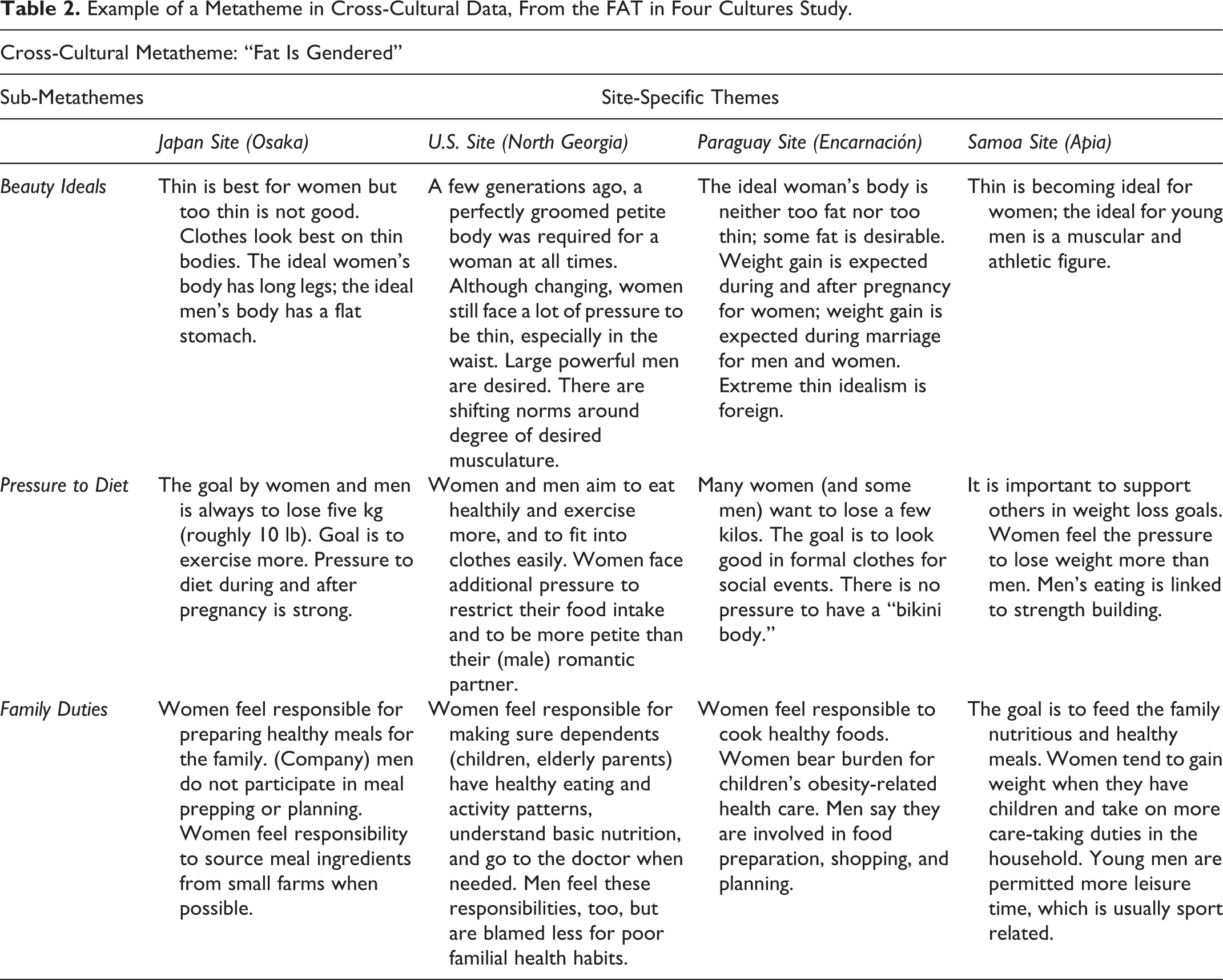
Metatheme Exemplars for “Fat Is Gendered”: Data From the Fat in Four Cultures Study.

Discussion: Benefits and Challenges of Metatheme Analysis
The following benefits and challenges of cross-cultural metatheme analysis emerged in detailed team discussions both during and following the analytic process.
Some Benefits of Metatheme Analysis
Benefit 1. Credibility
As qualitative analysts, we often triangulate our own data by being deeply enmeshed in our ethnographic context. Being in dialogue with seasoned fieldworkers across different cultural contexts provides a space for probing assumptions. This enhances the credibility of the data analysis.
Benefit 2. Direct comparison
Metatheme analysis allows for a deeper engagement with the data both individually and across sites. In a multi-sited study, the thematic analysis of any one individual data set was required to engage in a “dialogue” with the other data sets. This explicitly comparative step allowed the cross-cutting metathemes to be made visible though systematic comparison.
Benefit 3. Synthesis
Metatheme analysis enables fusion of the research findings from the broader study. Analysts are able to identify broad cross-cultural or cross-site trends, and to illustrate how they manifest in specific sites, cultures, or contexts. Such a synthesis helps describe the breadth of a phenomenon, beyond and including how it specifically manifests differently in each location.
Benefit 4. Scalability
Metatheme analysis harnesses the conventional advantages of highly-nuanced and small-scale thematic analysis, while also showing obvious utility as a framework and set of techniques that can be scaled-up and applied across many settings. This approach facilitates the application of global and transnational research to real-world problems, including those faced in agencies, programs, and companies that value scalability and standardization.
Some Challenges of Metatheme Analysis
Challenge 1. Constraint of protocols
Some standardization of data collection protocols is necessary for metatheme analysis. For example, researchers might adopt a standardized semi-structured interview protocol across sites. The drawback is that important additional themes may be missed. Such themes would likely emerge from data collected using more exploratory and divergent interviewing styles.
Challenge 2. Prior experience
Cross-cultural metatheme analysis requires deep knowledge and experience within each of the included research sites, communities, and languages. Often, site-specific themes appear initially to be quite different because they manifest in culturally and linguistically unique ways. Without deep contextual knowledge and experience, analysts may misunderstand or fail to identify metathemes.
Challenge 3. Data depth
Metatheme analysis requires enough data to be able to substantiate the themes within a site before moving onto comparison across sites. In addition, metatheme analysis may require observational fieldnotes in order to feel confident in the metathemes identified; detailed fieldnotes can act as a check on metatheme identification.
Challenge 4. Team dynamics
A team-based approach to metatheme analysis requires trust and respect. Analysts must be able to iteratively question and challenge each other’s analyses in a productive way. Metatheme analysis cannot function as we described in team dynamics dominated by distrust, disdain, disregard, or harmful competition. Good teamwork, in other words, is essential.
Conclusion
In cross-cultural ethnography and other cross-cultural qualitative research, metathemes are themes that occur across cultures (Bernard et al., 2016; Hagaman & Wutich, 2017; Ryan & Bernard, 2003). Qualitative metatheme analysis is challenging because it typically requires theme analysis to be conducted collaboratively, in multiple languages, in translation, and in ways that go beyond local context. While this can involve some of the hierarchical or nested coding that is common in thematic analysis, it is a fundamentally different analytic endeavor. Identifying metathemes in cross-cultural research is important because metathemes enable researchers to use systematic comparisons to identify significant patterns in cross-cultural datasets and to describe those patterns in rich, contextually-specific ways.
Our proposed approach to qualitative metatheme analysis (QMA) is a feasible and meaningful way to conduct systematic comparisons and synthesis of themes across and within textual datasets, for cross-cultural ethnography and cross-cultural qualitative research. Benefits include enriching credibility, enabling direct comparisons, facilitating synthesis, and enhancing the scalability of multi-sited, cross-cultural research. Challenges include the need for constrained data elicitation protocols, ethnographic and linguistic expertise, close attention to data depth, and maintenance of productive team dynamics. Future research, including on the feasibility of conducting cross-cultural metatheme analysis using constant comparison and thematic network analysis, may help illuminate additional approaches to qualitative metatheme analysis.
Footnotes
Acknowledgments
We acknowledge the support of the Mayo Clinic-Arizona State University Obesity Solutions initiative, which was generously funded through the Virginia G. Piper Charitable Trust, the ASU Office of the Provost, and the US National Science Foundation Cultural Anthropology Program (Award SBE-2017491) to the NSF Cultural Anthropology Methods Program. We also benefited from support from the ASU President’s Strategic Initiative Fund. We thank our colleagues and students for supporting our efforts, especially Charlayne Mitchell, Deborah Williams, Carol Ember, and H. Russell Bernard.
Declaration of Conflicting Interests
The author(s) declared no potential conflicts of interest with respect to the research, authorship, and/or publication of this article.
Funding
The author(s) disclosed receipt of the following financial support for the research, authorship, and/or publication of this article: We received funding from the Mayo Clinic-Arizona State University Obesity Solutions initiative, Virginia G. Piper Charitable Trust, ASU Office of the Provost, the ASU President’s Strategic Initiative Fund, and the US National Science Foundation Cultural Anthropology Program (Award SBE-2017491) to the NSF Cultural Anthropology Methods Program.
