




Abstract
Professionals seldom discuss those things that go well-rather the focus is often on problems, poor outcomes, and what does not go well. Exnovation is about illuminating the invisible or hidden strengths of existing practices in order to improve practice and is central to the contemporary, qualitative elicitation method: video-reflexive ethnography (VRE). VRE is a method to explore and articulate the taken for granted by means of short video clips of one’s own work practice that provides a basis for sharing experiences, assumptions, questions, and concerns about the way things are done in order to effect practice improvement. Reflexivity is key to the method. The creation of a safe space for this shared reflexivity is essential. Improvement activities frequently draw upon problem-focused approaches that imply blame and fault. Such approaches can serve to close down discussion, give rise to anxiety, and inhibit the very improvements sought. In contrast, a strengths-based, solution-focused approach serves to create the safe place where shared practices, rather than individuals, are the center of attention. By focusing on what works well practitioners are encouraged to identify and build on existing strengths. A solution-focused approach used alongside VRE provides a scaffold for building improvement that is relevant to context. In this article, we discuss exnovation, the elicitation method of video-reflexivity, and the incorporation of a strengths-based solution-focused approach with VRE. We highlight the transformative and complementary qualities of these methods and draw upon practical examples from health care to demonstrate how they serve to strengthen and enhance each other.
Keywords
Introduction
“Things or practices are not less valuable simply because they already exist” (De Wilde, 2000, p. 13). With this statement, the philosopher De Wilde challenges the dominant trend to discard existing practices. Although innovation is important to improve practices, De Wilde argues that this way of creating change makes us blind to what is already in place. According to him, practice improvement also requires “exnovation”-explication of the hidden strength of practices. After all, besides the intended formal measures, quality is also achieved by an unplanned but effective set of initiatives. In other words, explicating the hidden competences of practices and practitioners also deserves our attention (Mesman, 2011). In doing this, exnovation acknowledges the “ordinary” as an extraordinary accomplishment.
In order to recognize and learn from everyday routines, the method of video-reflexivity provides an apt instrument. Video-reflexive ethnography (VRE) is a method designed to capture the daily, taken for granted, moment by moment interactions and expose these to reflection, subsequent understanding, and modification of practices (Iedema, Mesman, & Carroll, 2013). The VRE method involves filming daily work practices (video-ethnography), selecting footage, and showing these clips back to the participating professionals (video-reflexivity) who collaboratively conduct the analysis. With its focus on the ways of doing and reasoning that have become invisible, due to their mundane character, the VRE method acts like a key to “opening up” existing practices for both researchers and practitioners. Its visual, as well as its collaborative character, makes VRE a strong device for practice optimization. It also provides an effective method for the collection and analysis of research data, engaging with professionals as co-researcher in the video-reflexive sessions.
Nevertheless, these video-reflexive meetings have the potential to provoke anxiety in the participants and mobilize defensive reactions including rationalization. Some of the sensitivity surrounding the reviews of clinical practice is linked to the problem-based way “we” approach change. This involves the use of problem-based language which is associated with negative connotations and blame. Like exnovation, a solution-focused approach is a strengths-based approach which does not take what is wrong and not working as the starting point but rather focuses on what works well and what “we” can learn from that. Such an approach does not blind participants to identifying suboptimal practices but aims to avoid these practices becoming the sole focus of reflexive meetings. Applying a strengths-based approach aims to address what could be done to ensure that good things happen consistently through the identification of what may need to change to make that happen (Walsh, Moss, & Fitzgerald, 2006). Solution-focused questioning that initially concentrates on strengths is more likely to keep people engaged psychologically in a video-reflexive session and less likely to trigger a threat response in participants.
Our thesis is that facilitated solution-focused approaches and the method of VRE strengthen each other and are complementary. In particular, the application of solution-focused questioning within the video-reflexive sessions. The strengths-based emphasis of the solution-focused approach enhances the VRE method, offering a scaffold for the facilitator to implement within reflexivity meetings. The visual element of VRE, on the other hand, presents another lens (excuse the pun) with which to view the practice of solution-focused approaches that, to date, have largely relied on verbal communication. Moreover, exnovation supported by solution-focused questions makes informal, “mundane” parts of practices the center of attention (as it has within the established VRE method). This enables participants to study and optimize practices on the basis of what is already there but has been forgotten or overlooked because this way of working has become habitual.
In the remainder of the article, we provide the foundation upon which we build our claim. To do so we will explain each building block: exnovation, the method of video-reflexivity, and the solution-focused approach. With the help of case studies, we will demonstrate how the solution-focused approach and the method of video-reflexivity strengthen each other.
Opening Up Practices: An Exnovative Approach and the Method of Video-Reflexivity
Our point of departure is exnovation: the idea that mundane and implicit routines of practices have become invisible over time but actually play a crucial role in the foundation and preservation of quality. Exnovation aims to explicate the already existing strength of practices so it can be reused for practice improvement and result in a reawareness and reappreciation of one’s own, and others, contributions (De Wilde, 2000; Mesman, 2011). By following De Wilde, we adopt a definition of “exnovation,” that is characterized by a positive perspective (strength of practices) and a temporality which is in the here and now (existing practices). In doing so, we distinguish ourselves from those who use exnovation as a form of abandonment of existing practices to support performance improvement. Examples of exnovation applied in this way can be found in literature in, for example, environmental science (e.g., Hermwille, 2017; Heyen, 2017) studies on innovation management (e.g., de Hoop, Pols, & Romijn, 2016; Frost & McHann, 2015) and health science (e.g., Rodriguez, Henke, Bibi, Ramsay, & Shortell, 2016). Others, like Bekelis, Skinner, Gottlieb, and Goodney (2017), are less drastic and use it to indicate scaling back of procedures and practices.
Compared to management and environmental literature, our use of exnovation is fundamentally different: it has a positive focus on potential. It is not aimed at “taking away what is there” but at digging out “what is there” to support improvement. Exnovation in the way we use it can be considered as aggregation of “excavation” and “innovation” (Iedema et al., 2013, p. 10). Excavation refers to “exposure of what is already there” as well as to “digging out” (Iedema et al., 2013, p. 10). It is in this way that exnovation is adopted in the method of video-reflexivity. Moreover, over the years, this conceptualization of exnovation has been developed into one of the four guiding principles of VRE, the others being collaboration, reflexivity, and care (Iedema et al., 2019). In this way exnovation directs VRE to foreground “the local ecology of care, that is, the accomplishment and complexity of everyday and taken-as-given-care practices unfolding in the here and now” (Iedema et al., 2019, p. 12).
A perspective on everyday practice as being a rich source for improvement is relevant in many societal domains. Increasing complexity presents all practitioners with unprecedented challenges. This article limits itself to the domain of health care as it aligns with our expertise and does justice to the VRE method, which is predominantly used in health care settings. Moreover, high-profile failures in health care safety and quality have highlighted significant harms as a result of care itself (Kohn, Corrigan, & Donaldson, 2000). Where at first considered as an issue of substandard performance of individual clinicians, in the late 90s, the locus of errors moved to the wider context in which health care is provided. Systems thinking and quantitative studies on adverse events such as hospital-acquired infections and errors in medication became dominant in safety research (Bates & Singh, 2018). This move was followed by a growing interest in organizational factors and safety culture (Vincent & Amalberti, 2016) and opened up the way for alternative approaches to the investigation of safety cultures including qualitative studies (Vincent, Carthey, Macrae, & Amalberti, 2017). Where “learning from mistakes” has been the leading principle for decades, nowadays, there is a growing interest in “learning from what goes well” to complement the “deficit perspective” on safety. 1
Considering this interest for what happens in daily routines, newer approaches, like exnovation, aim to understand features of everyday care. Think about the adjustments and trade-offs made by professionals who promote safety. Most of these routine decisions and actions are taken for granted by clinicians. Yet, making this underlying expertise more visible will enable clinicians to learn not only from failures but from successes as well. Therefore, practice optimization, we would like to argue, should include “exnovation,” meaning “articulating the invisible but necessary aspects of the mundane which promotes quality” (De Wilde, 2000, p. 13). This will allow frontline clinicians to tap into their own informal and mostly implicit and tacit competences including their “error wisdom” (Reason, 2004). The involvement of professionals engenders “innovation from within” (Iedema et al., 2013), as it empowers professionals to lead change and improve themselves from the bottom-up (Lawton, 2018).
Considering that the exnovative quest is to articulate practices that have become taken for granted, researchers and professionals alike run into problems. For the researcher, these aspects of practice are still obscure, and professionals are no longer aware of them. In order to go beyond this “practical blindness,” they need an outsider’s perspective. The researcher, on the other hand, needs the knowledge of professionals to understand the nitty-gritty of a practice. All need a so-called situated distance (Carroll & Mesman, 2018) in which the familiar and the unfamiliar overlap. It is here that the method of video-reflexivity makes a key contribution. The VRE method includes the video recording of day-to-day practice. A selection of this footage is presented to professionals for interpretation and discussion in video-reflexive sessions. The video-reflexive sessions provide a platform that enables participants to reflect upon the informal logic of their ways of working. An active engagement of professionals to interpret the footage is needed in order for VRE to be effective. On the basis of these reflections, they make suggestions for tailor-made practice improvement. Therefore, adherence to the basic principle that frontline clinicians have a say in what is filmed and what is shown back to them is crucial. For the researcher, the reflexive meeting is one of the few moments where not only deviations from standard practice are discussed but also the informal strengths of practices are articulated. The role of the researcher can be characterized as a “clinalyst,” which is shorthand for “outsider-analyst-catalyst” (Iedema & Carroll, 2011, p. 176). A clinalyst catalyzes insiders’ knowledge by asking outsider questions while collaboratively viewing video footage with professionals. In this way, the video-reflexive meetings provide the required distance for practitioners to see their daily work practices from a new angle. For the researcher, these meetings act “as a ‘knowledge lab’ where situations are reflected upon explicitly and as a collective activity” (Mesman, 2015, p. 177). The researcher also acts as a pair of fresh eyes to the practitioners.
The researcher’s naïve perspective can help practitioners see their practice anew. For example, one of the authors filmed the preparation of medication by nurses at eight o’clock in the morning for several days. Positioning herself on a stool in a corner of the medication room, she filmed the nurses in action. Although the medication room on this ward is small, there were eight nurses present and they were frustrated about lack of space. However, medication administration is tied to specific times and extending the time span to use the room was not an option. One week later, the footage was shown to the nursing staff. Interestingly, the footage was shot from an elevated position and this made them even more aware how crowded the room was. It immediately triggered their frustration: “Look at this! How many are we? Seven? Eight? Unbelievable! Now you see how small our workspace is!” The insider’s perspective proved them even more than right! The researcher however had seen something completely different. Indeed, she too was aware of the lack of space. But it was precisely this lack of space that made her aware of the spatial capabilities of the nurses: no one bumped into one another (except one: an intern!) and even when preparing medications using needles and other sharp devices, people were safe. Moreover, stepping aside to throw something away made an open space for a colleague to step into to take something else from the bench. Bending over to open a drawer allowed someone else to reach out and grab what was needed from the shelf above. Turning away and stepping in succeeded each other with a remarkable ease. The outsider’s perspective of the researcher had allowed her to see a “high-quality dance company in action” whose fluency was amazing. Not frustration, but admiration was what the footage had triggered. Sharing her perspective with the nurses made them observe their own practice in another way. By showing the video in slow motion, the fluidity of the motions and gestures of the nurses while preparing medication was highlighted. After some laughter, the discussion became more serious and moved to the direction of bodily capabilities and spatial abilities. After this meeting, the medication room was still as small as before. However, the staff redesigned the spatial organization of the room and expressed less frustration because now they knew “they are sublime dancers.”
This example shows how a “situated distance” allows for the cocreation of a new understanding of the taken for granted. This in itself is a more active process than the usual qualitative interview because the VRE sessions are first and foremost about learning instead of data collection (Iedema et al., 2013). In sum, both the visual and reflexive aspect of the video-reflexive method are key to opening up practices for all involved.
To explore and articulate the taken for granted by means of short video clips provides a basis for clinicians to share their experiences about the way things are done. However, visualizing what goes on “in situ” (actions which are taking place in the “ordinary” way which work unfolds) runs the risk of only being judged, instead of being reflected upon and learned from. A genuine exploration of what actually goes on requires suppressing the ingrained habit of focusing on what goes wrong and blaming individuals. Yet exnovation involves foregrounding practice and taps into the existing (group) wisdom. In other words, the articulation of practical know-how can be facilitated by video footage but only becomes effective if it is done in a safe place in which the shared practice is at the center of attention, instead of the individual practitioner. Exnovating the unarticulated richness of one’s work practice includes “taking care” as it requires a safe zone where questions can be posed without feeling embarrassed. The safe zone is where one can speak freely about the way things are done and for what reason, and where there is no need to pretend that things are better than they actually are. Providing a safe zone is not only a necessary requirement in group video-reflexive sessions both also in one-on-one video-reflexive meetings (e.g., Collier & Wyer, 2015; Wyer, Iedema, Hor, Jorm, Hooker, & Gilbert, 2017). The role of the facilitator in these video-reflexive sessions is crucial in order to create and maintain such a safe zone.
This description of VRE implies a set of methodological principles (Iedema et al., 2019): Exnovation: foregrounding the accomplishment and complexity of everyday practices; Collaboration: a participatory approach to data cocreation and analysis with stakeholders; Reflexivity: to perturb, review, and reimagine practices; Care: ensuring the psychological safety of participants.
These methodological principles underline how VRE is not an end in itself but a tool for practice optimization with a focus on “acting” based on the insights of the professionals themselves. Their discussion is about the way things are done and involves judgments about the accomplishment of tasks. This makes the outcome of the video-reflexive sessions and the input for the practice optimization rather unpredictable and underlines the importance of effective facilitation.
In collaborative research with practitioners, the need for researchers to have highly developed facilitation skills is often overlooked. It takes skill and experience to know when to intervene, when to lead and when to follow, when to be active or inactive, when to speak and when to remain quiet, and how to interpret the content, meaning, and behaviors of the group (Thomas, 2008, cited in Walsh & Andersen, 2013). 2 The facilitator is tasked with helping the group achieve its purpose. The facilitator does this by careful attention to the group process, the group context, and the group structure, including group membership (Schwarz, 2002). The facilitator must pay attention to the different positions within the group. For example, Iedema et al. (2013) stress that one should pay attention to the difference between senior and junior staff. Senior staff must feel safe to speak freely about “the normal-legal” and the “normal-illegal” (Iedema et al., 2013, p. 83). Junior staff must feel safe to ask questions about how and why and learn from the taken for granted. Sessions can be structured in different ways. One way is to have an open discussion, without informing those present, about the comments of their colleagues who have already discussed that particular footage in a previous meeting. The advantage of this open discussion is that it provides room for surprising new comments and new suggestions. Another strategy is that colleagues also reflect on what has been said before. In this way, there is an ongoing reflection. According to Gherardi (2012), in this way “…a cycle builds up around what workers do, what they say they do and finally what they do about what they say” (p. 167). Gherardi explains how one starts with showing footage to practitioners in which they themselves appear and are requested to describe what they are doing (self-confrontation). Next, a colleague is asked to comment on what is going on and what is done, while the first is still present (crossed self-confrontation). This interaction is recorded as well and shown back to the whole group. In this way, it becomes possible to compare implicit ways of working that goes beyond evaluating individual practitioners. However, a focus on “ways of doing” does not prevent a focus on possible mistakes and errors. In a problem-focused world, practitioners can become preoccupied with what went wrong rather than the skills buried in everyday practice. One way of counteracting this problem focus is the use of facilitated solution-focused approach within VRE.
Solution-Focused Approach
The solution-focused approach had its origins in brief solution-focused therapy which was pioneered by De Shazer and colleagues in the 1980s (De Shazer, 1985; De Shazer, 1988; Lethem, 2002). More recently, the tenets of the solution-focused approach have been adapted for use in education (Woods, Bond, Humphrey, & Symes, 2011), nursing (McAllister, 2003; Walsh et al., 2006), occupational therapy (Duncan, Ghul, & Mousley, 2007), coaching (Grant, 2013), and organizational redesign (Bloor & Pearson, 2004). The solution-focused approach is based on the premise that understanding the causes of a problem is not a necessary precursor to resolving it (Walsh et al., 2006). Indeed, helping people to…“disengage from problem focused and problem saturated thinking” can assist the individual to spend more time finding possible solutions and pathways to preferred outcomes and goals (Grant, 2013, p. 36).
The problem-focus is so ubiquitous as to be almost invisible. Problem-based thinking pervades the positivist view of science which is focused on cause and effect. It is therefore not surprising that it also pervades the standard approach to problem-solving and practice improvement. The usual first step in problem solving is problem identification. This diagnostic phase is useful in naming and clarifying the issue (McAllister, 2010). However, what usually follows is a detailed exploration of the problem, as based on the notion, that fully and deeply understanding that problem is a prerequisite to finding a solution (Jackson & McKergow, 2001). This approach to problem-solving works well in situations that require dispassionate logical reasoning and where relatively straightforward cause and effect relationships can be expected to be found (engineering, for example, Jackson & McKergow, 2001). However, the higher the degree of social or relational complexity (where people or people mediated systems are involved), the less well the standard problem-solving approach works (Jackson & McKergow, 2001; Kahane, 2007).
People add complexity in that they do not always react in “rational” and predictable ways (Walsh, Crisp, & Moss, 2011). This is compounded by the potentially negative effect problem-saturated thinking can have on the thinker. Jackson and McKergow (2001) contrast features of problem-and solution-focused approaches in Table 1.
A Comparison of Problem-Based and Solution-Focused Approaches (Jackson & McKergow, 2001, p. 27).

The problem-focus on deficits and what is wrong has entered our language. Problems have blame and ownership and negative connotations which give rise to comments such as: “that’s going to be a problem”; “that’s not my problem, that’s your problem”; “who caused the problem in the first place?” Problem-saturated thinking can psychologically disengage the thinker from the problem by mobilizing anxiety and putting the thinker into a psychological “away state” (Rock, 2006) and rob them of the psychological resources required to solve the problem (Walsh et al., 2011). “Problems” can trigger stress and confusion, and as a result, thinking can be clouded. Such psychological disengagement and clouded thinking, applied to the practice improvement context, will have a detrimental effect on the participants’ ability to develop their practice.
In contrast, the solution-focused approach seeks to keep the thinker in a psychological “toward” state (Rock, 2006). It looks for what works and what is going well. It endeavors to build on the strengths of individuals and groups, and it uses creativity and imagination to focus on a positive possible future and how to get there (Walsh et al., 2006). This approach enables people to think about how they want things to be and the actions to take. We have found that the action focus of the solution-focused approach helps the participants move forward and progress in their practice improvement. Some strategies that work toward this include: Look for what works and do more of it; Highlight and build on strengths; Cease doing what does not work; Use creativity and imagination to imagine a better future and work toward it (Grant, 2013).
Solution-Focused Questioning
The VRE facilitator plays a pivotal role in shifting participants embedded in the traditional problem-based paradigm to a strengths-based, solution-focused approach (Iedema, 2015). This pivotal approach by the VRE facilitator sets the agenda and tone for incorporating and respecting the expertise of participants and harnesses their attributes to inform research and quality improvement. Common types of questions include goal-defining questions, scaling questions, miracle questions, and questions that look for exceptions.
Goal-defining questions elicit what the participants hope to achieve, for example, “what is your best hope (goal) for this intervention or change?” Scaling questions are designed to encourage the participants to rate themselves against a concrete goal or hope and to look for the strengths or positives in a situation. For example, if the clinicians’ best hope is to embed person-centered ways of working in everyday encounters with patients, some scaling questions might include; “On a scale of 1-10, how person-centred was this encounter?”; “You have scored the encounter as 7, what is it about this encounter which makes it a 7 for person-centeredness?” (identifying existing strengths); “What would you need to do to make it 10?” (building on existing strengths). The miracle question can also be used to good effect. The miracle question has many variations but is designed to help the participants to imagine a desired better future and how to get there. Examples of the miracle question and follow-up questions might include: Imagine a miracle has occurred, we are now in the future and your ward is the best person-centered ward it could be. What is it that you see, hear and feel that indicate that it is the best person-centered ward? Today in your ward are any of those good things happening, even just a little bit? How do you make those good things happen? How can you make more of those good things happen? Rather than focusing on what is wrong, the miracle question moves the participants into the desired positive future and helps them find ways to achieve it in the present.
Finally, questions that look for exceptions can also be used to shift the focus from the times things go wrong to the times things go right, in order to learn from these situations. For example: … you say that sometimes the workload on the ward makes staff focus on the technical aspects of care, and person-centred ways of working are forgotten. Has there been a time recently, when you have balanced the need for the technical and the person-centred even though it has been busy? Can you tell me how you achieved that?
The premise behind “exceptions” questions is that bad things do not happen all the time, there are times when good things happen instead: find out what makes the good things happen and do more of it.
As discussed previously, we believe that blending video-reflexivity with the solution-focused approach outlined above has advantages for both. What follows is a case study illustrating the positive outcome of using video-reflexivity with clinicians in practice and the possibilities of further enhancing this approach using skilled facilitation and solution-focused questioning. This semi-fictitious case study is based on a real scenario involving the use of sterile gloves but has been adapted to illustrate how the solution-focused approach can be incorporated into a video-reflexive session.
Case Study: Unpacking Sterility
Sterile procedures before and during patient care are designed to prevent and minimize infection. Handwashing, applying sterile gloves, and preparing a sterile field are some of these practices. The following case study explores these activities within a neonatology ward. 3
A mixed group of doctors and nurses enters the meeting room in the neonatology ward to join today’s video-reflexivity meeting. The meeting is facilitated by two members of the video team: the facilitator and a video-operator. Today the video-team will present a series of video clips that captures six of their colleagues applying sterile gloves. When everyone is ready, the facilitator opens the meeting:
“Good afternoon everyone, today we will discuss the issue of putting on sterile gloves. You will see six examples in a video of around 8 minutes. What we show you is not a simulation but filmed here on the ward. It is also not about the individual person, but it tells you something about our way of working and we will discuss this. You might notice things being done differently. But doing something different does not always imply that it is wrong. It can be more or less handy, more or less efficient or otherwise. As always, we will watch the footage without sound so you will not be distracted by any of the conversations that were going on when we shot the footage. Before we start, I would like to remind you that today’s focus is on the question ‘what things go right?’.”
The first clip shows a nurse applying her gloves next to the incubator. There is not that much space left for her to open up a sterile package required for the procedure. The second clip shows a resident sitting behind a small empty trolley table while applying her gloves. The third clip is situated in the middle of the ward and shows a doctor in scrubs who prepares himself for a sterile procedure with the help of a nurse. A nurse helps him to open up the sterile package with gloves.
Before continuing showing the remaining clips, the facilitator opens the discussion:
Is there anything in particular you notice besides thinking, ‘yes, that is the way we do things here.’ ‘Yes, one of the doctor replies, you really miss a crucial part in this clip, she opens up the package with her bare hands.’ I wonder if she washed her hands before applying the gloves.
The conversation continues about the way to open up a package of sterile gloves. During this conversation and to everyone’s surprise, they realize they work with gloves of different brands on their ward. Prior to the video, no one was actually aware of this. More importantly, they also notice that the packaging of one brand is much easier to open than the other one. They suggest that all their gloves be replaced by the brand that allows them to open the package easiest. This will help them to maintain sterility of the inner part of the packages that can act as their sterile field. The facilitator indicates they are out of time. She summarizes the lessons learned and suggestions for improvement and closes the meeting. This could be considered a successful VRE meeting as clinicians discussed their ways of working and made suggestions for improvement.
Case Study and the Solution-Focused Approach
Given the example above, if we were to rerun this scenario using a strengths-based, solution-focused approach, we might be tempted to redirect the group immediately since they stray from describing “what things go right.” This would probably be unhelpful for two reasons. Firstly, the facilitator would be falling into the unilateral control model of facilitation (Schwarz, 2002). In this model, the facilitator judges the effectiveness of their facilitation on their ability, to get the group to do what they want it to do rather than what is most effective for the group. Effective facilitation requires the facilitator to work from where the group is at rather than from where the facilitator thinks they should be. Secondly, a purely technical application of the solution-focused approach quickly focusing on solution-focused questioning has been found to be unhelpful. Lipchik (2002) cautions us not to take a recipe-based approach to working in a solution-focused way. She contends that asking the right questions (such as the miracle question) and other techniques will not, in and of themselves, bring about change. The facilitator needs an appreciation of the role that emotions and situatedness (or life context) play. The importance of such affective components is also acknowledged in the VRE literature. Indeed, Iedema and Carroll (2015, p. 69) state, “Far from having a simply technical impact on how practitioners understand their work practices…reflexive video entwines the researcher and the researched in a complex relationship that underscores both parties’ vulnerability.” The impact of affect on “both parties” is further highlighted by Carroll and Mesman (2018). They state that while affective sensibility and the importance of affective flow are acknowledged in the literature, affective knowing is most often attributed to clinical team members rather than researchers. This limits the possibilities that the researcher’s affective momentum may bring to interpretations and interventions stemming from VRE work (Carroll & Mesman, 2018). 4 Therefore, they propose “affect-as-method” as a distinct mode of doing VRE. This mode will provide “potential for the researcher to explore, theorize, and acknowledge participation in the accrual of affective potential which, in turn, can be directed toward interpreting and intervening in the field site” (Carroll & Mesman, 2018, p. 6). In acknowledging the impact of affective components on all participants, Iedema et al. (2019) included “care” as one of the guiding principles for applying VRE. This principle stresses the importance of the safe zone. The affective effect of participants watching footage is certainly not limited to “disturbing” emotions such as shame or sadness. During the video-reflexive sessions, participants can feel also surprise or excitement. Emotions are important cues for the facilitator in order to “read” the processes going on during the session. In addition, expression of emotions provides participants the possibility to discharge before reflecting. Therefore, we would suggest that a space be maintained for clinicians and researchers to ventilate their initial ideas about what they see and feel and be able to express emotions such as surprise, curiosity, and excitement. Following this, the facilitator could bring in some solution-focused questions such as scaling questions: Now I want to ask you to rate what you have seen. Let us start with the first example. What would you prefer in a situation like we have in this first clip? The first clip has shown them a nurse at work in a cluttered environment. She had to open the package on top of a pile of other items as there was no other space. The second clip shows a resident in front of a little empty trolley. The contrast is so striking, it couldn’t be missed. The facilitator asks: How would you rate this way of doing this procedure? If you could mark it on a scale from 1 to 10, what would be your answer? One of the nurses replies: I would give it a 6. What is it that worked so well that you mark it with a 6?, the facilitator replies. Nurse: Despite the fact that she opened the package on this huge pile of stuff, she was able to put on the gloves in such a way that she maintained sterility. Have you experienced something like this yourself? Nurse: Oh yes, sure, some of the babies have so many support systems and they all bring in all kinds of additional parts and equipment. Outside the incubator there is hardly any space left for us to do our job properly. Facilitator: What might be a way to turn the 6 into a 7 or 8 according to you? Nurse: Honestly, her work environment seemed too messy for me. So that is something that has to be tackled first. I myself prefer the example in the next shot where you show one of the registrars who uses one of the empty trolley tables. I thought that was a smart move. The registrar happens to be one of the participants in today’s VRE meeting and the facilitator asks: What was it that made you think to use one of the trolleys as it is indeed a smart idea? Registrar: Actually, it was just a coincidence, because I was preparing myself for measuring the Mayo tube, while the nurse was still busy with the baby. Therefore, I could not use the table next to the incubator. There was no particular idea behind it actually.
Now the discussion shifts from “how” to do things to “where” to do things. What do you consider as the best place to put on sterile gloves? the facilitator asks? Everyone agrees: the little empty trolley. But we have only a two of those in the unit. What if both of them are taken? someone asks. One of the nurses suggests there should be more of those and three more should be ordered. Facilitator: If this issue was solved by having more trolleys on the ward what would be different? One of the nurses immediately responds: Where to put them when we do not use them? It is already rather cluttered here. We have hardly any room to manoeuvre, so let’s not add additional furniture in here. The facilitator: Then what might be a good solution if we are looking for a clean and quiet spot close to all incubators to put on our gloves? We can have three of them and position them in the middle of each unit. We can actually put our gloves on there instead of next to the incubator, the registrar suggests. That is not handy as you want to stay close to the patient because you are done with all the preparations, a nurse replies. The group continues to discuss the pros and cons of having three additional small mobile tables on the ward solely for the purpose of putting on gloves. There is no clear agreement. What do you think: It might be an idea to explore this idea further and check out with other ICUs how they deal with the problem of space? the facilitator suggests.
The participants have made some good suggestions to improve their practice but have also come across some practical puzzles like lack of space. Rather than summarize what has been discussed so far, the facilitator decides to try a miracle question. The miracle question aims to harness the power of video by inviting participants to reimagine the situation they have seen themselves in. The facilitator asks: Imagine a miracle has happened and we are now in the future, you have made changes to your processes for putting on sterile gloves. We watch the video of this new future situation and you mark it as a 10. What do you see now on the video? One of the nurses begins: Well, I think I would see us using our preferred brand of glove. There would be a clear trolley near to the incubator. I would also see consistency in how we prepare the area, washed our hands and put on the gloves. Other participants agree. The facilitator then says: As we are now in the future, I would like to ask you how you made those things happen? The participants think about this for a while and then say: We discussed the glove brand with the purchasing department who said our preferred gloves were slightly more expensive. We said that the cost would could be justified, as we believed our preferred gloves would likely reduce the risk of infection. The facilitator now asks: How did you overcome the space problem and place the trolley near the incubators? After some thought, one participant states: We realised that the layout of the ward had just evolved over time. By looking at the ward as a whole we were able to rearrange things to maximise our space within the constraints of things such as oxygen and suction outlets.
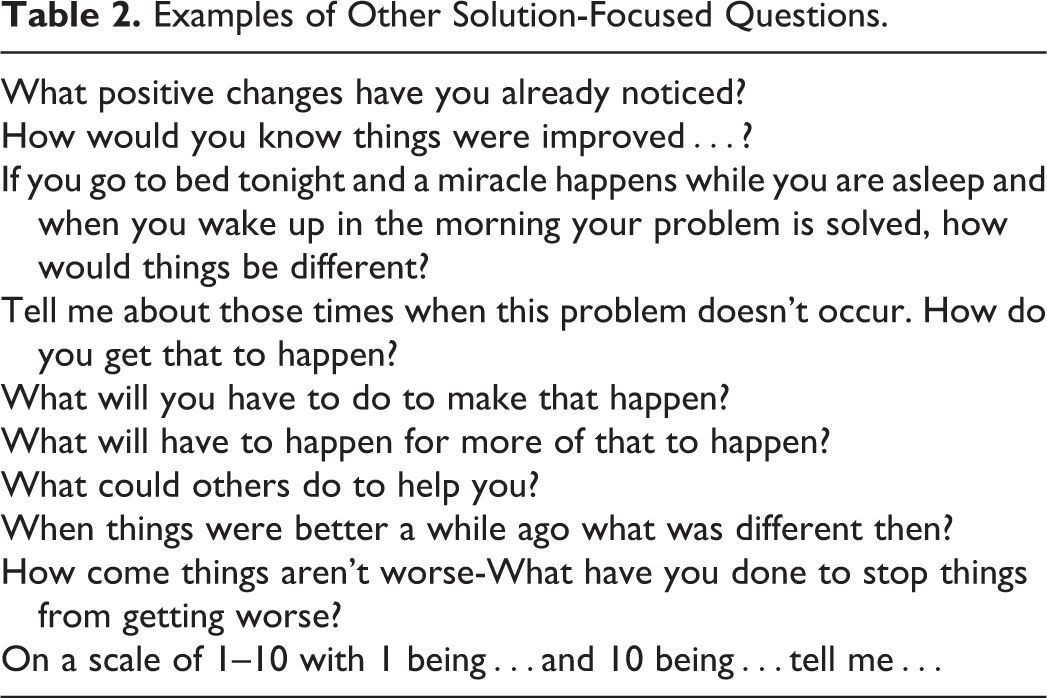
The miracle question had helped them to reimagine a preferred future state and explore some ways of making it happen. The solution-focused questions described above are but a few examples. The approach could use a variety of other solution-focused questions (see Table 2), but again the approach should be used flexibly and with regard to the group purpose and unfolding group dynamic. In this way, the skilled facilitator uses the solution-focused approach with VRE as scaffolding to build practice improvement designed specifically for the clinical context of the group. The importance of context cannot be overstated. Failure to consider context can alienate clinical staff, as can the imposition of solutions from elsewhere (Burnes & Cooke, 2012; Walsh et al., 2006). It is often said that in bringing about change we should not “re-invent the wheel.” However, there is a case to be made for groups to do just that. As Walsh et al. (2017, p. 333) state, “…it is sometimes essential that clinical teams invent their own wheel rather than use one designed for somewhere else. The process of construction can be as important as the wheel itself.”
Examples of Other Solution-Focused Questions.
Discussion: Unpacking the Advantage of Blending
Solution-focused approaches and video-reflexivity are both very powerful approaches to practice improvement. In this article, using clinical examples, we demonstrated how, when combined, they strengthen and complement each other. Without video, solution-focused approaches often rely solely on recall to explore an issue. Recall is notoriously unreliable and can be negatively or positively biased. Video displays how practitioners do things and how their actions unfold in their own space. Unlike numerical data, video includes more of the contextual circumstances, allowing practitioners to observe their daily events, amid the specificity of the circumstances and the spatial-temporal orderings through which they emerge (Reinders, 2014, cited in Den Uijl & Kramer, 2016). This “hologrammatic” effect of video makes one “see” not only what is shown within the frame of the footage but also what is outside the frame in time and space (Iedema et al., 2013). Watching a video means simultaneously “seeing” what falls outside the frame as one knows the particular place where the footage is filmed. It also means “looking into the past and future” for participants know what led up to the events shown and what happened next. The watching of video, in other words, engrosses and engages the clinicians in the complexity of their daily environment. However, the hologrammatic effect also makes less “visible” things come back, like how it felt to be in that situation (“like chaos”). With the support of the solution-focused approach, video is less likely to trigger the rationalization which can be activated by a problem-based approach. A solution-focused approach helps the facilitator to keep the participants on the track of the positive approach in a problem-based culture. In this way, a solution-focused approach continues to keep participants in a psychologically engaged state and contributes to a safe environment for discussion.
The solution-focused approach offers a structured way to enhance and deepen the exploration and reflexivity inherent to VRE while at the same time leaving room for spontaneous responses. In other words, a solution-focused approach offers scaffolding to the facilitator without determining the structure of the facilitation. A facilitated, lively discussion that allows participants to be surprised, to make suggestions and ask questions comes with an advantage. In the example we have used, in the neonatal unit the practitioners raise aspects of their practice that are crucial for infection prevention, and working with sterile gloves in particular. In VRE, footage does not act as an “objective record” of their ways of doing but as a trigger for discussion. A solution-focused approach facilitates the participatory and collaborative involvement of the whole team as they ask each other positive questions. By discussing what they consider the right way of doing things, while going back-and-forth between the footage and their personal experience and know-how, they provide themselves with a strong preparation for advancing in their learning trajectory. In the process, practitioners are actively engaged and share experiential data and indigenous knowledge. In this way, exnovation is not “just” about practical change but much more about learning (Iedema et al., 2013). The change resides in the learning, and this learning is transformative.
The focus on solutions can help practitioners use creativity to imagine a desired future state and to make it happen. A solution-focused approach enables participants to gain a sense of ownership and responsibility for the process and their practice, that is emancipatory, and that leads to doing more of what works and also positive practice change, in areas they identify where change is needed. Whereas VRE provides clinicians a platform of deliberation where they are allowed to take the time and sit down and reflect on their own ways of doing things. The solution-focused approach helps them to take the next step: “where do we want to be?” The miracle questions, for example, help clinicians to move away from the past and present into the future. Asking and answering the miracle questions helps them to verbalize their often-unarticulated dreams about how they would like things to be. VRE gives a voice to teams, but solution-focused approach gives them a language to express themselves. In this way, the solution-focused approach buttresses the emancipatory character of VRE.
Concluding Remarks
Blending VRE with solution-focused questions fuses these strengths-based approaches and acknowledges the health professionals as experts who contribute cogently to practice change and quality improvement. Reviewing the video-recorded clinical episodes provides another way for the health care team to reflect upon the strengths of the quality of the care delivered in situ. The addition of the solution-focused questioning contributes favorably to the efficacy of the video-reflexivity and creates a safe environment for the participants to engage in constructive discussion and produce ideas which instil change, as opposed to methods which concentrate on problems. The addition of solution-focused questions creates an important dimension to the video-reflexivity, providing a framework that facilitates a positive environment and allows an articulation of “hidden” practices and an identification of practice change from within the tacit knowledge of the professional team.
Footnotes
Declaration of Conflicting Interests
The author(s) declared no potential conflicts of interest with respect to the research, authorship, and/or publication of this article.
Funding
The author(s) received no financial support for the research, authorship, and/or publication of this article.
