




Abstract
Unlike historians, qualitative researchers’ engagement in studies in which archival sources form the core data corpus is less common than the exploration of newly generated data. Following scholars who have argued for secondary analysis of qualitative data, in this article, I illustrate how qualitative researchers might explore archival data methodologically. Examinations of archival records help us think about how research methods change over time and compare approaches to current practice. This article draws on records from the Federal Writers’ Project (FWP), one of the New Deal initiatives launched by President F. D. Roosevelt in the United States. The FWP was a work relief program administered during the Depression years in the 1930s that employed 6,500 white-collar workers as fieldworkers, writers, and editors to solicit stories from 1,000s of men and women across the country, including stories of over 4,000 former slaves. This article focuses on the role of interviewing in the Former Slave Project, examining methodological issues of concern observed by administrators and critics of the project, along with what we might learn and how we might think about these issues in contemporary interview research.
Keywords
In recent years, there has been growing interest in developing archival collections of qualitative studies (Corti, 2000, 2007; Corti, Witzel, & Bishop, 2005; Fielding, 2004). Corti (2007) has argued that archived data provide qualitative researchers with opportunities to (1) develop descriptive studies; (2) undertake comparative, follow up, or restudies of prior topics; (3) reanalyze data or complete secondary analysis of data; (4) examine studies with a view to exploring research design and advancing methodological discussion; (5) verify findings from other studies; and (6) use data for teaching and learning. As examples of these approaches, qualitative researchers have conducted secondary analysis of archival data using different theoretical perspectives (Myers & Lampropoulou, 2013, 2015), reanalyzed data-sets (Gillies & Edwards, 2005) and conducted comparative analyses of prior studies (Savage, 2005, 2007). Hsiung (2016) has developed an online resource on qualitative interviewing from archived data, Lives and Legacies, that provide teachers of qualitative inquiry access to interviews with immigrants in Canada (see https://www.utsc.utoronto.ca/∼pchsiung/LAL/). These approaches to examining archival sources are distinct from the biographical work in which sociologists engage (Hill, 1993), or the more familiar work of historians.
Qualitative researchers have also explored methodological issues in relation to archived data in special collections. For example, Tamboukou (2011) examined Gwen John’s love letters to Auguste Rodin to develop an argument for how letters might be analyzed; Pearce (2018) discusses the challenges of engaging in archival research; Tesar (2015) explores ethics in relation to archival research; and Moore, Salter, Stanley, and Tamboukou (2017) review approaches to conducting archival research in the social sciences. With respect to methodological examinations of archival data, Fielding (2004, p. 98), referring to the Qualidata Archive in United Kingdom (now hosted by the UK Data Service), argues that among other topics, archived qualitative data can provide “insight into the process of the fieldwork in a way which is seldom forthcoming from methods textbooks.” Likewise, Mauthner, Parry, and Backett-Milburn (1998, p. 743) assert that secondary analyses can “provide insights about where and how researchers were positioned in relation to theoretical, epistemological, methodological and substantive issues of the time of the research.”
In a similar vein, this article explores archival data from the Federal Writers’ Project (FWP) that was established in July 1935 as part of the Works Progress Administration’s (WPA) Federal Arts program in the United States for the purpose of methodological examination of the interview methods used. Focusing on the Former Slave Project, 1 I examine what might be learned methodologically from examining records concerning interviews conducted as part of this project. The article explores how the project was administered, how data were generated and represented, and how we might think about issues identified by administrators and critics in contemporary interview practice. This project provides exceptional source material to examine methodological issues, since administrative records have been archived in state and national collections, and many sources have been digitized by the Library of Congress (LoC), making records much more available than is typical of archived projects. As such, the project provides rich materials not only for methodological examinations in different regional areas but also for teaching purposes. For example, these records can be used by contemporary qualitative researchers—both novice and expert—to consider how historical contexts and how the race of interviewers and interviewees complicated the conduct of research at that time. When the Former Slave Project was conducted in the 1930s, fieldworkers were not called upon to examine their subject positions (i.e., such as race, gender, class, ability etc.) as they are today via the concept of researcher reflexivity.
Reflexivity
Reflexivity is a familiar concept among qualitative researchers and is typically taken to mean the approaches that researchers take to acknowledge and account for their own roles as researchers within the conduct of a project and in relation to the research participants. In other words, reflexivity involves “disciplined self-reflection” (Wilkinson, 1988, p. 493). Although not without critique (e.g., Lynch, 2000; Macbeth, 2001; Pillow, 2003), there are multiple paths to practicing reflexivity (Finlay, 2002, 2012). Researchers typically discuss their subject positions in relation to both the topic of study and research participants and provide accounts of the events that occur during a study. Strategies include bracketing interviews (Gearing, 2004; Rolls & Relf, 2006), confessional tales (Chaudhry, 2000; Van Maanen, 2011), accounts of the ethical dilemmas encountered in working with and representing the Other (e.g., Rallis, 2010), documentation of the relationships between researchers and participants, the examination of those in more powerful positions (“studying up”), and acknowledgment of how various aspects of identity impede and advance understanding of others’ lives (McCorkel & Myers, 2003, p. 204). Although the practice of including self-reflection on the research process is common in published research today, such was not the case over 80 years ago when the FWP was conducted. Yet, although we do not have fieldworkers’ accounts of their experiences of interviewing others, much can still be learned through examining administrative records and the narratives generated in the Former Slave Project.
Considering Race in Interviews
Although some interviews were conducted by Black fieldworkers, the majority of fieldworkers in the FWP were White. Unavailable to the mostly amateur workforce of fieldworkers during the 1930s was methodological writing that considers how interviewers might talk to participants who differ from them in a myriad of ways (i.e., race, gender, able-bodiedness, language, education, class, etc.). In contrast, contemporary scholarship on cross-cultural interview practice emphasizes the importance of in-depth preparation and knowledge prior to conducting interviews and urges researchers to recognize and account for the intersections of other subject positions occupied by researchers and participants (e.g., Dunbar, Rodriguez, & Parker, 2002). As Bhopal (2001, p. 282) asserts, “[d]ifference is a site of power relations and a site of diversity.” Scholars discuss a variety of ways forward with respect to cross-cultural interviewing.
For example, McCorkel and Myers (2003), as White feminist researchers, attempt to demonstrate what the practice of “strong objectivity” (Harding, 1993) and “strong reflexivity” might look like in their research studies that involved Black participants. These authors explore how the subject positions that they occupied were informed by master narratives grounded in White privilege. Since people use master narratives to “make sense of the world” and “operate to legitimize and naturalize the order of things” (McCorkel & Myers, 2003, p. 226), these authors argue that to not acknowledge privilege is to risk perpetuating master narratives. One solution, in their view lies in making use of “crisis points” to “apprehend, interrogate, and challenge the narratives that the researcher uses to make sense of the world” (p. 228).
When interviewees perceive interviewers to be of the same race, researchers may be seen as “one of them” (e.g., Ochieng, 2010), which can aid in rapport building and assist participants to be forthcoming in relating their life experiences to interviewers. Such is not always the case, however. Johnson-Bailey (1999, p. 659) reports how as an African American researcher interviewing African American women, even though race and gender brought her “closer to the participants,” color and class differences led to struggles within the interview context (see also Twine, 1995). These examples show that whether or not interviewers share the same race as participants, the generation of rich, descriptive accounts is not always straightforward.
As will be discussed in more detail later in the article, the representation of participants in ways that avoid stereotypes of marginalized groups was explicitly identified as a problem in the FWP (Brown, 1985) and is still a problem faced by contemporary researchers (Oliver, Serovich, & Mason, 2005). For example, the African American anthropologist Zora Neale Hurston (1891–1960), who worked on the FWP in Florida, was critiqued by contemporary Black scholars for her portrayals of African Americans (Bulger, 2017, p. 113). White FWP fieldworkers and editors (Stewart, 2016) also perpetuated damaging stereotypes of former slaves through their representations of dialect and in descriptions of participants.
The Context of the Former Slave Project
One of the challenges of examining archival data that have been noted by scholars (Carusi & Jirotka, 2009; Mauthner, Parry, & Backett-Milburn, 1998) is that researchers do not have access to the context in which data were generated. Thus, some context for the Former Slave Project, one of the Federal Writers’ Projects developed as part of the WPA, is merited.
The WPA was a New Deal program authorized by President Franklin D. Roosevelt, which provided over 8 million people with employment during the Depression years of the 1930s when unemployment in the United States had risen to 25%. The WPA created jobs in construction, industry, and the arts. Under the auspices of the WPA, projects were developed to provide employment for artists, actors, and musicians as part of the Federal Art, Theater, and Music projects, and writers, editors, historians, researchers, art critics, archaeologists, geologists, and map draftsmen as part of the FWP (these were collectively known as Federal One). The FWPcost US$27 million (one fifth of 1% of all WPA costs; Mangione, 1972, p. 369) and involved explorations of folklore and ethnic studies, generating 10,000 oral histories of people across the country. At its peak, the FWP employed about 6,500 people, paying them a wage of about US$20.00 per week (Library of Congress, n.d, “Introduction”). The intent of the FWP was to stimulate writing projects that would be taken up by commercial publishing houses or sponsored by civic organizations (Stewart, 2016, p. 67). In sum, 275 books, 700 pamphlets, and 340 “issuances” (which included articles, leaflets, and radio scripts) were published by the FWP (Brinkley, 2003).
Administration of the Federal Writers Program
The senior administrative personnel involved in the FWP represented multiple interests and disciplinary backgrounds but shared an interest in developing the project to support cultural diversity as part of a larger liberal-reformist politics of the 1930s (Hirsch, 2003, p. 3). Hirsch describes the national editors for the FWP as taking a “romantic nationalist, pluralistic, and cosmopolitan view of the nation” (p. 28). Hirsch writes: As romantic nationalists FWP officials assumed that the study of the experience of ordinary Americans would contribute to a revitalized national culture; as pluralists they believed all groups had to be taken into account; and as cosmopolitans they hoped the various diverse groups that constituted America could benefit from learning about fellow citizens who were different from themselves. (p. 22)
The House Un-American Activities Committee (HUAC) chaired by Texas Democrat Martin Dies (Mangione, 1969, 1972; Stewart, 2016) was convened to investigate people suspected of having communist or fascist ties, and members believed that the FWP had been infiltrated by the communist party. Evidence put forth by the HUAC included Richard Wright’s essay “The Ethics of Living Jim Crow,” published in the FWP anthology American Stuff, and Sterling Brown’s essay “The Negro in Washington,” which described racial discrimination against African Americans in the American guidebook Washington: City and capital (Stewart, 2016, p. 232). The work of the HUAC indicates that even though the administrators of the FWP encouraged writing by African Americans about contemporary racism, it was interpreted by politicians as dangerous, if not “un-American,” and unworthy of funding. This provides some context for the racist context in which the FWP fieldworkers and editors were working.
With U.S. involvement in World War II looming, by mid-1939, Congress cut funding for Federal One, and states were tasked with supporting operating costs for continuance of the arts projects (McDonald, 1969, p. 321). FWP workers who had been on relief for more than 18 months were terminated, and the national administrator Henry Alsberg was forced to resign. The name of the FWP was changed to the Writer’s Program on August 31, 1939, when the project became a unit of the Research and Records Program, Professional and Service Division. After funding for the FWP was cut by the U.S. Congress, materials were taken up as a conservation project by LoC in 1940, with a mission to “collect, check, edit, index, and otherwise prepare for use WPA records, Professional and Service Projects” (Administrative files, Botkin, 1941, p. vi). The state programs ended in the spring of 1943 (Bordelon, 1991, p. 242).
Although the FWP engaged in three main projects—The American Guide (Taylor, 2009), the Folklore Project (Couch, 1939), and the Former Slave Narratives (Rawick, 1972a, 1972b), archival records indicate some slippage in how projects were archived, since interviews on different ethnic groups are included in “Social-ethnic Studies,” and folk tales may be found among the Former Slave Narratives.
The Former Slave Project
The Former Slave Project, which collected oral histories from the point of view of people born into slavery, began in 1936, the second year of the FWP. 2 As part of other Federal Writers’ Projects, fieldworkers in Georgia, Florida, and South Carolina had submitted interviews with former slaves, which were assessed by administrators in the FWP’s Federal Office as contributing interesting material. For example, the Associate Director of the FWP, George Cronyn, wrote to the Virginia state director in April 1937 that the life stories from ex-slaves interviewed in Florida were “remarkably interesting” and that “such documentary records by the survivors of a historical period in America are invaluable, both to the student of history and to creative writers” (Administrative files, Memorandum from George Cronyn, 1937). Thus, state offices were instructed to embark on more systematic collection of oral history narratives from former slaves.
Musher (2014, pp. 101–102) asserts that approximately 4,000 narratives have been documented, with about 3,500 published. More than 2,300 of these have been digitized and made available through the LoC website. Narratives were collected in 17 states, along with 500 photographs of former slaves. Fieldworkers also conducted interviews with White informants regarding slavery and made transcripts of laws, advertisements, records of sale, transfer, and manumission (emancipation) of slaves (Administrative files, Botkin, 1941, pp. vi–vii). Botkin (1945, p. vii) worked as the chief editor of the Writers’ Unit at the LoC from 1939 to 1941 and supervised the organization and cataloging of the materials from the FWP. Botkin asserted that the life histories had been “taken down as far as possible in the narrators’ words,” reiterating elsewhere that the former slaves had been “permitted to tell their own story, in their own way” (Administrative files, Botkin, 1941, pp. viii–ix).
Once the FWP materials had been transferred to the LoC, project staff organized the narratives and photographs by state and alphabetically by informant within the state in which the narrative was collected. These were microfilmed and assembled into 17 volumes in two series, entitled Slave narratives: A folk history of slavery in the United States from interviews with former slaves, edited by George P. Rawick in 1941. Material omitted from the original edition included interviews with informants who were too young to recall details of slavery, unidentified manuscripts, manuscripts from Tennessee that appeared to have been plagiarized, and supplementary materials connected with the narratives (Administrative files, Botkin, 1941, pp. vii–viii). These narratives were published in 1972 under the title The American slave: A composite autobiography. Two additional volumes, Unwritten history of slavery and God struck me dead were subsequently privately financed and published by a historically Black university in Nashville, Tennessee, Fisk University (Woodward, 1985). Botkin also drew on the collection to publish a book in 1945—Lay my burden down: A folk history of slavery. This represented a selection of excerpts to provide a “flavor” of the whole collection. Yetman (2000) has published a collection of 100 narratives selected from the larger corpus. The LoC digitized the 1941 microfilmed edition and a selection of administrative files, scanned the photos, and made these available online in 2000–2001.
Fieldworkers, Writers, and Editors
Mangione (1969, 1972) and McDonald (1969) report that less than a quarter of the people employed on the FWP were professional writers. Fieldworkers were drawn from former librarians, teachers, secretaries, clerks, and bookkeepers among other occupations. Employment of amateurs to collect folklore was critiqued by scholars at the time. According to McDonald (1969), the FWP faced a dilemma: “the duty, on the one hand, of filling quotas from an unevenly distributed and unevenly qualified supply of unemployed persons certified for relief; and, on the other hand, the pressure to employ needy writers not on relief” (p. 682).
In employing people who were not skilled writers or interviewers, the FWP faced critique from writers and scholars alike. McDonald (John Lomax cited by McDonald, 1969, pp. 716-717) reports that representatives from the American Folklore Society (AFS), whom Henry Alsberg had consulted in his efforts to locate an experienced folklorist to work on the project, would not provide assistance, and did not initially believe in the merit of the project. Alsberg later found folklorist Benjamin Botkin, who saw value in involving “the people themselves” in the collection of folklore (Stewart, 2016, p. 16) and later became president of the AFS. Writing retrospectively in 1941 about the Former Slave Project, Benjamin Botkin commented that in spite of the limitations of the collection, which he outlined as “[b]ias and fallibility of informants and interviewers, the use of leading questions, unskilled techniques, and insufficient controls and checks”—the collection nevertheless remained: the most authentic and colorful source of our knowledge of the lives and thoughts of thousands of slaves, of their attitudes toward one another, toward their masters, mistresses, and overseers, toward poor whites, North and South, the Civil War, Emancipation, Reconstruction, religion, education, and virtually every phase of Negro life in the South. (Administrative files, Botkin, 1941, p. ix)
Instructions on Interview Practice
Evidence of the expectations for fieldworkers is found in the instructions that were sent to state directors for dissemination among local fieldworkers. Archived materials that survive include directives from the national office for (1) what questions should be asked, (2) how interviews should be conducted, and (3) how the life stories should be represented, including how dialect should be conveyed. In instances where state workers did not follow up on directives from the national office, state directors were notified. Stewart (2016, pp. 65–66) writes that the state directors were encouraged to acquaint staff with materials that outlined the aims and goals of the project and provided instruction for interviews and representation of life stories.
Guidelines and instructions for how interviews should be conducted were sent to the state directors on multiple occasions. Musher (2014, p. 104) has located several interview guides, including one with 333 questions which seems not to have been used. Instructional materials archived in the Georgia state collection provide samples of interviews with former slaves using an interview guide including up to 61 questions and answers. A letter that folklore consultant John Lomax wrote to FWP Associate Director George Cronyn on April 9, 1937, identified interviews of Lula Flannigan and Uncle Willis (both conducted in Georgia) as good examples of the kinds of narratives he wanted fieldworkers to collect. Lomax wrote: “All the stories are worthwhile but these two are mainly (one entirely) in dialect and abound in human interest touches.
Here, Lomax demonstrates an interest in documenting “natural” images and stories, a view shared by other administrators. For example, Cronyn (1937) wrote in a letter dated April 14, 1937 to the state director of the North Carolina FWP, Edwin Bjorkman, that we would like to have portraits wherever they can be secured, but we urge your photographs to make the studies as simple, natural, and “unposed” as possible. Let the background, cabin, or whatnot, be the normal setting—in short, just the picture a visitor would expect to find by “dropping in” on one of these old-timers. (Administrative records, George Cronyn)
3
not censor any material collected, regardless of its nature, not use dialect spelling so complicated that it may confuse the reader, pay a second visit to interviewees in order to gain further detail.
Additional instructions were included in a letter of May 3, 1937, from Cronyn to the state directors. Fieldworkers were asked to have the former slaves “tell the stories that were current among the Negroes when they were growing up. Some of the best copy that has come in to the office is found in these stories.” The instruction to conduct repeated visits to interviewees was repeated in a directive sent to state directors by Henry Alsberg on July 30, 1937, who implored fieldworkers to: cultivate relationships with informants to elicit stories, use the interview questions as a guide, be neutral, and not influence the interviewees, or show their opinions, record interviews word-for-word, elicit more detail concerning life since emancipation.
Regarding the latter, Henry Alsberg provided a list of questions about this topic. Later in September 1937, Alsberg suggested that fieldworkers discuss additional topics with former slaves, including Stories passed down from parents and grandparents. Events of importance where the date was known as a point of reference (e.g., a famous snow storm)—aiming for chronological accuracy.
Administrative documents show that national administrators not only valued the chronicling of folklore but advocated for verification of the accuracy of interviewees’ accounts.
Editing
After fieldworkers conducted interviews, the notes taken down by interviewers were subject to multiple rounds of editing. As Schwartz (2014, p. 92) notes, “the voices of former slaves were filtered through the pens and pencils, typewriters, and recording devices of others.” Stewart (2016) reports that the process involved a Field Copy (FC), in which a typewritten representation of each interview was prepared by fieldworkers. The FC was then subject to editing and retyping in a local office, producing a Field Edited Copy. The final drafts were edited at the state office, before being sent to the Federal Office. Questions posed about interviews by readers and editors in Washington were conveyed back to the state, and fieldworkers were encouraged to conduct second interviews (Stewart, 2016, p. 67).
The national editors wanted stories told in the “voices” of the former slaves and critiqued editorializing on the part of interviewers and fieldworkers in the submitted narratives. Further, federal editors were critical of the ways in which state workers represented dialect and responded with multiple missives to state directors on how to do this. For example, instructions for how to represent the speech were provided by National Editor on Negro Affairs, Sterling Brown: In order to make this volume of slave narratives more appealing and less difficult for the average reader, I recommend that truth to idiom be paramount, and exact truth to pronunciation secondary.… Finally, I should like to recommend that the words darky and nigger and such expressions as “a comical little old black woman”
4
be omitted from the editorial writing. Where the ex-slave himself uses these, they should be retained (Sterling Brown, June 20, 1937, “Notes by an editor on dialect usage in accounts by interviews with Ex-Slaves”; also published in Brown, 1985)
Since interviews were not audio-recorded, readers can only surmise what actually went on in interviews and how various layers of editing at the state and national level omitted, obscured, and transformed the voices of the original informants. Overall, suspicions concerning the authenticity and quality of materials in the Former Slave Project led to the narratives being largely overlooked as a source of credible material for decades after they became available (Woodward, 1985). Schwartz (2014, p. 90) asserts that this is partly due to historians’ reluctance to “allow black voices to enter the historical record.”
Problems With Interviews in the FWP
Three problematic issues have been discussed in relation to Former Slave Project by project administrators and scholars in succeeding analyses. These are (1) the interaction between interviewers and interviewees, (2) representation of narratives, and (3) the epistemological value of interview materials. 5
The Interaction Between Interviewers and Interviewees
There are two primary problems related to interviewer–interviewee interaction in the Former Slave Project. First, since interviewers were not formally trained to conduct interviews, the conduct of interviews was viewed by critics of the FWP as unskillful. Second, questions were raised concerning whether former slaves would honestly share their life stories with the mostly White fieldworkers.
First, FWP administrators handled the problem of supervising an amateur workforce by providing models of interviews that were viewed as well conducted and providing guidelines for what questions to ask and how interviews were to be conducted. Some 80 years later, the training of researchers for fieldwork has become routinized and formalized, and in addition to numerous texts on interview practice, pedagogies for teaching interview skills have emerged (Roulston, 2012). Further, approaches to examining interview interaction are well-documented (Roulston, 2019). Compared to the fieldworkers from the 1930s, the primary challenge for today’s researchers is in putting into practice the plethora of advice pertaining to the conduct of interviews.
Second, the issue of how legalized segregation of races in public spaces in the Southern United States impacted the generation of stories in the Former Slave Project has been identified as the foremost problem with assessing the value of WPA interviews (Blassinghame, 1985). The interviews with former slaves took place in the mid- to late 1930s, as the United States prepared for the 75th anniversary of the Civil War (1861–1865). As one example, in the state of Georgia, 75% of the interviews were conducted by White fieldworkers and of fieldworkers, only six were identified as Black (Kane, 2014, pp. 44, 58). Stewart (2016) reports that in the 1930s debates about Black equality, identity, and race relations had become central issues at a time when what were known as “Jim Crow laws” enforced racial segregation in the Southern United States. Thus, the interviews with former slaves took place in an era when master–slave relationships were within living memory, African American people endured discrimination imposed by segregation on a daily basis and were living in poverty-stricken conditions due to the Great Depression. Woodward (1985, p. 51) asserts that “the white interrogators customarily adopted a patronizing or at best paternalistic tone and at worst an offensive condescension. They flouted nearly every rule in the handbooks of interview procedure.” In comparing the narratives generated by Black interviewers in Florida with those conducted by White interviewers, Woodward (1985, p. 52) maintains that in interviews conducted and represented by Black fieldworkers the “whole atmosphere changes. The thick dialect diminishes and so do deference and evasiveness and tributes to planter benevolence. Candor and resentment surface more frequently.” These critiques of the conduct of interviews must be read in light of the fact that authors were commenting on the narratives produced from the interviews, since the FWP interviews were not audio-recorded.
Stewart (2016) discusses the complexity of the relationships between the mostly White interviewers and the elderly Black people who participated in the interviews—two thirds of whom were over 80 years of age when interviewed (Yetman, 2000, p. 2). Stewart (2016) has identified some of the interviewers as members of the United Daughters of the Confederacy and children of plantation owners. She argues that the interviewees “used their narratives as a form of currency, bartering them for goods and services from FWP interviewers,” and “created their own counternarratives of Black identity” (Stewart, 2016, p. 199; see also Kane, 2014). Stewart explores the rhetorical strategies used by the former slaves to evade questions from interviewers, including the strategy of “signifying,” in which speakers cloaked “statements that could be perceived as forbidden or insubordinate” by “smothering Whites’ questions under a blanket of voluble affability and humor” (p. 200). Similarly, Musher (2014, p. 113) discusses former slaves’ use of “corn pone,” in which Black interviewees told White interviewers what they thought they would like to hear rather than what they truly experienced. Clearly, the historical context in which legalized racism via Jim Crow laws had a profound impact on what was said in interviews by former slaves, as well as how former slaves’ narratives were represented by fieldworkers. Thus, the life stories made available to us today must be read with an eye not only toward the times in which they were generated but the interactional complexities produced by particular interviewer–interviewee relationships. These sorts of analyses highlight how the existing context of racial segregation of the 1930s impacted the interactions that took place within interviews (e.g., interviewees bartering for goods from the fieldworkers and carefully vetting their accounts).
In comparison, contemporary methodological literature provides insight into methodological issues and strategies relevant to the conduct of cross cultural interviews and research (Best, 2003; Chilisa, 2012; Dunbar et al., 2002; Ryen, 2008) or working with special populations such as elders (e.g., Peel & Wilson, 2008; Russell, 1999; Wenger, 2002) or deaf communities (Anderson et al., 2018). While there is no shortage of advice, researchers must reflect on and account for their practices in the field on a case-by-case basis.
Representations of Interviews in Texts
Blassinghame (1985, p. 87) points out that the Former Slave Narratives must not be read as verbatim accounts. Once fieldworkers had taken notes of the interviews that they conducted without benefit of audio recording, these were developed into narratives that vary considerably in length and detail. Some describe the context in which the interview was conducted, whereas others begin by reporting the name of the interviewee and where he or she was born. The life histories are typically represented in a first-person voice. Although the interviewer’s questions are typically omitted (Stewart, 2016, p. 67), some of the narratives refer to the questions asked. Exceptions to these patterns may also be found. For example, John N. Booth, who was a district supervisor working for the FWP in Georgia, contributed a narrative about Aunt Charlotte Raines (Rawick, 1972b), who worked for his family and whom he had known since he was a child.
A review of the narratives indicates that there was wide latitude in how the fieldworkers in the project interpreted and enacted the instructions provided by the state administrators. Compare, for example, the opening lines of several of the interviews conducted in Georgia. An interview with Julia Rush conducted by an African American interviewer, Edwin Driskell, in Georgia begins with: Mrs. Julia Rush was born in 1828 on Saint Simons Island, Georgia. Mrs. Rush, her mother, and three sisters were the property of a Frenchman named Colonel De Binion, a very wealthy land owner. (Rawick, 1972b) Hurrying for shelter from a sudden shower, the interviewer heard a cheerful voice singing “Lord I’m Comin’ Home,” as she rushed up the steps of Aunt Emma’s small cabin. Until the song was ended she quietly waited on the tiny porch and looked out over the yard which was attractive with roses and other old-fashioned flowers; then she knocked on the door. (Rawick, 1972b) A story of happiness and contentment on a big plantation where there were “a heap of us slaves” is told by Jane Mickens Toombs who said she was “five er six years ole when de Wah come on (1860) or mabby a lit’le ol’er.” (Rawick, 1972b)
As discussed earlier, the federal administrators for the FWP encouraged state editors to systematize how dialect was represented in the narratives (e.g., Sterling Brown’s directives to fieldworkers). Stewart (2016, p. 82) notes that Brown was well aware that White fiction writers’ adoption of Black vernacular at the time was a way to portray African Americans as “contented slaves.” Although Brown worked to have African American fieldworkers included in the project, to ensure adequate representation of African Americans in the American Guide series, and to develop guidelines for states on how to represent dialect in narratives, state directors frequently ignored his advice. Stewart (2016, p. 52) asserts that this occurred because White state directors believed that an African American could not provide “objective” feedback.
What might be learned from the contestations related to how the former slaves were represented in the narratives produced in the FWP and how these were subsequently represented? First, the Former Slave Narratives represent life stories filtered through the hands of fieldworkers—many of whom were unskilled as researchers and upheld paternal notions of slavery (what McCorkel & Myers, 2003 refer to as master narratives). Second, the state and federal administrators subjected the narratives submitted to multiple layers of editing that transformed what had been conveyed to interviewers in ways that cannot be fully estimated. While the administrators and proponents of the Former Slave Project had envisioned the project as contributing to an “objective” knowledge base about the lives of former slaves in “their own voices,” what actually transpired is far removed. Third, over time, publication of the narratives has also involved editing (Yetman, 2000). Musher (2014) recommends that researchers locate the earliest versions of narratives (i.e., those found in state archival collections) rather than those found in the federal collection. Further, she reminds present-day readers that 14 states did not submit all of the narratives collected to the federal office (p. 107).
How do these practices compare to those of contemporary researchers? Since the Former Slave Project was part of the much larger work of the FWP, narratives were subject to editing by multiple others. In comparison, today’s researchers typically have less oversight with respect to how they represent the participants of their studies. This is not to say that study participants and audience members might not resist representations. For example, one of the participants of Ralph’s (2014, p. xviii) ethnography in Chicago objected to the ways in which her words had been represented in African American Vernacular English. Further, the field of anthropology, for example, has long contended with critiques of how indigenous people’s narratives have been misrepresented in texts (e.g., Brill de Ramírez, 2007). What this means is that researchers must carefully consider not only their relationships with study participants but their transcription practices (Oliver et al., 2005), and how participants might be represented in ways that avoid stereotypes and objectifications in the cause of objective science (see also Chacaby & Plummer, 2016; Smith, 1999).
The archiving of the narratives and administrative files of the Former Slave Project provides detailed information from which researchers can learn about how research was conducted in the 1930s as well as how information collected at that time might be evaluated. In contrast, qualitative researchers today have tended to be resistant toward archiving of their work (e.g., Broom, Cheshire, & Emmison, 2009). This allows for less insight into how researchers do their work, including how interview transcriptions are transformed into narrative findings. Perhaps then, qualitative researchers should be more open to sharing the ways in which they transform and represent participants’ narratives in their work as well as how they represent their own contributions to the generation of research data.
The Epistemological Status of Interview Data
As scholars have repeatedly noted in the decades since the FWP interviews were conducted, care must be taken in interpreting information contained in the interviews of the former slaves (Fair, 2010). Challenges to interpreting the narratives relate to the fallibility of memory on the part of the interviewees, assessing the veracity of what interviewees were willing to share with interviewers, and accounting for the ways in which the accounts were subject to multiple rounds of editing. Although some historians have questioned the recollections of people of advanced age, Escott (1985, p. 43) argues that when read with attention to detail and nuance, it is “possible to work through layers of distortion toward a truer understanding of the former slave’s perspective” and describes strategies to do so. Escott (1985, p. 41) reminds readers that the Former Slave Narratives are “not a direct presentation” of the interviewees’ perspectives; thus, the FWP narratives are “one or more stages removed from the original interview” (see also Schwartz, 2014).
As the Writers’ Unit at the LoC began to index the narratives after the FWP’s work ended, staff were tasked with evaluating the reliability and factuality of information included in the narratives and appraising their value for others (e.g., writers, historians). An appraisal form to assess the validity and value of narratives was used, although this process was not completed. Hirsch (2003) quotes Benjamin Botkin, who oversaw the process of organizing and cataloging the materials submitted to the LoC, as noting that “all judgments of reliability must be based on purely internal evidence”…“valid tests of reliability are the tests of evidence, such as competence of the witness, internal consistency, and consistency with historical facts and with common sense” (pp. 158–159). Thus, narratives were carefully read with these criteria in mind. The form used by appraisers called on them to assess the accuracy, detail, and scope of the content of each narrative, in addition to the ways in which fieldworkers had represented the life stories. For example, first person was preferred to third person, overuse of phonetic spelling to represent dialect was critiqued, and appraisers noted both omissions in the narrators’ stories, as well as critical accounts of slavery. These appraisal forms provide good evidence for the importance placed by project administrators on assessing the “truth” value of the narratives in contributing to historical accounts.
An assessment form of an interview with Alec Bostwick, conducted in Athens, GA, shows that even the assessments of appraisers were double-checked and edited by a supervisor (Figure 1).
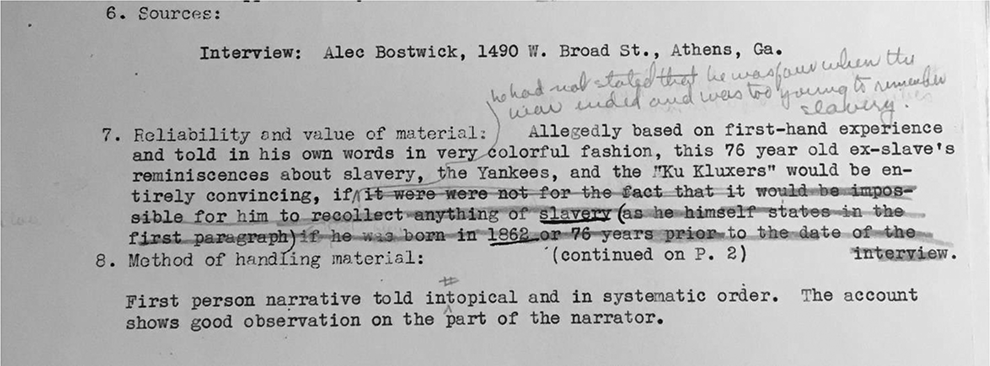
Excerpt 1 from appraisal form for interview with Alec Bostwick. Source: The Records of the U.S. Work Projects Administration, Box A 897, Library of Congress.
With reference to “style,” the appraiser notes: “Extreme dialect. The language is vigorous and colorful and the tone is often characterized by resentment.” This may well refer to the closing comments recorded by the interviewer to the effect that Bostwick was “disappointed” and no longer wanted to talk since the interviewer was not one of the “pension ladies what come for to fetch me some money.” An alternative reading of these comments is that Bostwick mistook the FWP worker for a government worker who could provide relief at a time of grinding poverty (Yetman, 2001). Bostwick also recounted the brutality of the plantation overseer and meanness of the plantation owner. The supervisor has noted “some passages too figurative to be convincing.” Yet, with respect to “suggested uses and development,” the appraiser writes: “Usable as reference material on slave and plantation life.” Once again, the supervisor comments on and revises the appraiser’s comments (Figure 2).
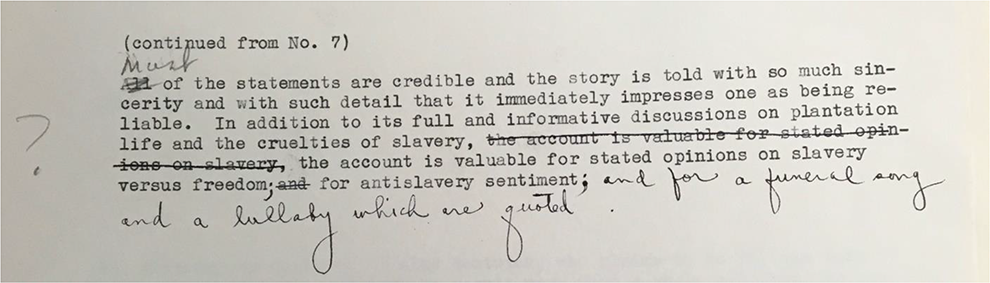
Excerpt 2 from appraisal form for interview with Alec Bostwick. Source: The Records of the U.S. Work Projects Administration, Box A 897, Library of Congress.
Whatever the flaws noted in the appraisal, the narrative was assessed as “fairly valid account of slavery and plantation life” and recommended for use (Figure 3).

Excerpt 3 from appraisal form for interview with Alec Bostwick. Source: The Records of the U.S. Work Projects Administration, Box A 897, Library of Congress.
Appraisers also questioned the narratives. For example, in an appraisal of an interview with Bennie Dillard, the lack of mention of the “unfavorable side of slavery” is noted, while in an interview with John Hill “obvious inaccuracies and inconsistencies” are identified. Overall, the appraisal forms provide some sense of how the team working on the archiving and cataloging of the Former Slave Narratives attempted to assess the credibility of information provided in the narratives to pursue realist historical accounts (i.e., what “actually” happened). Appraisers made recommendations as to which narratives included stories for the folklore collection (e.g., witches and ghosts), materials that could be used by creative writers for fiction, drama, or radio, or useful information for social studies of slavery and plantation life, and the postwar period. Narratives regarded as especially informative and interesting were recommended for publication. For example, an appraisal of an interview with Anna Parkes, which expressed the view that she was better off before the Civil War, although she “don’t want no slav’ry to come back” suggests: This interview is valuable for its information on urban slave life and for its point of view and opinions on slavery which would make it a welcome addition to any published or other collection of materials dealing with slave life. (The Records of the U.S. Work Projects Administration, Box A 897, LoC)
Given the emphasis in the FWP of gaining “authentic” stories that reflected “true” beliefs and attitudes of the interviewees, a positivist perspective underlays the project. That is, interviewers were expected to be “neutral” transmitters of factual information collected from the participants. Given what has been made evident in the prior two sections related to the interview contexts and the ways in which the stories generated were processed and represented, this was clearly not possible then nor is it possible now.
A good deal of methodological writing has applied a constructionist epistemological perspective to the interview (Holstein & Gubrium, 2004; Rapley, 2001; Talmy, 2010) and shown how the generation of research data is co-constructed by interviewer and interviewee and socially situated within particular contexts. While this has been well known for decades (Briggs, 1986; Cicourel, 1964; Mishler, 1986), researchers have been slower to acknowledge this in reports of interview studies. For example, researchers still routinely strip interview excerpts from questions posed and fail to account for their interactional contributions to how accounts are generated (Silverman, 2017). Further, recent methodological work that takes in how objects and the nonhuman are implicated in the generation of research data (Caronia, 2015; Flint, 2019; Kuntz & Presnall, 2012; Marn & Wolgemuth, 2016) points to other aspects of interview contexts that might be considered in the use of interviews for research purposes. This work also prompts researchers to consider the epistemological status of interview data and the kinds of claims that might be made based on interview accounts.
Summing Up: What Can Researchers Learn From the Interviews in the FWP’s Former Slave Project?
The Former Slave Project exemplifies some key challenges entailed in doing interview research. In spite of numerous instructions for how to conduct and represent interviews, fieldworkers’ enactment of the interview questions and guidelines varied considerably. This is not surprising given the complexities involved in eliciting narratives from elderly Black people about events and customs that took place 70 years previously. Coupled with this, the relationships of interviewers and interviewees were embedded in the racially segregated times of the 1930s in U.S. society. As the excerpts included earlier demonstrate, fieldworkers chose to represent their interviewees’ stories differently, and at times, these provide more insight into the fieldworker than the narrator. FWP administrators and historians clearly recognized the methodological problems entailed in the interviews generated in the project. These included problems to do with the interactional contexts in which interviews were conducted, representation of narratives, and the epistemological value of the narratives. Stetson Kennedy’s account of working with the FWP in Florida (Bulger, 2017) indicates that the racially segregated times of the 1930s inevitably impacted fieldworkers’ writing: Jim Crow kept watch over the shoulders of white and black writers alike, giving rise to varying degrees of pejorative and paternalism on pages produced by the former and sometimes deference and ingratiation in the pages of the latter. It was a form of job insurance for both parties. (Stetson Kennedy, cited by Bulger, 2017, p. 108)
Contemporary researchers can learn about these issues because the life stories generated by FWP workers, along with the administrative records, were preserved for others. Examination of the guidelines and instructions provided to the fieldworkers, as well as correspondence concerning how these were implemented, contributes immeasurably to our understanding of this project. The power of working with archival data has been noted by other scholars (Corti, 2000, 2007; Fielding, 2004; Mauthner et al., 1998). In this article, I have explored methodological issues to do with interview research as discussed by FWP administrators at the time the Former Slave Project was conducted as well as scholars who have explored this collection. This examination highlights issues still relevant for contemporary researchers.
Today, we have much methodological writing on reflexivity and conducting cross-cultural research that has taught us how to consider and account for the relationships that we bring to particular interviews and projects, ask questions in ways that help people to tell their stories, and consider how we might represent participants in ways that are respectful and avoid perpetuating harmful stereotypes. Nevertheless, new methodological writing on interviewing presses us to think about what has not yet been part of everyday practice in how interviews are conceptualized, analyzed, and represented. We are all products of our times, and perhaps at some point in the future our own actions will be seen as problematic, just as the problems of the Former Slave Project seem obvious now. How we make use of interviews and life story narratives matters. Although contemporary researchers have ready access to audio-recording devices, some of the selfsame questions that FWP administrators asked still pertain to the conduct of interview research today. For example, How do researchers account for their relationships with those they interview? How are interview questions formulated in ways that facilitate participants’ story telling in their own words? How do researchers include the questions that they pose in representations of interviews? How do interviewers account for their own talk in representations of interviews? How are interviewers’ practices shaped by master narratives, and how might these be recognized and disrupted? How are participants represented in the narratives generated by researchers? How do researchers avoid stereotyping research participants in research reports that rely on interviews? How are problems of memory accounted for in the analysis and representation of interviewees’ accounts? What is the epistemological status of interview data in a project? What are the nonhuman aspects of interviews that might be considered in the analysis and representation of interviews?
Recent methodological writing provides numerous suggestions for the 21st-century scholar to consider (Potter & Hepburn, 2012; Schaefer & Alvesson, 2017; Silverman, 2017) in the use of interviews. In this article, by examining a significant project aimed at recording people’s stories “in their words,” I hope to encourage researchers to use archival records of methodological practice to inform the present.
Footnotes
Acknowledgments
I would like to thank Kathleen deMarrais and the reviewers of earlier versions of this manuscript for their thoughtful comments and suggestions that have aided in revision. Also, thanks to the archivists at the Special Collections Libraries at the University of Georgia for their assistance with accessing relevant materials.
Declaration of Conflicting Interests
The author(s) declared no potential conflicts of interest with respect to the research, authorship, and/or publication of this article.
Funding
The author(s) received no financial support for the research, authorship, and/or publication of this article.
