




Abstract
Brought to life by an exchange with a crocus, we respond to our challenges with methodologies that privilege cognitive ways of theorizing and sharing together. As a Michif (Metis) woman and a woman of White settler descent, we engage in a layered dialogue across cultural understandings—what we call a spiritual exchange—guided by ethical relationality and the teachings of Spirit Gifting. The spiritual exchange offers a process to make meaning of experiences and to collaborate in ways that help us generate and live out ethical relationships. We question: How can we proceed in ways that might rehumanize the research process and honor the living earth? How might research look and feel if stories of respect, love, reciprocity, and responsibility were at the center? In this article, we offer an inquiry process that honors the act of study from an Indigenous sensibility, the multiplicity of kinetic and relational knowing, and the reanimation of the more-than-human.
Introduction: “The Crocus Brought Me Back to Life”
Being attentive to our responsibilities within a web of relations is perpetually on our minds and in our hearts. We come to this work positioned by different lived histories, stories, and experiences as we work together to deepen our understandings. Victoria Bouvier is Michif (Metis) with her ancestral connections to the historic Red River Settlement of Manitoba and grew up in Mohkinstsis 1 . Jennifer MacDonald is a white settler descendent whose heritage can be traced back to Scotland and England. She grew up in a small city in Eastern Ontario along the northern shores of Lake Ontario. The two of us met in an academic seminar as doctoral students of educational research and engaged with topics of curriculum studies. Amid the wider sociocultural context of the Truth and Reconciliation Comission (2015) in Canada and the creation of an Indigenous strategy for our own university (University of Calgary, 2017), the complexities and paradoxes of decolonization, truth, Indigenization, and reconciliation continuously surfaced.
While we come positioned by lived differences, we are inspired by Papaschase Cree scholar Dwayne Donald (2016), who discusses the ethical imperative of placing ourselves in relation to each other. He reminds us that “we need stories and mythologies that teach us how to be good relatives with all our relations—human and more-than-human” (p. 11). We share a commitment to this call for stories and want to include our multiple relations. Our initial seminar conversations were progressive in helping us label tensions and ponder possibilities for honoring Indigenous histories, ontologies, and epistemologies in institutions with colonial foundations. However, as we began sharing more outside of the class, it became evident that learning in a seminar room, and subsequently using normative modes for doing research, privileges cognitive modes of inquiry. To create better stories, we attest, we must attend to our bodies, hearts, and emotions, and to how our whole selves experience the places we live with.
Moving ourselves beyond merely theorizing lived experience into a praxis of relationality (Deloria, 1999), we questioned: How could we proceed in a way that might rehumanize the research process and honor the living earth? How might research look and feel if stories of respect, love, reciprocity, and responsibility were at the center? What might “data” look like? We want to expand beyond the unidimensional structure of sharing together and illuminate the multisensory knowledge generated through our whole being engaged with the world (Anzaldua, 2015; Simpson, 2017). As we imagined holistic possibilities for doing research together, we wanted to write about our experiences but were again challenged to locate a method to fully capture and articulate the layers of our relations, the intricacies of our stories, or our kinetic knowing. In response, the process we share was birthed out of an engagement Victoria had at Nose Hill Park with a crocus as expressed here in poetic writing I was feeling depressed A negative thought pattern was recurring in my mind; I drove to Nose Hill, tears rolling down my cheeks. Nose Hill—I instantly felt like it was exactly where I needed to be. I walked for some time, with tears still flowing. My attention was drawn to a purple speck among the grass. I noticed it was a purple crocus—the first sign of spring! I was delighted to greet this being. I kneeled and admired this beautiful creature. All that I had been feeling had fallen away—
The crocus brought me back to life
I felt grateful for the exchange with the crocus I reached into my bag to find my tobacco, but forgot that I put it in a different bag a few weeks prior. I searched for something else that I could offer, with nothing close at hand, I offered a prayer of gratitude for our exchange.

Victoria was called into relationship with the crocus on that particular day. When she returned home, she sent a written reflection about the exchange and a photo of the crocus to Jennifer, posing the question: Do all people have experiences like this—and if not, why is that? What can we learn from these experiences about relating to each other? In reciprocity, Jennifer carried the questions with her while going through her daily routines, eventually being struck by an exchange with a neighborhood tree that prompted her response. Victoria’s encounter with the crocus opened space for us to imagine relational possibilities for dialogic research. The exchanging of emotions and the gift of prayer and gratitude with the crocus is the inception of how we conceptualize our research.
We seek to give heed to the dynamic and organic wholeness of our experiences yet find limited support for the spirit in academic research literature. There is encouragement from others (Debassige, 2010; McIvor, 2010; O’Reilly-Scanlon, Crowe, & Weenie, 2004) who show us that spirit-centered and kinship-focused methodologies can be taken up. Moreover, we also note that these approaches bring alive specific tribal ontologies (which are difficult to replicate without proper protocol and foundational knowledge), that this work often rests in the periphery of mainstream, and that this work is just at the beginning stages of mainstream scholarly discussions (Meyer, 2008; Sheridan & Longboat, 2006; Simpson, 2014; Weber-Pillwax, 1999). As mentioned, this is consistent with our schooling experiences in Western institutions where discomfort and misunderstanding of the spiritual—including the assumption of religious dogma and attachment—prevails. Our schools commit to secular curriculum and methods of instruction; what we offer is not religious, but the centering of a praxis that, at the very core, is sinewed to understanding and becoming human (Justice, 2018).
Through using spirit as an energy and enactment, we hope to expand scopes of understanding and to offer a different perspective, but, like Nêhiyaw-Saulteaux scholar, Margaret Kovach (2010), we face challenges “explain[ing] how holistic epistemologies inform [our] research design in ways understood by Western academic minds” (p. 58). To appreciate the cosmological coherency of all beings, intellectualizing relational concepts is not enough, and acceptance of practice in multiple realms and manifestations of experience is a necessity. Unfortunately, it remains that multidimensional and sacred knowing is “reduced to the twin status of folklore and mythology” (Sheridan & Longboat, 2014, p. 309).
Examining the well-documented differences between Indigenous worldviews and Western science (for example, see Absolon & Willet, 2004; Battiste, 2013; Cajete, 1994; Deloria, 1999; Kovach, 2010; Little Bear, 2000) provides insight for recognizing where the resistance and wariness to include the spirit in research may originate. Modern Western research tends to rely on evidence from a scientific perspective, where there is a rejection of mind/body/spirit/emotion dialogue and a widespread desire for concrete and objectifiable models for explaining and understanding the world (Peat, 1994). As a result, humans are seen as superior and separate from their more-than-human relatives (Abram, 1996), thus generating an imbalanced and hierarchical relationship. We see the limits of the singular truth that has colonized mind, bodies, and hearts, and while an entire paradigm shift may be needed to unravel and repair intertwined social, environmental, and cultural damages, we, like others (Barrett, 2011; Barrett et al., 2017; Sheridan & Longboat, 2014; Simpson, 2017), see transformative opportunities for presencing ourselves to the agency of other sentient beings and to learn about the ethicality of engaging with specific ecologies of places and environments—essentially, learning how to become human.
In what follows, we explicate the life force of our work, share a brief example of living out the spiritual exchange through including some excerpts of our written exchanges, and provide an understanding for this inquiry process. We then reflect and glance forward to offer insights for how the spiritual exchange process can support the creation of stories for living and sharing together in ethical ways.
The Life Force of Our Work
In order to further understand the process of our inquiry, we worked together to explicate the intricacies of our exchange while quickly realizing that there is an aliveness—an energy—that is innate in our engagements with each other and all beings. The energy that is held within interactions with others within places cannot be controlled nor determined but is always present. Potawatomi scholar Robin Wall Kimmerer (2013), in describing gifts, asserts that: A gift comes to you through no action of your own, free, having moved toward you without your beckoning. It is not a reward; you cannot earn it, or call it to you, or even deserve it. And yet it appears. Your only role is to be open-eyed and present. Gifts exist in a realm of humility and mystery—as with random acts of kindness, we do not know their source. (pp. 23–24)
Gifts come through relationships with all of creation in a variety of ways and in a multitude of manifestations which holistically nourish our emotional, mental, physical, and spiritual well-being. These gifts can be anger, love, clarity, food, air, insight, and creativity (Ghostkeeper, 2007) and all can offer us an opportunity to learn more about ourselves in relationship. However, Ghostkeeper (2007) teaches us that there is a process of receiving and honoring the gifts we are given. Through a process of ceremony (wuskawewin)—the physical movements the body performs, ritual (isehchikewin)—the repeated patterns of behavior of both mind and emotion, and sacrifice (kamemithkmiteochi)—the offering and requesting of life to continue living, an ethical relationship is formed and renewed (Ghostkeeper, 2007). For our research inquiry, our actions are governed by the teachings of Spirit Gifting, wherein: activities are accomplished…through a series of continuous relationships established by gift exchanges with plants and animals…[t]he spirit, mind, and emotion are the only constant aspects in gift exchanges between any combination of living beings. (p. 11)
The context of the how is equally important and imperative to the exchange process that we are advocating for. Marc Higgins (2014) asserts that, “the telling of stories with rather than about place and the other-than-human bodies within it is an important facet of Indigenous ways-of-knowing that could and should be utilised to frame the voices that arise” (p. 214, emphasis added). We must, as Indigenous scholar, Michael Marker (2018) states, “move beyond seeing place as simply a circumstance or setting for inquiry…landscape contains paths to understanding both ecological minds and the dis-placing methods and mechanisms of colonizing forces” (p. 1). The very essence of colonial logics is to deny relationships (Donald, 2009); therefore, grounding our research process within Spirit Gifting, thus, positions relationships at the center, particularly relationships with “all our relations.” We aspire to remember and honor all the relationships that sustain us.
Acknowledging ourselves as storied beings interacting (mind/body/spirit) with and through places is the “field” of our research. We rely heavily on the use of photographs to provide a different dimension and connection to the stories we share. The photographs enable us to share in the experiences of our partner while allowing us to see and feel what she might have been experiencing. Moreover, photographs also provide an added layer wherein the act of seeing and living out the process becomes increasingly automatic. It becomes a ritual. As we journey together through the process, we see ourselves in relationship all the time; we are being trained to be in ceremony and ritual, and to see gifts of kinship in our everyday lives.
Living Out the Spiritual Exchange: Learning to Live Well
Arising from Victoria’s initial encounter with the crocus, our inquiry process organically came to life. As a way of working out our methodology, we engaged in a sustained back and forth, paying attention to the animacy of life around us. Both as educators, we came to graduate school observing a curricular void of including more-than-human relationships—and the subsequent notions of spirit—in school and within our urban communities. Therefore, the topic of living well within an urban ecology was an obvious intersection in our research interests and a rich topic for exploring the exchange process. We present here a brief excerpt from the initial sharing, as a way to set up our inquiry model.
This time of year, early spring, I feel full of lightness and new energy. It seems that hope is blooming all around me. Today, the buds on the tree outside my front door made me pause and, as I stood there in fascination, I noticed that I had a huge grin on my face. I felt full of promise after a winter that I found exceptionally dark, cold, and difficult. Often in the depths of winter I find myself wishing I lived in a place where I could enjoy the luxuries of a temperate climate year-round. However, when I hear the geese return and witness the leaves reappearing on the trees, I am grateful. I wonder if the experience would be lessened if I did not suffer through the adversity of winter to arrive at this moment. The resiliency of life is revealed each spring and comes with a feeling of having survived.

Growing up beside the Bay of Quinte the first sign of spring—besides spotting a robin—was watching the large body of water melt. “The bay,” for me, is a significant signifier of place and direction in the small city—always to the south from my daily activities. I can recall having conversations throughout the community about the bay across the seasons. Watching the freeze in the autumn, ice depths and fishing in the winter, and water levels in the summer. The spring though holds a special place in my heart. Always enthralled as the ice turned to water and the process is mostly invisible. It seems to happen all at once. I watch for weeks and then, all in one day, the thin layer of ice in the middle sinks and the whole basin floods within hours. I grew up walking along the bay shores with my grandparents. Watching the goslings and the shoreline come to life was a highlight. My grandma was attentive and marked by the docks being installed at the rowing club. Our on-water training season would begin after anticipation for months. The sport is embodied differently on the open water compared to feet strapped to an indoor rowing ergometer. On the open water there are many factors at play; the wind, current, balance of the boat, and finding rhythm with my fellow paddlers. We would train at the break of dawn. The water at this time of day was still at rest before the south westerly winds picked up. In the early spring, the cold air would freeze our bare hands and being splashed by frigid water was a good teacher to reacquaint us with the importance of hand levels in a rowing shell. Watching the sunrise each day was invigorating. Starting my day in this way was a unique experience that helped me see a different perspective of the city—instead of looking towards the bay, I became part of the ecology looking back at the city. I learned many lessons from this body of water and I am drawn to spend time with it whenever I visit home.
On a recent morning walk to my yoga studio, as the sky turned pink with the rise of the sun, I began reminiscing about those early mornings many years ago. I was thinking about the contrast in my life now as I live away from a large body of water for the first time. It took several months for me to realize that my initial feelings of isolation and homesickness arose from my lack of connection to water. With this insight, it is fascinating to me how sensitive we are to the places we live with, even if the connections are at times invisible. To feel more at home in Calgary I try to be more aware of my surroundings. However, Victoria, the questions you pose around spiritual exchange make me reflective on my own relationships and my taken-for-granted alliance with water. I think about all the times the bay would remain calm and keep me safe during my training, the teachings the water and wind provided of persistence and discipline, and the countless sunrises that enlivened my spirits. These places provided countlessly to me without anything in exchange. You help me acknowledge that I am in debt of gratitude.

Your response also left me contemplating the notion of listening. Listening, I believe, is part of guiding students to a place of being not only enchanted, but living within ethical relationality (Donald, 2016) that is existentially needed in this world. The other day I was out for a walk with my dog, I was craving some time to reflect and process. My neighborhood is not far from a walking path that skirts the city. This path runs parallel to a major roadway and has several intersections with other transportation arteries. As I approached the pathway, my attention was instantly clouded by the loud hum of the vehicles. I was distracted by the loud sounds of the traffic and I noticed the unnerving feeling I had as I walked so close to the road. But as I walked, I heard the croaking of frogs and I was brought to a standstill as the croaking of the frogs brought my attention back to the immediacy of my experience. Between me and the freeway was the presence of a wetland populated with an assortment of birds, plants, and water beings. I stood there watching the beings inhabit this area right alongside the highway and was amazed how two things—seemingly so disconnected—could live alongside each other. As I stood there, I was intrigued by all the different species of birds that were also there. As I continued to slowly walk along the wet pond, I remembered my son completing a unit in grade five on wetlands; with a wetland so close to his school, sadly, he never left the classroom to be immersed with and learn from our relatives. There is a certain kind of listening that is derived from being immersed within an environment. I would argue, a kind of listening that students are missing out on in their current classroom experiences. Meyer (2008) describes knowledge as a frequency—a life force that is spirit centered. This frequency comes from Land, “Land/aina, defined as ‘that which feeds,’ is the everything to our sense of love, joy, and nourishment. Land is our mother” (p. 4). We need to listen to “that which feeds us” (p. 4) if we and the more-than-human beings are to thrive. The question is—how do we teach and encourage our students to listen to the frequency of Mother earth? Meyer (2008) predicates the deriving of meaning within a triangulation of mind, body, and spirit. Within these three realms of mind, body, and spirit, Meyer (2008) claims that the body is inclusive of the external tangible plane that provides experiences; the mind is the plane of subjective knowing that comprises thoughts and feelings; and the spirit envelops contemplation, understanding, and memory.
Meyer (2008) affirms that “genuine knowledge must be experienced” (p. 227), thus within experiential learning, embodied knowing is formed. I think back to my experience with the crocus and how I was feeling depressed that morning, but when I “heard” the crocus speak to me through my heart, my emotions changed—I was brought back to life. Similar to my experience with the frogs—I was so focused on the traffic, but once I heard the frogs, and I stopped to acknowledge the place I was in relationship with, I was reminded that I was not the only being present. As a PhD candidate, I have had many conversations with my colleagues regarding how academia neglects and often silences the heartfulness of knowing. I am often required to leave my heart at the door of the university and rely solely on my mental faculties to be successful, which, as I have experienced, has been detrimental to my own well-being. Your response was bound to the question—how do we live well?—as I believe, living well is intricately connected to listening with your mind, body and spirit (Archibald, 2008; Meyer, 2008).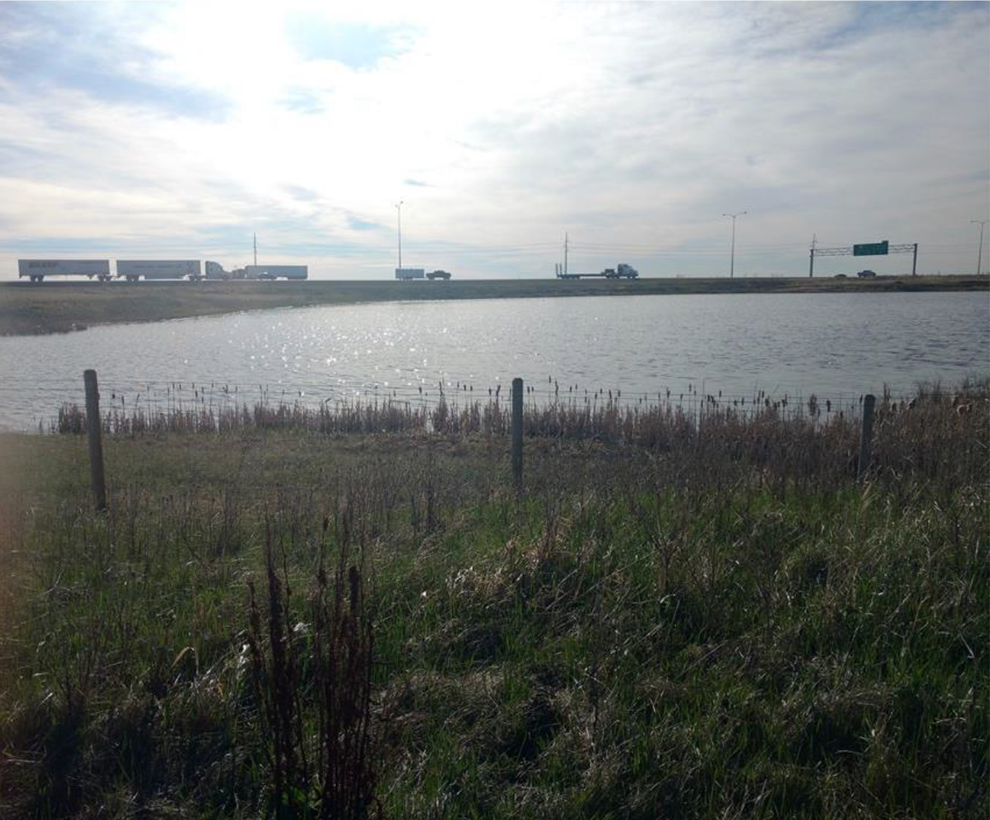
That same day, as I continued to walk and contemplate that act of listening, I noticed shoots of grass were breaking through the cement sidewalk. Reflecting on the role of listening to our own intuitive knowing, I thought about those shoots of grass and their plight in search of the sun. The intelligence within that blade of grass to know to seek out the sun for survival is humbling. As humans, each day, many of us search for our purpose, but Earth and all her inhabitants inherently know their purpose and fulfill that each day. To me, this signals a crisis wherein we have lost the connection of listening to our own intuitive knowing to find the solutions of how to navigate our way forward that allows all beings to thrive. We cannot rely only on our mental capacities to find solutions to the challenges that plague our well-being. I am reminded of the time I have spent listening to elders—first and foremost, the elders reiterate that when we speak and listen, it must come from the heart.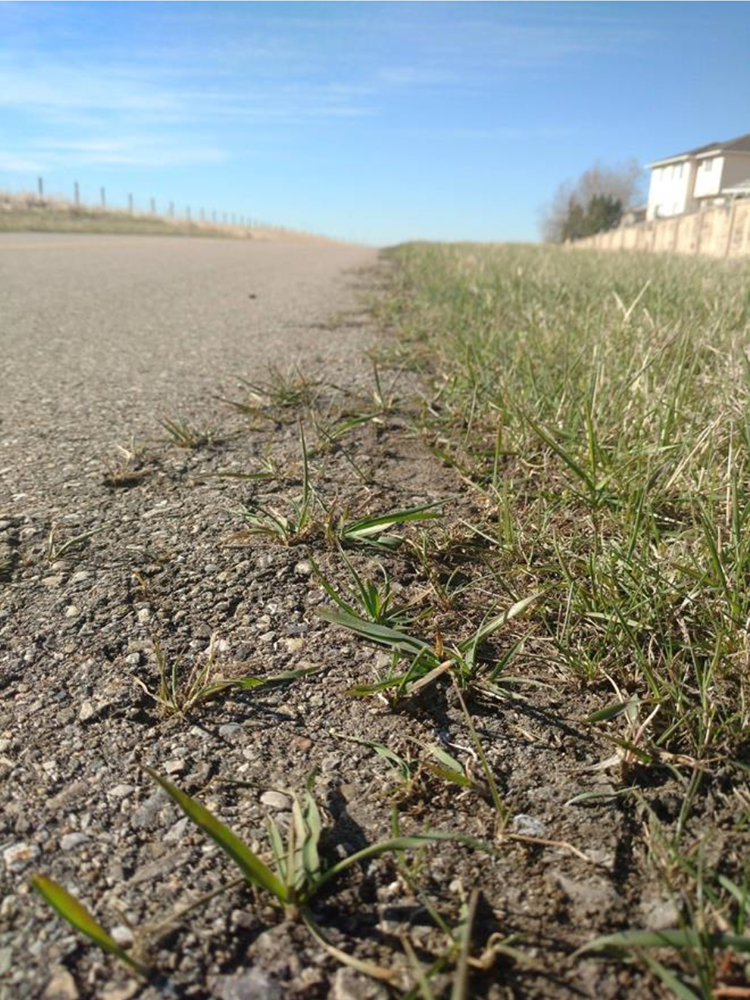
Spiritual Exchanging: A Process for Inquiry
Acknowledging that we arrive into inquiry already as storied beings is a central principle of our process. We are bound by the specificities of time and place that we exist with. Being open, mind and heart, to our kin relatives, and being interrupted by the diversity of perspectives can allow us to widen our understandings of our own positionality. We also emphasize that more-than-human surroundings are more than just a container for human experiences and memories. Places are interconnected to our experience and memories as cogenerators of knowledge. As our exchange emerged, we built capacity for our process and saw that “data” emerged as encounters and responses. The analysis of data is intertwined with the collection. As we interpret and carry the shared experiences and questions of the other with us, there is a layer of analysis that must occur in order to prepare and be struck by our subsequent response. This is the aliveness of our work.
After several exchanges of text and photo, we paused to reflect on our process and circled back to the crocus and to Ghostkeeper’s (2007) wisdoms of ceremony, ritual, and sacrifice. His guidance provides us with a solid foundation for considering how the exchange process is alive in the encounters we are having—with ourselves, with each other, and with our more-than-human coinhabitants. Respectfully, while honoring the path he laid for us, we wish to innovate and add new layers to reconsider his teachings within our own context. For us, to create and live out new stories inevitably involves complicating the binaries of our difference—thereby unlearning the normative mode of doing and calling attention to settler colonial violence—to generate a common vision of living and moving forward together.
The moment Victoria was greeted by the crocus on that particular day was pivotal for cultivating our process of inquiry. In Figure 1, we provide a visual to help envision the processes that we see occurring simultaneously within our exchange. We offer this not as a means to merely conceptualize a model, nor to offer a linear list of instructions, but rather to help animate and describe the layered and intricate nature of our practice. Our dialogue does not only envelop verbal or written modes of engaging but relies on the intuitive and emotive modes that are often silenced in research agendas. Working through the process together helped us expose the holistic, interdependent, interconnected, and cyclical nature of our processes that create the spiritual exchange through presencing, ritual, gifting, and kinship. Below, we delve into each of these processes to explain the intricacies of the methodology but with the recognition that they all feed the whole:
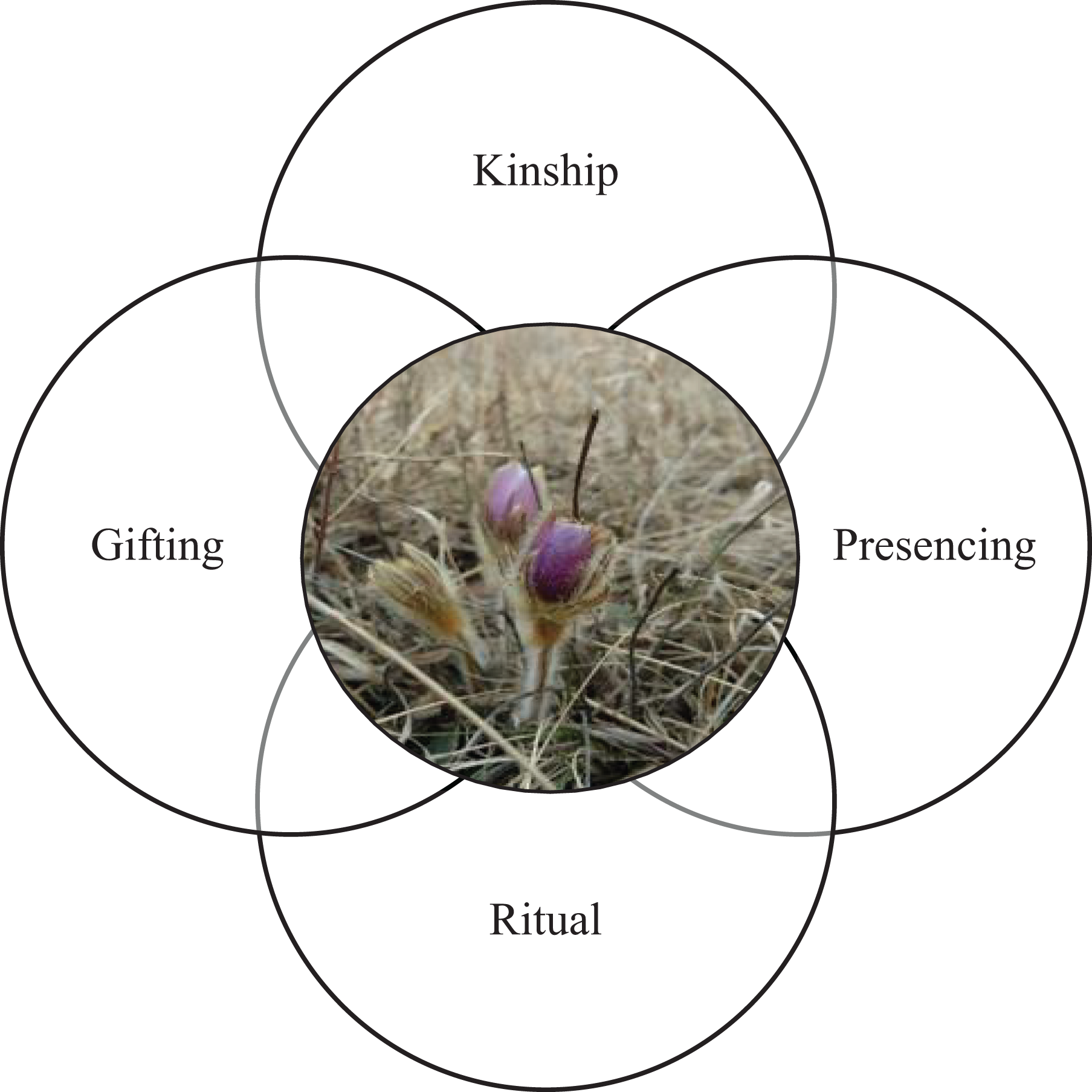
Spiritual exchange process.
Presencing (Ceremony): Being open, attentive, and reflective is essential for generating knowledge through the exchange process. Simpson (2017) discusses “presencing of the present” (p. 20) and points us to the agency of the present moment for enlivening theory through our kinetic doing. We are called on to be active participants in dialogue with all living beings. We propose that presencing as Simpson (2017) describes is equally important for our task of extending kinship relations and stories of (re)uniting the division between mind, body, spirit, and emotion. She states: “The only thing that doesn’t produce knowledge is thinking in and of itself, because it is data created in dislocation and isolation and without movement” (Simpson, 2017, p. 20). In our exchange, we are active subjects within a multidimensional process—for example, Jennifer was moving through her daily routine when the tree buds caught her attention and Victoria was walking her dog when she heard the croaking of the frogs. In these moments, our senses brought us to the present and this opened us to having an experience. The openness to vulnerability in our sharing together and our rising comfort dwelling with ambiguity, are additional layers to the process of presencing. Thereby, we move to disrupt a set of cognitive and isolating rules that are dominantly used, to rehumanize inquiry by listening, seeing, feeling, and experiencing in holistic ways and giving deeper attention to the world around us.
Ritual (Practicing): To rehumanize inquiry, we must understand ritual is essential in our exchange to honor kinetic and embodied knowing that is held within relationships. Ghostkeeper’s (2007) Spirit Gifting includes ritual—the continuous repeated behaviors of mind and emotion that come from the belief that we are always moving with spirit—points to the deep importance that the repetition of not only seeing ourselves engaging spirit–spirit, but continually enacting behaviors that honor the connectedness of ourselves in relationship is inherent in the processes of inquiry. Thus, ritual, is a continuous, practicing, and purposeful state of being in relation, not a fleeting moment of making contact. For connectivity to transpire, we need to honor the union of our mind/heart/body as generators of knowledge (Meyer, 2013; Simpson, 2017) and to recognize our kinship with all beings. The foundation of building and sustaining meaningful relationships is developed through repeated ethical acts, and through time, comes with a sense of accountability and responsibility. A means for practicing this is being attentive to the energy we mirror in our encounters, as Simpson (2017) explains: “Part of being in a meaningful relationship with another being is recognizing who they are, it is reflecting back to them their essence and worth as a being, it is a mirroring” (p. 180). Connectedness occurs when we see ourselves reflected in relationships in positive and loving ways. For Victoria, to have her feelings of sadness and depression dissolve, the crocus mirrored love and kindness, but this also evoked the responsibility that was required to gift the crocus as a means of acknowledging the relationship and connectedness that was forged.
Gifting (Sacrifice): Gifting has two parts, wherein, we, humans, request the life of a plant, animal, or being in order to sustain our health and well-being—physically, emotionally, mentally, and spiritually (Ghostkeeper, 2007)—and then gift back to honor the life that we were given. The “request is an exchange for an offering in the form of a gift of a pinch of tobacco or food, and it signals spiritual equality” (Ghostkeeper, 2007, p. 12). The gifting process is at the basis of building and sustaining loving relationships with all beings. Wall Kimmerer (2013) reminds us that gifts are essential in harvesting or collecting any life-giving entities because without the exchange of gifts the life of beings becomes a commodity disconnected from any responsibility and relationship. When Victoria was gifted with feelings of love and kindness by the crocus, she knew that an exchange needed to be offered to honor that which the crocus gave her. To acknowledge the gift of wellness, Victoria offered a prayer to the crocus, an exchange that bonded her to the crocus for not only that moment, but forever. From very early on in our inquiry process, we acknowledged we were gifting and being gifted consistently. Gifts entered in the form of exchanges with the crocus, the river, trees, frogs, birds, questions, sharing, insights, gratitude, and relationship. Gifting truly birthed our inquiry, and it will help us continue to honor layers of our relations and expand relations outward. We were being gifted with life-giving properties, we knew that the exchanges were also the relational axis of our inquiry.
Kinship: To understand and extend relational networks demands that we enact this work with care. A core idea of creating together, inclusive of Earth community, is working through and with tensions (Donald, 2016) to counter misunderstandings and to illuminate other possibilities. It can be uncomfortable expressing emotions or sharing experiences, in trepidation that misunderstandings will be exposed or that questions might offend the other. Through trust and love, we see a productive and ethical space being brought to life. For example, Jennifer shared with Victoria her experience rowing on the Bay of Quinte and her debt she owed to the water; Victoria’s response challenged and repositioned her to do and be of service to the water. This response encourages Jennifer to act on her words. In a sense, when we share together our stories are illuminated through a different perspective, which makes us accountable to move differently with our new insights. To gain deeper understandings of the phenomenon or question, there is necessity of collaboration to expose “what lies beneath the obvious, unmasking the journey of a phenomenon coming into being, and engaging ourselves in imagining the passing out of being” (Maracle, 2015, p. 232). The research inquiry we are advocating for is fully expressing when working in tandem with others. Stó:lō author Lee Maracle (2015) eloquently teaches us that we have a shadow land of our experiences; thus, we need relationships to reveal aspects of our practice that are hidden in the shadows. Full-bodied engagements with our encounters, posing and engaging questions with each other, and being courageous to share are all practices of reciprocity that strengthen and continually generate spiritual exchange inquiries.
Wisdom for Moving Forward Together
The spiritual exchange process we propose contributes to cosmological coherency—the belief that all beings have energy and exist within a cogenerative complex web of relations—which opens space for addressing the intricacies necessary to renew relationships. These relations are layered and involve the whole being of the self-connected to the aliveness involved in engaging emotionally, spiritually, mentally, and physically with all beings to generate knowing. Our inquiry process, generated through relationships and introduced in this article, is innovative for a number of reasons: First, the inquiry was born spontaneously out of an encounter with a crocus and further developed through subsequent embodied exchanges with place (as opposed to theorizing first and then taking a reductionist approach into the field to collect evidence); second, our approach relies on holistic knowing and enacting that calls on us to pay attention differently (to emotive and felt-sense experiences, rather than merely our thoughts); third, through reciprocity and sacrifice, the process provides us a guide to renew relations with wisdom and to honor the ideology that maintains the wisdom; and fourth, this inquiry provides a praxis that utilizes other beings as a mirror to better understand our own relationality while simultaneously revealing that which may be hidden. We acknowledge this process as dynamic and organic thus, as other researchers take up this inquiry in their own contexts, the stories generated will be unique to places and relationships. In moving diligently together for a sustained and consistent period of time, we have harvested teachings from this inquiry and would like to share with other researchers in hopes of widening our circle for those who may want to engage in spiritual exchanges.
While considering research and living out work with Indigenous ontological and epistemological foundations, we share many discussions around non-Indigenous participation. We see the significance of this process for wider consideration of kinship relations, and therefore, we do not see participation limited to Indigenous researchers or participants. However, it is vitally important to position oneself critically to the body of work by constantly examining biases and assumptions being made about knowledge, questioning motivations for participating, challenge one's own theoretical and ontological perspectives, and remain heartfully open to the process beyond just the formal research (Archibald, 2008; Ermine, 2007; Kovach, 2010; Smith, 1999). We also direct researchers to understand the research legacy that has caused harm and devastation to Indigenous communities with the understanding that part of our ethical responsibility is to not perpetuate imperialism and colonialism (Smith, 1999).
As we lovingly encourage this inquiry process, we are not asking people to become Indigenous, because that is impossible, but are inviting others to start where they are and be in relation with the self, others (human and more-than-human), knowledge and ideas, emotions, experiences, and story, in expanded ways. Based on cultural grounding and protocol knowledge, which Kovach (2010) explains as “the way culture nourishes the researcher’s spirit during the inquiry, and how it nourishes the research itself” (p. 116), we see multiple entry points for researchers to engage where they are—this was evident in the level of relational depth in our own exchange. Victoria spoke about the connection of offering tobacco, where Jennifer was critically negotiating her surroundings in preparation for having more relational encounters. Guided by ecological and cosmological balance, we understand that being in relation to what comes inwardly and intuitively is connected to the whole. Therefore, we see the process as a mode for extending, and perhaps at times complicating, relational networks to understand each other with hopes to go on together in respectful and responsible ways.
Through our own responsibility of understanding ourselves in relation, and more specifically our relationship to this process, ongoing conversations have guided us to identify four tenets of the spiritual exchange that might assist others in the enactment of this work. First, there needs to be a belief in the presence and intelligence and spirit of all beings and that we are all active subjects interacting to create knowing. Second, we need to acknowledge the ritual, the repeated continuous behaviors of honoring our connectedness to all of creation. To truly honor the ritual of this inquiry, the process requires continuous reflection and a temporal commitment to enact ethical relations in our everyday as to become a way of life. Third, gifting, the practice of proper protocol, based on the specific research context (i.e., offering tobacco, food, prayer) ensures that we are engaging in reciprocity as these actions are the tendons of our relationships. Lastly, the key in enacting this inquiry is the recognition that we are always in, and working through, kinship relationships with all beings. Moreover, we need to acknowledge the inherent tensions and complexities present in living our relationships with care and ethics. This ensures our commitments to each other are sustainable. It is through continuous acts of presencing, connectedness, and reciprocity that our relationships will be strengthened and maintained.
The purpose of the exchange process is not to find firm solutions, a one-size-fits-all, or outcomes to questions posed. Rather, engaging in the process allows us to grapple with complexity and to learn through and with inquiry. The theoretical and practical components are occurring simultaneously, supporting our challenge to move beyond the normative linear modes of intellectualizing to embrace multisensory and embodied generation of knowledge. While our mode of representing knowledge includes images and text, the process of collecting “the data” is a multidimensional and organic practice that is accessible to others who desire the freedom to embrace creativity, connectedness, and heartfulness in research. As Canadian institutions are engaging more with Indigenous worldviews, histories, and experiences, it is essential that the lens and practices employed to engage are also expanding. The spiritual exchange inquiry fundamentally reconsiders the ways in which we can perceive, exist with, and honor the world.
Footnotes
Declaration of Conflicting Interests
The author(s) declared no potential conflicts of interest with respect to the research, authorship, and/or publication of this article.
Funding
The author(s) received no financial support for the research, authorship, and/or publication of this article.
